|
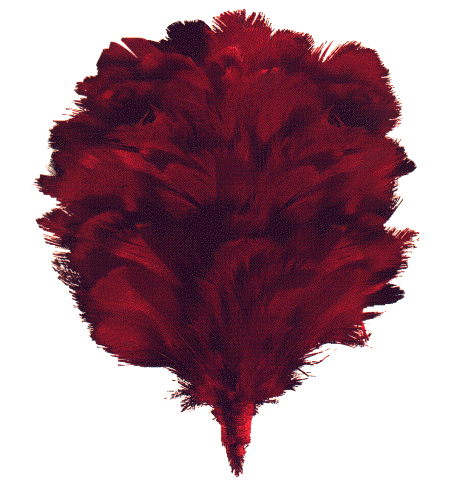
 Since 1795 the soldiers of the 42nd have worn a red feather
or "heckle" in their bonnets, being in this respect distinguished from all the
other Highland regiments. The following is the story of the "glorious old red
heckle", as told by Lieutenant-Colonel Wheatley, who, we believe, had his information
directly from those who took part in the exploit on account of which the Black Watch is
entitled to wear the plume. Since 1795 the soldiers of the 42nd have worn a red feather
or "heckle" in their bonnets, being in this respect distinguished from all the
other Highland regiments. The following is the story of the "glorious old red
heckle", as told by Lieutenant-Colonel Wheatley, who, we believe, had his information
directly from those who took part in the exploit on account of which the Black Watch is
entitled to wear the plume.
In December 1794, when the Forty-Second were quartered at Thuyl, as above mentioned, they
received orders for the night of the 31st to mark upon Bommell, distant some miles on the
opposite side of the river Waal, which they reached by four o'clock on the morning of 1st
January 1795. Here they were joined by a number of other regiments, and lay on their arms
until daybreak, when they attacked the French army, and drove them across the river on the
ice. The British held their position on the banks of the river until the evening of the
3d, when (the French having been reinforced) a partial retreat took place early on the
morning of the 4th. The British retired upon the village of Guildermalson, where the 42d,
with a number of other regiments, halted, and formed up to cover the retreat through the
village. The French cavalry, however, cut through the retreating picquets, and made their
way up to the regiments stationed at the village, where they were met and repulsed, and a
number of them taken prisoners. Two field-pieces were placed in front of the village to
protect the retreat of the picquets; but instead of resisting the charge of cavalry, they
(the picquets) retreated to the rear of the village, leaving their guns in possession of
the French, who commenced dragging them off. An A.D.C. (Major Rose) ordered Major
Dalrymple, commanding the 42d, to charge with his regiment, and retake the guns; which was
immediately done, with the loss of 1 man killed and 3 wounded. The guns were this rescued
and dragged in by the 42d, the horses having been disabled and the harness cut.
There was little or no notice taken of this affair at the time, as all was bustle; but
after their arrival in England, it was rumored that the 42d were to get some distinctive
badge for their conduct in retaking the guns on the 4th of January; but the nature of the
honor was kept a profound secret. On the 4th of June 1795, as the regiment, then quartered
at Royston, Cambridgeshire, was out on parade to fire three rounds in honor of his
Majesty's birthday, the men were surprised and delighted when a large box was brought on
to the field, and a red feather distributed to each soldier. This distinctive ornament has
ever since adorned the otherwise funereal headdress of the old Black Watch.
In 1822, from a mistaken direction in a book of dress for the guidance of the army, some
of the other Highland regiments concluded that they also had a right to wear "a red
vulture feather". The 42d, however, remonstrated, and their representations at
headquarters called forth the following memorandum:-
"For Officers commanding Highland Regiments.
"Horse Guards, 20th Aug, 1822.
"The red vulture feather prescribed by the recent regulations for Highland regiments
is intended to be used exclusively by the Forty-Second Regiment: other Highland corps will
be allowed to continue to wear the same description of feather that may have been hitherto
in use.
"H. Torrens, Adjutant-General".
The below email was received from Joseph Mad...
The article was taken from Canada's Red Hackle
Magazine, Written by Mr. Earl Chapman and rewritten by Spañiard.
THE True Story of the Origins of 42nd Black Watch Red Heckle. We spell
it with a A.
ORIGINS OF THE RED HACKLE
Over the years the origin of the Red Hackle has caused
some confusion. For some time it was believed the famous Red Feathers were
awarded as a campaign Distinction, for the regiment’s service during the
British retreat through the Flemish
village of
Glendermaisen
in January 1795.
It’s historically fact that
the first “Official” use of the Red Hackle occurred when the 42nd
Regiment at Royston Herttfordshire was issued
Red Vulture feathers on
June 4th 1795.
The 42nd Regiment paraded to celebrate the birth,
of King George III.
In fact, we know based on two letters discovered in 1967,
stating that the 42nd Regiment had worn Red feathers twenty
years earlier during the American War of
Independence, (1775-1781).
These letters are held in the
Regimental archives at Balhousie
Castle.
The first letter was written by Lieutenant-Coronal Sir Robert Dick Commander
of the 42nd on
September 8th
1822,
to General James Stirling who commanded the 42nd
in 1804 and served with the Regiment during the American War
of Independence.
In his letter to
Stirling, LCOL Dick asks for advice as how the Regiment first
acquired the right to wear the Red Hackle,
stating that “I always understood that the Red Feather was given for taking
or defeating a regiment of Grenadiers. But I can not remember when it took
place. Stearling replied; "The origins of their wearing this feather
commenced early in the American War of 1776 when the Regiment was Brigaded
with the Grenadiers and a light infantry of the army under the command of
the late Marquis Cornwallis. At this period there were no regulation
feathers. The Grenadiers wore White Feathers, the first battalion light
infantry wore Green. The second battalion wore Red, and to make the whole
uniform, General Sir William Howe,
ordered the 42nd to get Red feathers".
Stirling went on to state “When the Regiment arrived in
England
from Egypt
in (1802) they were received by His late Majesty and Colonel Dickson who
then commended them and asked his
Majesty’s permission for the regiment to wear the Red Feather, in which his
Majesty graciously granted.
This tells us the 71st
Highland Regiment of Foot, the re-raised Fraser Highlanders, Were the first
to wear a red feather while servicing in North America
around 1776. In hindsight the original Fraser Highlanders 78th of
Foot, were raised in 1757 for Service during the
French and Indian Wars and were disbanded in 1763.
LCOL John Maitland, then commanding the Fraser’s and
General George Washington. As old acquaintances, although apposed enemies
they exchanged some intimidating letters. As one sent by LCOL Maitland to
General George Washington warning him that in future his men would be
distinguished by a Red feather in their bonnets, so that the General would
not mistake them, nor avoid doing justice to their exploits.
After the War the only
regiment not to be disbanded was the 42nd. However the trend of
wearing a Red Feather appeared to have stopped
sometime after the war. Then it was reintroduced at the parade in Royston on
the occasion of the King’s birth.
It wasn’t until August 20th 1822 that the exclusive right to
wear the Red Feather was finally safeguarded by the Horse Guards.
"For Officers commanding
Highland Regiments.
General Order, The Red Vulture feather prescribed by the
recent regulations, for the Highland Regiments, is intended to be
used exclusively by the Forty-Second Regiment.
Other
Highland corps will be allowed to continue to wear the
same description of feather that may have been hitherto in use.
"H. Torrens, Adjutant-General".
As further reinforcement of the origins of the Red Hackle,
a pamphlet publish in 1862 Entitled “An Account of the
Scottish Regiments ”with the statistics of
each from 1808 to 1861, notes under the 42nd Regiment that,”
We cannot recollect our authority. But have always understood
that the Red feather worn in their bonnets was given as a mark
of distinction for their gallantry in
America” this
pamphlet was compiled by MacKerlie, who is know to have access to the
old record books.
The Canadian unit, then known as the Royal Scots of
Canada, was officially permitted To wear the Red Hackle by
General Order dated May 25th 1895.
It’s my Right and privilege to wear a Red Hackle but also
my responsibility, Under the Canadian Black Watch general standing orders to
keep my Red Hackle Bloomed. In order to distinguish me from my Scottish
Cousins.
6 beats to the drum HOY!
[LT COL DICK CO 42ND TO GEN JAMES STIRLING]
Tullymet House. Sept 1822
“Dear General, Colonel Cowell received a letter from Greenwood and Cox some
time ago by desire of the Adjutant General to acquaint them for the
information of the latter, from what period and by what authority, the 42nd
Regiment had worn the red feather the same as is now ordered for the other
Highland regiments. So many of the old orderly books have been lost that we
have no official document by which to answer their question. I have
therefore desired Colonel Cowell to write to the agent to that effect. But
as you served in the Corps and Commanded it so many years, I think you may
be able perhaps to give me necessary information on the subject and take the
liberty of addressing you- I have always understood since I have been in the
Regiment that the Red Feather was given them for taking or defeating a
regiment of Grenadiers and that the Lt Company of the 48th [sic] who were
with them on that occasion got it at the same time, but I cannot remember
when I heard this took place. May I beg the favour of a few lines from you
soon.
I remain
Dear General
Yours very truly
RH Dick”
[GEN STIRLING’S REPLY]
“In answer to your letter of 8th inst. relative to know how the 42nd Regt
came to wear the Red Feather. The origin of their wearing this feather
commenced early in the American War of 1776 when the regiment was Brigaded
with the Grenadiers and Light Infantry of the Army under the command of the
late Marquis Cornwallis- at this period there were no regulation feathers -
the grenadiers wore White Feathers, the first battalion Light Infantry wore
Green,- the 2nd Light Infantry wore Red, and to make the whole uniform
General Sir William Howe, then Commander- in-Chief, ordered the 42nd to get
red feathers which they have wore [sic] ever since.”
When the regiment arrived in England from Egypt they were reviewed by His
late Majesty and Colonel Dickson who then Commanded them asked His Majesty's
permission for the Regiment to wear the red feather, which he was graciously
pleased to grant- at this time the regulation feather had come out. It was
great neglect of Colonel Dickson in his not getting a Government order for
the Regiment to wear this feather, and to have it recorded in the Standing
Orderly Book of the Regiment. This is all the information I can give you on
the subject.”
The two mentions of the Regulation Feather in General Stirling’s reply
presumably refer to the white feather that was ordered to be worn by all
regiments in one of the War Office/Ministry of Defence’s periodic efforts to
impose some uniformity on Army dress- as unsuccessful then as it is today.
In addition to these two letters, there is evidence in Stewart of Garth’s
‘Sketches of the Highlanders’ that Fraser’s Highlanders, at least, wore a
Red Feather in 1776 or 1777. Taken with General Stirling’s letter it can be
assumed that all Highland Regiments engaged in that campaign took to wearing
a Red Feather. Of these regiments only the 42nd were not disbanded after the
war.
All this proves fairly conclusively that the Red Hackle was not won at
Guildermalsen but that it had been worn by the Regiment for at least 20
years before. This means that January 5th is not Red Hackle Day!
Where, then, did Sgt Cameron and Pte Dowie get their version? No doubt they
were correct in remembering a parade at Royston in June 1795 and an issue of
Red Hackles and no doubt the C.O., at that parade, referred to the
Regiment’s action at Guildermalsen the previous January. Where Cameron and
Dowie must have gone wrong was in associating the issue of the Hackle with
an honour for the action. In any case the award of such an honour would seem
to be extremely unlikely for the 42nd’s part in the action at Guildermalsen
was not even mentioned in General Dundas’s official despatch and most
telling of all, who ever heard of a Ministry of Defence Dress Committee
taking a decision stemming from a battle in January in time for a parade the
following June!
Sadly, then, there is no short and glamorous answer to the question "How did
the Black Watch get the Red Hackle-?" Perhaps it was the result of General
Howe wanting a distinctive badge for Lord Cornwallis’s makeshift brigade,
perhaps the custom started in Fraser’s Highlanders as a defiant gesture and
spread to the other Highland regiments involved in the campaign, perhaps the
Red Feather came to the regiment with the drafts from the disbanded Fraser’s
Highlanders. However it came, this unique regimental badge has been worn
continuously in every form of headdress except the glengarry for over 200
years. Today’s Highlanders can continue to wear it with pride.
[COLONEL HON. DAVID ARBUTHNOTT]
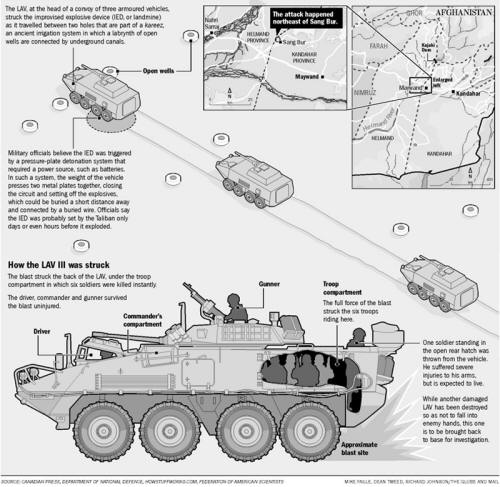
How an IED affected the LAV III
|