|
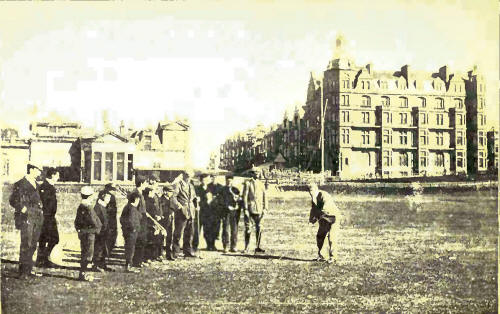
Tom driving off "Fore"
In 1821 Tom Morris was born.
I did not know St Andrews until 1854, when I came as a boy of eight years of
age to the old grey city, which was to be the home of my subsequent
childhood and early manhood. "What a difference from to-day! To begin with,
there was no Forth Bridge in existence, and the journey from Edinburgh was a
tedious and slow one. You took the train, as you do to-day, at the Waverley
Station, and you crawled slowly on to Granton. There you left the train and
got into the little steamer that was to take you across the Firth of Forth.
Sometimes the passage was made in perfect weather, and then the sail across
was a welcome relief from the stuffy and slow train. But more frequently the
weather was stormy and boisterous and the crossing was horrible in every
way. You were glad to reach Burntisland and get into the train again, though
you knew that it was a North British one and the slowest of the slow. You
had to "change carriages," and often have a long and tedious wait at
Ladybank. Thence on to Leuchars, where you had to change again.
But by that time the worst of the journey was over, and just before 3 am
reached Leuchars Junction you could descry the ancient city in the distance.
The hearts of those who loved her grey walls and old ruins, and their many
dear friends and acquaintances there, were lifted up, and a Te Deum of
Thanksgiving was sung. You grudged having to stop at Guardbridge Station,
and later once again to get your tickets taken. But by this time you had
skirted the famous links, and every inch of the ground was redolent of happy
memories. The tide might happily be in and the Eden looking like a lake; and
there is "The Shepherd's House," where, on many a warm summer day, you have
left your game as a boy with three other chums and gone for potations of
home-made beer. There you descry in those old days the forms of some players
you know old Mr Sutherland, perhaps, and Mr Walkinshaw, after whom two
bunkers are now named; Mr Glennic, in honour of whom the Medal was presented
to the Club; his friend "Pat" Alexander, philosopher, poet, bohemian, a
medallist in golf, and an Examiner in Philosophy, and the best of jolly good
fellows; his friend Principal Tulloch; their friends, John Skelton (Sir John
later on), the "Shirley" of Frascr's Magazine; "long Richardson," and Mr
Frank Wilson, who were living together in rooms in Bell Street, and made a
rubber for the pleasantly tired evening. There you would be sure to see Mr
Whyte Melville, of Bendochy and Strathkinness a gentleman of the old school,
the husband of Lady Catherine, a daughter of the Duke of Leeds, and the
father of the novelist, poet and sportsman, George Whyte Melville. Many of
the novelist's works appeared in Fraser Good for Nothing or All Down Hill,
Digby Grand, and others. He once told me, in his blase style, that he
thought he could go round the links as well and as often as his father if he
could get a glass of sherry before each tee shot. There also you would see
the handsome form of Mr F. Boileau Elliot, husband of Lady Charlotte, a
charming woman and a sweet poetess: the Mr Wolfe Murray of that day, and
Colonel, then Major Boothby, in the glory of his magnificent manhood: Sir
John Low of Clatto, riding on his cream-coloured pony, and dismounting to
play when his turn came in his foursome; and his brother, Colonel Low, whose
daughter, later on, was one of the belles of St Andrews. You might see Mr
John Blackwood, the famous publisher, and his brother James the match
followed by their cousin, Archibald Smith: "Tom" Hodge, a most successful
golfer who took to the game in middle life, and after he had given up
cricket. Mr Hodge is still alive [Since the words were in type. Mr Hodge has
passed away, 20th May 1907. He read this narrative with great interest in
the column of Golfind, and was looking forward to possessing it in book
form.] in Hampstead, and wearing his years well. But he takes no interest
now in the game, in which he used to excel. Quite lately I took him several
numbers of Golf Illustrated, thinking I would please him. But he refused to
look at them, and said there was no real golf played nowadays. And yet he is
an Englishman, or rather, a Cornish man. Every golfer knows his sketches in
the Badminton book on golf. Another "Tom" was Captain M'Whannell of Perth, a
very neat and successful player.
But now the train is slowing down. It is at what was the old station it
draws up, and pour moi, I much prefer the old one. Out one gets. He is
hailed by the 'bus-drivers, very likely by his first name if he is an old
resident who has grown up in the place. "Hoo are you, Wullie?" says a
stalwart driver to me it just seems the other day "You'll be gawn' to
Chairlie's" Mr Charles Stuart Grace. He was right, so possessing himself of
my luggage, off he went. And I joined a match at the Burn hole and walked in
with it, over the well-known Swilcan Bridge and up to the Club. In 1854
there was only one hole for the outgoing and incoming players. What think ye
of that, ye pampered golfers of to-day? And one couple had to give
precedence to the other if nearer the hole. I daresay there were sometimes
rows about the first holing out. No doubt there were some men who always
wished to claim the right of putting out first.
The great events of the year were the spring and autumn meetings for
competition for the Club medals. Though the number of competitors was
increasing steadily and was much above the "eighteen pairs" Dr Charles
Rogers specifies in 1849, some of the earlier eclat seems to have been
absent, for I do not remember the "proceedings of the day being commenced by
the golfers walking through the city to the links in procession, preceded by
a musical band with drums, flutes and clarionets, and usually accompanied by
an immense number of the inhabitants."
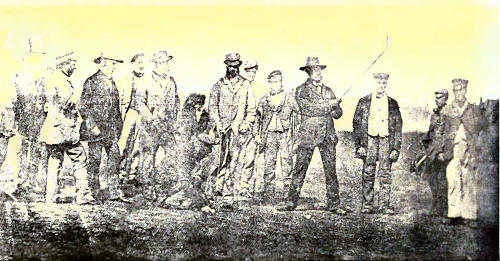
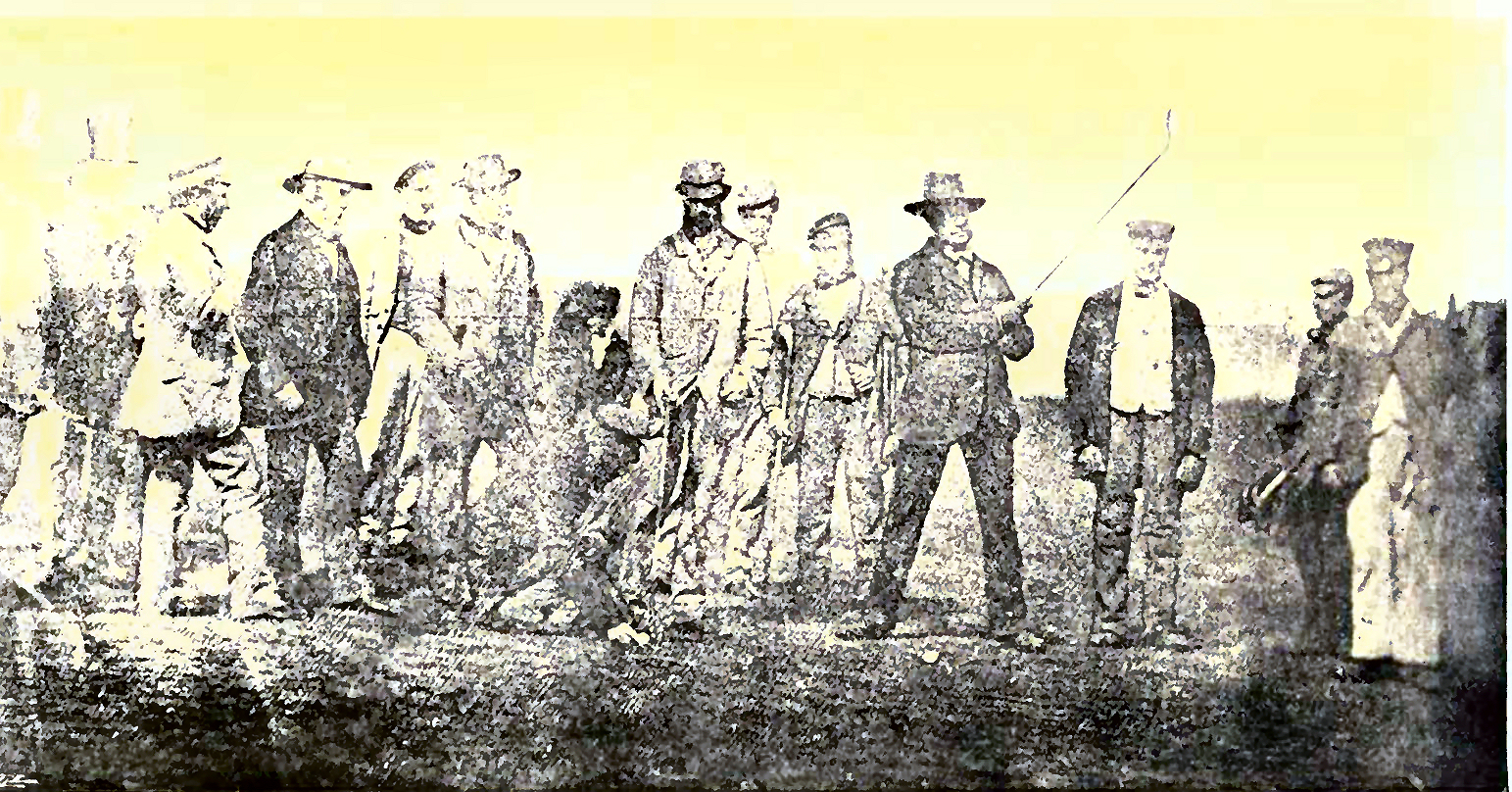
A very early group, 1850
The Club, too, was a very different place from what it is now. The old
"Parlour" had just been left, and the accommodation in the present building
was somewhat limited. After a chat in the Club one repaired to Allan
Robertson's shop to see and be welcomed by him and his wife. My father kept
his clubs in a box in Allan's in those days, before he got one in the
Club-House, and I knew the couple well. And in the by-going a visit might be
paid to Mr Forgan, the grandfather of the present head of the famous firm.
Mr Forgan was a most worthy man an elder in what is now the United Free
Church, of the ministry of which two of his sons are now ornaments, and
other two high up in banking circles in America.
Tom Morris was not in St Andrews in 1854. he was at Prestwick. But he was
born in St Andrews on 16th June 1821, and his early days were spent there,
as I shall show in a further chapter.
Meantime let me say something about his famous predecessor, Allan Robertson.
|