|
PRESBYTERY OF ABERDEEN,
SYNOD OF ABERDEEN.
Drawn up by William
Henderson, M.D. Aberdeen,—the articles Ecclesiastical State and State of
Education being contributed by the Rev. Abercromby Gordon; Fisheries, by
the Rev. Alexander Spence; Bridewell, by Alexander W. Chalmers, Esq.;
Mechanics' Institution, by Thomas Scott Benzie, Esq.; Gordon's Hospital,
by the Rev. W. K. Tweedie.
THE REV. JAMES FOOTE,
Minister of the East Church.
THE REV. ALEXANDER D. DAVIDSON, West Church.
THE REV. JOHN MURRAY, North Church.
THE REV. WILLIAM K. TWEEDIE, South Church.
THE REV. A. L. GORDON, Grayfriars.
THE REV. ALEXANDER SPENCE, St Clements.
THE REV. HUGH MACKENZIE, Spring Garden Church (Gaelic.)
THE REV. DAVID SIMPSON, Trinity Church.
THE REV. JOHN ALLAN, Union Church.
THE REV. JOHN STEPHEN, John Knox's Church.
THE REV. WILLIAM PRIMROSE, Melville Church.
I.—Topography and Natural
History.
Aberdeen, a city of
considerable size and extensive commerce, is situated along the left bank
of the river Dee, near its mouth, extending about a mile from east to
west, and stretching to nearly an equal distance northward from the river.
Name.—Various conjectures
have been formed respecting the etymology of the name of this city, of
which the two following are the most worthy of notice:
Mr Kennedy, in his Annals
of Aberdeen, says, on the authority of the late Mr Maclachlan, Rector of
the Grammar-School of Old Aberdeen, that "the Gaelic name,
Obairreadhain, pronounced Oberrayn, signifies the town situated on the
bank or space of ground near the entrance of two rivers; and is composed
of Abair or Aber, a well-known word, and Da-abhuinn,
(Da-awin), two rivers, namely, Dee and Don. This analysis is exactly
descriptive of the local situation of Aberdeen, which in former ages was
almost at an equal distance from the mouths of both rivers, although about
a century ago the channel of the Don, near the town, was altered, and the
stream diverted straight into the sea, about a mile further northward than
its ancient efflux;" and he endeavours in a note to give further
probability to this etymology, by saying, " probably at some very remote
period, Don had continued its former course still further southward down
the hollow of the links, till it united with Dee in the harbour, and both
together would form one stream into the ocean. Such conjecture is in some
measure confirmed by the works of Ptolemy and Richard (of Cirencester),
there being no such river as Don delineated in their maps, or even
mentioned in their tables, while Diva (Dee) and Ituna (Ythan) in the
district of the Taixali, are particularly noticed. In the earlier records
of the burgh, the river Don is distinguished solely by the name of Aqua
Borealis.' [Annals, Vol. i. p. 5.]
The conjecture advanced by
Mr Thorn in his History of Aberdeen, is expressed in these words: "The
name Aberdeen is composed of the Gaelic A-bar, and dun, which signifies
the hill in the marsh. Aber, spelt Abar in Gaelic, is a compound of two
words, aw, water, and bar, an obstacle; hence it signifies a marsh."
[History, Vol. i. pp. 28, 29.]
Various considerations seem
adverse to these conjectures. In the first place, there is no vestige in
either record or tradition, of the Don having ever run south into the Dee,
nor does it seem likely that it should hold for two miles a course
parallel to the seashore, and separated from it only by a line of
sand-hills so low and loose in several places as sometimes to be broken
through by a high tide when pains are not taken to prevent it. On the
contrary, if probability may be appealed to in the absence of evidence, it
seems much more likely that the course which it has held since the year
1727, (when advantage was taken by the salmon-fishers of a breach made in
these hills by a high tide or land-flood, to alter the place of its
mouth), was the ancient one, running straight into the sea, instead of
turning suddenly at a right angle, along the back of the sand-hills. In
the second place, no argument can be founded on the silence of Ptolemy
respecting the Don, for he does not mention above half of the rivers that
run into the German-Ocean, and the ltuna which he notices, is not in the
district of the Taixali, but on the west side of the island, and has a
longitude assigned to it of 18°, 30' while that of Divæ ostium is 26°. It
cannot, therefore, be the Ythan; and as it is termed by him an estuary,
and placed immediately to the north of Morecambe bay, it seems clear that
it is the Solway which he meant to point out by this designation. And in
the third place, it seems far-fetched to derive a part of the name of the
city either from the supposed junction of two rivers, or from the word
signifying a hill, when the name of the river that runs close by it
supplies the syllable that is wanting, without requiring to undergo any
change.
Ptolemy places the river
Diva in the territory of the Taixali, who occupied the most easterly part
of Albion, and he mentions the city Devana as being in the same province.
[Ptolemæi, Geog. Univers. l. ii. c. 3.] These, then, correspond with the
situation of the river Dee, and of some city near it. The exact site of
the Devana of Ptolemy has been disputed; "General Roy," as Mr Thorn
observes, " having placed it at Old Aberdeen, and the laborious author of
Caledonia somewhere in the parish of Peterculter;" [History, Vol. i. p.
18.] the former being about a mile north from Aberdeen, and the latter
about seven miles south-west of it, on the banks of the Dee.
That the Romans adopted and
Latinized the name of the river, seems probable from this consideration,
that while in very many cases the Roman names given to rivers have no
analogy with those by which they are now known, we find in several
districts of the Celtic territories, rivers whose present names, though
apparently not of Latin derivation, are almost identical with the names
under which they occur in the writings of Ptolemy and other ancient
authors, for example the Dee, in Galloway, mentioned by Ptolemy as the
Deva in the country of the Selgovii, the Dee in Cheshire, called by him
the Deva in the territory of the Cornabii, and the Deba in Guipuzcoa,
which is noticed by him under the name of Diva in the country of the
Caristi. It need not excite wonder that we find no vestige of the name
Devana given to the settlement of the Taixali by the Romans, except in the
writings of the ancients, for although the Romans adopted from the natives
the name of the river, there was no reason why the natives should give up
the name by which the town placed on its banks had previously been known
to them, in order to copy from their invaders the name which they chose to
affix to it. It seems in a high degree probable that the ancient name of
the city among the natives very nearly resembled the one which it bears at
this day, (though, perhaps, Camden goes too far when he charges Ptolemy
with having put Diva and Devana for Dena and Denana.) ["Quæ Devana,
Ptolemæo, pro Denana, Urbs perantiqua, ad Denam fluvium, qui falso itidem
apud Ptolemæum Diva legitur." Camden, Britannia, edit. 1587, p. 558.]
Mr Kennedy observes, that
in old records the name is variously spelt. - Aberdaen, Aberdon, Abirden,
Aberdene, and Abyrdene;—auuiivu.— and in Latin writings it generally
occurs in the form of Abredonia; but Buchanan, while he uses the name
Abredonia as applicable both to Old and New Aberdeen, says of the latter "Hanc
cite-riorem invenio vetustis monumentis Abredeam appellatam." [Buchanan,
Hist. Scot. 1. i. c. 26.]
The noun "Abar," is stated
by Macleod and Dewar in their Gaelic Dictionary to denote "a marsh, a bog,
a fen," and used as a verb "to join together," hence "a place where two or
more streams meet." On a reference to the situation of the numerous places
both in Scotland and Wales whose names begin with this word, it will be
seen that they are all (with one or two questionable exceptions, viz.
Abergeley in Flintshire, and Abernyte in Perthshire,) situated either,
1st, at the influx of a stream into the sea; or 2d, on the confluence of
two streams; or 3d, in the immediate neighbourhood of a stream; a very few
only presenting the anomaly of being on the sea coast, where there is no
river or stream of any notable magnitude, such as Abermenai in
Caernarvonshire, Aberdour in Fife, and Aberdour in Aberdeenshire.
If, then, it can be
admitted that the Celtic name of the river was Dee, or as Mr Thorn
asserts, [History of Aberdeen, Vol. i. p. 24.] "Deabhadh pronounced Devay,"
or some similar word, the origin of the name of the city seems easily
deducible from "Abar" or "Eabar," a marsh or fen, (and. it is worth notice
that the common people pronounce the name as if it were spelt Ebardeen,)
compounded with the name of the river, so that it signifies "the marsh of
the Dee." [Armstrong, in his Gaelic Dictionary, gives "a confluence of
waters" as the meaning of Eabar,—whence Eabardeen would signify "the
embouchure of the Dee."]
Topography, &c.—The parish
of St Nicholas, in which Aberdeen is situated, lies on the north side of
the river Dee, adjacent to its embouchure, and along the contiguous sea
coast. Its shape is irregularly quadrangular. It is bounded on the south
side, by the river, along which it extends for about l½ mile in a
direction nearly east and west. On the east side, the sea forms its limit
for nearly 1¼ mile, in a direction almost due north, to about the point
opposite the middle of the Broad Hill, a small eminence which is situated
nearly half way between the mouth of the Dee and that of the Don. From
this point there is no natural division of the parish from the adjacent
one of Old Machar; the boundary runs nearly west for about one mile, and
then turns irregularly a little to the south-west for about the same
distance, till it reaches the extreme west corner of the parish between
Broadford and Gilcomston, and from thence it turns nearly south, and
extends along the Denburn, almost three-quarters of a mile, till it meets
the south boundary at the place where that burn falls into the basin of
the harbour. The superficial contents of the parish may be estimated at
about 1100 imperial acres, of which rather more than one-half (including
the whole of the west, the greater part of the south, and nearly one-half
of the north sides,) is occupied by the city of Aberdeen, and the village
of Futtie which lies along the river towards the east end of the south
boundary. [It has of late become customary to spell the name of this
village Footdee, as if it were derived from the circumstance of its lying
adjacent to the embouchure or foot of the Dee; but the uniform spelling in
old writings is Futtie, or sometimes, though seldom, Fottie; and it may be
observed that etymological propriety would require, that, if the name had
reference to the foot of the Dee, it should have been either "Dee-foot,"
(as Elvan-foot, Bog-foot, &c.) or" Foot-o-dee," (as Foot-o hill.)] By far
the greater part of the remainder along the east side is occupied by the
links, and a range of low sand hills by which they are separated from the
sea coast. Along the north side, from the" Broad Hill to the point where
the buildings of Aberdeen begin, the ground is laid out in market gardens,
nurseries, and bleach-greens.
The origin of the name of
this parish is enveloped in obscurity. The great church of Aberdeen was,
in former times, dedicated to St Nicholas, though whether it was to
Nicholas, who was Bishop of Myra in Lycia in the fourth century, and who
is the patron saint of the Russian empire, or to some one else of the same
name, that it was dedicated, is a problem that probably cannot now be
solved. The name derived from this dedication, however, has by long use
extended to the whole parish; but in ordinary language it has of late
years been less generally used,—the name of the city which occupies so
large a portion of the parish being employed instead.
With the exception of that
part of the Broad Hill which is comprehended within the limits of the
parish, the surface of the whole of the east and north parts is nearly
level, and but very slightly elevated above the sea; but in the south and
west parts, the ground is more broken, rising into several eminences of
small height, one of which, the Heading Hill, may be said to lie beyond
the limits of the town on the east side, (although a few houses are built
on it, and on the adjacent grounds to the north,) while the others, known
by the names of the Castle Hill, St Catherine's Hill, the Port Hill, and
the School Hill or Woolman Hill, are occupied by the streets and buildings
of Aberdeen.
On the south side the
boundary of the parish is also the boundary of the district of Mar and of
the county of Aberdeen ; and the adjacent parish in the county of
Kincardine is Nigg, in which the small fishing village of Torrie lies
directly opposite to Futtie on the south side of the Dee. On the north and
west sides, the parish of St Nicholas is completely inclosed by the parish
of Old Machar, which contains the town of Old Aberdeen, lying about a mile
northward from Aberdeen, the manufacturing village of Woodside, at the
distance of about two miles to the north-west, and the village of
Ruthrieston, about two miles distant towards the south-west. In this
parish are also situated the suburbs of Broadford on the north side;
Gilcomston, along the north end of the west side; the Windmill-brae and
College Street near the south end of the same side; Holburn about a mile
off towards the south-west; and Dee village about half a-mile off on the
bank of the river. Besides these, the new streets which have of late years
been added to Aberdeen, and in which many of the best houses are situated,
are within the limits of the parish of Old Machar, lying between
Gilcomston and the river, and extending westward nearly three-quarters of
a mile. Soil, &c.— The soil of the parish is on the east side principally
sandy, derived from its vicinity to the sea, the beach being here composed
of fine sand, with occasional beds of small stones. The upper grounds in
the other parts consist generally of gravel, and the lower grounds shew in
several places extensive beds of peat moss lying under and mixed with the
remains of former buildings or artificial soil. There is reason to
conclude that the whole of the parish rests on a bed of rock of the nature
of granite, and this rock may be seen in some parts of the Broad Hill
cropping out to the surface. It has been found, however, in those parts of
the town and neighbourhood, where boring for water has been practised,
that the rock lies at a depth of nearly thirty feet under the moss and
gravel which form the subsoil.
According to the most
recent determination, that of Mr George Innes, which has been approved by
the engineers employed in the Government survey, the latitude of the
observatory on the top of Marischal College, which stands not very far
from the centre of the parish, is 57° 8' 57.8" north, and its longitude is
2° 5' 41.56" west from Greenwich.
The climate, in consequence
of its proximity to the sea, is not liable to very great or extreme
variations; but from the same cause it is very unsteady. The frosts in
winter are not often very severe, although occasionally the thermometer
has been observed as low as 13°, or even 10°; but this not for any long
continuance. And in the summer the temperature scarcely ever rises above
70° or 75° in the shade during the day, while during the night it is very
seldom above 60°.
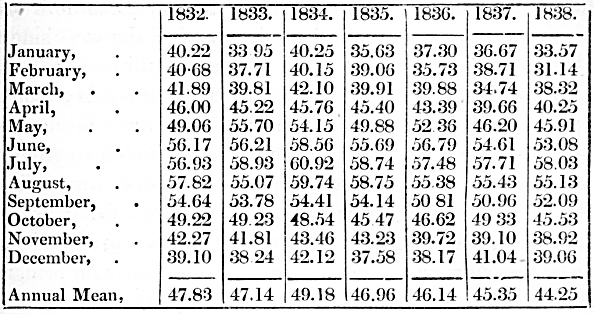
The following Table, drawn
up by Mr George Innes, shows the monthly mean temperature for the last
seven years—the thermometer being placed freely exposed to the E. N. E.,
and at the height of 16 feet above the surface of the ground, and the
observations being made daily at 8 a. m. and 9 p. m.
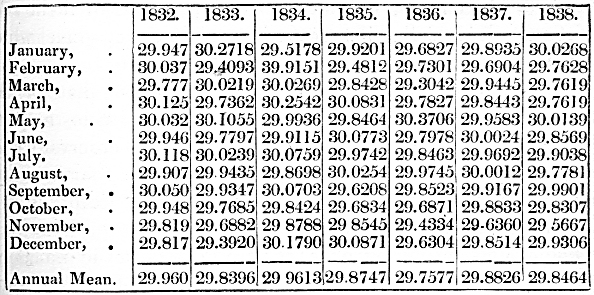
The fluctuations of the
barometer are not in general either very great or very sudden. It scarcely
ever rises above 30.5 inches, or sinks below 28. The effect of the east
wind in raising it, or in preventing its fall on the approach of rain, is
very frequently to be observed. In the following table Mr Innes has
collected the monthly mean for the last seven years—the barometer being
placed at the height of 45 feet above half flood, and observed night and
morning.
No series of observations
with the hygrometer has been recorded, nor indeed are such very
satisfactory when they are made. The principles of the various instruments
of this kind that are in use are liable to several fallacies which it is
not easy to remove, and nearly impossible to make due allowance for. Some
of them indicate only the moisture that is diffused in the air; thus
almost necessarily assuming that the air in which they indicate the
presence of moisture, already holds dissolved or combined with it, all the
water which at the observed temperature it is capable of taking. It is
obvious that there is therefore a great and a variable quantity of
moisture contained in the air to which such instruments are exposed, of
which they give no indication. Others are formed on the principle of
estimating the quantity of water which the air, under given circumstances,
is capable of dissolving, in addition to the unascertained quantity which
it already has. A third class depend for their principle on the known
facts, that cold air is capable of dissolving less moisture than hot air,
and that the moister the air is at any given temperature, the smaller will
be the reduction of temperature, required to cause it to deposit a part of
that moisture, or, as it is said, to bring it to the dew point; and the
hygrometer consists of a vessel having a thermometer inclosed in it, which
is to be cooled until moisture begins to be deposited on its surface, when
the indications of the inclosed thermometer will show at what temperature
the air subjected to observation would become incapable of retaining all
its moisture. And a fourth kind is founded on the principle, that
evaporation is accompanied by a diminution of temperature in proportion to
its rapidity; the instrument, therefore, consists of two thermometers, one
of which has its bulb covered with moistened muslin, and its indications
are obtained by noting the difference between the two thermometers. This
last kind of hygrometer seems to give a more philosophically accurate
result than the others; but there are circumstances which none of them
take account of, and which it is perhaps impossible to devise an
instrument to show satisfactorily.
The sensible effects of the
moisture contained in the air often depend not so much on its absolute
quantity, (or on its quantity as considered in relation to the temperature
prevailing at the time,) as on some differences whose causes are by no
means well understood, by which the air is rendered more or less disposed
to part with the moisture which it holds, or to dissolve an additional
quantity; and these, though not altogether unconnected with its
temperature, are yet by no means solely dependent on it. The indications
of the state of the atmosphere in regard to moisture and dryness, which
are furnished by the flight of insects and birds, and by the feelings of
persons of infirm health, are often more delicate, and not unfrequently
more accurate, than those given by any hygrometer. That changes in the
state of the air in regard to elasticity have a principal share in
producing those indications must be admitted; but such changes, at the
same time, produce a change in the relations of the air to moisture, which
often the most sensible hygrometer will fail to indicate, but which the
lapse of a few hours proves to be not the less real on that account. The
sensible proof that the air is saturated with moisture seems be obtained
by the falling of rain; but even here it is not sufficient to find that
rain has fallen in order to justify the conclusion that the air was
overloaded with moisture, or to find that no rain has fallen, in order to
warrant the inference that the quantity of moisture contained in the air
was less than it was capable of dissolving. Sudden changes in this respect
often take place, which are not by any means always proportioned to the
changes of temperature, and sometimes are even altogether unconnected with
them, and which it is extremely difficult to take any accurate account of.
It is true that rain often falls from a considerable height in the
atmosphere, and we are therefore unable to judge accurately of the
circumstances of that stratum of air from which it is precipitated; but
this is not always the case, and rain is sometimes produced as it were
before our eyes, while the previous indication of the thermometer and of
the hygrometer gave little information regarding it.
The rain-guage may thus
occasionally become a useful addition to both of these; though it is
obviously not capable of always indicating the actual quantity of moisture
separated from the air in any given situation; 1st, because it will catch
a considerable portion, (and indeed the greater part of what it does
catch, is probably to be considered as derived from this source,) of what
is separated from strata of air at a considerable but very variable height
above the place of observation; 2d, because the circumstances of the
various strata of air through which the rain falls before reaching the
guage, are liable to such endless variety, that the quantity of water
collected by the guage may be either very considerably greater, or very
much less than the actual quantity precipitated in the form of rain; and
3d, because when rain is produced from that stratum of the air in which
the rain-guage is placed, much of the amount of its indications will
depend on the situation which the guage occupies, as that which in the
upper parts of the stratum is but a drizzle or small rain, may sometimes
be found to be a very heavy shower, if observed in a situation only a
small number of feet lower. An observation of this kind was made on one
occasion by the late Dr Copland, Professor Natural Philosophy in Marischal
College, who found the rain small and by no means thick on the top of the
Observatory, while in the court below it was heavy and in large drops. The
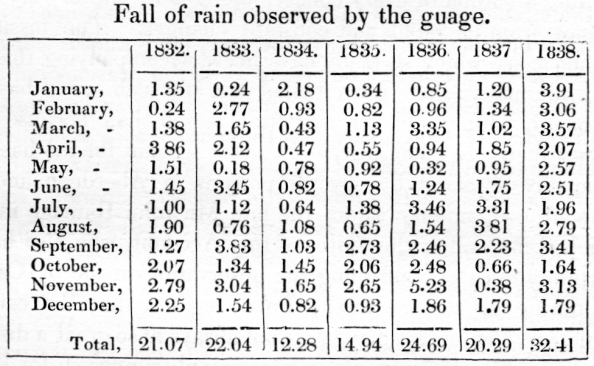
following table, therefore, showing the rain collected by the rain-guage
on the top of the observatory, at the height of 74 feet from the surface
of the ground, cannot be looked on as perfectly satisfactory. Yet perhaps
the objections to which it is liable, are (though of a different kind) not
on the whole stronger than those that might be urged against the
indications of any similar instrument however placed. Mr Innes, with the
view of removing these objections in as far as they are capable of being
removed, has taken measures for observing the fall of rain in future at
two additional stations in the vicinity of Aberdeen; the one in a garden
about half a mile westward from the boundary of the parish, where the
guage is placed seven feet above the surface of the ground, and the other
at the light-house on the Girdleness, about a mile south-east from the
extremity of the parish, where it is placed at the height of three feet
above the ground.
The prevailing winds are during the winter,
north and east, and during the summer, westerly; but there is so little of
steadiness in this respect, (excepting that there is a month or so during
spring when an easterly wind prevails very generally,) that it is
difficult to speak with any degree of precision about it. The following
table shows the direction of the wind during the last three years, no
register previous to that time having been met with.
| |
1836 |
1837 |
1838 |
| North |
19 |
38 |
28 |
| South |
37 |
42 |
44 |
| East |
19 |
10 |
26 |
| West |
59 |
28 |
23 |
| North to East |
25 |
24 |
30 |
| South to East |
45 |
32 |
61 |
| North to West |
64 |
65 |
59 |
| South to West |
64 |
73 |
74 |
| Two or more points |
16 |
53 |
20 |
| Variable |
18 |
Generally speaking, the
wind does not blow with any great violence, and it cannot be said that
there is any particular quarter from which a violent wind may be expected
to come, rather than any other; though, perhaps, on the whole, the north
wind may be said here to be oftener a violent wind than that which blows
in other directions.
The average rise of the tide at the mouth of the Dee is 13½ feet at spring
tides, and 8 feet at neap tides, and the former takes place when the moon
is about thirty-six hours past the full and change, —the latter about
thirty-six hours after the first and last quarters.
The magnetic variation is at present 26° 43'
westward. It was a few years ago somewhat greater, having been stated by
Mr In-nes at 26° 45' during the years 1830-31-32-33, and 34.
The aurora borealis is sometimes seen here in
great splendour, exhibiting a corona of every conceivable colour, and of
very great brilliancy from its rapid and constant changes. The hissing or
crackling noise which so many have heard accompanying this meteor, while
many others have denied that any such sound has ever been heard,
(apparently for no better reason than because they have not themselves
heard it, and cannot account for it,) has been occasionally observed by
several persons in Aberdeen and the neighbourhood, among whom the late Mr
John Ramage may be mentioned, as well as the writer of this Account, who
also had an opportunity once of confirming the observations made by
Captain Back during his sojourn in the Polar regions, that the cause of
this meteor, whatever it may be, is not always at so great a distance from
the surface of the earth as is commonly supposed, for he saw the beam of
light distinctly pass between his eye and a small cloud, while it passed
behind another small cloud, which evidently hung lower in the atmosphere.
The splendid phenomenon of a luminous arch, about 1° 30' broad, stretching
across the heavens nearly in the direction of the magnetic equator, and
slowly moving towards the south till it becomes more undefined, and at
last breaks up when it has passed a little beyond the zenith, has been of
late years several times observed here. Nothing can be founded on the
frequency or unfrequency of a phenomenon so irregular and so little
understood as the aurora borealis; but it may be mentioned by the way,
that after having been for several years very seldom observed, it has of
late become much more frequent, and during last winter scarcely a night
passed in which it was not seen in a greater or less degree.
Thunder storms are by no means very common in
this parish, and when they do occur they are scarcely ever very violent,
and it is not above once in two or three years that any injury is done] by
lightning to either buildings or lives in Aberdeen or the vicinity.
Springs, Wells, &c.—There are few springs of
any consequence in the parish, and although a supply of water can be got
in most places by digging from ten to thirty feet, it is generally rather
hard, and therefore comparatively of little value. Close by the boundary
of the parish, on the west side, are two springs closely contiguous, which
have been long known under the name of the Well of Spa. Both of these
springs, but especially the least co-pious one, are impregnated with
carbonate of iron, and they have been noted as medicinal on account of
this quality. In 1615, an account of the properties and powers of these
springs was published by Dr William Barclay, under the title of "Callirrhoe,
commonly called the Well of Spa, or the Nymph of Aberdene." A building
which at that time protected the spring having fallen into decay, was
repaired by the celebrated painter, George Jamieson, but was not long
after demolished by a flood of the Den-burn, which runs close beside. In
1670, another building was erected over the spring, which still remains,
consisting of a stone enclosure with steps or benches, and an entablature
bearing these inscriptions:—
"As heaven gives me, so give I thee."
"Hoc fonte derivata salus in Patriam populumque fluat."
"Spada Rediviva, 1670."
These springs have disappeared and been
recovered several times within the last two centuries, but until of late
their chalybeate virtues seem to have been always retained. Within these
few years, however, in digging on the adjacent eminence for the
foundations of the west wing of the New Infirmary, it would seem as if the
course of the water had been disturbed, or some other change produced, the
consequence of which is that now the larger spring scarcely appears to
possess any chalybeate impregnation, and the smaller one is much weaker
than it formerly was.
It is generally concluded among geologists,
that where granite rock forms the bed of a district, the attempt to obtain
water by sinking Artesian wells would be vain; and Messrs Richards and
Co., when they wished to obtain a supply of water for their manufactory in
the neighbourhood of Aberdeen, were dissuaded from incurring the expense
of boring, as not likely to be attended with success. Messrs Hadden and
Sons, however, about three years made the experiment at their manufactory,
in the lower part of the town, and with the result of obtaining an
abundant supply of water. In sinking this well, they cut through about
thirty feet of mossy soil and gravel before coming to the rock, into which
they made a bore of eight inches diameter, which was successively
contracted to six inches, and at the bottom to four inches. The depth to
which this bore was carried through the rock was 150 feet, and the course
of the operation they found the matter cut through mostly granite, though
of different degrees of hardness at different depths. The water thus
obtained, which probably comes from several fissures in the rock, rose to
within about eight feet of the surface, but on putting in a pump the
supply was found to be copious and capable of increase. On first using the
pump a good deal of air rose along with the water, but in about a month
this ceased, and it was then found that, by increasing the power of the
pump, a larger supply of water (accompanied, however, by a renewal of the
escape of air) might be obtained. The supply thus acquired is now equal to
nearly 180 gallons per minute, but the quality of the water is hardish, so
that it cannot be used except for condensing.
They have more recently
sunk another well about 100 feet distant from the first, and this they
carried to the depth of 220 feet, the bore throughout being eight inches
wide. Here they found the water rose only to within about fifteen feet of
the surface, and on applying a pump the supply was by no means so great as
from the first, not exceeding fifty gallons per minute, of the same
quality as the other, and apparently derived from the same fissures,— for
the yielding of the first well is so much diminished by the working of the
second, that both together scarcely give more water than the first did
alone, before the second was made.
Messrs Richards and Co., on hearing of the
success which had attended the attempts of Messrs Hadden, began to bore,
and after cutting through 18 feet of moss and black earth, 14 feet of
gravel and small stones, 4 or 5 feet of reddish clay, and, below that,
about 6 feet of loose sand and clay, they reached the rock, through which
a bore of 8 inches diameter was driven to the depth of 132 feet, making
175 feet in all from the surface. The rock was of variable hardness, but
mostly granitic. At the depth of 115 feet, a layer of sand was met with,
accompanied by much water, and there is reason to believe, that the
principal supply of water which was obtained came from this bed of sand.
Below this the rock was very hard. The boring was continued for 60 feet
further, but without any change in the nature of the rock, or any notable
ad-ditiun to the quantity of water. The spring rose to the surface of the
earth, and flowed over in small quantity, but on putting in a pump, the
supply was found to be equal to about 45 gallons per minute, and of
excellent quality, being, though not absolutely soft yet not by any means
materially hard. The
only other attempt of this kind which has been made is by Messrs Fisher
and Son at the Devanha Brewery, about a mile south-west from the boundary
of the parish, where a bore of six inches wide at the top, but diminished
to three inches at bottom, was driven to the depth of 140 feet. Nearly the
whole of this was through a red granite rock of variable hardness, and the
supply of water, which was obtained after boring about 35 feet, not having
been materially increased, the attempt was then given up. The water rose
to within two feet of the surface, and the quantity ob-tained by applying
a pump amounted to about 12 gallons per minute; but it was so strongly
impregnated with carbonate of iron as to be altogether useless for the
purposes of the brewery.
Zoology.—It cannot be expected that the
natural history of a parish which is nearly altogether occupied by a large
city should present many objects of rarity or interest. In regard to
quadrupeds, the only circumstance that occurs as being worthy of notice,
is, that the black rat, which formerly used to abound over all Scotland,
has for many years been altogether expelled from this parish by the large
brown rat, which is commonly said to have been imported from Norway. The
swallow and martin commonly make their appearance here about the end of
April, and depart a little before the autumnal equinox. The beautiful
bird, the Bohemian jay, is sometimes seen here, but seldom. The other
birds found are those which occur in other similarly situated parts of the
north of Scotland. The sea in the neighbourhood yields considerable
variety of fish, of which those principally caught are the haddock,
whiting, cod, skate, and flounders of various kinds, as plaice, &c. Ling,
halibut, soles, and mackerel are occasionally caught, and there is no
reason to doubt that an abundant supply of some of the finer kinds of
fish, as turbot, might be obtained, if the fishermen' were in the habit of
using decked boats, in which they could venture to go 15 or 20 miles out
to sea. An attempt was made some years ago by some fishers from Hartlepool
to introduce the turbot fishery here, but they did not meet with the
encouragement which they had hoped for. Herrings are occasionally caught
in' abundance along this coast, but it was not until about two years ago,
that, by the exertions of the late Provost Blaikie, a vigorous attempt was
made to establish a herring-fishery at Aberdeen.
There are at present about thirty boats
employed in this way, and the success which they have had has been highly
encouraging, so it may be hoped that this department of the fishery is
likely to be prosecuted henceforth with advantage. The salmon-fishery is
carried on to a very considerable extent both in the sea and in the river
Dee, and the rents accruing to the magistrates of Aberdeen, and to various
private individuals from this source, are to a considerable amount. A
statement of the actual quantity of salmon caught in the Dee and on the
beach adjacent cannot be given, because these fishings, being in the hands
of persons possessing similar fishings in other situations, it has not
been deemed of importance to distinguish the fish of each particular river
or station.
Occasionally considerable quantities of shrimps are caught in pools left
by the tide on the sands; and the fishermen who reside in Futtie use as
bait great quantities of sand-eels, which they collect by turning over the
sand after the tide has receded.
In consequence of the sandy nature of the
beach, it affords no resting place or shelter for shell-fish; and the
shells which are found on the beach are, therefore, brought by the sea
from other situations, and generally the fish have decayed before the
shells are washed ashore. Sometimes after a storm, a few Echini and
Medusae are found on the beach, but this is by no means frequent. The same
observation applies to several kinds of small Corallines, and to various
kinds of marine plants, none of which are properly speaking the produce of
this coast, nor ever found on it in sufficient quantity to be of any
importance either as manure, or for the purpose of preparing kelp.
Botany.— The botany of such a parish is
equally devoid of interest or variety as its zoology. The plants and trees
which thrive well are necessarily of the more hardy kinds, and there is
none of which it can well be said, that either the climate or the soil are
so peculiarly suited to them, as to render them specially the produce of
this parish. Forest trees of the various ordinary kinds, as fir, larch,
spruce, ash, elm, beech, birch, plane, mountain-ash, service, &c. &c., are
reared to a considerable extent in the nursery grounds in and adjacent to
the parish. The oak seems scarcely to thrive now in this part of the
country, although in executing the improvements which have lately been
carried on in the harhour of Aberdeen, the trunks of a good many oaks of
large size have been dug up, in such situations as to lead to the
conclusion 1 that they had not been brought down by the river, but had
grown where they were found. One of these, which, when entire and covered
with its bark, must have exceeded 15 feet in circumference, is set upon
the Inch or flat ground between the basin of the harbour and the bed of
the river Dee. No
great variety of plants can be said to belong to this parish, but by the
industry of the inhabitants, to which the establishment of a Horticultural
Society about ten years ago, has not a little contributed, a great many of
the natives of other districts, and not a few exotics, both esculent and
ornamental, have been successfully cultivated, and may be said to be
almost or altogether naturalized here now.
The mineral productions of the parish are not
less limited than those of the other departments of natural history. The
east parts of the parish lie altogether on a bed of sea-sand; and the low!
grounds on the north and east sides, as well as on the bank of the Dee
along nearly half of the south side, generally speaking, shew extensive
beds of peat moss lying under the vegetable mould. The higher grounds are
nearly composed of beds of gravel and small ounded stones.
Climate and Salubrity.—Notwithstanding the
variableness of the climate, the salubrity of Aberdeen is not inferior to
that of other places in the neighbourhood, which are more favourably
situated in this respect. Catarrhs, pulmonary complaints, and rheumatism,
may be said to be the only diseases that can in any degree be deemed
consequences of the exposed situation of the town on the east coast of the
island. As in every other large town, there is a considerable number of
cases of fever and other contagious complaints, which may be regarded as
consequent rather on the crowding together of a great number of
individuals, and on the unfavourable circumstances in which they live,
than on the climate or situation of the district. The tables drawn up at
the infirmary and dispensaries give information to a certain extend
regarding the diseases prevalent in a portion of the community and if
there were accurate bills of mortality kept, they would supply a good deal
of additional information, though it would not be quite complete or
accurate, as many who have lived beyond the bounds of the parish are
buried within it, and vice versa. In the absence of this information,
little more can be said than that instances of longevity, protracted
sometimes to nearly a century, by no means of more unfrequent occurrence
in Aberdeen, than in most of the other towns in Scotland.
II.— Civil History.
It would be useless to attempt to trace the
origin of the town of Aberdeen, as, in the total absence of records,
nothing but conjecture could be offered. It seems likely, that, whether
the present town can be identified with the ancient Devana or not, there
would be at a very early period a village or fishing-station near the
mouth of the Dee, and this may be supposed to have stood where the most
ancient traces of inhabitation in Aberdeen have been found, viz. along the
south and west sides of St Catherine's Hill, where the Ship-row and
Putachyside now are. Hector Boece says that it was erected into a city by
Gregory about the year 893, ["Aberdoniam ex pago urbem fecit," Hist. Scot.
l. x. fol. 220, edit. 1526.] but of this no record has been preserved. The
earliest document extant relating to the town is a charter by William,
granted at Perth, the date of which is with probability supposed to be
1179, and from this time the rise of Aberdeen as a place of note may be
dated. It had its
share in the troubles and misfortunes of the succeeding reigns, and in
1272, according to Boece, it was reduced to ashes by the fires caused by a
tempest which devastated a great part of Scotland, and which is mentioned
also by Fordun, though he does not speak of the destruction of Aberdeen by
it. [Hist. Scot. l. xiii. fol. 302—Scotichron, l. x. c. 30.] In 1298, the
town was garrisoned by the English; but about ten years after, the
citizens took possession of the castle, and massacred the garrison; having
taken part with Bruce, who, in testimony of their patriotic exertions,
granted them permission to bear as the arms of the town, "gules, three
towers triple towered, within a double tressure counterflowered argent,
supported by two leogards proper, the motto in a scroll above 'bon
accord,' " (that having been the watchword on the night when they rose
against the English); and soon after he confirmed and extended the
privileges formerly possessed by the citizens. In 1336, when Edward III.
had ravaged a great part of the north country, he desolated Mar on his way
south, and burned Aberdeen, killing a great number of the citizens, [It
would be out of place here to enter into any lengthened defence of the
historian Boece; but it seems necessary to notice that sometimes mistakes
are imputed to him without reason, as in the present instance; Mr Thom in
his History of Aberdeen, says, "Hector Boece mentions that Edward II. sent
ships to Aberdeen, anno 1333, from which a party landed and burnt the town
for six days; but this must be a mistake:" there is, however, no mention
of this expedition in Boece's history. Considerable confusion prevails in
the statements on this subject, some alleging (apparently on the authority
of an incorrect expression in Froissart, 1. i. p. 1, c. 57, where he says
that, in 1333, Edward entered Scotland, "qu'il foula gravement toute la
plaine d'Escosse, et ardit et exillat moult de villes privées de fosses et
de palis;—et coururent ses gens tout le pays jusques à Saint Jehanstone et
jusques à Abredane;") that the town was burnt in 1333 as well as in 1336;
and that on one or the other of these occasions, (for it is differently
stated) the fire raged for six days. There does not seem, however, to be
any good evidence for more than one burning; and it is by no means likely
that the town was then of such extent as to require six days for its
consumption, though possibly the work of destruction by Edward's soldiers
may have been carried on for that length of time. Vide Boet. Hist. Scot.
1. xv. fol, 332. Fordun, 1. xiii. c. 37.] in revenge, apparently, for the
death of Sir Thomas Roslyne, who had fallen in an attack on the town the
year before. [Wyntown's Chronicle, b. viii. ch. 31.] The town was within a
few years rebuilt, and seems at this time to have received the designation
of New Aberdeen;—not in contradistinction to the Kirktown of Seaton, which
is now called Old Aberdeen, but simply because it was then a newly built
town. It seems certain that Aberdeen was a town of some note long before
Old Aberdeen was any thing more than a hamlet with a church.
Subsequent to this time Aberdeen was
repeatedly honoured by the visits or the prolonged residence of the
Scottish King, and a mint was established in the town, from which coinages
were issued both by David and Robert III.
The records of the town council now extant
commence in the year 1398, but nothing requiring notice in this summary
occurs for a good many years. During the captivity of James I. and the
minority of James II., the troubled state of the country obliged the
inhabitants of each town to provide for their own security, and the
citizens of Aberdeen were ordered to arm, the town was protected with
walls, the gates being carefully shut at night, and an armed patrole of
thirty citizens was daily selected as a guard. against surprise.
In 1411, Donald, Lord of the Isles, made an
inroad on the country to the west of Aberdeen, and advanced with the
purpose of pillaging the town; but the Earl of Mar having collected forces
in the low country, opposed his progress, and on the 24th of July a battle
was fought at Harlaw, a place about twenty miles from Aberdeen, in which
both parties sustained considerable loss, and neither could claim the
victory. [Boet. 1. xvi. fol, 354—Majoris Hist. 1, vi, c. 10.—Fordun, 1.
xv. c. 21.] Among those who fell on the side of the Earl of Mar was Sir
Robert Davidson, the provost of Aberdeen, who joined him at the head of a
band of citizens. His body was brought to the town and entombed in the
Church of St Nicholas, where its remains were discovered when the church
became ruinous about the year 1740. [Kennedy's Annals, i. 51.] In
consequence of the death, in this manner, of Provost Davidson, it is said
that an act of the town-council was soon after passed, prohibiting the
chief magistrate from quitting the town in his official character; but Mr
Kennedy, though he mentions this, and though he refers constantly to the
council records, does not quote any authority for the statement, and the
writer of this has been unable to find any notice of such an act in the
council register. In
1462, the magistrates entered into a bond of manrent for ten years with
the Earl of Huntly; he engaging to protect them in their freedom and
property, and they promising to give him advice when required, to keep his
counsel, to receive him and his men into the town when he pleased, and to
take part with him if he should be attacked within the burgh, saving
always their allegiance to the King. [A copy of this bond is given in
Kennedy's Annals, i. 55.] In the course of the next year he called on them
for assistance, but not strictly in terms of the bond, for he required
them to meet him at the Cabrach, about forty miles from Aberdeen; but they
excused themselves, first because they could not obtain horses, the whole
country having been summoned at the same time to repress an incursion made
by John Lord of the Isles; and secondly, because they had been ordered by
the King to guard the town against the English, who were said to be on the
coast. James III.
having been killed in 1488, Lord Forbes and some other nobles came to
Aberdeen in the course of the next year for the purpose of stirring up the
people to assist in rescuing the young King from the party who had led him
into rebellion; and to aid their object they paraded the town, exhibiting
the bloody and torn shirt of the late King on the point of a spear. [Buchanani,
Hist. Scot. 1. xiii. c. 4. ] The appeal was not in vain, but the citizens
seem to have limited the expression of their loyalty to certain
resolutions which they passed on the occasion. In 1497, a blockhouse was
built at the entrance of the harbour as a protection against the English,
and in 1514, besides the gunners stationed there, two men were placed at
the bell-house on the south side of the river, with orders to raise a fire
as soon as the English fleet appeared in sight, while other two on the
castle hill had orders to ring a bell whenever they should see the fire.
The expected attack, however, was not made. James IV. paid several visits
to Aberdeen, one of which, though very brief, was remarkable. It was on
the 30th August 1507, when the King rode in one day from Stirling through
Perth and Aberdeen to Elgin, on his way to the shrine of St Duthac in
Ross-shire. [Leslæi de Gest, Scot. l. viii. p. 331, ed. 1675.]
In 1525, the town was the scene of a bloody
affray, caused by Seton of Meldrum, Leslie of Wardhouse, and Leslie of
Balquhain, who entered the town on the night of the 1st October with a
number of armed followers, and attacked the citizens, eighty of whom were
killed and wounded; but the assailants were repulsed, and the town
forthwith put into a state of defence. About the middle of the previous
century a public clock had been placed in the tolbooth; but so little
progress had the mechanical arts made in Aberdeen, or indeed in Scotland,
that in the beginning of this century, when it required repair, it was
found necessary to send it to Flanders for that purpose.
In 1514, in 1546, and again in 1647, the
plague raged with considerable violence in Aberdeen, and for the safety of
the other inhabitants, the sick were lodged in huts erected in the links.
When the Earl of Huntly rebelled against Queen
Mary, and the battle of Corrichie was fought, in 1562, the town seems to
have been equally in terror of both parties, but the occupation of the
place by the Royal army immediately before the battle, and the defeat of
the rebels, decided the question, and the Queen's army was joyfully
received on its return with the prisoners, and the town was at that time
the place of the Queen's residence for nearly three months.
At the earliest period of which any record
remains, the government of the town was intrusted to an alderman,
(afterwards called a provost,) four bailies, and twenty councillors, who
were annually chosen "cum consensu et assensu totius communitatis;" but by
a statute passed in 1469, the election of the magistrates was vested in
the council, and that of the new council was devolved on the preceding
council; and about the beginning of the sixteenth century, a custom began,
of the councillors once elected retaining their office for life, while the
election of provost became little more than a form, the office being
engrossed by one or two powerful families in the town or neighbourhood, in
proof of which it may be mentioned, that one individual filled the civic
chair for twenty-nine successive years, from 1547 to 1576. These abuses
continued till 1591, when the matter having been challenged, and confine
under the notice of King James, his Majesty issued one of the most
singular rescripts, perhaps, that ever passed the privy seal, in which he
ascribes the flourishing state of Aberdeen to the council continuing in
office "unalterit or changeit be the space of forty or fifty yeiris;" -
says the town would become a monopoly instead of an open burgh, if they
were changed annually according to act of Parliament;—and therefore
directs the council then in office to continue during life, re-electing
themselves annually; "renunceand and dischargeand all actioun and persute
competent to us or our successors twitching the contraventioun of our said
act of Parliament." This, however, did not give satisfaction, as indeed it
could not be expected to do; and next year the matter was referred to
certain umpires, who pronounced a decree-arbitral naming the magistrates
and council for that year, and "enjoining the acts of Parliament
concerning the election of magistrates, council, and office-men within
boroughs, to be precisely observed in all time coming."
In 1594, three Popish priests having been
apprehended by the magistrates, as abettors of the Popish Lords Huntly,
Errol, and Angus, who were then in a state of rebellion, these barons
forcibly rescued the prisoners, and denounced fire and sword against the
town; a threat which would probably have been executed, had they not been
soon after subdued, or rather starved into subjection.
James VI. paid several visits to Aberdeen,
viz. in 1582, 1589, 1592, 1594, and 1600, and, generally speaking, these
royal visits were expensive affairs to the citizens, both in
entertainments, and in presents of money given to his Majesty, according
to the custom of the time. About this time, the crime of witchcraft was
supposed to be prevalent in Aberdeen as well as in other parts of the
kingdom, and many poor old women were sacrificed to appease the terrors
which the belief in it was calculated to excite. Few of the individuals
who were suspected were allowed to escape from the hands of their
persecutors; several died in prison in consequence of the tortures
inflicted on them, and, during the years 1596-97, no fewer than 22 were
burnt at the Castlehill.
In 1639, the town having, at the instigation
of the Marquis of Huntly, taken part with the King, Montrose and General
Leslie came north, and after harassing the citizens for a time, and
reducing Huntly to the necessity of dispersing his troops, returned
southward. Soon after the Viscount of Aboyne resolved to publish at
Stonehaven a proclamation, issued by the King, against the Covenanters,
but he was repulsed, and pursued by the Earl Marischal, who, coming to the
bridge of Dee, found it fortified, but defended by a small number of men
only. These he overpowered, and, coming to Aberdeen, entered it without
resistance. [Spalding's History of the Troubles in Scotland, 4to edition,
Vol. i. p. 153.] In
1645, the town having mostly acceded to the covenant, Montrose, who had
embraced the royal cause, having crossed the Dee about ten miles up,
marched down to within two miles of Aberdeen, and sent a drummer with a
summons to surrender. This was refused, and the messenger dismissed; but
as he was returning, he was killed either accidentally or by design, on
which Montrose advanced, and being met by Burleigh's troops and the
citizens at the Crabestone, about half a mile from the town, a Woody
conflict ensued, in which Montrose overcame, and, pursuing his victory, he
took possession of the town, which he gave up to pillage, putting many of
the inhabitants to the sword.
The reigns of Charles II. and James were noted
for the cruel persecution of the Presbyterians, and for great distress
among the people generally, from which Aberdeen was not exempt. Among the
arbitrary acts of the latter, may be noticed his having on several
occasions controlled the election of magistrates, which was not restored
to its former freedom till 1689.
Some time previous to- this (probably at the
time when the disturbed state of the country rendered it unsafe to dwell
without the walls) a double row of houses was erected, apparently at first
of wood, in the middle of the Broadgate, by which that street was, reduced
in breadth from about thirty-five paces to its present breadth of about
fifteen or eighteen paces, and the west side of it, known by the name of
the Guestrow, or as it is called in some old writings, the "vicus lemurum,"
[Book of Bon Accord, i. p. 117.] thus became a separate street. And, about
the beginning of the eighteenth century, the magistrates, anxious to
deprive marauders of the shelter afforded them by the forest of the
Stocket, gave permission to such of the citizens as chose to take wood
from it for that purpose, to add balconies to the front of their houses,
projecting eight or ten feet into the street, viz. to the extent occupied
by the outer stairs—and thus the streets were considerably narrowed, and
the town rendered less healthy. One or two of the houses thus altered
still remain, having a wooden front, behind which, at the distance of
about ten feet, is the original stone wall of the house.
In 1715, the Chevalier de St George was
proclaimed at Aberdeen by the Earl Marischal, and soon after the Earl of
Mar sent to demand a contribution of L. 2000 from the town, for the
support of the Pretender's army, but of this only about one-half was paid.
In December of the same year, the Pretender having landed at Peterhead,
passed through Aberdeen on his way to Fetteresso, where he was met by
several of the nobles attached to his cause. Although the magistrates at
this time were on his side, the town's people generally seem to have been
afraid to commit themselves, and he received no effectual aid from
Aberdeen. About 1740,
some individuals in Aberdeen engaged in the nefarious trade of kidnapping
such young men as they could entice or compel, to go to the plantations in
Virginia, and though many were thus decoyed or forced away from their
friends, it continued for a good many years little regarded, and a house
in the Green is spoken of as having been used for confining those who were
refractory until they could be shipped off. Several of the principal
citizens appear to have been concerned in this villany, and it was not
until one of their victims, Peter Williamson, unexpectedly re-appeared in
Aberdeen in 1758, (for the measures taken to prevent their return, or
communicating with their friends, were in general successful,) that any
check was given to it. He had written a pamphlet, giving an account of the
manner in which he had been kidnapped, and of the hardships he had
sustained, and this he sold in Aberdeen on his return. For this libel he
was summoned before the bailies, and was fined 10s., ordered to beg pardon
of the magistrates, and thereafter to be banished from the town, and the
obnoxious parts of his book were torn out and burnt at the cross by the
hangman. Williamson afterwards went to Edinburgh, where, meeting with some
benevolent persons to espouse his cause, he raised an action against the
magistrates, which was terminated by these worthies being sentenced to pay
him L. 100, with all the expenses of the suit.
In 1745, Prince Charles having landed in the
West Highlands, Sir John Cope marched with the royal army to Inverness to
oppose him, but he having gone southward, Sir John returned and came to
Aberdeen in September, from whence he took shipping; and in November Lord
Lewis Gordon, the Prince's Lord Lieutenant for Aberdeen and Banff, came to
Aberdeen, and took possession of the town. Soon after, the Laird of
Macleod was sent by the Earl of Loudon with about 200 men to drive the
rebels from the town, but he was defeated in a skirmish near Inverury, and
the town continued to be occupied by the rebels until February 1746, when
it was evacuated on the approach of the royal army under the Duke of
Cumberland. His Royal Highness reached Aberdeen on the 27th February, and
remained in the town till the 8th April. [The Duke during his stay in
Aberdeen resided in the house which is now used as the House of Refuge.] A
part of the royal army returned to Aberdeen after the battle of Culloden;
and the citizens not being so alert in illuminating their houses as some
of the officers thought they should have been, they ordered the soldiers
to break the windows, which was accordingly done; but the magistrates
resented this aggression, and imprisoned one or two of the officers.
Ultimately the matter was accommodated by the officers paying about L. 60
for the damage done.
In 1767, the harvest being unfavourable, and the price of meal
consequently high, the populace broke open and robbed one of the meal
cellars in town, and threatened to hang its owner, under the impression
that he had wilfully raised the price beyond what was necessary. In order
to quell this riot, the magistrates were obliged to call in the aid of the
military, and it was not till one of the rioters was killed and several
wounded, that the mob was dispersed. In 1782, the alarming deficiency of
the crop led the citizens to adopt precautions to avert the threatened
famine, and accordingly a subscription was opened, and a committee
appointed to purchase corn to be distributed to the inhabitants. By their
accounts it appears that, up to the end of July 1783, they had imported
2205 sacks of various kinds of meal, 619 quarters of barley, and 9082
bolls of grain.
Attempts were made in 1786 to redress certain abuses connected with the
administration of the funds of the Scottish burghs, and in these attempts
several of the citizens of Aberdeen took a principal share; but the bill
which was introduced into Parliament for this purpose was thrown out in
1789. These attempts were renewed in 1792, and a select committee of the
House of Commons was appointed to report on the matter. This report was
presented in June 1793; but the odium which was cast upon reform by the
democratic principles of the "Corresponding Society" and the "Scottish
Convention," induced the prudent abettors of burgh reform to discontinue
their exertions. The
harvest of 1799 was extremely unfavourable, and the utmost exertions of
the magistrates were required in order to prevent famine. But though the
prices were very high, [The price per boll was, for oatmeal, L. 2, 5s.;
bear, L. 2, 4s.; potatoes, L.2, 2s.] and much distress was suffered in
consequence, no serious disturbance took place.
In 1802, the celebration of the anniversary of
the King's birthday terminated in a melancholy and fatal manner, in
consequence of some of the officers of the Ross and Cromarty Rangers, at
that time quartered in the barracks, having become intoxicated while
drinking the King's health in the town-house. On their appearing in this
state in the street, they were pelted by some idle boys, on which they
immediately ordered out the regiment, and fired on the crowd assembled in
the Castle Street, four of whom were killed and a good many wounded. It
was found necessary, in order to avert further evil, to remove the
regiment from the town next morning. The officers and some of the soldiers
who were most immediately implicated were apprehended, and soon after
ordered to be sent to Edinburgh for trial, but about two months after, the
Lord Advocate declined to prosecute any of them. The citizens, much
dissatisfied at this, raised a subscription for the purpose of prosecuting
them at the instance of those whose relatives had been killed, and three
officers and two sergeants were brought to trial, but after a trial of two
days, two of the officers were found not guilty, and the verdict was not
proven as regarded the two sergeants ; the other officer did not stand his
trial, and was outlawed.
One of the most melancholy shipwrecks that
have ever occurred on this coast took place on the 1st April 1813. The
Oscar whale ship left the port that morning along with four others, the
weather being fine; but appearances of a gale coming on, the Oscar and
another weighed anchor, in order to stand out to sea. The Oscar was
detained by one of her boats having been sent for some of the crew who had
not come on board, and the gale coming on from the north-east, she was
driven ashore about 11 a. m., in the Greyhope, immediately behind the
breakwater at the south side of the harbour, where she quickly went to
pieces, and out of a crew of forty-lour, only the first mate and one
seaman were saved. The same place proved fatal in 1815 to the Caledonia
and the Thames, which were both wrecked in one day, and the crews of both
perished. In 1817, it
was found that the expenses into which the magistrates had been led in the
execution of various improvements in the town, the harbour, and the roads
leading to the city, had so drained the treasury, that it became necessary
to declare the town insolvent. The amount of debt for which the security
of the town was pledged was L. 225,710, to meet the interest on which an
income appeared of L. 10,042, while the value of the property belonging to
the town was L. 139,440, exclusive of the value of feus in the new
streets, estimated at L. 106,851; so that time only appeared to be
required to enable the treasury to overcome its difficulties. A committee
of trustees was appointed, and, by careful management, his object was
attained in a few years ; and the last yearly accounts just published show
a revenue of L. 20,452, with an expenditure of L. 17,084. About the same
time attempts were made to open the set of the burgh, and the subsequent
election of magistrates having been informal in some respects was set
aside, and certain individuals were named by the Court of Session to act
until the next day of election. Since that time the Burgh Reform Act has
been passed, and the election of the council is now placed pretty much on
the same footing as it originally was,—the magistrates being chosen by the
council thus elected out of their own number.
Eminent Men.—It would not be easy, and perhaps
it is not necessary, to draw the line very nicely between those men of
talents and celebrity who have lived in Aberdeen, and those who have,;
been principally connected with Old Aberdeen. The notice here given can
only embrace a few of the principal, and must necessarily be very brief.
John Barbour was born in 1330, and is said to
have been the son of a citizen who lived in the Castlegate. He is known by
his office of Archdeacon of Aberdeen, and as the author of the metrical
history of Robert Bruce, which, as Mr Kennedy naively remarks, "has not
yet lost its reputation," adding, "the style of his composition is
regarded by the learned of both kingdoms as an ornament to our language,
and not inferior to that of his con-temporary Chaucer."
David Anderson of Finzeauch, commonly known by
the appellative of "Davie do a'-thing," was noted for his mechanical
genius, and in the year 1618 promoted the improvement of the harbour, by
removing a large rock which lay in the middle of the channel] at its
entrance. George
Jamieson, the son of Andrew Jamieson, a burgess of Aberdeen, who was born
about 1586, is deservedly celebrated as a painter of portraits, and his
pictures are remarkable for their soft-ness and the clearness of the
colouring. Lists of them are given in Mr Thorn's history of Aberdeen, and
in the Statistical Account in 1797. It may not be out of place to notice,
that there are still preserved, at the back of the magistrates' gallery in
the West Church, two pieces of tapestry worked by Mr Jamieson's daughter,
Mary representing Jephthah's Vow, and Susannah and the Elders.
James Gregory, the inventor of the reflecting
telescope, was born in the neighbourhood of Aberdeen in 1638, and educated
at Marischal College. He was afterwards Professor of Mathematics, first at
St Andrews and then at Edinburgh.
Edward Raban is worthy of note, as having been
the first printer established at Aberdeen, where he settled in 1621.
Mr Alexander Jaffray, the
son of a citizen of Aberdeen, occupied the civic chair in the years 1641
and 1649, [Alexander Jaffray, who was Provost in 1636 and 1638, is
generally supposed to be the father of the other, who in 1636 was not more
than twenty years of age.] and was highly beneficial to the community, by
the judgment and moderation which he exhibited in the direction of the
affairs of the town in very difficult times, as well as by the zeal which
he displayed for the promotion and maintenance of the true religion,
though in his latter days he shewed a considerable want of steadiness, and
ultimately became an adherent of the Society of Friends.
James Gibbs was born in Aberdeen in 1688, and
studied architecture in Italy, after which he settled in London, where he
acquired both reputation and fortune. It is to his taste and talent that
the design of the Church of St Martin in the Fields is said to be due; and
he gave the plan also for the West Church in Aberdeen.
John Gregory was born in Aberdeen in 1724,
and, having studied medicine, became Professor, first in King's College
and afterwards in Edinburgh, where, on his death, he was succeeded by his
son, the late eminent Dr James Gregory, who also was born in Aberdeen.
John Ramage, who was a currier and
leather-merchant in Aberdeen, deserves notice here on account of his
devotion to scientific pursuits, and his great practical acquaintance with
the construction of reflecting telescopes; one of which, made by him, is
placed in the Royal Observatory, and, though considerably inferior in
size, is said to be nearly equal in power to Herschel's 40 feet reflector.
Connected with Aberdeen, we must mention Dr
Robert Hamilton, formerly Professor of Natural Philosophy, and afterwards
of Mathematics, in Marischal College, the author of an Essay on the
National Debt, which has often been referred to as one of the ablest and
most perspicuous elucidations of the principles of the Sinking Fund; and
Dr Patrick Copland, who was Professor in Marischal College, at first of
Mathematics and afterwards of Natural Philosophy, who enriched the
collection of apparatus there with a great variety of models, made under
his own eye, and many of them with his own hand, so that at his death the
apparatus-room of Marischal College contained a collection probably
superior both in extent and accuracy to any other collection in Scotland.
It is not necessary to do
more than mention the names of such men as Dr Thomas Blackwell, Dr George
Campbell, Dr Thomas Reid, Dr James Beattie, Dr Gilbert Gerrard, and Dr
William Laurence Brown, all of whom were either natives of Aberdeen, or
for a considerable portion of their lives resident in it. Neither would it
be seemly in closing this list to say more than that Dr John Abercrombie
is a native of Aberdeen, and that Sir James Macgrigor received the first
elements of his professional education as the pupil of a medical man in
Aberdeen.
Ecclesiastical State.—Little precise information can be given regarding
the early ecclesiastical state of Aberdeen, except that, for two or three
centuries preceding the Reformation, there were in the town, houses of
Dominican, Franciscan, and Carmelite Friars, and a monastery dedicated to
the Holy Trinity, as well as a parish church dedicated to St Nicholas; and
that there is no reason to doubt that in Aberdeen, as in other parts of
Scotland, "the form of Popery which prevailed was of the most bigotted and
illiberal kind, and its superstitions and absurdities had grown to an
extra-vagant height." [Kennedy's Annals of Aberdeen, Vol. i. p.
109.] Malcolm having
gained a victory over the Danes at Mortlach, in Banffshire, in 1010,
founded a bishopric there, which was transferred to Aberdeen in 1139. The
bishop fixed his residence at Seaton, on the right bank of the Don, about
half a mile from its] mouth, and, in consequence of this, the cathedral
church was erected there. [That portion of the Cathedral Church which is
still entire is used as the parish church of Old Machar at the present
time.] The church of St Nicholas, as being a dependency of the bishopric,
was served by a vicar (who was generally the sixth prebendary of the
cathedral,) together with a curate, and, chaplains, the number of whom was
twenty-two in 1491, but in 1519 they were restricted to sixteen.
The influence of Protestant truth seems to
have early begun to manifest itself in Aberdeen; for, in 1521, Mr John
Marshall, master of the Grammar School, was summoned before the
magistrates for contempt of the Church of Rome. He answered bold-ly that
he did not consider himself amenable to the court of Rome. But two years
afterwards, he expressed his contrition, which, as Mr Kennedy observes,
"probably saved him from the dreadful punishment which generally awaited
the enemies of that church." In 1525, the principles of the Reformation
had made such process in Aberdeen, that the King sent orders to the
Sheriff to search for and punish those who had in their possession
heretical books, it being alleged that several strangers and others within
the diocese of Aberdeen were busied in propagating the errors of Luther.
Ultimately, however, the truth prevailed, and
the following extract from the council records, of date 4th October 1560,
shews the zeal and cordiality with which the cause of the Reformation was
at that time embraced by the magistrates: "The haill coun-sell present for
the tyme oblist thaim faithfullie to assist and council with the Provost
and Baillies, obey and fortifie the same in executione of all actis and
statutis devysit and mayd be the counsell for the comound weill of this
burgh and mantenans of Chryste's religioune, at thair uter power; and
peyne to be imputt alsweill upoune the said counsell as upoune the saidis
Provest and Baillies for observans of the present statute, that is to say,
under the paine of deprivatione of thair offices, gouns, and dignities,
and tynsell of thair fredome to be att the counsells will."
The parochial charge of the town was committed
to Mr Adam Heriot, who had been an Augustinian friar, but who having
renounced the errors of Popery, had joined himself to the Congregation,
and the time of his admission to the office seems to be nearly fixed by
the following entry in the council records of the same date with the
preceding: "The counsell ordains the thesaurer to pay Adam Heriot,
minister of the towne, the soume of twa hundreth pounds, usuall money of
Scotland, for his ministratione and preching for the space of ane zeir
nixt and immedyately following the first day of November nixt to cum."
In January 1561-2, the silver and brass work
belonging to the church, which had in the meantime been entrusted to the
care of member of the council, was sold by public roup for the common
good; and the magistrates about the same time resolved to abolish
monasteries, and to raise forty men for the service of the Congregation.
They seem, however, to have been partly induced to this resolution by a
visit which they had shortly before received from 1 some of the Reformers
of the south.
In 1567, the Provost of Aberdeen, writing to
excuse his non-at-tendance at the General Assembly called for the 26th of
July, 1 expresses the mind of the town as follows: "It shall please your
wisdomes understand and most assuredly believe us, professors of the
Evangell of the Kirk within the burgh of Aberdeen, to be of ane minde, and
be the grace of God to continue, to the mainte-nance of the furthsetting
of the glory of God, teaching of the true Evangell, and sustentation of
the ministers, with help unto the poore, and unto the tyme your wisdomes
with the nobilitie find ane order universall for the ministrie, we shall,
for our own part, God willing, sustaine our minister, so that of reason he
shall have no cause to plaint, and to the poore after our power doe
semblablie as uther burroughs shall take order." [Booke of the Universall
Kirk of Scotland, p. 63.]
At the commencement of the Reformation in
Aberdeen, a missionary (or assistant to the minister) seems to have been
employ-ed, as may be gathered from the following entry in the council
records of 11th October 1560: "The counsell ordanis David Mar, thesaurer,
to deliver Johne Brabaner ane garmound of cleithing of Frensche or
Flanders blak, that is to say, bonnet, goune, coitt, hoiss, and doublatt,
for his labours, cair, and diligens taine in tymes bygaine, in preching,
teching, and administratione of the sacra-mentis, without ony recompens."
Mr Heriot was greatly respected for his worth
and usefulness, and on his death in 1574 he was succeeded by Mr John
Craig, who had been for nine years the colleague of Knox in Edinburgh, and
afterwards minister at Montrose.
In 1579, Episcopacy was introduced into the
Church of Scotland, and David Cunningham was installed the first
Protestant bishop of Aberdeen. In the struggles which afterwards took
place for the abolition of that form of church government, as well as id
the opposition made by the country to the ecclesiastical proceedings, in
general, of James and his descendants, the citizens of Aberdeen,
influenced by their feelings of loyalty, and under the guidance of their
teachers, seem generally to have been less zealous than their countrymen
in other quarters. Stevenson having mentioned, (in his History of the
Church and State of Scotland) the prevalent feeling in favour of the
Covenant, makes the following exceptions:—"1st, Papists; 2d, Courtiers who
had no will to displease the King; and 3d, Clergy, of whom the chief were
the Doctors of Aberdeen." He goes on to say that the town, being much
under the influence of the Marquis of Huntly and the Doctors, (viz. Dr
John Forbes, Dr Robert Barron, Dr William Leslie, Dr Alexander Scrogie, Dr
James Sibbald, and Dr Alexander Ross,) refused to subscribe the Covenant,
which, with a view to their concurrence, had been sent to them in April
1638, by the hands of a commission from the Tables, consisting of the
Lairds of Dun, Morphy, Balmain, and Leyes, Mr Alexander Wedderburn, Clerk
of Dundee, and Mr Robert Barclay, Provost of Irvine. [Spalding in his
History of the Troubles in Scotland, (4to ed. Vol. i. p. 54,) gives only
the Lairds of Dun, Morphy, and Leyes, and Carnegie of-------as forming
this first Commission.] A short time before this, Aberdeen had been
appointed as the place of residence or exile of Samuel Rutherfurd, when he
was ejected from his parish of Anwoth, and Dr Barron undertook the task of
conferring with him, and bringing him to alter his views on the question
which then agitated the church and the nation. The result of these
conferences is stated by Rutherfurd in one of his letters, in his usual
homely but expressive manner, "Twa yokings laid him by." On the 20th of
July 1638, another commission, consisting of the Earls of Montrose and
Kinghorn, the Lord Cowper, the Master of Forbes, the Lairds of Leyes and
Morphie, with Messrs Alexander Henderson, David Dickson, and Andrew Cant,
ministers, came to Aberdeen, and though at first some difficulty occurred
with the magistrates, and the covenanting ministers were refused access to
the town's pulpits, yet about 500 subscribed after public worship in Earl
Marischal's Close, of whom several were persons of the best quality in the
place. [An evidence of the effect produced by this second visit is
furnished by the following extract from a minute of Council, of date 25th
December 1639. "The quhilk day, the Provest, Baillies, and Council agries
all in ane voice that Mr Alexander Henderson be delt with to accept the
chairge of the ministrie within this burgh in the vacant roume of umquhile
Doctor Alexander Ross, and that the magistrates writt to him, and use all
fair and possible means for his transplantation."] But though considerable
progress had been made among the citizens, the doctors continued adverse
to the Covenant, and were both active and successful in their efforts to
gain others to their opinions, and to repress the zeal of their
covenanting fellow-citizens; in consequence of which proofs of their "good
affectioune to his service," they received from Charles I. various
communications expressive of his "hartie thanks," and assurances that
"when anie thing that way concerne 'your good shall occurr we shall not be
unmyndful of the same.'" This promise the monarch performed not long
after, by granting a new Royal charter to the burgh, confirming in the
most ample manner all their ancient rights, privileges, and immunities. In
the latter part of this troubled reign, the citizens of Aberdeen seem to
have become more generally favourable to the cause of the Covenanters, the
consequence of which was, that they had now to endure the exactions of its
enemies, as they had formerly suffered from the hostile attacks of its
adherents. Yet it may be doubted whether many of them were not influenced
rather by the success which attended the Covenanters, than by any well-
grounded persuasion of the goodness of their cause. On the accession of
Charles II., and the re-establishment of Episcopacy, "the Synod of
Aberdeen distinguished itself by an humble address to | his Majesty's High
Commission and the High Court of Parliament, in favour of Episcopacy,
dated at King's College, 18th April 1661, in which they strongly reprobate
their own former conduct;" [Thorn's History of Aberdeen, Vol. i. p. 346.
4] and this seems to have been the beginning of a course of time-serving
compliance, by which they contrived in a great measure to escape from the
exactions and persecutions to which the Presbyterians were exposed during
that and the subsequent reign. At length the Revolution brought these
persecutions to a close, and led to the establishment of Presbyterianism,
as at present existing in the country; but while the people of Aberdeen
gave way to those who had power to enforce their commands, considerable
numbers of them continued attached to the Episcopal forms, and the
Presbyterians of Aberdeen were by no means remarkable for their zeal in
maintaining the doctrines of the Confession of Faith. The Arminianism
which, during the last century, infested the church of Scotland to so
lamentable a degree, may be said to have had one of its strongholds in
Aberdeen; and about the middle of the century, Mr John Bisset, minister of
the West Church, who continued faithfully to preach the doctrines of the
church to which he belonged, was excluded from his own pulpit by the
provost, who locked the church door against him.
It was not until about the beginning of the
present century that a better spirit began to manifest itself in the
pulpits of Aberdeen.
Since that time, a brighter day has dawned on
the Church of Scotland in general. The churches in Aberdeen have partaken
of its light, and the doctrines of the Confession of Faith have now some
as staunch supporters in the town and its neighbourhood, as are to be
found in any other part of the country.
The old parish of St Nicholas had, from an
early period, three churches, the East, the West, and Grayfriars, the two
former of which had been, for a period of at least 150 years, collegiate
charges, and the town, though constituting but one parish, was divided
into districts under the special charge of each of the incumbents. As the
population increased, additional church accommodation became requisite,
and several chapels of ease were at various times erected, as is noted
below more particularly. By a decree of the Court of Teinds in 1828, the
parish of St Nicholas was divided into six parishes. By a subsequent Act
of the General Assembly, the chapels of ease were each connected with a
parochial district quoad sacra; the effect of these two measures was to
increase the number of parish churches to ten; and within the last few
weeks a congregation of Original Burgher Seceders has been received back
into connection with the Church of Scotland, and is about to have a
parochial charge quoad sacra allotted to its minister. By this division of
the town, a very important object has been attained, inasmuch as parochial
superintendence is not now so completely out of the power of the ministers
as it formerly was, though still the population of most of the parishes is
so great as to prevent that close and intimate connection between the
minister and his people, which the parochial system, if properly followed
out, should produce and maintain. And when it is considered that each
minister, in addition to the parochial charge of an allotted district,
must also have a congregational charge, in consequence of many of his
hearers not being resident within that district, it will be at once
admitted that there is both room and cause for a still further division.
The places of worship in Aberdeen in
connection with the Established Church are the following:—1. The West
Church, which stands on the site of the old church of St Nicholas. This
building having become ruinous and unsafe, was disused as a place of
worship in 1732. The present church was founded in 1751, and opened for
Divine service in 1755. It ceased to be a collegiate charge on the death
of the Rev. Dr Brown. 2. The East Church stands where the quire of St
Nicholas formerly was. It was erected in 1834,—the quire, which had been
till then used, having become so ruinous, that it was judged necessary to
pull it own. This was a collegiate charge until the division of the town
into six parishes took place. 3. Grayfriars Church, which derives its name
from the monastery of Franciscan friars, to which it formerly belonged, is
the only ancient church now remaining in the town. 4. Futtie Church or St
Clements. There had been, before the Reformation, a chapel in Futtie,
dedicated to St Clement, but this having fallen into decay, there was no
Protestant church erected in its place till 1631, when a contribution was
made for the purpose of building one, and a catechist was settled there.
The present church was erected on the site of the old one, but
considerably enlarged in size in the year 1828. 5. The South Church. In
1779, a chapel was built in connection with the Relief body, which,
however, a few years afterwards, became connected with the Established
Church. The old chapel, being incommodious and insufficient for the
congregation, was pulled down in 1830, and the South Church was built on
its site. 6. The North Church was erected in 1826. These are the six
parishes, quoad civilia, into which the old parish of St Nicholas was
divided, as already mentioned.
The parishes quoad sacra are the following:—1.
Trinity Church was built in 1794 as a chapel of ease to the Establishment.
2. Gaelic Church. This place of worship was erected in 1795, and it
continues to be used by those of the population who speak the Gaelic
language. It has a small parochial district allotted to it, under the name
of Spring Garden parish. 3. Union Church was erected as a chapel of ease
in 1822. 4. John Knox's Church was built in 1833 as a chapel of ease. 5. A
place of worship, in connection with the Original Burgher Associate Synod,
was erected in 1771. The causes which had produced and kept up the
separation between this body and the Establishment having been happily
removed, its minister, the Rev. William Primrose, has been recently
received as a member of presbytery, and a committee of that presbytery is
at present engaged in allotting him a parochial district, under the name
of Melville Parish. Besides these, there was a small chapel erected in the
neighbourhood of the harbour, in 1825, by the Seamen's Friend Society.
This was for a time supplied indiscriminately by ministers of the
Establishment, and various denominations of orthodox Dissenters. Efforts
have been made of late to place it in connection with the Established
Church, and to have a small parochial district assigned to it, and there
is every probability that, in a short time, these efforts will be
successful.
There is also a place of worship in Aberdeen
connected with the Associate Synod of Original Seceders, which it is much
to be desired that the way might be opened for receiving back into the
Establishment.
The other places of worship in Aberdeen are as
follows:—3 chapels belonging to the Congregational Union; 3 chapels
connected with the United Associate Synod; 1 chapel in connection with the
Relief body; 2 chapels belonging, the one to the Scotch and the other to
the English Baptists; 1 chapel belonging to the Wesleyan Methodists; 1
English Episcopal chapel, with two clergymen; 1 Scotch Episcopal chapel,
with a bishop and a curate; 1 Roman Catholic chapel; 1 chapel which is
called the United Christian Church.
In addition to all these, there are also in
Aberdeen small numbers of Friends, Glassites, Irvingites, and Unitarians,
which have each their own place of worship.
The following table gives a summary view of
the ecclesiastical state of the inhabitants of Aberdeen, as ascertained by
surveys made chiefly by the elders of the respective parishes, and given
in to the Royal Commissioners for Religious Instruction, when they visited
this city in October 1837. [In this table, under the head of Dissenters,
are included both those denominations that are friendly and those that are
adverse to the principle of a national church.]
There is too much reason to fear, that,
although the surveys on which this table is founded were made with every
possible care, there are many included under the heads both of the
Establishment and Dissenters who are little, if at all, in the habit of
frequenting any place of worship. And it must be remembered, too, that the
strongest attachment to the forms of a professing church is unhappily too
often found to be compatible with an utter disregard or even a deliberate
rejection of the saving truths of the Gospel.
The extent of church accommodation provided in
Aberdeen at the time of the survey was reported to the Commissioners to be
as follows; and it has undergone no material alteration since, excepting
the recent admission of Mr Primrose's church into the Establishment:—
| |
Total sittings. |
Let. |
Unlet. |
| In the Establishment |
17271 |
14700 |
2571 |
| In the various denomination of
Dissenters |
13322 |
6249 |
7073 |
| |
|
|
|
| |
30593 |
20949 |
9644 |
The stipends paid to the ministers of the
East, West, and North parishes are L. 300 a year each; and to the
ministers of the South, Grayfriars, and St Clements L. 250 each; but in
the case of the South Church it is made up to L. 300 by the congregation.
The incomes of the other ministers in the Establishment are various,
according to the amount of seat-rents, collections, &c. from which they
are paid.
The ministers of other denominations are, in
this respect, situated nearly as the ministers of the five parishes quoad
sacra.
The above-mentioned stipends, paid to the
ministers of the six parishes quoad civilia, are paid out of certain funds
administered by the Magistrates and Council, arising from mortifications,
seat-rents, &c, and in case of a deficiency of these, it is made up from
the "common good," so called, it is to be presumed, as being the property
of the community, and designed for the advancement of the welfare and true
interests of the city; the principal means of which is, without doubt, the
maintenance of the worship of God and the ordinances of religion, since,
without these, all other efforts for the preservation of a sound state in
the community would be in vain.
In reference to this important object, it may
be observed, that the remuneration of the labours of the ministry should
be regarded in the same light as that of any other public functionary; and
that the services being performed, they should receive their incomes as
the price of the work done, and an acknowledgement of the good which they
have been instrumental in effecting. It happens sometimes, however, that a
minister is expected not only to give his services to the public, but also
to provide the funds out of which these services are to be paid. This must
necessarily be the case where, as in most of the Dissenting chapels and
the parishes quoad sacra, there are no other funds from whence the
minister's stipend can be paid. Accordingly, in the case of those parishes
for the stipend of whose ministers the magistrates and council are held
responsible, if the seat rents, &c. do not suffice for that purpose, the
sum drawn from the common good to make up the deficiency is regarded as a
debt incurred, or rather as so much lost, seeing there can be little
prospect of repayment. The fallacy of this view will be obvious, if the
following statement, which was made by the Rev. James Foote to the Royal
Commissioners, be considered: "The expenditure on the churches was L.
2124, 15s. 11d.: the mortifications amounted to L. 285; the rental of the
East Church for the year 1837, and the average collections in that church
for five years, amounted to L. 950, 10s. 1d.; and the rental and
collections of the West Church amounted to L. 917; making in all L. 2152,
10s. 1d.; so that there was here a surplus of L.27, 14s. 2d. beyond the
whole expenditure, and, whatever was produced from the other churches,
there was a clear gain to the public from these two churches alone, which
of themselves produced more than the whole expenditure on all the town's
churches."
In another respect, too, a mistake of no small
moment has been fallen into, viz. in stating the expense incurred in the
erection, or by contributing to the erection, of several of the parish
churches, as a debt against them in the town's accounts. ["The debt due by
the kirk charge, amounted at 15th October last, (exclusive of the expense
of building the East Church,) to L. 18,580, 12s. 2d., which may also be
considered as a debt against the treasury." Town's Accounts for 1838.] The
common good being destined for the advancement of the welfare of the
community, ought to be held as much liable for the expense of erecting
churches for the maintenance of that form of worship which is by law
established in the country, as for the cost of other public buildings,
whose purpose it is to benefit the community in a secular point of view,
such as court-houses, jails, colleges, &c. Each of these in its own
department tends to advance the welfare of the community, and in doing so,
they amply repay the sums laid out on their erection. The churches of the
Establishment are assuredly not less conducive to the good of the citizens
than these buildings, but, on the contrary, much more so, in as much as
they are erected and maintained for the promotion of that righteousness
which exalteth a nation; it must therefore be an erroneous and improper
view of the matter, to regard the expense of these erections as a debt due
to the community, while that of erecting the other buildings named is
looked on as a useful and necessary outlay of the public money. [In
support of this view, see particularly "Provisioun for sustentatioun of
the Ministers in Burrows." Book of the Universal Kirk of Scotland, p. 93.] III.— Population.
Although a statement of the population of the
town, as divided into ten parishes, was presented to the Ecclesiastical
Commissioners, and is given under the head of the Ecclesiastical
State,—yet that document not having been accompanied by the requisite
classifications, it becomes necessary to fall back on the result of the
census of 1831, taken when Aberdeen was divided into six parishes only,
and when there were in the city.
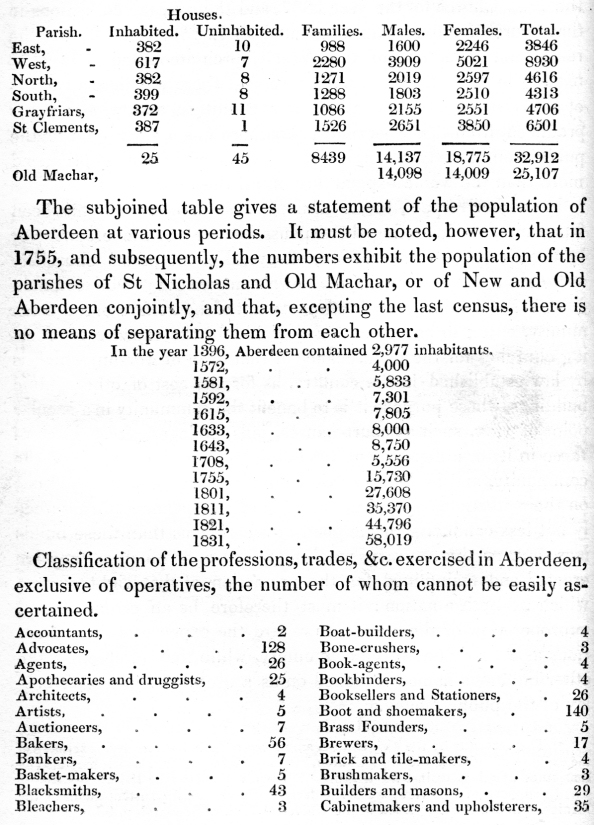
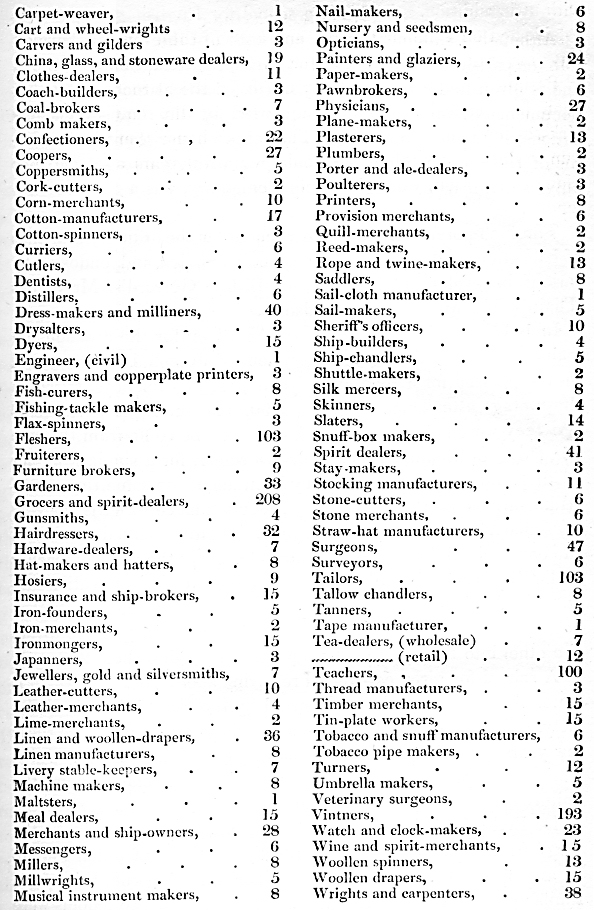
Educational State.—In 1607, a school for
instruction in writing, arithmetic, and book-keeping was instituted by the
magistrates, the master of which had a small salary allowed to him in
addition to the fees of the scholars, and this salary has continued ever
since with little addition. In 1672, a school for English grammar was
established on a similar footing, and both of these schools have always
maintained a high character.
Besides these, a school pretty much on the
parochial plan has been for a considerable time supported by the
magistrates and kirk-session jointly at Futtie. The school-house there
having begun to decay, was rebuilt and enlarged a few years ago, and the
plan of education, which is purely elementary, was a good deal extended.
The incorporated trades have a school for the
ordinary branches of education, and there are free schools founded and
endowed by various benevolent individuals, viz. Bishop Gerrard's, Mr James
Thain's, and Mr George Davidson's.
In 1815, a society was formed in Aberdeen for
the erection and maintenance of schools on the system of Joseph Lancaster,
and they supported for a good many years a school for boys, at which the
average attendance was about 450. About eight or ten years ago they were
enabled, by the bequest of L. 1000 from the late Mr Hogg of Shannaburn, to
erect a school for a similar number of girls; but other schools having
been about the same time erected in various parts of the town, the
attendance of girls scarcely exceeded 200; and Mr Robertson, the highly
talented teacher of the boys' school, having been induced to accept the
office of teacher of Dr Bell's school, the attendance of boys in the
Education Society's school fell off, in consequence of which the society
has deemed it advisable to give up one of their schools, and to divide the
other into two apartments, capable of receiving about 200 each. A school
for girls, capable of receiving about 100, and which is generally well
attended, is supported by the Seamen's Friend Society. They formerly had a
school for boys also, but within these few years it has been converted
into a parochial school for Union Parish, the society retaining the right
of recommending boys, the children of seamen, for instruction in it.
Dr Bell of Madras left L. 10,000, 3 per cent.
consols, to the Magistrates and Council of Aberdeen, two-thirds of which
were to be appropriated for schools in Aberdeen, and the other third for a
similar purpose in Old Aberdeen. Accordingly, two schools were erected in
Aberdeen, the one for about 400 boys, and the other for about 300 girls.
Dr Anderson of Jamaica also bequeathed certain
funds to trustees, for the support of a school in Aberdeen, as did also Mr
Donaldson of Orchardtown.
There are besides these partly endowed
schools, a considerable number of private schools of different, kinds, and
four or five boarding-schools, where young ladies are received and
instructed in the various branches of useful and ornamental education.
About nine or ten years ago, the Rev. A. L.
Gordon published an address to the inhabitants, on the necessity of
establishing schools, especially for the 'poorer classes, on the sessional
system, in the various parishes into which Aberdeen had then recently been
divided, and on the funds applicable to their support. The subject was
brought under the consideration of the Presbytery, who, "impressed with a
sense of the importance of the suggestion, recommended to the ministers of
Aberdeen, to consider and devise such means as may seem best for
accomplishing the object, and to report.'' A memorial was soon after
presented by the Presbytery to the Magistrates and Council, engaging to
erect the necessary buildings, if, in order that the fees might be made
sufficiently low to meet the circumstances of the poor, the city
authorities would grant a small salary to the parochial teachers out of
the common good. A similar memorial was soon after presented to them by
the synod, but both were unsuccessful. [The late Provost Blaikie expressed
himself in terms highly favourable to this object a short time before his
lamented death put an end to this and his other schemes of benevolence and
usefulness.] Notwithstanding this, the church courts encouraged the
ministers to persevere, and the consequence has been, that, by private
subscriptions, aided by grants of assistance from Government, (besides two
parochial schools in the adjoining parishes of Woodside and Bon Accord,)
two schools have been erected in John Knox's Parish, two under one roof in
Trinity Parish, one is now building in the North Parish, and funds have
been raised for the erection of one in the East Parish (where, as well as
in Grayfriars and Union Parishes, temporary schools have been for some
time in operation,) and in the South Parish, and measures are in
contemplation for obtaining parochial schools in the remaining parishes of
Aberdeen. That schools, connected as these are with the parish church,
will be placed in circumstances most likely to promote their usefulness in
the parishes, will be readily admitted by all who are not blinded to the
advantages of maintaining an intimate connection between the religious
instruction of the people, and the education of their children. Besides
the security thus obtained for the soundness of the instructions given in
the schools, the sympathies of the people will be enlisted in their favour;
and the teachers will be sustained by knowing that the ministers and
elders take a lively interest in their success.
The following is an abstract of returns which
were made in 1833, to queries issued by the Magistrates and Council, with
a view to ascertain the state of education in Aberdeen. In these returns,
all sorts of schools were embraced. Various changes have, to be sure,
taken place since that time, and allowance must be made for those pupils
who attend, at the same time, two or more schools for different branches,
as well as for those who, living in Old Aberdeen, attend schools in town,
and vice versa; but taking it as a whole, it may be looked on as giving a
pretty accurate view of the present state of education in Aberdeen:
Schools, 37; teachers, 49; pupils, 3664; males, 2546; females, 1118.
At the greater part of these schools, the fees
vary from 2s. to 5s. a quarter. Some, as already noticed, are free; and at
others scholars are occasionally taught without fees.
The following abstract exhibits a view of the
branches taught: English, 2792; writing, 1887; arithmetic, 1567; Latin,
208; Greek, 60; mathematics, 74; geography, 281; navigation, 15; music,
333; elocution, 67; sewing, 429. There is no return of French and the
other modern languages, because they are almost exclusively taught by
private teachers.
Besides these, there are also week-day evening schools established in a
good many of the parishes, for the benefit of those who cannot attend
school during the day, and of these the following return was made in 1833:
Schools, 9; teachers, 16; scholars, 699; males, 331; females, 368.
An association was formed about two years ago,
under the title of "The Association of Teachers of Sabbath Schools, under
the Superintendence of the Kirk-Sessions of St Nicholas and Old Machar,"
which promises to be very useful, and which a few months ago had in the
parish of St Nicholas 19 schools with 149 teachers, and upwards of 1800
scholars; besides which, the Aberdeen Gratis Sabbath School Society, which
has been in operation for about forty years, has in the parish and
neighbourhood, 20 schools, attended by about 1000 scholars.
The importance of normal schools, where those
who have in view to become schoolmasters may be trained in the knowledge
and practice of the duties of their office, has been for some time
strongly and generally felt, and in 1835, the General Assembly's Education
Committee, in their report, dwelt at considerable length on the benefit to
be expected from such institutions. The Assembly approved of the views
taken by their Committee, and acquiesced in their recommendation of
Aberdeen as a suitable place for the establishment of a normal school. In
April 1836, a public meeting was held in Aberdeen, at which it was
resolved to erect a school of this description in the town, and a
committee was appointed for the purpose of carrying this resolution into
effect. Several of the neighbouring counties, as well as the Presbytery of
Aberdeen, nominated committees to co-operate with this one, and the
Trustees of Dick's bequest have expressed their strong approbation of such
an institution, and their desire to assist the other bodies in securing
for the North of Scotland the benefits that might be expected to arise
from it. The expectation, that the Committee of the House of Commons on
Education in Scotland will take up the subject of normal schools, and the
hope that Government may make some acceptable proposal for their
establishment, with other causes of a less general nature, have hitherto
retarded the operations of these committees; but there is every reason to
expect, that in no long time a normal school will be established in
Aberdeen. Grammar
School.—The history of this school can be traced back as far at least as
1418, when Andrew de Syves, Vicar of Bervie, who had been master of the
school for some years, died. Little is known about it, however, at this
early period. In 1479, the salary attached to the office was L. 5 Scots.
About fifty years after, it was raised to 10 marks, and certain
perquisites were also allowed to the master. Twenty years later, the
salary was fixed at 50 marks, and 2s. quarterly assigned as the fee of
each scholar. In 1670, the rector, or head master, had 600 marks, and
there were under him three ushers, each of whom had 200 marks and the fees
arising from his own class, the rate of payment being at this time 13s.
4d. quarterly. The number and status of the teachers continue the same at
present; the fees are 10s. 6d. quarterly, and the salaries are L. 90 to
the rector, and L. 45 to each of the ushers.
The funds from which these salaries are
provided, arise from benefactions bequeathed at various times for the
purpose—the most important of which was by Dr Patrick Dun, Principal of
Marischal College, who, in 1634, mortified the lands of Ferryhill, in the
neighbourhood of Aberdeen, for the maintenance of four masters in the
grammar school. These lands were feued in 1752, at L. 164 Sterling, half
of which, in terms of Dr Dun's deed, is allotted to the rector, and the
other half equally divided among the other three masters. It is provided
by Dr Dun's deed, that any scholar bringing a sufficient testimonial of
poverty shall be taught Latin gratis; that all of the name of Dun, and the
sons of tenants on the lands of Ferryhill, "and haill remanent lands to be
conquiest for the use foresaid," shall likewise be taught gratis; and in
case of a vacancy in the office of any of the masters, a person of the
surname of Dun, or a tenant or tenant's son on the lands of Ferryhill, if
found qualified, shall be appointed "without anie contestatione."
The course of teaching followed in this school
occupies five years; and commencing with the elements of Latin, the pupils
are led on through a series of classical reading and themes, and of late
years, the elements of the Greek language have been taught to the more
advanced pupils. The
regular business of the school occupies the hours from 9 to 12 and from 3
to 5 four times a-week, with three hours on Wednesday and two hours on
Saturday, besides which arithmetic is taught at an extra hour.
Until lately it was the practice for all the
pupils to assemble every morning for prayer in the public school, but this
has been discontinued, and instead each master opens his class with prayer
in his own class-room. It is to be regretted that, with the exception of
this, and the prescribing in the two higher classes, of what are called
sacred lessons on Saturdays (if they deserve the name of exceptions),
neither master nor pupil has leisure to spare, from the communication and
reception of classical knowledge, to attend to the much more important
concern of religious and moral culture. [In one of a set of rules laid
down by the Town Council in 1700, for the regulation of the Grammar
School, the following clause occurs; "once a week all the rules and
questions of the Shorter Catechism are to be repeated publiclie." But if
this rule was ever attended to, it is long now, since it fell into
disuse.] In this respect, however, the Grammar School of Aberdeen is
probably not more to be complained of than most other public classical
schools, especially those on old foundations.
The number of pupils attending this school is
generally about 200; and there is an examination annually held in presence
of the magistrates, the ministers of the Established Church, and the
professors of Marischal College, when prizes, provided by the magistrates,
are awarded to the most deserving; and the appearance which is generally
made at this examination is such as to warrant the assertion, that, in as
far as regards the communication of a knowledge of Latin, the Grammar
School of Aberdeen, under the rectorship of Dr Melvin, is inferior to none
in Scotland. Gordon's
and Simpson's Hospital.—Robert Gordon, a descendant of the family of
Straloch, having acquired a competent fortune as a merchant in Dantzig,
returned to his native place about the beginning of the last century.
Subsequently to this, his habits gradually became extremely penurious, and
he almost denied himself the necessaries of life. Previous to his death,
which occurred in 1732, he executed a deed, by which he conveyed all his
property to the Provost, Bailies, Town Council, and the four Ministers of
Aberdeen [Since the division of the town into ten parishes, the Court of
Session has decided that the ministers of the East and West parishes, and
the two senior ministers of the other parishes, shall be the four clerical
governors.] in trust for the erection and maintenance of an hospital for
the reception and education of boys, who are sons or grandsons of decayed
burgess of guild; and, 1st, relations of the founder of the surname of
Gordon; 2d, relations of the founder of the surname of Menzies; 3d,
relations of the founder of any other surname; 4th, not related to him,
but of the surname of Gordon; 5th, not related to him, but of the surname
of Menzies; 6th, not related to him, and of any other surname; 7th, sons
and grandsons of decayed tradesmen members of any of the incorporated
trades; 8th, sons and grandsons of dyers and barbers ; and, 9th, sons and
grandsons of inhabitants of Aberdeen generally.
Mr Gordon had, during his lifetime, purchased
the ground formerly belonging to the Dominican Monastery in the
School-hill, and on this site his trustees erected, at an expense of L.
3300, a handsome edifice, according to the design furnished by Mr James
Gibbs, architect, which was finished in 1739. The expense of the building
had, however, materially encroached on the funds in their hands, (the
amount of which was originally L.l0,300,) and, owing to this and the
disturbed state of the country in 1745 and 1746, the house remained
unoccupied (except that it was used as barracks by the Royalist troops in
1746,) till 1750. By that time, the funds had accumulated to L. 14,000,
and the hospital was opened. Thirty boys were then admitted, and the
number has since been gradually increased, until in 1838 there were 130 on
the foundation. In
1816, Alexander Simpson, Esq. of Colliehill, devised to the I Principal
and Professors of Marischal College and the four Ministers of Aberdeen in
trust, the lands of Barrack, in the parish of New Deer, and Crickie, in
Old Deer, subject to the liferent of certain of his own relatives, after
whose death it became applicable to the purpose of educating boys in
Gordon's Hospital, the sons and grandsons of decayed burgesses. The
buildings of the hospital being, however, insufficient to accommodate more
than eighty boys, the number then in the house; and a considerable surplus
of revenue having accrued, the Governors of Gordon's Hospital, in
anticipation of the bequest of Mr Simpson, added two wings to the
hospital, connected with the centre building by a neat colonnade, after
the designs of Mr Smith, architect, at an expense of about L. 14,000.
These alterations were completed in 1834, and fifty additional boys were
soon after admitted; and in 1838, Mr Simpson's trustees paid over to the
governors L. 2000, in consideration of their being entitled to have
twenty-six boys accommodated in the hospital in the same manner as the
others, their maintenance and education being defrayed out of Mr Simpson's
trust-funds at the annual average rate; and in May 1838 they nominated
four to be received, so that the whole number now in the house is 134. The
age at which boys are admitted is from nine to twelve. They are clothed in
a suit of blue cloth with flat bonnets. The average period of their
remaining in the house is five years, it being a rule that no boy shall
remain after he is sixteen years of age. On leaving the hospital they are
generally apprenticed to various trades and professions in Aberdeen, and
at the end of the first year of their apprenticeship, they receive in name
of apprentice-fee the sum of L. 8, 6s. 8d., and on the expiry of their
apprenticeship the further sum of L.5, provided they have conducted
themselves to the satisfaction of their masters. If a boy can satisfy the
governors that he has favourable prospects by leaving the country, he is
allowed L.10 as an outfit, in full of all demands on the hospital.
By a special clause in the charter of
foundation, it is declared that young men educated in the hospital, who
may afterwards acquire or succeed to a fortune equal to 4000 marks
(L.216,13s. 4d.), shall be obliged to refund to the institution the whole
expense of their maintenance and education. But although several
individuals, who had received the benefit of this institution, have
attained to competent and even affluent circumstances, only two small
donations have been made to it by those who in early life had experienced
its benefit. The boys
are under the care of the master and two teachers, by whom they are
instructed in English reading, grammar, and elocution, writing,
arithmetic, geometry, geography, book-keeping, French and Latin. They are
also taught drawing and music by masters not resident in the house. By an
agreement between the Governors and the Professors of Marischal College,
four boys from the hospital may be recommended by the former to the
mathematical and natural philosophy classes, to which they are admitted
without payment of fees. The religious and moral training of the boys is
superintended by the master, and a portion of one of the galleries in the
West Church is rented by the hospital for their accommodation, and that of
the master and teachers.
Mechanics' Institution.—This institution was
commenced in 1824, soon after similar institutions had been established in
several of the manufacturing towns of England and Scotland. At first, the
plan adopted was to communicate instructions to mechanics by means of
courses of lectures at a cheap rate, on natural philosophy, chemistry, &c.
and the attendance on these lectures was for a time numerous; but after a
year or two it fell off so considerably that it was found necessary, in
1830, to discontinue the lectures, and if the projectors of the
institution had not wisely vested a considerable part of the subscriptions
originally obtained in the purchase of books, by which means (with the
help of numerous donations obtained,) a valuable library was formed, the
institution would have been extinguished.
The library, however, which consists of about
1100 volumes on practical and scientific subjects, (being the best
selected, and the richest, perhaps, of the collections possessed by
similar institutions in Scotland,) proved a rallying point, and a few
subscribers, who were sensible of the advantages to be derived from having
ready access to the best writers on the subjects in which they were
interested, continued to supply the funds necessary for keeping it up. In
this dormant state, the institution continued till 1835, when an attempt
was made to remodel it after the pattern of the School of Arts in
Edinburgh, by the establishment of classes at low rates in various
branches of science and literature. These have been since continued, and
with a considerable degree of success. In order to give regularity to the
studies of the members, these classes were arranged into a curriculum
extending over three sessions, and they embraced instructions in English
grammar and composition, French, geography, mechanical and architectural
drawing, sketching, arithmetic, algebra, geometry, trigonometry,
mensuration, logarithms, &c, mechanical philosophy, and chemistry. The
most striking feature, however, of the new arrangements is the "Mutual
Instruction Class." As its name imports, the members instruct each other,
and this is done by one reading a short essay or lecture on a subject
previously intimated to the class, and approved of by it; after he has
finished, a conversation takes place on the subject of the essay, in which
the opinions advanced are impugned and defended, and additional
information communicated. There is little method and no restriction as to
the subjects chosen, except that controversial theology and politics are
peremptorily excluded. This class has met with considerable encouragement,
the number of members being during the winter season from 100 to 120; and
individuals not members of the institution are admissible to it, the fees
being 3s. annually from them, while those already belonging to the
institution pay a fee of 2s. The fees of the other classes are 5s. for
each class, except the drawing, which is 7s.; and the price for the use of
the library is 4s., the payment of which constitutes a member of the
institution; while attendance on the classes is entirely optional, and
open to persons not using the library if they incline it. The number of
members of the institution at present is about 130.
United Fund.—"The Poor's Hospital was opened
on the last day of October 1741, for the reception of such idle and
strolling vagrants as should be found in town, and the poor inhabitants
who had no visible way of earning their bread; also for boys and girls,
the children of poor inhabitants, and for destitute orphans who had no
relations to take care of them. Every person in the house was to be
employed in work or labour of some kind, according to their strength and
capacity; the children to attend the school in the house for certain hours
every day; the boys to be taught reading, writing, arithmetic, and
instructed in the principles of Christian knowledge, and bound to trades
when they came to a certain age; the girls to be taught knitting of
stockings, and other branches of female education, to qualify them for
being good servants. The managers of the hospital were the magistrates and
council for the time being, and some of the most respectable inhabitants
chosen annually by the magistrates and council out of the different
societies and persuasions." [Statistical Account of Aberdeen, 1797.] The
revenue of the hospital appears to have consisted of a bequest left by Mr
John Kemp in 1713, for maintaining a free school for educating poor
children, together with four quarterly collections in the churches of the
Establishment and several of the Dissenting chapels, and occasional
donations from individuals. To these were soon after added the proceeds of
one-half of the residual estate of Mr Rickart of Auchnacant, bequeathed in
1741 towards endowing a workhouse in Aberdeen. In the year 1768, a system
of out-door relief was deemed preferable for the adult and aged inmates of
the hospital, and in order to constitute a fund for this purpose, as well
as generally for the supply of the parochial poor, without putting an end
to the hospital as an educational establishment for orphans and destitute
children, an agreement was entered into, whereby the kirk-session of St
Nicholas engaged to pay L. 241 annually, being the estimated surplus of
their hands after defraying certain settled charges; the managers of the
Poor's Hospital undertook to give L. 100, being the surplus remaining with
them after meeting the estimated expense of maintaining and educating
twenty-five boys; and the managers of St Paul's Chapel agreed to
contribute (for one year, but it was annually continued for a considerable
time), the sum of L. 30. By the union of these three, "the United Fund"
was established, which was "to be distributed among the poor, and applied
to all the charitable purposes at present provided either by the session
or by the directors of the Poor's Hospital." [Minute-Book of the United
Fund, 1768.] It was also resolved that the fund should be managed by all
the session, together with managers chosen by the directors of the Poor's
Hospital, and by the managers of St Paul's Chapel, in numbers proportioned
to the extent of their contributions. The foundation being thus laid of a
fund for the support of the parochial poor, considerable additions were
from time to time made to it by the donations and bequests of individuals,
and for nearly fifty years the money thus placed in the hands of the
managers was found sufficient (with strict economy) for this purpose; but
as the town became more populous and more commercial, the number of the
poor increased; and in the year 1818, the desire to rid the streets of a
number of beggars, by whom they were infested, and at the same time to
avoid the imposition of a legal assessment for their maintenance, led to
the collection of a voluntary contribution to meet the increasing demands
on the United Fund. At first, this plan was attended with success, the sum
obtained being nearly L. 1000; but after a few years, the trouble of
collection and other circumstances occasioned a gradual falling off, so
that in 1835 scarcely L. 400 was obtained ; in consequence of which, it
became unavoidable to attempt some other means of raising the requisite
sum. Accordingly, in 1836, at a head court of the inhabitants, a
resolution was entered into to raise the sum of L. 1700 for that year by
an equitable self-imposed assessment on heritors and tenants, on a
principle similar to that which had been for some years acted on in Dundee
and other places. It was, however, found impossible to collect this
assessment without resorting to law, and in 1838 the magistrates were
obliged to interpose their authority and enforce payment. It is
unnecessary to dwell here on the evils consequent on a legal assessment,
which at once puts an end to the Scottish system of parochial relief, and
gives the pauper, however undeserving, a legal right, not to "a help," but
to a maintenance; but one effect of it may be stated as being peculiar to
this parish, viz. the alienation of a fund which was destined by the late
Mr John Burnett " for the support and relief of such persons living within
the town and parish of Aberdeen only, who are unable to sustain
themselves, and who are bedrid, or are afflicted with bodily diseases that
are supposed to be incurable," or those afflicted with lingering diseases,
and others, particularly the aged. Mr Burnett, anticipating the
possibility of a legal assessment being imposed for the relief of the
parochial poor, annexed to his bequest the following provision: "I hereby,
therefore, in case of the foresaid assessment taking place either at my
death or at any time thereafter, discharge and debar the minister and kirk-session
of Aberdeen and my other trustees above-named, from applying the foresaid
for the purposes above-mentioned, during all the years that such
assessment for the poor shall continue. And in case such assessment shall
continue to take place within the town of Aberdeen at any time after my
death, for the space of seven years successively, in that event appoint
the minister and kirk-session of Aberdeen to denude themselves of the
foresaid haill lands of Kinnadie with all eventual interests competent to
them therein under this deed." [It is right to state, however, that the
alienation of this fund is in one respect less to be regretted than
otherwise it might be, because it will not be altogether diverted from the
poor, inasmuch as it is directed to be transferred to the managers of the
Infirmary, to be by them applied as noticed in the account of that
institution.] The proceeds of this bequest amounted to about L. 280
annually, which, until 1838, were carefully distributed by the trustees of
Mr Burnett, in accordance with his directions, among the aged and infirm,
"with a preference to such persons who are known to have lived soberly and
religiously ;" but these, the most necessitous as well as the most
deserving class of the parochial poor, are now merged in the general mass,
and receive a supply simply and barely according to their necessities,
without reference to their previous character; and the amount of this
relief given to them forms an addition to the sum to be assessed on the
inhabitants. The
relief of the parochial poor is placed under the direction of a committee
consisting of delegates from the general kirk-session, the magistrates,
the Dissenting congregations which contribute to the United Fund, and
individual donors, together with a proportionate number of gentlemen
appointed on behalf of the inhabitants at the time of commencing the
self-imposed assessment. This committee meets in the beginning of every
month to receive and determine on applications for relief, which it is to
be regretted is regulated much more by the means at their command, than by
the necessities of the applicants, being, on an average, certainly not
more than at the rate of 4s. a-month.
Table for seven years of the number of poor
and amount of relief given:
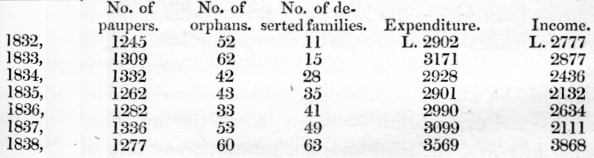
Boys' Hospital.—In pursuance of the agreement
entered into in the year 1768, respecting the relief of the parochial
poor, the adult inmates of the work-house or Poor's Hospital, and the
girls maintained there, were pensioned out of the United Fund, and the
hospital was thenceforth devoted to the maintenance and education of boys
only. The number of these was at first 25, and until the year 1795, when
it was increased to 40, no addition was made to this number. The cause of
this may be supposed to have been, that the United Fund necessarily
occupied prominently the attention of the managers, in consequence of the
continual recurrence of meetings regarding it, and the number and variety
of the transactions connected with it; by which means, in the course of
time, a system of keeping the accounts of both institutions came to be
introduced, by which the hospital was represented as subsidiary to the
United Fund, and dependent on it for a considerable yearly sum, towards
defraying its expenses. This, however, was not the case, and on a careful
scrutiny and separation of the various sources of revenue belonging to
both, which was made in the year 1828, it was found that the income
accruing to the Poor's Hospital was abundantly sufficient for all its
wants, and since that time the accounts have been kept entirely distinct.
The house which had been occupied since 1740 by the hospital being found
to stand in the way of projected improvements in the jail and court-house,
was purchased from the managers, and the hospital was removed in the year
1818, to a house in the Gallowgate, which they bought. Subsequently to
this, the managers wished to increase the number of the inmates, but the
accommodations being inadequate, they, in the year 1829, purchased a house
of larger size in the Upper Kirkgate, and since then, fifty boys have been
maintained and educated in the "Boys' Hospital;" and as there is still a
certain surplus of funds, proposals have been at various times entertained
for still further extending the institution. The age of admission into
this hospital is from eight to ten, and the boys received into it are
taught the ordinary branches of education,—reading, writing, arithmetic,
church music, and the principles of religion. The sources from which the
income of the hospital is derived, are various mortifications or bequests
secured on land, together with a collection annually in the churches of
the Establishment, and several of the Dissenting chapels. The following
table shows the income and expenditure for seven years; the number of
inmates being fifty-five, viz. matron, schoolmaster, treasurer, and two
servants, in addition to fifty boys:
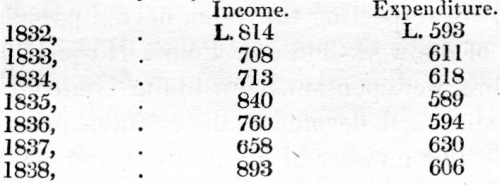
Girls' Hospital.— The want of an institution
for the maintenance and education of girls, similar to the Boys' Hospital,
had been for some time felt and regretted, and, in 1828, a subscription
was entered into for the purpose of obtaining a fund for the establishment
of such an hospital. This, in the course of a few months, amounted to L.
1500, and the Girls' Hospital was opened for the reception of twenty
girls, the children or orphans of parochial paupers, in 1829. The
encouragement given to it by the public was such, that next year the
managers were enabled to increase the number to thirty, and in 1835 ten
more were received. The ages within which these girls are admitted, are
from six to nine; the branches of education taught are, reading, writing,
arithmetic, church music, sewing, knitting, and house-work, with
instructions in the principles of religion, and they continue inmates of
the hospital generally till they reach the age of fourteen.
The income of the hospital is derived from an
annual collection in the churches, the interest of the subscribed capital,
and a fourth part of the proceeds of Mr Simpson of Colliehill's
mortification to the workhouse of Aberdeen: and the following table
exhibits its amount, with that of the expenditure, for the last seven
years:
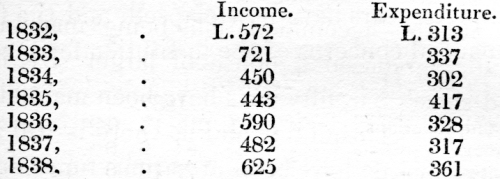
House of Refuge.—The establishment of a House
of Refuge in Aberdeen had been several times agitated, but it was not
until 1836 that sufficient funds for the purpose could be obtained. The
munificent donation of L. 1000, then given by George Watt, Esq. surgeon,
for the purpose of commencing this useful charity, was speedily followed
up by a general subscription in the town and neighbourhood, and the sum of
L. 3000 was raised in the course of a few months,—annual contributions to
the extent of L. 136 being at the same time subscribed for, and the
institution was commenced, a body of directors chosen, and regulations
laid down at a public meeting of the inhabitants.
A suitable house having been hired and
furnished, the House of Refuge was opened on the 5th September 1836. The
mode of conducting the details of its management has been principally
borrowed from the House of Refuge in Edinburgh; and though many and great
difficulties occurred in the outset, as indeed was to be anticipated,
there is abundant reason to know that not a little good has been done by
the institution, (especially in regard to great numbers of neglected
children, who are furnished with that education which their parents either
could not or would not give them), and that at an extremely moderate
expense. Under the
judicious care of the present superintendant, Mr Edward Reid, (who had for
some time officiated as chaplain and schoolmaster before his appointment
to be superintendant, and who still unites the duties of these two offices
to those of the superintendant), the system of domestic management of the
establish-ment has now been carried on for nearly two years, and the
extent as well as the nature of the benefits derivable from the
institution become more justly appreciated and more sensibly felt.
In the first outset of any institution, a
considerable expense must necessarily be incurred for furniture, &c.;
while, on the other hand, the income of an infant institution is generally
short considerably of what it afterwards reaches, when the public have
become aware of its claims on their support. Hence, the expenditure of J
the House of Refuge during the first seven months was L. 725, while its
income for the same period was only L. 191. Since that time, two complete
years have now elapsed, and the following is a view of the financial
concerns of the institution for these two years Income.
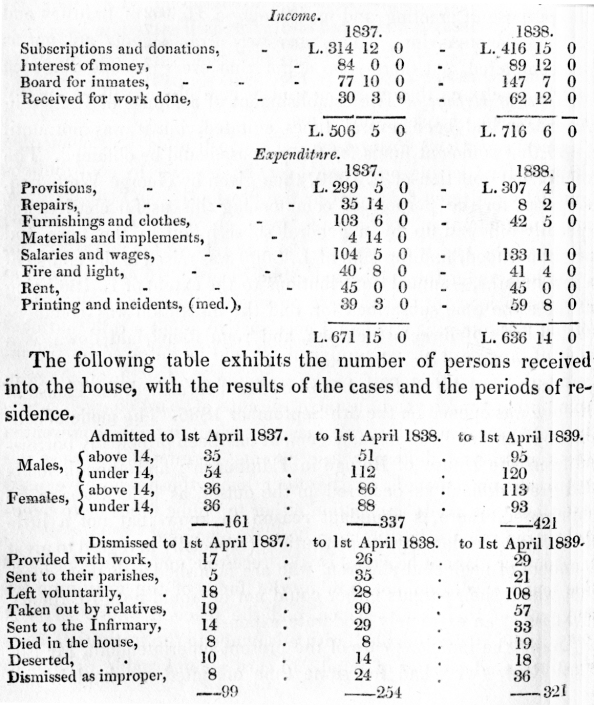
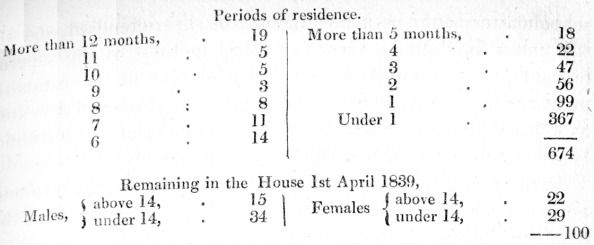
House of Industry and Magdalene Asylum.—Within
these few months, the same benevolent individual whose liberality was the
means of establishing the House of Refuge, has conveyed to trustees, named
by himself, along with the directors of the House of Refuge, the property
of Oldmill, situated about four miles westward from the town, which yields
about L.164 of yearly rent, for the purpose of erecting and maintaining a
House of Industry and a Magdalene Asylum. The necessary arrangements are
not as yet completed, but there is no doubt that every possible diligence
will be used, and that these beneficial institutions will be opened in the
course of a very short time.
Deaf and Dumb Institution.—This institution
was opened in 1819, a fund having been raised for the purpose by
contributions gradually collected for a year or two previously, and the
direction and instruction of its inmates were entrusted to Mr Robert
Taylor, who had been sent to Paris to receive the necessary instructions
under the celebrated Abbé Sicard. In consequence of the insufficiency of
the funds to provide for the entire maintenance of the institution, it was
found necessary to adopt a rule that one-half of the board of the pupils
only should be defrayed by the institution, the other half being required
to be advanced from some other source; and although the rate of board
charged be only L. 16 per annum, this rule has in several instances
prevented the admission of children whose parents were unable to raise the
required sum ; though, on the other hand, those who have used exertions,
and made application either to public funds or -to benevolent individuals,
have seldom been disappointed.
Another class of boarders is also received
under the charge of the teacher, who do not draw on the funds of the
institution for any part of their maintenance, and the teacher, whose
salary is only L. 60, is thus enabled, with advantage to the institution,
from the increased number of pupils, to earn a comfortable livelihood. The
branches of instruction taught in the institution are, the knowledge of
objects, English reading and writing, arithmetic, geography, and the
principles of religion.
In 1834, Mr Taylor, having resigned the
direction of the institution, Mr Matthew R. Burns, himself deprived of
hearing at a very early age, was appointed in his room; and his sister,
Miss Burns, was appointed housekeeper. At the time, some of the directors
felt a doubt whether Mr Burns's deafness might not prove an obstacle to
his usefulness, while others were rather of opinion that, by placing him
more closely on a par with his pupils, it would be an advantage.
Respecting the result, it is unnecessary to
say more than that, by his ability, zeal, and unwearied diligence, the
pupils have been benefited in no common degree, and the character of the
institution (which depends entirely on that of the teacher,) has been
raised to the level of those excellent and more extensive institutions of
the same kind in Edinburgh, London, and Dublin. The period of a pupil's
continuance in the institution is usually about five 3'ears. The number at
present receiving aid from the funds is 12, viz. 9 boys and 3 girls. The
expenditure is provided for by annual subscriptions, occasional donations,
the sale of work done in the institution, and by the proceeds of an annual
public examination of the pupils; and the sums thus obtained have been
sufficient, with great economy, to provide for the maintenance of a
limited number of pupils; but the institution is very far from meeting the
necessities of the north of Scotland, as was contemplated at its original
establishment. The
following table shows the income and expenditure, with the number of
pupils whose board was partly paid out of the funds, for the last seven
years.

Burnett's Fund.—In the year 1783, Mr John
Burnett of Dens died, bequeathing the bulk of his property to the
following charitable purposes : Two-thirds of the rents of Kinnadie for
the support of aged and diseased poor persons in Aberdeen, with a special
reference to their previous respectability and moral character. This
distribution (the amount of which was about L. 250 annually) was directed
to be continued as long as there should be no legal assessment for the
support of the poor of Aberdeen; but in the event of an assessment being
levied, then, during each year of the continuance of such assessment, the
money was directed to be applied by the managers of the Infirmary,
one-half to defray the expense of a physician to attend the sick poor of
Aberdeen, who are not proper objects to be received into the infirmary,
and the other half to the maintenance of pauper lunatics belonging to the
town and county of Aberdeen ; and this alteration in the destination is
declared perpetual if the assessment shall continue to be levied for seven
successive years. The other third part of the rents was directed to be
accumulated, for the purpose of yielding at the end of every forty years,
(reckoned from 1774,) two prizes, of L. 1200 and L. 400 respectively, to
be given to the authors of the two best essays on the following subject,
"that there is a Being all-powerful, wise, and good, by whom every thing
exists; and particularly to obviate difficulties regarding the wisdom and
goodness of the Deity; and this, in the first place, from considerations
independent of written Revelation; and in the second place, from the
Revelation of the Lord Jesus Christ; and from the whole to point out the
inferences most necessary and useful to mankind."
The decision of these prizes he directed to be
by a committee of three individuals, chosen by his trustees and the
Professors of King's and Marischal Colleges.
The term of forty years prescribed by Mr
Burnett, expiring in 1814, the first adjudication of the prizes took place
in that year: the three judges appointed by the trustees and the
professors were, the Rev. Dr Gilbert Gerrard, Professor of Divinity in
King's College; Dr Robert Hamilton, Professor of Natural Philosophy in
Marischal College: and the Rev. Dr George Glennie, Professor of Moral
Philosophy in Marischal College; and the first prize was by them adjudged
to the Rev. Dr William Lawrence Brown, Principal of Marischal College; and
the second to the Rev. John Bird Sumner, the present Bishop of Chester.
Any surplus of this fund that may remain after
the payment of these prizes is directed to be laid out in the purchase of
lands, the rents of which are to be added to the other two-thirds.
From the time of Mr Burnett's death until last
year, the former destination of these two-thirds has been acted on by his
trustees, and about 160 of the most deserving of the poor in Aberdeen have
been supplied by the distribution of these funds in small monthly
payments. An assessment having, however, been found altogether
unavoidable, this source of supply to the poor has been cut off, and the
pensioners on this fund have been transferred to the parochial funds. The
managers of the Infirmary, seeing that it would be utterly impossible for
one physician to attend the sick poor who are not fit for reception into
the house, now that the town is increased to upwards of four times the
population which it contained at the time of Mr Burnett's death, and that
the General Dispensary is well adapted to carry out the spirit of Mr
Burnett's intentions, but is very insufficiently supported by the
subscriptions raised for its benefit,—have resolved that the half of the
fund placed under their direction for this purpose, shall be given for the
present to that institution; its application to be under the direction of
a commitee, consisting of an equal number of Managers of the Infirmary,
and Directors of the Dispensary;—the other half they retain in their own
hands, to be applied for the maintenance of pauper lunatics from the town
and county of Aberdeen in the Lunatic Asylum.
Pauper Lunatic Fund.—In 1820, a fund was
instituted for the purpose of defraying the expense attending the
maintenance, in the Lunatic Asylum, of lunatic paupers belonging to the
parish of St Nicholas.
The sources from which its support is derived
are, collections (formerly annual, but which have been discontinued for
the last two years,) in the churches of the Establishment and in several
Dissenting churches, together with occasional donations and legacies, and
its management is entrusted to a committee, consisting of the Established
and other clergymen, with a few other gentlemen annually elected.
The annexed table exhibits the income and
expenditure of this fund, and the number of patients whose board has been
defrayed out of it for the last seven years:—
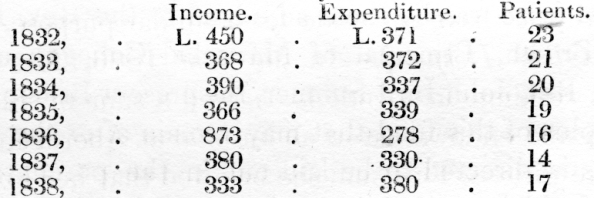
Murtle's Fund. —The late John Gordon, Esq. of
Murtle, by deeds dated in 1815, bequeathed a certain part of his property
to trustees, for distribution to various charitable objects, some of which
were specified, and others left to the discretion of the trustees. Among
those specified by Mr Gordon, was one respecting which he expresses
himself as follows:—"With regard to the sums bequeathed for the purpose of
establishing lectures on practical religion at one or both universities,
it may be proper to add a few words explanatory of my design and intention
in that bequest. The effect of early impressions on the youthful mind is
generally admitted. These lectures, therefore, if properly conducted and
pressed home, may, by the blessing of God, be the means of laying the
foundation of an early piety in the youthful mind, and thus give God the
first possession of the heart. Whilst almost every branch of useful
knowledge is ably taught in our British universities, it is matter of
regret that so little provision is made for the instruction of our youth
in the more important duties of religion. In apportioning the sums of
money for charitable purposes under this deed, I would, therefore, beg
leave to recommend to my trustees, to give a decided preference to all
charitable institutions having for their object the education of the
rising generation, more especially where due attention is paid to their
instruction in the principles of religion. In doing this, they will best
fulfil my intentions. The trustees accordingly, in the exercise of the
powers devolved on them, have annually paid L. 100 to lecturers on
Practical Religion in King's and Marischal Colleges: L. 150 to aged female
servants; L. 150 to Sunday schools; and set aside L. 800 as a fund for the
establishment of an hospital for orphan and destitute girls; and the
residue they have apportioned in annual or occasional donations to various
institutions, such as the Deaf and Dumb Institution, the Sick Man's Friend
Society, the Female Society, the Coal Fund, the Clothing Society, the
Dispensaries, &c.
Carnegie's Fund.—In 1835, Mr John Carnegie bequeathed a sum of between L.
7000 and L. 8000 to certain trustees, for the purpose of establishing an
hospital for female orphans, which will probably be conjoined with that
portion of Mr Gordon's bequest which his trustees have set aside for a
similar purpose.
Orphan Girls' Hospital.—In the year 1836, Mrs Elmslie, a widow lady,
residing in London, devoted a sum of L. 26,000 to the erection and
endowment of an hospital at Aberdeen for orphan and destitute girls. This
sum she believed that her husband, had he lived to execute his intention,
would have applied for this purpose. Accordingly, a site having been
selected on the west side of the town, the building was commenced, and is
now very far advanced towards completion.
Shaw's Fund.—In 1807, Alexander Shaw executed
a deed, vesting his property in trustees, with directions that it should
be allowed to accumulate till it should be sufficient to build and endow
an hospital for 5 boys and 5 girls, either orphans, or deserted and
destitute; these children to be admitted between the ages of two and four;
to take the name of either Shaw or Davidson; and to be taught English, and
a little French, writing, and arithmetic, (the girls also to be taught
needlework.) The boys to continue in the hospital till they are twelve
years of age, and to be allowed L. 6 of apprentice fee, and to receive L.
10 when their apprenticeship is out; the girls to continue in the hospital
to the age of thirteen, and to get L. 10 if afterwards they remain five
years in the families with whom they are placed as servants. A clause is
also inserted in the deed, directing that any boy of superior genius is to
be retained in the hospital till he is twenty-one years of age, to study
the French language diligently, and to be permitted to learn any
profession for which he may be fitted and most inclined. As vet the
trustees have not been in a condition to carry this deed into full effect,
but they have within the last few months rented a house in the Gallowgate
for the purpose of carrying into execution the benevolent designs of the
founder. Miss
Cruickshank's Fund.—Miss Elizabeth Cruickshank, who died in 1818,
bequeathed the bulk of her property to trustees, for the purpose of
accumulation until it should be sufficient to found and support an asylum
for the blind in Aberdeen. These trustees were three in number, but two of
them having died, the survivor, by virtue of a power contained in the
deed, assumed, in the year 1832, several gentlemen to act along with him
in the discharge of the trust.
Various difficulties occurred in regard to the
disposal of some parts of the property, and it was not until very lately
that any further steps were taken towards carrying Miss Cruickshank's
benevolent intentions into effect, than taking a census of the number of
blind persons in the city of Aberdeen and its neighbourhood, with their
ages and circumstances. Within the last few weeks, however, a plan of the
intended building has been approved of, and its erection will be proceeded
in forthwith. United
Coal Fund.—Bequests had been at different times made by various
individuals for the purpose of supplying the poor of Aberdeen with coals
during the inclement weather in winter, and in 1801, by an agreement among
the trustees appointed over four of these bequests, viz. those of Mr
Alexander Robertson, Mr Andrew Robertson, Mr John Smith, and Mr John
Cushnie, they were united into one fund for this benevolent purpose. The
fund thus obtained amounted to L. 1000, and by various donations and
bequests since added, it has now reached to nearly L. 2900; the interest
of which, along with occasional donations, and sometimes, in cases of
necessity, a small portion of the principal, is annually expended in the
purchase of coals in summer, which are distributed during winter, in
portions of one-fourth of a boll or one-sixteenth of a ton to each family.
The fund is placed under the management of twenty-one gentlemen chosen
from the kirk-session, the magistrates, the managers of the Poor's
Hospital, and the contributors or their trustees. The quantities of coals
distributed for the last seven years have been as follows:—
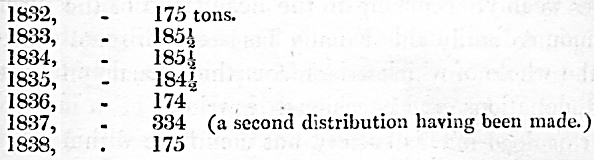
Ladies Working Society.—It is little more than
a year since this society was instituted for the purpose of providing
industrious females with the means of support, by supplying them with
needlework, mostly of a plain and useful kind, and by exposing the fruits
of their industry for sale at a moderate price. It may be regarded as a
useful assistant to the Clothing Society, and as serving, in some degree,
to lessen the demands on the funds of the Female Society. It is managed by
a committee of ladies, and depends for its funds entirely on the
contributions of members, and the sale of the work done for the society by
its objects. Clothing
Society.—This society was commenced in 1817, for the purpose of supplying
articles of clothing to the industrious poor. It is managed by a committee
of ladies, who superintend the making of the clothes, and personally
investigate the cases recommended before any supply is given.
The funds arise entirely from the
contributions of members, with occasional donations and legacies. From
deficiency of funds, the society has been unable, in general, to make a
distribution of clothes oftener than once in two years, when articles, to
the value of about L. 300, have been given to nearly 1000 individuals,
each article being previously stamped with the name of the society.
Within the last year, the plan of the society
has been modified in several particulars, the chief of which is, that the
clothes distributed shall not be considered as given, but as lent to the
persons receiving them,—a measure by which the society will be better
enabled to guard against the abuses to which they were formerly subjected
by individuals pawning or selling the articles which had been furnished to
them. Sick Man's
Friend Society.— This benevolent society was instituted in the year 1792,
and its object is, the relief of the indigent sick, by affording them such
aid in money from time to time as the funds will bear, and the
circumstances of the objects seem to call for. The town is divided into
thirty-two districts, which are allotted to visitors, whose duty it is
personally to investigate the cases recommended for assistance, and to
direct the amount of relief to be given, which is in payments of 1s. each,
monthly, fortnightly, or weekly, according to the necessities of the case.
The amount distributed annually has been, for
some time, nearly L. 320, the whole of which arises from the annual
contributions of members, donations, and occasional legacies.
Female Society.—This society was commenced in
1805, for the relief of aged and indigent females. Its funds are derived
from the subscriptions of its members, and occasional donations and
bequests. It is managed by a committee of ladies, who personally
investigate the cases recommended before giving relief. The distribution
is in sums of 1s. 6d., 2s. 6d., or 3s. twice a quarter, and in this way
about L. 250 are distributed annually. The number of regular pensioners on
the society's books is at present about 230, besides a good many receiving
occasional supply.
Bible Societies.—In 1811, a society was instituted in Aberdeen, auxiliary
to the British and Foreign Bible Society, and its operations were carried
on with considerable zeal and success, and besides supplying considerable
numbers of Bibles to the surrounding districts, contributions to a large
amount were sent by it to the society in London. The disputes that arose
in 1826 in consequence of the distribution of the Apocrypha by the London
Society, and other practices that were by many felt to be wrong, led in
1827, to the formation of another Bible Society, whose surplus funds have
generally been devoted to aid the operations of the Edinburgh Bible
Society. Previous to
this, a society had been instituted in Aberdeen for the purpose of
supplying Bibles at prime cost to the sailors trading at the port, which,
after issuing in the course of nine years upwards of 2300 Bibles, was, in
1827, joined with the Auxiliary Naval and Military Bible Society, then
recently instituted, the object of which is the same with that of the
similar societies in London, Edinburgh, &c. viz. to supply Bibles and
Testaments at a reduced price, (generally about two-thirds of the prime
cost,) to soldiers, sailors, bargemen, fishers, and. pensioners. The
surplus funds of this society, (which, however, can never be large, in
consequence of the terms on which the supply is afforded,) are remitted to
the Naval and Military Bible Society in London.
In the following table a view is given of the
income of each of these societies, and of the number of Bibles and
Testaments annually distributed by them since the year 1832.
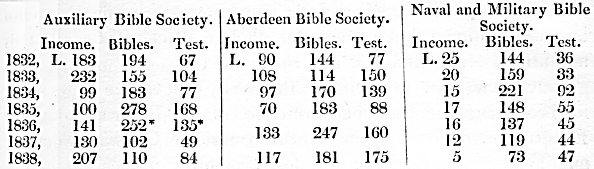
* These two numbers are but average
statements. The whole distribution for the year 1836 was 387; but as no
report was published, it has not been found possible to ascertain the
exact number of Bibles and Testaments which went to make up this total.
The above numbers are given, therefore, as being the averages proportional
to the aggregate distribution of the other six years stated.
Missionary and other Religious
Societies.—There are many associations of these descriptions in Aberdeen,
some of which are supported exclusively by the members of the Established
Church, others by various Dissenting bodies, and some indiscriminately by
both. As, however, they are all without any permanent funds or vested
property, it has been too often found that after being supported with
spirit for a time, they have been liable to languish, while new ones are
instituted or old ones revived from time to time, as occasional impulses
are given. Their existence and efficiency are thus rendered so precarious,
that it becomes not easy to say how many of them are at any time in active
operation. The
following is, however, given as a tolerably correct list of the principal
ones: Two Religious
Tract Societies,—the one, instituted in 1797 and revived in 1811, has
distributed about 1,500,000 tracts, partly gratuitously, and partly sold
at low prices;—the other lately instituted.
Eight Missionary Societies, of which three are
supported by members of the Church of Scotland, and five by Dissenters of
various denominations.
One Gratis Sabbath Evening School Society,
established in 1797—supported by Dissenters—has at present about twenty
schools, attended by nearly 1000 pupils.
One Seamens' Friend Society, instituted in
1823, has a chapel and a school for girls, (the male children being
received into the Union Parish Parochial School.) At first, the chapel was
sup-plied by ministers of the Established and Dissenting churches; but the
Voluntary controversy having put an end to this, the sup-ply was found too
burdensome for the parochial ministers alone. A chaplain was therefore
appointed, but the funds could not long bear the expense of his salary,
and the chapel has been for some time shut up. An effort has lately been
made to clear off the debt affecting the chapel, and this being now nearly
effected, there is reason to hope that a small parochial district will be
allotted and a minister settled in it in a short time.
One society for promoting
Christianity among the Jews; one for promoting the Religious principles of
the Reformation; one Antipatronage Society; one North American Colonial
Society; one Temperance Society; one for Promoting Education in the
Highlands and Islands; one for promoting Female Education in India; two
for promoting the total Abolition of Slavery; one for the Defence and
Extension of the Church of Scotland; one for pro-moting Education and
Reformation among the Prisoners in the Jail.
Harbour.—The river, as it approaches the sea,
passes through a wide basin which formerly extended from the foot of the
Castle Hill, on the north side, to the lands of Torrie on the south, and
the harbour of Aberdeen consisted merely of a channel near the north side
of this basin, separated from the course of the Dee by the Inches—low
sandy islands, generally covered at high water. For the accommodation of
shipping in this harbour, the quay-head was erected (at what period is not
known) opposite to the place where the weigh-house now is, and access was
obtained to it from the town by the Shore Brae. The entrance to this
harbour was bad, owing to a bar at the mouth of the river, the depth of
water in which was often not more than two feet at low water. The earliest
attempts to effect any improvement were by the erection of a bulwark on
the south side of the entrance, in 1608, and the? removal, in 1618, of a
large stone, which lay nearly in the middle of the river. Between 1623 and
1658, the quay was extended eastward towards Futtie, by which means a
considerable portion of ground was redeemed below the Castle Hill, and
this is now covered with buildings. In 1755, an additional quay was built
a good way farther down, opposite the village of Torrie. In 1770, further
improvements were projected, and on a report from Mr Smeaton, recommending
the erection of a pier on the north side of the entrance, (by which the
influx of sand from the north might be prevented, and the removal of the
bar effected by confining the water of the Dee within narrower bounds,)
the work was commenced in 1775) and finished in 1781. The length of this
pier was 1200 feet, and it terminated in a round head, whose diameter was
60 feet. Owing to a departure from Mr Smeaton's plan, (the pier having
been founded too far to the north,) it was found that a heavy swell
entered the harbour,—to obviate which, it was found necessary to project a
bulwark from the pier, about one-third across the channel. By these means
a considerable improvement was effected, but as the trade of the city
increased, inconvenience was still felt from deficiency of water on the
bar, and, in 1810, Mr Telford, having been consulted on the means of
remedying this, recommended that the pier should be extended, and that wet
docks should be formed in the harbour. These works were undertaken
forthwith, and the pier was completed in 1816 to the extent of 900 feet
beyond the head of Mr Smeaton's pier, where it was finished with a round
head. This, however, was destroyed by the sea in the following winter, but
being rebuilt with a slope towards the sea, it has since stood without
very material damage. A breakwater, extending to the length of 800 feet,
was also built on the south side, by which the mouth of the channel was
narrowed, and the entrance protected from the south-east storms. Wharfs
were built along the harbour on the south-west side of Futtie—the pier
formerly built opposite Torrie was enlarged, and more lately the quay has
been extended westward from the old quay-head, and by raising embankments
on the Inches, a considerable range of quay-room has been obtained there,
which is connected with the town by a swivel bridge opposite the foot of
Marischal Street. By means of all these improvements quay-room has been
provided to the extent of about 4000 feet, and a tide harbour has been
formed in which the depth of water at spring tides is about 11 feet at the
west end; gradually increasing to about 15 feet, where it joins the course
of the river, and the depth of water on the bar has been increased to
about 19 feet. The
wet docks planned by Mr Telford not having been executed, a plan for
completing the harbour, not very materially different from his, was lately
recommended by Mr Walker, and a Bill found-on this plan was last session
introduced into Parliament, but it was thrown out in committee, in
consequence of the opposition made to it by many of the merchants and
shipowners, to whom it appeared that it would have the effect of greatly
curtailing the extent of the tide harbour, without giving any adequate
compensation by the increase of accommodation, which it was proposed to
provide in the docks,—while a very serious addition would be made to the
debt by which the harbour funds are already encumbered. Shipping,
Ship-building, and Trade.— Ship-building is carried on in Aberdeen by
several firms with considerable spirit, as the subjoined table of the
vessels and tonnage built here for the last seven years will evince:

Within the last year, the building of iron
vessels has been commenced in this port, and a very large one of this
description is now nearly ready for being launched.
In 1836, the harbour trustees furnished a
patent slip for hauling up vessels requiring repair. The cost of this was
L. 3337. It has been extensively employed, and the sums paid for its use
will abundantly compensate for the expense incurred in procuring it, while
great facility is thus given to the repair of vessels.
The number of vessels and the amount of their
tonnage, registered as belonging to the port of Aberdeen for the last
seven years is as follows:

The introduction of steam navigation at
Aberdeen took place in 1821, when the Velocity of 256 tons burthen, and
furnished with two engines of 110 horses' power, began to ply between
Aberdeen and Leith. Another vessel was soon after put into the same trade,
and more recently, other two with more powerful engines were added, and
these now run during the greater part of the year between Leith and
Aberdeen, making also stated voyages to Lerwick and Kirkwall, and to Wick
and Inverness. The amount of I steam power at present employed in this
trade is 640 horses' power, and the tonnage of the vessels is 1360 tons.
In 1827, a steamer of larger size than any of
these, the I Queen of Scotland, of 550 tons, began to ply between Lon-don
and Aberdeen, and soon after, another was put into the same trade. A
third, still larger, was more recently added, I and an opposition having
been attempted by another company, a junction was soon after effected, in
consequence of which a fourth steamer was employed. These vessels sail
weekly from Aberdeen and London; but it is cause of regret to many that
the time fixed on for their sailing is the evening tide of Saturday, by
which means they are necessarily at sea on the Sabbath; and when any
detention occurs from weather or other causes, they most improperly leave
the port on the Sabbath day. Attempts have been made to put an end to this
abuse, but they have not as yet been successful. The amount of steam power
in the vessels in this trade is 860 horses' power, and their tonnage is
2410 tons. One of these vessels makes weekly voyages to Hull. There is an
inconvenience attending the use of these large vessels, that, from their
draught of water, they are unable to enter or leave the harbour, except at
the top of the tide; and sometimes when the tide is small, detention takes
place from their not having sufficient water to float them if they are
heavily laden, especially as there is a bank formed where the basin of the
harbour joins the channel of the Dee, which it has not as yet been found
practicable completely to remove, and on which they sometimes get aground
; so that, on the whole, it seems preferable, at least in the present
state of the harbour, to employ vessels of a smaller draught of water.
Besides these, there are two steamers which
sail between Dundee and Aberdeen, and one between Aberdeen and Peterhead
during the summer season. A small tug steamer is employed for hauling
ships into the harbour, and taking them out when required.
Several steamers have been built and wholly
fitted up at Aberdeen; and the making of marine steam-engines is carried
on by two firms to a considerable extent.
The extent of the shipping trade of Aberdeen
may be, in some degree, estimated by the following table drawn up for the
last five years by Mr Riddell, the clerk of the Shore Dues' Office, which
exhibits a view of the shipping actually arriving at the port in the
course of each year, terminating on the 1st July.
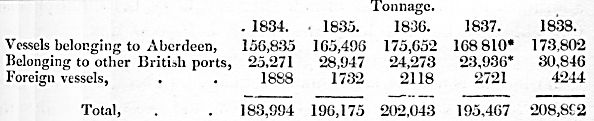
*This diminution of tonnage is only apparent,
the difference being occasioned by a late alteration in the mode of
measurement. The
following tables, also drawn up by the care of Mr Riddell, show the
principal articles of import and export during the same period of five
years, from the 1st July 1833:
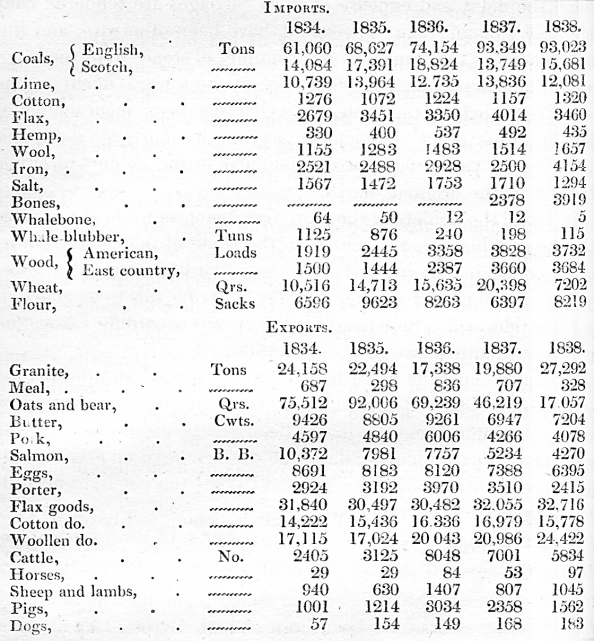
Canal.—In 1793, the formation of a navigable
canal for barges, to connect the harbour of Aberdeen with the river Don at
Inverury, was projected, and in 1796 an Act of Parliament was obtained, by
which the projectors were empowered to raise by the sale of shares L.
20,000 for this purpose. Of this sum only L, 17,700 was raised, and it was
found necessary to apply for another act, which was obtained in 1801,
empowering the proprietors to raise L. 20,000 additional by the creation
of new shares. Only L. 10,000 of this was obtained, but not long after
other L.10,000 was raised by! mortgage, and the canal was opened in 1807.
Its length is a little more than 18 miles, its
average breadth is about 25 feet at the surface of the water, and the
depth is 3 feet 9 inches. It has 17 locks, one of which is 10 feet in
height, 15 are 8 feet each, and one is 3 feet. The line chosen for it is
not, in the opinion of some, the most advantageous that might have been
obtained, as it throws the greater number of the locks to the lower end,
within three or four miles of Aberdeen, in consequence of which the delay
and expense of short carriages are rendered considerably greater than they
would have been otherwise, and the inducement to the transport, for
example, of stones from the large granite quarries in the neighbourhood of
the town, is much lessened. Nevertheless, the trade on it has not been
inconsiderable, though hitherto not sufficient to pay off the mortgage
debt, and therefore, as yet, altogether unproductive to the holders of
either the new or the original shares.
In 183*2, the holders of the mortgage, being
sensible of the great advantage which would accrue to the trade of the
canal from its being connected by a tide-lock with the harbour, agreed to
forego their dividends for a time, in order to permit this to be effected,
and the tide-lock, whose height is 6 feet, was accordingly executed in
1834, at an expense of about L. 1500.
By this means, the canal barges can be loaded
and discharged at the ship's side, and can enter the canal readily at
half-tide; by which, the intercourse on it has been greatly facilitated
and the trade consequently increased. The dues charged on articles
conveyed by the canal are from ½d. to 1½d. per ton per mile, according to
the nature of the goods.
The following tables shew the quantities of
the principal articles transported by the canal for the last seven years:—
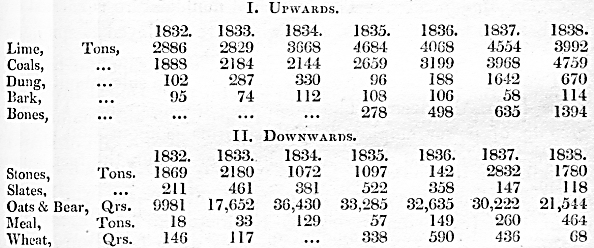
The increase in the quantity of grain is to be
in part ascribed to the introduction of covered barges, by which the cargo
is effectually protected from rain on its passage.
A Fly or passage boat was, at an early period,
established on the canal, and for some years it was carried on with
considerable success; but the establishment of numerous coaches on the
adjoining turnpike road, presenting the advantage of quicker travelling,
though at a higher rate, had the effect of diminishing the profits of the
fly-boat very materially. With the view of obtaining a renewal of the
encouragement formerly given to it, an iron boat was lately procured, and
the rate of going was increased from about four to eight or nine miles an
hour. The experiment cannot be, by any means, said to have failed, but the
effect has not hitherto been so favourable as might have been anticipated.
Flax Manufacture.—-The manufacture of flax is
carried on to a considerable extent in Aberdeen by three firms, all of
which carry on the several branches of spinning, bleaching, and the
manufacture of linen of every quality, from the coarsest floor-cloth and
Osnaburghs, to the finest shirting, and one of the houses is extensively
engaged in the manufacture of sewing thread.
The aggregate power employed by them consists
of steam to the extent of about 460 horses' power, and water (used in the
mills on Don side, about two miles from Aberdeen,) to the extent of about
250 horses' power.
The number of persons employed in these branches of manufacture is about
7600, of whom nearly two-thirds work in the mills, and the remainder are
employed at the bleach-fields, or as out-door weavers.
The amount of wages paid by these houses
weekly is about L. 2600 or L. 2700, at rates varying from 2s. 6d. to 8s.
to girls, and from 7s. to L. 1 to weavers.
Cotton Manufacture.—This branch of manufacture
is carried on at Aberdeen by four houses, all of which are employed as
spinners, and one of them also in power-loom weaving.
Two of these houses have their works on Don
side, about three miles from Aberdeen. The other two are in town. The
aggregate of power employed by these firms is about 600 horses' power, of
which 260 are obtained by water power, the rest being steam. [During the
summer season, there is often a deficiency of water in the river, and
several steam-engines have been put up for the purpose of meeting this
exigency. This applies also to the flax-mills on the Don.]
The number of hands employed in this branch is
about 2000 or 2200, and the weekly amount of wages paid is from L. 700 to
L.800. Woollen
Manufacture.—There are in Aberdeen and the neighbourhood two large houses
engaged in the woollen trade, and four or five small ones. They are
principally occupied in making of worsted carpets and hosiery. One of them
is also employed in the manufacture of broad cloth.
The extent of the power used by them is about
320 horses' power, of which 150 are obtained by water, the rest being
steam. From 2200 to 2500 persons are in the employ of these houses, and
the weekly amount of wages paid is about L. 1000.
Stone Trade.—The trade of Aberdeen in stones
is very considerable, as will be seen from the table of exports. The
principal part of this trade is in paving stones sent to London; but there
have also been, at various times, large quantities of building stones
exported; and some of the bridges over the Thames are in great part built
of, or faced with, Aberdeen granite. Some of the largest blocks that have
been exported, were those sent, not many years since, to the docks at
Sheerness. The extreme beauty of the granite when polished is well known ;
but its very great hardness formed an almost insuperable bar to its
general introduction, while the work of polishing it was carried on only
by manual labour Within these few years, however, Mr Alexander Macdonald
has contrived, by several very ingenious adaptations of machinery to this
purpose, and by some very considerable improvements in the tools used, to
effect a very great reduction in the expense of the process, insomuch that
ornamental articles of polished granite, such as slabs, chimney pieces,
pedestals, and vases may now be procured from his manufactory here, for
about one-third of the price which formerly they cost.
Iron Manufacture.—The quantity of iron
annually worked in Aberdeen is very considerable, and it is daily
increasing, in consequence of the introduction of new branches of the
manufacture, or of the extension of those formerly existing in the place.
It is not many years since the making of. spinning machinery, and of
steam-engines, was altogether unknown in the town, and there are now eight
or ten machine-makers, of whom five are engaged in the making of
steam-engines; and three, to a considerable extent, make both land and
marine engines. Iron ship-building, too, has been introduced here within
the last two years, and there is at present a vessel of this description
on the stocks, of the burden of 550 tons by measurement, being, it is
believed, the largest sailing vessel that has yet been constructed of
iron. There are in
Aberdeen and its immediate vicinity eight founderies, at most of which the
heaviest castings can be executed. One of the firms engaged in this trade
has a forge hammer and a rolling mill; and there are three establishments
at which the heaviest anchor-work is performed. There are also two houses
engaged to a considerable extent in chain-making; and five or six of the
firms are employed in boiler-making.
The number of men employed in this trade may
be about 1000. It is difficult to state the average rate of wages with any
degree of confidence; perhaps it may be from 18s. to L. 1, 5s. weekly; and
the annual amount of wages paid is probably not under L. 50,000.
Paper-making.—The first paper-mill in this
neighbourhood was erected at Peterculter about the year 1770. Others were
subsequently set agoing in other situations; and there are now four in the
vicinity of Aberdeen, viz. at Peterculter, belonging to Messrs Arbuthnot
and M'Combie; at Mugiemoss, Charles Davidson and Sons; at Waterton, Thomas
Jaffray; and at Stony-wood, Messrs Alexander Pirie and Sons. Of these, the
three first make only coarse paper; the last makes writing and printing
papers. The power
employed to drive these mills is altogether by water, and cannot be
reckoned at less than 250 horses' power, and the number of persons
directly occupied in the manufacture may be from 300 to 400. Within the
last five years, the quantity manufactured has been doubled, and there is
a prospect of a still increasing production. The material for the coarse
papers (consisting of rags, ropes, and mill waste,) is mostly collected in
this and the neighbouring counties. For the finer kinds the chief supply
is from abroad, though considerable quantities of rags are collected here.
By the last returns of the Excise from which we can derive local
information, the duty upon the paper manufactured in the neighbourhood of
Aberdeen was, for the year ending 5th January 1835,

We have no certain ground to go upon in regard
to the quantity produced last year; but it is probable that the duty paid
at the equalized rate of l½d. per lb. amounted to nearly, if not fully, L.
12,000. Rope and
Twine-making.—There are in Aberdeen eight rope-making works of
considerable extent, besides several small ones; and of these, three are
chiefly employed in the manufacture of cordage for ships, the others being
principally engaged in rope-making for agricultural and general purposes,
and in the making of twines for fishing and for manufacturers. The number
of men and boys employed in this branch of manufacture is rather above
than under 200. It is not easy to give any statement of the amount of
wages paid, as some of the manufacturers hire their men by the piece, and
others do not; but it cannot probably be much under L. 5000 annually.
Comb-making.—This branch of industry was
introduced into Aberdeen as far back as 1788, but it was carried on in a
very small way only till 1830, when the firm of Stewart, Rowell, and Co.
commenced on a larger scale than has been done in any other part of
Scotland, and they were the first in Scotland to apply steam-power to this
department. The
number of workmen employed by this firm is at present 245, the weekly
amount of wages paid by them about L. 90, and the number of combs of all
kinds finished in this manufactory amounts to about 43,200 weekly, which,
in consequence of the improvements recently introduced in the methods of
manufacture, can be sold now at a price not more than one-sixth of what
they cost nine years ago.
Fisheries.—It is probable that there have been
fishers settled at the mouth of the Dee, both in Futtie and at Torrie, (on
the south side) ever since Aberdeen became a town of any noticeable
magnitude. The fishers who now inhabit these villages are, like those
along most of the east coast of Scotland, evidently of a race distinct
from the other inhabitants, and from their aspect, features, and other
circumstances, it seems probable that they have come from the opposite
coasts of Denmark and Sweden.
They occupy a village consisting of two
squares of houses, which were erected by the town some twenty years ago,
at the south-east extremity of the parish, and immediately adjacent to the
entrance of the harbour. Each house consists of a but and a ben, with
occasionally a small apartment between. The magistrates designed to have
made the houses of two stories, but the fishers refused to live up stairs,
and they also refused to have any other than an earthen floor in their
houses. In both of these, though there may have been some superstition and
a good deal of prejudice, there was also some reason,—for it would have
been next to impossible for them to have kept a wooden floor clean, while
an earthen one, if not clean, at any rate does not show the dirt so much,
and it would have been very inconvenient for them to lug their long lines
and their heavy baskets up stairs. On the whole, their houses are,
generally speaking, as clean and comfortable as the nature of their
occupation will admit of.
From the circumstance of most of these fishers
being employed as pilots, and from their immediate connection with the
harbour, and constant intercourse with the inhabitants of Aberdeen, there
is in them a greater degree of civilization than is observable in most of
the other fishing communities. At the same time, their double employment
as fishers and pilots is by no means favourable to their religious, moral,
and domestic habits.
The unavoidable want of regularity in their hours, the general practice of
giving allowances in drink for any particular service, and their custom of
dividing the pilotage money among the boat's crews generally on Saturday
evening, all tend to lead them to the public house, where sometimes a
large portion of their earnings is spent. Yet drunkenness, though
prevalent among them, is by no means universal, and the number of
exceptions seems to be increasing of late.
A fisherman who is a pilot will earn as much
as L. 1, 10s. or even L. 2 per week during summer, but not half so much
during winter. On an average, however, they can make fully as much as any
other labourers in the same class of society, and of this money the
husband has the possession and command, while the wife retains possession
of all the money arising from the sale of fish. It is not often that
either party manages these gains to the best advantage.
The fishers are a hard-working people and
extremely honest, and they deem it the greatest possible reproach to cast
a doubt on their honesty, which they are the more easily enabled to
maintain unimpeachable, because all their bargains and transactions are
for ready money. They
seldom marry with persons not of their own community, except in a few
instances where the daughters of fishers have married with seamen and
ship-carpenters. This may arise not so much from any dislike to form
connections out of their own craft, as from the fact that, on the one
hand, a fisherman would find a woman of any other class wholly incapable
of giving him any assistance in this occupation, and unable to perform the
hard work devolving on the fisherwomen; and, on the other hand, a
fisher-woman, from the irregularity of her occupation, and want of leisure
and opportunity to attend to her daughters, unless when they follow her in
her fishing employments, cannot educate them so as to be useful wives to
persons of any other class.
A free school was established some years ago
by Mr John Davidson, goldsmith, exclusively for the white-fishers, and it
has been the means of doing a great deal of good among them. It is taught
on the plan of the sessional school, and its effects are manifest in the
decided and progressive improvement of the manners and habits of the
fishers. The children who attend the school re-act on their parents, and,
as it were, shame them out of their indifference to useful knowledge and
habits. The fishers
are, generally speaking, a long-lived people and very healthy, and,
notwithstanding the dangerous nature of their occupation, there are few
accidents of serious consequence among them.
Like most other fishermen, they have a good
many superstitious ideas and practices, and they have implicit faith in
many traditions, and in various omens. Thus they reckon it very offensive
for any one to count a boat's crew, or a company of them returning from
market, and it is not less so to tell how many fish they have caught. If a
fisher be turned back when he is going out to fish, he will on no account
go out that day, and is very much provoked. Often, too, things, which any
one but they would esteem mere trifles, cannot be spoken of without
interfering with some omen, whose influence they would hold it sinful to
doubt. It is at the
same time to be noticed, that the fishers of Futtie have less
superstitions than those that live in the fishing-villages along the
coast, both to the north and south, where they live almost entirely
secluded from intercourse with the inland agricultural population.
Whale-Fishing was first introduced into
Aberdeen in the year 1753, and the success which attended the first
attempts induced others to embark in the same trade, which, for a time,
was very profitable. Accordingly, the number of ships from Aberdeen
engaged in whale-fishing gradually increased, till, in 1820, there were
fifteen, which, on an average, had about fifty hands each. The greatest
tonnage of oil brought, home by these vessels in one season was in 1823,
when fourteen vessels brought 1841 tons. Of late years, however, from
various causes, such as the withdrawing of the Government bounty, the
reduction of the duty on foreign seeds from which oil is made, the
diminished demand for oil, of late, in consequence of the introduction of
gas as a means of obtaining light, and the want of success in the fishery,
several vessels having repeatedly come home clean, the trade has been, in
a great measure, given up, and there are only two vessels at present
engaged in it from this port.
Salmon-fishing.—This branch of trade has been
long carried on with considerable spirit, and generally with good success,
at Aberdeen, and the rents of the fishings in the river Dee form an
important item in the revenue of the town, and of several private
proprietors. Of late, too, the fishing has been carried on to a
considerable extent by stake-nets on the beach.
At present, the number of men employed in
salmon-fishing here may be about 200, and the annual amount of wages paid
about L. 3000. In an average season, the quantity of fish caught may be
reckoned at 20,000 salmon, averaging ten lbs. each, and 40,000 grilses of
four pounds each, of which by far the greater part is packed in ice, and
shipped for the London market, a very small part only being put into tin
cases for exportation. It is now about thirty years since the mode of
using ice for preserving the salmon fresh was introduced in Aberdeen.
Previous to that time, the fishers were under the necessity of boiling it
and preserving it with vinegar, but this mode is now almost altogether
disused. The average price obtained for the salmon and grilses sent to
London is about 8d. per lb.
Herring-Fishing.—-Until within the last few
years, this branch of industry was not prosecuted to any extent in
Aberdeen. The late Provost Blaikie used his endeavours to establish it,
and, to a certain degree, these endeavours were successful. The number of
boats employed in it has been annually increasing; and last year there
were about 60 thus engaged during the season, and their success has
hitherto been such as leaves no room for doubting, that this fishery will
continue to he prosecuted, probably to a greater extent than it has
hitherto been. Supply
of Water.—After two ineffectual attempts in the course of the seventeenth
century, measures were at last taken in 1706 for introducing a supply of
spring water into the town, and at first a single well was supplied in
Castle Street; but soon after, others were added in different parts of the
town. The supply having become inadequate from the increased population,
additional springs were taken in, and a cistern, capable of holding 31,000
gallons, erected in Broad Street in 1766. The water from these springs was
of excellent quality, though that from the lower springs next the town was
more pure than what came from the upper and more distant springs ; but
both the low level and the smallness of the springs prevented the whole of
the town being supplied from them. The average produce of the lower
springs in ordinary seasons was about 75 gallons per minute, and of the
upper springs about 55 ; but both were liable to considerable diminution
in dry seasons. The demands of the city having increased with its
population, and considerable inconvenience having been experienced on
several occasions by the deficiency of the supply, it was resolved in 1830
to bring a supply of water into town from the river Dee, and for this
purpose a steam-engine was erected at the north end of the bridge of Dee,
about a mile and three-quarters distant. The water is brought to this
engine by a tunnel about a quarter of a mile long, which does not
communicate directly with the river, but receives the water by filtration
through a bed of sand. There are two single stroke engines used, each of
fifty horses' power, which are wrought alternately for about twelve hours
per day, and by these the water is forced into a cistern situated at the
west end of Union Place, and elevated 130 feet above the engine, being
placed at the height of 40 feet above the street, by which means
sufficient elevation is obtained to permit the water to be distributed
abundantly to all parts of the town. The size of this cistern is 50 feet
by 30, with a depth of 9 feet, and it is capable of containing 84,375
gallons. The quantity of water raised by these engines in twenty-four
hours is about 900,000 gallons, and it is distributed through the town to
supply-both the public wells and private service pipes to the inhabitants,
through pipes, the aggregate length of which is nearly eleven miles and
a-half. The number of public wells is at present 92, and there are 909
private service pipes. The expense of procuring and maintaining this
supply is defrayed by an assessment of 9d. per pound on the rent of the
houses; shops, warehouses, &c. being charged 4s. annually in place of
this. These persons who wish to have a supply for their own use are
charged additional 6d. per L. 1 of rent. The management of the supply of
water is vested in the Commissioners of Police, on whom falls also the
care of lighting, paving, cleaning, and watching the streets, and for
these purposes (the expense of paving any street for the first time being
borne by the proprietors of the houses in the street) a police assessment
is levied, of 2s. per pound on the rent if above L. 3 and under L. 7, and
2s. 3d. if above this. The number of public lamps is 1130, of which 996 in
the principal streets are lighted with gas, the rest being oil lamps. The
number of men employed in cleaning the streets is 40, and there are 47
watchmen employed in patrolling the streets during the night.
Gas-Lighting.—At an early period in the
history of gas lighting, one or two individuals in this city and
neighbourhood erected small apparatus for the supply of their own
establishments; but until the Gas Company was set on foot in 1824, this
mode of lighting was resorted to by a small number only, and was regarded
by most rather as a curious philosophical toy than as an advantageous
means of obtaining light. On the first establishment of the Gas Company,
the preference was given to oil over coal gas, and they continued to
manufacture oil gas for about four years, which they supplied at first at
L. 2 per 1000 feet. They found it necessary to raise the price to L. 2,
10s. but afterwards reduced it to L. 2, 5s.; but the very limited
encouragement which they received from the public rendered it an
unprofitable speculation, and in 1828 they resolved to give up the
manufacture of oil gas, and to distribute coal gas. This change was
necessarily accompanied with considerable expense, both from the change of
apparatus, and because the laying down of larger mains than had been
required for the oil gas, became indispensable. The price at first charged
for the coal gas was 15s. but it has since been considerably reduced, and
is now 10s.; with discounts of from 5 to 25 per cent. according to the
quantity used. Since the introduction of coal gas the success of the
company has been steadily progressive, and from the increasing de-mand, it
became necessary, a few years ago, still further to enlarge the size of
the mains, which are now 12 inches in diameter. The length of iron pipe
(the smallest size of which is about 2 inches diameter) laid in the
streets, including Old Aberdeen and several manufactories on Don side, to
which gas has lately been conveyed, is about forty-eight miles. [A
considerable extension of the supply of gas has very recently taken place,
pipes having been laid, within the last few weeks, nearly as far out as
the third milestone on the Inverury road, for the supply of the populous
villages of Cotton and Woodside.]
The coal which is used in these works for the
production of gas is the best parrot coal, which, reckoning the average of
the stock at present on hand, costs them about L. 1, 8s. per ton laid down
at the works. At one time they were able to procure the same coal as low
as 13s. per ton, but in the latter part of 1836, owing to a scarcity of
this coal, they were under the necessity for a time of using Wigan coal,
which cost them not less than L. 1, 16s. The parrot coal is capable of
yielding 6 feet of gas per lb., but in these works it is scarcely ever
pushed beyond 4½ feet, which is worked off in a four hours charge. The
retorts employed are partly iron and partly of fire-brick, the former
cylindrical or kidney-shaped, the latter flat, elliptical, or D shaped.
The number fitted up is at present about sixty-four, some of which are
heated by coal and coke, but a good many are worked off entirely by the
tar of former distillations ; and generally about one-half of the retorts
are in operation at once during the winter, but in summer from four to ten
are sufficient. The gas produced is first subjected to atmospheric cold in
an extensive series of condensing pipes, and afterwards purified by being
passed first through a vessel containing lime diffused in water, and then
through several trays filled with dry lime; after which it passes into a
meter, to which Mr Massie, the present superintendent of the works, has
ingeniously adapted a clock, bearing a pencil attached to the minute hand,
which marks, on a card that revolves with the meter, the quantity of gas
produced in each hour. The gas then passes into the gasometers, whose
contents are at present about 93,000 feet, but another, capable of holding
61,000, is just erected, and almost ready for use.
The works are conveniently situated in the
lower part of the town, and the whole of the arrangements are well
contrived. The Company have hitherto been always careful to employ the
best quality of coals only, and to this and the intelligence and activity
of their manager is greatly to be ascribed the high degree of success
which has attended the speculation ; the gas produced at these works
being, it is believed, fully equal, if not superior in quality to that
made in any other part of the kingdom.
Mr Massie, not content with simply producing
and purifying gas according to the methods usually received, has applied
his ingenuity to the contrivance of various means for testing the purity
and value of the gas, with a view of detecting and obviating any
occasional failure, among which may be noticed an instrument for detecting
the presence of sulphuretted hydrogen by means of a jet of gas thrown on a
revolving disk moistened with a solution of acetate of lead, and a
contrivance for testing the illuminating power by the number of plates of
colourless glass of uniform thickness and texture through which the light
from a flame of a given size can be discerned.
The consumpt has been gradually increasing
since the use of oil gas was relinquished, and at present the nightly
distribution is about 140,000 feet in winter, and about 18,000 feet in
summer. The consumers may be thus classed: manufactories and
weaving-shops, 111; shops and warehouses, 1211; private houses, 1336;
churches, 27; schools and lecture-rooms, 50; public institutions, 33;
besides 1075 public lamps for lighting the streets. The gross consumpt of
gas for the last seven years has been as follows:—

Bridewell was erected at a cost of nearly L.
12,000, and opened in October 1809. It is situated in the centre of a
square space of ground, measuring nearly two Scotch acres, on the
outskirts of the town. It contains 109 cells, each 8 feet by 7, with a
height of 7 feet 8 inches, besides two infirmaries and eight small
sleeping apartments adjoining. It is warmed in winter by steam, and the
whole building is lighted by gas. The governor's house and other
accommodations are in a building behind the prison, but attached to it.
The officers employed are a governor, matron, two turnkeys, a watchman,
and a porter. A chaplain, teacher, and surgeon, also attend regularly.
The male and female prisoners are kept in
distinct parts of the building.
On the committal of a prisoner, he is stripped
and bathed, dressed in the prison uniform, and conducted to his cell; the
regulations are explained to him, and he is set to such work as he is
considered to be capable of executing.
Each prisoner is kept entirely separate from
every other. The kinds of work in which the prisoners are employed are,
weaving linen and shoe girth, picking oakum, making door-mats, teasing,
carding, and spinning hair, picking and carding wool, shoemaking,
tailor-work, and blacksmith and carpenter-work. A regular account is kept
of the work done by each, and when his earnings exceed his maintenance,
&c. one-third of the surplus is given to him at liberation, one-third at
the end of three months on producing a certificate of his honesty and
industry since dismissal, and the remainder after other six months on a
like certificate being produced. The amount of the prisoners' earnings
during the year from 1st September 1837 was L. 409, being the largest sum,
in proportion to the number of prisoners, realized in any prison in the
kingdom during a-year. The hours of labour are in summer from 5 a. m. to 8
p. m., and in winter, from 6 a. m. to 8 p. m., with the necessary
intervals for diet. The governor is empowered to punish for disobedience,
idleness, &c. by withholding a part of the allowance of food, by
confinement in a dark cell, by restricting the diet to bread and water, or
by putting in irons; but during the last year out of 281 prisoners, only
71 were punished in any way,— a small proportion, considering the
character and dispositions of the inmates.
Every prisoner who can read is supplied with a
Bible, and all are visited at least once a week by the chaplain, who
exhorts, catechises, and prays, with each separately. Those who conduct
themselves well are allowed to read the Scottish Christian Herald,
Chambers's Edinburgh Journal, and the volumes of the Kildare Street
Library. The teacher
attends for three hours and a-half daily to give instructions in reading,
writing, and arithmetic, to the prisoners who require them, each in his
own cell, and the governor examines, and reports their progress monthly to
the commissioners.
The surgeon attends daily, but there is very little sickness in the
establishment. Only four prisoners have died in the house since it was
opened. Of these two were ill when committed, and lived only a few days;
one was liable to epilepsy, and was found dead in his cell in the morning;
and the fourth was a woman about ninety years of age, who had passed the
greater part of the last twenty years of her life in prison. The expenses
of the establishment are defrayed by an assessment on the heritors of the
city and county, half being borne by each. The amount collected has been
for some years L. 900; of which about L. 600 are required for the annual
expenses, the remainder being applied to the reduction of the debt, whose
present amount is L. 4300.
In consequence of the majority of the
prisoners being confined for short periods, little permanent improvement
of their morals can be expected; for that system of discipline must indeed
be admirable, which could in thirty or sixty days eradicate bad habits and
implant good ones; nevertheless, there can be no doubt, that the
discipline of Bridewell has had a salutary effect on many of those who
have been committed, in the first instance, for long periods, as only a
small proportion of these have returned a second time, and some of them
are known to be now engaged in honest employment.
It is not possible to say to what extent the
fear of this prison has operated on the criminal population of the
district; but it is worthy of remark that, although the general population
is rapidly increasing, the number of criminals is apparently rather
decreasing than otherwise, as will be seen by the following table of
commitments for the last seven years:
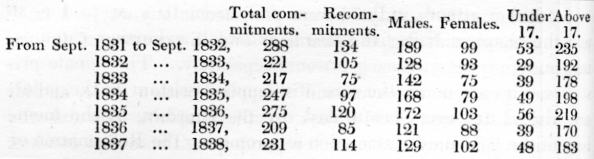
The following statement will give some idea of
the state of education, &c. of the persons generally committed to the
Bridewell:
During the year from 1st January to 31st
December 1838, the number of individuals committed was 252 ; of which were
recommitments, 32 ; making the number committed for the first time, 220.
Of these 220, there were 42 who could not read, 76 could read with
difficulty, and 102 could read easily; 124 could not write, 82 could write
a little, and 14 could write easily; 83 attended no place of worship, 103
attended church occasionally, and 34 had been in the habit of attending
regularly. 67 were natives of the town of Aberdeen; 40 of the county of
Aberdeen; 40 of the counties north of Aberdeen; 48 of the counties south
of Aberdeen; 14 of England ; 9 of Ireland; and 2 were foreigners.
Of the whole 252 commitments, there were
attributed to intoxication, 131; idleness and bad company, 78; want, 10;
uncertain, denied their guilt, &c. 33.
Prison.—The old prison, which was situated in
the tower under the steeple in Castle Street, was in every respect
unsuited to its object, being neither properly ventilated, sufficiently
capacious, nor secure. In 1829, the foundation of a new prison was laid
immediately behind the Court-house, and it was first occupied in July
1831. It contains sixty cells and ten day-rooms, one of which is
appropriated for debtors; the other nine have lately been converted into
work-rooms. There are six yards within the precincts of the prison, four
of which are used by the male prisoners, and one by the females, the
remaining one being connected with the debtors' room.
The criminal prisoners are not permitted to
hold any intercourse with each other, and they are kept apart as much as
possible. They are all employed, tried as well as untried, in such works
as picking oakum, weaving, tailor-work, &c, and for the females knitting
and sewing, and an account is kept of the produce of their labour; and
their earnings are given to them on leaving the prison. They are allowed
access to the yard one at a time, for about two hours each, daily.
A teacher attends in the prison daily from 10
a. m. to 1 p. m. and the chaplain visits five times in the week,
exhorting, catechising, and praying with each prisoner separately. The
female prisoners, who are under the care of a female assistant to the
jailer, are also visited every lawful day, except Saturday, by the members
of the "Ladies' Association for promoting the Reformation of Destitute
Females."
The diet of the prisoners is of the plainest
kind, but wholesome and in sufficient quantity; and the introduction of
every kind of luxury into the prison is strictly prohibited.
Untried prisoners are permitted to be visited
by their relatives in the presence of the keeper of the prison, once a
week, but after conviction this liberty is allowed only once a month.
The expense of maintaining the prisoners, and
of keeping up the necessary establishment, as well as the repairs of the
building, is defrayed out of the rogue money; the city and county bearing
each a share proportioned to the number of prisoners from each.
The debtors are not subjected to the same
restrictions as the criminal prisoners, being permitted the free use of
the yard and day-room of their ward from 6 a. m. to 9 p. m. daily.
The average number of prisoners during 1838
was about 57; the greatest number at one time being 86, and the smallest,
39.
The gross expenses (including salaries,
repairs, &c.) of the establishment was, during the year 1836, L.670; 1837,
L. 611; 1838, L.901. No sufficient return has been obtained of the number
of commitments, unless for the last year, when they were, males, 386 ;
females, 124: total, 509. By a return made for one year previous to August
1838, it appears that there were in prison during that period,
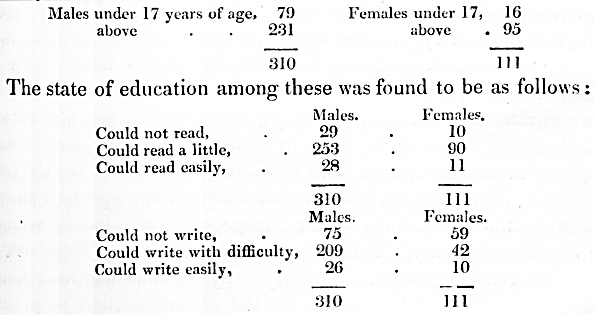
Medical Society.—In the year 1789, twelve
young men, who were engaged in the study of medicine in Aberdeen, formed
themselves into a society for their mutual improvement, by meeting to
discuss questions connected with medical science. Of these only four are
now alive, viz. Sir James M'Grigor, Bart., the present active and
enlightened Director-General of the Medical Department of the Army; Dr
John Grant, who has been for some years resident at Forres; Dr Colin
Allan, at present settled in Nova Scotia; and Dr James Moir, who has been
long established as a practitioner in Aberdeen.
Their meetings were, for a good many years,
held in one of the class-rooms of Marischal College, and subsequently in
apartments hired for the purpose; and the additions made to their numbers
by the accession of new members, both increased the usefulness of the
society and testified the advantages that were derived from the
discussions and examinations held at their meetings. In 1791, the
commencement was made of a library devoted to medical literature, and by
donations from the members and their friends, as well as by the purchase
from time to time of such works as their funds enabled them to procure,
the collection gradually increased, so that it became necessary, in order
to protect their books, as well as that they might have convenient
apartments to hold their meetings in, to endeavour to obtain the means of
erecting a house for the purposes of the society. A subscription for this
purpose was accordingly commenced in 1809, and by the unremitted exertions
of Sir James M'Grigor, very considerable additions were made to this fund
during the subsequent years. It was not, however, till 1818 that the
society found themselves in a condition to undertake the work of erecting
the Medical Hall in King Street, which was completed in 1820, and has been
since that time occupied by the meetings of the society, and the library
and museum belonging to it.
When the society, during the collection of
this fund, began to acquire property to a considerable amount, it was
deemed requisite to provide for its security by vesting it in trustees,
and a deed was accordingly drawn up in 1815, by which the Principal and
Professors of Marischal College were appointed to this office, and the
constitution of the society, both at that time and subsequently, underwent
certain alterations, which change of circumstances seemed to render
necessary. It embraces now two classes of members,— the one consisting of
practitioners, mostly resident in or near Aberdeen, who meet once a month
for the communication of professional information—and the other consisting
of students of medicine, who hold weekly meetings for mutual examination
and the discussion of medical questions.
The number on the roll of the ordinary members
is at present 44, and the number of junior members is 10. [At the time
when the society was instituted, and for many years after, there were no
medical classes in Aberdeen, and the Medical Society furnished almost the
only means by which the students could with advantage prosecute their
studies, by adopting a system of mutual instruction. Of late years, in
consequence of the establishment of a regular medical school in Aberdeen,
the opportunities of the students have been very much increased, and their
mode of study materially altered, so that in fact the meetings of the
society which constituted at one time its principal advantage have now
come to be felt rather as a burden and an encroachment on their other
occupations, and this will account for the very small number of students
at present on the roll of the junior class.]
There are, besides, a few honorary
members—distinguished men, foreigners and others, principally, though not
exclusively, of the medical profession.
The number of volumes in the society's
library, to which the members have every facility of access, is about
3000, and there was formed, a few years ago, a collection of valuable
works of reference, &c. which the members may consult at the society's
hall, but which are not permitted to be lent out. A regulation has lately
been introduced by which the library has been rendered accessible, under
certain restrictions, to students not attending the meetings of the
society.
The society's museum is not as yet of any
great extent, but it contains some valuable anatomical and morbid
preparations, as well as a good many specimens in various departments of
natural history.
Medical Classes.—Besides the medical lectures
instituted within the last twenty years in connection with the
universities, (the account of which is omitted here as being more properly
to be taken in along with the account of these bodies,) there have been
others lately set on foot by various individuals desirous of advancing the
cause of medical education in Aberdeen. These have been attended with a
degree of success probably as great as their projectors anticipated,
though, of course, the limited number of students at Aberdeen has been a
bar to any splendid success on the part of either them or the university
lecturers.
The following are the branches in which
courses unconnected with the universities were delivered last season:—
Anatomy and Surgery by Mr Moir. [Mr Moir has
been recently appointed Lecturer on Anatomy and Surgery to King's
College.]
Midwifery, Mr Robertson.
Instructions to Women, Mr Jamieson. [Mr
Jamieson has recently received the appointment of Lecturer on Midwifery to
Marischal College.]
Medical Jurisprudence, Dr Ogston. [The
appointment of Lecturer on Medical Jurisprudence to Marischal College has
been lately conferred on Dr Ogston.]
Chemistry, Mr Shier. [Mr Shier's chemical
lectures have been discontinued, in consequence of his being appointed, by
the Senatus of Marischal College, assistant to Dr Davidson, the Professor
of Natural History.]
Botany, Dr Knight.
Botany, Mr Dickie. [Mr Dickie has been
appointed Lecturer on Botany to King's College.]
Infirmary.—Among the institutions for the
relief of the sick poor, the first and most important is the Infirmary,
which was established by a subscription begun in the year 1739, in
consequence of a proposal to that effect made by the magistrates, who
granted a sum of about L. 06 annually towards its support, and also gave a
plot of ground for its site. The plan adopted was one which admitted of
being executed in parts, and the central portion, capable of accommodating
40 patients, was erected in 1740—41, at an expense of L. 584. The funds
subscribed being exhausted in the building, "the directors were obliged,
from the very first, to borrow money for furnishing the house, and fitting
up the apartments properly for the reception of patients." [Account of the
Rise and Progress of the Infirmary at Aberdeen, published 1768.] In the
year 1746, the patients were displaced, and the Infirmary was filled
during the greater part of the year with sick and wounded soldiers
belonging to the army under the command of the Duke of Cumberland. This
interruption to the charity having ceased, and the number of applicants
for reception continually increasing, funds were gradually provided by the
donations of various individuals, collections in the neighbouring
parishes, and bequests, and in the year 1753, it was determined to build
the east wing of the house, which was done at an expense of L. 495, and by
this means room was obtained for 16 additional patients, and various other
accommodations; and in 1760, the west wing, capable of receiving 32
patients, was added, at an expense of L. 477. No further addition of much
consequence was made until the year 1820, when two new wards, capable of
accommodating 22 cases, were added, the cost of which was L. 583, for the
reception of fever patients, which, of course, permitted the wards
previously used as fever wards, to be added to the apartments destined for
the reception of ordinary cases. But, in 1833, the managers finding a
necessity for increased accommodations, both for fevers and other
complaints, resolved on erecting a new building on an enlarged scale, and
with the various improvements in its construction, which have been
suggested by experience and the judgment of those conversant with the
requisites of hospitals; and in the course of the next year, the west wing
of the new house was erected, at an expense of L. 5300. Sixty beds were
thus obtained for the reception of fever cases. In pursuance of the plan,
a contract was entered into in the latter part of the year 1835 for the
completion of the building, at an expense of L. 8500. The principal part
of this erection is now finished, and has been occupied for several
months. The arrangements cannot be completely carried out until certain
buildings be erected in the rear of the house, on the site of the old
building; but when this is accomplished, the whole number of patients that
may be received into the house will be 210. The wards are of large size,
lofty and well aired, in number twenty, with eleven smaller apartments for
the reception of cases requiring to be treated separately, and with every
convenience that is to be found in the most approved hospitals in the
island.
When, by the liberality of the public, and by
means of numerous donations and bequests, the managers of the Infirmary
found themselves not merely possessed of the funds necessary for carrying
on the institution from year to year, but able to accumulate a surplus to
meet future exigencies, it became of importance that this property should
be secured by giving a permanent character to the body in which it was
vested. Accordingly, in 1773, a Crown charter was obtained, by which
certain of the magistrates, the Professor of Medicine in Marischal
College, and the Moderator of the Synod of Aberdeen, (all for the time
being,) together with individual donors to the extent of L. 50, and
persons named by those bequeathing a like sum, were appointed to be the
directors, to whom were added, as annual directors, donors to the extent
of L. 5, and fourteen persons to be chosen out of the various bodies and
classes of inhabitants in Aberdeen, according to a scheme laid down in the
charter.
The details of the management of this
institution are, in accordance with a resolution of date 28th November
1821, entrusted to a committee of sixteen chosen annually, which divides
itself into four sub-committees, each of which takes the duties for three
months in rotation. These sub-committees hold weekly meetings, and report
monthly to the committee, whose proceedings are laid before the general
body of managers at their quarterly meetings. Special meetings of the
managers are also held whenever any occasion renders them necessary.
The subjoined table exhibits the principal
particulars of interest relating to this institution for the last seven
years:—
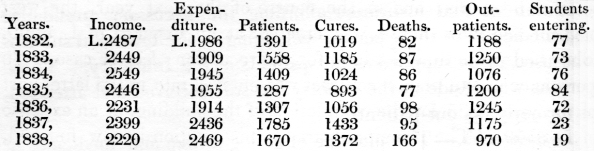
The medical officers of the Infirmary are 5 in
number, viz. 2 physicians, 2 surgeons, and a house-surgeon, who is
resident. There is also an apothecary employed to compound the medicines
prescribed, and, since the removal of the establishment into the new
house, two wards have been appropriated to the reception of ophthalmic
cases, and placed under the charge of the surgeon attached to an eye
institution in town.
By a recent resolution of the managers, one of
the physicians and one of the surgeons are appointed to deliver courses of
lectures on Clinical Medicine and Surgery to the students attending the
hospital, and from the number of cases annually treated in the
institution, it has become of much importance, as an auxiliary, to the
school of medicine lately established here by the authority of the
Universities, and by the exertions of several private individuals. The
number of students frequenting the wards of the Aberdeen Infirmary has for
many years been considerable, and as a certificate of attendance on its
practice is received by the various public boards connected with the
service of the country, there is every probability, that, while the
opportunities and advantages presented to students by Aberdeen remain
undiminished, there will be no material or permanent diminution in the
number of students. During the last two years a considerable falling off
has been experienced, but neither is Aberdeen the only medical school
where this has taken place, nor is the medical profession the only one in
which the number of entrants has been of late considerably diminished.
It is shown by the table, that, during the
last year, the number of out-patients has been considerably diminished;
and there is a probability that, in future years, it will be still
less,—an arrangement having been, in the course of the last year, entered
into by the managers of the Infirmary, who had become possessed, as
trustees, of a fund left by the late Mr Burnett of Dens, for "the supply
of medicines and medical attendance to such of the sick poor of Aberdeen
and the suburbs thereof as are not fit objects to be received into the
Infirmary." It was agreed that this money should be paid over to the funds
of the General Dispensary, on condition of that institution affording the
necessary attendance and medicines to those persons belonging to the town
and suburbs who used to be supplied as out-patients at the Infirmary.
Those persons who reside in the country are still received and attended,
as formerly, as out-patients.
Dispensaries.—The practice of giving advice
and medicines at the Infirmary to persons who could not be received into
the house necessarily began almost from the very commencement of that
institution, and it was probably not very long after, that persons began
to be received as out-patients who had no wish to be admitted. No separate
account, however, of these cases appears to have been kept until the year
1764, when the number of out-patients was 1332, and from that time they
went on increasing, and thus entailing a heavy additional duty on the
medical attendants, and causing a considerable expense to the house.
In 1781, in consequence of a memorial
presented to the managers of the Infirmary, they resolved to institute a
Dispensary in connection with the Infirmary,—(at first as an experiment
for one year, but afterwards they continued it by an annual vote,)—a part
of the expense being borne by the Infirmary, and the rest defrayed by
subscriptions. This source of income having declined, however, the new
institution became more burdensome to the Infirmary, and it was deemed
necessary to take steps for reviving the interest of the public in the
Dispensary by making collections at churches, &c., and, at the same time,
to withdraw the aid which it had hitherto received from the funds of the
Infirmary. In 1788, the managers of the Infirmary agreed to defray the
expense of the medicines used in the Dispensary, provided the sum
necessary to meet the salary of the physician were raised by subscription;
but two years after, they again deemed it necessary to disunite the
Dispensary from the Infirmary altogether. Subsequently to this time, as
the population of the town increased, other institutions, with the same
benevolent design of providing advice and medicines for the sick poor at
their own houses, were successively established, to the number of
five,—three of which embraced the city generally, while the other two were
chiefly intended for the districts of Futtie and Gilcomston.
In 1823, these five were incorporated into
one, called the General Dispensary; the five medical men previously
attending continued to officiate, and, in fact, the only changes consisted
in the establishment of a single depot of medicines, the election of a
single set of managers, and the allotment of the town and suburbs into
five districts, of which one was assigned to each of the medical
attendants; lately a sixth medical attendant has been added, and a
district has been assigned to him by a new division of the town.
For several years, there was a midwife
attached to each district, to whom was assigned the care of all ordinary
cases, (for which a small allowance was made according to the number of
cases,) the medical attendants giving their assistance when cases of
difficulty occurred; but in 1834, the low state of the funds compelled the
managers to discontinue the allowance, and since that time the medical
attendants have taken charge of all the midwifery cases applying at the
institution, which, however, have been of late comparatively few.
In 1831, the small-pox being very prevalent in
Aberdeen, it appeared to the medical attendants of the dispensary, that in
visiting among the poor, they possessed peculiar facilities for
encouraging among them the practice of vaccinating their children, which
was too generally neglected. It was therefore resolved to give attendance
weekly at the dispensary for the purpose of vaccinating children.
Mr John Burnett had by his will, dated 1783,
bequeathed a sum of money to be applied for the prevention of small-pox,
and on the promulgation of Dr Jenner's discovery, this sum was
appropriated to defray the expense of an institution for vaccination. For
a good many years, the numbers who were benefited by this institution were
considerable, but in consequence partly of the increasing prevalence of
the custom of midwives vaccinating the children at whose birth they had
assisted, and partly of the negligence of parents to avail themselves of
the means of avoiding a disease whose ravages were become much less
formidable than they had formerly been, the Vaccine Institution declined
very much, so that at the time when the medical attendants of the General
Dispensary began to vaccinate, the office of the Vaccinator had become
little better than a sinecure, and medical men often experienced great
inconvenience from the inadequate supply of lymph that could be obtained
at the Vaccine Institution. These circumstances, and the success which had
attended the attempt to induce parents to bring their children for
vaccination to the Dispensary, led to a proposal to incorporate the two
institutions together, and this was accordingly done in 1837, by the
appointment of the Vaccinator as one of the medical attendants of the
Dispensary, having charge of a district of the town in addition to his
duties as Vaccinator. The number of children vaccinated at the institution
previous to its junction with the General Dispensary was 6543.
The only permanent income which the General
Dispensary possesses, except the annual income arising from Mr Burnett's
bequest (which continues to be received by the Vaccinator as his salary,)
is the interest of a bequest of L. 400 by the late Mr J. Cushnie, which
was left in 1793 to the two Dispensaries at that time existing in
Aberdeen. Excepting this, the whole support of the institution rests on
voluntary subscriptions, and an occasional collection at some of the
churches. Subsequently to the establishment of the General Dispensary, two
others have been set on foot in Aberdeen. One in the lower part of the
town, whose object is principally to provide speedy assistance in the
numerous accidents which happen on board the ships and in the various
works about the harbour, and the other in the western part of the town,
and altogether beyond the limits of the parish. The expenses of both of
these are borne entirely by voluntary contributions, and they amount
together to about L.60 annually.
The subjoined table shows the income,
expenditure, and number of patients treated by all the institutions of
this sort in town for the last seven years.
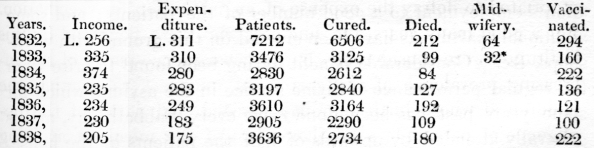
* Subsequent to this date, the midwifery cases
of the General Dispensary are included in the general report.
Lunatic Asylum.—Connected with the Infirmary
of Aberdeen, in so far as it is under the management of the same body of
directors, is the asylum for the reception of lunatics—an institution
which was begun in the year 1799. Previous to that time there was no
attention paid to the comforts of this unfortunate class in Aberdeen, and
but very little provision made for their safety; the only accommodations
provided being a few miserable cells on the ground floor of the Poor's
Hospital, and one or two equally wretched among the cellars of the
Infirmary. In the year just mentioned, a building was erected by
subscription, capable of receiving about 50 patients, on a site nearly a
mile out of town. The expense of this, including that of the ground, was
L.3484, of which the magistrates, as trustees of a bequest by Bailie
Cargill, contributed L. 1130, on condition of having right to admit 10
pauper patients, gratis, to the institution. In 1819, in consequence of a
great deficiency of accommodation having been experienced, and especially
the impossibility of properly classifying the patients, either according
to the varieties of their disorder or their station in life, a piece of
ground adjoining to the asylum was purchased, and an additional building
erected on it at an expense of L. 13,135, which the managers were enabled
to defray by the munificent bequest of L. 10,000 from the late John Forbes
of New. In this building about 70 additional patients can be accommodated,
and the general attention which had in the interval been paid to the
construction and arrangement of lunatic asylums, enabled the managers to
avail themselves of many improvements, by which the comfort and
restoration of the patients might be promoted.
In 1836, the number of patients having
continually increased, and a considerable proportion of them being in a
situation which rendered them capable of being employed, with benefit to
themselves in out-door work of various kinds, for which there had hitherto
been very little facility, a portion of ground adjoining, of the extent of
about 11 acres, was purchased at the price of L. 3000, which, being laid
out in various kinds of useful crops, &c. affords employment to a good
number of the patients; and some additional apartments have been erected
on this ground with workshops, &c. Considerable benefit having been found
to arise from the regular performance of divine service in the asylum,
which for some years past has been done twice every Sabbath day, and is
generally attended by upwards of half the patients in the house, it is
intended that a chapel shall be erected soon in a suitable situation. It
used to be remarked, that Sabbath was commonly a very troublesome day, in
consequence of the cessation of the usual occupations of the patients, no
object of interest being presented to them instead ; but since the
establishment of the practice of having worship regularly twice on that
day, the patients are generally as quiet on Sabbath as any other day of
the week. Much pains have been taken by the physician, Dr Macrobin, to
devise the means of employing actively all the inmates who are capable of
engaging in any sort of work, and the males, besides the out-door work
which the late acquisition of additional ground has given opportunity for,
are employed in such other work about the house as they can assist the
servants in; and it is hoped that in a short time the introduction of
basket-making, weaving, &c. may be effected with advantage. The females
are employed in assisting the servants, and in sewing, knitting, spinning,
&c.
The details of the management of this
institution are entrusted to the same committee (annually appointed,) who
superintend the Infirmary, and the general body of managers meet twice
a-year specially for the business of the asylum, besides holding
occasional meetings when requisite. The funds of this institution having
been derived entirely from voluntary subscriptions and bequests, the heavy
expenses incurred in the purchase of ground, and the erection of the
buildings, have hitherto rendered the managers unable to make the rates of
board at which patients are received, so low as they would have wished,
especially in regard to the class of paupers, 10 of whom, as already
mentioned, are maintained gratis in terms of the agreement with the
magistrates on commencing the institution. Another is received without
board in terms of a bequest by the late Mr Innes of Balnacraig. Other
paupers coming from parishes within the county of Aberdeen are received at
L. 15 per annum. Paupers from other places pay 8s. 6d. per week, and the
higher rates are adjusted according to the accommodations, &c. required by
the friends of the patient.
The following table shows the chief
particulars regarding the asylum for the last seven years:
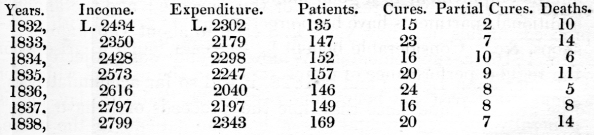
Incorporations.—It is not necessary to inquire
into the origin of those societies among craftsmen, which are
unquestionably of considerable antiquity, and which have given rise
ultimately to the various incorporations in burghs protected by certain
statutes and enjoying certain privileges. The corporations of Aberdeen at
the earliest period of which correct information can be obtained, were the
Litsters, the Hammermen, the Tailors, the Skinners, the Cordwainers, the
Fleshers, the Barbers, the Wrights, (including the Coopers and Masons,)
and the Bakers. It is uncertain at what period these corporations were
formed into a joint society. The first mention of the deacon-convener is
in 1587, when the person holding this office was appointed, along with
others, to arbitrate between the craftsmen and the burgesses.
About the year 1610, the Joint Society of
Incorporated Trades instituted a fund for the relief of decayed members;
and in 1632, Dr Guild, one of the ministers of Aberdeen, founded an
hospital for poor artificers, in the place formerly occupied by the monks
of the Holy Trinity. The corporations of Hammermen, Bakers, Tailors,
Wrights, Cordwainers, Weavers, and Fleshers contributed to the
establishment and support of this hospital. The objects of relief are not
now, as formerly, received into the Trades' Hospital, but relieved as
out-pensioners, and the building is used for the purposes of meetings of
the trades, and as a school for the children of tradesmen of both sexes.
The fund for distribution has, by various
bequests, and by the rise in value of land purchased in the close vicinity
of the town, increased considerably, so as to enable them, of late years,
to distribute about L. 600 annually, among about 130 decayed members.
By the deed of Dr Guild, who was one of the
principal founders of this fund, "None shall be admitted to its benefit
but those who shall be of good fame, and not reduced to poverty by their
own vice or drunkenness or intemperance; and therefore that none receive
the fruits of the said mortification but good, holy, and sober men."
A Widow's Fund was instituted in 1771, a small
payment from entrant members being reserved for this purpose; and the
annual proceeds of this fund now yield L. 5 each to about 150 widows.
In 1816, a supplementary Widow's Fund was
projected by Convener John Leslie; and in 1828, it had so far accumulated
as to be available, and since that time the proceeds of it have been
annually distributed.
During the year 1837, the general funds of the
trades for distribution amounted to L. 1102, whereof L. 572 were
distributed to 122 superannuated members; L. 490 were apportioned among
150 widows; and L. 40 were paid as bursaries to students at Marischal
College.
Besides these general institutions, in which
all the corporations have a common interest, each possesses its own
peculiar stock and revenues, appropriated to the relief of decayed
members, widows, and orphans immediately connected with it.
These funds, during the year 1837, amounted to
L. 2622, which were distributed according to rates fixed by each
corporation independently of the others, among 154 superannuated members,
150 widows, (the same who received the benefit of the general fund and of
the widows' funds,) and 156 orphans.
The following table will show the proportion
of these funds, and their objects appertaining to each trade :—
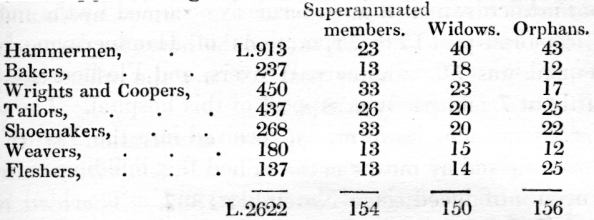
Society of Advocates.—We find the
practitioners of the law in Aberdeen recognized by the title of "Advocati,"
as early as 1633, and under that title they received a charter from the
Crown in 1774, and again another of a more extensive nature in 1799, in
which they are styled, "the President and Society of Advocates in
Aberdeen."
The chief object of the society is to
maintain, by the contributions of its members, a fund for the purpose of
giving allowances to indigent members, and to the widows, orphans, and
nearest relatives of deceased members. This fund was instituted in 1685 ;
the allowances which they have been able to give from it have been at
different times augmented, but it is believed that they have never yet
found it necessary to diminish the rate. At present the annual allowance
to a widow is about L. 40. The Society also possesses a valuable
law-library, which is kept up by the contributions of the members, and by
fees from entrant apprentices. This library is open to the free use of all
the members of the Society. It contains about 1900 volumes, and was begun
to be collected in 1786.
The Society has lately erected a spacious Hall
for the purpose of their meetings, with suitable accommodations for their
library, &c. in Union Street.
Society of Shipmasters.— This association was
formed in 1598, and was chartered in 1600, with a right to levy a tax on
all shipping entering the port, but this right was annulled in 1784. The
Society was re-chartered in 1801, by the title of "the President and
Society of Shipmasters of Aberdeen." Their funds, which formerly arose
from the tax which they were entitled to levy, and which now are derived
from the contributions of the members, are applicable to the purpose of
pensioning indigent members, and the widows and orphans of deceased
members, and the sum distributed by them is above L. 600 annually, in
allowances varying from L. 16 to L. 20.
Post Office.—For a good many years, the south
mail used to arrive in Aberdeen at 6 a. m., and the various north and
inland mails from half-past 12 to 2 p.m., and the hours for despatching
the south mail was 50 minutes past 2 p. m.; the others being made up
partly at 7 and partly at 8 a. m.
In consequence, however, of the acceleration
of the mails through England by means of the railroads, &c. various
alterations have been introduced since November 1837. There are now two
mails daily from Edinburgh, the one arriving at a quarter-past 6 a.m. and
the other at 6 p.m., and the hours of despatch for the south are at
present quarter-past 7 a. m. and half-past 3 p. m. The various country
mails arrive about an hour previous to the afternoon despatch of the south
mail, and they are despatched at 7 a. m., and to one or two places also at
10 p. m.
The increase in the size and trade of the city
has of course been attended with a corresponding increase in the revenue
and business of the Post Office. By the statement of the postmaster, the
Post Office revenue of Aberdeen has been for a considerable number of
years steadily on the increase, and is at present from L. 9500 to L.
10,000.
Stamps.—The amount of bill stamps annually
made use of in the Aberdeen district, which comprehends Aberdeen and
Kincardineshires, on an average of the last three years, is L. 4955. The
amount of stamp duties collected in the district in the same average of
three years is L. 18,802; while the unstamped duties levied annually have
on the same average amounted to L. 11,581.
Stage-Coaches.—As may be supposed, the number
of these is liable to great fluctuation, some being started as a
speculation on roads where the intercourse is soon found insufficient to
bear the expense, or by individuals without the necessary capital.
Accordingly, the number of coaches running from Aberdeen varies almost
every season. At present there are about 20, viz. 8 on the south road; 4
on the north road; 4 on the north coast road; 2 on the Dee side road; 2 on
the Skene road; and the amount of mileage paid by these coaches on an
average of the last three years is L. 5372.
Banks.—A bank on a small scale was established
in Aberdeen in 1752, but it did not succeed, and was soon given up. Soon
after, the Thistle Bank of Glasgow opened an agency here, and received
great support. In 1767, another attempt was made to establish a bank in
this city, by the formation of the "Banking Company in Aberdeen," with a
capital of L. 72,000. At first it met with great opposition from the
Glasgow agency, but ultimately it drove the Thistle Bank from the field,
and since that time has continued to experience a degree of prosperity
unequalled by any similar establishment, in so much that an original share
of the stock, for which L. 150 was paid, sells now for about L.3000.
It may be worth notice here that this bank had
adopted the plan of using paper for their notes, bearing in watermark a
waved line, and the amount of the note expressed in words, along with the
designation of the company; but about forty years ago, a gentleman
connected with this part of the country brought this paper under the
notice of the Bank of England, in consequence of which they adopted it,
and procured an act of Parliament to be passed prohibiting the use of
paper so marked by any provincial bank.
In 1788, the "Commercial Bank of Aberdeen" was
established, which experienced on the whole considerable success, but was
ultimately given up in 1833 in favour of the National Bank of Scotland,
whose agency here is doing a good deal of business.
In 1826, the "Aberdeen Town and County Bank"
was projected with a paid up capital of above L. 100,000, and it is amply
proved that the increasing wants of the commercial community required such
an addition to the banking establishment, by the fact that the share for
which L.75 was paid, now sells for L. 145.
The "North of Scotland Banking Company" was
instituted in 1838, with a paid up capital of L. 200,000. The partners in
this concern are numerous, and it has experienced great success.
All of these establishments appear to be
conducted with great propriety and liberality, and they have in a very
material degree benefited the city as well as the surrounding country, in
various parts of which they have established agencies.
The Bank of Scotland, the Commercial Bank of
Scotland, the British Linen Company, and, as already noticed, the National
Bank of Scotland, have thriving branches in Aberdeen, some of them for
many years past.
Savings Bank.—In the year 1815, the judicious
and benevolent plan of the Rev. Dr Duncan of Ruthwell, by which labourers
and others may be enabled to lay up their small savings in security, and
to receive interest on them, was introduced in Aberdeen, and the
regulations under which the savings bank was established were, that sums
from 2s. to L. 5 should be taken in every Saturday between 9 and 10
o'clock; that interest at the rate of 5 per cent. should be allowed on
sums exceeding L. 1, (excluding, however, any odd shillings and pence,)
after they had been deposited for one month; that the bank should not hold
more than L. 30 from any one depositor; and that the whole or any part of
the deposit might be withdrawn at any time on giving a week's notice.
Twenty-four gentlemen undertook the office of directors, attending two at
a time for a month in rotation, to receive and give out the money; and at
first the necessary expenses were defrayed by subscriptions obtained among
the inhabitants. The surplus interests of the odd sums on the accounts
soon enabled the directors to carry on the establishment without a
continuance of the subscriptions, and this was further facilitated by a
fortunate purchase of 3 per cents. made by the directors a few years
after, in consequence of which the auxiliary fund was at once increased to
nearly L. 1200.
In the infancy of the institution, it was
greatly indebted to the liberality of the Aberdeen Banking Company, who
for several years allowed 5 per cent. interest on the sums lodged in that
bank by the savings bank. Afterwards the rate of interest having been
reduced generally, and the savings bank being fully established, and its
advantages sufficiently appreciated by those for whose benefit it was
intended, this favour became no longer necessary, and consequently the
rate of interest allowed to depositors has since then fluctuated; at
present it is 3¾ per cent., having been recently advanced from 3½. The
funds of the bank are vested in bonds and other heritable securities, and
an idea may be formed of the benefits arising from this institution, and
the confidence reposed in it by the labouring classes from the following
table of the number of depositors, and the amount of cash deposited with
it since the year 1832:

The only improper advantage which, as far as
is known, has been at any time taken of this bank is, that occasionally
societies have deposited their funds with it, dividing them into small
sums, which; have been deposited in the names of different individuals.
This the directors have endeavoured to discourage, but it has not always
been in their power to discover it in time to prevent it. A great
inconvenience had been felt from the number of depositors, rendering it
impossible to transact the weekly business without causing a loss of time
to the applicants and to the directors, that could be ill spared from
their other avocations; and to remedy this a set of premises has recently
been fitted up, (the office was previously in the office of the United
Fund,) where attendance is given at 9 a. m., and 7 p. m., on Thursday,
Friday, and Saturday. The expense of conducting the business will be thus
considerably increased; but the state of the auxiliary fund is such as to
enable the directors to meet it without difficulty, and without any
necessity of reducing the interest to depositors.
No savings bank on the national plan has yet
been established in Aberdeen. It has been proposed to do so, but the
advantages possessed by the present one are so fully appreciated by the
depositors, that there is no reason to suppose that it would be materially
affected by this should it take place.
Insurance Offices.—In the year 1801, a company
was formed in Aberdeen for insurance against damage by fire, which for a
time was carried on successfully, but after continuing for about thirteen
years, it was dissolved, it being found that the principal business of
this kind continued to be engrossed by the agencies of various companies,
both English and Scotch.
About 1803, a company for insuring lives and
granting annuities was formed, and seemed likely to prove profitable, but
the partners (probably imperfectly acquainted with the principles on which
such a concern should be based) became alarmed apparently without
sufficient grounds, and abandoned the speculation after it had been
continued about ten years.
In 1817, a Marine Insurance Company was set on
foot, but it was unsuccessful, and was abandoned in a few years after the
loss of the greater part or the whole of its capital.
Notwithstanding the fate of all these
companies, in 1826 the "Aberdeen Fire and Life Insurance Company" was
established with a capital of L. 750,000, and it has met with great
success and patronage in every part of Scotland, insomuch, that they may
now boast of being "the most successful institution of the kind in the
kingdom," and the share for which originally L. 2 was paid may now be sold
for L. 5, 11s. This success induced in 1836 the formation of a rival
establishment, the "North of Scotland Fire and Life Assurance Company,"
which has experienced a considerable degree of success during the time it
has existed, and the share on which L. 1 was paid, now sells for L. 1, 8s.
6d.
Last spring two Marine Insurance Companies
were started on an extended scale, and as far as can be judged, in so
short a time, both seem likely to succeed.
There are also two Mutual Insurance Societies
which were formed among the operatives a few years ago, but their success
has been very limited.
Besides these, there are agencies in Aberdeen
for no fewer than 39 Scotch and English Insurance Companies, of which the
oldest is that of the Sun Fire Office, which was established here nearly
eighty years ago.
Newspapers.—The Aberdeen Journal is one of the
oldest, if not the very oldest, of the papers in the north of Scotland. It
was commenced in 1748, and was at first published on Tuesday, on a very
small sheet. Some time after, the day of publication was altered to
Monday, and subsequently to Wednesday, on which day it still continues to
be published. It has been repeatedly enlarged in size, and is now printed
on a larger sheet, it is believed, than any other Scottish paper. In the
number of its advertisements and the extent of its circulation, it takes
the lead of all the Scotch papers, and it was the first paper that was
printed by steam north of the Forth. Its weekly circulation is from 2200
to 2400. The principles advocated in the Aberdeen Journal are those of
very moderate and timid Conservatism, and it adopts the views of what is
termed the moderate party in Church politics.
The Aberdeen Herald was begun in 1832, having
succeeded the Aberdeen Chronicle, which had been carried on for about
twenty years previously. The present circulation of the Herald is about
1300 weekly. The politics of this paper are what is now called
Liberal,—perhaps rather Radical; and the principles which it advocates are
partly those of the Voluntaries, and partly infidel in their character. It
is published on Saturday, and has begun to be printed by a machine within
the last twelve months.
The Aberdeen Constitutional was commenced in
1837, taking the place of the Aberdeen Observer, which had struggled
through an existence of about twelve years.
The object of the original projectors of the
Constitutional was to promote a better tone of thinking and feeling among
the people, by establishing a paper whose characteristic should rather be
its Christian principle, than its political partisanship. In this attempt,
however, they were unsuccessful, and the paper is accordingly merely a
Conservative journal, which in Church politics favours the moderate party.
Its weekly circulation is about 900. At first it was published on
Saturday, but, in consequence of recent changes in the time of arrival of
the mails, it has for some months past been published on Friday morning in
town, a second edition being published in the evening for country
circulation, embracing the intelligence that used formerly to be brought
by the mail of Saturday morning.
Public Libraries.—Besides the libraries
belonging to the University, the School of Divinity, the Medical Society,
the Society of Advocates, and the Mechanics' Institution, there are
several subscription libraries in Aberdeen, the principal of which are
those belonging to Messrs A. Brown and Co., D. Wylie and Son, and W.
Russell.
The number of volumes contained in these
libraries may be about 10,000 or 12,000; they are chiefly in the lighter
departments of literature, but there are many also of more permanent
interest, and of a more important character.
The terms of subscription vary from 15s. to L.
1, 11s. 6d. per annum, according to the number of volumes borrowed at a
time, and, generally speaking, these libraries are tolerably well supplied
with the new publications, at least with those by authors whose reputation
is already established: in regard to works of less general interest,
either as respects their subject, or the name of their author, it cannot
be supposed that the proprietors of such libraries should be desirous of
accumulating them on their shelves; and, indeed, there is often great
difficulty in getting a sight of them in any other way than by purchasing
them, for the booksellers in Aberdeen do not often choose to incur the
risk of ordering books that are not already in some degree regarded as
standard works, unless in consequence of receiving an order for them from
an intending purchaser.
Markets.—There is a weekly market on Thursdays
for meal, and on Fridays for grain, butcher-meat, and other provisions.
Within the last few years several butchers' shops have been opened in
different parts of the town, where a supply of meat may be obtained on any
day of the week.
There is a market of fish daily, unless in
tempestuous weather; and a supply of cured fish, including the well known
"Findon haddocks," may be had daily.
A market for the sale of linen is held in the
Green on the last Wednesday of April, and a wool market is held there in
the last week of June, and the first two weeks of July, on Thursday and
Friday.
The timber-market, for the sale of tubs and
other wooden articles, is held in the Castle Street on the last Wednesday
in August.
The feeing-market for the hiring of
farm-servants is held in the vicinity of the meal-market at Aberdeen, on
the second Friday of May and November.
Besides these markets held in Aberdeen, there
are several markets for horses and cattle, held in the close vicinity of
the town, as follows: 1. At bridge of Don, on the first Tuesday of each
month; 2. at Mannofield, on the Dee side road, on the second Monday of
each month; 3. at Ruthrieston, near the Bridge of Dee, on the third Monday
of each month; 4. at Old Aberdeen, on the last Thursday of April, and on
the Wednesday after the last Tuesday of October.
Inns and Alehouses.—There are in Aberdeen no
less than 193 inn-keepers and vintners, including six principal inns, viz.
the Royal Hotel, the Union Hotel, and the Aberdeen Hotel in Union Street,
the Lemon Tree, in the Huxter Row, Cruickshanks' Inn, in the School-hill,
and Macdonald's Temperance Hotel in Queen Street.
Pawnbrokers.—It is between twenty and thirty
years since this lucrative but not commendable occupation was first
introduced into Aberdeen, and there are now six of them established and in
full occupation. The capital invested in this trade may be about L.
10,000, which is generally understood to be turned five times in the
course of a year. About nine-tenths of the articles pledged are redeemed
within the legal period, and, unquestionably, much occasional relief is
afforded in seasons of temporary distress by their assistance, though, at
the same time, it is to be feared that the greater part of their trade
arises from the improvident and the dissipated.
Streets.—Less than half a century ago, the
only approaches to Aberdeen were, from the south and west by the
Windmillbrae and the Green, and from the north by the Gallowgate, and the
streets in general were inconvenient, from their narrowness and the
badness of the pavement, which consisted mostly of irregular causeway or
round stones. About the end of the last century, a street was opened from
Broad Street to North Street, which facilitated the entrance from the
north, as North Street runs along the foot of the Port Hill, over which
the Gallowgate passes. Soon after, Marischal Street was opened from Castle
Street to the Quay, and it was the first street in Aberdeen that was paved
with dressed stones; but its steepness renders it inconvenient.
About the beginning of this century, a
turnpike road having been made to Inverury, a new line of approach to the
town was obtained, by opening George Street, through the middle of what
had in former times been a loch or pool of stagnant water. But the grand
improvement of Aberdeen in this respect was not effected until several
years later, when a new approach was made from the south by the opening of
Union Street, and from the north by means of King Street, both of which
are spacious streets, which pass right into the middle of the town, both
opening into the Castle Street. And it cannot be looked on as the least of
the benefits which Aberdeen derived from the opening of these streets,
that, in order to their formation, it was necessary to remove a
considerable number of houses, which were huddled together in a manner
that renders it difficult to conceive how the town could be ever free from
pestilential disorders. In order to avoid the inconvenience and danger of
the steep descent of the Windmill Brae, and the equally steep ascent of
the Shiprow or Nether Kirk-gate, the hollow through which the Denburn
flows was spanned by a magnificent bridge of three arches, one of which
has a span of 132 feet, while the others (which are concealed by being
built over) are of 50 feet each. Union Street, which is carried along this
bridge, is also carried over two of the old streets of the town, viz. the
Correction Wynd and Putachy side, [The intervening space till it reaches
St Catherine's Hill, part of which was removed in opening the line, being
tilled up by embankment, so that Union Street is considerably raised above
the Green, which lies alongside of it.] and by the opening of St Nicholas
Street, which connects it with George Street, the access is rendered easy
and direct from the north into the centre of the town.
Public Buildings.—There are a good many public
buildings in Aberdeen, some of which are in no small degree ornamental to
the town. To enumerate them all here would be tedious and improper, but it
may be right to notice some of the principal.
The Barrack, which stands on the Castle Hill,
was erected in 1796, and is capable of accommodating 600 men. The
situation is airy and healthy, and the design of the building good.
Gordon's Hospital, with the additions lately
made to it, forms a highly ornamental building.
The Court House, which was erected in 1818,
from a plan by J. Smith, Esq. is commodious; but, from its situation, it
is completely hid, as is also the prison, which lies behind it, and which
was built in 1830.
The County Rooms were erected in 1820, on a plan given by A. Simpson,
Esq., and form one of the most striking ornaments of the principal street.
The North Church was planned by J. Smith,
Esq., is an elegant building, and forms a very conspicuous ornament in
King Street.
The Lunatic Asylum and the Infirmary, both
planned by A. Simpson, Esq., are exceedingly handsome buildings,
especially the latter.
The East Church, an elegant building in the
Gothic style, was planned by A. Simpson, Esq.
The Bridge in Union Street, over the valley in
which the Denburn runs, is a very elegant structure, shewing a single arch
whose span is 132 feet, and the height to the top of the parapet 56 feet.
The Cross is an elegant octagonal structure,
having a column rising from the centre surmounted by a unicorn bearing a
shield, and surrounded with medallions of the monarchs of Scotland from
James I. to James VI. It is remarkable as having been the work of a
stone-mason, from the village of Old Rayne.
The Orphan Hospital, just finished, is a
handsome building, without any superfluous ornament.
Marischal College is not yet finished, but is
fast advancing, and when completed will be both commodious and ornamental;
but it is not well situated, being much hemmed in by the surrounding
buildings.
December 1839.
N. B.—An account of the Universities of
Aberdeen will be given along with the General Observations on the County.
Addenda.—When the note on page 17 was penned,
the writer had not seen Boece's Lives of the Bishops, and at first sight a
discrepancy seems to exist between this work and his History of Scotland,
on the subject of the destruction of Aberdeen by Edward. In the latter
work, he says, "Moraviam omnem incendio ferroque late præter sacra
devastat, ac per Marriam rediens non minus earn populationibus afflixit.
Aberdoniam urbem regiam habitatore exhaustam solo æquat." And the time of
this expedition, though not distinctly stated in the passage itself, is
proved by previous dates given, to have been about 1336. In the latter
work the statement given is as follows: "Per id tempus, triginta naves
Anglicanæ in statione portui Aberdonensi proxima jecere anchoras, unde
expositæ copiæ in terram, pene Aberdoniam prius sunt ingressæ quam cives
eas advenisse senserant. Angli . . complures Aberdonensium trucidant;
urbem simul atque pontificis et canonicorum ædes omni supellectili
populates incendunt. Arsit Aberdonia, sex dies lugubre intuentibus
spectaculum. Pepercere hostes templis, pietate moti, religiosorum quoque
Abbatis. . . Fuit annus quo Aberdonia funestam hanc cladem accepit, a
Christo incarnato tertius supra mille-simum tercentesimum tricesimum."
While it must be admitted that one of these
accounts refers to an invasion by land troops, and the other to an attack
made by a naval expedition, it must be remarked, that it is exceedingly
improbable that, if they were different attacks, Boece should have only
mentioned one of them in each of his works; and by a reference to Fordun,
the difficulty is in part, at least, removed, for he says, "totam Moraviam
igne, consumens, usque Elgyn pervenit. Et progrediens inde, salvis
ecclesia et canonicorum sedificiis de Elgyn, flamma universa devorante,
villam de Abirden solo coquavit. Hac tempestate contigit piratas
Angligenas de navibus suis de-scendere, et universa maritima cis fluvium
de Forth usque ad montes de Hochel sine resistentia crudeliter devastare."
So that while Edward came with his army from Moray, there seems to have
been an attack made by English ships about the same time. Fordun, to be
sure, does not state they came so far north as Aberdeen, and perhaps they
did not; and the mistake of Boece may have been in ascribing the burning
of the town to them, instead of the army, not recollecting what he had
said in his History. That the town was burnt once, seems clear, but the
evidence of two burnings is very doubtful. With regard to the date of this
disaster, Lord Hailes, in his Annals, has traced the progress of Edward's
army through Scotland, and established that his return from Moray must
have been in 1336.
ERRATA.
Page 100, under the head "Newspapers." The
circulation of the Aberdeen Herald here stated, bears reference to the
date at which the materials for preparing the Account were first obtained.
The circulation of that Journal for the two years and a half previous to
January 1840 amounted to 1961 per week.
Under the same head, the principles of the
Aberdeen Herald being described as "partly infidel;" and this being
contradicted by the proprietors, the conductors of this work beg to
retract the statement. |



