Land-owners.—The Earl of Kintore is proprietor of
about three-fourths of the united parishes. Balbithan, the property of
Benjamin Abernethy Gordon, Esq. forms an eighth part. Kin-muck, which is
rather less, belongs to Alexander Irvine, Esq. of Drum. The Synod of
Aberdeen hold in trust the small estate of Newplace, which rents about
L. 80; and the Society of Friends or Quakers are proprietors of three
acres, on which they have a meeting-house and cemetery.
Parochial Registers.—The register of births, or
rather baptisms in Keithhall, has been kept pretty regularly since 1678;
but the oldest of them are a little frail. It is doubtful whether there
were ever any similar registers for Kinkell.
Antiquities. —The antiquities in this quarter
have suffered much from the ploughshare and the erection of stone
fences, The cairns or mounds raised to commemorate ancient heroes and
events have been broken down; and the place of the Drui-dic temples that
stood in the end of last century is now unmasked, with one exception,
where a single stone remains, nearly two and a-half feet square and
seven feet high. It is remarkable that the corn grows very luxuriant
around this solitary pillar to a distance of fifteen yards, and has
always been eighteen inches higher than the crop immediately beside it.
Part of an encampment still remains in the moor of
Kinmuck, where tradition records that a great battle took place between
the Danes and the Scotch. The latter are said to have slain a boar in
their advance, and hence the name Kinmuck, or boar's head. The place of
combat bears the name of Blair Hussey, or field of blood.
In a large barrow or tumulus, about eighty yards from
a Dru-idic stone, a chance visitor observed an urn partially uncovered.
It was found to contain calcined bones. Two larger urns were
subsequently found in a reversed position to the other, and were taken
out in fragments. The bones in all the three were put into a box, and
buried in the original spot.
The residence of the Earl of Kintore, generally
denominated the house of Keithhall, of which the castle of the Johnstons
forms a small part, is a very magnificent building.
III.— Population
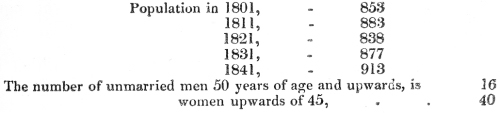
The resident heritors are the Earl of Kintore, and
Balbithan.
IV.—Industry.
Agriculture.— The land under tillage is nearly
5000 acres, The waste land is about 2000. Of this a third part might be
advantageously improved. About 400 acres are planted.
Average rent of land in cultivation is 14s. per acre.
The sheep are of the South Down, Leicester, and
Scotch breeds. Several farmers have superior cattle, chiefly of the old
Aberdeenshire breed. Lord Kintore has long had a very select stock of
Ayrshire and short-horn or Teeswater cows and bulls, and is very
indulgent to his tenantry in this matter. The Keithhall ox, as one of
his Lordship's bullocks was called, was for some time one of the
greatest wonders in the north of Scotland. This animal carried the first
premium at the Highland Society's show in 1884, was sold at seven years
of age for one hundred sovereigns, and certainly was one of the hugest
animals ever seen in the shambles. The gross weight of the bullock alive
was 1 ton 8 cwt. or 3136lbs.
There has been a considerable extent of waste land
reclaimed within a short time. The duration of leases is nineteen years.
All the turf-covered houses have disappeared. A few
of the farmers have their houses slated, and the others are neatly
thatched. The enclosures are mostly of stone. Lord Kintore brought a
hedger from Berwickshire, a few years ago, and has planted hedges of
hawthorn on several farms.
None of the proprietors give any encouragement for
improving waste ground. Only two or three individuals have accepted the
terms of one who advances money at seven and a-half per cent. on that
security.
Produce.—

V.
—Parochial Economy.
Inverury is the nearest market-town, and only a
quarter of a mile from the west boundary. The post-office is in that
burgh.
There are two bridges on the Ury; one of stone, which
has been built upwards of thirty years; the other has stone piers and a
wooden arch, and was built lately.
Ecclesiastical State.—The parish church is in the
most centrical situation, as ascertained by measurement. It was built in
1771, repaired last in 1823, and holds 600 persons. The seats are all
free. The manse was built in 1772; the last addition was made only two
years ago. The glebe is 25 English acres, and would rent for L.30, if
let to a farmer; but when the greater part is in grass, as at present,
it is of more value. The stipend is L. 110, 10s. l
2/12d.; meal, 112 bolls, 8 stones, 9 1/10
lbs.; bear, 20 quarters, 3 bushels, 1 peck, 1¼
quart; barley, 5 quarters, 6 bushels, 2 pecks, and 3 quarts.
The Society of Friends have a meeting-house at
Kinmuck. Their number in 1831 was 16 persons.
The number of families who attend the Established
Church is 168; and persons of all ages, 650. There are 13 Dissenters,
and 8 Episcopalians. Due attendance is given in the church, and the
number of communicants is 430. The yearly amount of church collections
is L. 45.
Education.—At the parochial school, Latin,
geography, grammar, arithmetic, writing, and reading are taught. The
lower branches are taught at the unendowed school, with the addition of
needle-work. The salary of the schoolmaster is L. 30; fees in 1833, L.
15; other emoluments, L. 25; and his whole income L. 65, besides the
legal accommodations.
All between six and fifteen years of age either can
read or are under tuition; none above the higher age are known to be
unable to read.
The only library is one for the Sabbath scholars.
Poor.—Paupers, at an average, are 17 in number;
and the supply for each, L. 4. Church collections during the year for
the funds, L. 35; and for charitable purposes, L. 10 ; legacies,
donations, &c, L. 40.
There is only one market, Michael Fair, at Kinkell,
for cattle and horses, on the Wednesday after the last Tuesday of
September, old style.
Alehouses.-—There is no public-house in the
parish; but there is a spirit shop on the lands of the synod of
Aberdeen.
Fuel.—The fuel is of peat and turf, the expense
of preparing which is 1s. the cart-load.
General Observations.
The greatest variations observable, within the last
forty years, are in the value of houses and enclosures, which has risen
from L. 150 to above L. 3000; and in the ordinary provision for the
poor, which has been tripled within that time. The Earl of Kin-tore
gives, unsolicited, an annual donation, which is more than the former
yearly supply, then only L. 18. The other heritors are absentees, and
draw their rents without remitting any return to the poor; but it has
not been necessary to solicit a contribution from them.
July 1842.



