|
IN order to make himself quite safe from his
enemies, Macbeth thought that he would build a strong castle on the top of
Dunsinane hill. It cost a great deal of money to build this castle, because
the wood and stones for it had to be dragged up such a steep slope. So
Macbeth made all his Thanes help. Each in turn had to build part of the
castle, sending men and horses to drag the stones and wood up to the top.
At last it came to the Thane of Fife's turn to help
with the building. This Thane, who was called Macduff, was a very great man
and he was much afraid of Macbeth. For the greater and richer a man was, the
more Macbeth seemed to hate him. Besides Macduff had loved Duncan, and
secretly hoped that Prince Malcolm would one day return. Macbeth knew this,
and hated him the more. Macduff sent builders and workmen with everything
that they might need for the work. He gave them orders to be very careful,
to work diligently and well, and to do everything aright, so that the King
might find no fault with them. But he himself kept away, for he knew that
King Macbeth had no love for him, and he feared to be seized and put to
death, as so many nobles before him had been.
One day Macbeth came to see how the castle was getting
on. 'Where is the Thane of Fife?' he asked, looking round, and seeing him
nowhere among his men.
On being told that the
Thane of Fife was not there, but had sent his workmen only, Macbeth fell
into a violent rage. 'I knew beforehand of his disobedient mind,' he said.
Now I am resolved to punish it.'
At this
moment some oxen which were drawing a load up the hill stumbled and fell.
'lie cannot even send beasts fit to work,' cried Macbeth. 'I will make an
example of him. I will lay the yoke upon his own neck instead of upon that
of his oxen.' One of Macduff's friends who
stood by heard the King's angry words. This friend went quickly to Macduff
to warn him to fly from the country, for it was quite certain that the King
meant to do him an evil.
Macduff, as soon as
he heard, mounted upon a swift horse and fled away to his strong castle in
Fifeshire. The King lost no time in
following. Close behind Macduff he came with a great army of soldiers. It
was a fast and furious race. Macduff was almost alone, and he had had to
ride away in such haste that he had little money with him. When he came to
the ferry across the river 'L'ay, which he must pass in order to reach his
castle, he had nothing with which to pay the ferryman except a loaf of
bread. But the ferryman was content to take the loaf, and for many years the
place was called the Ferry of the Loaf.
On
again rode Macduff, faster and faster still, until at length the turrets of
his castle came in sight. Now he was quite close; now he was thundering over
the drawbridge; now his breathless, sweating, panting horse carried him safe
within the courtyard.
'Up with the
drawbridge, men, let the portcullis fall,' he shouted. In olden times a
castle was always surrounded by a ditch filled with water, called a moat.
Over the moat there was a bridge, but the bridge was made so that it could
be drawn up in time of war. In this way an enemy often found it difficult to
get across the moat and enter the castle. The entrance was also guarded by a
portcullis. This was a heavy, barred gate, but instead of turning upon
hinges as gates usually do, it was raised up and let down like a window.
As soon as Macduff had seen his orders obeyed, he went
to greet his wife and tell her what had happened. Together they looked out
from the castle turret. In the distance they saw a dark, moving mass. Now
and again as the sun caught it, they could see the glitter of steel. It was
the King's army.
'We cannot hold the castle
long against such a host,' said Lady Macduff, as she watched the long lines
moving onward. 'You must fly. Our little vessel lies in the harbour ready to
put to sea. Go quickly on board. I will hold the castle until you are safe.'
Macduff did not want to go and leave his wife and
children whom he loved. But there was no help for it, so he said good-bye,
and stepping on board his little vessel which lay in the harbour behind his
castle, he sailed away. He sailed away to England to see Prince Malcolm and
to ask him to come and be King.
Meanwhile,
brave Lady Macduff held the castle. Macbeth and his soldiers came close
below the walls, calling to Macduff to give up the keys. But no one
answered. With beating heart Lady Macduff
watched the white sail grow smaller and smaller in the distance, and
listened to Macbeth as he poured out dreadful threats of what he would do if
Macduff did not yield himself at once.
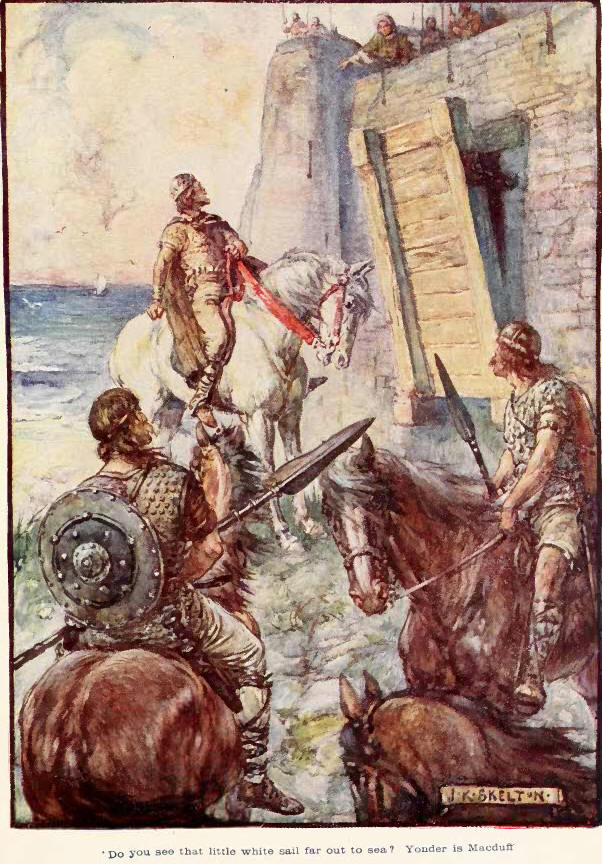
Then,
at last, when Macduff was safely beyond the reach of pursuit, Lady Macduff
came to the walls. I Do you see that little white sail far out to sea?' she
asked. 'Yonder is Macduff. He has gone to England to the court of Edward. He
has gone to bring Prince Malcolm back to Scotland. When he comes we will
crown him King. You will be dragged from the throne and put to death, so you
will never put the yoke on the Thane of Fife's neck.'
When Macbeth heard these brave words, and knew that
Macduff had escaped him, he was fiercely angry. He began to storm the castle
at once. The few men who had been left to guard it fought bravely, but in
vain. In a very short time Macbeth's fierce soldiers won an entrance, and
gallant Lady Macduff and all her children were put to death.
Macbeth then took all Macduff's land and money,
proclaimed him a traitor and an outlaw, and forbade him ever again to return
to Scotland. But Macduff did return.
 |