|
WHEN Robert Bruce died in 1329 A.D., his son was at
once crowned under the title of David II. David was only a little boy, so of
course could not himself rule, and Randolph, Earl of Moray, was made Regent.
For three years Randolph ruled. He was very just, but very strict, and even
cruel, so he made many enemies. One day he died suddenly. Some people
thought that he had been poisoned. but that has never been proved.
Another Regent was chosen, but he turned out to be
neither a good soldier nor a good ruler, and so once more troubles began.
There were, as you know, many great lords who had lands both in England and
in Scotland. During the wars, many of these lords who had fought for Edward
lost their Scottish lands. This made them very angry. Now that there was
only a child upon the throne, they rebelled, hoping to win their lands
again. They found a leader in Edward Baliol, the son of .John Baliol, who
had been King before Robert the Bruce.
Edward Baliol said that he had a better right to the
throne than David, and, in spite of the treaty of Northampton, he was helped
and supported by Edward of England, who hoped once more to become Scotland's
over-lord.
Once again Scotland was torn in two by civil wars,
some taking the part of Baliol, some that of David. A battle called the
battle of Dupplin Moor was fought, few miles from Perth. In this battle the
loyalist Scots, that is, those who were fighting for the King, were utterly
defeated.
A base Scottish baron showed Edward Baliol where to
cross the river, on the other 'side of which the King's army lay. Silently,
at midnight, l3aliol led his soldiers over, and broke into the Scottish camp
while the soldiers were all asleep. The Scots were soon awake, and sprang to
arms. Randolph, Earl of Moray, the son of the famous Earl, gathered his men
together quickly. They fought so bravely, that in spite of the surprise the
battle might have ended in victory instead of defeat, if only the Regent had
known how to command his men. But he drew up his soldiers in such close
lines that they fell over each other, and crushed each other to death,
without ever getting near the enemy. Thus, far more of the Scots were killed
by their friends than by their foes. So dense was the crowd, so awful the
slaughter, that in one part of the field the dead lay in heaps of a spear
length in depth. The Regent and most of the bravest and the best of the
Scottish nobles were among the slain. After this battle Edward Baliol
hurried to Scone, and there he was crowned. So there were two Kings in
Scotland—David Bruce and Edward Baliol. But King David and his young wife,
who you remember was Edward of England's sister, fled away to France.
One of the first things Edward l3aliol did after he
was crowned, was to own himself, as his father had done, vassal of the King
of England. But Baliol's triumph was not for long. There were many Scotsmen
who were still true to their King. They chose another Regent to rule in
David's name, and one dark night they suddenly attacked Edward Baliol. They
slew many of his barons, and Edward himself barely escaped with his life. He
had to flee so fast that he had not even time to dress, but throwing himself
on a bare-backed horse he galloped away through the darkness. So in less
than three months after the crown had been placed upon his head, he was
chased from his kingdom, penniless, and almost naked.
He fled back to
England, to his master Edward, and Edward gathering a great army, marched
against the Scots, and in a battle called Halidon Hill, the Scots were once
more defeated.
Edward then overran the country, plundering and
conquering, till no one dared call David King any more, except the little
children in their games when they played at being kings and queens.
But Scotland would by no means yield to England, and
fighting still went on. Among those who fought most bravely for their
country was the Countess of March. She was called Black Agnes because she
was so dark. Her husband, the Earl of March, was away fighting for the King,
when the English besieged his castle of Dunbar. Dunbar was a very important
castle, and Black Agnes made up her mind that nothing would make her yield
it.
In those days cannon had not yet come into use.
Instead of cannon, armies carried about with them great engines, with which
they threw enormous stones at the walls of the castles which they wished to
take.
The English brought their strongest engines against
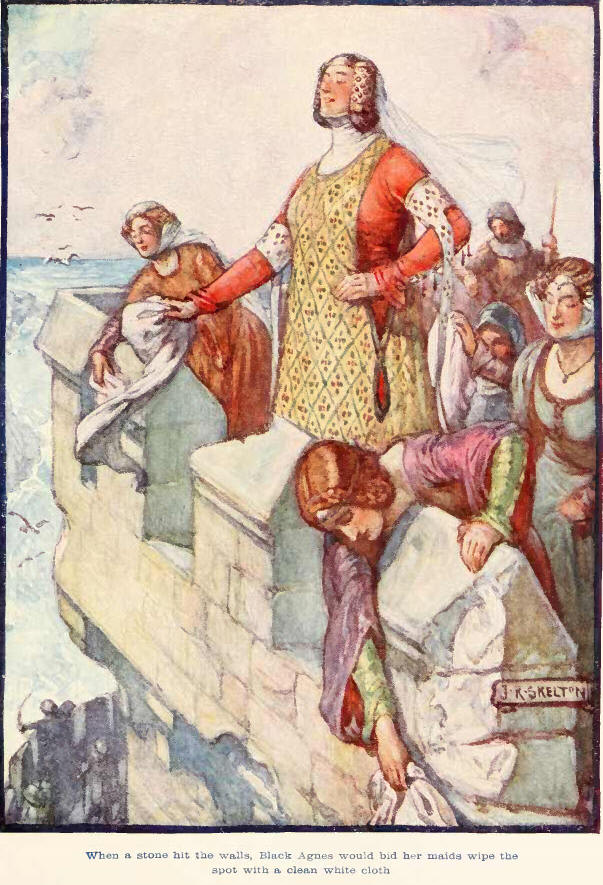
Dunbar, but Black Agnes laughed at their big stones. She used to stand on
the walls with her ladies and her maids, and when a stone hit the walls, she
would bid them wipe the spot with a clean white cloth, as if to say, that
she liked to keep her castle clean and tidy, and all the harm the English
could do was to make a little dust.
She was always on the walls, or at the gate, and in
the most dangerous places, taunting the English, and eo couraging her own
men by her brave words.
She kept a stir in tower and trench,
That brawling,
boisterous Scottish wench;
Came I early, came I late,
I found Black
Agnes at the gate.'
Angry as they were, the English could not but admire
Black Agnes for her courage, and they accepted her gibes and jeers with a
rugged chivalry. 'There goes one of my lady's tiring-pins,' said the English
leader one day as a knight fell dead beside him, pierced by a Scottish
arrow. 'Black Agnes's love-shafts go straight to the heart.'
For five months Black Agnes kept the castle. By the
end of that time the men and women within the walls were near starving.
Dunbar is by the sea, but the English watched so carefully that no help
could be brought to the brave little garrison either by land or by sea. One
night, however, a bold Scotsman managed to slip between the English ships
which lay close about the castle. In his little vessel were forty men, and
plenty of food for the brave defenders.
After this the English lost all hope of taking the
castle, so they went away, angry and ashamed at having been beaten by a
woman. But the Scottish people were proud of Black Agnes, and the minstrels
made poems about her, and sang of her valiant deeds.
 |