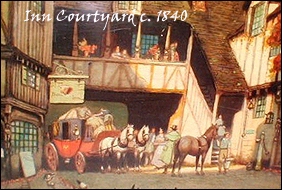
 The first attempt at establishing a
stagecoach service in Scotland occurred on 6th August 1678, when the
magistrates of Glasgow entered into an agreement with William Hume, an
Edinburgh merchant, whereby he would "Have in readiness ane
sufficient strong coach, to be drawn by sax able horses, to leave
Edinbro ilk Monday morning, and return again (God willing) ilk Saturday
night". By way of a minor perk, the burgesses of Glasgow
were always to receive preference, so if the coach was full and one or
more of these illustrious gentlemen desired to reach Edinburgh, somebody
had to get off. Since the fare was 4 pounds 16 shillings Scots (8
shillings sterling) in the Summer months and 5 pounds 8 shillings (9
shillings sterling) in the Winter months, it stands to reason that the
sort of individual who could afford the trip would not easily be ejected
from his seat. The first attempt at establishing a
stagecoach service in Scotland occurred on 6th August 1678, when the
magistrates of Glasgow entered into an agreement with William Hume, an
Edinburgh merchant, whereby he would "Have in readiness ane
sufficient strong coach, to be drawn by sax able horses, to leave
Edinbro ilk Monday morning, and return again (God willing) ilk Saturday
night". By way of a minor perk, the burgesses of Glasgow
were always to receive preference, so if the coach was full and one or
more of these illustrious gentlemen desired to reach Edinburgh, somebody
had to get off. Since the fare was 4 pounds 16 shillings Scots (8
shillings sterling) in the Summer months and 5 pounds 8 shillings (9
shillings sterling) in the Winter months, it stands to reason that the
sort of individual who could afford the trip would not easily be ejected
from his seat.
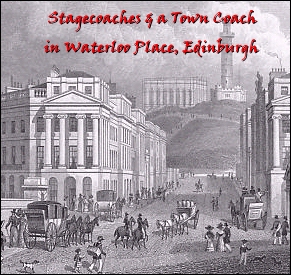 To ensure that the service continued come
what may, the Glasgow magistrates allowed Hume the sum of 200 merks a
year for five years, with two years being paid in advance. Hume's
undertaking was that the coach would run as agreed and without fail
whether or not any passengers required the service. To ensure that the service continued come
what may, the Glasgow magistrates allowed Hume the sum of 200 merks a
year for five years, with two years being paid in advance. Hume's
undertaking was that the coach would run as agreed and without fail
whether or not any passengers required the service.
Unfortunately, Hume's stagecoaching
empire did not last beyond the agreed period and for a long time there
was no regular service. By 1713 the sum total of Scotland's contribution
to the world of coaching were two stagecoaches plying between Edinburgh
and Leith, and a once-a-month coach from Edinburgh to London, which was
twelve to sixteen days on the road, depending on conditions.
When a service was re-established between
Edinburgh and Glasgow the vehicles, described by those used to southern
coaches as "of the clumsiest construction",
were drawn by four horses in good weather and six in bad. The passengers
almost always had to leave the contraption at the bottom of a hill and
climb on foot until able to join it again. Generally, and unless
anything untoward happened, the journey between the two main cities took
around eleven or twelve hours, progressing at the rate of three and
three-quarters miles per hour, stoppages allowed for. There were two
main stoppages and a variable number of minor ones. Each time the
passengers dined and took tea, and a convention arose that the gentlemen
making the trip always treated the ladies.
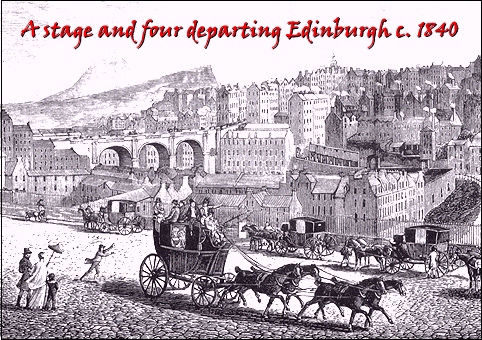 This daily service continued unabated for
almost 30 years, until 1790 when the coaches were replaced by chaises
drawn by two horses. These chaises reduced the travelling time by around
four hours to seven and a half, and by 1799 these were in turn
superseded by improved coaches drawn by six horses and capable of doing
to the trip in six hours. The first of this kind was the Royal
Telegraph, which started on 10th January of that year and was
owned by John Gardner of the Star Inn, Glasgow. This daily service continued unabated for
almost 30 years, until 1790 when the coaches were replaced by chaises
drawn by two horses. These chaises reduced the travelling time by around
four hours to seven and a half, and by 1799 these were in turn
superseded by improved coaches drawn by six horses and capable of doing
to the trip in six hours. The first of this kind was the Royal
Telegraph, which started on 10th January of that year and was
owned by John Gardner of the Star Inn, Glasgow.
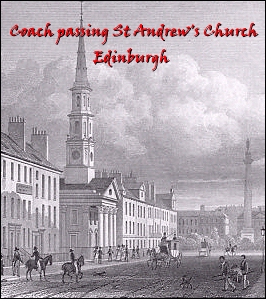 In the years that followed, up until the
advent of the railway in the 1830s, the number of stagecoaches making
the daily run between the capital and the industrial capital increased
to twelve, each carrying between ten and fourteen passengers and
completing the journey in five hours. Also, experiments were carried out
wherein coaches were drawn by two horses and changing six times instead
of four was for a while considered to be the best arrangement, even
reducing the journey time in some cases to three hours and forty
minutes. But the greatest time-saving of all came with the establishment
of the early morning stagecoach, which started at six o’clock and
allowed the passengers to make a return trip in one day. In the years that followed, up until the
advent of the railway in the 1830s, the number of stagecoaches making
the daily run between the capital and the industrial capital increased
to twelve, each carrying between ten and fourteen passengers and
completing the journey in five hours. Also, experiments were carried out
wherein coaches were drawn by two horses and changing six times instead
of four was for a while considered to be the best arrangement, even
reducing the journey time in some cases to three hours and forty
minutes. But the greatest time-saving of all came with the establishment
of the early morning stagecoach, which started at six o’clock and
allowed the passengers to make a return trip in one day.
Although the coming of the railway
largely put an end to the stagecoaches on the Edinburgh to Glasgow run,
other parts of Scotland would remain purely horse-drawn for some time to
come. In the next article we will look at the peculiar problems
besetting those who attempted to establish a transport system in the
Highlands. |



