 By 1800, some 122 years after the Glasgow
magistrates approved the first stagecoach service between there and
Edinburgh, there was still no transport of any kind in the Highlands. In
that year, however, a brave attempt was made at establishing coaching
links between Inverness and Perth, and between Inverness and Aberdeen.
Both ventures were doomed from the start, not through lack of interest
or support, but because of the state of the roads. In the previous year,
Colonel Anstruther, superintendent of military roads in the Highlands,
had reported to the Lords of the Treasury that the people were unable to
maintain or repair roads. Four years later, in 1803, the Parliamentary
Commissioners began the works that were to open up the Highlands to the
greater world. By 1800, some 122 years after the Glasgow
magistrates approved the first stagecoach service between there and
Edinburgh, there was still no transport of any kind in the Highlands. In
that year, however, a brave attempt was made at establishing coaching
links between Inverness and Perth, and between Inverness and Aberdeen.
Both ventures were doomed from the start, not through lack of interest
or support, but because of the state of the roads. In the previous year,
Colonel Anstruther, superintendent of military roads in the Highlands,
had reported to the Lords of the Treasury that the people were unable to
maintain or repair roads. Four years later, in 1803, the Parliamentary
Commissioners began the works that were to open up the Highlands to the
greater world.
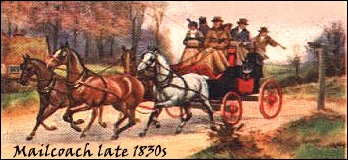
In 1806 the Inverness to Perth stagecoach
service was reintroduced, and in 1811 the Inverness to Aberdeen was
again established. This time they were a success, and became the first
to regularly ply between Highland towns. In time, services were to be
provided between Inverness and Dingwall, Invergordon, Cromarty and Tain,
plus a mail coach along the northern coast road from Inverness to Wick
and Thurso. This meant that by 1819 there was a direct line from London
to Edinburgh, Inverness and the northerly points of Scotland – a total
distance of 800 miles!
The early 1830s saw the introduction of a
stage line from Inverness to Oban, which in turn resulted in an increase
in the number of vessels using the Crinan Canal. Elsewhere, stagecoach
services likewise led to an increase in passengers using the Caledonian
Canal and the new steamers plying the western islands. All these modes
of transport were interdependent, and the lynchpin in the decades before
the arrival of the railway was the stagecoach.
The coming of the stagecoach to the
Highlands also heralded the sort of establishment not commonly found in
the north – the inn. As a result of expectations on the part of the
coach-using class, facilities and accommodation quickly proved equal to
those found in most other parts of Scotland and England.
During the period of introduction and
eventual success of Highland stagecoaches, other forms of transport also
showed a marked increase in both quantity and quality. There were only
five post-chaises in Inverness in 1803, but that quickly increased to a
dozen. Post-chaises were also found for hire at many of the inns on the
great Highland Road, and also at Dingwall, Tain and Inverary. The
Highlands, so recently bleak and inaccessible, had been accessed in a
way that would have been inconceivable even in Dr Johnson’s time.
A further benefit of the Parliamentary
road system was the increase in other forms of horse-drawn vehicles
carrying goods along routes that would previously have been impossible
to navigate. The result of this opening up of the Highlands to the
markets of the Lowlands was a large increase in the total amount of land
under cultivation and a general improvement in living standards. And
this horse-drawn world was not to be short-lived. Whereas the railway
would quickly replace the coach in the southern regions of Scotland, the
Highlands, like the American west, would continue to use the coach on
all minor arteries that would not see rail tracks for quite some time. |



