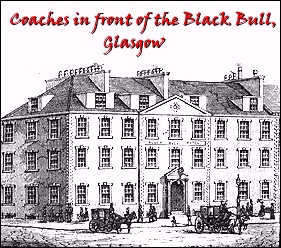
 City transportation, both public and
private, was linked to two things: financial success and the social
round. Initially, Glasgow’s domination of the tobacco trade saw her
leave well Edinburgh behind, but after the American War if Independence
the thirteen former colonies took it upon themselves to sell their own
tobacco to Europe at the best available price, thereby cutting out the
middle men – the Tobacco Lords of Glasgow. City transportation, both public and
private, was linked to two things: financial success and the social
round. Initially, Glasgow’s domination of the tobacco trade saw her
leave well Edinburgh behind, but after the American War if Independence
the thirteen former colonies took it upon themselves to sell their own
tobacco to Europe at the best available price, thereby cutting out the
middle men – the Tobacco Lords of Glasgow.
The second factor in limiting the growth
of transport in Glasgow was the city’s attitude to entertainment in
all its forms. Whereas theatres blossomed in the capital, they were
reviled and even burned down in the west of Scotland, particularly
Glasgow, wherever and whenever they arose. The result was that in
Edinburgh sedan chairs and carriages congregated outside the Theatre
Royal, Taylor’s Hall, the Caledonian, etc., while it was said of
Glasgow that in the third quarter of the 18th century, even
before the American Revolution, there were no hackney coaches and few
sedan chairs to be seen. Those that did exist were for the purpose of
conveying old ladies to the kirk.
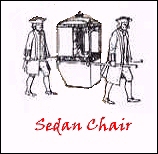 As the grip of religious tyranny in
Glasgow eased, so did everything else. The loss of the tobacco trade was
unfortunate but not calamitous. There was still rum and sugar from the
West Indies, cotton for the mills, calico printing and a great deal
more. By 1790, Glasgow had a population exceeding 60,000 and lines of
new houses took the place of the former green fields. Sedan chairs,
which were in short supply in an earlier time, never really caught on
because by then there was no shortage of hackneys. As a point of
interest that has little to do with transport, while Dr Reid could say
in the mid 18th century that he never heard an oath or saw a
drunken man, the male inhabitants of Glasgow now began to swear like
troopers, because that was the fashion in London and keeping up with
fashion had suddenly become the order of the day. As the grip of religious tyranny in
Glasgow eased, so did everything else. The loss of the tobacco trade was
unfortunate but not calamitous. There was still rum and sugar from the
West Indies, cotton for the mills, calico printing and a great deal
more. By 1790, Glasgow had a population exceeding 60,000 and lines of
new houses took the place of the former green fields. Sedan chairs,
which were in short supply in an earlier time, never really caught on
because by then there was no shortage of hackneys. As a point of
interest that has little to do with transport, while Dr Reid could say
in the mid 18th century that he never heard an oath or saw a
drunken man, the male inhabitants of Glasgow now began to swear like
troopers, because that was the fashion in London and keeping up with
fashion had suddenly become the order of the day.
For some reason no one can quite explain,
a form of conveyance sprang up in Glasgow at the start of the 19th
century that was never really accepted in Edinburgh. This was the ‘Noddie’,
which was a slightly lighter coach drawn by a single horse, and was
considered to be a great improvement in city transport. The decline of
the sedan chair around this time is recorded in the city records: 1800,
twenty-seven sedans; 1817, eighteen sedans, 1828, ten sedans. Thereafter
they rapidly disappear from history. In that same period the number of
hackney carriages rose to one hundred and fifty, and reflected the new
wealth of the industrial capital.
Although both London and Edinburgh
enjoyed a thriving trade in the buying and selling of gentlemen’s
second-hand carriages, this was never done in Glasgow. There, the man of
means paid up to 250 guineas for a new coach, and it was frequently
pointed out that the coaches of London and Edinburgh were the worst in
Britain, being drawn by the most wretched of animals, while the
gentlemen of Glasgow and Manchester had a reputation for only travelling
in vehicles of the highest quality. |



