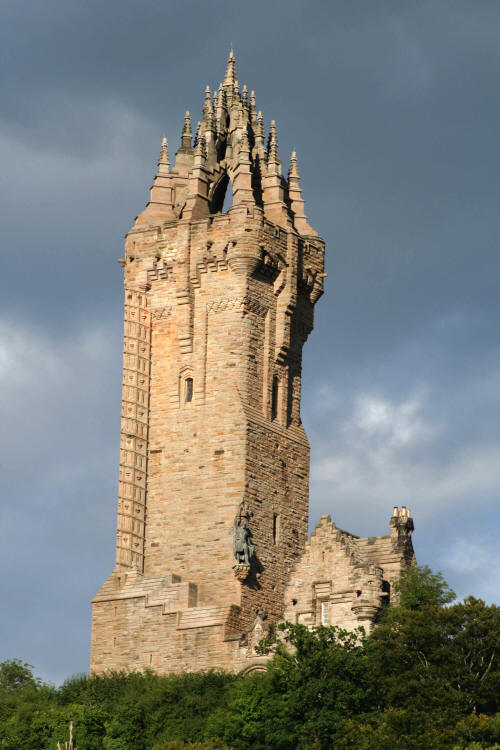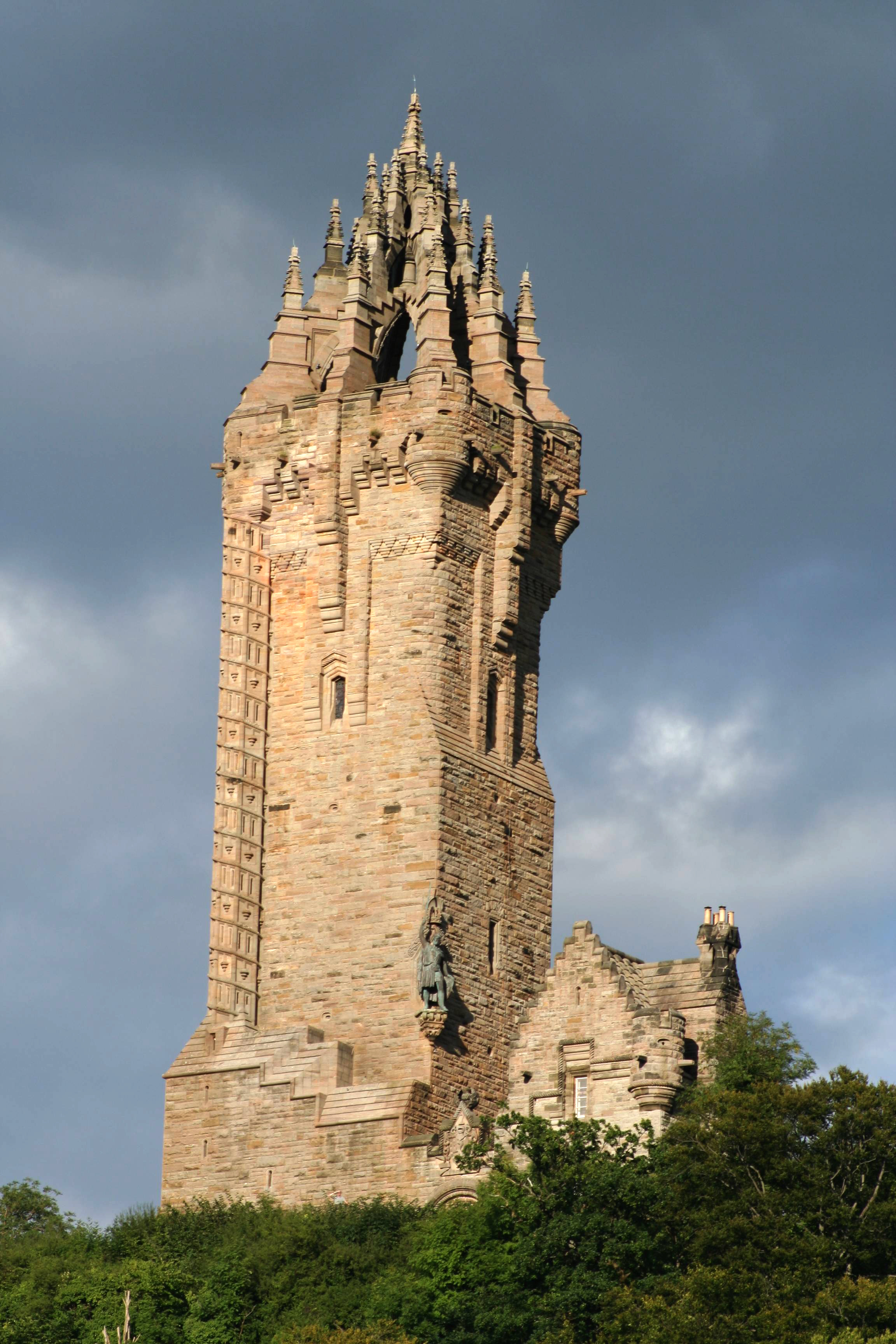
On the 23rd June 1861, it was raining in Stirling. Not an
unusual occurrence for Scotland with its swirling mists and unpredictable weather. On this
particular June day, however, a monument was being opened to the public, a monument which
still stands today in the 21st century as a reminder of William Wallace, one of Scotland's
famous heroes.
By midmorning the sun came out, and the crowds began to flock to
the festivities. Stirling Station was decked out with flags and other emblems and
commercialism was rampant even then as visitors found on sale special medallions to
commemorate the event. Others arrived in Stirling by horse drawn carriages and many walked
towards the Abbey Craig where the Wallace monument had been built. It was even reported
that local holidays had been declared in surrounding areas such as Falkirk and Alloa,
which accounts for the fact that some 80,000 visitors converged on Stirling that day to
swell the town population of around 100.000. You can well imagine the mass crowds
approaching this 220ft tower which dominates the surrounding plain and enjoying the
spectacular views from the well appointed position of the monument.
In the 1830’s a committee had been set up to build a
monument to the ‘Great Patriot’, Sir William Wallace. A tide of nationalism
swept the world in the 1850's and the Wallace monument was one of the ways this was
expressed in Scotland. A number of revolutions had taken place in Europe in 1848. These
nationalist forces in Italy led to the unification of Italy in 1860 and the German states
were finally united in 1871.
Other expressions of this Scottish nationalism were seen in the
setting up in 1853 of the National Association for the Vindication of Scottish Rights.
Concerned was being raised that some of the terms of the Act of Union were being broken.
In particular, England was displaying the St. George's flag in the navy when it had been
agreed that the Union Jack was to be used in all circumstances. At one point a meeting was
held in Glasgow when 5000 people attended. This campaign fizzled out, however, with many
seeing it as a rather minor grievance. Nevertheless, patriotic feelings had been aroused
and the Wallace monument campaign no doubt gained momentum from these earlier nationalist
feelings.
In 1850 the Rev Charles Rogers, chaplain of Stirling Castle, had
been appointed secretary in charge of raising funds for the monument. A funding campaign
had been launched throughout Europe, eliciting support from any leaders, including the
Italian patriot Garibaldi. Donations were pouring in from expatriate Scots on every
continent, and by 1859 the sum of £3,387 had been raised. It was decided to commission
the architect J T Rockhead to design and build a fitting tribute. The monument was not
completely finished until 1869 at a cost in excess of £10,000.
It may surprise some to realise that it took some 564 years
before Scots decided to raise a major monument to this national hero. It may also surprise
us to realise that many of those who gathered in Stirling in 1861 may well have had a
variety of notions about Wallace's place in Scottish history and an even vaguer
understanding of the facts surrounding the rebellion against Edward I of England.
For those who have seen the modern version of Wallace's exploits
in the film "Braveheart", there is clearly an issue of how far the events in the
film were embellished to make for good drama. There is one scene in the film, for example,
where Wallace's army is lined up against the English forces. The well known mystery of
what a Scotsman wears under his kilt is exploited by the Scots raising their kilts to
reveal their bare buttocks to the opposing army. What a cheek! But hardly historically
accurate one might think.
So why is it important to think of the past? And is it important
that we get our facts right? The Wallace monument is one of many landmarks still in
Scotland which illustrate that history is all around us. The growing interest in tracing
our ancestors is another example of our fascination with the past. Perhaps we want to
understand how we came to be the people that we now are or perhaps we want to learn from
our mistakes. History can make us proud of our past but it can also cause division and
hatred, as witnessed in the Balkan conflicts of recent times or the troubles in Northern
Ireland.
Yet we are drawn to the past by a human desire to understand
humanity in all its tragedy and triumph.
Perhaps you have some connections with Scotland, or simply have
a love for history. There are all sorts of opportunities for studying history and
Cumbernauld College in Scotland has developed three online Scottish History courses as one
option you might like to investigate. The courses are designed to allow access for
students at varying levels of ability and can be started at any time of the year.
The course relating to Wallace is "Scotland in the days of
Wallace and Bruce" where you will be able to explore the background to the Wallace
rebellion, follow the course of events, and look further to the rise of Bruce and his
enthronement as King of Scots.
In the course "Bonnie Prince Charlie and the Jacobite
Rebellions" you can pick up on the career of another leader who led a rebellion,
partly in response to the 1707 Act of Union, though you will find that there were other
motives behind Charlie's ill fated campaign.
Finally, you can dig in to the social and cultural changes which
took place in Scotland in the 18th and 19th century by signing up for the course
"Scotland: 1700 to 1850". Find out what changes took place in industry and
agriculture as a result of Scotland's union with England.
If you wish to discuss any of the issues raised in this article
or wish to join one of the courses, why not visit the Scottish History Forum at www.delphi.com or contact me at my email
address.
You may be embarking on a quest for historical understanding
which will become a lifetime interest.
Peter S. Lanigan
Scottish History Tutor (Cumbernauld College)
Scottish_history@compuserve.com