Women in
History of Scots Descent
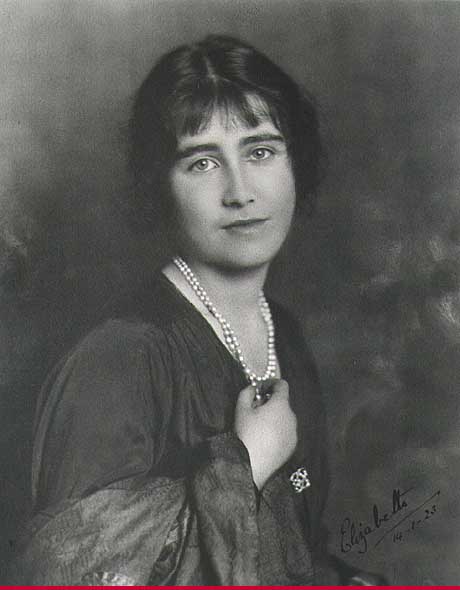
Her Majesty Queen Elizabeth, The Queen Mother
Her Majesty Queen Elizabeth The
Queen Mother is the mother of Queen Elizabeth II, the present British sovereign, and the
widow of the late King George VI. She was born the Honourable Elizabeth Angela
Marguerite Bowes-Lyon on 4 August 1900 (daughter of Lord Glamis, later 14th Earl of
Strathmore and Kinghorne) and spent her early childhood at St Paul's Waldenbury in
Hertfordshire, north of the capital. This was the country home of her parents. The
Bowes-Lyon family is descended from the Royal House of Scotland. One of The Queen Mother's
14th-century ancestors became Thane of Glamis, home of Macbeth 300 years before, and
Glamis Castle
is the family seat.
Childhood Lady Elizabeth was educated at home. By the age of 10, she was fluent in
French. When the First World War started - coincidentally on her 14th birthday - Glamis
Castle became a hospital. Although Lady Elizabeth was too young to work as a nurse, she
did assist with welfare work with the patients. One of her brothers, Fergus, was killed at
the battle of Loos in 1915.
Marriage and family From childhood days The Queen Mother and her older sisters had been
friendly with the children of King George V and Queen Mary. Occasionally members of the
Royal family stayed at Glamis Castle. In 1922 Lady Elizabeth acted as one of the
bridesmaids at the wedding of their daughter, Princess Mary. In January 1923 came the
announcement of her engagement to HRH The Duke of York, The King and Queen's second son.
They were married on 26 April 1923 in Westminster Abbey.
They
had two children, Princess Elizabeth, born on 21 April 1926 at the Strathmores' London
home, 17 Bruton Street, and Princess Margaret, born on 21 August 1930 at Glamis Castle.
Royal tours The Duke and Duchess made many overseas journeys. Six months after their
wedding they went to Belgrade, where they both stood sponsor at the christening of the
future King Peter II of Yugoslavia. Later they travelled to Kenya, Uganda and the Sudan,
and in 1927 they spent six months on a world tour, during which the Duke opened the
Federal Parliament of Australia in Canberra, the new capital.
Accession King George V died in January 1936. When King Edward VIII abdicated on 11
December the same year, the accession of the Duke and Duchess was proclaimed and they
assumed the
responsibilities of the throne. Their coronation took place on 12 May 1937.
Activities as Queen The King and Queen continued to visit other Commonwealth nations and
overseas countries. Between the coronation and the outbreak of war in September 1939 they
made two important visits: in July 1938 to France, and in May and June 1939 to Canada and
the USA.
With the outbreak of war in 1939, there was some suggestion
that the Queen and her daughters should evacuate to North America, but throughout the
Second World War the Queen and her children shared the dangers and difficulties of the
rest of the nation. She was in Buckingham Palace when it was bombed in September 1940. She
and the King visited badly damaged areas throughout the country after the air-raids, and
toured Britain visiting hospitals, factories and troops.
After the war, in 1947, they went on an extensive tour of
South Africa.
In 1948 the King and Queen celebrated their Silver Wedding.
Broadcasting to the nation, the King spoke movingly of the inspiration that he had
received from his marriage. Sadly, his health prevented him carrying out further
Commonwealth tours. The last major public occasion that he and the Queen attended together
was the opening of the Festival of Britain in May 1951. In autumn 1951, Princess Elizabeth
and The Duke of Edinburgh took his place on a tour of Canada, and did so again the
following January on a postponed visit to Australia and New Zealand. It was at the
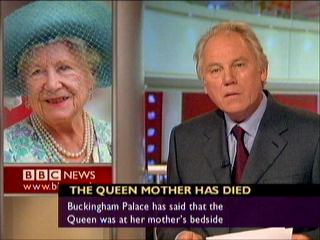
beginning of this trip that the King died peacefully at Sandringham, on 6 February 1952.
Public duties Since the King's death, The Queen Mother has continued her public duties
in the UK and overseas. These have included over 40 official visits abroad, including a
1989 visit to Canada which marked the fiftieth anniversary of her first visit there.
Her Majesty is Patron or President of some 350 organisations.
She is Commandant-in-Chief of each of the Army and Air Force Women's Services and for
Women in the Royal Navy. For many
years she was President of the British Red Cross Society, and she is Commandant-in-Chief
of the Nursing Division of the St John Ambulance Brigade.
She is also Colonel-in-Chief or Honorary Colonel of many UK
and overseas regiments, and Commandant-in-Chief of the Royal Air Force Central Flying
School. She has accepted honorary
degrees from many universities, and was Chancellor of the University of London for 25
years until 1981.
In 1978 Her Majesty was appointed Lord Warden and Admiral of
the Cinque Ports and Constable of Dover Castle.
Remarkable for her verve and energy, The Queen Mother remains
actively engaged in public life. In the summer of 1990, her ninetieth birthday was
celebrated with a parade and ceremonial on Horse Guards Parade. In her ninetieth year she
undertook 118 engagements throughout the UK. In 1995, The Queen Mother oficially opened
the VE (Victory in Europe) 50th anniversary commemorations in Hyde Park, London; she
appeared on the balcony at Buckingham Palace with her daughters, as they had in 1945. In
1997 she carried out 58 engagements.
Leisure activities In 1952 Queen Elizabeth moved out of Buckingham Palace to Clarence House
in St James's. In 1953 she bought the Castle of Mey, in the extreme north-east of
Scotland, and spends time there in August and October every year.
The Queen Mother also finds time to pursue her love of the
countryside and sport; she has been a keen and expert fisherwoman and enjoys horse-racing.
She remains at the centre of the Royal family's life, retaining the closest links with
every generation.
Honours The Queen Mother was created a Lady of the Garter in 1936, when she became
Queen. At the time of the coronation she became, as a Scottish Queen, the first Lady of
the Thistle ever created.
This comment system
requires you to be logged in through either a Disqus account
or an account you already have with Google, X, Facebook or
Yahoo. In the event you don't have an account with any of
these companies then you can create an account with Disqus.
All comments are moderated so they won't display until the
moderator has approved your comment.



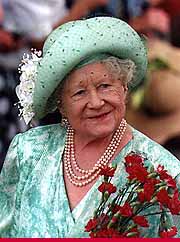 Her Majesty Queen Elizabeth The
Queen Mother is the mother of Queen Elizabeth II, the present British sovereign, and the
widow of the late King George VI. She was born the Honourable Elizabeth Angela
Marguerite Bowes-Lyon on 4 August 1900 (daughter of Lord Glamis, later 14th Earl of
Strathmore and Kinghorne) and spent her early childhood at St Paul's Waldenbury in
Hertfordshire, north of the capital. This was the country home of her parents. The
Bowes-Lyon family is descended from the Royal House of Scotland. One of The Queen Mother's
14th-century ancestors became Thane of Glamis, home of Macbeth 300 years before, and
Her Majesty Queen Elizabeth The
Queen Mother is the mother of Queen Elizabeth II, the present British sovereign, and the
widow of the late King George VI. She was born the Honourable Elizabeth Angela
Marguerite Bowes-Lyon on 4 August 1900 (daughter of Lord Glamis, later 14th Earl of
Strathmore and Kinghorne) and spent her early childhood at St Paul's Waldenbury in
Hertfordshire, north of the capital. This was the country home of her parents. The
Bowes-Lyon family is descended from the Royal House of Scotland. One of The Queen Mother's
14th-century ancestors became Thane of Glamis, home of Macbeth 300 years before, and