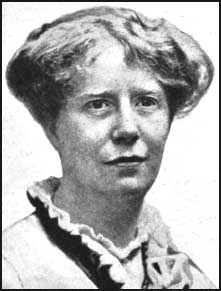
 Mary
Macarthur, the daughter of John Macarthur and Anne Martin, was born in Glasgow in 1880.
The couple had six children, but only three survived, all of them girls. Mary attended the
local school and after editing the school magazine, decided she wanted to become a
full-time writer. Mary
Macarthur, the daughter of John Macarthur and Anne Martin, was born in Glasgow in 1880.
The couple had six children, but only three survived, all of them girls. Mary attended the
local school and after editing the school magazine, decided she wanted to become a
full-time writer.
In 1895 the family opened a drapery business in Ayr and Mary was
taken on as a book-keeper. John Macarthur was a supporter of the Conservative Party and an
opponent of trade unions and sent his daughter to observe a meeting of the Shop
Assistants' Union. Mary was converted to the cause of trade unions by a speech made by
John Turner about how badly some workers were being treated by their employers. Mary
became secretary of the Ayr branch and at socialist meeting in the town, she met and fell
in love with Will Anderson, an active member of the Independent Labour Party.
In 1902 Mary became friends with Margaret Bondfield who
encouraged her to attend the union's national conference. Mary did, and was elected to the
union's national executive. Mary's political activities created conflict with her father
who had a strong hatred for socialism. Anderson proposed marriage but Mary decided to
pursue a career instead, and in 1903 moved to London where she became Secretary of the
Women's Trade Union League.
As well as her trade union activities, Macarthur was an active
member of the Independent Labour Party in London where she worked closely with two other
Scots, James Keir Hardie and Ramsay MacDonald. Macarthur was involved in the Exhibition of
Sweated Industries in 1905 and the formation of the Anti-Sweating League in 1906. The
following year she founded the Women Worker, a monthly newspaper for women trade
unionists.
Mary Macarthur was an inspirational figure and recruited many
women into the movement. This included Dorothy Jewson and Susan Lawrence, who both went on
to become Labour Party MPs. Active in the fight for the vote, she was totally opposed to
those women in the NUWSS and the WSPU who were willing to accept the franchise being given
to only certain categories of women. Macarthur believed that a limited franchise would
disadvantage the working class and feared that it might act as a barrier against the
granting of full adult suffrage. This made Macarthur unpopular with middle class
suffragettes who saw limited suffrage as an important step in the struggle to win the
vote.
Will Anderson followed Macarthur down to London and the couple
married in 1911. Anderson was elected to the House of Commons in 1914 but was defeated in
1918. Macarthur also stood as a Labour candidate, but like the others who opposed the
First World War, she was defeated in the 1918 General Election.
Mary was devastated when Will Anderson died in the 1919 influenza
epidemic. She continued her work with the Women's Trade Union League and played an
important role in transforming it into the Women's section of the Trade Union Congress.
Mary Macarthur died of cancer on 1st January, 1921.
(1) John Turner, an official of he Shop Assistants Union, met
Mary Macarthur in 1901.
I visited Ayr to open a branch of the Union, and a fairly
well-attended meeting was held in a rather dark and dreary schoolroom in an obscure part
of the town. Among those present I noticed an animated group of young ladies in the centre
of the room, with a laughing, vivacious, fair-haired girl in their midst. I immediately
turned my attention to them, and I remember even now that I felt I had got to arrest the
attention of this part of the audience if we were to get a branch opened. As soon as I sat
down, and questions had been answered, I made straight for this group, and asked the
fair-haired girl (who, I could tell was the leader) whether I could persuade her to join
the Union. This seemed to surprise her, and she smilingly said she feared she was not
eligible. I then learned that she was engaged in her father's business, and therefore she
expected it was not possible for her to join. She, however, frankly said that she thought
all the young ladies (who, she told me, were assistants in her father's shop) should join.
(2) Margaret Bondfield, A Life's Work (1948)
In 1902 Mary Macarthur came as a delegate, and leader of the
Scottish contingent, to the Newcastle Conference of the Union. I had written to welcome
her into the Union, but, when she came to meet me at the station, I was overcome with the
sense of a great event. Here was genius, allied to boundless enthusiasm and leadership of
a high order, coming to build our little Union into a more effective instrument.
(3) During the First World War Mary Macarthur was active
in the National Federation of Women Workers. Margaret
Bondfield, wrote about her activities in a A Life's Work
(1948)
Mary Macarthur had endeavoured for a long time to get a minimum
wage ruling for a very large class of operatives in munitions work. In 1916 she had
secured an award from the Munitions Tribunal for an increase in the wage rate for a large
firm in the Newcastle area employing 8,000 women. Week after week went by, and still the
firm was not given authority to pay the increased rate. One morning Mary was rung up, and the furious voice
of Winston Churchill, Minister of Munitions, asked her in effect what did she think she
was up to, allowing the girls to stop work. Mary answered that the girls had waited
patiently for the wages award granted them three months ago. She had not advised them to
come out, and she would not advise them to go back until the firm was instructed not only
to pay the rate, but promptly to pay the back money.
It was a stay-in strike, and the girls sat on their seats before
the machines, knitting socks for soldiers. Within twenty-four hours the authorization to
pay the rates came to the firm and work was resumed. |



