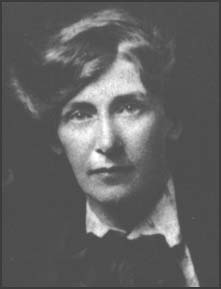
 Cicely Mary Hamilton, the daughter of Danzil Hammill and Maude Piers,
was born in Paddington on 15th June 1872. At the time of the birth, Hammill was a captain
in the Gordon Highlanders. When Cicely was ten years old, her mother disappeared from her
life. Although Cicely always refused to talk about the matter, it is believed her mother
was committed to an asylum. With Hammill serving in Egypt, Cicely was brought up by foster
parents. Cicely Mary Hamilton, the daughter of Danzil Hammill and Maude Piers,
was born in Paddington on 15th June 1872. At the time of the birth, Hammill was a captain
in the Gordon Highlanders. When Cicely was ten years old, her mother disappeared from her
life. Although Cicely always refused to talk about the matter, it is believed her mother
was committed to an asylum. With Hammill serving in Egypt, Cicely was brought up by foster
parents.
After an education at a boarding school in Malvern, Cicely became
a pupil-teacher. She disliked the work and soon found employment as an actress with a
touring company. It was during this time she changed her name from Hammill to Hamilton. In
1897 Hamilton joined a Shakespearian company led by the English actor, Edmund Tearle.
Over the next few years she appeared as Gertrude in Hamlet, Emilia in Othello and one of
the witches in Macbeth.
Unable to obtain leading roles on the London stage, Hamilton
decided to turn to writing. Her first play, The Traveller Returns, was performed at the
Pier Theatre, Brighton, in May 1906. This was followed by Diana of Dobsons. The play was
an immediate success and ran at the Kingsway, London, for 143 performances.
In 1908 Hamilton joined the Women's Social and Political Union.
However, Hamilton disliked the autocratic way that Emmeline Pankhurst ran the organisation
and after a few months left to join the Women's Freedom League. She was also a founder
member of the Actresses' Franchise League and the Women Writers Suffrage League. Hamilton
wrote two propaganda plays, How the Vote was Won (1909) and A Pageant of Great Women. She
also joined with the composer, Ethel Smythe, to write March of the Women.
Hamilton's most important contribution to the feminist movement
was the influential, Marriage as a Trade (1909). In the book Hamilton argued that woman
were brought up to look for success only in the marriage market and this severely damaged
their intellectual development.
On the outbreak of the First World War, Elsie Inglis, one of the
founders of the Scottish Women's Suffrage Federation, suggested that women's medical units
should be allowed to serve on the Western Front. With the financial support of the
National Union of Women's Suffrage Societies (NUWSS), Inglis formed the Scottish Women's
Hospitals Committee. Hamilton was one of the first women to join the organisation and in
November 1914 helped to establish the 200 bed Auxiliary Hospital at Royaumont Abbey in
France.
In the summer of 1916 Hamilton helped nurse soldiers wounded at
the Battle of the Somme. This included treating 300 new patients in three days. Others who
worked with her at Royaumont Abbey included Elsie Inglis, Louisa Martindale, Evelina
Haverfield and Ishobel Ross.
In May 1917 Hamilton left the Scottish Women's Hospital Unit and
joined the Women's Auxiliary Army Corps. After training in England, Hamilton returned to
France where she took control of a postal unit. However, soon afterwards, she was asked to
form a repertory company at the Somme. For the rest of the war Hamilton's company
performed a series of plays for Allied soldiers fighting on the Western Front.
After the war Hamilton became a freelance journalist working for
newspapers such as the Daily Mail, the Daily Mirror and the Daily Express. She was also a
regular contributor to the feminist journal, Time and Tide where she campaigned for free
birth control advice for women and the legalization of abortion.
Hamilton's autobiography Life Errant, was published in 1935.
Other books written by Hamilton include Modern Italy (1932), Modern France (1933), Modern
Russia (1934), Modern England (1938), Lament for Democracy (1940) and The Englishwoman
(1940). Cicely Mary Hamilton died on 6th December, 1952.
(1) On 23rd December, 1909, the newspaper of the
Women's Freedom League, The Vote, wrote an account of
how Cicely Hamilton and Bessie Hatton formed the Women
Writers Suffrage League.
One night Miss Hatton was at the Dramatic Debates where she heard
Miss Cicely Hamilton speak on the suffrage. She was immensely struck by her earnestness
and the power she exercised over the small audience, which was composed largely of
"indifferents". The next day she wrote to Miss Hamilton and said how much she
enjoyed her speech. She received a prompt reply to which was expressed the desire to found
a Women Writers Suffrage League, "If only someone would undertake the
secretaryship." This wish was immediately fulfilled by Miss Hatton.
(2) Cicely Hamilton wrote about Auxiliary Hospital at
Royaumont Abbey in her autobiography, Life Errant (1935)
Our bedrooms were monks' cells with stone walls and mullioned
windows. There was a mattress on the floor, a packing case for a bureau, basin and water
jug and a rubber bath, as there were no staff bathrooms. Bats frequently flew around the
room at night as monastic windows could not be screened and nightingales sang outside.
(3) In her autobiography, Life Errant , Cicely Hamilton
described an elderly French civilian receiving the Croix de
Guerre on behalf of his dead son.
When the ribbon was pinned on the workman's coat, a woman beside
me stirred and drew a breath - a young woman dressed all in black; and then, the ceremony
over, she went forward to meet the old man. I remember a thin fine rain was falling, and
they said not a word as they met; but the woman took out a square of white handkerchief,
unfolded it, spread it on her hands, and stood waiting. The father unfastened the cross
from his coat and laid it on the linen, and they stood in the rain and looked down on
it... all they had received in exchange for the life of a man. Then, slowly, they
walked away together; she was carrying the medal as a priest might carry the Host.
(4) Cicely Hamilton, letter to the Society of Authors (11th
November, 1917)
At present I am struggling to establish a small repertory theatre
for the troops in one of the army areas; the difficulties are enormous of course as one's
arrangements are liable to be upset at any moment - one of the best actors has just been
snatched away as a minor consequence of the German advance into Italy. All the same we get
along somehow and Miss Ashwell (under whom I am working) is increasing my company as far
as women are concerned.
(5) Cicely Hamilton, Senlis (1917)
Modern warfare is so monstrous, all-engrossing and complex, that
there is a sense, and a very real sense, in which hardly a civilian stands outside it;
where the strife is to the death with an equal opponent the non-combatant ceases to exist.
No modern nation could fight for its life with its men in uniform only; it must mobilize,
nominally or not, every class of its population for a struggle too great and too deadly
for the combatant to carry alone.
(6) Cicely Hamilton, Life Errant (1935)
If and when our civilization comes to its ruin, the destructive
agent will be Science; man's knowledge of Science, applied to warfare, meaning slaughter
not only of human bodies, but of human institutions, of all we have created through the
centuries.
|



