|
Scots-born Canadian
American Alexander Graham Bell's first practical telephone emerged in
1876 after a race to the patent office. Now the landline, as we know it,
will very soon be no more in the land of his birth along with the rest
of the UK.
Bell's invention was not without controversy. To this day he is accused
of "stealing" it from a prototype by US electrical engineer Elisha Gray.
But Bell's patent was upheld in court with his integrity remaining
unblemished.
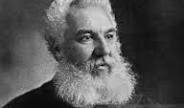
Alexander Graham Bell
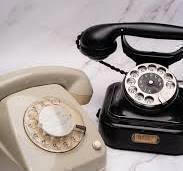
Classic Telephone models
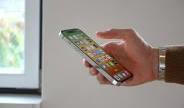
Today's mobile equivalent
Landline phones will be
switched off across Britain next January 31 with "no extensions."
Openreach, infrastructure of BT Group, has circulated the warning to
communications providers that use its network to deliver services.
Those still on legacy public switched telephone network (PSTN)
connections will be at risk of disruption if they do not heed the switch
off directive.
Elderly & Vulnerable Warning
Beyond the landline PSTN systems include business point-of-sale
terminals, fire and security alarms and personal care alarms for elderly
and vulnerable folks.
It is part of a wider government scheme to get the UK onto all-digital
high-speed networks running on fibreoptic infrastructure with legacy
copper cabling a thing of the past.
The Register reports public awareness seems pretty well non-existent to
the change and Age UK warns that with only three months to go the
digital landline switchover has entered a critical final phase.
"Responsibility cannot rest with customers alone and providers must not
give up on people who have not responded, recognising some may be
unwell, living with dementia, worried about scams or without anyone
nearby to help."
Teacher of the Deaf
Edinburgh-born and university educated Alexander Bell died aged 75 in
Nova Scotia. He was much more than an inventor being also an engineer,
professor and teacher of the deaf. It was whilst concentrating on the
latter that he accidentally came upon the telephone!
He subsequently co-founded AT&T the American and Telegraph Company in
1885.
Both his mother and wife were deaf and this profoundly influences Vell's
lifework with research on hearing and speech leading him to experiment
with devices that eventually led to the first US patent for the
telephone on March 7, 1876.
In reality Bell viewed the phone as an intrusion on his real work as a
scientist and, apparently, refused to have one in his study as he
devised other groundbreaking work including optical telecoms, hydrofoils
and aeronautics.
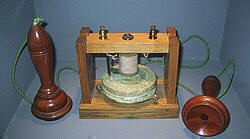
Bell system devised in 1877

Melville House, Bell's first home now
a National Historic Site of Canada
Wikipedia notes that in
1872 Bell became professor of Vocal Physiology and Elocution at Boston
University School of Oratory where he was "swept up" by the excitement
engendered by the many scientists and inventors living in the city.
He continued his research in sound endeavouring to discover a way to
transmit musical notes and articulate speech and was known to lie awake
at night, running experiment after experiment in his head.
The Phonautograph
By 1874 his initial work on the harmonic telegraph had entered a
formative stage and he experimented with a "phonautograph" pen shaped
machine drawing shapes of sound waves on smoked glass by tracing
vibrations.
Telegraph messaging traffic was rapidly expanding becoming "the nervous
system of commerce," according to Western Union.
The following year Bell developed an acoustic telegraph drawing up a
patent application with an Ontario associate requested to do the same in
Britain.
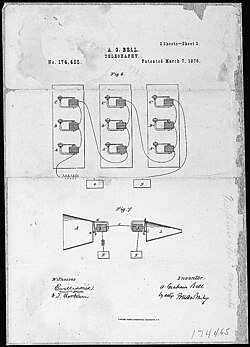
Telephone Patent Diagram
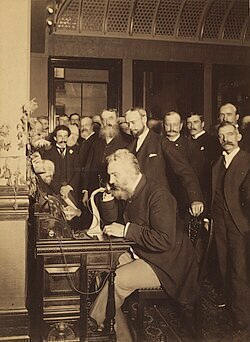
Bell makes that first call
In January 1915 Bell made
the first ceremonial transcontinental telephone call from the AT&T head
office at 15 Dey Street City in New York City. Its value was
acknowledged throughout the world with patent applications made in most
major countries.
Bell remained a British subject throughout his early life in Scotland
and later in Canada until 1882 when he became a naturalized citizen of
the United States.
On learning of his death in 1922, Canadian Prime Minister Mackenzie King
cabled Mrs Bell, when he said of her husband and the telephone: "...It
will ever be a source of pride to our country that the great invention,
with which his name is immortally associated, is a part of its history." |



