|
The House of Gask - the
“auld house” of Lady Nairne’s song - in the middle of the eighteenth
century stood upon a hill in the Strath of Earn, a curious, rambling
house, which owed its interest to its quaintness and the picturesqueness
of its situation. There lived Laurence Oliphant, the laird, descendant of
an old family as proud as it was ancient, a Jacobite of the Jacobites, who
loved the Stuarts with all the adoration of his absurd old soul. To win
his undying favour it was only necessary for a neighbour to present him
with a relic of the Royal house - a garter, a brogue, or spurs worn by His
Royal Highness. To look at - but for heaven’s sake not to touch - the
sacred memorials, a lock of Prince Charlie’s red hair, his bonnet, his
cockade or crucifix, was with him almost a religious service. With
indignation he bundled off Mr. Cruikshank the chaplain’s gown and books by
carrier when he learned that he had, on the death of Prince Charles, begun
to pray for George III.; for a “nominal” prayer - that is, one in which
the Hanoverian usurper was mentioned by name - was an abomination. With
what care had he and his wife conveyed to Florence the piece of seed-cake
which the hands of Mrs. Forbes, the nonjuring bishop’s wife, had prepared
for His Majesty’s delectation; and with what joy he reported that when his
sacred Majesty took it in his hands, he opened a drawer and graciously
said: “Here you see me deposit it, and no tooth shall go upon it but my
own.” There was something so sturdy, so honest, so loyal in his disloyalty
that King George sent him his fine message, couched in phrases to
conciliate his heart: “The Elector of Hanover presents compliments to the
laird of Gask, and wishes to tell him how much the Elector respects the
laird for the steadiness of his principles.” [Oliphant’s Jacobite Lairds
of Gask, p. 368.]
When Lady Gask died her
last words to the children gathered round her were: “See which will be the
best bairn to papa.” To that household came the governess whom the aunt
provided, with this recommendation: “Mr. Oliphant joyns me in thinking
there is no better sign than diffidence in what one knows nothing about,
therefore has no doubt Mrs. Cramond (for you know I cannot call her Miss
when a governess) will make herself usefull to ye children with a little
practice in many things besides ye needle, particularly as to behaviour,
principles of Religion and Loyalty, a good carriage and talking tolerable
English which in ye countrie is necessarie that young folks may not appear
clownish when presented to company.” [Oliphant’s Jacobite Lairds of Gask,
p. 387.] From which it would appear that Lady Henrietta’s own
accomplishments did not entitle her to be too exacting in the
qualifications of a governess, especially as the remuneration was to be
twelve guineas for the first year and ten guineas “ever after.” Mr.
Marconchi, the foreign fiddler, walked over from Perth once a week to
teach the art of dancing and the harpsichord to the family of two sons and
four daughters.
Caroline - whose baptismal
name veneration for Prince Charles had once more made popular in Jacobite
circles - was born in 1766, the third of the family, and she grew up
reserved and dignified into a tall beauty with dark eyes and hair, the
toast of the country as the “Flower of Strathearn.” At the county balls
she danced with so fine a grace and skill, that the eyes of little Neil
Gow, the prince of fiddlers, would gleam with delight as he watched her
threading the gladsome windings of a strathspey. In 1792 the laird of Gask
died - the soldier of the ’45 who suffered long, though he was not
long-suffering, from his aches and ails, which the abominable concoctions
prescribed as sovereign cures by his friend the laird of Thriepland had
helped to intensify. He was true to the end to the Stuart cause, and never
forgot when proposing a toast to look at his handsome son Charles, and to
say with significant accent: “The King - Charles.” Never had he permitted
any who read the newspapers to him to mention George III. and his queen,
except as “K” and “Q.” In such Jacobite associations his sons and
daughters grew up.
It was at a tenantry dinner
given by the new laird that Miss Caroline Oliphant heard sung “The
Ploughman,” a coarse song with a good Scots air. Vexed at finding such
songs pleasing the people at their rustic meetings, and disgusted, as she
passed through a country fair, to notice the broadsides and ballads which
were greedily bought from barrows and pedlars’ packs, she became filled
with desire to make verses more wholesome, and not less attractive, to
take their place on the people’s lips. This she did in secrecy. It was the
ancestral enthusiasm for the good old cause which then and afterwards
quickened her fancy to write such songs as “Charlie is my darling,” “Will
you no come back again?” “A Hundred Pipers,” - with their romantic
sentiment and martial strain that make the pulse beat faster - songs
produced when the Jacobite cause was dead as Queen Anne, and when no
romance or song could stir it to life again. Who imagined there could come
from that stately damsel, and afterwards so proud a dame, with whom humour
could scarce venture to dwell, the lively “John Tod” and “Laird o’ Cockpen,”
which generations should sing with never-failing glee; or the humble
“Caller Herrin’,” with its charming refrain caught from the sound of the
chimes of St. Giles’ in Edinburgh? Fond recollection of Gask she enshrined
in the “Auld House,” with its “auld laird, sae canty, kind, and crouse.”
But in the “Land o’ the
Leal” the poet rose to her highest level, from the beginning “We’re wearin’
awa, John” to its close, in which the simplicity of true pathos moves with
rare and tender touch.
In those days and for
several years she was engaged to her cousin, Charles Nairne; but they were
both poor, the young man having remote prospects of promotion in the army.
“Miss Car the pretty,” as she was called by the people, was no longer the
beauty at every county ball, the bloom of the “Flower of Strathearn”
became somewhat faded as she matured into the staid, stately, handsome
lady of forty. It was then, however, when her cousin, at the mature age of
fifty, became a major, that the long engagement issued in a happy
marriage, and life in Edinburgh in a frugal home called “Caroline
Cottage.” They were poor, that high-bred couple, and they were
pronouncedly proud; they belonged to the exclusive aristocratic set which
was dwindling away in that city as London became the resistless centre of
attraction for all who had claims to rank or position. Sydney Smith’s
description of Edinburgh society as “a pack of cards without honours” was
becoming true.
The new century had gone on
its way some years when one day there called on Mr. Purdie, the
music-seller, a lady giving the name of Mrs. Bogan of Bogan, who had
already corresponded with him, transmitting songs in a feigned
handwriting. Mrs. Nairne appeared before the worthy tradesman in the guise
of an old lady of a bygone generation - which after all was on her part no
very great deception - and told him of songs she had got to publish. This
was good news, because the Scottish Minstrel was being compiled by him;
and accordingly with extraordinary mystery verses set to well-known airs
by “Mrs. Bogan of Bogan” were produced. [Songstresses of Scotland, ii.
130.] For years the exquisite song, the “Land o’ the Leal,” had been
familiar throughout the land; the pathos of Scots hearts seemed voiced by
it as by no other song, and to the strains of “We’re wearin’ awa, John, To
the Land o’ the Leal,” eyes had grown dim with tears. Mrs. Nairne had
heard them praised and seen them bewept; and had noticed with a fret the
words changed to “Wearin’ awa, Jean,” but she said nothing. With
inexplicable reticence she even kept the secret of authorship from her own
husband, spreading a newspaper over her manuscripts if he came into the
room. This may have been caused by doubts as to her husband’s powers of
keeping a secret; but it was due also to that self-contained nature, that
resolute reserve, which made her avoid with impatience the kiss which the
bridegroom offered after the chaplain at Gask had married them.
In 1824 George IV. made his
memorable visit to Scotland, when Sir Walter Scott worked himself up into
grotesque enthusiasm in welcome of the not too respectable monarch. A
memorial was prepared by Sir Walter praying His Majesty that the title
forfeited by the Rebellion might be restored to Major Nairne. The petition
was granted, and Major Nairne became a lord before he died in 1824.
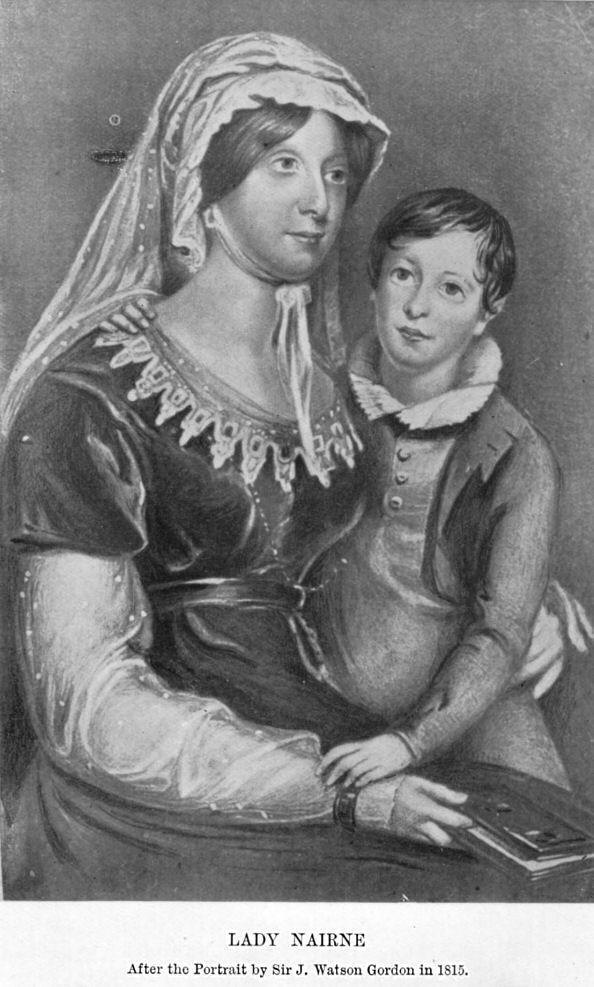
In her later years Lady
Nairne was involved in the atmosphere of pietism which began to prevail
over Scotland, dating from the pious crusade of the Haldanes. Secular
amusements - save painting - were no longer to her mind, the fashions of
the world that pass away were no more to the taste of her who had in
unregenerate days written the “Laird o’ Cockpen.” She had always been
religious, though the humour would bubble over into fun in her songs. In
later years the wave of evangelicalism went over her head, as it did over
that of Susan Ferrier, who, it must with sadness be confessed, like Hannah
More, degenerated as a writer as she became regenerated as a Christian. As
years went on she returned to Gask, to which her nephew, the laird, had
urged her to return. But it was not the “Auld House.” That had been
knocked down, and a more pretentious dwelling built in expectation of a
fortune that never came. With the quaint old home departed associations
with the olden time. In the new house, amidst her kith and kin, Baroness
Nairne died, and with her the last of the band of Scots songstresses of
the eighteenth century passed away. [Rogers’s Life and Poems of Lady
Nairne.] |



