|
 Mention
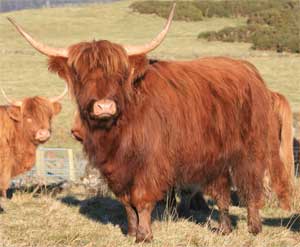
Scottish Highland Cattle and people conjure up images of rugged and wild
mountain landscapes, misty hills, heather clad moorland, lonely long
horned cattle grazing in
isolation.
This is the image we have inherited from the Victorian landscape artists,
it isn’t to far from the truth, but it is far from the full story of the
Highlander. Mention
Scottish Highland Cattle and people conjure up images of rugged and wild
mountain landscapes, misty hills, heather clad moorland, lonely long
horned cattle grazing in
isolation.
This is the image we have inherited from the Victorian landscape artists,
it isn’t to far from the truth, but it is far from the full story of the
Highlander.
Archaeological evidence can place Highland Cattle back in the sixth
century whilst written records go as far back as the twelfth, yet no one
can determine the exact origins of the breed. What is known is they’re the
oldest pedigree breed of cattle in the world and the first breed to be
registered. The Highland Cattle Society's first herd book dates from 1884.
 Originally
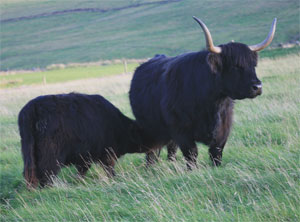
there were two types.
Kyloes,
these were small and black in
colour, and
were associated with the West of Scotland and the Islands, whilst the
larger red haired cattle grazed the Highlands. Today they are known
collectively as Highland Cattle and the
recognised colours
are red, black, yellow, dun, white, brindle and silver. Originally
there were two types.
Kyloes,
these were small and black in
colour, and
were associated with the West of Scotland and the Islands, whilst the
larger red haired cattle grazed the Highlands. Today they are known
collectively as Highland Cattle and the
recognised colours
are red, black, yellow, dun, white, brindle and silver.
The correct name for a herd of Highlands is a Fold and that
long almost comical fringe is called a Dossan. Highlands don’t have a fat
layer hence their long double layered ‘hairy’ coat which combined with
sweeping horns makes them so recognizable.
 Some
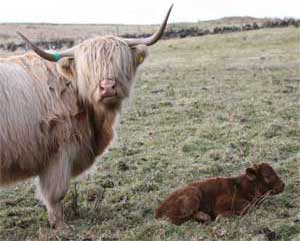
little known facts associated with Highland Cattle is they thrive on poor
grazing, so their ability to improve scrubland makes them a valuable asset
in conservation grazing. That thick woolly coat is cast in summer but in
winter they can survive in the harshest weather. In Sweden they are the
only cattle allowed to out winter by law! Some
little known facts associated with Highland Cattle is they thrive on poor
grazing, so their ability to improve scrubland makes them a valuable asset
in conservation grazing. That thick woolly coat is cast in summer but in
winter they can survive in the harshest weather. In Sweden they are the
only cattle allowed to out winter by law!
Highland Cattle don’t have a fat layer like other cattle, because of this
Highland beef is lean. Independent testing has shown that highland beef is
lower in cholesterol than chicken and also contains less fat, due to that
special thick insulating double layered coat. Tests done by the Scottish
Agricultural College have proven that Highland Beef is significantly lower
in fat and cholesterol, and higher in protein and iron than other beef.
Today Highland Cattle can be found around the World with
many countries having their own Societies and Herd books. They can be
found all over America, Canada, the Australia’s and Europe, but hazard a
guess and like most Scots, deep down, their hearts are still Highland.
See
http://www.highlandcattleworld.com for more details.
 |



