|
The Otter: Habits — Catching of — Shooting — Attachment to each other —
Anecdotes — Fish killed by.
HAVING lately seen the
tracks of three or four otters about the edge of the burn, I had some
strong traps placed on a sandbank where they were in the nightly habit of
landing. For some unknown reason of their own, they appeared to leave the
water at this bank, and, after going round some alder bushes, to
return again to the pool. We placed the traps with great care, fastening
them strongly, and covering them with sand. Before setting the trap for an
otter, both the hands of the person who sets it and the trap itself should
be well washed and rubbed with sand, in order to take away the human scent
as much as possible. After setting the trap, a small branch of a tree
should be used to smooth the ground and obliterate all footmarks, and then
dipping the branch in the water, the whole place should be well sprinkled,
which generally does away with all marks of people having been about it.
As otters invariably have some particular points at which they leave the
water, it is easy to know where to place the trap. They do not, however,
always hunt the same part of a stream, so the trapper must have some
patience. After our traps had been set for two nights, we found, on going
to them in the morning, that an otter had been caught, and by twisting the
chain round the root of a tree had contrived to break it, and escape with
the trap on its leg. I sent home for my retriever, who, from having been
severely bitten by other otters, was very eager in pursuing them. We
hunted up and down the burn for some time in vain; at last we found his
track and that of the trap in the sand at a shallow place of the water.
This encouraged us, and we renewed our search. At last, nearly a mile from
where the trap had been set, the dog began to run up and down the bank,
whining and showing evident symptoms of perceiving, or, as my old keeper
called it, " feeling" the smell of the otter. He could not make out
exactly where it was, till at last corning to a dead stop opposite a
quantity of floating branches and roots that had collected at a turn of
the water, he pointed for a moment, and then springing in, pulled out a
large otter with the trap still on him. It was rather difficult to know
whether the otter was bringing the dog, or the dog the otter, so
vehemently did they fight and pull at each other; but we ran up, and soon
put an end to the battle. The next morning I found another otter in the
traps. Nothing could keep the dog from him; the moment he came within
three hundred yards of the place he smelt him, and rushed off to attack
him. A few nights afterwards, the moon being bright and the air quite
still, my keeper determined to lay wait for the remaining otter. His track
showed that he was a very large one, and he seemed too cunning for the
traps. The man's plan was to make himself a 'small hiding place, opposite
a shoal in the burn, where the otter must needs wade instead of swimming.
We had come to the conviction from the tracks that the otters remained
concealed during the day time a considerable way up the water, and hunted
down the burn during the night to where it joined the river.
It was a fine calm December
night, with a full moon. The old man, wrapped in a plaid, and with a
peculiar head-dress made of an old piece of drugget, which he always wore
on occasions of this kind, took up his position at six o'clock. Before
nine the otter was killed, having appeared, as he had calculated, on its
way down to the river.
This is one of the surest
ways of killing this animal when he frequents a river or brook which in
pasts is so shallow as to oblige the otter to show himself in his nightly
travels. They appear to go a considerable distance, generally hunting down
the stream, and returning up to their place of concealment before dawn. At
certain places they seem to come to land every night, or, at any rate,
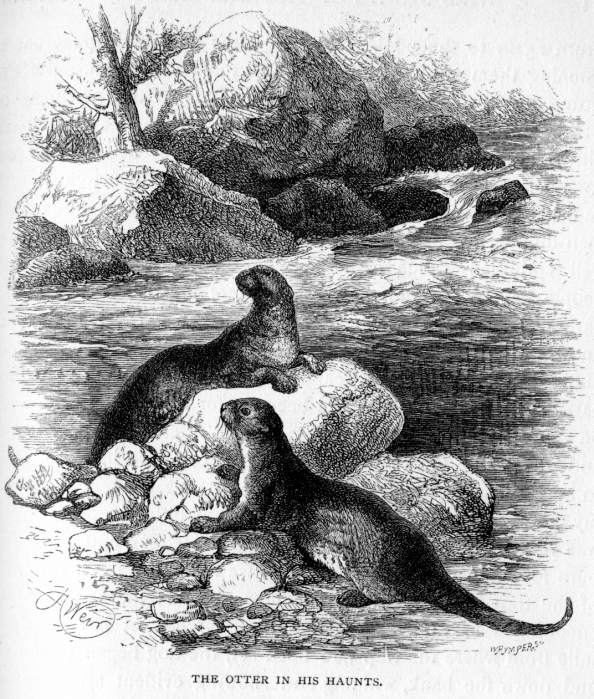
every time that they pass that way. In solitary and undisturbed situations
I have sometimes fallen in with the otter during the day. In a loch far on
the hills, I have seen one raise itself half out of the water, take a
steady look at me, and then sink gradually and quietly below the surface,
appearing again at some distance, but next time showing only part of its
head. At other times I have seen one floating down a stream with no
exertion of its own which could attract notice; but passing with the
current, showing only the top of its head and its nose, with its tail
floating near the surface, and waving to and fro as if quite independent
of all restraint from its owner. If he fancies that he is observed on
these occasions, down he sinks to the bottom, where he lies quietly as
long as he can do without air; and when obliged to rise to breathe, he
comes up close to the bank, or amongst weeds, with 'only his nose above
water. If, however, the water is clear, and you persist in watching him,
and by quickly approaching him, oblige him constantly to dive, the poor
beast will at last in sheer despair crawl out on the bank, concealing
himself in the best manner he can. But it takes some time to oblige him to
do this.
Otters are very
affectionate animals. If you shoot an old one who has young in the
vicinity, they very soon appear searching anxiously for their mother; and
if you kill the young ones, the parent will come boldly to the surface,
and hover about the place till she is killed herself. When a pair of
otters frequent a place, if one is killed, the other will hunt for its
lost mate in the most persevering manner. If one is caught in a trap, the
other remains all night near her, running round and round, in vain trying
to get her away. Though usually so noiseless and quiet, on these occasions
they make a great hubbub, blowing and snorting almost like a swimming
horse.
Sometimes they lie all day
on some small island or bank covered with rushes, ready to slip down into
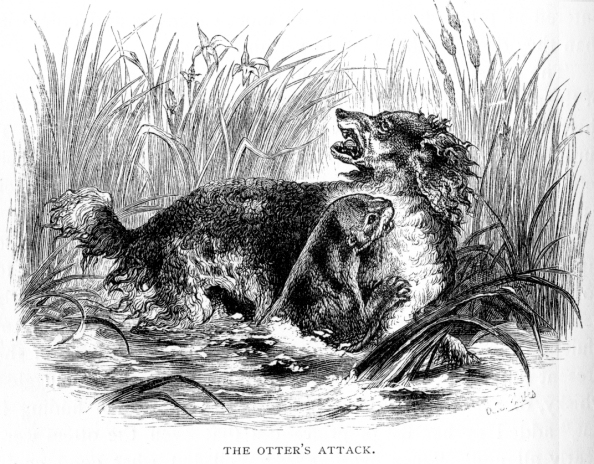
the water on the approach of danger. I was one day in August looking for
young wild ducks in a swamp covered with rushes and grass, when my dog,
who was running and splashing through the shallow water, suddenly stood
still, sometimes whining as if caught in a trap, and then biting furiously
at something in the water. I could not imagine what had happened to him,
and he either would not or could not come to me when called, so I waded
over to see what was the matter. I found a large otter firmly holding on
'by his powerful jaws to the dog's shoulder, and had he not had a good
covering of curly hair, I believe the brute would have broken his leg, so
severe was the bite : even when I came up the otter seemed very little
inclined to let go; but at last did so, and I shot him as he splashed
away.
When one of these animals
is surprised in an open place, he will for some time trust to being
concealed, remaining fiat on the ground, with his sharp little eyes, which
are placed very high on the head, intently fixed on you. Like all other
wild animals, he has an instinctive knowledge of how long he is
unperceived, for the moment he sees that your eye is on him, he darts off,
but not till then. During the winter many of the river and lake otters
take to the coast, travelling a long way for this purpose, sometimes
keeping the course of the streams, but occasionally going across the
country. I have seen their tracks in places at a very great distance from
water, where they evidently had been merely passing down to the sea.
When on the coast, they
frequent the caves and broken masses of rock. The otters that live wholly
on the coast grow very large. It is easy to turn them out of their holes
with terriers, as long as you remain quiet and unobserved by the otter
yourself. If he once has found out that you are waiting to receive him at
the mouth of his hole, he will fight to the last rather than leave it. I
have been told that they bolt more readily to a white-coloured dog than to
any other. All courageous dogs who have been once entered at otters, hunt
them with more eagerness and animosity than they do any other kind of
vermin.
The otters here are very
fond of searching the shallow pools of the sea at the mouth of the river
for flounders, and I often find their tracks, where they have evidently
been so employed. If surprised by the daylight appearing too soon to admit
of their returning to their usual haunts, they will lie up in any broken
bank, furze bush, or other place of concealment.
At some of the falls of the
Findhorn, where the river runs so rapidly that they cannot stem it, they
have to leave the water to go across the ground; and in these places they
have regularly beaten tracks. I was rather amused at an old woman living
at Sluie, on the Findhorn, who, complaining of the hardness of the present
times, when "a puir body couldna get a drop smuggled whisky, or shot a rae
without his lordship's sportsman finding it out," added to her list of
grievances that even the otters were nearly all gone, "puir beasties."
"Well, but what good could the otters do you?" I asked her. "Good, your
honour? why scarcely a morn came but they left a bonny grilse on the scarp
down yonder, and the vennison was none the waur of the bit the puir beasts
eat themselves." The people here call every eatable animal, fish, flesh,
or fowl, venison, or as they pronounce it, "vennison." For instance, they
tell you that the snipes are "good vennison," or that the trout are not
good "vennison" in the winter.
It seems that a few years
ago, before the otters had been so much destroyed, the people on
particular parts of the river were never at a loss for salmon, as the
otters always take them ashore, and generally to the same bank or rock,
and when the fish are plenty, they only eat a small piece out of the
shoulder of each, leaving the rest. The cottagers, aware of this, were in
the habit of looking every morning for these remains.
 |



