|
Different kinds of Gulls: Large Collections of — Breeding-places —
Islands on a Loch — Eggs of Gulls — Young Birds — Food and Voracity of
Large Gulls: Salmon-fry killed by — Boatswain-Gull - Manner of procuring
Food.
As great a variety of the
gull tribe frequents the Findhorn Bay and. the Moray Firth as perhaps is
to be seen in any one locality in Great Britain. To the uninterested
passer-by a gull is a gull, and nothing more, whether the race is
represented at the moment by that splendid bird, the great black-backed
gull, Larus marinus, or by the small but elegant black-headed gull, Larus
ridibundus of Linnaeus, or as Buffon, alluding also to its laugh-like cry,
calls it, la Mouette rieuse. Yet, if closely observed, every kind of gull
has its own peculiar ways and habits, all of which are worthy of note, and
adapted to its own manner of feeding and providing for its wants. During
March and April the black-headed gull, which has been absent during the
winter, returns in innumerable flocks. After sunset they hold long
consultations on the sands of the bay, and when the night is calm I can
hear them from my windows at the distance of nearly two miles chattering
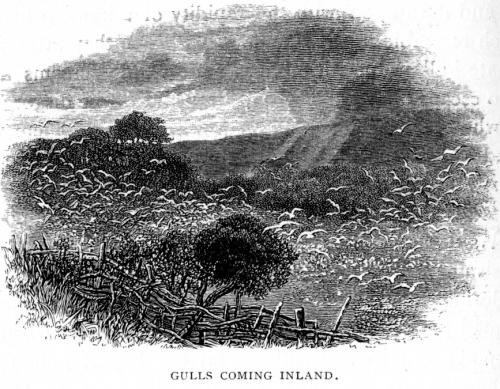
and clamouring for hours together. In the daytime they frequent the
fields, and wherever a plough is at work there are the black-headed gulls
in thousands, hovering over the ploughman's head, and keeping up such a
continual screaming, that I have seen both man and horses fairly
bewildered by the noise. A man left his plough and came to me the other
day, as I was passing in the next field, to beg me to fire a shot or two
at these noisy and uninvited followers. As fast as a worm or grub is
turned up by the plough, down drop two or three gulls to scramble for it.
In this manner they soon get the necessary supply of food, and return to
join the assembly on the sands, where, having drunk and bathed, they
remain for the rest of the day. After passing a fortnight or more in this
manner, they betake themselves to their breeding-place, which is generally
either some rushy and quiet pool or island on some mountain lake, where
they can breed and rear their young unmolested. There are several lochs in
this neighbourhood where they breed. One they chiefly resort to is a small
piece of water in the forest of Darnaway, where they are not allowed to be
annoyed or disturbed during the time of incubation. In these places their
nests are placed as close as possible to each other, and from the constant
noise and flying backwards and forwards of the birds, one would suppose
that the greatest confusion must prevail amongst their crowded
commonwealth, but every bird knows and attends to her own nest, and though
their cries sound angry and harsh, the greatest amity and the strictest
peace are preserved. Though crossing and jostling each other in all
directions, they never appear to quarrel or fight. On the contrary, the
birds all unite and make common cause against any enemy, man or beast,
that approaches them, or whose presence seems to threaten danger. I once
took a boat to a mountain lake in Inverness-shire, where thousands of
these birds bred on some small islands which dot the surface of the water.
The gulls, though not exactly attacking me, dashed unceasingly so close to
my head that I felt the wind of their wings, and I sometimes really feared
some one more venturous than the rest might drive his bill into my eyes.
They had probably never had a visitor to their islands before. The
shepherds, having a kind of superstitious dread of the place, from its
being supposed to be haunted ground, never attempt to cross to the islands
by swimming or wading.
The greater part of the
largest island was absolutely covered with eggs, laid in small hollows
scraped by the birds, with little pretensions to any other kind of nest. I
could scarcely walk without treading on them. Close to the edge of the
water, indeed, so near that the nest was always wet, was the domicile of a
pair of black-throated divers, or loon, with a couple of long greenish-coloured
eggs. The old birds swam out to a short distance, and watched me with
great interest, uttering their strange hollow call. There were several
smaller islands, or points of rock, appearing above the water, on each of
which a pair of black-backed gulls had made their nest, constructed with
more care and skill than those of their black-headed cousins. These large
birds allowed none of the others to approach them, and each couple kept
undisputed possession of their own particular kingdom, not joining in the
same sociable kind of society as other gulls. When I approached the
black-backed gulls' nest, they did not dash round me like the smaller
kind, but flew in circles at some height, uttering a loud warlike kind of
shout, much like the voice of 'a human being. The eggs of the black-headed
gulls are exactly like those of the common lapwing, and are equally good
eating; so I took home a great number, selecting them from the nests that
had only one or two eggs, knowing that the owners of these would not have
commenced sitting. I returned in a week, and found every nest with its
full number in it. I was walking along the shore of the lake some weeks
afterwards, when the birds had hatched, and whole fleets of young gulls of
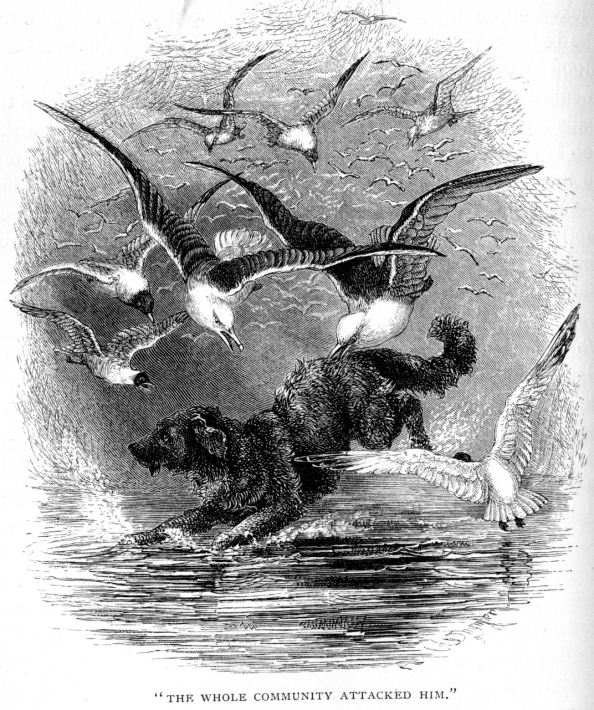
a dark grey colour were swimming about. A young retriever I had with me
swam into the water after them. He had scarcely got twenty yards from the
shore when the whole community of gulls attacked him, and not content with
harmless threats, struck down on the dog with right good will; and I am
convinced that his life was only saved by my keeping up a constant fire on
the large black-headed gulls, which, in defence of their young, made
common cause with the others, and, from their great weight and strength,
were most dangerous assailants.
When lounging, gun in hand,
on the sea-shore here, or lying in wait for seals, I have frequent
opportunities of watching unobserved the proceedings of the gulls of
different kinds. The large black-backed gull soars slowly along the edge
of the receding tide, with his sharp eye fixed on the beach, and turning
his head and neck to observe every object that may be left by the tide. If
anything is seen which his omnivorous appetite covets, down he pitches on
it, and with his powerful bill soon tears up and swallows it. The sand-eel
or small fish is swallowed whole. If a floating prize presents itself,
such as the remains of a large fish or dead bird, it is soon discovered by
one of the large gulls, who is not allowed, however, to enjoy his prize
alone ; for every one of his fellows within sight joins in tearing it to
pieces. When I have winged a duck, and it has escaped and gone out to sea,
I have frequently seen it attacked and devoured almost alive by these
birds. If a dead fish is left on the shore they alight a few feet from it,
and, having reconnoitred carefully, fall to and devour it. It is
interesting to see these strong birds battling against a high wind, always
working to windward, and taking advantage of every headland and cliff for
a moment's shelter. When going to windward in their search for food
(indeed, they never fly down wind if they can help it), and perceiving
something edible, they keep on a short distance beyond it, and then
drifting back with the wind, drop down upon it. I saw a seal last week
(April) who had caught a salmon, and was eating it above the water. A
number of large gulls had collected round him, and seemed inclined to
dispute his prize, darting down at it with clamorous cries. The large grey
gull, or wagel, hunts the shore in much the same manner; but is still more
voracious than the black-backed gull. Nothing comes amiss to this greedy
bird. I have seen a dozen of them feeding on a dead and putrid horse,
digging it out with their powerful bills like so many ravens. I have no
doubt a dead human being would be considered a fair and lawful prize also.
While I am lying esconced on the shore for seals, this bird frequently
comes hovering over me, as if well inclined to pounce down. If wounded, he
does good battle against my retriever, aiming (like a heron) at the eyes.
When shot, he often disgorges a great quantity of food, generally small
fish; and on one occasion a wounded wagel brought up, amongst a variety of
undigested food, a well-sized young kitten, which he had somewhere made
prize of. The grey gull, though frequently feeding in the fields, seems
very seldom to take to fresh-water lakes. The next-sized gull which is
common here is the blue-back, a beautiful, clean-looking bird, though, as
far as fish is concerned, as great a glutton as the two last-named kinds.
This bird is particularly conspicuous in its attacks on the salmon-fry as
they descend the river in May. Thousands of them fish in the shallow pools
at low-water in the bay; and every bird seems to feed wholly on these
silvery little creatures as long as they are to be had. The quantity that
they disgorge when shot is perfectly astonishing, and they must be one of
the most destructive enemies that the salmon has. Besides these larger
kinds of gulls there are several smaller species, who hover constantly
about the shore and sandbanks, drifting to and fro, and beating against
the wind in search of any prey, and darting fearlessly into the very foam
of the breakers to obtain it, or floating as buoyantly as corks at a
respectful distance from the larger gulls, who may be engaged in tearing
to pieces any cast-up carcass, and being content to catch at the smaller
morsels which are detached unperceived by the rightful owners of the
prize.
I was much amused the other
day by the proceedings of a pair of the black-toed gull, or boatswain.
These two birds were sitting quietly on an elevated ridge of sand, near
which a number of other gulls of different kinds were fishing and hovering
about in search of what the waves might cast up. Every bird, indeed, was
busy and employed, excepting these two black robbers, who seemed to be
quietly resting, quite unconcerned. When, however, a gull had picked up a
prize, these birds seemed instinctively to know it, and darting off with
the rapidity of a hawk (which bird they much resemble in their manner of
flight), they attacked the unfortunate gull in the air, and, in spite of
his screams and attempts to escape, they pursued and beat him till he
disgorged the fish or whatever he had swallowed, when one of them darted
down and caught the substance before it could reach the water. The two
then returned quietly back to their sandbank, where they waited patiently
to repeat the robbery, should an opportunity occur. As the flock of gulls
moved on with the flow of the tide, the boatswains moved on also, hovering
on their flank like a pair of plundering freebooters. I observed that in
chasing a gull they seemed perfectly to understand each other as to who
should get the spoil; and in their attacks on the largest gulls (against
whom they waged the most fearless warfare) they evidently acted so as to
aid each other. If another pair of boatswains intruded on their
hunting-ground, they immediately seemed to send them farther off, not so
much by actual battle as by a noisy and screaming argument, which they
continued most vigorously till the new comers left the neighbourhood.
I never saw these birds
hunt for their own living in any other way than by robbing the other
gulls. Though not nearly so large as some of the birds which they attack,
their hawk-like swoops and great courage seem to enable them to fight
their way most successfully. They are neatly and powerfully made; their
colour a kind of sooty dull black, with very little gloss or shining tints
on their feathers. The boatswains seldom appear here excepting during
April and May. All the gull tribe during their first year are of a dingy
and mottled colour, very unlike the neat and elegant combination of
colours they afterwards acquire.
 |



