|
Tameness of Birds when Sitting.
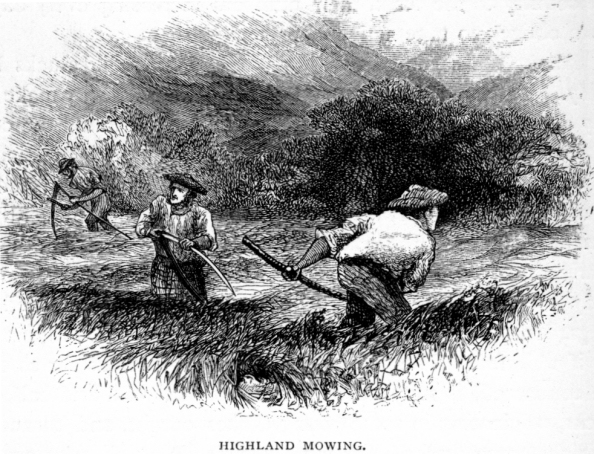
July 1st.—In walking over a
field, the grass of which had been cut the day before, but was not yet
carried, I disturbed a landrail, who was still sitting on her eggs,
notwithstanding the great change that must have come over her abode,
which, from being covered with a most luxuriant crop of rye-grass and
clover, was now perfectly bare. How the eggs had escaped being broken,
either by the scythe or by the tramping of the mower's feet, it is
difficult to understand; but there was the poor bird sitting closely on
her eggs, as if nothing had happened, and on my near approach she moved
quietly away, looking more like a weasel than a bird as she ran crouching
with her head nearly touching the ground.
In another part of the same
field I passed a nest of landrails in which the young ones were on the
point of, or rather, in the very act of being hatched, some of the young
having just quitted the shell, while others were only half out of their
fragile prison. Both old birds were running around the nest while I
stooped to look at their little black progeny, and were uttering a low
kind of hissing noise, quite unlike their usual harsh croak. The mowers
told me that they had seen several nests in the same field, but had
avoided breaking the eggs whenever they perceived them in time. Though
innumerable landrails arrive here during the first week in May, always
coming regularly to their time, the period and manner of their departure
are quite a mystery to me. Although in general their young are not hatched
till the first and second week in July, they seem to have entirely
vanished by the time that the corn is cut: it is very rare indeed to find
one when you are beating the fields in September.
The partridges here are
chiefly hatched about the last week in June. Like the landrail, the hen
bird sits very close, and during that time will almost allow herself to be
taken up in the hand, especially when near their time of hatching. They
seem to be quite confident in the forbearance of my boys, who have an
intimate acquaintance with almost every nest in the neighbourhood of the
house, the old bird allowing them to peer closely into her nest, and even
to move aside the grass and herbage which conceal it, when they want to
see if she is on her eggs. A retriever one day caught an old hen partridge
on her nest, but let her go again on my rating him, without doing more
damage to her than pulling out some feathers. Notwithstanding this she
returned to the nest, and hatched the whole of the eggs the next day. Had
she not been so near her time of hatching, I do not suppose that she would
have returned again. All birds have the same instinctive foreknowledge of
the time of hatching being near at hand, and do not, when this is the
case, leave their nest so easily as when disturbed at an earlier period of
incubation. Some small birds are much tamer in this respect than others. A
bullfinch will often allow herself to be taken off her nest, and replaced
again without showing the least symptom of fear. Indeed, this bird, if put
into a cage with her nest of young ones, will continue to feed them as
readily as if her habitation was still in its original situation.
Blackbirds, also, are very unwilling to fly off from their eggs. The
common wren, on the contrary, immediately forsakes her nest if it is at
all handled and examined before she has laid her eggs. She will abandon it
if she merely observes people looking too closely at it; but when she has
commenced to sit I have known her to be caught on her nest, and replaced,
and still not forsake it. A small blue-headed tomtit formed her nest this
year in a chink of my garden wall, and allowed the children to take out an
egg to examine it from underneath her, without leaving the nest. In fact,
instead of being frightened at the intrusion of their hands into her
little warm, well-feathered domicile, she picked courageously at their
fingers, hissing, and spluttering at them, and never seeming inclined to
fly off. When the young ones were hatched, the activity and perseverance
of the old birds in providing them with caterpillars and blue-bottle flies
were perfectly wonderful. They appeared to fly backwards and forwards to
their young family every minute of the day, always bringing some insect in
their bills. The good done by these little birds in destroying grubs and
flies ought to earn them an immunity from all danger from trap or gun.
Gardeners are always too much inclined to wage war against all small
birds, forgetting that they invariably feed their young, not with seeds,
but with different kinds of grubs and caterpillars, in this way amply
repaying any little mischief they may do to the early-sown seeds. For my
own part, I never trust a gun in my gardener's hands, but let the
blackbirds and thrushes take as many cherries as they like, in return for
which they destroy thousands of grey snails, etc., besides giving me many
a moment of pleasure by their song. I admit that I do occasionally shoot
the crows and jackdaws when they destroy too many of the cherries,
particularly as these active marauders come from some distance in large
flocks as soon as the fruit becomes red on the trees. I invariably observe
that at this season one or two jackdaws arrive first, flying round and
round at a great height above the garden. After some chattering between
themselves they fly away, returning some hours afterwards with the rest of
their family, four or five in number; and if not checked by a few charges
of shot, these first intruders soon invite every jackdaw in the country to
the feast, their numbers increasing every day, till I am obliged to take
active steps against them.
About the second week in
July the young wild ducks begin to fly. Those hatched high up in the
country usually make their way down to the sea-side in that month. They
follow the course of some stream or river till they arrive at their
destination. Like the fable of the ostrich hiding her head when pursued,
the young wild ducks when chased on the river will frequently dip their
heads under the water, and keeping it there till they are nearly drowned,
fancy themselves secure, although their whole body is exposed. If taken
up, and put into some enclosed yard or garden, they will soon become
tolerably tame, and get very fat if well fed. The whole of my poultry-yard
(as far as ducks are concerned) is supplied by a breed of half wild and
half tame ducks, originating in some young drakes caught, and turned out
with the tame ducks — the tame drakes being all sent away, in order to
ensure the proper cross in the breed. The birds are very much improved for
the table by this cross, and are quite as tame as the common domestic
duck, only showing their wild parentage in an inclination to hide their
nests, and to build at a distance from home — always, however, if allowed
so to do, bringing home their broods as soon as they are hatched. At other
seasons they never seem inclined to wander, though they are always to be
seen at the very earliest dawn of the morning, before it is quite light,
spread out over the grass-field adjoining the house, hunting it in a
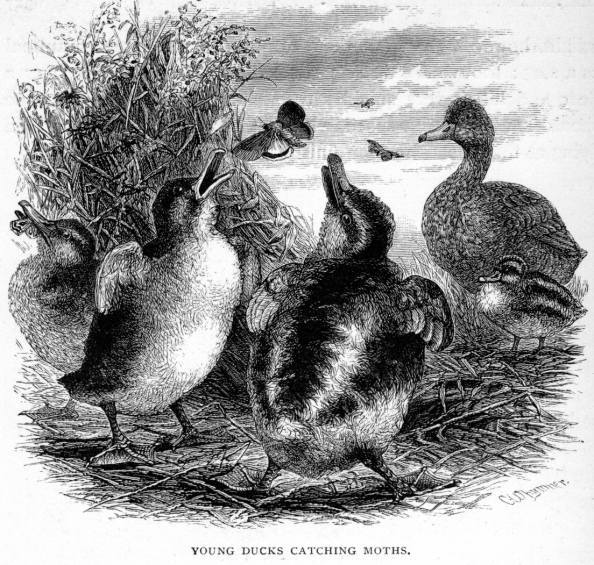
regular line of advance for worms and snails. As the evening comes on,
too, it is amusing to see them bent on the same pursuit, and displaying
the greatest activity and skill in catching the large evening moths, as
these insects rise from the grass or fly low over it.
|



