THE white hare inhabits many of our mountains. It is not
confined, like the ptarmigan, to the tops of the highest and most
inaccessible, but, on the contrary, is often met with on grouse-shooting
ranges, where there are few crags or rocks to be seen. I have frequently
shot it on flats, between the hills, where it had made its form like the
common hare; and, though I have more often moved it in rocky places-where it
sometimes has its seat a considerable way under a stone-I do not think it
ever burrows among them, as some suppose; for, although hard pressed, I have
never seen it attempt to shelter itself, like a rabbit, in that way. Indeed,
there would be little occasion for this, as its speed is scarcely inferior
to the hares of the wood or plain, and it evidently possesses more cunning.
When first started, instead of running heedlessly forward, it makes a few
corky bounds, then stops to listen-moving its ears about : and, if the
danger is urgent, darts off at full speed, always with the settled purpose
of reaching some high hill or craggy ravine. If not pressed, it springs
along as if for amusement; but takes care never to give its enemy an
advantage by loitering.
I put up one, on the 16th of last March, when inspecting
the heather-burning on my moor, which (contrary to their usual practice)
kept watching, and allowed me, several times, to come within a hundred
yards. I was at first surprised, but the explanation soon occurred to me
that it had young ones in the heather. I had thus a good opportunity of
noticing the commencement of its change of colour. The head was quite grey,
and the back nearly so ; which parts are the last to lose, as well as the
first to put on, the summer dress. I shot one nearly in the same stage, on
the 22nd of last November (183q). [I twice last autumn (1840) shot fine
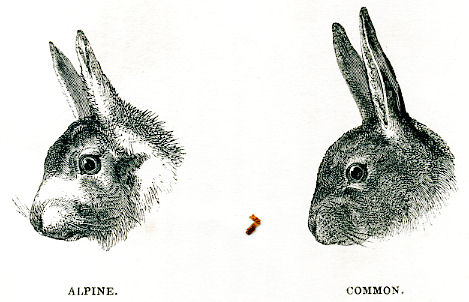
specimens of the alpine and common hare on the same day. The difference
between them, when thus closely compared, was very perceptible. The head of
the alpine was much rounder, which was rendered more obvious by the
shortness of its ears. The sent was also ludicrously small ; while the
roundness of the body was increased by the soft and very thick coat of fur,
which made that of the common hare appear hard and wiry. One of the alpine
hares was shot on the 17th of September ; there was not the least appearance
of the change of colour. The other, shot on the 6th of October, had a few
silver hairs about the toes. On the 11th I shot another which had the feet
and half the hind legs white, and was a little silvered behind the ears. On
the 2nd of December I shot another couple; the lower part of the body and
hind legs were like swan's down, the back and sides grizzled, and the only
unchanged parts were the' crown of the head and cheeks. The last day I went
after them was on the 15th of December, when I wished to ascertain whether
the change was quite complete. On that day I killed two hares and a leveret,
and was astonished to find that one of the former was in the same stage as
those shot on the 2nd of December, while the change in the other hare and in
the leveret was entire, except indeed a shading of grey on the back, which
is never purely white but in the depth of the severest winters.] The only
difference was, that the whole coat of the former appeared less pure. This
is easily accounted for, as in winter the creature, though receiving a fresh
accession of hair, loses none of the old, which also becomes white; whereas
in spring it casts it all, like other animals. Thus, by a merciful
provision, its winter covering is doubly thick; while at the same time,
being the colour of snow, (with which our hills are generally whitened at
that time of year,) it can more easily elude its numerous foes. The same
remark applies to the ptarmigan.
During a mild winter, when the ground is free from snow,
the white hare invariably chooses the thickest patch of heather it can find,
as if aware of its conspicuous appearance; and to beat all the bushy tufts
on the side and at the foot of rocky hills, at such a time, affords the best
chance of a shot. The purity, or dinginess of its colour is a true criterion
of the severity or mildness of the season. If the winter is open, I have
always remarked that the back and lower part of the ears retain a shade of
the fawn-colour; if, on the contrary, there is much frost and snow, the
whole fur of the hare is very bright and silvery, with scarcely a tint of
brown. When started from its form, I have constantly observed that it never
returns, evidently knowing that, its refuge has been discovered. It will
sometimes burrow in the snow, in order to scrape for food, and avoid the
cold wind, as well as for security. These burrows are not easily discovered
by an unaccustomed eye ; the hare runs round the place several times, which
completely puzzles an observer, and then makes a bound over, without leaving
any footmark to detect her retreat. It is hollowed out, like a mine, by the
hare's scraping and breath, and the herbage beneath nibbled bare.
When deer-stalking in Glenartney, last autumn, I was
quite amazed at the multitudes of Alpine hares. They kept starting up on all
sides, some as light-coloured as rabbits, and others so dark as to resemble
little moving pieces of granite. I could only account for their numbers from
the abundance of fine green food and the absence of sheep, which are as much
avoided by hares as by deer, from their dirting the ground with their tarry
fleeces. [Should anybody be disposed to call in question the correctness of
this word, I beg to say my title to it is long use and wont. "Tarry woo'!
tarry woo'!" Tarry woo is ill to spin."]
The alpine hare is a good deal less than the common -
shorter, and stouter made for its size - and its legs stronger, for climbing
in rocky places. Its colour in summer is a kind of fawn, and in winter the
tips of the ears, which are much shorter than those of the common species,
are jet black.



