|
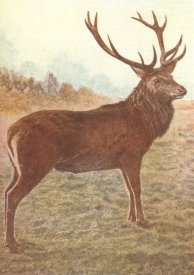 The
largest and noblest surviving member of the ancient British fauna, the Red
Deer to-day has a very limited range—the mountain glens of Scotland and
Westmorland, in the north, and the wide Devon and Somerset moors and the
New Forest in Hampshire. Even in the New Forest, where only a few score
remain, it is extinct officially, for an Act of Parliament passed in the
year 1851 decreed the extermination of the Deer, the reason being that
they destroyed a vast quantity of what had then become of far greater
national value than venison—the growing timber, and demoralised the
inhabitants by creating a race of deer stealers. The
largest and noblest surviving member of the ancient British fauna, the Red
Deer to-day has a very limited range—the mountain glens of Scotland and
Westmorland, in the north, and the wide Devon and Somerset moors and the
New Forest in Hampshire. Even in the New Forest, where only a few score
remain, it is extinct officially, for an Act of Parliament passed in the
year 1851 decreed the extermination of the Deer, the reason being that
they destroyed a vast quantity of what had then become of far greater
national value than venison—the growing timber, and demoralised the
inhabitants by creating a race of deer stealers.
A full-grown Stag, as the
male Red Deer is called, stands about four feet in height at the shoulders
; the Hind, or female, somewhat less. The summer coat is reddish-brown,
sometimes golden-red, which changes to a brownish-grey in winter by the
new growth of grey hairs. On the under parts the colour is white, and a
patch of white around the short tail furnishes a " recognition
mark," common to most of the Deer family, which serves to guide the
herd when they are in flight before an enemy.
If one were seeking to
judge the habits of the Red Deer, one would feel justified in saying, as
many have said—" This is a creature of the open mountain-side and
the moorland, where there are no trees which could entangle those
branching horns." Yet the Deer can actually run through dense woods
with ease, and we know from its habitats in other countries where it is
still plentiful, that it is a true woodland animal.
When pursued and he takes
to the woods, the Stag throws his head back so that his antlers lie along
each side and protect his body from many a bruise that might otherwise be
inflicted by the branches as he rushes through the undergrowth. The
antlers may be used with deadly effect in self-defence, and many a hound
is killed by a Stag at bay. Their function appears to be mainly protective
against carnivorous beasts ; they are seldom if ever effective against
those of their own kind.
In spring and summer whilst
his horns are growing the Stag lives apart from his kind, but in the early
autumn when these are well-developed and hard, we may in suitable
localities hear his "belling" call to the Hinds, or in defiance
to some rival.
There is a good deal of
furious fighting when two jealous Stags of similar age and strength meet
in the vicinity of the hinds. He is then in the prime of condition, his
neck and shoulders clad in a thick mantle of long brown hair, and his head
adorned with the noble pair of antlers that reveals his age. Those that
decorated and armed him last autumn and winter were shed bodily about
March, and a new growth started soon after from the burred frontal knobs
that were left.
The mating of the Red Deer
takes place in the autumn; and in the spring the Hinds separate, each
retiring to a lonely spot among the bracken where her single calf (rarely
two) is born about the end of May. The little deer is already covered with
fur, and its back and sides are dappled with white after the manner of the
Fallow Deer, though unlike the livery of that species the spotting of the
Red Deer is not retained beyond calfhood. A hind bears her first calf when
she is about three years old.
The food of the Deer is
herbage and the young shoots of trees and shrubs. It is this fact that led
to their nominal extermination in the New Forest and other places. By
nature they are woodland animals—although their greater prevalence
to-day in the Highlands might give us a different impression—and in the
winter especially do great damage to the plantations of young trees.
Agricultural lands in their vicinity also suffer greatly, a whole field of
turnips being mined in a night by a visit from a herd of Deer. They also
destroy wheat, potatoes, and cabbages ; and in the woods consume many
toadstools, acorns, and chestnuts.
It is in the northern
localities quoted above that there is still the best chance of studying
the Red Deer under natural conditions. But the southerner has also a
prospect of meeting with the noble beast on Exmoor and in Hampshire, to
say nothing of the tamer herds in parks. To get a good view of these, they
should be approached with a pretence of unconcern they can often be well
observed from a road at a few yards’ distance without arousing their
suspicions, whereas a few steps towards them on the greensward will cause
them to bolt.
It should be stated that
the British examples of the Red Deer are considered to constitute a
geographical race known as scoticus. The European range of the
species extends from the Mediterranean to central Sweden and centraI
Norway. |



