|
Search just our
sites by using our customised search engine |
|
Unique Cottages | Electric Scotland's Classified Directory |
|
|
1950 – 1957
Cambusbarron / Bannockburn / Stirling Home - School - Sport - Church - Music - Holidays
Part Four Academic Life at School - 1951-54
As you can well imagine, my enrolment in 1A(ii) of the 1st Year at The High School of Stirling in August, 1951 brought about significant changes and additions to the network of people and events in my life. From 1944 to this point my experiences had been primarily parochial. For the next six years, at least during school-term time, these became more urban than rural, although summer holidays in particular offered me some international networking experiences as well.
Primary school influences had not curtailed my social activities in the village or elsewhere nearby, but going to secondary school certainly changed all that. Its daily lesson demands, its activity opportunities, its staff, and my peers became pivotal to my academic, social and sporting development, and thus dominated, not only my doings in weekday daylight hours and Saturday mornings, but also, because of my hefty three-hour school homework schedule, my Monday to Thursday evenings and Sunday afternoons as well.
As a relatively high IQ youngster, I was placed in one of a stream of three classes whose ‘in-mates’ tended to be labelled by their undertaking of the study of two, rather than one foreign language. Thus the examinable menu for me in a nine-period school day for the first three years became, French, Latin, English, Mathematics, Science, Technical Drawing and Woodwork, History, Geography and Art. The non-examinable subjects were Physical Education, Music and Religious Education.
All classes up until Year 4 were segregated by gender, so, because the ninety plus pupils who had been deemed suitable for the two foreign language stream comprised about sixty boys and thirty girls, the boys from the Primary School section of the town High School were put in 1A(i), while we the ‘rural bright sparks’ formed 1A(ii), and the girls, 1B. The one language streams were 1C, 1D, 1E and 1F, with greater emphasis on Commercial or Technical or Domestic Science subjects replacing the second language.
Thus my ‘enlarging puddle’ of peers within these ‘streams’ were country bumpkins like myself, and, the chosen discriminatory segregation actually worked quite well. Extra-curricular sports’ activities [which were not compulsory due to the high numbers of pupils who had before and after school jobs to help family income] were avenues of integration for all seven classes, and I, being a willing participant, soon made friends and ‘enemies’ in most of these other classes – the boys’ ones only of course!
Two words probably best describe these early schooling days in August/September 1951 – ‘novelty’ and ‘trauma’. The experience of changing teachers, subjects and classrooms every thirty-five minutes or so was totally new to us all so accustomed as we had been to the one teacher/one classroom life in our primary days. Thus the most precious document one had for the first few weeks [until memorised] was one’s class timetable pasted in one’s homework diary that served, not only for noting the twice weekly collected-in ‘ink-exercises’ for the three language subjects, but also for the more randomly set ‘ pencil or memory homework’ in the remaining subjects. The ‘trauma’ came from the increasing complexity and volume of work arising from all ten of the examinable elements in our wide curriculum.
Mathematics, I loved and had no bother with. The foreign languages, I initially detested, despite the two able, but exceptionally demanding teachers who tried to interest me in this area for three years. Homework for them troubled me a lot …. Not only the difficulty, but also the fact that I did not want to let myself, my parents or the teacher down …. and I wanted good marks to continue as a ‘top dog’ in this wider environment. My French teacher Mr George Sinclair was also my first rugby coach …. and I worshipped him …no way would he get anything less than my best in any ink-exercise. My Latin teacher Mr Jimmy ‘Jumbo’ Murray had been a teacher colleague and friend of my father … so the pressure to please him was also there …. I sweated blood and spilled many a tear in my bedroom study struggling to keep up to the mark … but looking back from the dizzy heights of later senior school days, it all seemed well worth the early anguish endured!
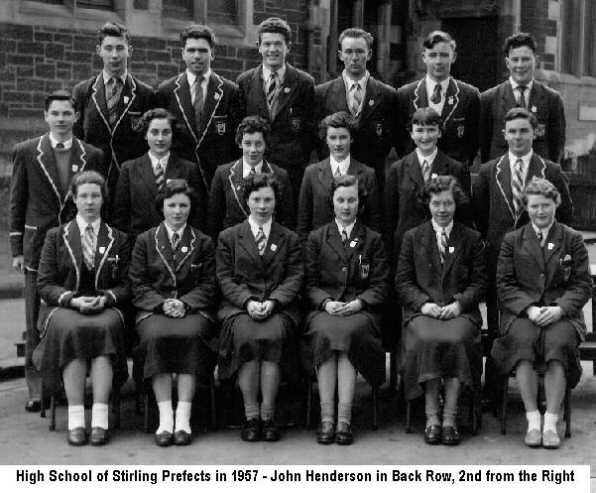
The Dizzy Heights – Senior School Prefects
Sad to say, the quality that I found so valuable in my own later teaching career, ‘a sense of humour’, was hard to find amongst those who taught me in these junior school days. Life was supposed to be hard. Life was earnest. We were working long-term to get enough Higher Leaving Certificates in 5th Year to become eligible for University. Formality, conformity, unquestioning obedience and ‘swotting’ were the rules of the game! Rote learning, ‘jug to mug’ teaching, learning theory and memorising theorems, dates, facts, places, people … that was schooling then. Problem solving was merely then an add-on for the genius types among us. This and practical applications, we were told, would come when we moved on to senior school after three years of foundation studies. No wonder our teachers found little to smile about! The curriculum and approved methods must have bored them to tears …to be repeated year-in and year-out. So fun for us pupils had to come from baiting the less able disciplinarians, or sniggering unseen and unheard at the expository faux-pas of others.
Mrs ‘Tiger’ Thomson, our history teacher, was not to be trifled with – red hair, hot temper … but could have been an absorbing person to listen to, had it not been for her unconscious and continual interjection of the words ‘actually’ and ‘really’. We used to run book on the number of times these words would be used by her in a thirty-five minute period … three types of gamble were usually on offer, each of the words and both … the currency for bets being collectors’ items - the small cards, sponsored by tobacco firms, portraying famous footballers that many of us hoarded /exchanged.
My various early teachers of English were competent, but rarely inspiring. Of our Science teachers, one was ‘over the hill’; one a martinet who had us copying down dictated experiments endlessly after his demonstration without practical input by us; the last was listless and only interested in senior school level science.
However, within all the limitations that convention and formal methods imposed, one middle-aged spinster - a dedicated teacher who travelled daily in the train from Perth to make us numerate, well organised and biddable - the unique Miss Gaedecke, became a shining star in my firmament. I ‘sat at her feet’ for five years, and eventually became one of ‘her boys’. She was built sparingly thin, sounded very severe, but inside that façade she had a heart of gold. She cared for us all … and we grew to know it and thus in due course forgave her all the apparent austerity that her normal demeanour displayed. She acted the part so graphically, as overheard by me as a nipper, when described by a friend of my father thus, “Lady teachers – ‘soor faces, bashed cases, an’ a wee bunch o’ flooers’!” However, at the end of each school year she was seldom short of flowers from her ‘aye a wee bit feart o’ her’, but, adoring pupils. |
|