|
Search just our
sites by using our customised search engine |
|
Unique Cottages | Electric Scotland's Classified Directory |
|
|
1950 – 1957
Cambusbarron / Bannockburn / Stirling
1951-54 Rugby Union Football at the High School of Stirling
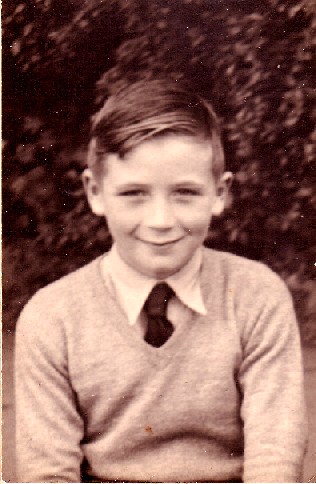
As the young, innocent, nearly twelve year-old lad pictured above in the back garden of Cambusbarron Schoolhouse, I was at that point only a few months away from taking a wary leap into the unknowns … by transferring to the High School of Stirling in August, 1951.
One of the unknowns was the opportunity I might earn to widen my sporting experience by making the grade at rugby union football. Initially, being ‘soccer daft’, I had been somewhat disappointed to learn that only one winter game for boys – rugby - was on offer at my new school. However, I also found out that, as practices took place on Tuesdays and Thursdays after school, and that inter-school matches were normally played early on Saturday mornings, a commitment to this novel activity would not prevent my participation in, or limit my spectating at, soccer games at other times.
So, during my first week at the ‘School on the Rock’, I duly attended a meeting that was convened for current and potential Junior rugby players in the school gymnasium by volunteer rugby ‘supremo’, Mr George Sinclair. His message was clearly optimistic when he said that, although for the current season there would be only one team run for all twelve to fourteen year-olds, he, because of the massive increase in pupils in the Second Year, was in the process of planning to introduce a First Year team from the following 1952/53 season to augment the current provision. He also indicated that by the 1953/54 season, his target was to have 1st/2nd/3rd Year teams in the Junior School and 1st/2nd/3rd XVs to serve the Senior School – six teams instead of the current three.
That was the good news. The challenging news to me was that to get a competitive game representing the school against other schools, I would have to get into a team that was likely to be mostly filled with boys two years older than myself. At that point I did not realise that my being physically small for my age - other things being more than equal - might just offer me a glimmer of hope of selection. Indeed I knew nothing then about the laws of the game itself, far less its demands on one being tough and fearless! The bad news was that all lines for the two pitches out at the Torbrex playing-field would have to be dug and clods of turf turned over by pupils before any serious practice would be permitted. I later discovered from my father that such digging and turning of turf for a whole season’s line-marking (and the long-term time-saving common sense of it) had been a chore he too had undertaken as a senior pupil on the same field away back in 1924! As he spoke, he handed me his trusty ‘Never Bend’ spade, adding, “Use it well, but don’t lose it!”
As British Summer Time ended in late October, we had daylight for mid-week practices until about 5.30 pm through to about the second week in that month. That gave me only six or seven weeks to prove myself at a game that I soon found to be most unusual due to the fact that it asked you to do unheard of things like, for instance, passing the ball by hand backwards or sideways only, keeping behind the ball at all times, scrummaging – tight and loose (!), jumping in line-outs, dribbling only when one or two of your own team were closely with you, punting the ball to touch for safety, knocking-down an opponent with a legal form of arm and shoulder tackle only when he was in possession of the ball , scoring by diving over a line that extended the width of the pitch at the attacking end (seemed too easy when a soccer goal was so small) and, lastly of these ‘for instances’, and what became my ‘trump-card’ - kicking the ball over the crossbar from penalties for 3 points and conversions for 2 points.
Although I may here belittle my other skills a trifle [as also, in all modesty(!),may have been the case in the season just before my retirement from the adult game some twenty years later] the selectors were overheard saying, “What position can we hide the wee fellow in so that he can do minimal damage in general play, but give the maximum of points scoring advantage to us with his magical kicking boots?” Thus I became a fixture in that team of big boys - a tiny ‘hooker’ in the middle of the confrontational row of the scrummage, where ironically my ‘footballing-sense’, if not my cowardice, also earned me my crust! Only two of us first-year ‘morsels’ made the team …. and Dad and I were just about as equally proud as Punch by my making the grade. However, from my mixing with much older boys on Saturday mornings, I, somewhat prematurely, certainly learned a few things about life that otherwise might have been much, much longer delayed.
The following two seasons in the new age-group year teams were different and much better. For one thing I escaped from being a ‘hooker’ to become a ‘fly-half’ and thus the pivot man for distribution from set-pieces as decision-maker and instigator of running, passing or punting manoeuvres in both attack and defence situations. My ball-feeder-cum protector-scrum-half in Year 2, and then right on through to Year 6, was Jimmy Watson. Almost inevitably we became very close friends. We trusted and respected each other completely ….. both on and off the field. It is grand that, since that first meeting in the High School gymnasium some fifty-three years ago, we are still in friendly contact today.
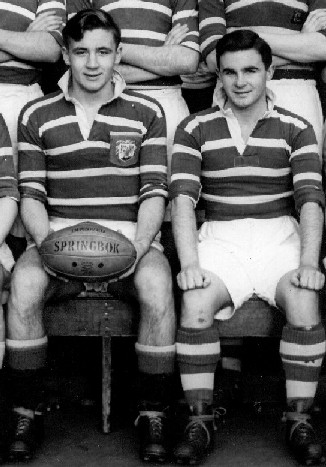
As you can see from the following photograph taken later in 1957, the eventual Dr James Ingram Watson, MB ChB, was a chunky wee fellow. He was also physically as hard as nails, courageous and indomitable …. but also, like myself, he was an improviser … mainly I think because, even in these days as callow youths, we thought and talked a lot about likely winning strategies and tactics ….. that certainly, I might add rather boastfully, brought a great deal of success for the sides we played in together over the years.
|
|