1944-1949
Banknock Village – ‘Sabbath days’
Chapter 7 seems
to be an appropriate juncture in this auto-biography to shift
the focus of my recounting blessings in Banknock, at least
temporarily, away from the happenings of week-in, week-out,
work and play days, and on to some recollections concerning
the activities, predominantly religious, in which we became
involved as a family on the Sabbath. In retrospect these
experiences were also blessings to me as a child, even if they
were certainly not understood then as such by my slowly
maturing five to ten year old mind.
Sundays were
undoubtedly different from other days of the week. For one
thing, I soon became aware of the institution called ‘having a
long lie’. Our household, instead of stirring around 7.30
a.m., was seldom encouraged to look for breakfast until after
nine. But then, in addition to the usual cereal, toast and
marmalade, my mum normally made a cooked breakfast of bacon
and eggs or the like.
From that point
on, the so-called ‘day of rest’ became anything but that!
However, as I now realise, all that was done as these days
‘raced’ on were clear illustrations of my parents’ firm belief
in, among other spiritual things, Moses’ message from God,
that the Lord had blessed the Sabbath day and hallowed it. In
due course, I also became aware that, of the Ten Commandments,
they not only prioritised this ideal, but also the other
positive statement among the so many negatives in the Ten,
“Honour thy father and thy mother.”
My sister
Elizabeth and I, it must be said, often somewhat unwillingly,
were absorbed into the Henderson-Telfer Sabbath routine - its
expected ‘busy-ness’ in quietness and obedience; our
dressing-up in our ‘Sunday best’; our readiness for the
half-mile walk to the Haggs for 11.15 a.m. and the ‘enduring’
of, as most children saw it, the Rev. ‘daily cold bath before
breakfast’ John Jackson’s long sermons at Longcroft Church of
Scotland; our rushed walk back home for a cold lunch; then
either, our being sent over in the early afternoon, much more
willingly, to the school for the Mission Hour of gospel texts
and rousing choruses provided there by the Band of Hope, or
our setting out by double-decker bus to Grandma Telfer’s and
Uncle John’s home in Falkirk for high-tea before attending
evening service at the Church of Christ in the Pleasance; our
after-church rush to catch the last Glasgow via Kilsyth bus
home to Banknock in order to avoid, if possible, the long
walk from Longcroft Monument if we missed it, and had then to
take the Glasgow via Cumbernauld instead.
On these
visits, firstly to 13 Watson Street, and then in later years
to 13 Wolfe Road, to that marvellous home-baker, my much loved
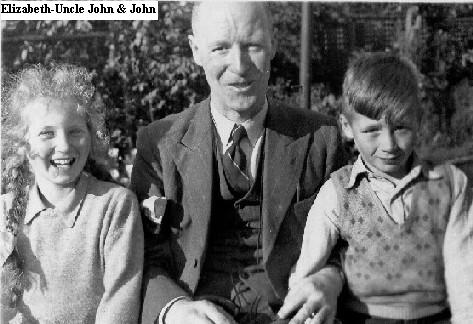
my Grandma Telfer, who had been widowed in 1931, it was Uncle
John who gained most of my attention with his passion for
photography and singing, as well as his willingness to talk
about my particular sporting interest of the moment. In a real
sense I suppose he became the Grandad Telfer whom I had never
known. In his younger days he had played tennis with my mum at
the Carron club,
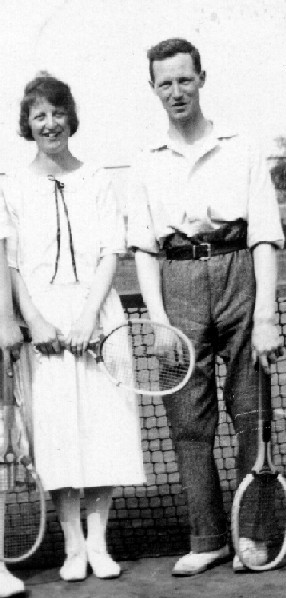
and cricket at
the Castings, so these were the sports he liked me to enthuse
about. However, unlike other Uncles who occasionally visited
us at Banknock on Saturdays, Uncle John would never accept my
inevitable challenge to a ‘game o’ heiders’ between the
clothes poles on our back ‘green’! He knew his strengths and
was usually content only to photograph such encounters with
others and thus avoid the stiff necks that adults often
suffered next day from their unaccustomed indulgence in trying
to flick the ‘cuv’ with their heads past an acrobatic ‘Bobby
Brown type goalie’ like me!
As just
mentioned, these family visits were usually on Saturdays as
the likes of ‘heiders’ were just not allowed on the Sabbath!
Long Sunday walks along the Forth and Clyde Canal were often
taken, when, instead of our going to Falkirk or Stirling, our
kin-folks would come to see us in the village schoolhouse.
After tea, especially if it was Uncle Willie Telfer, Aunt
Minnie and cousins Constance and Marion who were visiting, my
mum would get out her carefully preserved piano and violin
sheet music, and with little coaxing she and brother Willie
would re-live their ‘dueting’ of their pre-marriage days in
the 1920s in the family home in Watson Street.
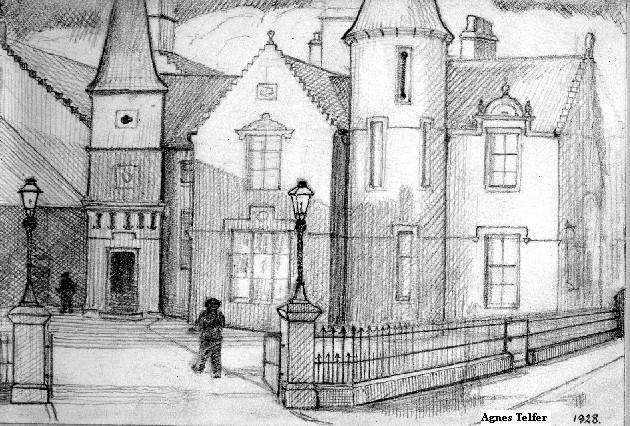
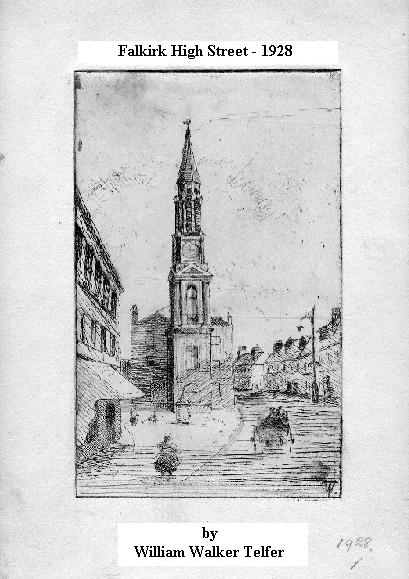
Both of them
were also accomplished artists in pencil, water-colour and
oil, but, whereas my mum after marriage contented herself with
producing wonderful visual aids for her Infant classes, Uncle
Willie continued to gain nationwide recognition by exhibiting
his paintings, mostly still-life, at the Royal Scottish
Academy in Edinburgh and at other venues around the country.
In addition he eventually became conductor of the Snowdon
Orchestra in Stirling.
Two examples of
their early sketching talents are ,
Our old
wireless set also got a rest on Sundays as all entertainment
had to be chosen as befitted the Lord’s day. Thus, such
evenings progressed, when we were not actually in church, with
hymn and psalm singing in the parlour accompanied on the piano
by my mum. Again, to us under tens, all this may not have been
very much to our liking, but obediently we conformed … until
…. the adults became so engrossed in their music not to notice
us making ourselves scarce by, either slipping out into the
garden for a game of ‘hide and seek’ well away from the
parlour windows, or tip-toeing upstairs to play other
‘forbidden fruit’ type card or board games.
As I got a
little older, there were at least two other highlights that I
recall from our Sunday visiting to Falkirk, and indeed
elsewhere to various Churches of Christ in Glasgow. These,
apart from the excitement of going by bus to the big city and
meeting other wee folks to play with out of sight of parents,
were for me, primarily my listening intently to my father’s
lay preaching of the gospel – he had a way with words, both in
writing and speech that was spell-binding even to my young
mind as well as to his congregations; and, the glorious
singing that to this day I can still hear as it immersed one
in what could be described as ‘dry-land’ baptism by music. In
retrospect, I am certain that all this growing up in Sabbath
contexts of ecumenism influenced my later tolerant attitudes
to all forms of faithful public Christian witness, and all the
people who trod these different paths to salvation.
Without
becoming over-sentimental, the religious experiences of these
days were indeed blessings, and thus I feel well worth the
recounting.



