|
The following extracts, selected by
current Doric lyricist, John Henderson BA, DPE, from the FOREWORD and
BIBLIOGRAPHY in ‘A Doric Dictionary’ by Douglas Kynoch MA (1996), are quoted
here for educational purposes and to alert scholars to the enlightenment
they may gain from purchasing the book from, among other sources,
“http://www.amazon.co.uk/Doric-Dictionary-Doric-English-English-Doric/dp/1898218803”
“Doric is a name given to broad and
rustic dialect. Deriving from that spoken by the Dorians in ancient Greece,
it has been applied in more recent times to the dialects of England and of
Scotland, while in Scotland itself the term refers pre-eminently to the
dialect of the Scots language which is spoken in the north-eastern corner of
the country. The Doric of North-East Scots meets both the traditional
qualifications. On the one hand, its broadness can present difficulty even
for Scots in other parts of Scotland, while on the other, its richest
manifestation has always been found in the rural hinterland, where the
language has recorded and labelled all the trappings of everyday life in
what was a largely farming and fishing community. ……
It should come as no surprise to
anyone that over so extensive an area there should be a considerable number
of linguistic differences. If language can change slightly from village to
village, as it does, then changes from county to county may be expected to
be even greater. It would be a rash man who would say that this or that
expression was not Doric simply because it was not his Doric. The truth is
that there is not one monolithic form of Doric but a multiplicity of forms,
differing to a greater or lesser degree here and there. Not only is there a
northern and southern Doric and a Banffshire and Meams Doric, but also there
is a farming and fishing Doric and a now somewhat diluted urban Doric.”
“George
Abel of Aberdeenshire (1856-1916); brought up on farms in the parish of
Kintore; minister of Udny Free Church for 35 years; author of the verse
collection ‘Wylins Fae My Wallet’, published 1916.
James Alexander of Ythan Wells,
Aberdeenshire; author of ‘Mains and Hilly’, a collection of dialogues in the
Aberdeenshire dialect, originally published in the Aberdeen Weekly Free
Press and brought out in book form in 1929.
William Alexander of Aberdeenshire
(1826-94); author of ‘Johnny Gibb of Gushetneuk’, first published 1871;
ploughman, journalist and editor of the Aberdeen Free Press, in which Johnny
Gibb was serialised.
Peter Buchan of Peterhead (1917-1991); a fisherman like
his father; author of a collection of poems, ‘Mount Pleasant’ and a
collection of North-East tales, ‘Fisher Blue’. What has been drawn on here
is his contribution to ‘Buchan Claik’, a compendium of North-East words and
phrases which he compiled in collaboration with David Toulmin.
Helen Beaton of
Aberdeenshire. Mrs Beaton’s account of life in the Garioch in the nineteenth
century is based in particular on the parish of Rayne and relies on the
stories and language of her grandmother. Entitled ‘At the Back o’ Benachie’,
it was published in 1915.
J. M. Caie of Banffshire (1879-1949). John Morrison
Caie was born in Banchory-Devenick, the son of a Banffshire minister, he was
brought up on a farm in the parish of Enzie. Trained both in law and
agriculture, he spent much of his working life with the Board of Agriculture
for Scotland. Of his two volumes of verse, it is ’Twixt Hills and Sea' which
helps give the dictionary its Banffshire flavour.
Helen B. Cruickshank of Angus
(1886-1975). Helen Buurness Cruickshank was reared at Hillside between
Montrose and the North Esk. The greater part of her working life with the
civil service was spent in the Department of Health in Edinburgh. A devotee
of Hugh MacDiarmid, her Scots vocabulary, tends to be eclectic, so only the
most basic terms are quoted as examples of Angus speech.
Alexander Fenton
of Aberdeenshire (1929- ). Director of the European Ethnological Research
Centre in Edinburgh, Prof. Fenton himself a native of Auchterless, has used
a farm in that parish as the basis of a study of the words and expressions
describing farm equipment and techniques in the second quarter of the
twentieth century. This invaluable record of North-East farm practice, is
described in his book, ‘Wirds an Work ’e Seasons Roon’, published in 1987.
Flora Garry of Aberdeenshire (1900-
). Of farming stock, Mrs Garry was brought up at Mains of Auchmunziel, New
Deer. Trained as a teacher, (she taught at Dumfries and Strichen, married R.
Campbell Garry, Regius Professor of Physiology at Glasgow University and
ultimately retired to Comrie. Her verse collection ‘Bennygoak’ was first
published in 1974.
Sir Alexander Gray of Angus (1882-1968). Gray was first
Jeffrey Professor of Political Economy at Aberdeen University from 1921-34,
to which period much of his Scots verse belongs. The linguistic variants of
Angus become apparent in his verse collection, ‘Any Man’s Life’ which
appeared in 1924.
Violet Jacob of Angus (1863-1946). Mrs Jacob (nee
Kennedy-Erskine) was sister of the 19th laird of Dun, the family having
owned for centuries the Dun estate between Brechin and Montrose. Author of
four books of verse, her ‘Scottish Poems’ were published in 1944.
Charles Murray of
Aberdeenshire (1864-1941). Born in Alford, Murray was a civil engineer who
spent most of his professional life in South Africa, where he was ultimately
appointed the Union’s Secretary for Public Works. He retired to the
North-East of Scotland, where several books of verse were published in his
lifetime, ‘Hamewith: the Complete Poems’ appearing in 1979.
J. C. Milne of
Aberdeenshire (1897-1962). Another writer of farming stock, John Milne was
born at Memsie near Fraserburgh. After a brilliant academic career at
Aberdeen University, he turned to teaching, later becoming Master of Method
at Aberdeen College of Education. His verse collection, ‘The Orra Loon’, was
published in 1946; his collected ‘Poems’ in 1963.
David D. Ogston of Aberdeenshire
(1945- ). In two volumes of autobiography, ‘White Stone Country’ and
‘Dry-stone Days’, David Ogston, minister at St John’s, Perth described in
Doric his upbringing on farms in Buchan and the Garioch.
Elsie S. Rae of
Banffshire. Elsie Ray was the wife of the Rev. Robert Wilson. Her verse
collections include ‘Private John McPherson’ (1917) and ‘Hansel Fae Home and
other Scots Poems’ (1927).
Alexander Smith of Kincardineshire (1911-1993). Alex
Smith is remarkable for having, in the years before his death, written three
substantial books in Doric. Two of them, ‘Forty Years in Kincardineshire’
and ‘Forty Years in Buchan and Banff’ are autobiographical; the third, ‘Fairmin
the Wey It Wis’ records farm life over the period of a year. As well as
having what appears to be total recall, Smith had a keen ear, which
discerned the differences between the Doric of Kincardineshire and that of
Buchan and Banff.
David Toulmin of Aberdeenshire. This is the pen-name of
John Reid (1913- ) born at Rathen in Buchan, the son of a farm-worker. He
himself spent his working life in farm labour but turned, in due course, to
the writing of novels. He contributed the farming data to ‘Buchan Claik’,
while his collaborator, Peter Buchan provided the fishing material.”
The
Making of our Mother Tongue
By P. Giles, M.A., LL.D.(1906)
Fellow of
Emmanuel College, Cambridge ; University Reader in Comparative Philology.
Electric Scotland Note: Below you
will find a rough ocr of this small book but due to all the Scots words we
have also made it available as a pdf file below...
The pdf version
Many
thousands of years ago there lived on the continent of Europe a people which
by and by was to play a great part in the history of the world. What name
this people gave to itself we do not know, what manner of men its members
were we do not know, no single word of its language is preserved. We do not
know even the boundaries of its home—how far it spread to north and south
and east and west. But somewhere in the great plain that runs across all
Europe and half Asia this people were to be found, and men in modern times
call it for want of a better name, the Indo-Germanic people.
The name
is clumsy and ugly, and in a sense is unhistorical. For the name refers to a
much later time when this people had lengthened its cords and strengthened
its stakes and become not one people but many. It did what has been done
elsewhere. In America one stock till the arrival of Columbus and his
Europeans was found throughout the whole continent, from the snows of the
Vukon to the torrid heats of Panama, and again from Panama to the Strait of
Magellan. In the old world the tie was more complex, but in the course of
ages this people had spread east, and no doubt after unrecorded struggles
with Semites and Mongols had
readied
Persia, and from there had passed into Northern India. North of the Black
Sea the great Russian stock was forming ; into the southern peninsulas had
passed the peoples that we know later as Greeks and Romans, and far in the
west, pushing and struggling for room till they were faced by the boundless
ocean, were the two peoples whose flesh and blood we are—the Teutons or
Germans and the Kelts. Thus far these peoples had got at least iooo years
B.C. The different branches of the original folk had become far separated
and lost even the memory that they were one people. But though this was so,
the words that come from later stages in their respective languages make it
quite clear that they all come from one original source. In all of them
occur the same words for
father and
mother, in all of them the same words for
horse and
coro
and hound,
and for many other things, though as time goes on more and more changes take
place, rendering the words less and less like one another. Just as in botany
or zoology plants or animals become isolated and change till only the expert
can recognise the relationship between them and the other members of their
family, so in language the changes are often so great that it has required
in modern times long and laborious investigation to prove any connexion at
all.
For long
the relationship of the Germanic peoples in the matter of language to other
peoples was concealed by various strange changes that had taken place in
their dialects. Greek and Latin and other languages agreed in using for
father a word, which varying shghtly from one
language to another, may be fairly represented by
pater, the Germanic peoples living between the
Rhine and the Elbe, and extending down towards Central Europe call it
fader. The other languages agreed to call the
tooth by some word like the Latin
dens, which we borrow in i modern times to make
words like dental.
But part at least of the early Germanic peoples called it
tunthu 1 The other languages agreed, in
addressing a second person, to call him
tu thou , our forefathers changed the
t to
th (|)) and called him
\>u.
There
were a great many other changes of this kind. Large numbers of examples of
these changes began to be collected about a hundred years ago, and a general
statement was drawn up about them in 1822 by a great German scholar, called
Grimm, and for this reason this statement has always since been called in
this country " Grimm's Law."
Why did
these people make these curious changes in their language? We cannot tell
for certain. We may be quite sure that they were not conscious of making
them. Though we are not certain as to the cause,
wc may at
least hazard a guess. It will be noticed that in modern times Germanic
peoples live in a large part of the area which in the map is assigned to
Keltic peoples. It is probably the fusion between Kelt and German that
caused those changes. The Germans have occupied the soil of the old Keltic
settlements ; the Kelts have avenged themselves on the pronunciation of the
Germanic languages. The first stage of these changes took place before the
history of Northern Europe begins, and that stage was probably brought
about, not by Germans overlapping Kelts, but by Kelts overlapping Germans.
Both nations have always been prolific, and the whole history of modern
Europe is only an account of their struggles to get more elbow-room. The
Kelts have, in the course of their history, left few countries unvisited :
about 390 B.C. they
attacked Italy and Rome; a hundred years later they made an inroad into
Greece, and even passed over into Asia, where, three hundred years later, St
Paul found them, under the name of Galatians, as difficult to manage as if
he had been an English bishop in an Irish diocese. Whether it was in
connexion with this great migration of the Kelts that these changes came
about in the Germanic languages we are not quite sure, but at any rate the
change of pater
into fader
and the like, had taken place by about 200 B.C. Many centuries later when
the Germans spread down over the Keltic area, a second series of changes
came in, which makes the difference between modern German and modern
English, which makes the German say
zapf for the English
tap and
schiff ior the English
ship.
These changes only took place in southern Germany, and though fashion
carried some of them a good long way northwards, some of them never reached
the northern sea at all. Hence the low German, the vulgar dialect spoken all
along the northern parts of Germany, is much more like English than the book
German which is founded upon a southern dialect. If Luther, who really made
the modern German language, had chosen to translate the Bible into a
northern instead of a southern dialect, the acquiring of German would not
have been so difficult a matter as a good many Englishmen find it.
It is
with Julius Cresar that the written history of Western Europe begins. The
Greek sailors had been round these shores before in their search for tin and
for amber, but no foreign power had tried to include the wild northern
nations 1*11 its Empire. In a series of campaigns extending over ten years
(58-49 B.C.) Julius C?esar annexed the greater part of what is now France to
the Roman Empire. He even found time to make two short expeditions into
Britain. At that time southern
England
was a very different country from what it is new. The ancient Britons,
though they painted their skins, were not absolute savages ; but the country
generally speaking was left by them much as Nature made it ; great forests
and great fens occupied a large part of its area. The inhabitants that Cesar
saw were people of the same race and speaking the same language as the
Welsh. As yet the country was Britain, it had not yet become England, the
land of the Angles. Caesar made no permanent conquest. Almost a hundred
years later, the Emperor Claudius set about annexing Britain in all earnest
to the Roman Empire. The Kelt has always been a good fighter and the Romans
found the conquest no easy task. But the trained soldier, if well led, has
always an advantage over the untrained horde, and in less than half a
century the Romans were the masters of the country everywhere, except among
the mountains of the north and of the west.
It is to
this period that we owe the first account of the inhabitants of Eastern
Scotland. Tacitus, the Roman historian, was the son-in-law of Agricola, the
Roman general who first penetrated to the north. Agricola made no permanent
conquests in this country, but in a couple of sentences Tacitus tells us
that the Romans were struck by the difference between the Caledonians and
the Silurians of Wales ; the latter were dark, the former tall men with red
hair, a fact which Tacitus thought proved their German descent. So stated,
Tacitus' conclusion is probably incorrect. Modern ethnologists describe the
Germans as yellow-haired, the Kelts as red-haired. But the ancients, as a
rule, fail to note the difference though Diodorus speaking of the Galatae of
Gaul, tells us that their children were born with the white hair of old men,
a description which, however inexact, was probably intended to describe the
fair hair of a German race.
In these
tall red-haired people described by Tacitus others have seen the Picts, who
in later centuries are found occupying the same area. Perhaps on no other
question, unconnected with religion, have so much paper and ink been wasted
on futile theories as on the origin and language of the Picts. The subject
has been discussed at length in an elaborate memoir by Professor Rhys in the
Proceedings of the Society of Antiquaries of Scotland for May 9, 1892. In
this memoir Professor Rh\-s argues that the Picts were of the same Iberian
origin as the Basques of the Pyrenees, and that the scanty remains of their
language show a combination of Basque and Keltic characteristics. It would
be unbecoming for one who is not a specialist in Keltic scholarship to
criticise this paper, which is the work of a scholar whose native speech is
Keltic, and who has devoted a lifetime to the elucidation of Keltic
problems. But Professor Rhys is well aware of the many difficulties which
beset the question and of the uncertainty of the results. It is sufficient
here to say that the most feasible explanation of the psculiarities of
Keltic syntax-is to assume that they were produced under the influence of a
language of a different type spoken by a people which preceded the Kelts in
the areas later occupied by them, but that the evidence at present is hardly
sufficient to show that Pictish is a dialect of this earlier language
contaminated by Keltic elements. The analysis of the scanty remains of
Pictish made by Professor Rhys implies a mixture of different elements to
which amongst living European languages Albanian alone would supply a
parallel. Nor is the comparison of Basque (which possesses no records
earlier than the sixteenth century) with Pictish of nearly a thousand years
earlier likely to be satisfactory, so long as no investigation of the
ancient Iberian inscriptions, which have been edited by Hubner in a large
volume, has been made. In them it is possible that Basque elements some
hundreds of years older than the Pictish remains may be found. But at
present no one can say. That Professor Rhys is not convinced of the finality
of his own analysis is shown by the fact that in the book entitled
The Welsh People, published by him and Mr Brynmor-Jones
in 1900, the Pictish language is still held to be of a non-Aryan stock, but
its connexions, according to a theory of Prof. J. Morris Jones set forth in
Appendix B. are to be found not in Basque but in the Berber of Northern
Africa. On the other hand some ethnologists identify these tribes racially
as of the Indo-Germanic or Aryan stock. In any case the red-haired
Caledonians are not likely to have been the Picts, if any reliance may be
placed upon tradition. For if northern tradition is consistent in anything,
it is in the statement that the Picts or Pechts were a short, dark people.
Mr Watt in the
History of Aberdeenshire, p. 16, quotes from the
account of St Manire in the Aberdeen breviary to show that in the ninth
century there was still a wood folk addicted to old superstitions, and
speaking a language or dialect differing from that of-the low country, and
of most of the Christian teachers. It is probable, therefore, that in
ancient Caledonia, just as in ancient Gaul, there were two stocks
intermingled, a short dark race and a tall red-haired race—the red Kelt and
the black Kelt. The results, however, in the two countries have been
different. The tall red race has been absorbed by the black short race and
has disappeared from France, while the Scotch remain one of the tallest
races in Europe, though on the East Coast with but a small percentage of red
hair.
For
more than three hundred years the Roman hold upon Britain never relaxed.
From that occupation dates the use of a few words upon the soil of Britain.
Of these the most noteworthy are:
Saturni dies, Saturday "culter,
sutor (Old English,
sutere) ; fuller of cloth (Latin,
fullo,
Old English,
fullere); Incus (Old English,
laeu, "lake "), which, in the Northern dialect
was replaced by the Keltic
lull, "loch";
vwns or Putunt,
"hill"; partus,
"port." By the 4th century A.D.,
however, the Roman empire was rapidly falling into decay. Its population was
decreasing at an alarming rate. All along its northern frontier it was being
pressed by those energetic and prolific tribes who poured in countless
thousands from the forests of North and North-Eastern Europe upon the
hapless Roman Empire. Once more it was the old need for elbow-room, and the
barbarians by this time had discovered that Rome was not invulnerable. So
greed combined with necessity to tempt the northern hordes to make an
onslaught on the Empire. But clearly this must be the work of the tribes
next her frontier in the first instance. From the shores of the North Sea
and the Baltic it is a far cry to Rome. The tribes on those coasts were in
no position to penetrate to the heart of the Empire. But like some of their
northern descendants, who are supposed to cast longing eyes upon another
empire, they recognised that "their future lay upon the water". They turned
pirates, and they soon became a terror to the English Channel. From about
364 A.D. the Roman
Government of Britain had to calculate in its budget for the expense of
works of defence against those terrible pirates. A special officer was
appointed to deal with them, who was called the Count of the Saxon shore. He
had a good deal to do, and he appears not to have been very successful. The
Romans were not able to keep these pirates from interfering with the Channel
trade ; they were not able even to prevent them landing and plundering town
and country on the borders of the North Sea and the English Channel. To this
period belong the great Roman defensive works, the remains of which may
still be seen at Brancaster in Norfolk, built to keep, if possible, the
pirates from penetrating up the Wall and along the Ouse and its tributaries.
In
another forty years the Empire became so weak at its heart that of necessity
it must withdraw its soldiers from Britain altogether. If it was not to
perish utterly it must concentrate its forces more. And so it came to pass
that in 410 A.D. the Romanized Britains of Southern England were left to
fight their battles by themselves. And it was not only the German pirate
they had to fear. Ever since the Romans had been in Britain they had been
harassed from the north by peoples called Caledonians and Picts. The Romans
at different times had built walls from sea to sea to break the force of
these invasions. A wall between the Firth of Forth and the Firth of Clyde
was tried, and another between the Tyne and the Solway. But the Picts were
not to be denied. In spite of walls and forts they made their raids just the
same.
A happy
idea struck the sorely tried Southern Britons. They would set a thief to
catch a thief. They employed the German pirates to beat back the Picts. As a
reward the Britons allowed these pirates to settle in the Isle of Thanet,
which in those days was divided by about a mile of sea from the mainland. No
doubt they devoutly hoped that Pict would kill German and German Pict, till
their fate was that of the proverbial Kilkenny cats. But their hopes belied
them. The Pict was driven back and the pirate realised what a goodly land
Britain was, He would not allow the Pict to eat up the helpless Briton, he
would eat him up himself.
By this
time a new element appears amongst the invaders from the north. These are
the Scots who from henceforth, till the Picts disappear from history, are
always combined with them in the Chronicles. Whenever a raid is recorded
upon Southern Britain from the north, it is declared to be the work of the
Picts and the Scots. These latter, according to our records, were emigrants
from the North of Ireland. Throughout the early middle ages considerable
vagueness prevailed as to where
Scotia really was situated, as to whether it was
Ireland or North Britain. This vagueness led sometimes to no small
disturbance on the Continent, where there were so many monasteries both of
Irish Scots and British Scots. Hence the greatest of mediaeval philosophers
is generally characterised in a hybrid compound, half Keltic, half Latin, as
the "Irish born"—Scotus Eriugena.
The
emigrants spread over central Scotland from Argyllshire, where they first
landed, and where, in those days, there could not have been much to tempt
them to stay. But the common notion that they ultimately extinguished the
Pictish people on the north-eastern coasts is improbable. No doubt in a
later age they gave their name to the whole country, but this result was
achieved by their greater political influence and by the fact that Kenneth
Mac Alpine was fortunate enough to combine in his own person the royal
rights of both Pict and Scot. All evidence gees to show that in Pictland
inheritance was not through the father, but through the mother, and through
this quaint law Kenneth the law
ful heir, according to the ordinary rules of descent, to the Scottish
Throne, fell heir also, through the female line, to the crown of the Picts.
In the
campaigns when Saxons and Britons were matched against the peoples from the
north, the Scots seem to have played a large part. Nennius tells us that
Hengist, the Saxon leader, offered to Vorti-gern, the British king, that he
would send for his son and his brother to fight against the "Scots and the
people who dwell in the north, near the wall called Guaul." This is no doubt
the Roman Wall between Tyne and Solway, for that between Forth and Clyde was
apparently not long held by the Romans, and the Picts had long since swarmed
to the south of it. The history of the more northern wall, along part of whi<M
the North British railway between Edinburgh and Glasgow now runs is
extremely obscure, but probably it was not held by the Romans after 200 xA.D.,
for the large number of coins found recently at Gartshore all date either
from Antoninus Pius or Marcus Aurelius, the Emperors of the latter half of
the second century. Vortigern accepted the Saxon's offer and accordingly
Ochta, Hengist's son, and Ebissa, Hengist's brother, came with forty ships.
" In these they sailed round the country of the Picts, laid waste the
Orkneys, and took possession of many regions even to the Pictish confines."
Such is th^ first account of the first recorded landing of a Teutonic or
Germanic people on the shores of north-eastern Scotland.
In the
invasion of Southern Briton three tribes we are told took part, the Jutes,
the Angles, and the Saxons. The accounts which are given of their settlement
in England are drawn almost entirely from the Venerable Bede who lived at
Jarrow on the Tyne about two hundred years after the settlement took place.
Mr Plummer, the most recent editor of Bede's historical work—the
Historia Ecclesiastica—complains not without
reason that modern historians make their statements more definite than the
information which they derive from Bede warrants. He has considerable
justification for his remark that J. R. Green in his
Making of England
writes as if he had been present when the settlement was going on. As a
matter of fact, Bede's own information must have been largely drawn from
tradition, a very uncertain guide after the lapse of two hundred years, and
this information has never yet been satisfactorily tested by the facts that
can be derived from the history of the countries whence the settlers came.
According to our information the Jutes came from what is called Jutland,
though they did not speak a Norse dialect like the modern Danes. They
settled mostly in Kent. The Angles came from Sleswick, from the district
that is still known as Angeln. They made for the Eastern coast and pushed
inwards to Central England up the rivers that flow towards the East. It is
possible that earlier than this Frieslanders had settled in the district
between the Forth and the Humber. Of all the English dialects the
Northumbrian is the closest to Frisian, the records of which, unfortunately,
do not go i farther back than the thirteenth century of our era. The Angles
occupied what is still known as East Anglia and there broke into two
portions, the North folk and the South folk, whence we get the county names
of Suffolk and Norfolk. But the whole of the settlers from Suffolk to
Lothian claimed for themselves the name of Angles, though it is easy to see
that, however dense the population of the Continental Angeln had been, it
must have had many reinforcements from other quarters before it could have
effectively occupied such an extensive area as the East Coast, from the
Forth to Suffolk. The Angles came bag and baggage, leaving their own country
desolate as, according to Bede
(.H.E.,
i. 15), it still remained in his time. The Saxons came only partially. Those
who came seem to have come at least partly from what is now Hanover. They
settled south of the Angles and round the Jutes. We have their names still
in the county names Essex, Middlesex, Sussex. Except in Thomas Hardy's
novels, Wessex has disappeared, but the area represented now by Hants,
Dorset, Wilts, and Somerset became the land of the West Saxons. It was the
Saxons who did most in pushing back the Keltic Britons towards the west, and
hence to the Keltic peoples the English-speaking folk have been the
Sassenach to this day.
The
making of southern Britain into England was a long task. Unfortunately our
information as to how it was done is extremely scanty. But the Britons were
steadily driven back towards the west, into the fastnesses of Cornwall,
Wales, and Cumbria. Modern Welsh is of course the lineal descendant of the
language of these ancient Britons, the Welsh are the lineal descendants of
that people. Even some of the old names remain. A name like Cradock, the
Welsh Caradoc, is the same as that of the great chieftain Caratacus of the
first century A.D.
Did the
ancient inhabitants entirely disappear from the districts colonised by the
Teutonic peoples? Professor Freeman and Mr J. R. Green always contended
that, like the ancient Israelites, the newcomers hewed their enemies in
pieces and left not one remaining. But this is not probable. As pirates they
had made much money by selling slaves; j they were not likely to close their
eyes to the main chance now. Even if they massacred the fighting men, they
would find the women and children too useful to treat in the same way. And
this consideration is strengthened by another which the ethnologists, have
lately emphasised. The Welsh are a dark people. These newcomers were a fair
people. But to this day, in some of the Eastern counties,
e.g., Bedford, the people are darker on the
average than they are even in Wales. How can this be, unless a large section
of the earlier population survived?
Yet the
number of words taken over from the Keltic inhabitants by the new settlers
was small. In the early history of English the most important Keltic words
are brocc
"badger," hogge
"pig," ass, bratt,
" mantle, apron,"
inattoc, dunn, " brown "(the same as Don in
Keltic river names),
cradol " cradle,"
dun " hill,"
cumb "combe,"
rocc " rock,"
denu " den,"
luh " loch."
Southern
Britain as far as the Forth has now become England, and English not Welsh is
its language, at least on the eastern side. In the great central peninsula
on the West of England, Welsh to this day is strong ; it has long ceased in
Cumberland and the district in Scotland connected with it in early times ;
but a few people could still speak the ancient Keltic of Cornwall a hundred
years ago. The coming of the English had put civilisation back in the
island. The newcomers were heathen, and in every respect less developed
intellectually than their predecessors. In 597 A.D., a hundred and fifty
years after the invasion, ! Pope Gregory sent Augustine to convert the
Saxons to Christianity. Augustine met with great success. But there were
many independent little kingdoms, and it was a long time before they were
all converted. When converted, however, they took their religion seriously,
and a large part of the Old English (or Anglo-Saxon) literature consists of
religious works, translations or paraphrases of the Bible, and devotional
books. The first English poet—Ciedmon—sings not of the myths of his own
race, but of the story of early man as recorded in Genesis. Poems, I no
doubt, the English brought with them, though Beowulf, the oldest extant, is
preserved to our day only in a manuscript of the tenth century. These poems
were handed down by recitation; no reading public existed. It was King
Alfred, who died in 901 A.D., that first developed an English prose style.
As three
tribes took part in the conquest so we might expect to distinguish three
dialects in the language. There are, however, four dialccts, for the M
ercians of the central counties north of the Thames though lumped together
with the Angles by Bede, spoke a distinct dialect. These dialects are,
therefore, proceeding from north to south, (1) Northumbrian, (2) Mercian,
(3) Kentish, (4) West Saxon.
(1) The
Northumbrian dialect was spoken between the Forth and the Humber, lor it was
many centuries after this before the boundary between Scotland and England
was drawn at the Tweed. When English came into England it had a number of
cases and declensions like Latin. Northumbrian lost these earlier than the
other dialects, and hence Northumbrian, generally speaking, is easier to
read than the other dialects. It is out of Northumbrian that the dialects of
Yorkshire, Northumberland and Scotland have developed. As has already been
mentioned, Northumbrian was closer to the language of Friesland than were
the other English dialects, and it is interesting to observe that fur
centuries the connexion was kept up. It was the Northumbrian missionary
Wilbrord that converted the Frisians to Christianity, and who ultimately
became Archbishop of Utrecht. Wilfrid, the great Archbishop of York had also
been in Frisia and consecrated in exile a Frisian, Suidbert, as missionary
bishop of Frisia. The connexion of Frisia and Northumbria was broken by the
invasion of the Danes. It is four hundred years later before we reach any
Frisian records. But the close resemblance of this language to English can
easily be seen from the following passage, which is a form of the Decalogue
somewhat different from that to which we are accustomed :
From
Hunsingo, north of Groningen.
Hir is
scriven alsa dene bode, sa god selua ief Moysi in Monte Synai, uppa tha
berche Synai, on tuam stenena teflum ; tha scelen witaallera monnalik, ther
eristen send. Primum mandatum, thet erste. bod : minna thinna god fore feder
ende moder rnith inlekere herta. Thetotherbod : minna thinne euncristena
Literal
Translation.
Here is
written the commandments, even so as God himself gave [them] to Moses in
Mount Sinai, on the mountain Sinai, on two stone tables" ; them shall all
classes of men know, who are Christians.
Primum mandatum — the first commandment: love thy
God before father and mother with all thy (literally, inner) heart. The
second commandment: love thy fellow (lit., like till selwm. Tliet thredde
bod : fira even) Christians like thyself. The third thene sunnandei and
there helche degan. commandment: keep the Sunday and Thet fiarde bod : minna
thine feder end the holy days. The fourth command-thine moder, hu thu longe
libbe. Thet ment : love thy father and thy mother, fifte : thet thu thi
nowet ne ower hore. that thou mayst live long. The fifth : Thet sexte : thet
thu nenne mon ne .sle. that thou no whit break the marriage-Thet Blende :
thet thu nowet ne stele. bond. The sixth : that thou no man Thet achtende :
thet thu thi nowet ne slay. The seventh : that thou nought ursuere, ne nen
falesk withscip nedrine. steal. The eighth : that thou in nought Thet
niugende : thet thu nenes thines forswear thyself, nor no false witness'
oimcrisU na wines ne gereie. Thet practise. The ninth : that thou covet
tiande : thet thu nenes thines euncris- the wife of none of thy fellow
Christians, ena godes ne ierie. The tenth : that thou covet nothing of thy
fellow Christian's.
The
similarity to English is somewhat concealed by the confusion between
d and
th which appears, and also by the interchange of
g and
i (i.e. y) which is found in
ief and
ierie. But it could be turned with very few
changes into Anglo-Saxon. The double negatives which are found in most of
the commandments, and which, except in dialect, English has now abandoned,
are of course as common in old and middle English as they are in Frisian.
That Frisian is as intelligible to the modern reader as the earliest records
of the northern dialect, even to northern men, will be seen from the
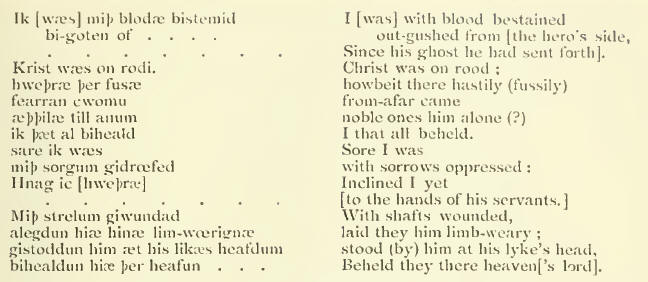
following passage, which is probably among the earliest records of the
Northumbrian dialect. It is inscribed upon the famous stone cross of
Ruthwell in Dumfriesshire, and thus has not been liable to corruption by
transcription. Fortunately there is a West Saxon paraphrase of the poem
which is often attributed to Ca^dmon, the earliest of northern poets. Both
versions are given by Dr J. A. H. Murray at page 20 of his invaluable
treatise on the Dialect of the Southern Counties of Scotland. I give Dr
Murray's literal translation. The parts missing on the Ruthwell cross are
filled in from the West Saxon paraphrase—
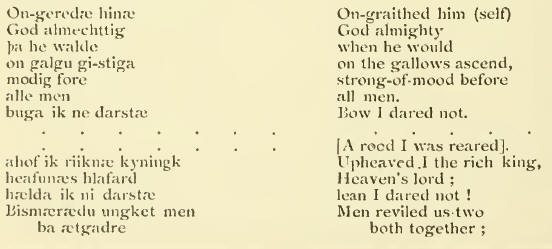
(2) The
dialect of central England was called Mercian. Unfortunately there is very
little literature in it from early times. But from the fact that it was the
dialect spoken in London, Oxford, and Cambridge, it is from Mercian that
modern literary English has developed.
(3) The
dialect of Kent was the most difficult but did not long survive for literary
purposes, though Caxton tells us that even in his time at the very end of
the fifteenth century, the people south of the Thames estuary did not
clearly understand what the people north of it said, the Kentish folk
e.g., still saying
eyren, where the men north of the Thames used the
form eggs,
which had been brought in by the Norsemen.
(4) The
dialect in which most of the old English literature is preserved is that of
the West Saxons. The reason for this has now to be explained. The part of
England which, as far as we know, first developed a literature was
Yorkshire. Ca;dmon and his successor Cynewulf are said to have both been
connected with the great monastery which existed at Streana;s-halch now
known to us as Whitby. But a great disaster fell upon this part of Britain.
That disaster was the invasion of the Danes. Where the Danes came from is
not altogether clear, for the first of them who came are called simply
Northmen, and under that name were included Norwegians and Swedes as well as
Danes in the modern sense. No doubt a large number may justly be called
Danes, for curiously enough, they were descendants of settlers who had come
from the north and fixed their abode in the old Angeln which had been left
desolate by the removal of its inhabitants to England. Not less certainly a
large number were the sons of Norwegian farmers along the sides of the
Norwegian fiords, where the natural increase of the population very soon
outruns the means of subsistence.
These
people took a leaf out of the book of the Saxons four hundred years earlier
and became pirates, though we know them under the more dignified name of
Vikings. They settled in France, whence the name Normandy ; they settled
along the east coast of Ireland, and for a time in the western isles of
Scotland. Hence to this day the Bishop is called the Bishop of Sodor and
Man, Sodor being a corruption of the Norse words for South Isles, the name
by which the Norsemen distinguished the Hebrides from Orkney and Shetland.
Hence also the name of the county of Sutherland, which from the Scottish
point of view is the north land, but to the Norsemen was a southern land.
When, in the ninth century, the Norsemen descended upon the coasts of
Northumbi ia, they swept away the greater part of the old civilisation and
the literature. Thus it was that the Northumbrian literature would have been
entirely lost, had it not already become popular in the south-west of
England, which never suffered so much from the Danes and where consequently
it was preserved in a form more or less approximated to West Saxon.
The area
covered by the Danes in England is easy enough to trace by the place names.
To say nothing of names which are more limited in area, wherever a
place-name ends in —by, there, unless the name is a recent coinage, we are
sure that there was a Danish settlement. Thus Streanaeshalch became Whitby,
in the north-west we have Kirkby, on the east coast Grimsby, down as far as
Leicestershire, Ashby. But in Scotland only a few like Lockerby close to the
Norse settlements in Cumberland, though there are some isolated instances in
more northern counties (see a paper by Dr David Christison in the
Proceedings of the Society of Antiquaries of Scotland, 1892-3, p. 278). The
equally characteristic Norse —garth and —thwaite are almost non-existent in
Scotland, entirely so north of the Forth ; though the former has a parallel
in the Keltic —gorth found in names like Crimondgorth, Auchnagorth.
The
invasion of the Norsemen brought many common words into English ;
take for which the English was
nim, till (Eng.
to), egg wing.
ey). The Norse language had a very great
influence upon the local dialects, and to this day the Northumbrian dialect
is full of Danish words. Wherever the verb
gar (compel) or the verb
bigg (build) is found, there Norse influence is
certain. Neither of these verbs has rooted itself in book English, although
Spenser attempted to introduce the former in Elizabeth's time, this being
one of the reminiscences of his residence for some time in Lancashire. Other
words brought in by the Norsemen were
earl, carl, lurfene, "haven" (earlier English
hfj]) " hithe"),
handfazstan (whence the marriage on trial called
handfasting which survived so long in Scotland),
husbonde " husband,"
scale (of a balance),
score.
Till the
Danish invasion apparently an active commerce was kept up between the
English and the kinsfolk they had left behind 011 the Continent. But when
the Norsemen seized the coast this traffic was no longer possible. Thus the
connexion between the English and the Continent was broken. But something
that was soon to happen was to break the connexion still more effectually.
This event was the Norman Coin uest.
The
Norman conquest, as far as the language was concerned, had begun before
William the Conqueror. Edward the Confessor had lived long abroad and loved
the courtly Normans, so that Norman French was prevalent at his court. The
Northmen had very little trouble in adopting another language. They adopted
French in Normandy and English in England. In this some people have seen
proof of their wonderful versatility. The explanation is probably simpler.
The majority of these Northmen who settled in foreign countries were single
men who married wives of the land. The result was that the next generation
grew up knowing their mother's language better than their father's.
The
Norman conquest had a tremendous influence upon English (1) by introducing
new words, (2) by respelling the whole language. Every schoolboy knows that
while cow, sheep,
swine, are good old English words,
beef, mutton, pork, are equally good Norman
words. The old words remained because the English people for a couple of
centuries became servants to Norman barons and minded their flocks and herds
as we see in Ivanhoe. These herdsmen had to supply the meat for their lord's
table, and had for this purpose to use words which would be intelligible to
their lord. The respelling of the language has had the effect of divorcing
it still more from its kindred languages on the other side of the channel in
appearance and approximating it to French. In old English
gu is never found before another vowel, henco.
guard, guise, guide, guild, guest, are all Norman
words or spellings; guard, guise, are Norman words, guide, guild, guest, are
Norman spellings for gide, gild, gaest.
The
Normans had so much influence upon English because the great monasteries
which they built were filled with Norman monks, and from among them came the
scholars that made a study of the language. Norman William himself tried
hard to learn so much English that no man need make his complaint to him
through an interpreter. But a contemporary assures us that he had not much
success. Norman French remained for long the language of the Court, and it
was the language taught in ladies' schools. This is the meaning of the
phrase so often quoted (and so often misunderstood) from Chaucer of the
Nonne a l'rioresse—
And
Frensh she spak fid faire and fetisly After the scole of Stratford atte
Bowe, For Frensh of Paris was to hire unknowe.
It was a
long time after the conquest—nearly three hundred years— before English
recovered its rights. In 1362 the English Parliament ordained that in all
law courts the English tongue should be used—" in any courts whatsoever,
whether in the king's or other courts, before the king's justices or
others." As time went on the French spoken in England got worse and worse,
for, from the days of John onward, the tie with France was less close, and
soon Englishman's French became a proverb, and its character, I fear, is not
even now restored.
But all
the time that the grand people were talking and writing French there were a
large number of insignificant people engaged in writing the English tongue.
The old dialects under the veneer of Norman French still survived. But in
the middle of the fourteenth century their use in literature began to die
out. The Kentish was the first to go and next after that the West Saxon,
though it had been the book language of the last Anglo-Saxon period. The
Midland dialect comes more and more to the front. It looked at one time as
if through Piers Plowman, the West Midland, the language of the Malvern
Hills was to become the literary language. But a greater than he arose in
Chaucer who wrote the educated London dialect of his day, and from then to
now that has been the literary dialect. But the other dialects were not
dead. They are not dead even now, though the spread of education in all
ranks is on the way to kill them.
Meanti me
the old Northumbrian dialect had entered upon a new lease of life because it
had become the language of the northern kingdom of Scotland. As we have
already seen the name of that country was transferred from Ireland. In the
making of most nationalities there are many elements. Of Scotland this is
not less true than of other countries. At a period long anterior to the
Norman conquest we have seen that the Scots had occupied the western
mainland of Argyll whence they had spread northwards and eastwards till
under Kenneth MacAlpin they were amalgamated in one Government with the
Picts who held the eastern districts north of the Forth. The district from
Tweed to Forth also we have seen was English, both racially and
linguistically. The Picts of Galloway and the ancient British kingdom of
Strathclyde were in process of time swamped by Scots, whose language
survived in Galloway till a period comparatively recent. The Norsemen held
Caithness and Sutherland and the Western Isles, and till the times of
Alexander III. formed a permanent menace to Scotland. Out of these varied
elements the Scottish nationality had to be formed, but the details of the
process belong to history and concern us only in so far as they affect the
development of a national language.
As Dr
Hill Burton remarks, we are unable to trace satisfactorily the stages by
which the predominance of the Scots was lessened till at last they occupied
a position dishonoured and despised. All that we can see is that Saxon
pre-eminence begins with the reign of Malcolm Can-more. In all probability
the Court language of Malcolm and his predecessors from Kenneth MacAlpin
downwards was Gaelic. The marriage of Malcolm with an exiled English
princess seems immensely to have increased Saxon influence. As the higher
civilisation of the Scots had assimilated the Picts, so in Malcolm's time
apparently, the higher civilisation introduced by Queen Margaret and her
numerous English followers usurped the place of the rougher Keltic
civilisation which preceded it. From this time onwards the English language
and a trading population of English-speaking men spreads steadily and
rapidly along the eastern coast. Many attempts had been made to extend both
English language and English conquests north of the Forth during the
preceding four or five centuries. As far back as 685 A.D. the Saxon Ecgfrid
had been defeated and slain at the great battle of Nechtansmere, probably
Dunnichen in Forfarshire. Ecgfrid had aimed at an over-lordship over the
whole northern half of the island. By his death all such dreams were shown
to be impossible of realisation, and in later centuries the arrival of the
Danes gave the English plenty of employment elsewhere.
That,
till about the period of Malcolm, the English tongue and the English
population had not extended far beyond the Forth is shown by several
considerations. Of these, perhaps the most conclusive is that when Queen
Margaret, in 1074, wished to have what she considered abuses in the Church
rectified, she found that the clergy could speak only in Gaelic, and her
husband, Malcolm Canmore. who knew both English and Gaelic, had to act as
interpreter. For Buchan we have the evidence of the charters in the Book of
Deer. These are all in Gaelic except the last, which dates from David I. and
is in Latin. That the grants which purport to have been made to Columba and
Drostan, should be made by people with Ivcltic names is only to be expected.
But in the grant by David I., which brings us to the generation after
Malcolm Canmore, the names of the witnesses are still of the same character.
The bishops who are witnesses have Biblical or Church names, Gregory,
Andrew, Samson. But what could be more Keltic than " Broccin and Cormac,
Abbot of Turbruaid (Turriff) and Morgunn, son of Donchad, and Gille-petair,
son of Donchad and Malaechin, and Matne's two sons," who witness the
preceding gift by " Colbain, mormaer of Buchan, and Eva, daughter of
Garnait, his wedded wife, and Donnachac, son of Sithech, chief of Clann
Morgainn," in a document which belongs to the same reign ? Nor are the other
signatures to the grant in Latin less Keltic—Donchad, Earl of Fife, Malmor
of Athol, Gillebrite. Earl of Angus, Gillecomded, son of Aed, Adam, son of
Ferdomnac, and Gillendrias, son of Matni, who along with Broccin and Cormac
and the three bishops already mentioned, form the witnesses. There can be no
doubt that Dr Stuart, in his preface to the Book of Deer (p. lviii.), is
fully justified in his remark that " it is clear that the population and
institutions of Buchan were wholly Celtic in the time of David I., and that
the influences which led to a change in both must be traced to a later time,
and to a concurrence of causes gradually working out their issues throughout
the kingdom." If further proof were necessary, it could be supplied from
charters granted by the great landowners to their sub-tenants. When, in the
first quarter of the thirteenth century, William Cumyn, the first Earl of
Buchan of that name, granted the lands and mill of Stratheyn and Kindrochet
(Strichen and Kindrought), to Cospatrick Macmadethyn, the tenant bore a name
which shows a decidedly Keltic origin. Three centuries later when the
Sheriff Court Records of Aberdeen begin, such names have entirely
disappeared from Buchan and seem confined practically to the uplands of the
Dee and Don, where, for example, we find John and Donald Makincal^our
combining with John Forbes " fear of Brux," and others with common names on
3rd April, 1505 to be sureties for the production of " Thome Coup before our
soverane lords Justice . . . for the slauchter of Wat Makynreoche."
The steps
by which the change from the Highland to the Lowland tongue took place in
the eastern counties north of the Forth cannot be traced in detail because
of the lack of documentary evidence. As we
have
seen, in the history from Kenneth MacAlpin to Malcolm Canmore there is but
darkness visible. A long procession of kings passes before us, which is
hardly more substantial than that which emerged before the eyes of Macbeth
in the witches' cave. In the succeeding period from Malcolm Canmore to
Alexander III., the period which is all important for this and many other
changes in Scotland, the torch of history burns but with a feeble ray. Amid
the prevailing darkness a few important points can be detected. Tlie coming
of the English tongue was no doubt at first confined to the sea-coast, its
trading towns and their vicinity. Before 1124 the towns of the north-east,
Aberdeen, Banff, Elgin/ Forres, Nairn and Inverness, had formed themselves
into a miniature Hanscatic league. From these towns as centres, the language
of the Sassenach spread.
But it
was not only people of the Lothians who spread northward. The Scottish kings
had themselves great estates in England and their Norman friends followed
them to the north where they presently established themselves, Comyns,
Byssets, Frasers, and many more, with surprising success, paralleled only by
the achievement of Strongbow's followers in Ireland, also among a Keltic
people. Nor were English and Normans the only people who came. When Henry
II. expelled the Flanders traders from England, many of them migrated to the
northern kingdom. Long ere this the kings, however Keltic in blood, had lost
all touch with their kinsfolk of the north and north-west and found their
kingly authority in those districts not even of nominal value. The Lord of
the Isles looked upon himself, not as the subject, but as the equal of the
King who ruled south of the Grampians. HeneeMalcolmIV.no doubt was only too
glad to settle a colony of Flemings in Moray, an 1 early anticipation of the
procedure followed by his remote successor, James I. of England, in the
plantation of Ulster. Nor was it only in Morayshire that the merchants of
Flanders were to be found. As Mr Watt says in his History of Aberdeenshire
(p. 37) "they formed little settlements in many parts of the country,
established trade and handicrafts, particularly weaving, and reclaimed waste
land. One of these settlements was at Crutertston or Courtieston, in the
parish of Leslie, named probably after a Fleming settler ; and Flinder,
still prominent among the place-names of the neighbourhood, is a further
record of this medieval colony." Like European settlers in semi-civilized
countries of the present day, these foreigners were for long entitled to the
enjoyment of their own Fleming law. To this day the name of Fleming is not
uncommon, and perhaps, as appearing in the " Life and Death of Jamie Fleeman,"
is the most widely known of all Aberdeenshire names.
But it
was neither Saxon nor Fleming merchants, nor Norman chieftains that
converted the districts remote from the seaboard towns to the English
speech. Something more drastic in its proceedings was the cause.
Throughout almost the whole of the thirteenth century the Comyns were the
most powerful family in the north-east of Scotland, if not indeed in the
whole kingdom. They were connected with the royal house, and John Comyn of
Badenoch was one of the candidates for the throne, rendered vacant by the
death of the Maid of Norway. When his claim was rejected, Comyn supported
Baliol. This was the first of many grievances which embittered the house of
Bruce against the house of Comyn so much that they must always be on
opposite sides in the conflict with England. When Comyn, Earl of Buchan, as
general of Baliol, invaded England, Carlisle Castle was held in Edward's
interest by the father of Robert the Bruce, later King of Scotland. For this
Baliol declared the estates of Bruce in Annandale " forfeited, and conferred
them on the Earl of Buchan. Henceforth there was no goodwill between the
Bruces and Comyns, though a dozen years were to elapse before their final
conflict in Aberdeenshire" (Watt, History of Aberdeenshire, p. 59).
In 1308
the time of vengeance arrived. Robert the Bruce defeated the Earl of Buchan
near Old Meldrum, and then proceeded to extirpate the Comyn influence. John
Barbour, who was born within a generation of the event, and who, as parson
of Rayne, had every opportunity to be well acquainted with the facts, sums
up the whole history in a few pithy lines (The Brus, ix. 294-300) :—
Now ga we
to the King agane, That of his victor wes richt fane And gert his men burn
all Bouchane Fra end
till end, and spartt nane. ; And her) it thame on
sic maneir That eftir that, neir fifty jheir, Men menyt the heirship of
Bouchane. The King than till his pess has tane The north cuntre, that
hwmylly Obeysit till his senjory, Swa that be north the Month var nane, That
thai ne war his men ilkane. His lordship wox ay mair and mair.
Though
the statement that " he sparit nane " may be taken with a grain of salt, it
is significant, as has already been said, that when the court records of
Aberdeen begin two hundred years later the names of the jurymen and parties
to suits who come from Buchan are so characteristically Lowland. From the
date of the Comyns' overthrow, no doubt the Lowland dialect has steadily
advanced from the coast inland.
It has
always to be remembered that the dialect now spoken in the north-eastern
counties is an imported dialect which was originally uniform with the
dialect, not only of Mearns, Angus, and Fife, but also with that which was
spoken from Forth to Humber. It is in fact an English dialect, as presumably
now every schoolboy knows, though nearly a hundred years ago Jamieson
prefaced the first edition of his Scottish Dictionary with a long
dissertation to prove that it was not. Jamieson, in fact, by this denial and
by deriving Scotch words from Dutch, " Suio-Gothic," from anything but their
real source, did much to retard a really effective study of the phenomena of
the language which he had so well and laboriously collected in his
Dictionary. That the dialect was English, indeed, hardly required to be
proved, for no Scottish author earlier than Gawain Douglas ever thought of
calling it anything else but Inglis (English). Till this time when the
language of the Scots was referred to, what was meant was Gaelic, or as the
old Scotch writers term it, Ersch (Irish). More than thirty years ago Dr J.
A. H. Murray, in the treatise already referred to, collected a
catena of passages from the Scottish writers
themselves, showing that the Lowland tongue, " the langage of the northin
lede " was regularly described as Inglis. How, then, did the Scottish
writers describe the language of their southern neighbours, which, founded
as it was upon the Mercian dialect, was now very different from
Northumbrian? As
English was annexed by them as the term for their
own tongue, southron
or suddron
was all that could be applied to the literary dialect of England. It is
interesting to note that even a writer so intensely national as John Knox
was twitted by his Roman Catholic opponents as writing a foreign tongue. No
doubt long residence out of Scotland, and probably more than all else the
English Bible, had considerably influenced Knox's writing in the direction
of the literary English of his day. Hence we find Ninian Winzet, in the
controversy which he carried on with Knox, declaring " gif 5011 throw
curiositie of nouationis hes forget our auld plane Scottis, quhilk ^our
mother lerit 5011, in tymes cuming I sail wryte to ^ou my mynd in Latin ;
for I am nocht acquyntit with 50ur southeroun." To "knapp suddron " was
insisted upon by other Roman Catholic controversialists as a characteristic
of the Scotch Protestant Reformers, who were supported from England.
The
earliest form of the Northumbrian dialect known to us has been illustrated
by a document on Scottish soil—the Ruthwell cross. Unfortunately the next
stage is not so easy to illustrate, as the interlinear glosses of the
Gospels, the Lindisfarne and part of the Rushworth, are not a consecutive
translation but merely the vernacular meanings of the words written above
them, much in the same way as schoolboys in difficulties still write the
meanings of hard Latin words between the lines. On the northern side of the
Border, however, there is nothing at all parallel to these glosses, which
date probably from before the Norman Conquest. The only information indeed
that we obtain concerning the English language of the northern kingdom comes
from the old Burgh laws, some of which in their Latin form, date from the
reign of David I., in other words from the first half of the twelfth
century. The Latinist often left technical terms in the vernacular, and
Cosmo Innes in the preface to his edition of Barbour collected a
considerable number of such phrases. One example may suffice.
Si quis verberando fecerit, aliquem blaa
et blodi,
ipse qui fuerit blaa
et blodi
prius debet exaudiri. The phrase
blaa and blodi
was probably one in very common use. Not only is it found in the much later
vernacular version of the law, but appears even in a hymn :—
His sydes
full bla and bludy ware,
That sumtyme war full brig-hte of blee;
His herte was perchede with a spere;
His bludy woundes was reuthe to see.
But this
hymn is no product of Scotland ; it belongs to the Yorkshire of the 14th
century, and is printed by Professor Horstmann, as possibly a work of
Richard Rolle of Hampole, who wrote about 1340 A.D.
In
poetry, however, the language is rarely the common spoken language of the
date of composition. Poetry gains in dignity and emotional effect from the
use of phrases borrowed from earlier poetry or archaic in themselves.
Unfortunately, connected prose from the Scottish side of the Border is late
in appearing. No doubt it had existed, but the long turmoil of the War of
Independence, and the ravages of the English have swept it away with most
other traces of the well-being of Scotland prior to the death of Alexander
III. Hence the earliest piece of continuous prose, that Cosmo Innes is able
to cite, is a precept under
the privy
seal of the Earl of Fife, Warden of Scotland, to pass the wool of the monks
of Melrose free of custom. It is dated 26 May, 1389.
"Robert,
&c., ffor quhy that of gude memore Dauid Kyng quhilom of Scotland that God
assoillie wl his chartir vndre his gret2 sele has gyvin to the
religiouss men the abbot and the conuent of Meuros and to thair successours
for ever m-.re frely all the custume of all thair wollys as wele of thair
awin growing as of thair tendys of thair kyrkes as it apperis be the forsaid
chartir confermyt be our mast soucreigne and doubtit Lorde and fadre our
lorde the Kyng of Scotland Robert that now ys wyth his grete sele &c." (Liber
de Melrose No. 480.)
Of more
human interest is a letter of George, Earl of Dunbar, which he wrote to
Henry IV. of England on 18 February, 1400, and which is given in full in the
appendix to Pinkerton's History, vol. i. p. 449. Plere need only be quoted
the end part, of which Innes obtained a recollation from the document in the
British Museum, and of which therefore the dialect forms are certain :—
"And
excellent prince syn that I clayme to be of kyn tull yhow, and it
peraventour nocht knawen on yhour parte, I schew it to yhour lordschip be
this my lettre that gif dame Alice the Bewmount was yhour graunde dame, dame
Mariory Comyne, hyrr full sister, was my graunde dame on the tother side, sa
that I am bot of the feirde degre of kyn tyll yhow, the quhilk in aide tyme
was callit neir. And syn I am in swilk degre tyll yhow I requer yhow as be
way of tendirness thareof, and fore my seruice in maner as I hafe before
writyn, that yhe will vouchsauf tyll help me and suppovvell me tyll gete
amendes of the wrangs and the defowle that ys done me, sendand tyll me gif
yhow lik yhour answer of this with all gudely haste. And noble prince
mervaile yhe nocht that I write my lettres in Engl, fore that ys mare clere
to myne vnderstandyng than latyne or fraunche. Excellent, mychty, and noble
prince, the haly Trinitie hafe yhow evermar in kepying. Writyn at my castell
of Dunbarr, the xviii. day of Feuerer.—Le Count de la Marche Des-coce."
The
doughty earl to whose understanding, as he says, English was more clear than
Latin or French, signs himself with a little remnant of the French that was
becoming in a scion of so Norman a stock as that which produced Dame Alice
the Bewmont and Dame Marjory Comyn. Almost contemporaneous with his letter
is the following missive sent by the magistrates of Aberdeen in 1401 to some
important personage mi whose name unfortunately is lost. The letter is
printed in Stuart's
Extracts from the Council
Register of Aberdeen, a volume issued by the
Spalding Club in 1844.
"
Reuerence and honour likit yhu to wit, that the lord of Keth arestn: yhur
wyn and yhur oxin, and for gud causis as he lete ws wit ; and for yhur sakis
we made him request that he suld frely delyuer thaim, for the quilk request
he has delyuerit thaim frely at this tym, for we ar thai at wald at gud
acord war betwex yhu and hym, and wil do our besynes to bryng it thar to at
our power, at the quilk accord he sayis he wald be gladly and sal nocht leve
in his defaute. Qwarfor, der lord, it is our consale, and we requir yhu,
that for essy of the contrar and quiet of our place, yhe wald asich gif yhe
ocht aw hym, sa that hym nedit nocht in tyme to cum til mak sic punding and
namly in our tovn, for he says it is previt dete that yhe aw hym, and of
lang tyme by gane ; and gif yhe will adreis yhu to be at ony day with hym
for the knawlege of the forsaid thyngis sends ws word, and we sal late hym
wit, and gif it langs ansuer we sal ger send it yhu, for we ar richt mykil
haldyn to yhu, and als til hym. God kepe yhur estate as we desir."
How
little this English from north of the Tweed differed from that not far north
of the Humber will be clear from the following little homily of Richard
Rolle, the hermit of Hampole, on the text of the bee.
Moralia Richardi, heremite
de natura apis, unde quasi apis argu-mentosa (Horstmann,
Richard Rolle of Hampole (1895), p. 193.
The bee
has thre kyndis. Ane es
pat scho es neuer ydill, and scho es noghte with
thaym J)at will noghte wyrke, bot castys thaym owte and puttes thaym awaye.
Anothere es J)at when scho fiyes scho takes erthe in hyr fette,
pat scho be noghte with thaym
pat will noghte lyghtly ouer-heghede in the ayere
of wynde. The thyrde es J»at scho kepes clene and brighte hire winge^. Thus
ryghtwyse men J)at lufes god, are neuer in ydyllnes ; fifor owthyre J)at ere
in trauayle, prayand, or thynkande, or redande, or othere gude doande, or
withtakand ydill mene and schewand thaym worthy to be put fra ])e ryste of
heuene ffor ])ay will noght trauayle here. J)ay take erthe,
pat es
pay halde ]}amselfe vile and erthely that thay be
noghte blawene with ]?e wynde of vanyte and of pryde. Thay kepe thaire
wynges clene, that es ]?e twa commande-mentes of charyte
pay fulfill in gud coneyens, and thay hafe othyre
vertus vnblendyde with ])e fylthe of syne and unclene luste. Arestotill sais
J)at ]?e bees are feghtande agaynes hym ])at will drawe ])aire hony fra
thayme. Swa sulde we do agaynes deuells J)at afiforses thame to reue fra vs
}>e hony of poure lufe and of grace. For many are Jiat neuer kan halde J>e
ordyre of lufe ynesche ])aire frendys sybbe or ffremmede, bot outhire J)ay
lufe J)aym ouer-mekill, settand thaire thoghte vnryght-vvysely on thaym ; or
|)ay luf thayme ouer lyttil, yf J)ay doo noghte all as J>ay wolde till J>ame.
Swylke kane noghte fyghte for thaire hony, ffor-thy J)e deuelle turnes it to
wormed and makes J)eire saules ofte-sythes full bitter in angwys and tene,
and besynes of vayne thoghtes and o])er wrechidness, ffor thay are so heuy
in erthely frenchype ])at })ay may noghte flee in till ])e lufe of lhesu
Criste. in |)e wylke )My moghte wele for-gaa ])e lufe of all creaturs
lyfande in erthe."
Here may
be noted the most important of the characters which distinguish this from
the earlier literary English of the south. They may for convenience be taken
in the order of the words as they stand in the passage. They are as follows,
the first in each couple being Hampole's word, the other the contemporary
southern literary English:—has = hath ; ane = oon, one; scho = heo ; thay m
= hem; kepes = kepeth ; men ])at lufes = men J)at lufeth (in the south), men
])dt lufe (midland); (observe that this form is found oftener in relative
clauses than in principal sentences; cp. in modern Buchan
Them at his- a hantle tae dae with
They hiv a hantle a mo thir haris)\ prayand,
thynkande, &c. = prayinge, thynkinge, &c. (since Layamon in the 13th
century); swylke = swich, wylke (Barbour, or quhilk) = which. Observe also
agaynes which still survives in the north without a final t ; for this the
southern Middle English is ayeines.
It may
not be uninstructive to compare a sentence from a sermon by John Gaytryge or
Gawtry (a follower of Hampole) on the Ten Commandments with the Frisian
passage quoted before, in order to see how far the languages, as represented
by documents separated in time by less than a century, have diverged. The
date is about nine hundred years after the emigration of the Angles to
England, and about five hundred after the total isolation of Frisian and
English from one another.
Opis
tene Comanndementis pat er befor rekennede, er vmbylowked in twa of ])e
gospell ; ])2 tane es, ])at we luf god ouer all thyngs ; ]?e tothir, J)at we
luf our eeuen-cristene als we do otireselfe. For god aw vs to luf haly with
hert, with all our mygth, with all our thogth, with word and with deide. Our
eeuenecristene alswa aw vs to luf vnto ])at ylke gud pat we luf our-self,
])at es at say, welefare in body and in saule, and come to Jnt ylke blysse ]nt
we thynketill." (Horstmann op. cit. p. 109).
At this
period the dialect which has ever since remained the literary dialect of
England was already taking shape. At first the popularity of
Piers
Plowman bid fair to make the literary dialect that of the west, for William
Langland its author was a native of the Malvern hills. But a much greater
poet arose presently in Geoffrey Chaucer who represented the cultivated
speech of London. That speech as the dialect spoken in the three great
centres London, Oxford, and Cambridge, was already on the way to become the
literary dialect of England. Chaucer did much to strengthen the tendency,
which was confirmed by the fact that England produced no author equal in
influence to Chaucer for more than a century and a half after his time.
An
instructive parallel may be drawn between the English of Wiclif's New
Testament as revised by John Purvey, which belongs to this period (the end
of the fourteenth century), and a transcription of that translation made in
the dialect of Ayrshire, probably by one Murdoch Nisbet, about a hundred
years lat;r. This Scottish version has been recently edited by the late Dr
T. G. Law for the Scottish Text Society.
WiCLIF
AND PURVEY, MSS. And he seide, A man hadde twei sones ; and the monger of
hem seide to the fadir, Fadir, 5yve me the porcioun ot cat el, that fallith
to me. And he departide to hem the catel. And not aftir man)' daies, whanne
alle thingis weren gederid to-gider, the monger sone wente forth in
pilgrymage in to a fer cuntre ; and there he wastide hise goodis in lyuynge
lecherously. And aftir that he hadde endid alle thingis, a strong him pre
was maad in that cnntre, and he bigan to have nede. And he wente, and droii5
him to oon of the citeseyns of that cnntre. And he sente hym into his toun
to fede swyn. And he coueitide to fille his wombe of the coddis that the
hoggis eeten, and no man jaf him. And he turnede a5en to hym silf, and seide,
noil many hi rid men in my fadir hous han plente of looues ; and V perische
here thorouj hiingir. Y schal rise vp, and go to my fadir, and V schal seie
to hym, Fadir, Y haue synneil in to heuene, and hifor thee ; and now I am
not worthi to be clepid thi sone, make me as oon of thin hirid men. And he
roos vp, and
Mt'RDOCH
CVlSBKT, I520? And he saide, A man had ij sonnis ; and the yonngara of thame
said to the fader, Fader, gene me the portionn of substance, that fallis to
me. And he departit to thame the substance. And nocht monv dais eftire,
quhen al thingis war gaderit togiddire, the yomvjrar sonn went furth in
pilgrimage into a ferr cuntree, and thare he waistit his gudis in leving
lielierouslie. And eftir that he had endit al thingis, a stark hungire was
made in that cuntree ; and he began to haue need. And he went, anil drew him
to aan of the citezenis of that cnntre ; and he send him into his tovn to
fede swyne. And he couatit to fill his wambe of the coddis that the hoggis
etc ; anil na man gave to him. And he turnit agane into him self, anil said,
now mony hyretmen in my fadris hous has plentee of laaues, and 1 peryse hi
re throu hungir. I sal ryse up and ga to my fadere, and I sal say to him,
Father, I haue synnyt into heucn anil before thee, and now I am nocht
worthie to be callit thi sonn : mak me as aan of thi hyret men. And he rase
up, and com cam to his fadir. And wliannl ho was _;it afor, his fadir srii5
hym, ami was stirrid bi mercy. And I10 ran, and fol on his necke, and
kisside hym. And iho sone seide to hym, Fadir, V haue synned in to hetiene,
ami bifor lhee;and now V am not worlhi lo be clepid thi sone. And the fadir
seide to liise sor-uauntis, Swithe btynge 50 forth the firsle stoole, and
clothe 50 hym, and fyue ;e a nngin his hoond, and schoon on hise feet ; and
brvnge ~e a fat calf, ami sle 50, and ete we, ami make we feeste. For this
my sone was deed, and hath lived ajen ; he perischid, and is foumlun. to his
fader. And quhen he was yit on 'er, his fadere saw him, and was mouet bir
mercy, and he ran, and fell on his neck, and kissit him, And the sonn said
to him, Fader, I haue synnyt into heuen, and before thee, and now I am nocht
worthie lo be callit thi sonn. And I he fadere said to his seruandis, Suythe
bring ye furthe the first, slole, and cleithe ye him ; and gene ye a ryng in
his hand, and schoon 011 his feet ; And bring ye a fat calf, and sla ye ;
and ete we, ami mak we feest : For this my sonn was deid.and has leeuet
agane; he peryset, ami is fundin.
If
Murdoch Nisbet, or whoever the translator was, had made a translation for
himself from the Vulgate, and not a mere transliteration of Wiclif's
version, no doubt he might have used here and there a somewhat different
vocabulary. As it is, however, he has made correctly such changes in form as
were necessary to render his version a really Scottish version. He has
changed the pronoun
hem to
thame, the present tense
fallith to
fallis,
and the past tenses in-de
into past tenses in-t
('coueitide, couatit), he has introduced the
characteristic third plural
hyret men has, while Wiclif keeps the old
han ; Wiclif has made the change of
an into
oon, of
laves into
looues,
but the Scotch transliterator has restored the old forms which mark the
distinction between the dialects to this day ; he has put in
send as the past tense, a form which long
survived his time. But even at this comparatively late date some
characteristics of modern Scots do not appear in it. Most-marked of all
northern peculiarities to an Englishman of our day is the loss of final
I after
a and
u in
ba\fa\fou,pu\ etc., and the change of
ol into
ozv, so that
roll appears as
row, poll as
poiv, and the like. In the passage quoted, as it
happens, there is not much to illustrate these peculiarities but we find
al in
endit al things where modern Scotch dialects
would put althing.
And this brings us face to face with one of the great difficulties of the
literary language of Scotland throughout the sixteenth century and later.
Eccentricities of spelling, or what appear to us as such, were at an earlier
period attempts, no doubt often imperfect, to represent phonetically the
sounds which the writer intended to express. But now we come to a period
where the spelling had begun to deviate considerably from the pronunciation.
The history of" Middle Scots," as this period in the language is called, is
a large and difficult subject, into which I do not propose to enter. It is
enough to say that the language of a large part of its literature, and
especially of its prose literature, was couched in a phraseology which was
employed oniy by literary men familiar with French and with Latin and was
unknown or, if known, unintelligible to the general. The best known example
of this is the strange and interesting work known as the
Complaynt of Scotland and dating from 1549 A.D.
From the period of the Reformation, and naturally with greater acceleration
after the Union of the Crowns in 1603 A.D., the literary language of
Scotland became assimilated to that of England. The prose writers commanded
a larger audience by appealing to an English as well as to a Scottish
public. The poets found the English vocabulary on occasion very convenient
for providing rhymes. Hence a large part of the literature on which Scotland
most prides herself is
written only in a bastard Scots which is more than half "southron." This
charge has often been made, and with truth, against Burns. It has been less
noticed that, nearly seventy years earlier, Allan Ramsay had recognised the
truth of the criticism and gloried in what some of his contemporaries would
have thought his shame. Even the most fanatical of Scotchmen could not say
more in praise of his native tongue than does "honest Allan " in the prcface
to his poems.
"That I
have exprest. my thoughts in my native dialect, was not only inclination,
but the desire of my best and wisest friends ; and most reasonable, since
good imagery, just similies, and all manner of ingenious thoughts, in a
well-laid design, disposed into numbers, is poetry.—Then good poetry ma}' be
in any language.— But some nations speak rough, and their words are
confounded with a multitude of hard consonants, which makes the numbers
unharmoniou*. Besides, their language is scanty, which makes a disagreeable
repetition of the same words. There are no defects in ours ; the
pronunciation is liquid and sonorous, and much fuller than the
English, of which we are masters, by being taught
it in our schools, and daily reading it ; which being added to all our own
native words, of eminent significancy, makes our tongue by far the
completest; for instance, I can say,
an empty house, a too?n barrel, a boss-head, and
a hollow-heart."
This is
bringing the mountain to Mahomet with a vengeance, but nevertheless
Ram-say's statement faithfully represents the practice pursued by himself
and all his poetical successors from then till now.
The
practice in prose was somewhat different. During the greater part of the
eighteenth century, in Edinburgh at least, persons of education really
employed two dialects. What Ramsay of Ochtertyre says of Lord Karnes, will
illustrate this. " The language of his social hour was pure Scots, nowise
like what he spoke on the bench, which approached to English. In all
probability he used the same words, phrases, and articulations which the
friends and companions of his younger years made use of in their festive
hours, when people's hearts knit to one another. Nevertheless there was
nothing mean or disgusting in his phraseology or tone." Here we have clearly
Dandie Dinmont's counsellor, Mr Pleydell, brought before us. But that the
character survived even into the nineteenth century could be plentifully
illustrated from Cockburn's Memoirs. How far even the common dialect has
changed in a century and a half may be seen from Lord Kames' remark that to
hear the sound written 2 in the names Mackenzie and Menzies oro-nounced like
an English c, was enough to turn his stomach. Though Menzies has been
successful in retaining its original sound, there are probably no districts
now where Mackenzie is pronounced in the old way as
Mackingie, and probably few persons living who
have heard it so pronounced except as an intentional archaism.
But what
of the language of the common folk through all these centuries ? As we have
seen, the Saxon language in Scotland had in different areas different
substrata. These substrata of extinguished languages are to some extent
reflected in the counties of the mainland outside the Highland line by
differences in the Scots spoken in them. Thus the dialect of Galloway and
Dumfries differs markedly from that in the adjacent counties of Selkirk,
Peebles, and Roxburgh. The dialect of the Lothians many centuries since
extended itself over most of Fife. The ancient Strathclyde represented by
northern Ayrshire, Lanark, Renfrew, and Dumbarton has a dialect of its own.
Perthshire outside the Highland line has a dialect which encroaches to some
extent on Fife and Forfar. From this the dialect of Angus and the Mearns is
distinct as it is also from that spoken outside the Highland line from
Aberdeen to Inverness. In Caithness, Norse and Gaelic have both had to give
way to a dialect similar to, though not identical with that of Aberdeenshire.
The dialect of Aberdeenshire is upon the area which once was Pictish. So is
that of Angus and the Mearns. Why then are not the dialects identical ?
There are no linguistic elements in the one which are not in the other. The
chief and perhaps the only cause for the difference is the isolation
produced by geographical barriers.2 The
Grampians and the river Dee prevented much communication except by sea, and
each district has consequently gone "its ain gait" in the matter of
language. The differences are mainly, though not altogether phonetic, and a
comparative study of the history of their sounds would make it tolerably
clear how the differences arose. Every community which is well marked off
from its neighbours by geographical boundaries tends to develop a dialect of
its own. Even in the area in which the Aberdeenshire or " Broad Buchan " is
spoken, there are a considerable number of sub-divisions with special
characteristics. The late Dr Gregor distinguished three sub-dialects in
Banffshire. In Aberdeenshire, Buchan proper can be distinguished in dialect
from the Garioch and from Mar, while all three are different from the
dialect in the city of Aberdeen. The differences are matters of phonetics
and vocabulary which the greater facilities for movement from one district
to another, and the levelling effects of education have already almost
entirely obliterated in the rural districts, the dialect of which, however,
remains distinct from that of the city.
The
dialect spoken in the north-eastern corner from the Dee to Inverness is weli
deserving of investigation by reason of its peculiarities, and also by
reason of the large amount of literature which has been produced in the area
with at least some traces of the local characteristics. To th is region
belongs the first important work extant in any Scottish dialect—Barbour's
Bruce. It might even be possible to urge a
prima facie claim to the earliest lyric extant in
Scots. Its two stanzas are well known and have been handed down in a variety
of forms. The first of these runs thus in Laing's edition of Wyntoun's
Original Chronicle i., 266 :—
Ouhcn
Alexandyr cure King wes dode
That Scotland led in luwe and le.
Away wes sons off ale and bred,
Of wyne and wax, off gainyn and gle.
The
scansion of the verse shows clearly that Alexandyr here could not have been
pronounced like the modern Alexander, because it can have
only
three syllables. The pronunciation must in fact have been something like
Alshiner, and in Buchan the last generation spoke of a man whose name was
Alexander Alexander as Sanners Elshiner. Nor is this a recent change in
Aberdeenshire, for Alzenor, Elshenour, Alshonour, (the two last of the same
person) are all found in Aberdeen documents of the sixteenth century. But
the change was possibly not confined to this area.
Of far
greater importance, however, is Barbour's Bruce because of its extent and
also of its indisputably northern origin. The date of John Barbour's birth
is not certain, but he died an old man in 1395. He was, therefore, probably
born somewhere about 1320, possibly, as most authorities think, some years
later. By 1358 he was archdeacon of Aberdeen and from the numerous
references to him in extant documents, it is clear that not only was he a
capable churchman as the " bishop's eye" ought to be, but also a scholar
ar.d a statesman. The history of the Bruce, which alone is preserved to us,
was only part of his literary work. A mythical history called the Brut,
tracing the descent of British sovereigns from Brutus a descendant of
Aeneas, and an equally mythical metrical history of the family of Stewart we
know to have been written by him, but both are lost. The contents of the
first were no doubt much like those of the earlier English poem of the same
name by Layamon ; the contents of the second are preserved for us in Hector
Boece's Latin prose translated into the vernacular by another archdeacon,
John Bellenden, archdeacon of Murray and canon of Ross. This translation was
made for the benefit of James V., who, we are told elsewhere, was " nocht
perfyte in Latin toung."
As
Barbour was in all probability a native of Aberdeen we might expect in his
work traces of the local dialect. There is no evidence that in his time
there was a standard form of the Scots tongue differing from that of
Aberdeen, and considering how the dialect of the North East had spread from
the South, the development of marked differences at so early a period is
improbable. But unfortunately we do not possess the manuscript as written by
Barbour himself. The two extant copies were both written by the same scribe,
John de Ramsay, more than a hundred years after 1375 when the work was
composed, and the scribe undoubtedly adapted spelling and forms to the
manner of his own age and his own dialect. The greater part of Barbour's
language is still quite intelligible to Aberdonians, but the majority of the
words which appear to them specially characteristic of north-east Scotland
are words which can be traced back to Anglo-Saxon, though in literary
English of modern times they may have died out. For the characteristic
/'instead of roh
in fa
" who "far
" where" fan
" when I' fup
" whip," etc., Barbour gives no help. Nor is there any trace of the loss
general throughout Scotland of
11 in
all, pull, etc. Possibly these changes had not
yet come in, though the latter, as we shall see presently, had certainly
appeared in some situations soon after the date of the writing of our
existing manuscripts in 1487 and 1489.
A still
larger body of verse, which has been wrongly connected with Barbour, is to
be found in the Legends of the Saints preserved in a manuscript in the
Cambridge University Library. That they are of northern origin is shown by
the fact that, of the only two Scottish saints included, St Machar, whose
fame is entirely connected with Aberdeen, is one. St Ninian also, the other
Scottish saint, though most closely connected with Galloway, had his
festival specially observed in Aberdeen, as the Aberdeen Breviary shows.
Moreover it is easy to see the reason for the introduction of St Machar,
though apparently it has escaped the attention of the editors. The writer of
the collection had been engaged on the life of St Nicholas, who, though born
at Patara in Lycia, was very popular in many countries including Russia and
England where a very large number of churches are dedicated to him. The
great church of Aberdeen is St Nicholas, and the editor of the collection
naturally passed from the saint of the new to the saint of the old town—St
Machar, to whom the church preceding the present cathedral and the cathedral
itself were dedicated. As two passages of 21 and 34 lines respectively are
common to the legends of St Machar and St Ninian, it seems probable that the
original, whence the present collection was drawn, contained no legend of St
Machar, but that the local editor or translator inserted it as interesting
to his readers. As Dr Metcalfe, the editor for the Scottish Text Society
says, the dialect forms are not clear proof of origin in Aberdeen, nor in
any other definite area. We have, however, no reason to suppose that this
MS. is anything more than a fifteenth century copy of an older collection,
so that we have the same difficulty about transcription as in the case of
Barbour. There is, however, one interesting point in the legend of Mary of
Egypt (xviii.) which is the most carefully finished of the whole collection.
Here we are told (1148) that the monk who conversed in the wilderness with
Mary of Egypt.
leite |)at
haly lyme ga by
till Biil feris lhur[s]day come ncre.
The text
of the second line is uncertain. The MS. seems to read
iheris furday
and Dr Metcalfe in his glossary reads
feris furs day, i.e., Holy Thursday or Maundy
Thursday. The word
feris, however, is probably a misreading of the
word sckir,
regularly applied to the Thursday preceding Good Friday, which this Thursday
is. In any case, the initial
f
of furday,
if it may be trusted, when combined with other proofs, strengthens the claim
of Aberdeen to be the home of the collection, and is the earliest example of
this well known dialect change.
Between
this early literature and the modern dialect literature in " Broad Buchan "
there is a gap of centuries. Before we come to the plentiful literature of
the last two centuries, we find that the peculiarities of the dialect are
stereotyped much in their present form. The earliest known literary
reference to the peculiarities of" Broad Buchan " is in Dr Archibald
Pitcairne's satire of " The Assembly or Scotch Reformation," written in
1692. I quote from a note of Dr Joseph Robertson's in his
Collections for a History of
Aberdeen and Banff (Spalding Club, 1843) p. 73,
Pitcairne's volume not being contained in any library accessible to me. But
a friend has collated Robertson's quotations with a copy of the original in
the Advocates' Library, and assures me that the note is accurate and
contains practically all the phrases that imitate or parody the " Broad
Buchan." The remarks are put into the mouth of " Laird Little-wit, a
north-country man," and are as follows : " Cleense out the keerates, that
the gospel may be preached ; let that be first deene." ..." I jeedge it guid,
and for sekeerity of the protestant religion, that na keerate get leave to
sett his fitt within this bigging." ..." But see the doors be nae opened to
him." . . . " Fat ha' they deen ? If that be true, we are but a beik of bees
without stangs." . . . "If we be nae ither-ways sekeered, bot be the claim
of right, we've a cald coal to blau at; I wad anes see to sekeere the
quintra frae free quarters, and a' the rest of the abeeses mentioned in't;
and then we may expect sume guid o't; but, guid seeth, moderator, Sir
William Littlelaw had nae a's wits about him fan that claim was drawn, and
sae's seen o't the day, for they say he takes fits." . . . "A wast quintra
believer, moderator, can teach better than ony keerate i' the north, and
they'll seen learn to gi' the com-meenion."
Apart
from Barbour's Bruce and the Legends of the Saints, the poetry of the North
East of Scotland has been almost exclusively lyrical and, with some notable
exceptions, even its lyrics have not enjoyed more than a local reputation.
Moreover, even the best productions in this kind, with rare exceptions, are
uncertain guides to the dialect, because there are manifest attempts to
assimilate the language to that of writers in the south of Scotland, and
secondly, because, like other Scotch versifiers, the authors never hesitate
to use an English word more or less disguised by spelling, or an English
construction, where either appears to be more convenient than the words or
phrases of the native dialect. These characteristics have become more
accentuated within the last century through the influence of Burns, though
Allan Ramsay, as we have seen, was a conscious sinner in this respect. How
it affected the best of Buchan song writers can easily be seen in the
difference between John Skinner's
Monymusk Christmas Baing, which was written not
later than 1738, and his other pieces. Yet even the title of this is
conveniional Scots, since the Aberdeenshire dialect had never had an ending
in —ing
for words of the type of
Baing, which ought to be
Ba'in. And among the songs there is a well marked
gradation in dialect quality. The
Eivie zvi the crookit horn
approaches closely to the spoken dialect and the comparative purity of
dialect seen in the
Christinas Baing ; lulloch-gorum has a greater
English element in it an
([John of Badenyon a still greater than
Tullochgorum. No doubt the difference is one
rather of writing than of pronunciation. Could we have heard those charming
daughters who, as Skinner writes to Burns in November, 1787, "being all
tolerably good singers, plagued me for words to some of their favourite
tunes, and so extorted those effusions which have made a public appearance
beyond my expectations and contrary to my intentions," we should probably
have found that often where the written word was Anglicised, the spoken word
was in no way different from that of other inhabitants of Linshart.
A much
more faithful representation of local peculiarities is to be found in Jfax
his speech to the Grecian Knabbs attempted in broad Bitchans by R. F. Gent,
which was first published in 1742. The author of this, which is a
translation of part of Ovid's Metamorphoses Book xiii., was a Buchan man
named Robert Forbes who was a hosier in London. The author, in a poetical
shop bill printed at the end of the Edition of
1754, the earliest which I have seen, gives us this information himself:
I
likewise tell you by this bill That I do live upo' Towerhill Hard by the
house o' Robie Mill, just i' the nuik, Ye canna' mist when 'ere you will,
the sign's a buik.
In
Chalmers' life of Ruddiman we are told that the grammarian and printer, when
this translation was read to him "in the vulgar dialect of Buchan, declared
it the best, that had ever been made." Ruddiman ought to have been a good
judge, for he was a native of Boyndie in Banffshire. That he meant what he
said is shown by the fact vouched for by Chalmers that the edition of 1754,
which has no ptinter's name, was printed by his firm and the glossary
supplied by Walter Ruddiman his nephew.
Robert
Forbes is not much of a poet. If he had been, he probably would have
selected a more poetical author than Ovid from whom to translate. Like most
translators he is occasionally hampered by the difficulty of putting his
author into the vernacular. Thus he can perpetrate a verse like the
following which in its versification savours of the scotch version of the
Psalms at its worst :
The slaik
indeed is unco' great,
I will
confess alway. But, name Ulysses to it anes, The worth quite dwines away.
It must
be acknowledged, however, that this is also Forbes's worst. Sometimes, as in
the following lines, he is spirited enough, however little poetical, though
perhaps after a hundred and sixty years occasionally not altogether
intelligible to everybody even in Buchan :
Fan he
spang'd out, rampag'd an' said
That nane
anion' us a' Durst venture out upo' the lone,
Wi' him
to shak' a fa' ; I dacker'd wi' him Iiy mysel',
Ye wish't
it to my kavel, An' gin ye speer fa' got the day, We parted on a nevel.
More
poetical, though less satisfactory as a representative of the dialect, is
the contemporary author of a book which once had a great vogue in the north
eastern counties of Scotland—Helenore or the Fortunate Shepherdess.
Alexander Ross was a native of Aberdeenshire, having been born in the parish
of Kincardine O'Neil in the year 1699. For more than fifty years of his long
life he made his home in Lochlee on the Forfar side of the Grampians where,
as long as strength lasted, he was schoolmaster. According to Rev. Harry
Stuart of Oathlaw, the story of Lindy and Nory, as it was familiarly named,
was originally written in English and, by the advice of a wise friend,
metamorphosed into Scots before publication. If this be so, and there seems
no reason to doubt Mr Stuart's evidence, the poem must have been
considerably altered in the process and the introduction distinctly suggests
that it was modelled upon Allan Ramsay's
Gentle Shepherd. Dr Longmuir the most careful of
the editors of
Helenore has some doubts where to place its
dialect. " As to the language, it is said to be ' the broad Scotch,'
although it is neither the language of Ramsay nor Burns, neither is it what
is known as the Buchan dialect, which may be regarded as the broadest in
Scotland . . . . it is, in short, the ordinary dialect of the people whom he
has so successfully represented." This appears to mean that Dr Longmuir
supposed the dialect to have been that of the people of Glenesk. If so the
dialect then must have approached that of Aberdeenshire more closely than it
is said to do now. In the introduction Scota lays her command upon the bard
in these terms :
Speek my
ain leed, 'tis gueed auld Scots I mean, Your soudland gnaps I count not
worth a prine. We've words a-fouth, we well can ca' our ain, Tho' frae them
sair my bairns now refrain, But are to my gueed auld proverb confeeriii',
Neither gueed fish nor flesh, nor yet salt herrin'. Gin this ye do, and lyn
your ryme wi' sense, But ye ll mak friends of fremmit fouk, fa kens ? With
ihir injunctions ye may set ye doon.
The
phrase Ja kensl
locates the dialect on the Highland border, for in the other counties of
Scotland wh
at the beginning of a word does not become
f. But south of the Grampians the word for
good is not
gueed as here but^u^/, with the same modified
u sound as in the Forfarshire pronunciation of
shoon, moon, etc. The pronunciation
giveed, sheen, meen, is characteristic of the
area north of the Grampians. On the other hand though a very large number of
northern documents employ the pronoun
thir, it is doubtful how far it was native and,
if native, how early it disappeared in the spoken language. In all
probability it was not in use north of the Grampians in Ross' lifetime. No
less doubtful is it whether he had any authority other than the literary
quh- for a form beginning with
f to represent the southern
whom, as in the line—
They
wistna fuvn to send upon the chase.
Ross
apparently had doubts on the subject, himself, for in the second edition he
removed most of the examples.
We may
conclude, in short, that the characteristic forms found in Helenore belong
to Aberdeenshire, but that a large part of the language is founded upon
literary models, partly Scotch and partly English.
Of more
modern versifiers the most trustworthy is
The Goochvife at Home, a poem which was obviously
intended to illustrate the vocabulary of north-west Aberdeenshire without
reference to other linguistic characters, but which nevertheless has not a
single rhyme in it that is drawn from southern Scots or from English. It was
the work of Mrs Allardyce, the wife of a former minister of the parish of
Forgue. and as a dialect source is full of interest.
If we
turn, now, to our prose sources we shall find difficulties of a similar
kind. It is unnecessary to consider here the literary prose already
mentioned, of John Bellenden, because, though archdeacon of Moray, he
probably came from the south of Scotland, and because his translations,
being made for the benefit of King James V., would no doubt in any case be
as free as possible from dialect characteristics unfamiliar to the King. Our
documents are therefore more of a business nature ; the records of the
Courts and Councils of Aberdeen, Elgin, and Banff, and the contents cf
charter chests, so far as these records are not in Latin but in the
vernacular. The oldest piece of continuous prose known to me, which belongs
to the dialect area and is not connected with the City of Aberdeen, is a
document published by Cosmo Innes in 1848 in the Spalding Club volume
entitled " The Family of Kilravock." The document which is dated " at Elgin,
the xv dai of the moneth of Feueryere, the yere of our Lord a thousand four
hundir twenti and twa yere," is curious enough in point of contents. It is a
formal release given by Thomas, Earl of Murray to John Hay, of Lochloy, from
an agreement made by the Earl with John's father that John should wed a
daughter of the Earl. The other terms of the original bargain are duly set
forth, but upon representations of Donald, thane of Cawdor, that John
desires to marry a daughter of his instead, the Earl magnanimously declares,
" we relesche you, dischargis you, and quite-clemis you for ever, giffand
and grantand to you our counsale, our licence, fredom, and gude will to
spouse and til haf to your wife, the douchter of the saide Donald, thayne of
Caldor, with sic fredomes, profitis, and rewardis, as war forspokin in our
first connandis, togidder with our help, suppouel, and manetenance in al
your lachful and leveful erandis in al tyme to cum." The whole document,
however, is couched in such legal phraseology, that it is clearly 110 work
of the
Earl's own hand, but in all probability of some lawyer churchman unconnected
with the district.
Of the
numerous " bonds of manrent " from the north-east of Scotland the same may
be said. The oldest of them, by which " James of Forbes, sone and ayer
apperande of my derrest fadir, schir Alexander of Forbes, knycht " binds
himself to be the man of" Alexander of Setoune of Gordon," is amongst the
Gordon papers printed in the Spalding Club Miscellany, vol. iv., and dates
from 1444. All such bonds follow a definite model, no doubt derived from
Edinburgh. Even after the lapse of more than a century the form remains the
same, as can be seen from other documents.
In the
records of the town councils there is greater freedom, or, as a contemporary
would probably have called it, greater carelessness. From them we shall
consequently be able to glean more of what was actually uttered at the time.
On the other hand the court records manifest a legal rigidity, which is all
the greater, the less the clerk knows. In the literary language of the
sixteenth century it was usual to put the plural ending to adjectives as
well as substantives. Thus
the saidis persouns would be the correct literary
idiom. This was also adopted by the law courts, from the Latin documents of
which it may have originally emerged, for there is no evidence that it was a
popular idiom. No doubt after the establishment of the Court of Session in
1532, the minor courts modelled their phraseology upon that of the High
Court. Hence in the earliest court records of Elgin, which date from 1540,
we find the saidis
continually recurring. But it is clear that the
clerk of court had no idea what it meant, since he uses it of a single
person, as when Agnes (or, as he spells it, Angnes) Baldon appeared before
the court for hitting Katerine Falconer with a stone and drawing bluid and
als for the mane- [ ssing of the saidis Katerine with ane rung " (Cramond,
Records of Elgin, i. p. 49.) But in the very next
line he writes " the said Katerine."
From the
court and council documents we learn that from the very beginning of the
sixteenth century changes had taken place in the sound of certain syllables
containing/. Thus in the Sheriff Court records of Aberdeen, recently edited
for the Spalding Club by Dr Littlejohn, we are told in an entry for May 17,
1505, that " Andro Elison had
stoivin ane gray hors," where we have already a
still surviving form developed alongside
ane before a consonant, which is a literary
mannerism never recognised in popular speech. Yet in an entry for 1503 we
still find mollis oj
aits, though now
bows is as much part of the dialect as
stowui.
But in 1543, at Elgin, the clerk still wrote
stollin, and it is 1576 before I note
stowin at Elgin. The stereotyped spelling
bollis long survived, and it is 1591 before the
Town Clerk of Aberdeen, Thomas Mollisone, annoyed at the negligence of his
predecessors, informs us that before 1380 there were no volumes of records
but"scrowis on parchment, written in Latyne all, and for ilk year ane skrow."
By then, no .doubt, not only
scroll but all similar words, had long been made
to end in oiv
in pronunciation. Yet Thomas Mollisone still writes
all, though that word, no doubt, in vulgar
parlance was a',
and as early as 1509 we find Bawblair for Balblair, and in 1541 William Haw
(for Hall) at Elgin, for which Pitcairn's Criminal Trials has a similar
instance as early as 1501. In 1541 a certain David Gaw or Ga figures much in
the Elgin courts. His name is the same as the modern Gall. In the records of
both Aberdeen and Elgin, the greatest ingenuity is expended on the spelling
of the word tolbooth.
In 1462 we still find it spelt in Aberdeen,
| tolbmth
; in 1598 we find an entry " for mending die quheills and extre of the
towbuithe knok " (the wheels and axle of the tolbooth clock). In 1540 the
clerk of court at Elgin writer,
towbootk and
tolbowytht (the latter, as he imagined, the
aristocratic spelling) in the same paragraph, and on the next page
toivbowyth. It is clear that by the middle of the
sixteenth century, the word was far on its way to the
towbeeth of later times.
The
writing of /"instead of
ivh—or, as Scotch scribes wrote it,
quh —was obviously regarded as vulgar, and is not
easy to find. One somewhat doubtful example of
f {or
til we have already found for the fifteenth
century in the Legends of the Saints. The same word is found in the records
of Elgin for March 4, 1541 : "the next lawday eftir Schyir turisd.iy."
Walter Cullen, reader in St. Nicholas Church of Aberdeen, in the second half
of the sixteenth century, generally shows his scholarship by writing his
Chronicle of Aberdeen in the literary dialect. But in 1576 he notes that "on
Furisday, the sewint day of October, it blow
{sic)
at the soithest of woynd and weytt, that the lyk was not sein in mony yeris
afor." This writer regularly uses the literary
quha and
qnluiir for the relative pronoun and conjunction,
although the relative in all Scottish spoken dialects is really
at, which is also found in the literature
occasionally from Barbour downwards. A typical example of English written as
Scots is Burns' phrase "Scots wha hae," which in the Buchan pronunciation
ought to be Scots at
his. This is one of the Norse peculiarities of
the dialect which Northern English shares. It is only when Walter Cullen has
been excited by seeing his sovereign, King James VI.,
that we
ascertain that the dialect form for
where began with an
f: " The fyrst tyme that I, Walter Cullen, reder
of Aberdeen, sehit (not Scots, but well-known to English visitors in the
mouths of rustics who wish to talk "properly") his graice, was the xx day of
the said monett of June, 1580 yeris, and that at the woid of Fetteresso, he
beand at the huntis with sertane of his lordis ; and thaireftir I paist to
Dunnottar,/«> I beheld his grace at his supar, quhill he paist to his
chalmer." The spelling, which uses arbitrarily
u, v, and
w for the same vowel or consonant, makes it
impossible to trace the history of the characteristic
v
in vmng, vratch,
vring, vrickt, and many other words, where
w and
r are found in combination.
Even at
an earlier time we learn from the records of Elgin that the plural of
calf was
cair, the modern
car, which is interesting as a survival of the
original English plural, found with a second suffix in Wiclif's
calver-en.
These
examples will show how it is only from the occasional negligence of our
northern scribes that the historical development of the dialect can be
ascertained. They generally take the greatest care to conceal its
characteristics. In the smaller townships less care was exercised than in
the larger. Hence in the latter part of the sixteenth century more can be
gleaned from the records of Elgin than from those of Aberdeen, in the
seventeenth more from those of Banff than from either of the other more
important burghs. From the end of the sixteenth century onwards the writers
of prose literature steadily eschewed, so far as they were able, all dialect
peculiarities. In the eighteenth century interest, in the dialect was
awakened and Robert Forbes the author of the
Speech to the Grecian Knabbs presents us in
A fournal from London to Portsmouth with a
specimen of such prose as Buchan farmers used about i/OO, for it is pretty
clear that Forbes's language represents a somewhat older period than his
own. Only a few of the words he uses are unintelligible to the older
generation of living Buchan men, and he preserves a considerable number of
words and phrases that were often on the lips of the country folk though but
seldom committed to writing.
In the
nineteenth century the dialect has found a much larger number of interested
enquirers and most of the local newspapers have not unfrequently excellent
specimens of rural colloquies. But by far the best representation both of
the dialect and of rural manners is to be found in the works of the late Dr
William Alexander—fohnny
Gibb of Gushetneuk and
Life among my ain folk. Wherever dialect is
studied
scientifically these books are recognised as the standard authority for
Aberdeenshire. And justly so ; for though, in imagination, George Macdonald
attains higher flights than ever William Alexander attempted, and can write
admirable Aberdeenshire Scots when he pleases, he cannot be trusted to
confine himself to the dialect. The objection which was made to Christopher
North's Lights and
Shadows of Scottish Life, that "all his elders
were fit to be ministers," applies with even more truth to George Macdonald,
and consequently his characters wander into lofty regions, whither the pawky
and " hame ower" Aberdeenshire dialect is unable to accompany them.
In a
paper already of great length it is impossible to catalogue in detail the
characteristics of a dialect so peculiar and so different from literary
English as is the Broad Buchan. To the southron both sound and syntax are
alike strange. Is a sentence like " The quynie coudna be on-grutten,"
intelligible anywhere outside the north-east corner of Scotland ? " The
little girl couldn't help crying " seems, to a Buchan man, but a faint
reflection of the meaning. The history of this curious usage of the past
participle is still unwritten. Even in the great Dialect Dictionary recently
completed, though a similar phrase occurs amongst the examples, I have not
been able to find that any attention has been devoted to the idiom or any
explanation offered. Other usages of the negatived past participle can be
traced back to the sixteenth century, but this was more colloquial and
therefore harder to trace in documents of any kind. Yet it is highly
desirable that these and many other points of dialect usage should be
collected and recorded before it is too late. The dialect vocabulary is
rapidly disappearing ; now that the Education Department has appointed an
itinerant instructor in English sounds, presumably the next generation will
lose the dialect pronunciation also.
Of
external influences upon the popular language, there is little room to
speak. As has been already said, the ornate and rhetorical phraseology of
Middle Scots literature never reached the common folk. Yet even their
language was not without a sprinkling of words taken over from French or
from Latin. The influence of France, as represented in a book like
Francisque Michel's, is greatly exaggerated, many of his derivations of
common words being obviously wrong. But the influence of France in
refinements of the dinner table is visible enough in servit, ashet, jigot of
mutton and others. Of these the first occurs in the inventory of the rags
and tatters that Bishop Gordon's servants did not think it worth w hile to
carry off in 15 19—" Item vij seruiatis of lynning, of ])ame iiij. riffin."
The
influence of Latin was greater rather than less as compared with French. For
boys, secondary education, as it would be called nowadays, consisted almost
entirely in a good knowledge of Latin. Till well into the nineteenth
century, the University awarded its entrance scholarships practically upon
the ability to turn a piece of English into idiomatic Latin. E\ en in side
schools a show was made of talking Latin till at least the second quarter of
the nineteenth century. As late as 1830, a worthy who kept a little school
at Techmuiry, and taught his pupils in a " sleeved waistcoat," expected them
to ask permission in Latin to leave the room.
Licet exire was the formula which probably
comprised most of his Latin. A decade later the schoolmaster of the Cabrach
was found reading the Schoolmen by the light of a fir candle. To the
influence of these old schoolmasters, true successors of the old scholars of
the middle ages, not a few words in Buchan are owing. The word
dominie itself, which is widely spread, is only
the vocative of
domimis used correct!)' in addressing the
schoolmaster, for the
dominus or B.A., had to give practical proof of
skill in teaching and punishing too, before he was promoted to the rank of
mogister or M. A. Hence where the
Dominie is found, generally is to be found the
pandie also, for
pande (sc.
mttnum\ the dominie's exclamation preliminary to
administering castigation. But the Latin words in dialect come not from this
side of learning only. In Buchan the English name of the plant coltsfoot is
altogether unknown ; it is
tussilago or
tissilago and nothing else, though this name
seems to have escaped the dictionaries.
Of the
old Keltic words, oy
"grandchild" is one of the few which have reached the literature. In the
spoken language there is a considerable number, though they form but a small
proportion of the total vocabulary.
But this
paper is on the making of the mother tongue and not its present day
condition, to which if time and health, and above all the patience of the
Club allow, it may be possible someday to return. |