Fergusson finished his
elementary education at the grammar school of Dundee, which he attended for
two years. His parents had resolved to educate him for the church; and with
that view removed him in his thirteenth year to the university of St
Andrews, which he entered with the advantage of a bursary, endowed by a Mr
Fergusson, for the benefit of young men of the same name. Here his abilities
recommended him to the notice of Dr Wilkie, author of the Epigoniad, then
professor of natural philosophy, and it has even been said, that learned
person made choice of him to read his lectures to his class, when sickness
or other causes prevented his own performance of the duty. Dr Irving
ridicules the idea of a youth of sixteen "mounting," as he expresses it,
"the professorial rostrum;" and besides the inadequacy of years, Fergusson
possessed none of that gravity of demeanour which was calculated to secure
the respectful attention of his compeers. His classical attainments were
respectable, but for the austerer branches of scholastic and scientific
knowledge he always expressed, with the petulance of a youth of lively
parts, who did not wish to be subjected to the labour of hard study, a
decided contempt. Dr Wilkie’s regards must therefore have been attracted by
other qualifications than those of the graver and more solid cast—namely, by
the sprightly humour and uncommon powers of conversation, for which
Fergusson was already in a remarkable degree distinguished. The story of his
reading the lectures in public arose from his having been employed to
transcribe them. Professor Vilant, in a letter to Mr Inverarity on this
subject, says, " A youthful frolicsome exhibition of your uncle first
directed Dr Wilkie’s attention to him, and he afterwards employed him one
summer and part of another in transcribing a fair copy of his academical
lectures." On the doctor’s death, in 1772, Fergusson showed his gratitude in
a poem dedicated to his memory. In this composition, which assumed the form
of a Scottish eclogue, Wilkie’s success as an agricultural improver was not
forgotten. He had cultivated, with a very remarkable degree of skill, a farm
in the vicinity of St Andrews; and we must go back to the time when our
fathers were contented to raise small patches of stunted corn here and
there, on the unenclosed moor, in order to appreciate fully the enterprise
which merited the youthful poet’s compliment—
Lang had the thristles and the dockans
been
In use to wag their taps upo’ the green,
Whare now his bonny rigs delight the view,
And thriving hedges drink the cauler dew.
Among his fellow students,
Fergusson was distinguished for vivacity and humour, and his poetical
talents soon began to display themselves on subjects of local and occasional
interest, in such a way as to attract the notice both of his companions and
of their teachers. We are warranted in concluding, that the pieces to which
he owed this celebrity were distinguished by passages of no ordinary merit,
for professors are not a set of men upon whom it is easy to produce an
impression. It is indeed said, that the youthful poet chose the ready
instrument of sarcasm with which to move their calm collectedness; but if
this were true, the satire must have been of a playful nature; for, from all
that has appeared, these gentlemen manifested nothing but kindly feelings
towards their pupil, and he a corresponding affection and respect for them.
Besides the tribute which he paid to the memory of Wilkie, he wrote an elegy
on the death of Mr Gregory, the professor of mathematics, in which, though
the prevailing tone is that of respectful regret, we probably have an
example of the length to which he ventured in his satirical effusions.
Bewailing the loss that the scientific world had sustained by the decease of
this learned person, and enumerating various instances of his sagacity, he
says, with irrepressible waggery,
By numbers, too, he could divine
That three times three just made up nine;
But now he’s dead!
Another effusion, of which
the occasion may be referred to the time of Fergusson’s attendance at
college, is his elegy on John Hogg, porter to the university; in this piece
he alludes with some humour to the unwillingness with which he was wont to
quit his comfortable bed in a morning after some frolic, when that
functionary was sent to summon him before the college tribunal. The
familiarity of the old door-keeper, together with the demi-professorial
strain of his admonitions, is not unhappily pourtrayed in the stanza—
When I had been fu’ laith to rise,
John then begude to moralize—
"‘The tither nap,’—the sluggard cries,
And turns him round;
Sae spak said Solomon the wise,
Divine profound!"
If Fergusson thus remembered
in a kindly manner the species of intercourse which his exploits had
rendered necessary between him and the servants of the university, they seem
on their part to have cherished a corresponding degree of partiality for
him. Mr James lnverarity, a nephew of the poet, had the curiosity to ask one
of them if he recollected Robert Fergusson. "Bob Fergusson!" exclaimed the
man; "that I do! Many a time I’ve put him to the door—ah, he was a tricky
callant; but," he added, "a fine laddie for a’ that." He seemed to feel
great pleasure in the recollection of so lively and so amiable a boy.
While at college, the young
poet used to put in practice a frolic which marks the singular vivacity of
his character. Whenever he received a remittance from his friends at
Edinburgh, he hung out the money in a little bag attached by a string to the
end of a pole fixed in his window; and there he would let it dangle for a
whole day in the wind. He is supposed to have done this partly from puerile
exultation in the possession of his wealth, and partly by way of making a
bravado in the eyes of his companions; among whom, no doubt, the slenderness
of their funds and the failure of supplies, would be frequent subjects of
raillery.
His talents of mimicry were
great, and his sportive humour was ever too exuberant, and sometimes led him
to overstep the bounds of justifiable indulgence. "An instance of this,"
says Mr Tennant, in the Edinburgh Literary Journal, (No. 164,) "was
communicated to me by the late Rev. Dr James Brown, his fellow-student at St
Andrews, who was also a poet, ["Dr Brown, who was for thirty years rector of
a considerable parish in the neighbourhood of London, was the author of a
poem called ‘Britain Preserved,’ written about 1793, in reference and
commendation of,, Mr Pitt’s planet policy, then adopted."] and who,
from kindred delights and sympathies, enjoyed much of Fergusson’s society.
On the afternoon of a college-holiday, they took a walk together into the
country, and, after perambulating many farms, and tripping with fraternal
glee over field and hillock, they at last, being desirous of a little rest,
bethought themselves of calling at a small farm house, or pendicle,
as it is named, on the king’s muirs of Denino. They approached the house,
and were kindly invited to a seat by the rustic and honest-hearted family. A
frank and unceremonious conversation immediately took place, in the course
of which, it was discovered, that a young person, a member of the family,
was lying ill of fever. The playful Fergusson instantly took it into his
head, to profess himself a medical practitioner;—he started to his feet,
begged to be shown to the sick-bed; approached, and felt the pulse of the
patient; assumed a serious air; put the usual pathological interrogatories;
and pronounced his opinion with a pomp and dignity worthy of a true doctor
of physic. In short, he personated his assumed character so perfectly, that
his friend Brown, though somewhat vexed, was confounded into silent
admiration of his dexterity. On leaving the house, however, Mr Brown
expostulated with him on the indefensibility of practising so boldly on the
simplicity of an unsuspecting family, and of misleading their conceptions as
to the cure of the distemper, by a stratagem, on which, however witty,
neither of them could congratulate themselves."
The impulse of the moment
seems to have been at all times irresistible with Fergusson, without any
dread or consideration of the consequences which his levity might produce.
His voice being good, he was requested, oftener than was agreeable to him,
to officiate as precentor at prayers. His wicked wit suggested a method of
getting rid of the distasteful employment, which he did not scruple to put
in practice, though there was great danger that it would incense the heads
of the college against him. It is customary in the Scottish churches for
persons who are considered to be in a dangerous state of illness, to request
the prayers of the congregation, which it is the duty of the precentor
publicly to intimate. One morning, when Fergusson occupied the desk, he rose
up, and, with the solemnity of tone usual upon such occasions,
pronounced,—"Remember in prayer, --, a young man (then present) of whom,
from the sudden effects of inebriety, there appears but small hope of
recovery."
A proceeding so indecorous
could not but be frowned upon by the professors; and another incident, which
it was still less in their power to overlook, soon occurred. The
circumstances attending the expulsion of the poet from the university have
occasioned some controversy, and we therefore deem it best to give the
account drawn up in 1801, by Dr Hill, and attested by professor Vilant, who
was unable from sickness, to do more at that time, than affix his name to
it. "Mr Nicholas Vilant," says this document, "professor of mathematics, the
only person now in the university, who was then a member of it, declares,
that in the year 1767, as he recollects, at the first institution of the
prizes given by the earl of Kinnoul, late chancellor of this university,
there was a meeting one night, after the determination of the prizes for
that year, of the winners in one room of the united college, and a meeting
of the losers in another room at a small distance; that in consequence of
some communication between the winners and the losers, a scuffle arose,
which was reported to the masters of the college, and that Robert Fergusson
and some others who had appeared the most active were expelled; but that the
next day, or the day thereafter, they were all received back into the
college upon promises of good behaviour for the future." Dr Wilkie’s
intercessions were exerted on this occasion in behalf of the poet; nor are
we to suppose that the cordial co-operation of others was wanting, for Mr
Inverarity assures us, that in Mr Vilant, Fergusson had found a friend and
judicious director of his studies. On the whole, this transaction affords a
proof, that Fergusson, whatever might be his indiscretions, had not, by
refractory or disrespectful conduct, rendered himself obnoxious to the heads
of the university, since, had that been the case, it is to be presumed, they
would have availed themselves of this infraction of academical discipline to
make good his expulsion. If, therefore, the first aspirations of his muse
were employed in satirical effusions against his instructors, it must have
been with an absence of all bitterness, and in a vein of pleasantry which
was not meant to be, and did not prove offensive.
Of the progress made by
Fergusson in his studies, we have no means of forming a very exact estimate.
"He performed," says Dr Irving," with a sufficient share of applause, the
various exercises which the rules of his college prescribed." Yet, it is
acknowledged that he found more pleasure in the active sports of youth, and
in social enjoyment, than in habits of recluse study. His time, however,
does not seem to have been spent without some plans of more serious
application. A book which belonged to him, entitled, "A Defence of the
church government, faith, worship, and spirit of the presbyterians," is
preserved; the blank leaves of this volume were devoted by him to the
somewhat incongruous purpose of receiving scraps of speeches, evidently the
germs of a play which he meditated writing. Another dramatic scheme of his,
assumed a more decided shape; he finished two acts of a tragedy, founded on
the achievements and fate of Sir William Wallace, but abandoned the
undertaking, having seen another play on the same subject, and being afraid
that his own might be considered a plagiarism. Probably both productions
were of a common place description; and the poet, perceiving the flatness of
that of which he was not the author, and conscious of the similarity of his
own, relinquished an undertaking to which his abilities certainly were not
equal. It has been observed, that the choice of the subject affords an
evidence of Fergusson’s judgment; inasmuch as the fate of the illustrious
Scottish hero, together with his disinterested patriotism and bravery,
supply a much more eligible theme for the tragical muse, than the deaths of
Macbeth, Richard III., Pizarro, or any other tyrant of ancient or modern
times, whose catastrophes, being nothing more than the vengeance due to
their crimes, cannot excite those sympathetic feelings that arise only from
the contemplation of suffering virtue. This would be very justly said, if it
were true that the success of a dramatic author depends upon his enlisting
the approbation of the audience in behalf of his hero. But the case is
widely different. A view of human nature under the influence of some
powerful emotion, with which mankind, in general, are not familiar, seems to
be what is mainly required. All men are not acquainted with the workings of
an ambitious and wicked heart; and hence, when the tyrant is exhibited
before them, they learn something that is new and surprising, and the skill
of the poet meets with its proportionate need of applause. But there are
few, indeed, who have not considered from their youth up, the character of a
great patriot like Wallace; their admiration and pity have been bestowed
upon him from their tenderest years, and there is nothing left for poetry to
effect. Nor was the genius of Fergusson fitted for the delineation of a
majestic character. He had a fund of humour, an agreeable gayety, but not
much reach of passion or of feeling. In his English blank verses, there is
no stately flow nor elevation of sentiment. His mind, moreover, did not
possess strength sufficient to accomplish more than can be done in a series
of occasional verses; he had not as much resolution to carry him through the
succession of efforts necessary for the completion of a dramatic poem; and
on the whole, we see no occasion either for surprise or regret, that he
never perfected his third act.
What were the reasons for
Fergusson abandoning his academical career, is nowhere mentioned. Probably
he had no great heart to the profession to which he had been destined, and
was prevented by want of pecuniary means, from pursuing his studies with a
view to any other. When the term of his bursary expired, which was at the
end of four years, he quitted St Andrews, and returned to Edinburgh, to his
mother’s house, his father having died two years before. Here, if his
prospects were not gloomy, his plans were unsettled, and never took any
decided aim for his settlement in life. The profession of a teacher has been
resorted to by many who have acquired some learning, but whose narrow
circumstances did not allow them to aspire to more pleasant and profitable
employments; and, even after qualifying themselves for superior offices,
numbers of young men, failing to obtain the reward of their labours, fall
back upon that humbler means of obtaining a subsistence. But for the patient
duties of a schoolmaster, Fergusson’s ardent temperament completely
disqualified him; and probably, he never thought of the alternative. The
study of medicine was suggested to him; but this was no less distasteful,
for, to such vivid nervous excitement was he liable, that he could not read
the description of a disease, without imagining that his own frame felt its
symptoms.
After some time spent in vain
hope that some opening would present itself, he paid a visit to Mr John
Forbes, a maternal uncle, near Aberdeen, who, being in easy circumstances,
was expected to do something for his nephew. That gentleman, according to
the usual account, entertained him for some time, hoping, perhaps, that
after a reasonable stay, such as the hospitality of an uncle’s roof might
warrant, he would take his leave and give him no farther trouble. But time
slipt on, and Fergusson still continued his guest. At last, the habiliments
of the dependent relative begun to grow somewhat shabby, and an intimation
was conveyed to him, that he was no longer fit to appear at Mr Forbes’s
table. The indignant poet immediately retired to an ale-house in the
neighbourhood, where he penned a letter full of resentment of the usage he
had received. This remonstrance produced some little effect, for his uncle
sent him, by a messenger, a few shillings, to bear his charges to Edinburgh.
He performed the journey on foot, and returned to his mother’s house so worn
out with fatigue, and overwhelmed with mortification, that he fell into a
serious illness. In a few days his strength of body revived, and he regained
sufficient composure of mind to express his vexation in a poem, entitled,
"The Decay of Friendship," and his grounds for philosophic resignation in
another, "Against Repining at Fortune." These pieces exhibit some fluency of
versification, but do not breathe any poetic fire. In the first, he bewails
the ingratitude of man, and according to ancient usage, determines to resort
to some solitary shore, there to disclose his griefs to the murmuring surge,
and teach the hollow caverns to resound his woes. In the second, he
declares, that he was able to contemplate the gorgeous vanity of state with
a cool disdain, and after reasoning the matter on the inadequacy of wealth
to procure happiness, concludes that virtue is the sacred source of
permanent and heartfelt satisfaction,—a fact, the truth of which is so very
generally acknowledged, that the statement and elucidation of it is no
longer considered to constitute poetry.
The behaviour of Mr Forbes in
the matter just related, has been reprobated as ungenerous in the extreme.
But it seems questionable, whether the censure be merited in its full
extent. Every man is, no doubt, bound to assist his fellow-men, and more
particularly those who are connected with his own family, or have other
claims to his patronage, as far as lies in his power. But it is difficult to
fix the limits to which his exertions ought, in any particular case, to be
carried. It may seem very clear to every one at the present day, that
Fergusson was a man of genius, and ought to have been promoted to some
office which might have conferred independence, at the same time that it
left him leisure for the cultivation of his literary talents. This was,
however, by no means so apparent at the period to which we refer, nor,
perhaps, at any future period during the poet’s lifetime. He presented
himself in his uncle’s house an expectant of favour; but his expectations
might not, to any ordinary-minded person, appear very reasonable. He was a
young man that had addicted himself to the profitless occupation of rhyming;
(who could tell he was to render himself eminent by it?) he could not submit
his mind to common business, and had aversions that did not appear to rest
on very feasible foundations, to certain employments which were proposed to
him and when we consider to how close a scrutiny, it is reasonable that
those who solicit patronage should be prepared to submit, it does not seem
wonderful that he should have been regarded as a young man who was disposed
to remain idle, and that his friends should have been discouraged from using
their influence in behalf of one who did not seem willing to do what he
could for himself. We know few of the circumstances that took place during
Fergusson’s residence with his uncle, and it is unjust to deal out
reproaches so much at random.
Some time after his return to
Edinburgh, Fergusson obtained employment as a copyist of legal papers, in
the office of the commissary clerk of Edinburgh; a situation miserably
inferior to his talents, but which his straitened circumstances and his
total want of an aim in life, compelled him to accept. With the exception of
some months devoted to similar duties at the Sheriff-clerk’s office, he
spent, in this humble employment, the remainder of his brief and unhappy
life. The change from the one office to the other seems to have been
dictated purely by that desire of an alternation of misery, which caused the
soldier who suffered under flagellation to cry first "strike high," and then
"strike low." Having experienced some trouble from the fretful temper of the
deputy commissary clerk, Mr Abercromby, under whom he performed his
drudgery, he sought relief in the other office; but finding worse evils
there, in the painful nature of the sheriff’s duties as an enforcer of
executions, he speedily solicited re-admission to his former place, and was
glad to obtain it. It is generally supposed that Fergusson’s employment
involved the study of law, and that in that lay the unpleasantness of his
situation. But in reality, the study of law, allowing it to be as dry as
several of Fergusson’s biographers have represented it, and as unsuitable as
they have supposed to the mercurial genius of a poet, would have been
absolutely a daily delight of the highest kind, compared to the monotonous
duties of perpetual transcription, which formed in reality the extent of the
poet’s professional labours.
This wretched drudgery,
however, was relieved in two ways. Fergusson, during the whole period of his
residence in Edinburgh, as a clerk, or copyist, wrote more or less poetry
almost every day. At the same time, he spent a part of almost every evening
in those convivial regalements, with which the citizens of Edinburgh of all
classes were then accustomed to solace themselves after the drudgery of the
day.
The mind of the poet was
partly directed to English classical models: he wrote pastorals and
dialogues, in the manner of Pope, Shenstone, and Somerville; but these are
mere exhibitions of language, totally uninspired by the least force or
originality of ideas, and would now weary even the most patient antiquary in
the perusal. Fortunately, he also adventured upon the course lately left
vacant by Ramsay, and there found themes for which his genius was better
adapted. The humours and peculiarities of social life in the ancient city of
Edinburgh attracted his attention, and became in his hands the materials of
various specimens of Scottish poetry, which far surpassed the similar poems
of Ramsay, and are but little inferior to those of Burns. In his "Leith
Races," "the Rising and Sitting of the Session, "Cauler Oysters," and "the
King’s birth day," there is a power of humourous description which at once
stamps him as a poet of superior genius, even if the nervous sense of his
"Braid Claith," "Cauler Water," and other poems upon general subjects, and
the homely grace of his "Farmer’s Ingle," which describes in the most vivid
and genuine colours, a scene worthy of the highest efforts of the muse, had
not placed him still more unequivocally in that rank. The language employed
by Fergusson is much more purely Scottish than that of Burns, and he uses it
with a readiness and ease in the highest degree pleasing. He has not the
firm and vigorous tone of Burns, but more softness and polish, such as might
have been expected from his gentler, and perhaps more instructed mind. The
poet chiefly wrote these effusions for a periodical work, entitled
Ruddiman’s Weekly Magazine, where they attracted a considerable share of
public attention, not only in Edinburgh but throughout the country.
The convivialities of
Fergusson have been generally described as bordering on excess, and as
characterizing himself in particular, amidst a population generally sober.
The real truth is, that the poor poet indulged exactly in the same way, and
in general to the same extent, as other young men of that day. The want of
public amusements, the less general taste for reading, and the limited
accommodations of private houses in those days, led partly to a practice,
which, as already mentioned, prevailed among all orders of people in
Edinburgh, of frequenting taverns in the evening, for the sake of relaxation
and exercise of the intellect. The favourite haunt of Robert Fergusson, and
many other persons of his own standing, was Lucky Middlemass’s tavern in
the Cowgate, which he celebrates in his poem on Cauler Oysters. One of
the individuals, who almost nightly enjoyed his company there, communicated
to the present writer, in 1827, the following particulars respecting the
extent and nature of their convivialities.
"The entertainment almost
invariably consisted of a few boards of raw oysters, porter, gin, and
occasionally a rizzared (dried) haddock, which was neither more nor less
than what formed the evening enjoyments of most of the citizens of
Edinburgh. The best gin was then sold at about five shillings a gallon, and
accordingly the gill at Lucky Middlemass’s cost only threepence. The whole
debauch of the young men seldom came to more than sixpence or sevenpence. Mr
S— distinctly recollects that Fergusson always seemed unwilling to spend any
more. They generally met at eight o’clock, and rose to depart at ten; but
Fergusson was sometimes prevailed upon to outsit his friends, by other
persons who came in later, and, for the sake of his company, intreated him
to join them in further potations. The humour of his conversation, which was
in itself the highest treat, frequently turned upon the odd and obnoxious
characters who then abounded in the town. In the case, however, of the
latter, he never permitted his satire to become in the least rancorous. He
generally contented himself with conceiving them in ludicrous or awkward
situations, such, for instance, as their going home at night, and having
their clothes bleached by an impure ablution from the garrets—a very common
occurrence at that time, and the mention of which was sufficient to awaken
the sympathies of all present."
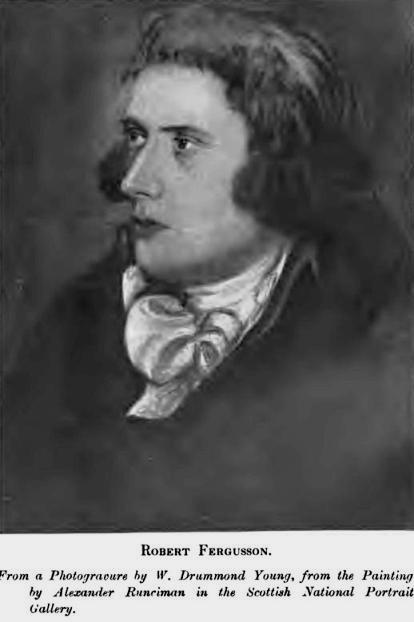
The personal appearance of
the poet is thus described by the same informant. "In stature Fergusson was
about five feet nine, slender and handsome. His face never exhibited the
least trace of red, but was perfectly and uniformly pale, or rather yellow.
He had all the appearance of a person in delicate health; and Mr S—
remembers that, at last, he could not eat raw oysters, but was compelled by
the weakness of his stomach, to ask for them pickled. His forehead was
elevated, and his whole countenance open and pleasing. He wore his own fair
brown hair, with a long massive curl along each side of the head, and
terminating in a queue, dressed with a black silk riband. His dress was
never very good, but often much faded, and the white thread stockings, which
he generally wore in preference to the more common kind of grey worsted, he
often permitted to become considerably soiled before changing them."
The following anecdote has
been related for the purpose of showing the irksomeness of the poet under
his usual avocations. In copying out the extract of a deed, one forenoon, he
blundered it two different times, and was at length obliged to abandon the
task without completing it. On returning in the evening, he found that the
extract had been much wanted, and he accordingly sat down with great
reluctance to attempt it a third time. He had not, however, half
accomplished his task, when he cried out to his office companion, that a
thought had just struck him, which he would instantly put into verse, and
carry to Ruddiman’s Magazine, (on the eve of publication,) but that he would
instantly return and complete the extract. He immediately scrawled out the
following stanza on one Thomas Lancashire, who, after acting the gravedigger
in Hamlet, and other such characters, on the Edinburgh stage, had set up a
public house, in which he died :—
Alas, poor Tom how oft, with merry
heart,
Have we beheld thee play the Sexton’s part!
Each comic heart must now be grieved to see
The Sexton’s dreary part performed on thee.
On his return towards the
office, he called at the shop of his friend Sommers, paintseller and
glazier, in the parliament close, where he found a boy reading a poem on
creation. This circumstance furnished him with the point of another epigram,
which he immediately scribbled down, and left for Mr Sommers’s perusal.
These proceedings occupied him about twenty minutes, and he then returned to
his drudgery.
Uniform tradition, and every
other testimony, ascribe to Fergusson an excellent voice, and a most
captivating manner of singing the simple melodies of his native country. His
Birks of Invermay long survived in the recollection of his associates, as a
musical gem of the first lustre. The following anecdote, communicated by his
biographer Sommers, at once proves his vocal powers and reflects a light
upon his character. "In one of his convivial frolics, he laid a wager with
some of his associates that, if they would furnish him with a certain number
of printed ballads, (no matter what kind), he would undertake to dispose of
them as a street singer in the course of two hours. The bet was laid, and
next evening, being in the month of November, a large bundle of ballads were
procured for him. He wrapped himself in a shabby great-coat, put on an old
scratch wig, and in this disguised form commenced his adventure at the
weigh-house, head of the West Bow. In his going down the Lawnmarket and High
Street, he had the address to collect great multitudes around him, while he
amused them with a variety of favourite Scottish songs, by no means such as
he had ballads for, and gained the wager by disposing of the whole
collection. He waited on his companions by eight o’clock that evening, and
spent with them in mirthful glee, the produce of his street adventure."
Fergusson’s disposition led
him into many frolics; of which the following instances are recounted. His
landlord happened to be a man very much given to intemperance, at the same
time that he aspired to all the honours of a saint. One night, he attempted
to perform family worship, in a state of complete intoxication, when, to his
inconceivable horror, every sentence of his prayer was echoed by some unseen
being at no great distance. Confounded with drunken terror, he ordered his
family to retire, and tak awa the buiks. It was Fergusson who thus
alarmed him from a neighbouring closet. Afterwards, the poor man gave his
family an impressive lecture on the necessity of their improving their ways,
as he felt certain that something serious was about to befall them. He even
unbosomed his own conscience to the waggish cause of all his terrors, and
received, with marks of extreme contrition, the absolution which Fergusson
administered to him in consideration of his repentance. On another occasion,
Fergusson went, with some companions, to the door of a similar zealot, and
began to whine forth a psalm in burlesque of the hypocritical habits (as he
considered them) of those within. With even less justifiable
thoughtlessness, he once threw into the open window of a Glassite
meeting-house, a paper, on which he had inscribed some lines in imitation of
the manner in which they were pleased to perform their devotions. A more
innocent frolic was as follows: having procured a sailor’s dress, he dressed
himself in it, assumed a huge stick, and, sallying out, paid a round of
visits to his acquaintances. He was so effectually disguised that few or
none of them knew him; and by throwing forth hints of some of their former
indiscretions, he so much surprised them, that they imputed his knowledge to
divination. By this means, he procured from many of them such a fund of
information, as enabled him to give them a greater surprise when he resumed
the genuine character of Robby Fergusson. For in the sailor’s habit he
informed them of many frailties and failings, which they imagined it
impossible for any one of his appearance to know; and in the habit of Robby
Fergusson, he divulged many things which they believed none but the ragged
sailor was acquainted with. Fergusson’s power of mimicry were, indeed,
admirable, and he displayed a considerable turn for acting in general.
Towards the end of his life, he was the very life and soul of a particular
spouting club to which he attached himself.
In the circle of his
acquaintance, though it extended through nearly all ranks of society, he had
few more respectable friends than Mr Woods, a distinguished player long
established in Edinburgh. Woods was a man of wit, taste, and good sense, to
which good qualities he added a prudence of conduct in which it is to be
wished that the poet had uniformly imitated him. Through the influence of Mr
Woods, and in consideration, perhaps, of occasional poetical services, he
enjoyed a free admission to the theatre, of which he took not unfrequent
advantage. To quote a memorandum which has been supplied to us on this
subject—"He always sat in the central box, denominated the Shakspeare box;
and his mode of expressing approbation in comic performances was very
singular. Instead of clapping his hands, or using any exclamations, he used
to show how much he was delighted by raising his right hand clenched above
his head, and bringing it down emphatically on the front of the box, with a
sweeping blow."
His brother, Henry, who was
eight years older than himself, had before this period been obliged by some
youthful indiscretions to go to sea. Henry was a youth of considerable
acquirements and ingenuity, and, in particular, had an extraordinary taste
for fencing. Some letters are extant, which the young sailor addressed to
his mother and brother, and they certainly display powers of mind and habits
of reflection, which, if discovered on ship-board, must have astonished his
superiors. Apparently quite tired of the hopeless drudgery of his office,
and perhaps impelled by more pressing considerations, Robert Fergusson at
one time contemplated the course of life now pursued by his brother, the
wild dangers of which might have some charm to a poet’s breast. He thus
humorously alludes to his design in an epigram:
Fortune and Bob, e’er since his birth,
Could never yet agree;
She fairly kicked him from the earth,
To try his fate at sea.
He was not destined, however,
to execute this resolution.
In 1773, Fergusson’s poems
were collected from the Weekly Magazine into one volume; but it does not
appear that the poet reaped any pecuniary benefit from the publication. It
is probable, indeed, that this admired son of genius never realised a single
shilling by his writings.
For a brief number of years,
Fergusson led the aimless life which we have endeavoured to describe,
obtaining the means of a scanty subsistence by a servile and unworthy
drudgery, and cheering his leisure moments with mingled intellectual
exertion and convivial dissipation. To many persons he was recommended by
his fascinating conversation, his modesty, and his gentle and affectionate
character. Of these, however, with but one exception, there were none who
either felt called upon or had it in their power, to advance his worldly
fortunes. That exception was a Mr Burnet, who, becoming much attached to the
poet at Edinburgh, was afterwards enabled to send him a draught for a
hundred pounds from India, with an invitation to come thither, in order to
experience still more solid and lasting proofs of his friendship. Even of
this single ray of kindness from his fellow men, the poor poet was destined
to reap no advantage, being dead before the money and the invitation
arrived. The unhappy youth continued, so long as his mind was sensible of
any thing, to feel that, with powers which elevated him above most of his
fellows, and were likely to make him be remembered when all of them were
forgotten, he yet ate every day a bitterer and a scantier meal, and moiled
on and on in hopeless poverty, at once the instrument and the victim of
their pleasures.
Early in the year 1774, when
his frame was peculiarly exposed by the effects of a certain medicine to
cold, he was induced to accompany some gentlemen, who were interested in an
election business, to one of the eastern counties of Scotland. It is no
uncommon thing for cold, contracted under such circumstances, to produce
mental derangement; and such was the melancholy destiny of Fergusson! Being
involved in the riotous scenes of the election, he easily caught the baneful
distemper, the effects of which were quite as much mental as physical. While
in this disordered state, he happened one day to wander into the
church-yard, where he was soon after accosted by the venerable John Brown,
author of many well known works in divinity, and who exercised the humble
but respectable functions of a dissenting clergyman in this town. After a
few trivial remarks had passed between them, Mr Brown was led by the nature
of the scene to advert to the mortality of man, observing that, in a short
time, they would soon be laid in the dust, and that therefore it was wise to
prepare for eternity. To Mr Brown, the conversation seemed the most casual
and unimportant that could well be. But such were not its effects. In the
present state of the poet’s mind, his early religious impressions were fast
reviving, and, while the penalties of folly wrung his nerves, his thoughts
wandered back over his mispent and unprosperous life. Upon a mind so
prepared, the accidental remarks of the divine (who did not even know who he
was) sunk as deep as if they had been imprinted in characters of fire. He
returned home, an altered and despairing man.
One of his intimate friends,
who met him in March, 1774, a short time after this event, found him
somewhat tranquillized, but still in a very precarious state. The poor bard
gave an account of the excesses which had lately produced such dreadful
effects, and spoke with terror of what would be unavoidable in the event of
a relapse—confinement in the common asylum for insane persons. He also
introduced the subject of religion, and conversed with much earnestness on
some of its fundamental doctrines. "Upon a particular occasion, which he
specified, he said, a Mr Ferrier, at, or near St Andrews, had alarmed and
rather displeased him, by maintaining, what are usually denominated the
orthodox tenets of our Scottish creeds: and Fergusson appeared to differ, in
a very considerable degree, from the commonly received notions on these
subjects. He did not seem to be satisfied of the necessity of the fall of
man, and of a mediatorial sacrifice for human iniquity; and he questioned,
with considerable boldness, the consistency of such doctrines with the
attributes of divine wisdom and goodness. At the same time, however, he
confessed the imperfect nature of the human intellect, and the unfathomable
depth of all such inquiries. This is the only gleam of infidelity which ever
seems to have diminished the fearful gloom of superstitious terror: no
consoling rays of genuine religion charmed his bosom; no sounds of peace
gladdened his heart, and enabled him to sustain, with fortitude and
calmness, the sorrows which oppressed him. He anticipated ‘the last peal of
the thunder of heaven,’ as the voice of eternal vengeance speaking in wrath,
and consigning him to irremediable perdition." [Peterkin’s Life of
Fergusson, prefixed to London edition of his poems, 1807.]
After having partially
recovered from his disorder, his mind is said to have received another shock
from the following incident :—
"In the room adjoining to
that in which he slept, was a starling, which being seized one night by a
cat that had found its way down the chimney, awakened Mr Fergusson by the
most alarming screams. Having learned the cause of the alarm, he began
seriously to reflect how often he, an accountable and immortal being, had in
the hour of intemperance, set death at defiance, though it was thus
terrible, in reality, to an unaccountable and sinless creature. This brought
to his recollection, the conversation of the clergyman, which, aided by the
solemnity of midnight, wrought his mind up to a pitch of remorse that almost
bordered on frantic despair. Sleep now forsook his eyelids; and he rose in
the morning, not as he had formerly done, to mix again with the social and
the gay, but to be a recluse from society, and to allow the remembrance of
his past follies to prey upon his vitals. All his vivacity now forsook him;
those lips which were formed to give delight, were closed as by the hand of
death, and on his countenance sat horror plumed!"
It is probably to this period
that we are to refer two anecdotes, which have been related as giving the
first proofs of a decided craze in his understanding. Mr Tennant, in an
article which has been already quoted, says:—"It is difficult, even in sane
persons, to determine where wit ends, and temporary reeling of the
imagination begins; and, in the case of Fergusson, whose conceptions were
ever so vivid, and whose wit was so fantastical and irregular, it was
difficult for his friends to discriminate between his wit and his madness—to
set a boundary line between those of his days that were but frolicsome and
funny, and those that were desperately and invariably delirious. The first
occurrence that startled his comrades, and put them in alarm for the safety
of his understanding, took place one day in the High Street of Edinburgh,
when Mr B—, one of his friends, (who, I believe, is still alive,) was
standing engaged in conversation with a knot of acquaintances. Fergusson
came running up, apparently in a state of high perturbation; and, accosting
them familiarly, as he was wont, acquainted them, that, confused and
perturbed as he was, it was a marvel that they saw him alive that day at
all. On questioning him, with a desire that he should explain himself, he
informed them, that on the night before he had met with some Irish students
in the street, with whom he had an altercation that led to a quarrel; that
they scuffled and buffeted each other furiously; that the combat deepened to
deadly ferocity, when one of them, the bloodiest homicide of the troop, at
last drew out a cutlass, with which he smote off his head at one blow; that
his head ran down the strand trembling and streaming blood for many paces;
that, had it not been for his presence of mind, he must infallibly have been
a dead man; but that, running instantly after the head, decapitated as he
was, he snatched it up, and replaced it so nicely on its former position,
that the parts coalesced, and no man could discover any vestiges of
decapitation. This story was told with such wild looks and extravagant
gesticulation, as impressed the hearers with the suspicion that his mind had
shifted from its wonted ‘form and pressure;’ a suspicion that was afterwards
fully confirmed by other more decided and unfortunate indications."
The other anecdote, which
indicates a more advanced stage of insanity, is as follows :—Mr Woods, of
the theatre royal, one day met him at the bottom of St Anne Street, under
the North Bridge, (a street which does not now exist,) and found him in a
very disordered state. "I have just," said Fergusson, in a confidential
tone, "made a most important discovery." On Mr Woods’ inquiring what it was,
he answered, "I have found out one of the reprobates who crucified our
Saviour; and in order to bring him to proper punishment, I am going to lodge
an information against him with Lord Kames." He then walked off towards the
residence of that distinguished philosopher and judge.
Even from this second shock,
his reason was beginning to recover, when all was thrown into ten-fold
disorder by a fall which he met with, one evening in descending a stair.
Having cut his head severely, he lost a great deal of blood, and was carried
home to his mother’s house in a state of delirium, and totally insensible of
his deplorable condition. His reason seemed to be now in a great measure
destroyed. He passed nights and days in total abstinence from food,
sometimes muttering dolefully to himself, and at other times so outrageous
that it required the strength of several men to keep him in his bed.
Occasionally, he sang his favourite melodies, but in a style of pathos and
tenderness such as he had never before reached. In particular, he chanted
"the Birks of Invermay," with such exquisite melody, that those who heard
his notes could never forget the sound. While in this state, probably
anticipating that miserable catastrophe which soon after happened, he burned
all his manuscripts, remarking, when the task was done,"I am satisfied—I
feel some consolation in never having written any thing against religion."
Like Collins, he now used but one book, but he probably felt, with that
unfortunate bard, " that it was the best." It is needless to mention, that
this sole companion of his moody hours was the bible.
The circumstances of his
widowed mother were not unfortunately of such a kind, as to enable her to
keep her son, and procure for him the attendance necessary for his malady,
in her own house. She was, therefore, compelled to make arrangements for
consigning him to a very wretched public asylum, which, before the erection
of an elegant building at Morningside, was the only place in connexion with
the Scottish capital, where such accommodations could be obtained. This
house was situated within a gloomy nook of the old city wall, with another
large building closing it up in front, as if it had been thought necessary
to select for the insane, a scene as sombre and wretched as their own mental
condition. To this horrid mansion it was found necessary to convey Fergusson
by a kind of stratagem, for he was too well aware of what was contemplated,
and too much alive to the horrors of the place, to have either gone
willingly himself, or to have been conveyed thither without some indecent
exposure. Two friends, therefore, were instructed to pay him a visit about
night-fall, as if for the purpose of inquiring after his welfare. He met
them with easy confidence, and after some conversation, in which he took
part like a sane man, they proposed that he should accompany them on a visit
to a friend at another part of the town. To this he cheerfully consented,
and was accordingly placed in a sedan which they had in readiness at the
bottom of the stair. The unhappy youth then permitted himself to be conveyed
peaceably along the streets, till he arrived at the place which he had all
along feared would be his final abode. The chair was conveyed into the hall,
and, it was only when Fergusson stepped out, that he perceived the deception
which had been practised upon him. One wild halloo—the heart-burst of
despair—broke from him, and was immediately echoed from the tenants of the
surrounding cells. Thrilled with horror, his friends departed, and left the
wretched Fergusson to his fate.
"During the first night of
his confinement," says Mr Sommers, "he slept none; and when the keeper
visited him in the morning, he found him walking along the stone floor of
his cell, with his arms folded, and in sullen sadness, uttering not a word.
After some minutes’ silence, he clapped his right hand on his forehead, and
complained much of pain. He asked the keeper, who brought him there? He
answered, ‘friends.’—’ Yes, friends, indeed,’ replied Robert, ‘they think I
am too wicked to live, but you will soon see me a burning and a
shining light.’—‘You have been so already,’ observed the keeper,
alluding to his poems. ‘You mistake me,’ said the poet: ‘I mean, you shall
see and hear of me as a bright minister of the gospel.’"
Fergusson continued about two
months to occupy a cell in this gloomy mansion. Occasionally, when the
comparative tranquillity of his mind permitted it, his friends were allowed
to visit him. A few days before his dissolution, his mother and sister found
him lying on his straw bed, calm and collected. The evening was chill and
damp: he requested his mother to gather the bed-clothes about him,
and sit on his feet, for he said, they were so very cold, as to be almost
insensible to the touch. She did so, and his sister took her seat by the
bed-side. He then looked wistfully in the face of his affectionate parent,
and said, "Oh, mother, this is kind, indeed." Then addressing his sister, he
said, "might you not come frequently, and sit beside me; you cannot imagine
how comfortable it would be; you might fetch your seam, and sew beside me."
To this, no answer was returned: an interval of silence was filled up by
sobs and tears. "What ails ye?" inquired the dying poet; "wherefore sorrow
for me, sirs? I am very well cared for here—I do assure you, I want for
nothing—but it is cold—it is very cold. You know, I told you, it would come
to this at last—yes, I told you so. Oh, do not go yet, mother—I hope to be
soon—oh, do not go yet— do not leave me!" The keeper, however, whispered
that it was time to depart, and this was the last time that Fergusson saw
these beloved relatives.
Mr Sommers thus describes his
last interview with the poet, which took place in company with Dr John
Aitken, another friend of the unfortunate maniac. "We got immediate access
to the cell, and found Robert lying with his clothes on, stretched upon a
bed of loose uncovered straw. The moment he heard my voice, he arose, got me
in his arms, and wept. The doctor felt his pulse, and declared it to be
favourable. I asked the keeper to allow him to accompany us into an
adjoining back-court, by way of taking the air. He consented. Robert took
hold of me by the arm, placing me on his right, and the doctor on his left,
and in this form we walked backward and forward along the court, conversing
for nearly an hour; in the course of which, many questions were asked both
by the doctor and myself, to which he returned most satisfactory answers;
but he seemed very anxious to obtain his liberty. Having passed two hours
with him on this visit, we found it necessary to take our leave, the doctor
assuring him that he would soon be restored to his friends, and that I would
visit him again in a day or two. He calmly and without a murmur walked with
us to the cell; and, upon parting, reminded the doctor of his promise to get
him soon at liberty, and of mine to see him next day. Neither of us,
however, had an opportunity of accomplishing our promise; for in a few days
thereafter I received an intimation from the keeper that Robert Fergusson
had breathed his last."
Before this period, Mrs
Fergusson had been enabled by a remittance from her son Henry, to make some
preparations for receiving the poor maniac back into her own house, where
superior accommodations, and the tenderness of a mother’s and a sister’s
love, might have been expected to produce some favourable effect. But it
came too late: misery had already secured her victim. "In the solitude of
his cell," says Mr Peterkin, "amid the terrors of the night, ‘without a hand
to help or an eye to pity,’ the poet expired. His dying couch was a mat of
straw; the last sounds that pealed upon his ear were the howlings of
insanity. No tongue whispered peace; and even a consoling tear of sympathy
mingled not with those of contrition and hope, which, in charity, I trust,
illumined his closing eye."
Robert Fergusson died on the
16th of October, 1774, aged one day less than twenty-four years. His body
was interred in the Canongate church-yard, where his grave remained quite
undistinguished, until his successors and (as he was pleased to
acknowledge), his imitator, Robert Burns, appeared in Edinburgh. When Burns
came to the grave of Fergusson, he uncovered his head, and, with his
characteristic enthusiasm, kneeling down, embraced the venerated clay. He
afterwards obtained permission from the magistrates to erect a monument to
Fergusson, which he inscribed with the following stanza :—
No sculptured marble here, nor pompous
lay,
"No storied urn, nor animated bust ;"
This simple stone directs pale Scotia’s way,
To pour her sorrows o’er her poet’s dust.
On the reverse of the
monument, which is literally a "simple stone," is the following honourable
inscription: "By special grant of the managers, to Robert Burns, who erected
this stone, this burial-place is ever to remain sacred to the memory of
Robert Fergusson." In more than one of his effusions, in prose and poetry,
the Ayrshire poet has bewailed the fate of Fergusson; but perhaps the
following little elegy, which he inscribed on a copy of the works of that
poet, which he presented to a young lady (March 19, 1787), are less
generally known than the rest:
Curse on ungrateful man that can be
pleased,
And yet can starve the author of his pleasure!
Oh thou, my elder brother in misfortune,
By far my elder brother in the muses,
With tears I pity thy unhappy fate!
Why is the bard unfitted for the world,
Yet has so keen a relish of its pleasures?
Whatever may be thought of
the philosophy of this stanza, its feeling has an irresistible appeal.
The external appearance of
Fergusson, so far as it is left undelineated in the sketch already quoted,
was as follows: [According to another individual who recollects seeing him,
"he was very smally and delicate, a little in-kneed, and waigled
a good deal in walking."] His countenance was somewhat effeminate, but
redeemed by the animation imparted to it by his large black eyes. Mingled
with the penetrative glance of an acute and active mind, was that modesty
which gives to superior intellect its greatest charm. Unfortunately there is
no authentic portrait in existence, though it may be worth while to mention
that his grand- niece, the late Miss Inverarity, the actress, bore so strong
a resemblance to him, as to have struck the mind of an individual who
remembered the appearance of Fergusson, and who had learned neither the name
of the young lady nor her relation to the poet. Fergusson’s manners were
always accommodated to the moment: he was gay, serious, set the table in a
roar, charmed with his powers of song, or bore with becoming dignity his
part in learned or philosophical disquisition. "In short he had united in
him," says Mr Alexander Campbell, "the sprightliness and innocence of a
child, with the knowledge of a profound and judicious thinker."—"Gentleness
and humanity of disposition," says Dr Irving, "he possessed in an eminent
degree. The impulse of benevolence frequently led him to bestow his last
farthing on those who solicited his charity. His surviving relations retain
a pleasing remembrance of his dutiful behaviour towards his parents; and the
tender regard with which his memory is still cherished by his numerous
acquaintance fully demonstrates his value as a friend." It may be added,
that, to this day, there prevails but one universal impression in favour of
Fergusson. Cut off in the greenest of his days, he still lives in the
feeling of the world, exactly what he really was in life, a gentle and
youthful being; of whom no one could think any ill, and who was the friend
and brother of every body.