|
The Malay Archipelago extends for more
than 4,000 miles in length from east to west, and is about 1,300 miles
in breadth from north to south. It would stretch over an expanse equal
to that of all Europe from the
extreme
west far into central Asia. It includes 3 islands
larger than
Britain, and in one of them, Borneo, the whole of the British Isles
might be set down. Sumatra is more than equal in size to Britain.
Java,
Leyte and the Celebes are each larger than Ireland.
At daybreak the islands were in sight.
Flying fish were numerous; more active and elegant than those of
the Atlantic.
They turn on their sides displaying their beautiful fins and taking
flight of about 100 yards, rising and falling in a most graceful
manner. The coast was very picturesque. Light coloured limestone rocks
rose abruptly from the water to a height of several hundred feet, and
were clothed with variant and luxurious vegetation. Little bays and
inlets presented beaches of dazzling whiteness. The water was
transparent as crystal. I was in
a new world
and could dream of the wonderful products hidden in the rocks, forests,
and the azure abysses. But few European feet had ever trodden these
shores or gazed upon its
plants and animals,
and I could not help speculating what my wanderings might bring to
light.
I landed at a trading settlement near
Ternate. It has a clear entrance
from the west
among the coral reefs, and there is a good anchorage. The beach is
backed by a luxuriant growth of lofty forest. The traders here are of
the Malay race. The Moluccas are the spice islands, and the native
country of cloves. Drake and early voyagers purchased the spice cargoes
from the Sultans and Rajahs, and not direct from the cultivators.
Nutmeg and mace were brought here from New Guinea. In the trader’s
house are bundles of smoked tripang or beche de mer, dried shark fins,
mother of pearl
shells and
birds of paradise.
The food we obtain regularly is rice, sago, and fish and cockles of very
good quality. Fresh water is carried in vessels suspended by a rattan
handle. *
Natural History of the Moluccas, in The
Malay Archipelago
Alfred R Wallace, English naturalist 1823 – 1913 (adapted)
In October 1965 when in Moscow with an international group
studying the Soviet system of marine and fisheries education, we heard
that there had been an attempted coup in Indonesia. We paid little
attention to that as the bigger news was the outbreak of war between
India and Pakistan. What had happened in Indonesia was that a group of
communists in the military, with the encouragement of the Foreign
Minister Dr Subandrio, and the active assistance of the Air Force chief,
Omar Dhani, and Chairman Aidit of PKI, the Indonesian Communist Party,
who was a cabinet member, (and some later claimed, with the tacit
agreement of President Sukarno), had rounded up seven leading generals,
taken them to the Halim airforce base, murdered them, and had their
bodies thrown into pits. The abductions and murders actually took place
during the night of 30th September / 1st October. Why
General Soeharto was not included in the number of those killed, is
uncertain. To this day he has given no clear explanation of his
whereabouts that night. He was either not at home, or was regarded as
sympathetic by the plotters. As head of the major commando force in the
country, many Indonesians believe that he must have had some advance
warning of the coup attempt. For some tense days, matters hung in the
balance, then Soeharto moved his KOSTRAD commando troops into action,
and got the rebel units to move out of Jakarta.
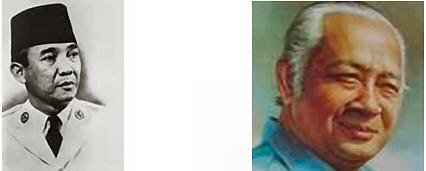
Indonesia’s first
President, Sukarno | President Soeharto who deposed Sukarno after the
failed 65 coup
The coup attempt
suffered from the need for secrecy, and poor communications between the
plotters forces afterwards. Sukarno was placed under virtual house
arrest, but without much publicity on that. Soeharto then got the loyal
troop units to act together, and they went through Java killing and
capturing the communist elements. They also seized the opportunity to
settle scores with suspect groups in the country. Published reports
since indicate that the CIA had assisted by giving lists of names of
‘suspected communists’. It is believed that well over 200,000 persons
suspected of being active communists were shot, but many were members of
extreme Muslim groups, and some were simply Chinese traders who were
regarded with jealousy or resentment by indigenous Malays. Many others
(over 100,000), were arrested and were to be incarcerated for a long
time. Ex-foreign minister Dr Subandrio was released only recently, and
died in 2004 at age ninety. Soeharto strengthened his hold on power,
and eventually replaced Sukarno as President. In classic Indonesian
style, the transition was accomplished with smiles and no loss of face.
Sukarno stepped down from his position claiming he was doing so due to
his deteriorating health. Soeharto claimed that Sukarno had authorized
his take-over of the Presidency, but the original signed document has
never been made public.
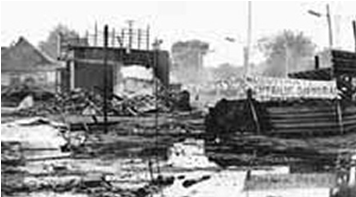
Reprisals on suspected communists in 1965
The military then
clamped down on all subversive activity. No one could obtain or keep a
job with government who was not cleared of involvement by the security
forces. Many innocent persons were classified as suspect for as little
as belonging to the wrong club in University, or having studied in a
socialist country abroad. My local counterpart in the U.N. project was
one such person. A brilliant officer and extremely diligent worker, he
managed to be cleared to become Director of a government-owned tuna
fishing and export company in the east of the archipelago, but though
the outstanding candidate by far, he never became Director General of
the Fisheries Department. A major question in the security form (which
both foreigners and nationals had to answer), was, “Where were you in
October 1965?” I obfuscated in my replies, since ‘Moscow USSR’
could have given the authorities the wrong impression.
I arrived in Indonesia
in 1973, some 8 years after the attempted coup. The country was still
under strict military control, practically all Ministries and Government
Departments being run by ex-military officers. A few were educated and
competent. Most were dull and ignorant. Many exuded personal greed,
and used their positions of authority solely to line their pockets. To
this day, the Indonesian military receives only a small part of its
budget from the government. It has always been understood that it was
free to develop other sources of funds. The easiest was to control the
vice trade which the army did with some relish. Today, the military’s
businesses and investments are much wider, and include many legitimate
enterprises (like the “Bulog” monopoly on rice distribution,
which has put up prices and hampered national self sufficiency), and
some less than legitimate ones.
We landed at Kemayoran
airport in the middle of Jakarta, which, though large, was a much
smaller city then than the megalopolis it is today with over 12 million
residents. Kemayoran airport was small and welcoming. It appears in an
early Mel Gibson / Sigournay Weaver / Linda Hunt film, “A Year of
Living Dangerously”, that portrays the period of the attempted
coup. It is also drawn with some accuracy in one of the “Tin-Tin”
cartoon books, Flight 714, in which the little reporter has some
adventures in Indonesia and the region. (That cartoon book also quotes
bahasa Indonesia conversations accurately, which impressed me).
Halim air force base
became the next national airport before the present large Sukarno-Hatta
airport was built on the east side of the city.

Poster for the film ‘A Year of Living
Dangerously’
The Fisheries
Department was most fortunate to have one of the most able and visionary
of the Director-Generals in the Government. Admiral Nizam Zachman had
both flair and tenacity. He had decided early on that Indonesia was to
develop its own offshore fleets, and would control its own seafood
exports. I met him in his office in Salemba Raya, where before a large
wall map of the archipelago, he spelled out his vision and plans for the
sector. Prior to that, when passing through Rome where the UN Food and
Agriculture Organisation had its headquarters, I was briefed by Herman
Watzinger, one of Thor Heyedral’s men on the Kon Tiki expedition, who
had gone on to become Director of Fisheries in FAO. The contrast was
interesting. Zachman simply painted a picture of what the country’s
fisheries needed and urged me to get on with the job. Watzinger was
more concerned that I conduct myself circumspectly and diplomatically at
all times, and whatever happened, that I avoid getting “kicked out of
the country”.
We traveled by minibus
past innumerable paddy fields along the north Java road to Tegal, our
destination in the central Javanese province, a journey that took the
best part of a day due to the narrow road and the traffic that included
buses, trucks, cars, pony-and-trap taxis, motor-cycles, bicycles,
ox-carts, becaks or cycle rickshaws, pedestrians, and an
assortment of animals including cows, bullocks, sheep, goats and ducks.
Tegal was a dusty rural town of some 200,000 inhabitants. Local
industry included a large Japanese-owned textile factory, and some
jasmine tea-flavouring plants. Today the town even has its own
university. Tegal lay between Cirebon to the west and Semarang to the
east, about half-way between Jakarta and Surabaya. Local fields were
cultivated for rice and for onions. Over 1,000 sailing canoes operated
from its shallow river in the coastal waters of the Java Sea. Today
there are but 150 canoes and all are mechanized. A motley fleet of
decked boats, trawlers, seiners and gill netters, operated from the main
harbour. Tegal had been a centre of some subversive activity, and
Colonel Untung, one of the plotters, had fled there in an attempt to
escape by boat from Soeharto’s troops. Behind the school and training
centre where our project was based, was the local ‘killing ground’ for
those deemed guilty. Becak operators would not carry passengers there
after dark. Actually Tegal had been a centre of the PKK – Indonesian
Communist party as far back as 1926. In 1945 the Three Regions
Movement, a socialist and revolutionary movement was active there but it
was defeated and destroyed by the Indonesian army. However, at the time
of our arrival we knew nothing of the troubled political past of that
part of Central Java.
Our Project had seven
stations spread out over the 3,000 mile long island state. Tegal was
our main base, but we had a marine and fisheries Academy at Pasar Minggu
in Jakarta, and other training centres in Medan, north Sumatra;
Singaraja, Bali; Manado, north Sulawesi; Ambon; and Sorong, Irian Jaya
(now the Province of Papua). I had to visit all seven sites regularly,
and to help direct and equip the programmes in each location. For that
task I had a remarkably supportive team. My first counterpart was
Patapau Pasau, an amiable local officer, but he was changed later by the
man who was to be my chief counterpart for most of the 5 years.
Soepanto had been educated in Jogjakarta, and had undergone marine
training in Yugoslavia. He was extremely hard working, wholly
determined to succeed at every task, and had a sharp, analytical mind
when addressing problems. He and his wife, a general’s daughter, became
dear friends of ours.
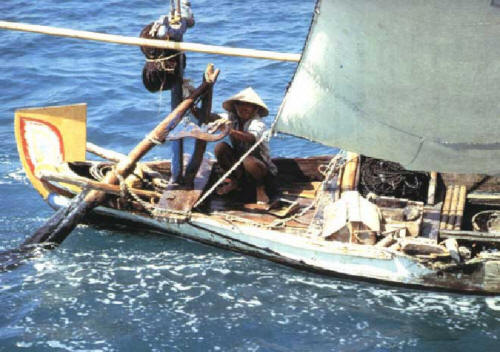
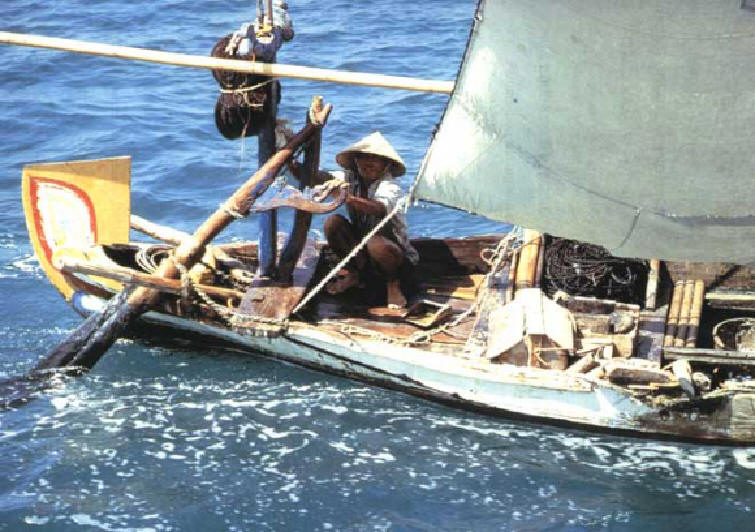
A typical Indonesian prahu canoe
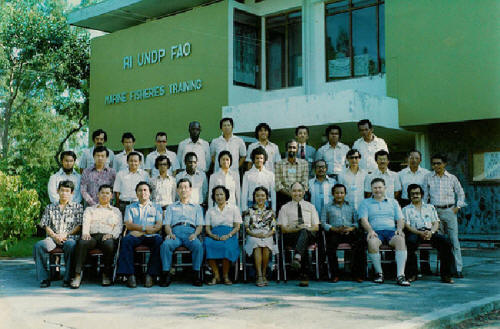
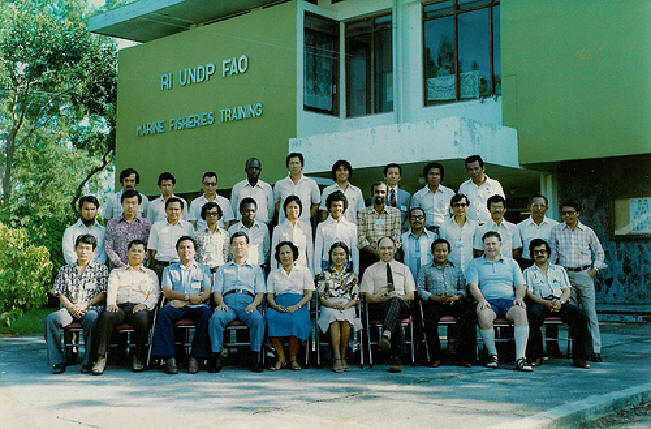
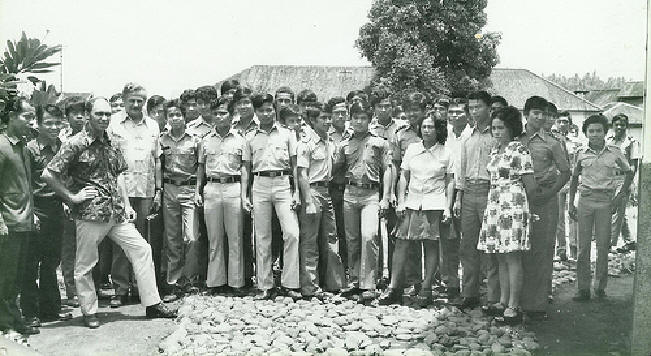
My Project centre in central Java, with a
visiting international group
I also had a team of
fine expatriate officers, hailing from Germany, Denmark, Japan, Korea,
and the Philippines. Later we had specialists join us for shorter
periods, and they hailed from Iceland, Spain, the Netherlands, and the
USA. The station was well equipped with workshops, net sheds, a
navigation bridge, and an ice plant. It had dormitories which
accommodated up to 250 students and trainees, and we had a fleet of 17
training vessels. The German marine engineer ran the several workshops
with shipyard precision, and to German technical standards. Trainees
filed, cut and machined metal till they were able to make almost any
component of a fishing vessel or its machinery. Future graduates of his
courses were to obtain responsible work in the engine rooms of large
ships abroad. The Danish fishery technologist, later to be an ADB
project officer, was equally demanding of the deck students, all of whom
had to learn to splice rope and wire, and to rig and repair every kind
of net used. They still use his shrimp trawl designs in Indonesia
today. Navigation was taught by ex-Indonesian Naval officers who were
competent and reliable.
With Einar Kvaran of Iceland at the
training centre in Ambon
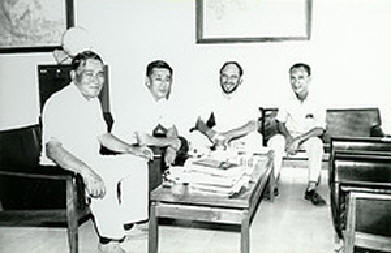
With Japanese colleagues
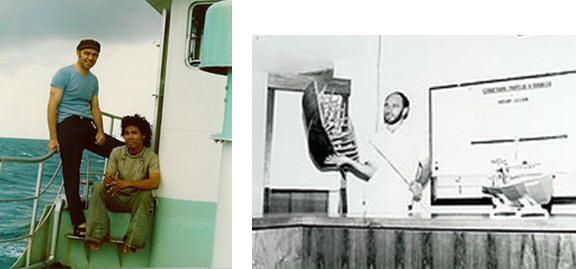
On the research vessel Lemuru in the Java
Sea Conducting a vessel technology class
Within 12 years of the
project commencement, Tegal and out-centre graduates had replaced all of
the foreign officers (mostly Japanese and Korean) on the joint-venture
fishery vessels operating in the country. The whole project produced
120 fishery high school graduates, and 380 technical course graduates
each year. A number of Diploma students were trained at the Academy in
Jakarta, for work in fish processing plants. Initially most deck and
engine trainees were posted to serve on joint-venture and
government-enterprise vessels fishing for tuna and shrimp. Occasionally,
we had classes of graduate students from the Universities in Bandung and
Bogor, who came to get a taste of practical fisheries work. They were
fine, intelligent young men whose questions in class would range beyond
fisheries to social, environmental and economic issues facing the
nation.
The research side of
the project work focused chiefly on the operation of an FAO research
vessel which was equipped for trawl and purse seine fishing, and had a
range of electronic and navigational equipment. I skippered it one year
for a few months when the Icelandic Captain was on home leave. It was a
memorable experience, sailing west to Sumatra, past Krakatoa island,
(the site of the volcano eruption of 1883) then around Java, Madura and
Bali, and east as far as the island of Timor, then blissfully unaware of
the troubles that lay ahead for its people. The seas we explored
contained a variety of fascinating marine life, - whales, sharks,
dolphins, turtles, tunas, swordfish, colourful reef fish, sardines,
mackerels, shrimp, lobster, squid, sea snakes, and sea cucumber. We
sailed past Kimodo island but did not stop. On our way along the
southern coast of Flores we came upon a volcanic island that had
appeared from a depth of 70 metres, and was still venting sulfuric
steam, and throwing hot rocks into the sea. Two years later I sailed
through the same stretch of sea only to find that the volcanic rock had
vanished without trace.
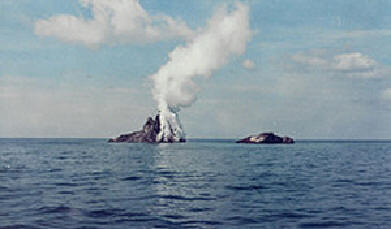
At a new sea volcano off Flores
The engineer of the r/s
Lemuru, was Jose Alamanar Sansalone, from Spain. In addition to
being a fine engineer and seaman, he had a particular interest in
wildlife, and was never without an animal or reptile of some
description. His activities would be seen as illegal today, but
conservation laws were in their infancy in the sixties and seventies,
and so Jose had been able at different times to keep orang utans,
gibbons, crocodiles, snakes, parrots, toucans, bears, bush babies, and
an assortment of other intriguing pets. Our kids loved him for that.
He was a bachelor then (what wife would have put up with all the
animals!), and though he had many girl friends, showed no signs of
settling down. Later he met and married an ex-nun of all people. Maria
del Carmen, a truly lovely girl, was a teacher of psychiatry who had
entered a convent after graduating. However, she became uncertain of
her calling, and was granted a one-year’s leave of absence from her
order. I think this was prior to the time of John Paul II who would
probably not have granted a dispensation. Her father was FAO country
Representative in Cuba where he met Jose. Carmen and Jose were
introduced, and that was the end of her career in the cloisters! They
became dear friends of ours, and later visited us in Scotland. We were
entertained in their homes in Denia, Spain, and in Santa Cruz,
Tenerife. Now in retirement, Jose has blossomed as an artist. His
paintings and bronze sculptures are regularly displayed at exhibitions
in Spain. Two of his paintings adorn the wall of our living room in
Scotland.
Few in Indonesia spoke
English in those days, particularly in the countryside, so we had to
acquire a minimum skill in bahasa Indonesia. Our children also picked
up bits of the Javanese dialect, but we found bahasa was enough to
contend with. In some ways it is a beautifully easy language, having no
tenses or conjugations. We also grew to enjoy Indonesian food which is
liberally spiced with sambal or crushed chilies. The rice was
especially tasty. Our cook used to purchase the most flavourful
slow-growing local varieties which were so delicious, you could eat it
without any relish. It was like eating freshly baked bread. I have
been suspicious of genetically modified cereals since. The modern
varieties of rice taste like sawdust in comparison.
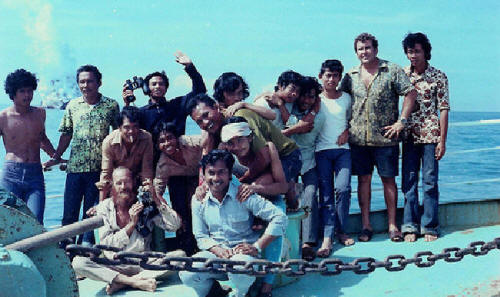
Crew of the research ship
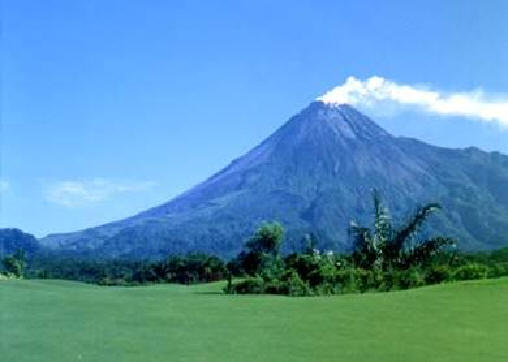
Gunung Merapi, a volcano we observed
daily from our living room window in central Java
The Indonesian culture,
was well worth the effort to appreciate. The people are so polite, and
so gentle and passive in the way all is said and done. The politeness
can be misleading. A “yes” will usually mean “Yes, I hear and
understand what you are saying”, rather than “Yes, I agree with
you, or will do what you request”. A “Yes, but”, is normally
a pretty clear negative. Many foreigners made things unnecessarily
difficult for themselves by failing to detect the nuances in speech and
body language. The oriental smile can be as misleading as the oriental
“yes”. It is infra-dig in that culture, to show feelings of anger,
embarrassment or disappointment. So they will respond with a smile at
times when that could be misleading to a Westerner.
I read Conrad’s Lord
Jim, when in Indonesia, and was most impressed by the detailed and
still relevant descriptions of ports from Zamboanga Philippines to
Penang Malaysia. I also read K’tut Tantri’s “Revolt in Paradise”.
This is an account of the immediate post-war struggle for
Independence by a British born American lady who lived in Bali before
the war, was practically adopted into the family of the Raja in Bali,
and who came to be known by the Dutch as “Surabaya Sue” for her
pro-independence broadcasts from that city.
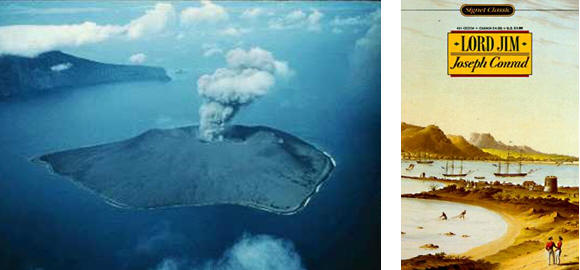
Krakatoa island I used to sail around
in the Sunda Strait. Lord Jim - Conrad’s fascinating book
Back in Java, the Indonesian people rallied behind their
new government, spurred on by Radio Pemberontak in Surabaya, where the
charismatic Ketut Tantri broadcast regularly. The ill-designed
intervention failed, and the British withdrew in December 1946. Dutch
forces continued to fight the national movement, often using Ambonese
soldiers, and thus sowing the seeds of the conflicts in that island to
this day. They left Indonesia in 1949, but held on to Irian Jaya, the
northern part of Papua New Guinea until 1962.
A Remarkable Colonial
Administrator
Few in Britain are aware
that Indonesia, or rather, Java, was a British colony from 1811 to 1816.
This was a short interlude in the long period of Dutch rule of the East
Indies, that was organised as a result of the Napoleonic wars. The
British Lieutenant Governor was a young and relatively unknown colonial
officer who was sponsored for the position by Lord Minto. He was
head-quartered at Bogor in the elevated part of west Java, on the road
to the tea plantations at Puncak Pass, and some 40 miles south of the
seaport capital of Batavia (the modern Jakarta). An example of the best
of the colonial administrators that Britain produced, he set to work
planting botanical gardens and undertook numerous surveys of the
island. Sadly his first wife died of fever and was buried in the
beautiful Bogor garden. In 1816 Java was handed back to the Dutch and
the young administrator was made Lt. Governor of Benkulu in West
Sumatra. (Benkulu lay near the island of Nias which was struck by the
huge tsunami wave of 2004 and the earthquake of 2005). In 1819 he was
posted to a small trading port on an island off the southern end of the
Malaysian peninsula. The administrator applied himself to development
of the island port which soon became the main trading station in the
region. The island was Singapore, and the officer’s name was Stamford
Raffles – later to be knighted for his services and memorialised in the
name of the prestigious Singapore hotel and its partner group of luxury
accommodation. Amazingly, when Raffles retired to England, jealous
British officials denied him a pension. He died in somewhat penurious
circumstances in 1826.
And a not so Prescient
One
The British were back in
Indonesia 130 years after Raffles, when in 1945 – 46 they occupied the
country to root out the last of the Japanese forces, and to ensure the
return of Dutch colonial rule. Unfortunately they landed just as
Indonesia declared its Independence under Bung Sukarno and Mohammed
Hatta in August 1945. Lord Louis Mountbatten had sent General Sir
Philip Christison to command British and Empire troops from Batavia
(Jakarta). (I later came to know one of his officers, Major Fred Ray,
who was at one time posted on the lighthouse island off the entrance to
Batavia port. I think of him every time I fly over that island on
flights approaching Sukarno-Hatta airport). General Sir Philip tried to
suppress the independence movement with inflexible single- mindedness.
700 of his troops were to die over the next year, including the more
reasonable Brigadier Auburn Mallaby who was negotiating for an agreement
with Sukarno’s forces in Surabaya, when General Christison over-ruled
him and dropped leaflets on the city demanding immediate and total
surrender. The Labour Government of Clement Attlee supported the return
of Indonesia to Dutch control, and Foreign Minister Ernest Bevin refused
to permit a United Nations committee of enquiry.
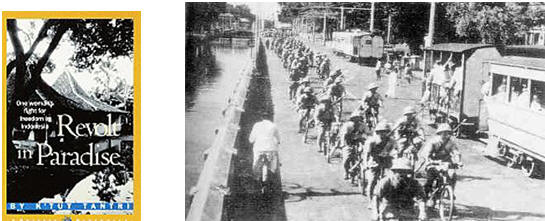
Revolt in Paradise, - K’tut Tantri’s
Troops entering Batavia (Jakarta) 1942
account of the independence struggle
Surabaya Sue
K’tut Tantri, is best known by the Indonesian name given
to her by the Raja Bangli of Bali who practically adopted her into his
family. She was an independent minded, talented, determined , artistic
person whose real origins are somewhat obscure. Possibly due to her
being regarded as a dangerous subversive by the Japanese, and later by
the Dutch, she had a number of pseudonyms, and it is now difficult to
determine which were her real names. She has variously been referred to
as Muriel Pearson, Muriel Stewart Walker, Miss Manx, Miss Daventry, Miss
Oestermaan, Miss Tenchery, etc. Timothy Lindsey, in his recent book,
The Romance of K’tut Tantri and Indonesia, has tried to clarify
her life as far as its details can be ascertained.
She was born in either 1898 or 1908, in Glasgow,
Scotland. Her parents were from the Isle of Man, and her father died
during the first world war. She went to the USA with her mother around
1930, where she worked for British magazines writing about Hollywood and
the cinema. She became a U.S. citizen. After seeing an intriguing
film about the island and culture of Bali, she traveled there in 1932,
with the idea of painting and studying the culture. Shortly after her
arrival in Bali, she met Raja Bangli and became a part of his family.
She died her red hair black at the Raja’s prompting as red hair was not
culturally acceptable. By 1936 it appears she left the Raja’s house and
set up a hotel on Kuta beach that became a meeting place for artists and
visiting celebrities.
K’tut had been married in America but broke early with
her first husband. In Bali, there were rumours of a romance with the
Raja’s son, and later with a gifted male dancer of international renown,
“Mario” Ketut Marya. But no second marriage ever took place.
During the war she became increasingly active in the
independence movement, and for a time was imprisoned and by some
accounts, tortured by the Japanese. The Dutch claim she collaborated
with the Japanese or spread propaganda for them, but this is unlikely
though it was a common Dutch accusation against the supporters of
Soekarno and the nationalists. Her most prominent role was as a radio
broadcaster for the Indonesian movement, from a base in Surabaya. It
was this activity that prompted the Dutch to give her the nickname
‘Surabaya Sue’. To this day, Dutch accounts of her life and work
are somewhat derogatory. But there is no doubt that K’tut displayed
much courage and fortitude, and that she was a considerable help to her
adopted country. Australia accepted Tantri for a period till the Dutch
withdrew after recognizing Soekarno’s national government.
After Indonesia achieved its independence, K’tut Tantri
was less involved in its politics, but worked for the fledgling Ministry
of Information. All who knew her say that despite her remarkable life
and achievements, she was a difficult person, and this may explain why
no permanent position was found for her. She wrote her well known book,
‘Revolt in Paradise’, which was published in 1960, and soon
became an international best-seller.
They say that in her
senior years she showed signs of dementia, and became an embarrassment
to Indonesian embassies in the USA and Australia, by arriving uninvited,
and being reluctant to leave. Nevertheless, she lived into her nineties
and died in Australia in 1998. Her ashes were scattered in Bali at her
request.
If at all possible,
readers should get a copy of Revolt in Paradise from the
library. It is a moving well-written account of Indonesia’s struggle
for independence, and of the life and culture of the island of Bali,
over half a century ago. They will not regret the effort.
. . . . . . . . .
. . . . . . . . . . . . . . . . .
Although the largest Moslem country in the world, Indonesia
has been blest with a form of Islam that is largely tolerant and
respectful to the outside world. When attending a Gereja Protestan
Indonesia church (the Indonesian Protestant church that sprang from the
Dutch Reformed Church) in Sumatra, I have been pleasantly surprised to
see veiled Moslem students in attendance. They were required to attend
a Christian church occasionally and observe the worship, to be more
fully informed on other faiths. Such open contact with other faiths
would seldom be seen in other Moslem lands. To be fair, I have
discussed matters of faith, the Bible and the Koran, with Moslems in
Arabia, Africa, central Asia, and the far east. On a personal level, I
have found them to be respectful, willing to listen, and also prepared
to discuss painful issues, and to share their own heart beliefs.
Clearly there are extreme groups in Islamic society in most Moslem
lands, as there are some extremist ‘Christian’ or sectarian groups in
the USA, Northern Ireland, Uganda, and other countries, as well as
extremist Hindu groups in India and militant Buddhist groups in Sri
Lanka. Mercifully, they are all a minority, but nonetheless can wreak
much havoc and bloodshed.
There were 90 million
people in Java when I arrived in the country, and 130 million in the
whole country. Today the population numbers over 200 million. I could
not imagine where all of the thousands of kids running around the
streets were to get food, clothing, education, jobs, and housing. Many
of their fathers were crewing sail-boats or pedaling becaks for a
wage of perhaps Rp 6,000 a month, or less. Their mothers may have been
working in the rice paddies, the textile factories, or the batik dyeing
sheds, for about the same amounts. The basic monthly wage was equivalent
to US $ 15 or just above ₤ 9 then. How could they survive on such low
incomes ? This was something I wrestled with for a long time, and never
ceased to ask those willing to discuss, how the poor people existed.
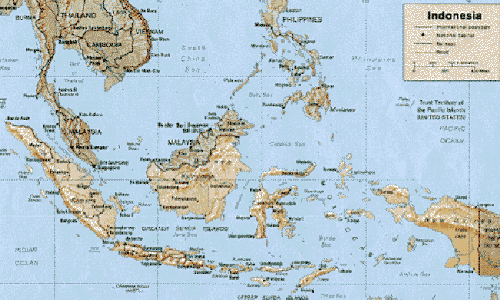
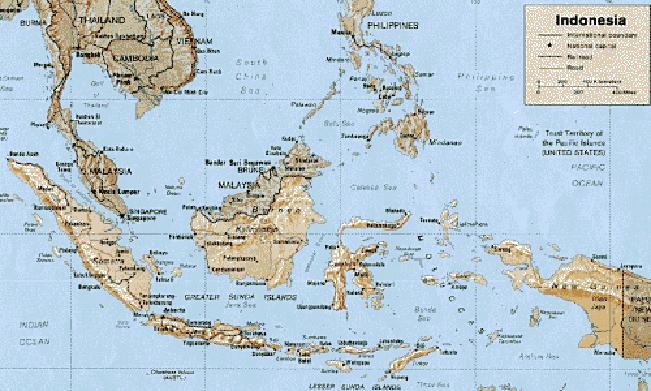
Map of Indonesia
It was around that time
I read Small is Beautiful for the first time. This is the
prophetic treatise written by the renowned economist Dr Ernst Fritz
Schumacher. He had been a Rhodes scholar, and a participant in the
Bretton Woods conference, then later made economic adviser to the
National Coal Board in Britain, but his heart was in third world
development. He founded the Intermediate Technology Group and was a
leading member of the Soil Society. For me, struggling to come to terms
with the formidable problems of bringing remunerative work and food and
a future, to a vast nation like Indonesia, reading Schumacher was like
putting on spectacles and seeing these problems in focus for the first
time. When in Africa, I had debated with departmental economists over
the direction of the interventions we were making, and whether they were
really in the people’s long term interest, but had no answers to the
arguments of conventional economics. Now, here was an economist of
stature, challenging the very basis of much of modern development
theory, and showing us a better way to a sustainable future on planet
earth.
The sub-title of the
book is Economics as if People Mattered. It painted a lucid, if
alarming, picture, of the phenomenal growth of pollution and industrial
production in the post-war world, of the escalating consumption of
irreplaceable fossil fuels, mainly petroleum, and of modern industry and
technology’s treatment of human beings and their aspirations as if they
just did not matter. It also challenged the sustainability of growth
and market systems based on human greed, and the impact of globalism on
poor societies.
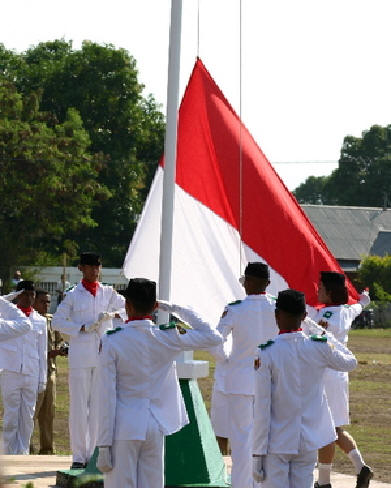
Raising the Indonesian flag to
commemorate independence day
Most of what Schumacher
proclaimed is now accepted as sane and sensible by the United Nations
and the majority of development agencies, if not by the governments of
the USA and the UK, and the major global industrial corporations. But
in the early 1970’s it was considered very new and radical, even though
Schumacher had accurately predicted the OPEC oil crisis 5 years before
it occurred. I began to debate the issues with World Bank economists,
and to write some papers based on the application of Schumacher’s
theories and principles in my own work. I found that most economists
had never really thought out the social and environmental implications
of their policies. To them an efficient business or economic system was
one that used the fewest number of human beings, and made the greatest
profit for the owner, regardless of how much capital it required, or how
much energy it consumed, and with scant attention to the environmental
problems it created.
Some of my ideas were
accepted surprisingly by the Asian Development Bank, and somewhat more
understandably by developing country governments. Dr Shei, the head of
the Agriculture Department of ADB, was remarkably sympathetic. At my
suggestion, and following a meeting with his senior staff, Dr Shei
financed a regional workshop and conference on the application of
alternative and renewable energy systems, which I organized together
with a visionary American research officer, the late Dr Ian Smith of
ICLARM (now WorldFish). But when I wrote a paper for FAO, for the
Indo-Pacific Fishery Council meeting in Japan in 1979, it was banned
from circulation within FAO Rome, and remained so for two years. The
Organisation even refused to agree to my attendance at the Latin America
Fisheries Symposium to which I had been invited by the Government of
Mexico whose officers had read my IPFC paper. However I was able to
take leave of absence for that period. But more of that later.

Small is Beautiful, - E F Schumacher’s
marvellous book which opened my mind to the
need to protect global resources and to follow an economics that valued
people
Though its population
was poor, Indonesia had enormous natural wealth, chiefly petroleum, but
also nickel and copper, timber, and plantation products, rice, spices,
tea and fish – mainly shrimp and tuna. Its growing industry produced
textiles, batiks, shoes and plastic goods. Domestic production of motor
vehicles was achieved following considerable pressure on Japan, but a
fledgling aircraft business did not fare so well. The Industry Minister
Dr Habibie (a friend of Mrs Thatcher’s who had earlier worked in the
German aircraft industry, and was later Vice President and President),
wasted huge amounts of public money on high-tech aviation projects that
failed. But the biggest financial loss to the country came from the
milking of profits from the oil industry, by the regime. Pertamina, the
national oil company, was the goose that laid the golden eggs.
The figures are
mind-boggling. Someone has illustrated a billion dollars thus: If you
were born at the time of Christ, and if you were still alive today, and
if every day of your life (not every week or month), you had spent a
thousand dollars, - you would still not have spent a billion dollars.
But the Pertamina embezzlers had no problem in stealing such amounts,
and no conscience about it afterwards. One middle-level executive,
whose official salary would have been around $9,000 a year, died in 1979
I believe. His first wife had passed away, and his second wife went
immediately to Singapore to claim his bank accounts there, as also, but
separately, did the children of the first wife. The dispute over who was
entitled to the funds went into litigation and became public knowledge.
The frugal officer had accumulated $30 million. Shortly after, a brave
reporter dared to ask President Soeharto, “Mr President, should we
not re-open the Pertamina case”. His reply was, “No, no, - we
have no proof”. Soeharto surprisingly admitted that a newspaper
report that he himself possessed $70 million in Singapore bank accounts,
was true. In his defense, he said, “But the money is not for me. I
am keeping it for the poor children of Indonesia”.
Soeharto stepped down
in May 1988, and in November of that year he handed over to the state,
seven tax free foundations he controlled. Early next year prosecutors
revealed that he had violated the corruption law. He was placed under
arrest in April 2000, and was charged with involvement in a US $500
million scam. Around the same period, Time magazine alleged that the
former President and his family had amassed a fortune of $15 billion,
some $9 billion of it in Austrian banks. Soeharto issued a defamation
suit against the magazine, but it was turned down by both the district
and high courts in Jakarta. However, in February 2001, the Supreme
Court ruled to stop legal proceedings against the former President due
to his deteriorating health. President Megawati mentioned a possible
pardon for him in December of that year. As I have opined elsewhere, in
the world we live in, only small crooks are punished. Really big ones
usually get off. But they all one day will stand before a Higher
Tribunal.
Soeharto’s family followed in his steps, assisted by an army
of sycophant bureaucrats and boot-licking officials. Each of those
amazingly talented kids ended up with ownership or control of dozens of
large companies. Some were granted monopolies, like the one for
internal air freight, by the Government. One son, Tommy, who was given
a monopoly over the clove trade, became an infamous gangster and drug
dealer. The Supreme Court Justice who sentenced him at one of his
trials, Ir. Safiudin, was later murdered. Tommy was charged with
complicity in the shooting and ultimately convicted. Some talk in the
street even blamed him for the death of his mother, Tien Soeharto,
following a struggle in the family home in which a gun was fired. [Hutomo
‘Tommy’ Mandala Putra was jailed for 15 years for paying a hitman to
kill Judge Safiudin, and for other offences. The sentence was
considered too lenient by many, yet was later reduced to ten years on
appeal. Tommy was released after serving a mere third of the 10 year
sentence. The hired gunman and an accomplice were jailed for life and
are not eligible for remission of their sentences.]
 Tommy
was incarcerated in the high security island prison Nusakambangan near
Cilacap on Java’s south coast, but remained there for only three years.
His short-lived business empire had been run from a lavish building in
Jakarta city centre, Gudung Timor. After the collapse of the corrupt
enterprises, the building was taken over by the newly created Ministry
of Marine Affairs and Fisheries with which I worked on a number of
Bank-financed projects. So I was a regular visitor to the site of
Tommy’s former kingdom. Tommy
was incarcerated in the high security island prison Nusakambangan near
Cilacap on Java’s south coast, but remained there for only three years.
His short-lived business empire had been run from a lavish building in
Jakarta city centre, Gudung Timor. After the collapse of the corrupt
enterprises, the building was taken over by the newly created Ministry
of Marine Affairs and Fisheries with which I worked on a number of
Bank-financed projects. So I was a regular visitor to the site of
Tommy’s former kingdom.
Right : Tien Soeharto , former
first lady
|
Two interesting
generals
Even within the
military regime of President and former General, Soeharto, which
was infamous for its corruption, mismanagement and nepotism,
there were individuals who displayed competence, integrity, and
a commitment to making Indonesia a just and well-ordered
society, with opportunity and protection for all its citizens.
Two such persons were Ali Sodikin and Hoegeng Iman Santoso.
General Ali
Sodikin from Sumedang, West Java, became a naval officer and
rose to high rank in the Indonesian armed forces. He was
appointed as Governor of Jakarta shortly after Soeharto took
over from Sukarno. Jakarta then (and now) was one of the most
populous cities in the world, and it faced the immense urban
problems of all large cities. Known as Batavia to the Dutch,
Jakarta in 1970 had a population of over 6 million persons.
Today it has double that number of residents. Unemployed poor
from rural areas came to the capital in search of work. Lacking
money or a place to stay, they became squatters, erecting shanty
towns on scraps of land beside the canals and railway lines or
the back streets of the city. Sanitation was poor, and potable
water scarce. (All of the early visitors to Batavia from the
times of Magellan, Drake and Cook, mention that they and their
crews succumbed to fevers and disease in that port). The
squatters had also to compete with the growing number of modern
hotels, office blocks and expensive apartments that demanded and
received top priority for electricity, water and urban
services.
Ali Sodikin set
about modernizing the huge city, and resolving its formidable
social and infrastructural problems. He did this with a zest
and an optimism that won him respect and admiration at home and
abroad, even leading to talk of him being an ideal future
leader. That suggestion was not welcome in the Soeharto
circle. Sodikin had resisted efforts by the ruling elite to
over-ride procedures and grab land and businesses for
themselves. So he was seen as stubborn and uncooperative by the
Soeharto family, and in consequence was dismissed from his
position as Governor. The reward for his sterling service, was
to be put in charge of the country’s football team. The spite
of thwarted greed knows no bounds.
Hoegeng Iman
Santoso hailed from Banyumas in Central Java. He attended the
Police Academy in Jogjakarta, and studied at the Military Police
School in Fort Gordon, Georgia, USA. He rose through the ranks
of police service to become the General in charge of Police in
Jakarta. Santoso took his responsibilities seriously, and
sought to introduce discipline and safety measures such as the
compulsory wearing of crash helmets by motor cyclists. He
refused to turn a blind eye to the excesses and illegal actions
of the Soeharto clique and so fell out of favour. Together with
Ali Sodikin he joined the “Petisi 50” group of concerned
intellectuals that challenged the Soeharto regime on a range of
issues. Tired of vainly fighting corruption, General Hoegeng
eventually resigned and took up a civilian career with TVRI,
leading a family singing group that specialized in Hawaiian
music. Our family greatly enjoyed that splendid weekly
entertainment programme in the 1970’s days of the single-channel
black-and-white television in Indonesia. Hoegang’s wife Mary,
also a quality singer, had a cheerful outgoing personality, but
to me, Hoegang himself always looked sad, as though he carried
the weight of Indonesia’s troubles on his shoulders. |
There is one thing that
must be said in favour of Soeharto and his 32 year rule. Despite all
the corruption and strong-arm tactics, the smiling General gave the
country stability. There was economic growth, and an absence of the
ethnic and religious strife that was stirred up after his resignation.
A young Indonesian government officer, a Moslem, said to me in 1995 when
we were in a Jakarta shopping centre in December, where Christmas music
was being played over the sound system, “Isn’t this a great example
of the tolerance of the Soeharto administration? Would there be as much
celebration of a Christian festival in any other Moslem state?”.
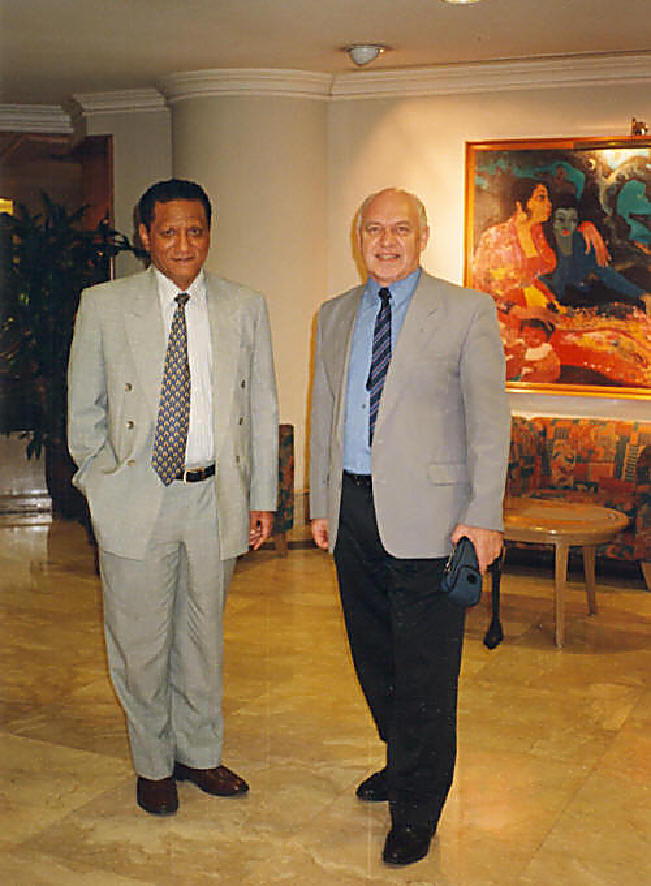
Below : with the Minister of
Agriculture, Indonesia
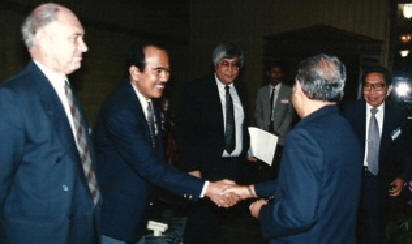
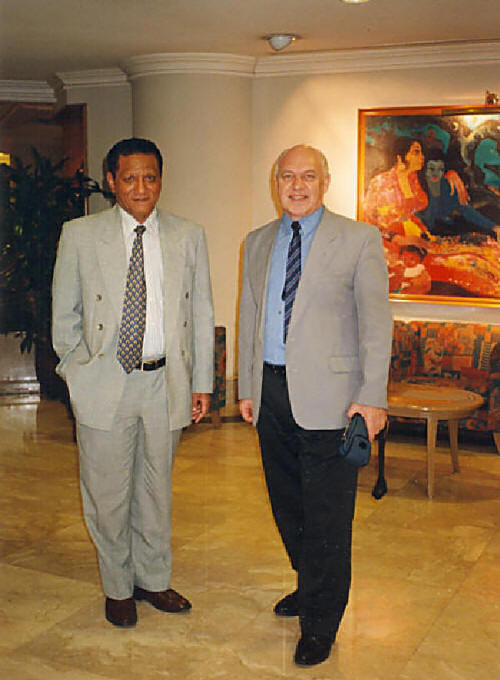
Meeting with an East Timorese officer.
My own view of the
cause of most of the troubles since then, from East Timor to Banda Aceh,
and to Sulawesi, was that the hoodlums who set the different groups
against each other were financed and organized by former Soeharto
loyalists in the Indonesian military who had lost their privileged
positions. They hoped that if sufficient unrest came about, then
martial law would be declared and they would be back in power. This has
since been confirmed publicly in the national press, and in most other
books on that sad period. General Wiranto himself, Soeharto’s armed
forces chief, has been indicted as a war criminal by a court in East
Timor. That did not prevent him from continuing to seek high office
including the Presidency itself in 2004. Thankfully, however, he was
well beaten at the polls.
The Bali bombing was
different, being the direct work of Al Qaida type extremists. In East
Timor, together with the Indonesian armed forces, the hoodlums killed
hundreds of thousands of civilians. It is true however that during this
period, the United States (which almost alone in the world supported
Indonesia’s claims on East Timor), continued to provide weapons and
training to the Indonesian armed forces. The USA eventually withdrew
support from Soeharto, but that had more to do with his intention to
cancel an order for American military jets, and to purchase similar
aircraft instead from Europe.
As one who loves the
Indonesian people, and who has experienced much kindness at their hands,
I wish that populous land stability, justice, peace and prosperity.
There is in Java, an ancient legend of a King of Peace who will one day
come to right all wrongs and bring harmony and justice to the people. He
is called “Ratu Adil”. The legend or prophesy is so powerful,
that it commands respect to this day. During the latter period of
Soeharto’s rule, a former Professor of Agriculture, Ir. Sawito, claimed
to be Ratu Adil. He attracted a small following, but was quickly put in
prison by the authorities. Whether it is a Herod of 2,000 years ago, or
a modern despot, - no autocratic ruler welcomes the arrival of a
messiah.
Bali bombing and
Sumatra earthquake and tsunami.
. . . . . . . .
I visited Bali several
times, when in command of the UN research vessel, and when on my annual
tour of our out-centres, one of which was situated in Singaraja.
Together with my family, we often stayed at Kuta beach which we loved.
It is located on the Bali Strait, facing west, and just north of the
airport. K’tut Tantri’s famous little hotel was there. There had been
a bad air crash not long after the airport opened in the late 1950’s.
And of course, in 2002 it was the scene of the dreadful Bali bombing
outrage.
Sumatra I knew well
having traveled from one end to the other of that huge and fascinating
island. I spent over a year in Padang West Sumatra, among the Mening
Kabau people, and had visited Lake Toba and its Samosir island in the
province of North Sumatra, home of the Batak people. The island is home
to a dwindling population of tigers, elephants and orang-utan apes. It
is rich in petroleum, particularly in Riau province on the east coast
facing Singapore. Sumatra still has substantial tropical forests, and
plantations of oil palm, rubber and teakwood. Its northernmost
province, Banda Aceh, is an area of strict Islam that has sought
independence from the rest of the archipelago. In consequence, it was
kept under careful surveillance by the Indonesian military.
But no-one could have
foreseen the disaster that was to strike the area suddenly and without
warning on December 26th 2004 when a tsunami wave caused by a
submarine earthquake, hit the coast with such velocity that over 280,000
lives were lost, and scores of villages wiped off the map. The
surviving population will rebuild their villages and restore the
shattered economy, but the social and psychological scars of the
disaster will remain for generations to come.
Three months after the
tsunami disaster, North-West Sumatra was struck by a major earthquake
that mercifully did not result in a tsunami wave, but which caused
serious damage to certain localities. The island of Nias alone
suffering many hundreds of fatalities. The total number who died from
that earthquake in Sumatra is reckoned to amount to over 1,300 persons.
Coming on top of the havoc wreaked by the tidal wave, this was a double
tragedy for the area. |