|
Beyond the greed, the pride, the insolence and the pretensions
of those who rule us by
force and fear and fraud, there is a living
Almighty God who knows
the dark mysteries of evil in the hearts
of men. I know his
justice, truth and righteousness will reign and
endure for ever …
I believe the cause
delaying our liberation may be found in ourselves,
in our reluctance to
assert our rights and frontally confront the
forces of evil. We are
afraid to die and our fear has immobilized us.
We have forged our own
chains with our cowardice.
Senator Benigno Aquino
Having already seen
much of south-east Asia, my first impressions of the Philippines were,
“this is not Asia, - this is Latin America”. The combination of
American and Spanish influences on the islands of the archipelago dubbed
“the pearl of the orient”, has led to the growth of a culture that
resembles Mexico or Hawaii more than the far east. The standing joke of
Filipinos is that their nation emerged after spending 300 years in a
Catholic convent, and 50 years in Hollywood ! Filipinos are delightful
people; - friendly, out-going, happy, hospitable, and with a care-free
attitude to life, even when poor and disadvantaged. They are more
willing to travel abroad for work than most Indonesians, Malaysians or
Thais, and as a result you will find communities of emigrant workers in
Hong Kong, Singapore, Kuala Lumpur, Tokyo, Rome, Vienna, Frankfurt,
Paris, London, and throughout Canada and the USA. Earnings sent home by
Filipinos working overseas, are the largest source of national income
for that country.
There is little
cultural or trade connection now between the Philippines and Spain,
except that a course in the Spanish language is compulsory for many
university degrees. Though I met many Filipino graduates from the
Spanish course, I could not get any of them to speak a single sentence
in Spanish. Relations with the United States, in contrast, are active
and vital for the country. To many Filipinos, a working visa to the USA
is akin to a ticket to paradise ! Yet there is a strong latent
resentment against the former colonial occupier which supported
oppressive dictators like Marcos, and paid little attention to the poor
peasants who suffered under his rule. The more educated of the people
dislike the intimidation of US governments which regularly pressure the
country to toe the US foreign affairs policy line. The most common
description applied to America in that respect, is that of a bully.
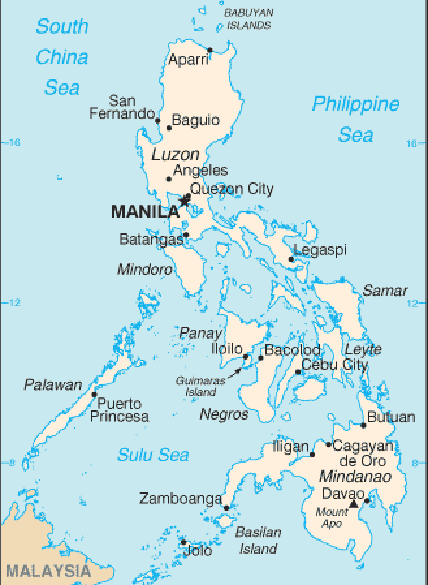
Map of the Philippines
Its economy is
stagnant, and it is difficult to understand why. Corruption is probably
no worse or no better than in other parts of the East. The people are
intelligent and hard working. The islands are blest with good natural
resources. There is timber, sugar cane, coconut, pineapple, banana,
livestock and fish. Local mechanical skills and ingenuity are seen in
the ubiquitous “jeepney” vehicles, and the “bancas” and
‘pump boats’ used for water transport. One reason for the decline in
industry may be that multi-nationals find
labour cheaper
and more compliant in China and other parts of the
region.
An
Icelandic colleague who worked many years for the UN once said to me
that in Sri Lanka he observed socialism at its worst, and in the
Philippines he saw capitalism at is worst. Like most generalisations it
was only true in certain respects, and to be fair to both countries,
there are others that are not far behind them in poor governance.
Certainly the Philippines has a real Laisser Faire attitude to
business. That business freedom however, is manipulated by an
over-strong central government that has long been ridden with cronyism.
Some thought that the country did well under Marcos, but in hindsight it
was only his family and close business colleagues that profited.
National economic decline began with Marcos before 1970, and has
continued since.
Before
going on to discuss the country’s recent turbulent Political history,
let me share some personal experiences that might give a flavour of the
lovely land and its happy, outgoing people. They are natural
extroverts, most of them being able to speak or perform in public
without being self-conscious or embarrassed. During my first week in
Manila, I wandered into a small café for a light lunch. It so happened
I was the only customer in the place when I sat down. A young girl
appeared from the kitchen, and eyeing me carefully, began to sing and
gesture and move around, as if performing on the stage. She went
through the whole act, then when finished, turned and ran back inside
the kitchen. I assumed that her performance had been the result of a
dare with the other staff members.
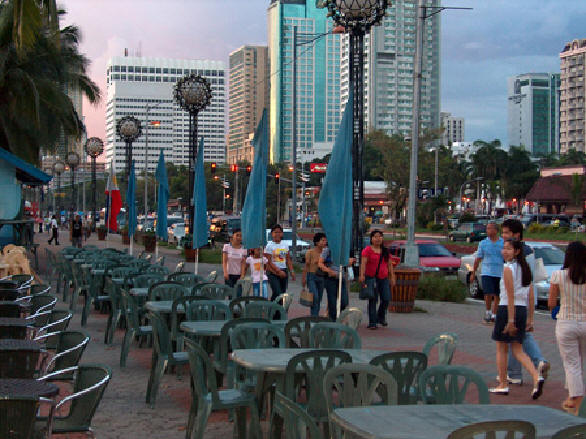
Manila city, Makati district
The
relationship between wealthy families and the ‘barrio’ people in their
areas, is somewhat paternalistic. I observed this on the island of
Marinduque where I had gone to discuss some low-cost water filtration
systems. We were received and entertained by Mrs Reyes, wife of the
Commissioner for Customs, who was the leading matriarch of the island
community. She was then involved in restoring an old Spanish church,
and we saw how she took a personal interest in the welfare of all the
workers. One young man from another province had gotten his local girl
friend pregnant, and Mrs Reyes was concerned to ensure that the
situation was handled properly and the couple encouraged to marry and
set up home there. We stayed at her house which was beautifully
furnished, and early next morning she invited us to visit and swim at, a
small uninhabited island she owned offshore. The boat carrying us took
over half an hour to reach the place, but on stepping ashore we found
that her staff had gone ahead and already prepared a breakfast of
grilled fish, rice, salads, omolettes, pandesal bread rolls, mangos and
coffee. Only those who have enjoyed a full Filipino breakfast will know
what a memorable experience it is.
But the
wealthy oligarchy of islands like Negros, the once great sugar producer,
also have a sinister record of exploitation and domination of the rural
poor, aided and abetted by the military which often is a law unto
itself. Frustrated in their attempts to defeat the NPLA, the communist
new people’s liberation army, have often taken their spite out on
innocent civilians whose sole crime may have been membership of the
left-leaning Catholic BCC, basic Christian community movement, which was
led by priests with a social conscience. Murders of peasants by
Philippine army soldiers, or by the goons employed by plantation bosses
to keep the workers in order, are reported as the work of the NPA, or if
the military’s role was clear, the victims were ‘working for the NPA’.
The plantation owners and the military enjoyed special protection during
Marcos’ time, but in truth, no President has been able to control them.
Most Philippine Presidents, in fact, come from large land-owning
families themselves.
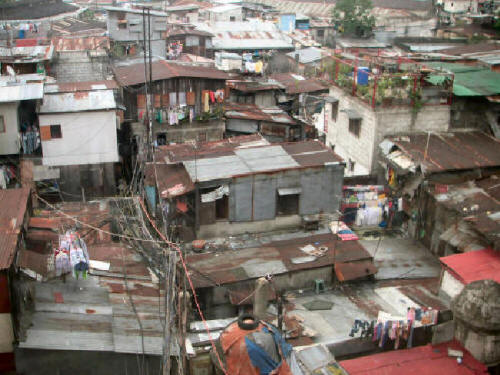
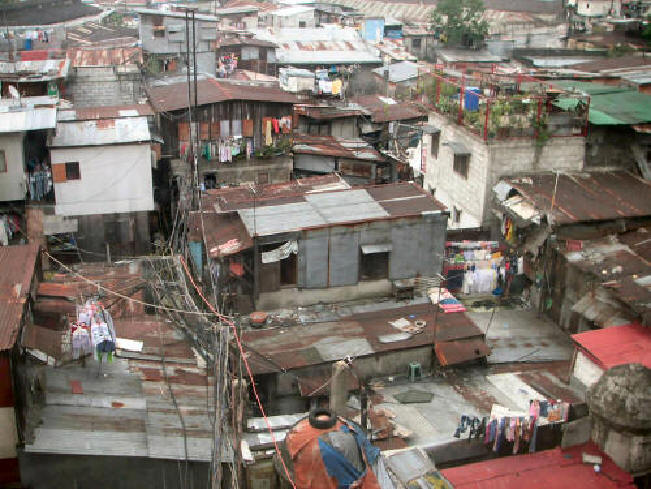
Manila slum
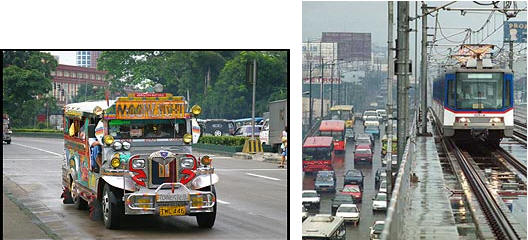
Typical Filipino
“jeepney” Manila
traffic
I had a
narrow brush with death in Manila in 1985. The Asian Development Bank
had recruited me to advise on a project in Sumatra, and took me to the
Philippines first for briefing. A room had been reserved for me in the
Regent hotel on Roxas Boulevard, just a few hundred yards from the ADB
office. (A new and much more lavish office complex was constructed
shortly after in the Pasig City part of the capital). There was a
problem with the hotel staff some of whom had gone on strike. I took
little notice and went to bed in my room on the 6th floor, as
with jet lag, I was quite tired. I was awakened at 01.30 in the morning
by hammering on my door, and the sound of confused voices. There was no
electric power and the telephone was not working. I rose in the
darkness and looked out the window. The Pasay City fire brigade was
there, already extending its ladder. Opening the door to the lobby,
even in the darkness, thick acrid smoke was evident. Having taken no
notice of the position of the fire escapes I realised that I would have
difficulty finding them in the darkness and smoke. A few inhalations of
the smoke would have put me out of action. So I turned to the window
which was sealed and locked. Feeling where the locks were, I beat them
with a stool till they gave way and pushed the window open. There was a
tiny ledge I got to sit on and from there I signalled to the fire
brigade. The fireman acknowledged my wave and indicated they would get
to me eventually. I went back into the room to pick up some personal
belongings, but had to climb back out the window as the room by then was
full of acrid smoke. The fire brigade ladder reached to the sixth floor
and no further. I got out safely, but 36 other unfortunate guests lost
their lives. Three days later I was allowed in to check for belongings
in my room. There was nothing to see there. It had become a charred
black hole. The fire was probably started by an act of arson by
disgruntled employees, then an unfortunately common occurence.
The
Philippine President from 1970 – 1986 was Ferdinand Marcos, an Ilocano
from the north-west of Luzon. A family museum there has an array of
photographs and memorabilia about him, - and even more about his mother
Donia Hosefa Edraline Marcos. There is only one faint old oil painting
of his father, Don Mariono Marcos, about whom little factual information
is available. Some say that he collaborated with the Japanese, and some
say that he was not Marcos’s true father. There is a school named after
him in the province. I visited it when it was in poor shape and seeking
help for expansion and upgrading. It is now a University, and the
Province appears to be thriving under its present Governor, Ferdinand
Romaldez Marcos III, or “Bong-Bong”, Marcos’s son. At a party in Quezon
City I met a classmate of Bong-Bong’s who had taken the rap for him in
the UK for some misdemeanour, and was accordingly rewarded by Marcos
with a job in his administration.
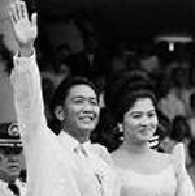
Ferdinand and Imelda
Marcos
Marcos’s wife, Imelda Romualdez, was from the Province of Leyte.
Despite colourful and glowing accounts of her family history, her
background is somewhat obscure, as is the precise arrangement by which
she married the then young Senator. But I will spare readers further
details of that gossip.
Ferdinand Marcos was a
gifted and able lawyer, and grew to be a formidable politician. He
built himself an image of a Philippine war hero with a series of epic
tales which few now believe had any genuine factual basis. Marcos was
elected as President in 1968. He declared martial law in 1970 and ruled
the land with a rod of iron thereafter. Politics is a tough business in
the Philippines and rarely does an election go past without some
bloodshed or without serious manipulation of the vote. Marcos’ chief
rival was Senator Benigno Aquino who he jailed in 1970, and who was to
be granted only brief periods of freedom till he went abroad for heart
surgery in 1980.
Also jailed by Marcos
was Roger (‘Bomba’) Arienda, a former radio commentator who had become a
committed Marxist and revolutionary. I visited Arienda regularly in
Muntinlupa penitentiary, south of Manila, during 1978 – 1980. At that
time he was in minimum security, but with Roger’s help I was able to
visit maximum and medium sections of the large prison that had up to
18,000 inmates. So I got to know a number of political prisoners as
well as some serious criminals including a few of those on death row.
Roger had gone through a spiritual experience in prison in 1975, and by
1978 had come to be a remarkable witnessing Christian. Through his
influence, hundreds of prisoners were to go through public acts of
repentance and professions of faith. They built a church in the grounds
of minimum security and set up a half-way house to prepare prisoners for
useful and remunerating work outside. Some notable cases of physical
healing took place under Roger’s ministry, - but that’s another story. I
was able to get Roger’s story published in UK under the title “Free
within prison walls”. Publishers Wesley Owen sent a tabloid features
writer, Dan Wooding, to Manila to interview Roger and edit his
manuscript. Dan went on to press work in California where he is still
active.
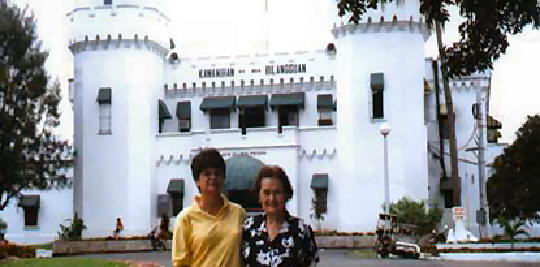
Bilidad penitentiary, Muntinlupa,
south of Manila
Muntinlupa, or to give
it its correct name, Bilidad prison, was the largest penitentiary in the
country, and often operated at up to 250 % capacity. When I first went
to the Philippines there were 18,000 men incarcerated. Female prisoners
were kept in the Correctional Institute for Women in Manila city. What
struck me was the strange mixture of criminals and political prisoners,
and how wealthy prisoners were much better dressed and fed than the
ordinary inmates. Minimum security section was reasonably pleasant, and
there was almost free movement in and out for visitors. Medium security
was strictly guarded, and had decidedly unpleasant aspects to it. It
held the majority of inmates, in separate sections as prisoners of
different gangs that were identified by tattoos, had to be kept apart to
keep them from killing each other. But maximum security was grim.
Prison guards allowed
us in after we signed to say we accepted the risks, and once inside,
they left us. The high concrete walls topped with barbed wire, the
narrow passageways, the roughly welded strong doors, the lack of paint,
and the pervading smell of stale urine, added to to the dismal and
forbidding atmosphere. Death row where I met seven prisoners destined
for the electric chair, was as can be imagined. The seven I met were
allowed out to spend time with us (still within maximum), but I will
never forget the look on their faces as we bid farewell and returned to
freedom and fresh air and to wives and families, and they walked
solemnly beck to their cells. Some will say ‘well they deserved it for
taking other lives’. But after talking to them, it was apparent that in
almost every case there were extenuating circumstances. One strong
fellow from the Visayas, Joe Balaez, sticks out in my mind. He had
killed a man in a drunken brawl, which sounded more like manslaughter
than murder. But he had also killed a prison guard during a rebellion
in Bilidad prison. Whatever the provocation, it was reckoned that he
would probably not escape the death sentence for that second killing.
But sitting beside him on a bare wooden bench, listening to fellow
prisoner Arienda speak, I could feel only pity for a fellow human
being. Would I have fared any differently had I been born and brought
up in his circumstances ? As it happened, most of the seven I knew
probably had their sentences commuted to life, and some were released
after a period, for good behaviour.
The death penalty was
and still is, in force in the country, though execution today is by
lethal injection and no longer by the gruesome means of the electric
chair. The ultimate penalty was carried out on rare occasions only even
during the Marcos era, with sentences often commuted to life
imprisonment. I met one prisoner a few weeks before he was due to be
executed, and again later after his sentence had been commuted.
Apparently the warders knew the day before that he would not be put to
death, but they did not tell him as they wanted to share the special
meal that was offered to all condemned men the night before.
Understandably, the death row prisoner had no appetite for food, so the
guards tucked in and enjoyed it instead. Only after the meal was over
did they pass on the welcome news.
In
the late 1970’s I led a World Bank / FAO team in designing and planning
a new university – the University of the Philippines, Visayas, or UP
Visayas for short. It was intended to provide tertiary education for the
people of the central islands, and since their economy was mainly based
on fishing, it was to focus on marine science and aquatic subjects.
Intended first for the port town of Ilo-ilo on Panay island, it was
eventually constructed a few kilometers to the east at Miago. Coupled to
the University were 7 marine institutes and 7 fishery training centres,
but they were located around the country from Aparri to Zamboanga.
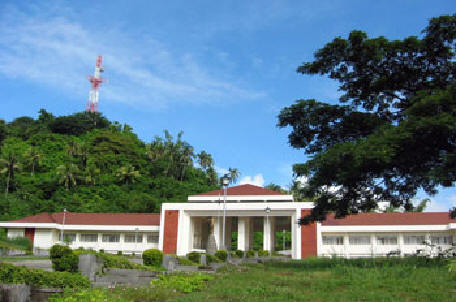
The gate to UP Visayas in Miagao
Benigno Aquino was
released and permitted to run for election as Governor of Metro Manila
in 1979. That election was also contested by Imelda Marcos. The vote
count was running 2 : 1 in Aquino’s favour when there was a general
power cut that affected most of Manila. When the power was switched on
again 2 days later, the government said that there had been a big swing
in the count back in favour of the First Lady, and she was duly
appointed. No one was surprised. Aquino was later permitted to go to
the USA for heart surgery on condition he remained out of the country.
I was present during
the visit of Pope John Paul 2 to the Philippines in 1981. This was a
huge national event which delighted the people immensely. I watched on
television as he shook hands with hundreds of official guests at a
reception in the capital. It intrigued me how he took time to speak
warmly with certain persons, and gave others a mere cursory handshake –
some of them known to be corrupt politicians. He and Cardinal Sin, the
leader of the Filipino Catholics, tried to curb the excesses of Imelda
Marcos who made a pretence of great piety. She wanted to build a church
to match St. Peters’ but they would not approve of the project.
On one occasion I sat
behind Cardinal Sin at a cinema showing of a film by the Presbyterian
theologian Francis Schaeffer of Switzerland, whom I’d also heard speak
in Edinburgh. The film covered a range of moral issues from euthanasia
to abortion. The Cardinal, a large corpulent figure, had drawn attention
to his presence by marching out to the middle of the aisle and placing
his hand on his heart during the playing of the national anthem. He also
led in the applause at the end of the film.
Another of Imelda’s
projects was construction of a Cultural Convention building and Fine
Arts Centre on the seafront area. Her project manager was a well-coiffured
society lady Helena Benites, assisted by a neice-in-law, Jollie
Benites. The project was falling behind schedule and Imelda wanted it
ready for a prestigious opening event. It was to have been an
international film festival to rival Cannes, but few of the major movie
companies would participate, and it ended up as a rather tawdry
exhibition of second rate and somewhat pornographic films. Pressure was
placed on the contractors to speed up the completion. In the haste to
pour a huge central concrete foundation, several workers fell into the
mix. The contractor wanted to halt work till their bodies could be
retrieved, but Imelda and Helena refused to delay the progress. So the
building rose above the entombed bodies. This was bad, particularly in
a superstitious country like the Philippines. To this day the building
(which like many arts / cultural centres is rather ugly), is regarded as
haunted.
Jollie Benites was
later killed in a road accident when she was a passenger in a car driven
by Minister of Information Onofre ‘Odi’ Corpus. It was rumoured that
they were having an affair at the time. Many Filipinos thought her
death was somehow a revenge by the ghosts of the bodies she had
entombed. I had met with Onofre Corpus when he was Vice President of
the University of the Philippines and I was working on a World Bank
financed university project. He was one of many Marcos loyalists whose
career prospered during the period of the Marcos Presidency.
I met the President
himself just once, in 1979 when he came to address a regional fishery
gathering hosted by our UN South China Sea Programme and the Philippine
Bureau of Fisheries. He arrived on a chair supported by burly security
guards wearing barongs – the national male dress shirt. As ever, he
spoke powerfully and with few notes for the best part of an hour. As
was his wont, he made a number of Presidential declarations in favour of
the fishery sector. Such decrees were largely meaningless since they
were never backed up by genuine enforcement or implementation. The wife
of the Commissioner for Customs, Mrs Reyes, the most prominent woman on
her island of Marinduque, told me how she attempted to protect local
fishers from the incursions of large trawlers and seiners from Manila.
Such was the power of the Marcos supported private sector, although Mrs
Reyes had the law on her side, she was threatened with prosecution
herself.
Imelda I met only
once. That was at the funeral of Senator Waldo Perfecto who had led
national support for the World Bank project I worked on to establish the
University of the Philippines, Visayas, which was to focus primarily on
marine and fisheries subjects. At the funeral, the First Lady was as
ever, a focus of attention, charismatic, attractive and well-dressed,
and publicly showing her condolences for the late senator’s family.
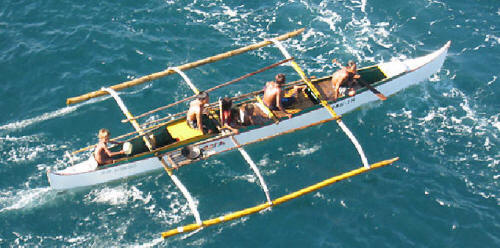
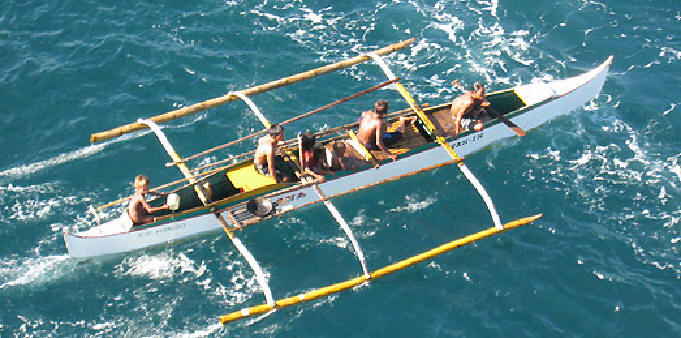
Filipino ‘banca’ fishing boat
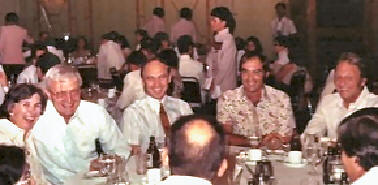
Below : with staff and friends of the
South China Sea Programme. This was a UNDP financed regional
progragramme that served the Philippines. Malaysia, Thailand. Indonesia
and Hong Kong. Vietnam was nominally a member but could not participate
due to the war. I served as the senior regional extension officer. Art
Woodland, the Director, is on my right, with his wife Elaine. The Deputy
Direstor was Erling Oswald .
The sugar sector was
controlled by Marcos and the oligarchs of the Visayan islands, for their
own advantage. The President nationalized the sugar industry and
hoarded thousands of tons of the commodity, gambling on a rise in the
world price. Instead, it fell to record lows and tens of thousands of
cane workers lost their jobs and meager incomes. In the sugar-dependent
island of Negros, children went hungry and died as a result. On his
visit to the Philippines in 1981, Pope John Paul II spoke out against
the greed and exploitation of the sugar barons of Negros. At the
island’s capital of Bacolod, in front of the wealthy elite of the
island, he said:
“Injustice reigns when,
within the same society, some groups hold most of the wealth and power,
while large strate of the population cannot decently provide for the
livelihood of their families, even through long hours of back-breaking
labour in factories or in the fields. Injustice reigns when the laws of
economic growth and ever greater profit determine social relations,
leaving in poverty and destitution those who have only the work of their
hands to offer. The church will not hesitate to take up the cause of
the poor, to become their voice, to ask for justice; … because the
land is a gift of God for the benefit of all.
The landowners and the
planters should therefore not let themselves be guided in the first
place by the economic laws of growth and gain, nor by the demands of
competition or the selfish accumulation of goods, but by the demands of
justice and by the moral imperative of contributing to a decent standard
of living and to working conditions which make it possible for the
workers and for the rural society to live a life that is truly human and
to see all their fundamental rights respected.”
However, as local
commentators later noted, the Negrense elite, like the owners of most
huge estates using poor labour, was beyond shame or guilt, and the
Pope’s words had little apparent impact on their behaviour or on their
system of exploitation.
The country is a
paradise for lawyers willing to fight the case of any crooked client
that has enough money. I recall one nautical case that concerned an
inter-island ferry, the Don Juan, that was rammed and sunk at
night by a local oil tanker in Tablas Strait, with the loss of 1,000
lives. The tanker had no lights, its skipper was not qualified, and it
hit the ferry on the port side under its red light. In any other
country the judge would have ‘thrown the book’ at the tanker skipper and
owners, - but no, - instead they heaped all the blame on the ferry
skipper on the grounds that he was carrying too many passengers, -
whatever that had to do with the collision ! Interestingly, in view of
the account of Negros Island, above, the Don Juan, owned by the
Negros Navigation Company, had come from Bacolod, and had on
board members of landowners’ families, as well as hundreds of rural
peasants, heading for Manila to find work, or to visit relatives.
|
The
Philippine’s great patriot
The “pearl
of the orient” venerates as its greatest patriot, a man of
remarkable intellect, integrity and ability. Jose Rizal was a
doctor, a writer, an artist, a poet, and a nationalist leader.
As an intellectual nationalist he stood in contrast with Andreas
Bonifacio the leader of the Katipunan armed revolutionary
organization, and with a host of more military nationalists from
Lapu Lapu who killed Magellan in 1521, to the young general
Gregorio del Pilar who fought against the American occupation in
the early part of the 20th century. Spain had
occupied the Philippines for over 300 years, but by Rizal’s time
was clinging to pockets of power and had lost effective control
over much of the country while resisting the nationalists with
brutal force.
Rizal
himself received a Jesuit education, and completed doctoral
studies in Spain, then in Paris and Germany. He also visited
the USA and England. His academic record was outstanding, and in
addition to medicine and philosophy, he excelled in languages,
learning Spanish, Latin, Italian, Greek, Hebrew, Arabic and
French; plus some German and English as well. His thirst for
education extended to religion. In Germany he wrote : “I am
going from town to town, visiting schools, parishes, churches;
and after listening to a Catholic sermon, I go to a Protestant
church, and sometimes to a synagogue of the Jews”. Back
home he had been President of the Academy of Spanish Literature,
and Secretary of the Academy of Philosophical and Natural
sciences. Rizal’s writings were voluminous during his short
life of 35 years, his greatest books being the allegorical
novels, Noli Me Tangere (Touch Me Not) and El
Filibusterismo (the Filibuster).
A tagalog
speaking native of Laguna in Luzon, he had witnessed first-hand
the oppression of his people including the imprisonment of his
mother Dona Teodoro who had supported the secessionist Friar,
Padre Burgos. Later when in Hong Kong, he formed ‘La Liga
Filipina’, a society of intellectual exiles. In 1892 he was
exiled to Dapitan, Zamboanga for four years, a time he used to
practice medicine and to help develop that community. He
volunteered to go to Cuba to work as a doctor but was sent back
from Barcelona on suspicion of revolutionary activities and was
confined to prison in Fort Santiago, Manila. Following a
mockery of a trial he was sentenced to death, and at 7.03 a.m.
on December 30th 1896, refusing a blindfold or bonds,
he was shot by firing squad. His last words were,
“Consummatum est”. [“Consummatum
est”, -
‘it is finished’, - the last words of Christ on the cross, from
the Latin Vulgate Bible.] |
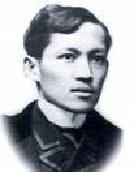
Jose Rizal, poet and patriot
The Marcos era had
begun auspicially as he brought a degree of discipline and respect for
law and order during the first few years of his Presidency. But these
improvements began to lose respect as the corruption of his family and
cronies became ever more evident. The end of the Marcos era began with
the return of Benigno Aquino on 21st August 1983. He was shot by
General Fabian Ver’s military men as he descended the steps from his
flight from Taipei. Ver’s troops had selected a small-time criminal,
Rolando Galman, to be the fall guy. Galman was also shot, possibly
beforehand, and his body was dumped on the tarmac beside that of
Aquino. Ver claimed that he had been a lone communist activist who had
amazingly penetrated the intense airport security. Those who knew
Galman doubted if a single political thought had ever passed through his
mind.
Two strange things then
happened. The military took Galman’s mother Saturnina and his sister
Marilyn into detention, and attempted to get them to support their
story. They were just simple peasant women, but they absolutely would
not lie about Rolando. The two unfortunate women were taken away by
some of Ver’s officers and were never seen or heard of again. Galman’s
girl friend who had been with him in a hotel near the airport just prior
to the assassination, had already vanished, along with her sister. Then
some weeks later when Galman, the unknown petty gunman, was buried, over
a million Filipinos turned out for his funeral thus expressing their
total disbelief in his guilt. Other characters on the periphery of
events were to die, including Rosendo Cawigan, a ‘star’ witness the
government produced, who began to contradict himself.

Benigno Aquino, murdered by Marcos’s
military on 21 August 1983
It is believed that
Imelda Marcos and General Ver planned the Aquino assassination between
them when they heard that Benigno was en route for Manila, as Marcos
himself was undergoing a blood transfusion that week for his liver
disease. A friend of the family told me that when he got back from
hospital the President threw an ashtray at Imelda, cutting her on the
head, and shouted that she had brought about their downfall, and had
‘killed them all’, or words to that effect.
Anti-Marcos resentment
and protest grew over the next three years. Marcos called an election
in 1985, and this time he was opposed by Mrs Correzon Aquino, the widow
of Benigno Aquino. She had no political skills or experience apart from
supporting her husband throughout his political life. All over the
country, the lead-up to the election was marked by public prayer
meetings large and small as the people sought an end to dictatorship,
and a peaceful transition to truly democratic government. Aquino won
the election but Marcos refused to concede. President Reagan supported
him in this stance, but the U.S. State Department eventually got him to
accept the inevitable. The country was brought to the brink of civil
war when General Ver ordered tanks onto the street, but Filipino people
came out in their thousands to block their way to Fort Bonifacio where
General Fidel Ramos, Defense Minister Juan Ponce Enrile, and other
military officers had pledged their support to Mrs Aquino.
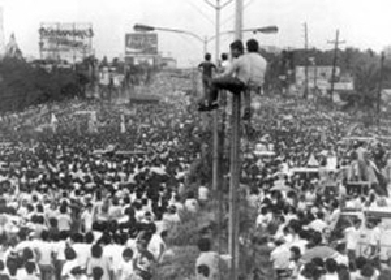
People power non-violent revolution, EDSA,
February 1986
Eventually a U.S.
helicopter took the Marcos’s from Malacanang palace to the U.S. base,
and from there they were flown to Hawaii via Guam. It is believed they
had to drug Marcos to get him on the flight as he wanted to go to his
home province of Ilican Norte from where he might mount a
counter-revolution. It is believed that Marcos and his cronies had
robbed the Philippines of billions of dollars. Some of the money was
later located in Swiss bank accounts and is presently being re-credited
to the country, but it has been a long, slow process.
Before leaving
Malacanang palace, Marcos held a hastily organised inauguration party,
and broadcast an acceptance speech over the radio, (since by this time,
television stations were closed to him). I read the speech in its
entirety and concluded that it was either a clever ploy to lay the basis
for a possible future return to power, - or else it was the incredible
naivety of a head of state who had listened to his sycophants for so
long, that he believed all their flattery and lies about the true state
of affairs. He had lost the election. He had lost the support of the
people, the military, the media, and erstwhile foreign allies like the
USA. Yet he talked over the radio as if none of that was real. He
“accepted the honour and the responsibility offered to him by the
Filipino people in free and fair elections”. “The task ahead of him the
next five years, was formidable, but he had the strength and courage to
undertake it to the best of his ability for the benefit of the nation.”
All this while Imelda was running around filling suitcases with gold and
valuables, and wads of dollar bills, political cronies were pressing for
seats on the flight to exile, and as American helicopters were warming
up outside in the palace grounds. It reminded me of Adolf Hitler in
his bunker during the last weeks of the war, moving symbols on maps and
ordering non-existent battalions and divisions to counter-attack the
allied forces on all fronts.
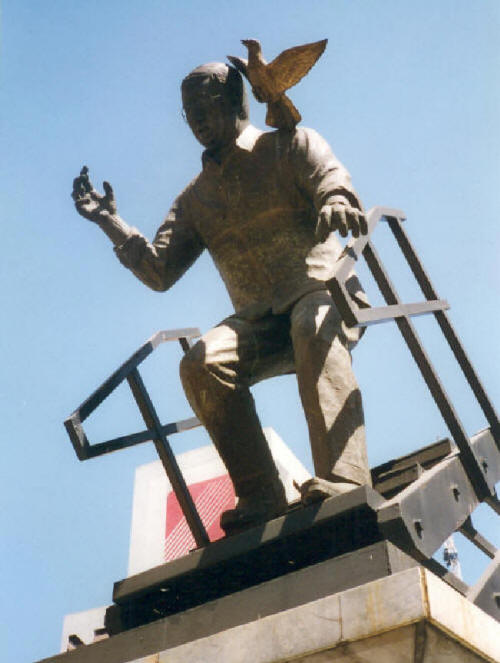
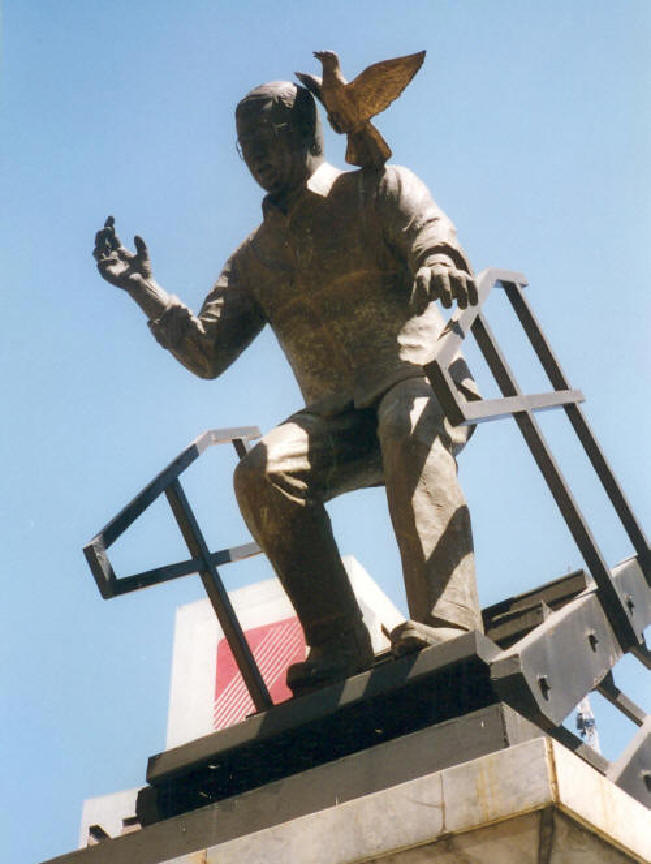
Memorial to Benigno Aquino in Ayala
Avenue, Makati, Manila. It shows him descending the steps from the
aircraft at the moment he was shot by the Marcos military.
I was in Manila shortly after Marcos’s departure. One
evening, walking along the main road, Rizal Avenue, that runs from the
south end of the seafront to Fort Intramuros and the Manila Hotel (where
General Douglas MacArthur had his headquarters during the latter part of
WW 2), two truckloads of soldiers passed by. The people on the
sidewalks stopped and broke into spontaneous applause at the site of the
troops. This was in recognition of their role in the “people’s
revolution” when they refused to carry out Ver’s orders to open fire on
the people. I have never seen soldiers feted so much anywhere else in
the world, though I guess it was so for our soldiers coming home from
war.
Corrie Aquino came to the Presidency on a wave of popular
support that many observers thought gave her the moral authority to take
some of the difficult steps the country deeply needed. Unfortunately,
she hesitated, and the country languished as a result. It is also
believed that some of her advisers (not all) gave her poor guidance.
She had to face at least one major coup attempt during her Presidency.
This was led by one of the soldiers who had been in Fort Bonaficio with
Ramos and Enrile. He was Lt. Gregoria Honasen, later a Colonel, and
afterwards a Senator. The coup attempt failed, but some Filipinos
believe that Honasen had been encouraged by the CIA and the Reagan
administration. After the coup failure, the soldiers marched out
publicly, behaving like heroes, and their leader Honasen was never
brought to court.
Mrs Aquino came into
the Presidency in such a wave of popular support, many believe she could
have pushed through the much needed agrarian and human rights reforms in
her first year in office. Initially she made a number of speeches and
pledges to that intent. But tragically she hesitated, and her
land-owning oligarchy relatives and colleagues saw their chance. Those
entrusted with justice and reforms delayed and watered down the measures
proposed. In the end the whole movement died, and along with it the
hopes of millions of Filipinos and the supporters of the “people’s power
”bloodless revolution. Several coup attempts reduced the President’s
policies to one of survival.
Aquino was followed by
Fidel Ramos, who though having some personal integrity, also protected
the establishment. He in turn was followed by a complete disaster in the
former film star, Joseph Estrada, (supported, strangely by, among
others, the powerful Iglesia de Cristo church of the Philippines). He
was later imprisoned for a period, though by all reports, he lived in
relative comfort and under a relaxed regime. Big crooks are rarely
punished properly, - only the small ones. Estrada was succeeded by a
former President’s daughter, the diminutive Gloria Magapagal Estrido
whose administration has been fraught with internal and external threats
expressed in impeachment attempts and rumours of pending military
coups. For such a lovely people it is all so sad and unjust.
What has never ceased
to surprise me is the impunity with which a small band of military
officers, police and wealthy businessmen, get involved in coup attempt
after coup attempt, over many years and through the reigns of different
Presidents, - yet still remain employed and seemingly immune to
prosecution. Names like Gregoria Hunasen and others feature regularly
in these events, plus behind them, businessmen like the Cojuangco’s.
Their arrogant behaviour and treachery would lead one to conclude that
either their loyalty belongs to another government, or they are
protected by powerful external forces.
Behind every government
in the Philippines lies the power of a handful of wealthy families.
They are extraordinarily rich, and control the major corporations in the
country, like San Miguel, Mercury Drug, and the Supermarket companies,
as well as the sugar plantations, logging businesses, and mining
companies. Outside of the country there is the interest of its former
colonial ruler, the U.S.A. which regards the land largely as it does the
South American states – part of its own ‘backyard’ and of strategic
military importance. Sadly the combination of these forces too often
results in the formation of governments that serve the interests of the
wealthy and powerful, and leave the population trapped in a stagnant
economy with little hope of improvement.
Among Estrada’s many
blunders was a macho-type military incursion into Camp Abubakar, a
Moslem centre in Mindanao. This provoked MILF the extreme Moro
liberation movement into counter-attacks and a series of kidnappings. I
have visited Mindanao several times and discussed the insurgency
problems with a number of residents.
Most Mindanao
Christians sympathise with the feelings of injustice and neglect felt by
the Moslem community. Attempts by successive governments to achieve a
military solution without counter-balancing this by genuine efforts to
address economic and social problems, are doomed to failure, and succeed
only in exacerbating the problem. President Ramos developed fairly good
relations with the Mindanao Moslems during his tenure, but this good
work was undone by his successors. As Jose Rizal often observed, the
Filipinos are sometimes their own worst enemies, and the fiercest
opponents of their own true patriots.
To give an example of
how things really are in the interface between Moslem and Christian
communities, let me relate an account of a school near Zamboanga, run by
a group of Carmelite nuns. The school has both Moslem and Catholic
pupils. Occasionally the MILF exercises in the area, but they are
always careful to inform the nuns, - not that they would be hurt in any
way by MILF forces, but they might get caught in crossfire if national
troops attacked as was likely. This happened on a particular occasion.
One of the nuns, sister Filomena, was respectfully warned to get to a
safe place. An MILF soldier was to guide her. Imagine her surprise to
discover that the young soldier was one of her own students. She was
taken to a safe resort till the hostilities were over, then escorted
back to her school and convent.
This kind of story I
have heard recounted in a number of forms. All the Filipinos I know who
have direct dealings with the Moslem community speak of them with
sympathy and respect. That is not to ignore the atrocities that have
taken place, but to explain that the Mindanao Moslem issue needs to be
looked at in the wider context.
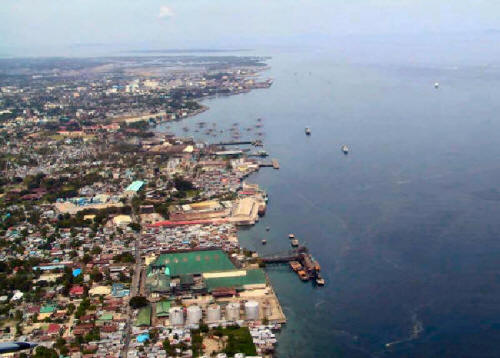
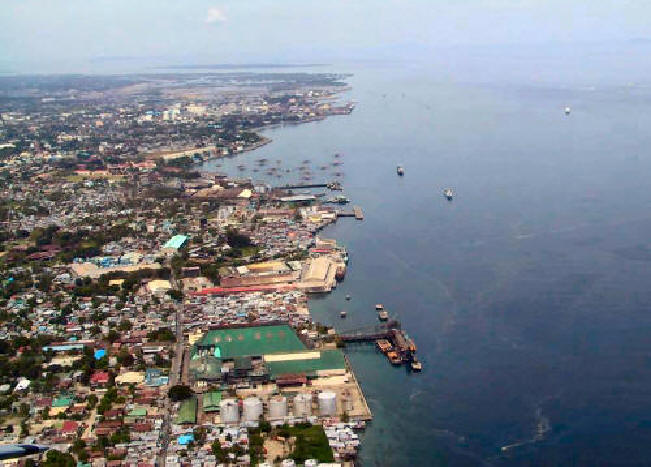
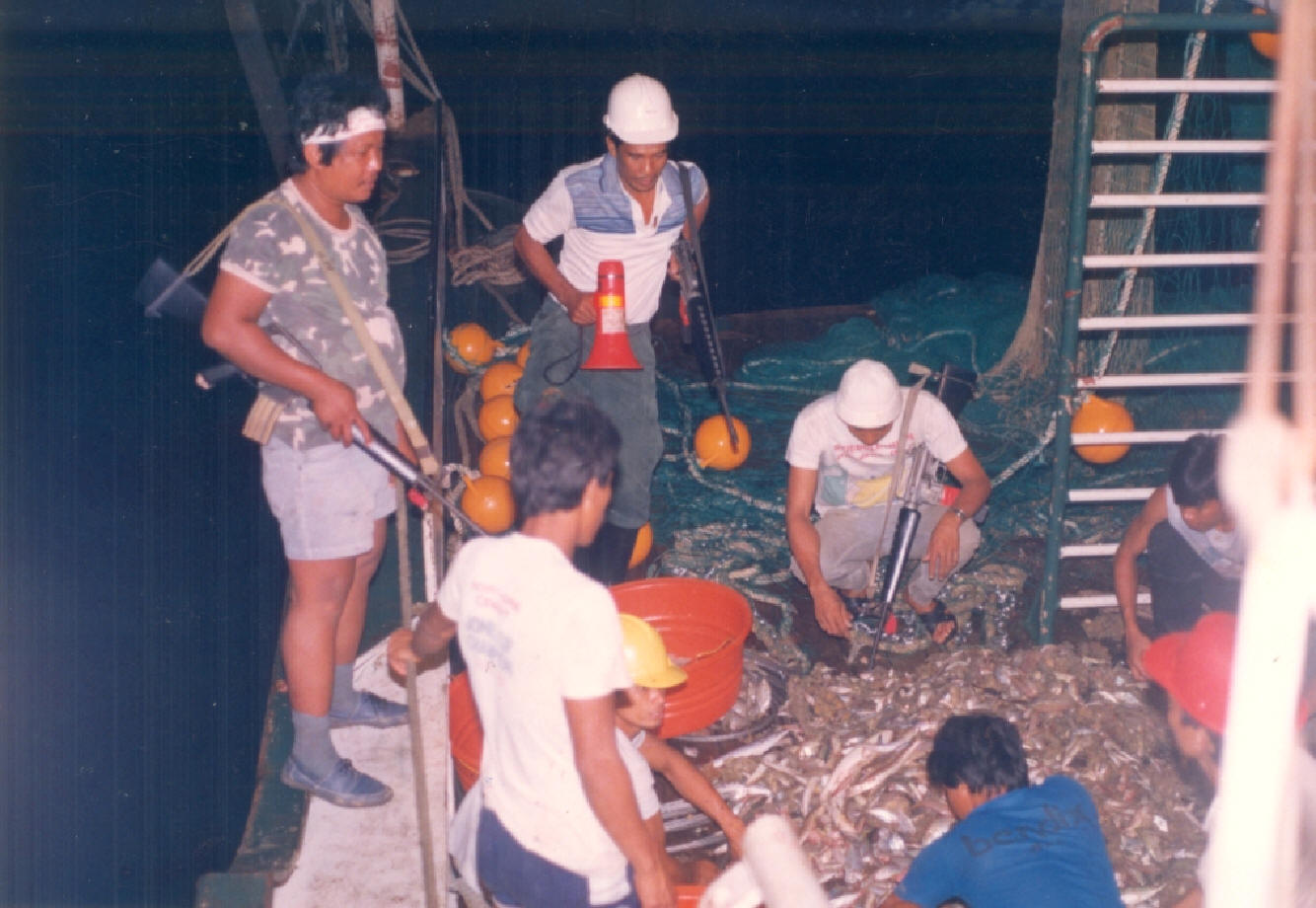
Zamboanga, SW Mindanao
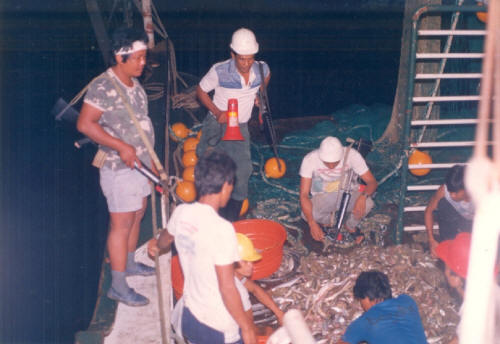
Aboard one of or training vessels fishing
off Zamboanga. The instructors and officers had to be equipped with
firearms owing to the very real risk of attacks by the MLF.
In his lifetime,
Benigno Aquino was often to call for reconciliation, and a sane end to
the internal conflicts in the Philippines.
The blood-letting must stop ! This madness must cease !
think it can be stopped if all Filipinos can get together as
true brothers and sisters, and search for a healing solution,
in a genuine spirit of give and take. We must transcend our
petty selves, forget our hurts and bitterness, cast aside thoughts
of revenge, and let sanity, reason, and above all, love to country
prevail during our gravest hours.
Close on a century before Aquino’s death, another Filipino martyr penned
‘Mi Ultimo Adios’ his farewell to his native land:
Farewell, beloved land, region of the sun
caressed,
Pearl of the Orient Sea, our Eden lost,
Gladly I give you my life, sad and repressed;
Were it more brilliant, more fresh, more pure,
I would more gladly yield it for your good.
Pray for all others who died,
Who endured and suffered, and
For our mothers who shed tears,
For the orphaned, widowed and imprisoned,
That we might know redemption.
My native land for which I pine,
Dear Philippines hear my last goodbye;
I leave you, parents, loved ones, all;
To go where are no tyrants, slaves or
executioners;
Where faith lives on and God reigns all supreme.
Jose Rizal [Jose
Rizal, doctor, poet and patriot, born at Laguna 1861, died by execution
in Manila, 1896.] Farewell to
my Native Land (selected lines, translated from the Spanish). |