|
The east was old and feeble; the west was
young and strong.
Life turned from the east, and pushed its immortal fortunes on the
banks of the Tiber. … This was the heroic stuff of which the best
Romans were made: A man’s word was his
bond.
Fear was regarded
with contempt. All pain could be endured. Death was better than
dishonour.
The rise of Europe was an ascension of
the human spirit from depravity
toward moral
grandeur.
The noble Romans carried in their souls the
fortunes of the human race.
The Rise of
Europe Arthur Mee’s Children’s Encyclopaedia
The first tender manifestations of
the spiritual
force called
the Renaissance,
the awakening of art after its long sleep, occurred in Tuscany, in the
little town called
Siena.
A great sense of beauty lay behind the movement, as mysterious as beauty
always is. It was something intensely airy and alive, and it captured
men’s hearts and found expression in art and architecture. The artists
were influenced by new ideas.
Dante
had just written his allegory, and
Saint Francis of Assisi
was going about in that region, preaching and teaching. The Florentine
school of art followed that of Siena, producing some wonderful artists.
Among them were two giants of the Renaissance, - Leonardo
da Vinci
and Michael Angelo.
The Wonder Men of
Florence Arthur Mee’s Children’s Encyclopaedia
The legacy of Europe’s
peoples to the rest of the world is incalculable. Their creativity,
endeavour and inspiration in literature, faith, music, art, science,
architecture, philosophy and exploration has been the basis of much of
modern civilization. Following the rise and fall of past empires of
Egypt, Babylon, China, Persia, Greece and Rome, European culture
achieved global eminence for most of the past millennium. My first
impressions of the glory of the European states came from Arthur Mee’s
Children’s
Encyclopaedia
which I loved to peruse.
Beginning in northern
Italy at the start of the Renaissance, and spreading later into the
Netherlands, France, Spain and other European states, scores of
brilliant, gifted, dedicated artists appeared, seemingly out of
nowhere. Duccio de Buoninsegna was one of the first to break out of the
old Gothic mould of the heavy Romanesque movement. Then followed
Giotto, Orcagna, and later, Fra Angelico, Gozzoli and Botticelli, - just
names to us today, but all instruments of the remarkable art movement
culminating in da Vinci and Michelangelo. From the Germanic states came
Durer and the two Holbeins. The Dutch and Flemish schools followed later
with men like the great Rubens, Hals, Jordaens, Van Dyck, and the
renowned Rembrandt. In the 17th century Spain produced
artists of the calibre of Velasquez and Murillo. So Renaissance art
spread.
In exploration, the
Italian states, France, Spain, Portugal and Holland, led the way from
the time of Marco Polo in the 13th and 14th
centuries, with a golden age of sea voyages and discovery from the late
15th to early 16th century. Six renowned
navigators of that period were Giovanni Caboto (Jean Cabot), Bartholomew
Diaz, Christopher Columbus (Cristobal Colon), Vasco da Gama, Ferdinand
Magellan, and Jacques Cartier. With the exception of Cartier who lived
to 66, they all died relatively young, - the average age of the first
five was just 49 years. Their voyages covered the Atlantic and Indian
Oceans and in Magellan’s case his ship circumnavigated the world before
Drake’s. Abel Tasman followed in their steps exploring the southern
seas in the 17th century. From my youth, the exploits of
those pioneers fired my imagination and expanded my interest in foreign
lands and oceans. Much of my information came from Harold Wheeler’s
compilation of marine lore in the volume, The Wonderful Story of the
Sea. A favourite chapter was, In the Wake of Navigators.
Behind those
explorations lay the lust for power and empire by Europe’s rulers, and
the greed for wealth by its merchants. Kirkpatrick Sale concluded that
Columbus began the long process by which 120 million indigenous American
Indians were effectively destroyed, and much of their culture
annihilated. The wealth of their two continents, - gold, silver,
pearls, timber, fish, tobacco, potatoes, corn, medicines, and much else,
were discovered, exploited and exported. In addition, much of the land
was to be laid waste. European institutions and economies came to
dominate all countries of every land or longitude. This most successful
domination by any civilization in the history of humanity, led to the
most successful domination by any single species in the history of life.
[K.Sale,
The Columbian Legacy and the Ecosterian Response, in People, Land
and Community, Yale Univ. Press.]
But the subsequent
exploitation does not detract from the bravery, skill and determination
of the navigators. It is interesting to bear in mind what motivated
much of the expansion of trade. It was not a vital necessity for the
home countries, nor was the exchange of goods arranged out of any desire
to bring development or civilization to the new lands. Global trade
began strangely, out of a demand for luxuries such as spices, silks,
purple cloth, ivory, precious stones, gold and silver. Much of global
trade today continues that tradition. Some commodities such as
petroleum, electrical and electronic goods, vehicles and machinery, have
become necessities for poorer developing regions, as certain foodstuffs
and raw materials are for us; but I fail to see how nuclear power,
luxury automobiles, Rolex watches, digital cameras, western music,
Hollywood movies, Coca Cola, hamburgers, or brand name clothes and shoes
are really that important. But glittering toys of global capitalism are
difficult to resist for those who have acquired some disposable income.
In the science of
astronomy, there were remarkable discoveries in the 16th and
17th centuries beginning with Nicolaus Copernicus of Poland,
who was followed by Johannes Kepler in Germany, and the great Galileo
Galilie in Italy. Having both a romantic and a professional interest in
astronomy, I was delighted to meet a modern galactic astronomer from
Italy who was working on the Hubble space telescope project in
Maryland. It happened on a flight from Johannesburg to London in the
1994 when we were fortuitously sat together. An attractive young
Italian scientist, her name was Daniela Calzetti. After brief
introductions, I took the opportunity to ask her about her work and
profession, and she kindly gave me an amazing two hour panorama of the
universe and its galaxies, stars, black holes, quasars, pulsars, comets,
planets, moons and asteroids, and the energy systems that permeate the
boundless vistas of space and maintain the whole in seeming harmony and
equilibrium. I recall the impromptu lecture with pleasure to this day.
A final comment by Miss
Calzetti left me with food for thought. “Do you know that you are
made of stardust?” How is that I asked. “The human frame is
made up mostly of carbon atoms,” she responded. “The only place
in the universe where carbon can be created is in the intense heat of a
burning star. Carbon dust is star-dust”.
The Italian states
produced many religious scholars and pioneers of faith, as did France,
Spain, Portugal, Holland, Switzerland and Germany. Five notable
men of faith
were (in chronological order), Bernard of Clairvaux, Francis of Assisi,
Thomas Aquinas, Dante Alighieri, and Thomas A’Kempis. Reformation
scholars began their work in the 16th century, building on
the labours of scripture translators and anabaptists. Desiderius
Erasmus laid the ground for Martin Luther, with men like
John Calvin,
building the new theological frameworks. A post-reformation revival of
spirituality in the Roman church was marked by the work of men such as
Ignatius Loyola and Francis Xavier in the 16th century, and
Blaise Pascal in the 17th. Subsequent centuries saw further
movements in faith and theology. Count von Zinzendorf founded the
Moravian church in the 18th century, and the 19th
and 20th centuries brought Christian scholars like Soren
Kirkegaard, Karl Barth and Dietrich Bonhoeffer to prominence. The lives
and writings of all of these have enriched my own understanding, as
heavy as some of their works are in places.
In music also, Europe’s
legacy is awe-inspiring and invaluable. I love music of all kinds but
as I was not blessed with a musical ear or any latent talent in that
area, I will not say much about that glorious art form other than to
acknowledge its importance. But Europe has also suffered much. It has
experienced earthquakes, landslides, famine, pestilence, disease,
economic hardship and social distress. But worst of all have been its
wars and invasions, civil conflicts and slaughters. It is probably
those experiences in the historical memory of the people that makes most
European states desire the stability and protection they believe will
come from membership of a United States of Europe.
The folly and insanity
of Europe’s wars was well expressed by the poet Robert Southey in his
poem “After Blenheim”. Some verses read :
With fire and sword the
country round was wasted far and wide,
And many a childing mother then, and newborn baby died;
But things like that, you know, must be, at every famous victory.
They say it was a
shocking site, after the field was won;
For many thousand bodies here, lay rotting in the sun;
But things like that, you know, must be, after a famous victory.
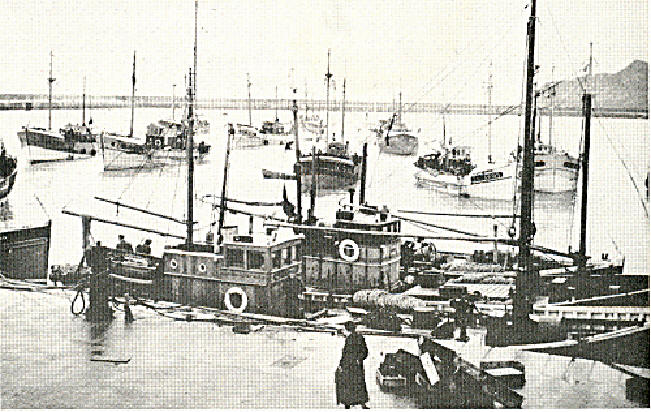
My direct experience of
European people and culture, began at a basic level with odd sorties to
French trawlers when they were berthed in ports in the Republic of
Ireland. An Irish deckhand, Joe Glynn used to ask me to join him on
those visits. I thought that with my schoolboy French I might help him
to communicate, but he had no problems in that area. His language
skills were limited to, “vin rouge, - vin blanc, - and - cognac”,
and once the ice was broken, and the glasses offered, he preferred to
stick to cognac ! The French fishers were mostly from the Breton
ports, and probably of Celtic origin like the Irish. They were humble
down-to-earth men, much like our own seafarers.
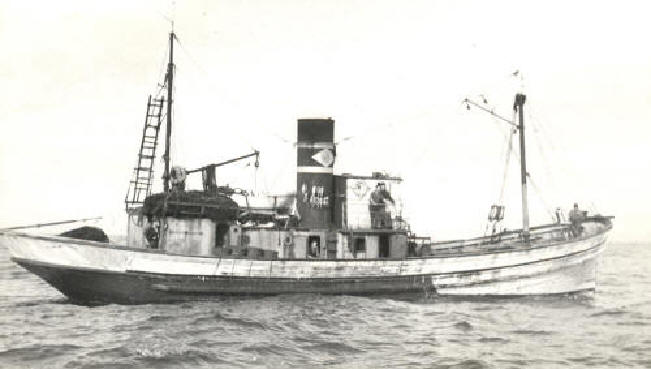
Spanish trawlers also
were often in southern and western Irish ports during bad weather or
breakdowns. They fished mostly for hake in deep waters off the west
coast, using a two-boat “pareja” system. The men were mostly
small and poor, - their working clothes covered in patches. (This was
around 1950). On entering our boat’s mahogany-lined cabin they would
blow kisses in the air in admiration. Looking around at the crew, they
would point to the most corpulent figure and say – “Capitan !”,
then pointing to the next heaviest person, they would say, “cookee
!”, to the amusement of all. (They were often correct in their
humorous assumptions). They had no love for General Franco, the
mention of whose name they would treat with a hiss and a throat-cutting
gesture with the hand. One injured sailor joined my father’s boat for a
few weeks after his release from hospital, while awaiting the return of
his own ship. Ricardo Diaz was a sincere and gentle soul, and most
appreciative of the kindness shown to him.
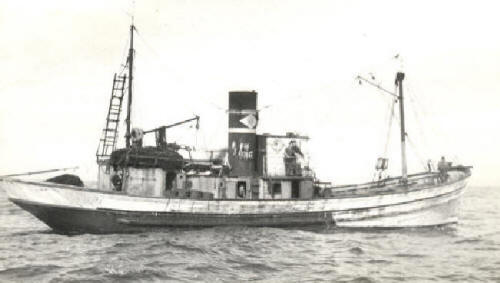
My first encounter with Europeans:
Spanish ‘pareja’ hake fishermen off the SW of Ireland in the early
1950’s
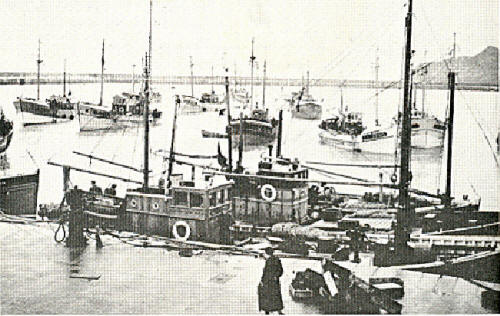
French trawlers in Howth, Ireland, during
the great gale of 1953.
Years later I was to
visit much of Europe, and to work for extended periods in Italy in the
1980’s and in Austria during the early 1990’s. I spent shorter periods
in Scandinavia which is not part of Europe; specifically Norway, the
Faeroe Isles, Denmark and Iceland. It was also a pleasure to work with
a number of Scandinavian colleagues in the United Nations Agencies where
they are well represented and where their countries have made
outstanding contributions over the past 50 years.
I first visited Italy
in 1966 to undertake a brief assignment for the UN Food and Agriculture
Organisation Fisheries Department at the request of Hilmar Kristjonsson,
who was then the organisation’s chief technical fisheries officer.
Hilmar was an amazing character in many ways. He had an encyclopedic
mind and could quote facts and figures from memory, on almost every
fishery in the world having visited practically every country apart
from mainland China. Sadly he suffered from alcohol addiction in his
later years, and was to die before he reached sixty. But for all of us
who knew him in his prime, he was the most outstanding fishery
technologist of the 20th century. His name lives on in the
Fishing Gear of the World volumes he edited in an attempt to chronicle
all the major methods and equipment used in fish capture in the three
decades after the end of the second world war.
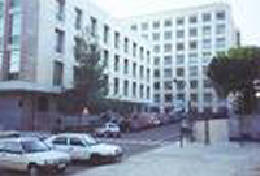
The headquarters of the UN Food
and Agriculture Organisation in Rome, Italy.
I was employed by FAO a number of years, in SE Asia, Africa, and Italy.
FAO Logo
Below: with Dr
Joaquin Cortez at an international FAO conference
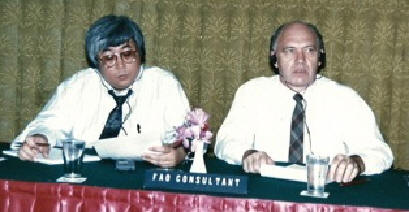
I was to work
occasionally in Rome for varying periods, over the next 30 years. The
first visit was probably the most memorable. I stayed at the San
Anselmo Pensione, (now a hotel), on the Aventino between the Tiber and
the Pyramide. Walking down the cobbled street the first morning, I was
attracted by the graffiti on the walls on either side : “Vota
Communista” on one side, and “Viva il Duce” on the other.
Italy’s cafés and restaurants were an experience in themselves. What
splendid food. What a relaxed atmosphere in which to eat. What coffee,
and what wine. And those crisp fresh rosetti rolls that Rome is famous
for, - what a breakfast they made, with fresh butter and jam, and heaps
of café latte with loads of hot milk.
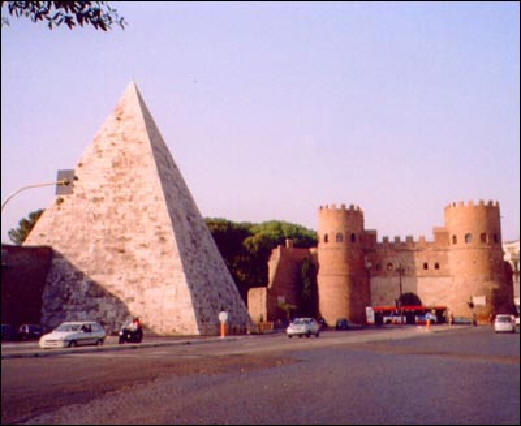
Near the Aventino, and the San Anselmo,
the Pyramide monument
The manager and owner
of the San Anselmo showed me much kindness. He invited me to join him
one evening to attend an international boxing title fight at the Sports
Palace in EUR. The main contestants were Nino Benvenito, the
middleweight champion of the world at that time, and the challenger Luis
Rodriguez. Benvenito being Italian, was the home favourite. Rodriguez
was managed by Angelo Dundee who also trained Muhammed Ali. My
recollection is that Benvenito won by a knock-out in the 11th
round, but it was the whole spectacle that was memorable. All the
razzmatazz, the animated spectators, and the physical speed and prowess
of those young prizefighters who were trained to the peak for that
particular sport, - combined to create the atmosphere and excitement of
the evening.
In my youth I loved to
watch live boxing contests on television. Before television was common,
we would gather around the radio to listen to fight commentaries by
Raymond Glendenning or Eamonn Andrews. When black and white television
arrived in our house I was even more captivated. British boxers I
enjoyed watching included Henry Cooper, Dave Charnley, Terry Downes,
John ‘Cowboy’ McCormack, and Billy Walker. Walker was at his best as an
amateur. He was the heavyweight in a famous team of ten British boxers
that beat an American golden gloves team in London 10 – 0 to everyone’s
surprise. But strangely, though several of that team of amateurs (like
Walker) turned professional, - not one of them won a title. So then I
enjoyed the sport. But not now. Either I am getting old, or else the
sport has gone far downhill since the fifties and sixties. Later I was
to meet a few former champions including Ken Buchanan [One
of Buchanan’s sparring partners at the Sparta club in Edinburgh, boxer
Jimmy McCarron, became a dear friend of mine during my years in that
city. He worked hard through our church to help young people and
unemployed men in the area. His wife and four daughters were also
marvellous workers for the fellowship.],
Alan Minter and Rocky Graziano. My brother James actually arrested (or
rather, cautioned) Muhammed Ali. He was a Metropolitan policeman on the
Westminster beat when he received a call that someone was holding a
public meeting in Trafalgar Square without permission. James went along
to find a tall, handsome negro holding forth to an eager audience. He
halted the proceedings and informed the boxer that he could speak at
Hyde Park without prior notice, but not in the Square. The former
Cassius Clay was most courteous and accommodating in complying with the
instruction.
My meeting with Rocky
Graziano was in Rhode Island where he was naturally popular with the
Italian community. He occasionally showed up to help Italian
businessmen to sell cars or fill their restaurants. Not to be confused
with the heavyweight Rocky Marciano, Graziano was a welterweight cum
middleweight who had some epic battles with Tony Zale. Some claim that
Graziano had been involved in criminal activities and should have gone
to jail. However, he did not, and lived to enjoy his earnings and die
with some respect. That may have been on his mind when he wrote a
biography titled “Somebody up there loves me”. Paul Newman
acted his part in a Hollywood film based on the book.
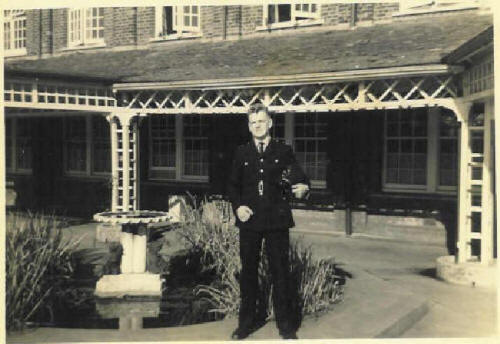
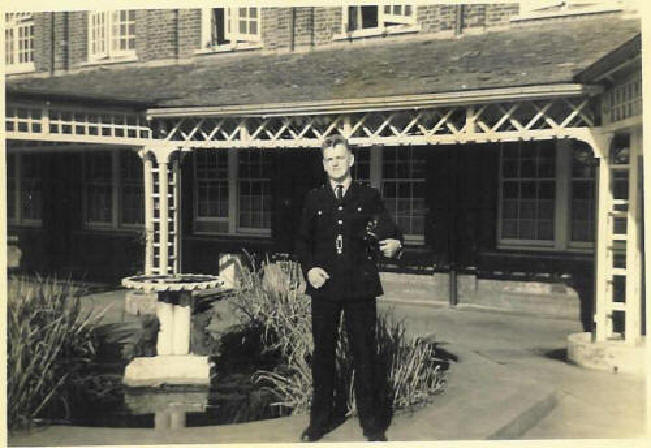
My brother James when a
Metropolitan policemen. On one occasion he had to caution and remove
Muhammed Ali (Cassius Clay) from Trafalgar Square where the boxer was
conducting a public meeting without permission.
Another tale from my
days at the San Anselmo, provides a bit of the flavour of Italy on a
summer holiday. On 15th August at the end of the hot summer
months, there is the Roman holiday of Farragosto. Manager Petroni told
me that no-one stayed around the city on that day, and I should also go
off somewhere. I am a poor tourist despite my travels, but agreed to
his suggestion. He arranged for me to take a trip to Naples and Capri
with a local tourist company. The bus duly collected me early the
Monday morning, and off we went down the road to Naples past Monte
Cassino, the monastery that was a scene of fierce fighting during the
war. Our guide stood at the front of the bus before we arrived there
and said, “Good morning. My name is Gepetto and I am your guide. See
how I wear a very funny hat. That is for a good reason. In Naples there
will be very many peoples. You follow Gepetto, and keep watching for my
funny hat. We get onto a boat and go to Capri and have a good time”.
The bus arrived at Naples harbour where it ploughed into a sea of
humanity. Our guide stepped out first and disappeared into the enormous
crowd. That was the last I ever saw of Gepetto and his funny hat.
I was swept along the
pier by the throng, at times almost lifted off my feet. We arrived at
the place where a fleet of tourist boats were moored. The operators had
long since given up on careful checks of the passengers. As soon as a
full complement was deemed to have stepped on board, the skipper went
ahead to drive the boat away from the pier while the main mooring rope
remained attached. One distraught Italian mother who had been
chaperoning her daughter and the girl’s boyfriend, was stranded on the
pier while the boy and girl made it on board. How that poor woman
screamed and shouted to the skipper, - how she cried and pleaded with
her daughter. She perspired and got so flushed, the steam was literally
rising from her forehead. But it was all in vain. The boat left
without her, taking the courting couple off on a trip free of maternal
supervision.
I also landed on a
boat, but not the correct one for my tour ticket. However, no one
seemed to mind, and in Capri another tour group kindly took me with
their party to the blue grotto and other sites on that lovely isle. I
got friendly with the second tour guide, a young woman from Peru whose
father had been head of the Salvation Army there and had done a lot of
famine relief work. I also got to know her Italian boyfriend, a less
than full member of a titled family due to some anomaly I now forget. I
was to spend some evenings with them later in Rome, including a
memorable open-air dinner and musical evening in the
Tresteveri part of the old city. The second tour group kindly brought
me back to my hotel. How they sorted the payment out with the first
group I have no idea, but the Italians have ways of fixing these
things. On the road back I recall that the restaurant where that group
was meant to have dinner was full and the manager claimed to have no
record of the booking. But following a fifteen minute harangue between
him and our determined guide, we were permitted to eat. All in all it
was a most memorable day, and I was glad to have had the experience.
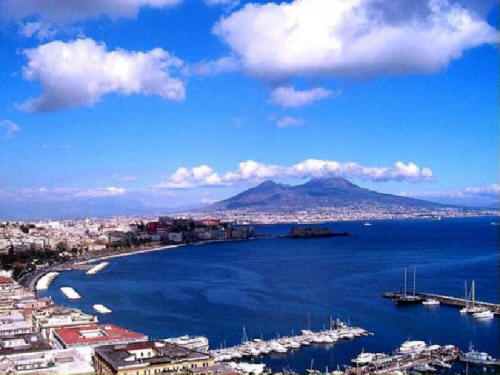
Naples - I went there and to Capri on a
memorable Roman holiday.
A colleague of mine had
a house in Castelgandolfo, by a volcanic lake, and near the summer
residence of the Pope. We would motor there some weekends and spend a
pleasant day in that scenic town. On the road back to Rome through
Frascati we would pass the memorial and initial grave of one Charles
Edward Stewart, the “Young Pretender” or Bonnie Prince Charlie as
he was called. He led the Jacobite rebellion of 1745-46 which nearly
overturned the English Government. But as the Scots have been wont to
do over the years, they snatched defeat from the jaws of victory, and
having gotten as far as Derby, with London in a panic, they began to
quarrel among themselves, and went back north. The English army
recovered its composure and followed them into Scotland, eventually
slaughtering what was left of the Scots at Culloden moor near
Inverness. Prince Charlie sailed back to France and from there he later
returned to Italy where he died a drunken alcoholic by most accounts.
Another mountain lake
we used to visit was Braziano to the north of Rome. The town
overlooking that lake is typical of the beautiful and well-preserved
medieval castle towns of Italy. Our friend Werner Kley, had a small
speedboat on the lake, which our children loved. We sometimes went
there by train which was more leisurely than driving. On one trip, a
fellow passenger who had imbibed rather much wine, took a great interest
in the family. He rushed out at one station and bought a large number
of ice cream cones which he proceeded to distribute among us. He had
over-estimated the size of the family and was left with a surplus. The
ticket collecter came in and was pressed to accept some, much against
his better judgment, by our very generous travelling companion.
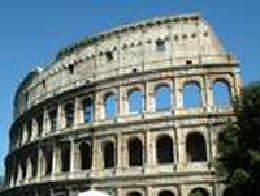
Below: The Coliseum,
perhaps the best known of Rome’s ancient buildings
“Beautiful, beautiful
Roma” was
how Charlotte Loewenthal [Mrs
Loewenthal was a Jewish lady, the wife of a Nottingham doctor, who
raised large sums for charities, including the Freedom From Hunger
Campaign. She died tragically in a car crash in 1967. I admired her
greatly, having met her twice and corresponded with her for a few years
before her death.]
described the city to me when I made my first visit there in 1966. I
have to concur with her words though Rome then also had its poorer
districts. In compensation it also had a host of small restaurants
where one could eat well for very little. But these cheap dining places
are a thing of the past, replaced now by rather unappetizing ‘pizza
rustica’ take-away shops. However, Rome had, and I guess will always
have, the largest and most magnificent range of treasures of art and
sculpture and architecture in Europe. It was my wife Margo who
introduced most of them to me in the late 1980’s when she made it her
business to guide our many house guests around the ancient churches and
temples and ruins of old Rome. At that time we rented a flat off the
Grotta Perfetta, not far from the old Appian Way, the main road that led
into Rome from the south in days gone by. The FAO Fisheries building
lay off the Cristoforo Colombo highway that linked old Rome to E.U.R.
the more modern part that was built by Mussolini as a monument to
Fascism. The main FAO headquarters building was at Terme di Caracalla,
by the Circus Maximus, and just a few hundred yards from the ruins of
the Coliseum and the Forum.
We visited the
Pantheon, the Catacombs, St. Peters, the church of San Paolo (where Paul
was beheaded), the
Coliseum and the old Forum, and the numerous old churches that housed
magnificent sculptures and paintings. Our friends were also shown some
of the more recent constructions including the Vittorio Emanuel
monument, the Spanish Steps, the Trevi Fountain, and other attractions.
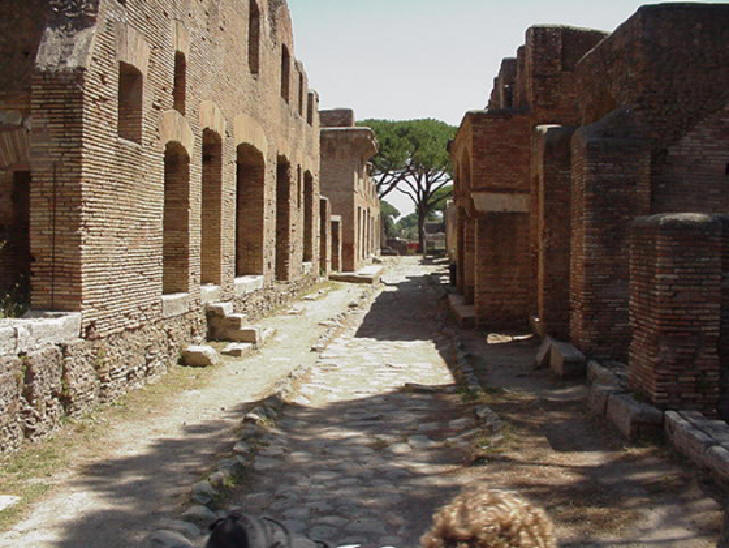
Outside of Rome by the Leonardo da Vinci airport was the old Roman port
of Ostia with wonderfully preserved streets, shops, baths and houses. We
marveled at the sculptures of Moses and David and Mary by Michelangelo,
as well as his magnificent paintings in the Cistine Chapel, along with
those of Leonardo da Vinci. Margo was particularly fond of the works of
Caravagio, one of the finest of Italy’s medieval artists.
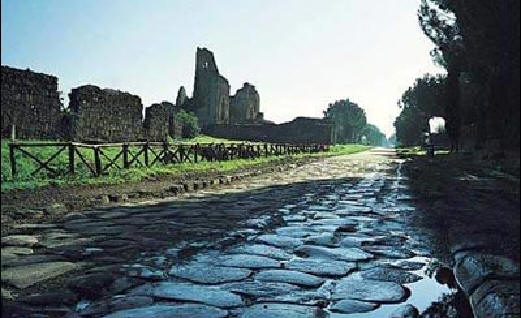
Appia Antica, the ancient road to Rome
from the south.
We had an apartment just minutes away from here.
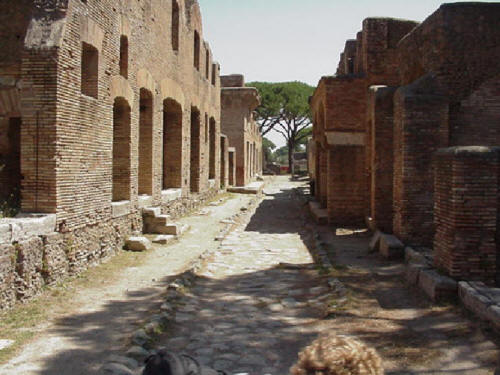
Ostia, the seaport of Rome when the
empire was at is height.
Near the Coliseum, on
via Capo d’Africa, was another favourite pensione of ours where we spent
many stays. It was run by two pleasant ladies, Mrs Khan and Mrs Musik.
A sign of their good management was that the staff hardly changed. The
leading waitress, Vera, a delightful woman with a perceptive Roman wit
that put cheeky guests in their place, was there when I first stayed in
the 1960’s, and had just retired on my last visit nearly thirty years
later. The Lancelot, in true pensione fashion, served breakfast and
dinner, though some weekends a lunch was provided if necessary. For
dinner, guests had to be in place at 7.30 pm. Woe betide the casual
diner who wandered in a half-hour late ! There was a set menu
consisting of soup or risotto, a main course, and fruit for dessert.
The tables were furnished with all the bread, mineral water, white and
red wine the guests could consume. Guests were seated, eight to a
table. Coffee was served after dinner, with, as a special treat on
Sunday evenings, a glass of
sambucca
containing a coffee bean.
It was the conversation
around those Lancelot tables that was so often fascinating. There were
UN project field workers from practically every corner of the globe. We
met visiting delegations from all member countries of FAO and IFAD, and
conference speakers on just about every subject remotely connected with
food production. There were occasional tourists who had stumbled upon
the hotel, and once there was a young newly-wed Irish couple who had for
their own reasons, opted to have their service in Rome, and their
wedding feast in the Lancelot, without an Irish friend or relative
present. The bride sat there in her wedding attire, totally
unembarrassed at celebrating her nuptials in a public dining room. I
could not resist presenting them with some Scottish souvenirs and
wishing them every happiness, in an attempt to add a touch of festivity
to the occasion. The staff provided the couple with a bottle of
champagne at management suggestion.
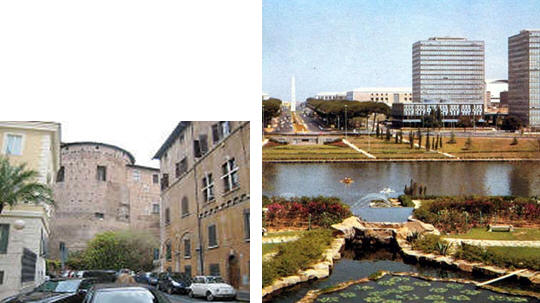
Via Capo’d’Africa where I
often stayed EUR, modern part of south Rome built by
Mussolini
at the Lancelot Pensione The FAO Fisheries
building was located here in 1966
An amusing encounter
with European Members of Parliament, occurred when FAO was asked to
receive a large delegation from Strasbourg who had some questions about
fisheries and about food aid. Director Kojima of Fisheries Operations
asked Serge Garcia, Director of Resources, and myself, to meet with the
group and respond to their enquiries. We waited in the meeting room a
full 2 hours before they showed up. The MEPs had been given lunch by
the World Food Program, and it had taken longer than planned. By their
flushed appearance and glassy eyes, it looked like some of them had been
liberally wined as well. The group of over two dozen filed in and took
their seats. Mr Kojima welcomed them and their spokesman responded. He
thanked us for the welcome and then apologised that as they had spent
too long with the WFP, most of them had now to leave for Leonardo da
Vinci airport at Fumicino. With that they got up and departed, leaving
the Director rather dumbfounded.
Two MEPS from England
remained, (I will not name them!). The senior one, a Tory, who was
accompanied by his wife, was appointed spokesman. He then asked how we
should begin. Kojima responded, “perhaps we can begin by answering
your questions.” “What questions?” the MEP asked. “The
questions in your e-mail to us” responded Kojima. “What e-mail
?” replied the MEP. Kojima then read the communication to them.
One of the questions related to fish stocks off the Falklands (or
Malvinas). Garcia started to list the species, beginning with squid.
“Squid?”, exclaimed the second MEP (who had just been deselected by
his Labour constituency). “What do they taste like? I’ve never
eaten them.” My recollection is that the discussions continued
even farther downhill from then on. Afterwards I apologised to Dr Garcia
for the calibre of the English MEPs. “It’s all right”, he
responded. “We have MPs like that in France also”.
When I first visited
Italy, Italian government was synonymous with instability, short term
ministries, uneasy coalitions, and ineffective rule. Public life was
later afflicted with extreme violence, as perpetrated by the marxist Red
Brigade, and brutal murder of any politician or judge that stood up
against the Mafia, that huge network of organized crime and callous
domination of businesses, centred mainly in Sicily and Palermo at the
southern end of the country. Some remarkably brave individuals like
Antonino Caponnetto, stood up to the evil empire and some paid for their
integrity with their lives.
The Mafia or Cosa
Nostra, have of course been around for generations, but it is
believed that the USA laid the basis for their rejuvenation by employing
gangster Lucky Luciano to help prepare for the allied landings in Sicily
in 1943. Luciano lost no time in involving two notorious colleagues,
Michele Sindona, and Gaetano Badalamenti, who were later to figure
prominently in Mafia activity. Once Sicily was liberated, Mafioso
characters were installed as mayors in many of its towns.
Apparently the Allies thought this much better than having
communist-leaning officials hold office.
In 1983, the Mafia
murdered Rocco Chinnici, then head of the office in Sicily that was
investigating organized crime. In 1992, they assassinated two
magistrates, Giovanni Falcone, and Paolo Borsellino. Some of their
bodyguards and family members were also killed in the brutal bombings.
Despite the terror, a few courageous prosecutors continued to hunt down
the criminals. Among the crime fighters was Anna Maria Palma, a tough
prosecutor with a combative spirit. As a result of her efforts and the
support of a growing number of brave officials, several mafia bosses
were eventually tried, convicted and jailed.
Mafia violence was
paralleled for a period by that of the Red Brigade or Brigate Rossi,
who murdered Fulvio Croce, a leading Milan lawyer in 1977, and then
a former Prime Minister, Aldo Moro in 1978. The Red Brigade went on to
kill Emilio Alessandrini, a young prosecutor in 1979. Other lawyers
murdered included Giorgio Ambrosoli and Guido Galli. The list is
depressing, and even sadder was the public cowardice shown at the time.
Many politicians would not even attend the funerals of assassinated
prosecutors. Fortunately, the Brigate Rossi is no longer around, but
the Mafia continues to flourish.
|
Aldo Moro and
Italian politics
The Aldo Moro /
Red Brigade events give us a glimpse into the sinister and murky
world of Italian crime, corruption, and politics. As with other
national scandals in that lovely land, one finds a Byzantine
trail of collusion between, and manipulation by, Italian
politicians, underworld Mafia figures, P2 Masonic Lodge groups,
and Marxist terrorists; - with interference from outside by
powerful entities like NATO and the CIA.
Aldo Moro, a
leader of the Christian Democrats, one of Italy’s longest
serving Prime Ministers, had also held the posts of Minister of
Foreign Affairs, Minister of the Interior, Minister of
Education, and Minister of Justice. He was highly respected for
his intellect and his diplomatic patience. Early in his career
he helped draft Italy’s post-war constitution. He had a
strategic vision of a Compromesso Storico (historic
compromise), of a unity government that would bring together
elements of the centre, left, and rightist, parties in Italy.
This was opposed by Kissinger who (according to Moro’s widow),
warned him, “you must abandon your
policy of bringing all the political forces in your country into
direct collaboration, … or you will pay dearly for it”.
The Red Brigade
kidnapped him in March 1978, hoping to exchange him for some
terrorists held in prison. From the beginning the police and
judicial authorities appeared to bungle efforts to locate him
and secure his release. They also laid false trails and raided
houses, in apparent attempts to pressure the Red Brigade to
act. The Prime Minister, Giulio Andreotti, and some of his
inner circle insisted on sticking to a hard line of no
negotiations with the Red Guard despite pleas from Moro’s family
and from Pope Paul VI, and despite suggestions from Moro in
letters from his prison that were delivered by the Red Brigade.
Some observers speculated that Andreotti and his supporters saw
an opportunity to get rid of a powerful competitor within the
Christian Democrat Party.
Aldo Moro was
killed on the 9th of May, 1978. Following his death
there were seemingly endless speculations about his kidnap and
murder, with suggestions that the Italian Masonic Lodge, P2, was
involved, or elements in Nato’s Gladio network, the Mafia, or
the CIA.
In a bizarre
twist, it was Romano Prodi who directed authorities to a house
where Moro may have been held. Prodi claimed that elder
Christian Democrat figures gave him the information following a
séance, and use of a Ouija board ! Some Italian members of the
European Commission claimed that he had made up that story to
conceal the real source of the tip-off. Romano Prodi served as
President of the European Commission from 1999 till 2004.
Giulio Andreotti
was known to have had close links to the Mafia until 1980. He
was investigated for this but the charges were never proven.
However, he was found guilty in 2002 of complicity in the 1979
murder of news reporter Mino Pecorelli who had published
allegations about his ties to the Mafia. He was sentenced to 24
years in prison but the following year, 2003, the Supreme Court
quashed that verdict and the sentence was not carried out.
|
I had my own brush with
criminals in February 1989 when entering a branch of Banca Commerciale
Italiano that was located inside a UN FAO building on the Via Cristoforo
Colombo. I stepped into the small bank and took a queue number ticket
from a system just installed. Looking at those ahead of me in the line
along the wall, I noticed they each were holding their hands up and
looking straight ahead. Only then did I see the hoodlum with a broken
nose and balaclava, holding a large pistol to the head of one of the
cashiers. His two accomplices were filling black plastic trash bags
with bundles of Lire notes. This was inside a building that had
security guards at every entrance ! The gang took their time, and
showed neither fear nor nervousness. Eventually they sauntered out and
returned to their vehicle through the front door. Some surmised later
that they had some help from the inside, possibly from one or more of
the security staff, but I’m not sure. One sharp-eyed secretary had
noticed what was happening. Unfortunately she ran to tell the main door
guard and was made to sit beside him by another gang member who was
holding the guard at gunpoint inside the foyer where his gun would not
have been visible to people entering and leaving.
A number of Brits and Americans had settled in Rome, and I
came to know a few. One elderly man from the USA who attended our
church was “Red” Faulkner, a nephew of the novelist William Faulkner who
died in 1962. The writer once stayed a few weeks with his nephew in
Rome. According to “Red”, he hardly spoke two words the whole time he
was there. Some writers can be like that.
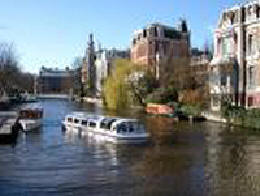
Amsterdam, where my
wife and I spent our brief honeymoon.
In addition to the
periods spent in Italy, I visited France, Spain, Portugal, Holland,
Germany, Belgium and Denmark. Margo and I had a brief honeymoon in
Amsterdam where we stayed in the old American hotel. We returned many
years later to find that magnificent hotel thoroughly modernized, and
its beautiful suites made into a larger number of tiny rooms to
accommodate more guests. We spent a romantic few days on the canals and
visiting Delft and the Hague. On our second visit we saw Anne Frank’s
house. I had read the book but could not bring myself to watch the
film. To this day it pains me how anyone could have betrayed that
innocent young girl who died so tragically in Belsen
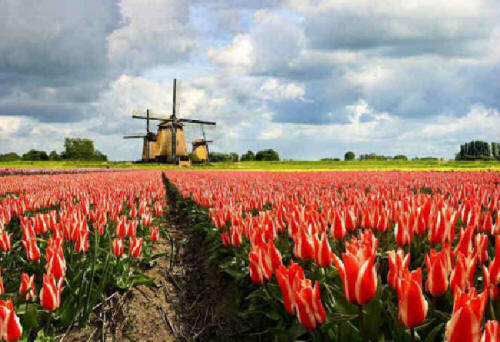
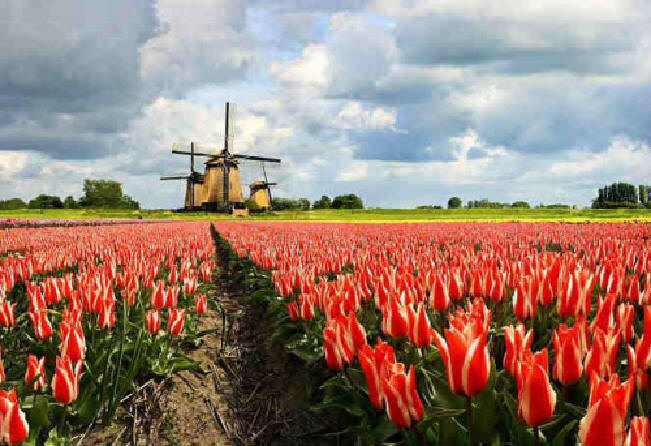
Tulip fields near the
Hague, Netherlands.
Spain has happy
memories of family holidays when we swapped houses with dear Spanish
friends. That was in Denia on the Mediterranean coast. Our friends
included my former research vessel engineer, Jose Sansaloni, and his
lovely wife Maria del Carmen, and Jose’s sister’s family, the Garcia’s.
Rita Garcia had spent a summer with us as a young teenager then gaining
fluency in English. She is now a medical doctor. Needless to say, we
got by far the better piece of that arrangement! Later we also spent a
holiday in Tenerife.
My work took me
occasionally to France, Germany, Belgium and Denmark where there was
little time for sight-seeing, but in each country I was well received by
colleagues and contacts. In France I visited a fish merchant friend at
Granville near Mont San Michelle. He had a beautiful house built in the
style of an old Norman manor villa, with a huge central room and an
inner balcony overlooking it, from which the upper bedrooms were
accessed. Even more memorable than his house was the seafood he served,
mainly shellfish, which were prepared as only the French can cook them.
Two other countries I
spent time in are probably my favourite parts of Europe. They are
Switzerland and Austria. Both are blessed with magnificent scenery and
a well-ordered society. In both countries, the streets are clean,
trains run on time, and there is an apparent absence of crime and
graffiti.
Critics say that both societies can be rather dull and humourless, but
that was not my experience.
Our memories of
Switzerland stem from a convention at Interlaken which I attended with
the family one summer. The younger kids stayed at a youth camp in
Grundevald, near to the glacier. The rest of us rented a self-catering
apartment in Interlaken. As our eldest daughter said, it was “like
living inside a picture postcard”. You could point your camera in
any direction and still get a splendid result. The whole experience was
delightful, from the funicular railway to the mountain chalets, to the
small but high quality restaurants. One can understand why men of
wealth settle there, - even if there were no tax-free benefits!
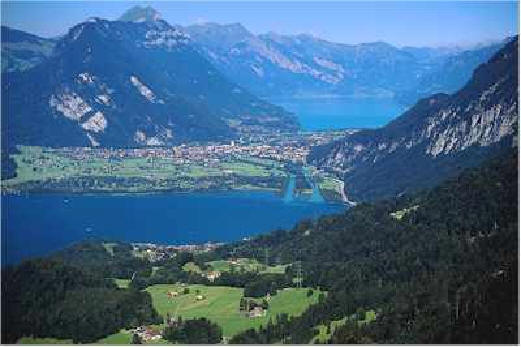
Interlaken, Switzerland, of which my
family has happy memories.
Austria in many ways
was just a larger Switzerland. I worked in Vienna for most of three
years for the United Nations Industrial Development Organisation. It is
located in a magnificent modern building constructed on an island in the
re-engineered Danube river. The building also houses the UN Agency that
monitors nuclear power developments. This Agency has been much involved
with developments in Iran and North Korea in recent days. While I was
working in UNIDO, a friend of mine delivered a protest letter to the
IAEA, the International Atomic Energy Agency, from the Scottish National
Party, about plans to send nuclear waste from East Europe for
re-processing in Scotland. The request was received with a degree of
consternation on the part of the official concerned.
Below left : The UNIDO complex on the
Danube river, Vienna, Austria. It also houses IAEA, International
Atomic Energy Agency, and the UN Narcotics Commission. OPEC has its
offices elsewhere in Vienna.
Below : The Austrian Alps
My first assignment
with UNIDO began when after returning to Scotland from Sumatra, I
received a call from a Colombian lady in Vienna. Teresa Salazar
described how her unit was undertaking a global study of the patterns of
fish industry development. They had recruited a Harvard computer
programmes professor to design a package to contain basic fishery sector
data on every significant fishing country in the world. After running
the programme, the print-outs identified groups or clusters of fishery
industries that shared some commonalities. The problem then was to
identify whether and which clusters were significantly meaningful from
the viewpoint of the study. Since none of those involved had any
detailed knowledge of global fisheries, they were unable to interpret
the results.
I flew to Austria to
join the team for a few weeks. It proved to be one of the most
fascinating assignments of my career. Dr Cliff Zinnes, the Harvard
professor, was a mine of information on how computer programmes could
analyse a host of data on numerous aspects of an industrial sector, and
could identify patterns not easily detected from a normal desk study of
the basic information. He was also a brilliant musician, and could play
Bach, Beethoven and Schubert from memory, and improvise to illustrate
the particular styles those composers preferred. His young wife, from
Latin America, was quite different but equally gifted, with an artistic
talent and a typical Latin temperament.
What amazed me when
examining the ‘clusters’, was not what they told us about the fish
industry patterns, but what else they indicated. It was easy for me to
identify the clusters with large artisanal fisheries and big domestic
markets; those with smaller, commercial, export-oriented industries;
those with significant reduction fisheries, making oil and meal; and the
ones that followed a high-tech, big investment path; and so on, in a
variety of different patterns. But what surprised me was that the
computer also clustered countries that had large petroleum reserves;
countries that suffered from political instability, civil wars, or
insurgencies; states that had centrally controlled economies; and states
with free market systems. All of that from information about the
fishery sector ! Somehow the programme detected relationships that
indicated other factors were at work.
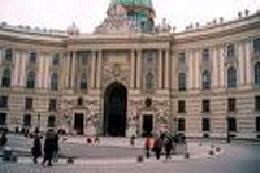
Above : The Hoffburg Palace, Vienna where
I spent many hours
I visited the Hoffburg
palace regularly when in Vienna as my friend Dr James Wilkie used an
office there when working for the Ministry of Foreign Affairs. Among
other tasks, he produced the Austrian Foreign Policy Yearbook, and
edited Austria Today, an official journal about the country,
current affairs and cultural history. Jim had a wealth of intimate
knowledge about Europe and its politics, which he shared with me over
dinner many evenings in a range of small restaurants in the city.
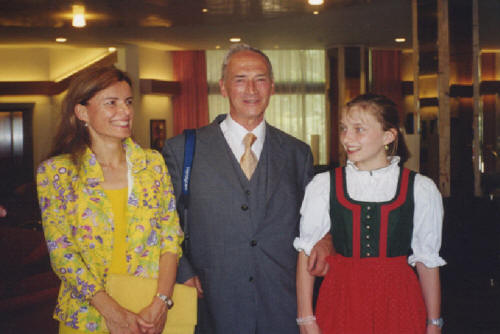
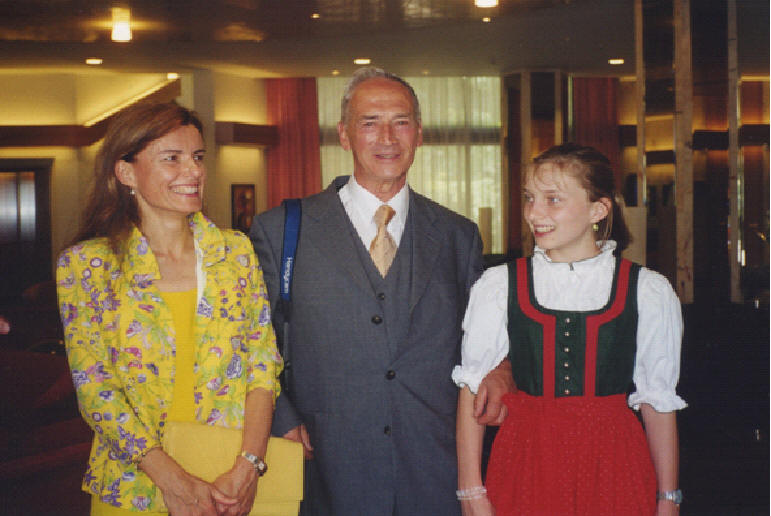
Dr James Wilkie with members of the
Habsburg family, Austria. Dr Wilkie worked with the Austrian Foreign
Ministry for many years, and has latterly been assisting United Nations
projects in Africa, Asia and the Middle East. He was a founder member
of the Scotland-UN Committee, and has been a long-time correspondent to
the Scotsman newspaper readers letters page.
European history and
the current emergence of a United States of Europe, from the European
Community and the Common Market, featured prominently in our
discussions. The states and peoples of west and east Europe have
experienced over 300 years of limited democracy, political and economic
instability, wars and internal conflicts. That probably explains their
attachment to the EU and their willingness to surrender national
sovereignty to achieve long term stability and protection. But these
factors I believe do not apply to Britain. For Scotland, the economic,
social and national costs of EU membership, far outweigh any advantages
that the Union brings.
One evening Wilkie and
I attended a meeting addressed by British Minister and close confidant
of John Major, Tristan Darel-Jones. On a platform with the British
Ambassador to Austria, he gave his reasons for the need for Britain to
be fully involved in the European Union, some of which appalled me. One
was that if the EU had existed in 1956, Britain could have continued
with its invasion of Egypt and retained control over the Suez Canal.
This confirmed my suspicions that rather many of the inner core of
thinkers and strategists behind the European Union, have fascist
leanings. There are also some who came from centrist socialist
backgrounds with little sympathy for genuine democracy.
As the full
implications of the European Union began to emerge in the late 1990’s
and early years of the 21st century, I started to examine the
loss of national sovereignty, the imposition of mountains of EU
legislation, and the Union’s control over the economies, resources, and
foreign policies of its member country’s, - and I was astonished by the
surrender of centuries of democratic control of our institutions to the
mindless, ruthless, unelected apartchniks of Brussels. The emergence of
the “Super-State” of Europe, with its proposals to forbid any member the
possibility of withdrawal, filled me with alarm.
The caliber of senior
EU and European politicians also fills me with unease. Many of them
have criminal records, or have escaped conviction by wielding
considerable influence on the judiciary. Those from France and Italy
are well known, several books having been written about their corruption
and misdeeds. The EC or European Commission is itself riddled with
corruption, evident in the misuse of funds, the nepotism, and the
manipulation of power and programmes to satisfy personal or political
agendas. Several brave whistle-blowers [Among
the whistle-blowers have been, former EC Chief Accountant, Marta
Andreasen (sacked by Neil Kinnock); former EC auditing officer, Paul van
Buitenen; and former senior EC economic official, Bernard Connolly, (now
an MEP), and author of The Rotten Heart of Europe, which contains
an in-depth critique of EU monetary and economic plans and policies.]
have drawn the world’s attention to the improper inner workings of the
EC. Without exception they have been pilloried and dismissed or forced
out by intimidation or by being ‘quarantined’. In contrast, the guilty
have mostly been allowed to remain in power, or have even been promoted.
Commissioners tasked with the job of ending corruption, have instead
persecuted the whistle-blowers and protected the guilty. Among these
cowardly Commissioners was our own Neil Kinnock, the former Labour MP
from the mining valleys of Wales. What would his honest, working class
forbears have thought of his behaviour once he reached the pinnacles of
power?
I had addressed several
public meetings in Scotland on the fisheries issue, and how the industry
had been systematically destroyed by the EC as part of a long-term but
unspoken policy of the EU. What surprised me at those meetings was the
number of non-fishing sector people, - farmers, processors, small
businessmen, who in effect affirmed that what I had observed in the
fishery sector was but a mirror image of what the EU and the EC were
doing to them and their communities. |