|
Oh
East is East and
West is West
And never the twain shall meet,
Till
Earth and Sky stand presently
At God’s great Judgment Seat.
Kipling The Ballad of East and
West
And the end of the fight is a
tombstone white
With the name of the late deceased,
And the epitaph drear : “a Fool lies
here
Who tried to hustle the East”.
Kipling Naulahka
[Quoted
by John Le
Carre
(David J.M. Cornwall) on a BBC television interview, with reference to
the invasion of Iraq. The famous spy story writer had no illusions
about the consequences of that illegal act of war to obtain control of
the second-largest source of petroleum in the world.]
I doubt
if Rudyard Kipling had much direct experience of the Arab
world, but certainly the culture of the Orient and its people is well
expressed in his ballads, two of which are quoted from above. I have
always enjoyed Kipling, and never found him to be the poet of
imperialism as some describe him, though they probably studied his life
and works more deeply than I. He described the empire period but also
challenged much of the empire attitude. He spent much of his early
years in what is now Pakistan where he was born in Lahore, though his
initial education was in England. He later traveled around the
sub-continent, but spent little time in the Middle East or Africa, -
regions he was to write about with
eloquence and insight. Kipling spent more time in Burma,
China, Japan and the USA, than he did in Arabia or Africa.

The Middle East
The Rubaiyat of Omar
Khayam has long been a a favourite poem of mine. How much Edward
Fitzgerald’s translation really expresses the Persian philosopher’s
ideas has been a matter of debate, but no other translation of the
Rubaiyat inspires me like his. It reads in parts like
Ecclesiastes, the profound wisdom book of the aged King Solomon. My
own radical instincts, and my life-long frustration from seeking to
rectify or improve matters in situations where the basic structures were
very imperfect, find an eloquent echo in the verse :
“Ah love, couldst thou and I with fate
conspire
To grasp this sorry scheme of things entire,
Would we not shatter it to bits, - and then
Remould it nearer to the heart’s desire”
A soldier of
the British Empire who served in the Middle East and North
Africa whose exploits I enjoyed reading was General C.G. Gordon of
Khartoum. He was only 52 when killed by the army of the
Mahdi, Muhammad Ahmed. I knew one of his descendants, a Gioia Gordon,
resident in Italy, and there is a house I used to visit in our home town
that had connections with his family, but precisely what they were I
could not ascertain.

General Charles G. Gordon of Khartoum
fame. He explored much around Yemen and Palestine, discovering
“Gordon’s Calvary”, the skull rock and the garden tomb in Jerusalem. He
also discovered the massive rock-hewn water reservoirs in Aden, Yemen.
|
Ancient Mesopotamia
The ancient land between the two rivers has a cultural heritage
that goes back thousands of years. In the fragile remains of a
pioneer of human civilisation in the "Fertile Crescent".
Contemporary with Egyptian civilisation, probably even earlier,
there sprang up in Western Asia, in the river valleys of the
Tigris and Euphrates, the region which came to be called
Mesopotamia ("between the rivers" in Greek). It was peopled by
the Sumerians. Both countries, Egypt and Mesopotamia, had ideal
conditions for development: adequate water resources, food and
building materials. Both learned how to control water with
dikes, distribute it through irrigation ditches, reap abundant
harvests, and raise cattle, sheep and goats. Each knew the hoe
and the plough. But in Nippur on the Euphrates, donkeys pulled
wheeled carts and chariots -- a device that was invented there.
There, too, cuneiform writing was developed, inscribed on an
almost imperishable pottery tablet. There is evidence of a city
community in Mesopotamia even as early as 6000 BC, and the first
accounting methods can be traced to the ancient city of
Babylon. The Sumerian city-states continually warred against
one another. Soldiers used spears and shields and fought in
close formation. In every city officials and priests formed the
aristocracy and free landowners the middle class, while slaves
were at the lower end of the social strata. The Sumerians built
a great tower to their chief god Enil at the ancient city of
Nippur. Other towns did the same thing, and the tower of Babylon
may well have been based on the one referred to in the Genesis
story of the tower of Babel. The Sumerian empire was founded by
the high priest of the god of the city of Erech and extended --
according to an inscription at Nippur -- "from the upper to the
lower sea". That is to say, from the Persian Gulf, west to the
Mediterranean or the Red Sea.
These ancestors of the Iraqis ruled a powerful state, which came
to an end in 2750 BC when a tribe, the Akkadians who lived in
the desert adjoining Sumer, conquered it. Sargon I's
Sumerian-Akkadian empire stretched from the Persian Gulf to the
Mediterranean and endured for another two hundred years. As the
kingdom declined, other tribes appeared. The Elamites conquered
some of the southern cities, while the Amorites settled in the
north and, about 2200 BC, established themselves in the as yet
small village of Babylon. There the state built by the great
king Hammurabi reached its peak from about 2100 BC. The city of
Babylon (which has perished completely), surrounded by its
famous walls, developed under his rule. Even more famous were
the Hanging Gardens, one of the Wonders of the Ancient World.
With his eye upon every corner of the land, the great and
powerful Hammurabi saw how necessary it was to bring into
uniformity all the various and sometimes conflicting laws and
business customs of the land. He therefore collected them,
arranged them systematically, added new and improved laws, and
issued his celebrated code for the management of his empire. It
was engraved on a piece of stone more than two metres high, at
the top of which is a sculptured scene representing Hammurabi
receiving the law from the sun-god.
The code, one of the earliest of ancient law, which was set up
in the temple of the great god Marduk in Babylon, survived.
Copies of it were written on clay tablets and used by the local
courts. The law stipulated justice to the widow, the orphan, and
the poor. Marriage required a legal agreement between man and
wife, and the position of women in the early Babylonian world
was a high one. They engaged in business on their own account,
and were even professional scribes. Especially prominent in the
law was the principle that punishment for an injury should
require the infliction of the same injury on the culprit. Even
should a house collapse and the son of the householder be
killed, it was the guilty builder who must suffer the loss of
his own son. The law was understood and adhered to. And, thus
regulated, Babylonian communities prospered as never before.
There was a standing army that kept the frontiers safe and
quiet, trade was active, Babylonian merchants used temples as
storehouses, loaned money like banks, and dealt in merchandise.
Hammurabi's commercial influence was widely felt. To train the
future generation and furnish clerks for business and
government, schools were established. Clay tablets with the
exercises of youths 4,000 years ago have been found. This was
the first chapter of early human progress along the "twin
rivers". It was swept away by the horse-breeders (Babylonians
called them "animals of the mountain") in
the 20th century BC.
The second chapter of the history of the "twin rivers" occurs in
the north-east corner of the desert bay overlooking the Tigris
on the east and the desert on the west and south. At Assur, the
Assyrian civilisation developed, rising to a peak from about 750
to 612 BC. Nineveh, to the north of Assur, became the capital.
The lofty and massive walls of this city, built by the powerful
Sennacherib, stretched along the banks of the Tigris. Here, from
a lavish palace, he ruled the western Asiatic world with an iron
hand, collecting tribute from all the subject peoples and
maintaining a system of royal messengers to transmit royal
business. It was the beginning of a postal system, and there are
indications that it was already in existence in Asia under
Egyptian rule, as far back as 2000 BC.
[From
the Cradle of Civilisation, Al Ahram, Cairo] |
Among my many Arab
acquaintances, two stand out for very different reasons. Fahry Shehab
was a former financial adviser to the government of Kuwait. He was also
an Oxford Don, and a frustrated mechanic to boot. His lifelong hobby
interest was motor cars, and he longed to become proficient in their
maintenance and repair. But when he attempted to enter a course on
motor vehicle mechanics, he was refused admittance on the grounds that
he was a University don (though why that should be, neither he nor we
could fathom!). Fahry lived for a period in Bridge of Weir in the west
of Scotland, which was where I first made his acquaintance with a few
friends. He was the soul of politeness and courtesy, and for many
years, advised us on contacts with the Middle East, and on conducting
business in the Arab world.
Another Arab friend at that time was a young Iraqi, Nabil Orow who had
applied for asylum in the west during the dreadful rule of Saddam
Hussein. Nabil wanted the freedom to express his real political and
religious beliefs which was not then possible in Iraq, and he was
reconsidering his future. We met in Rome Italy, and for a period I
tried to assist him in his applications for acceptance in a western
country. We spent several evenings and weekends together and planned
and worked on renewed applications for his acceptance in Britain,
America, and Australia.
I wrote to my local MP in Scotland, - Malcolm Rifkind (later UK Foreign
Minister, and who was knighted by the Queen). Mr Rifkind was, as ever,
attentive and considerate, but was unable to move the British
bureaucracy on the matter. No one in official position then appeared to
take Orow’s case seriously. However we persevered, and eventually Nabil
was accepted by Australia. There he married a lovely girl and raised a
small family. Then he went on to study law, obtaining a Ph.D in an
Australian university. He now practises as a barrister in Victoria.
After all these years we are still able to keep in touch.
In 1978 I was asked to
go to North Yemen for a month, by the Indian Ocean Programme which was
then headed by a fine Newfoundlander, Harry Winsor, one of the original
team of fisheries specialists in the Food and Agriculture Organisation.
North and South Yemen were then separate states. One was the Yemen Arab
Rebublic, and the other was PDRY, the People’s Democratic Republic of
Yemen which was beginning its brief flirtation with Marxism. (As a
comedian once remarked, “any country with democratic in its name,
usually is’nt”)! I found the capital Sanaa and its culture to be
quite medieval. Women were completely veiled; - not an inch of skin
visible anywhere. Even the eyes were hidden behind a lattice in the
veil. The men, mostly bearded, wore turbans and had ornate curved
knives stuck in the sash belt around their waist. Many also carried
guns slung over their backs or shoulders; - old fire-pieces they were,
that appeared to belong more in a museum than in actual use during the
later 20th century. The food in the quasi-Western
restaurants in hotels in Sanaa and Hodeidah, was pretty awful. The
menus were the same in each, and even contained the same mis-prints. I
found the local food in the roadside eating places away from the city
much better. They served mutton soup, and a kind of spicy potato stew
that one dipped into with pieces of bread torn of a large flat round
loaf. The girls in those places were not veiled like their city
counterparts. Instead, they had a gypsy look to them, with countless
bangles on their arms and ankles.
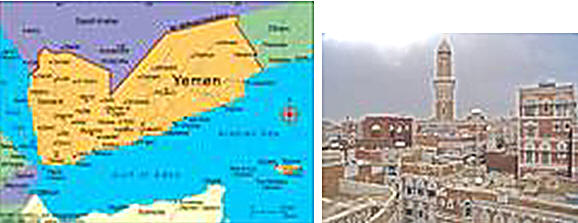
Map of the Republic of Yemen. For many
years divided into north and south Yemeni states, the country is once
more united. Right : Sanaa, ancient city and capital of Yemen.
The country was
fascinating to me for several reasons. This was the land of the Queen
of Sheba. Her capital was at Marib, east of Sanaa where she had built
enormous dams and cut huge water tanks in the rock, amazingly engineered
to catch the rain water that ran along the wadis parallel to the coast
during the brief periods of heavy rain that occurred every few years.
General Gordon (of Khartoum fame) discovered similar water storage tanks
in Aden where they can be seen to this day. The Arabs called her Bilqis,
but to the Israelis she is She’va, though some identify her with Makeda.
Her name is not mentioned in the Bible. In the first century AD, the
historian Josephus referred to her as Nikaulis. She is reputed to have
borne a son to Solomon, who was later sent to Jerusalem for education,
and returned to Sheba with 70 nobles to help him run the country. He was
Menelek, or Ibn al-Hakim (son of the wise). His descendents ruled the
Sheba region for centuries, and the last emperor of Ethiopia, Haile
Selasse, claimed to be his direct descendant which is why he took the
royal Jewish title, “Lion of the tribe of Judah”.
Yemen, called
“Arabia Felix” by the Romans, was renowned for its wars and feuds,
and the period of my visit was no exception. President Ali Saleh
quarreled with the head of the army commando unit who stormed out of
Sanaa and took 600 of the troops south across the border. While I was
driving up from Al Mocca on the coast to Taiz in the mountains, jet
aircraft buzzed overhead, strafing the commando positions across the
border.
The trip from Sanaa to
Hodeidah was an experience. I had to negotiate with a taxi driver for a
fee which he insisted included “qat money”. Qat is a narcotic leaf the
men chew there, much as South Sea Islanders drink kava. We headed off
down the desert road which had sheer drops on one side, and cliffs on
the other, past strips of green in tiny streamlet basins, and little
villages perched on pinnacles (no invader could ever really conquer that
country). The driver gulped what I hoped was water from a Johnny Walker
whiskey bottle, and chewed qat till his cheeks bulged and his eyes
dilated. When we reached the coastal plain it was getting dark and we
had to beware of camels which could be difficult to see in the fading
light. They make quite a mess when hit by a speeding car.
I was to visit Aden,
South Yemen twice later. This was still before the unification of the
territories in 1994. There had been a civil war in 1986, and the royal
yacht Britannia had taken numbers of expats out of the port to safety in
Djibouti. While I was there the Britannia was invited back so the
Yemenis could thank her for that act of assistance. I went through the
local museum which was like a record of local warfare the past 300 to
400 years. It also had a large number of gory colour photographs of the
recent civil war. At the airport one could spend the waiting time
counting bullet holes in the large plate glass windows. I believe these
scars of the conflict have all since been repaired.
The British had
occupied Aden in 1839, and made it a crown colony in 1957. In 1967 the
territory became the People’s Republic of South Yemen, and the People’s
Democratic Republic of Yemen in 1967. Aden, to me resembled the Khyber
Pass, - a region of almost perpetual conflict of one sort or another.
Yet its people, the Yemenis themselves were great company. They had a
forthrightness, a friendliness, and a sense of humour that I found
rather Scottish. The Arab propensity for hospitality, for argument,
for honesty and for shrewdly assessing character, used to make me think
they must be related to the Scots or the Celts in the dim and distant
past.
North and south Yemen
have since been re-united, and remain a maverick part of the Arab
world. The Yemenis take a pride in making their own decisions,
regardless of the views or influence of their rich neighbour to the
north, Saudi Arabia, and regardless of the positions adopted by Oman,
and the Emirate states to the east. Osama Bin Laden’s family hailed
from Yemen, (or part of it), and this may shed some light on how he came
to his strong, independent and radical views.
Though I had landed at
Teheran airport a few times, and helped administer FAO projects in Iran,
I did not have an opportunity to visit that great country. The nearest
I got to the Iranian border was when travelling to the mountains south
of Ashgabat in Turkmenistan. I had known Iraninan students at workshops
and seminars, and once met with diplomatic officers from the government
of the late Shah. This was on a tour boat on Moscow river. Their
monarch, Mohammed Resa Shah Pahlavi, was visiting the Soviet Premier at
the time. His entourage of diplomats and aides exhibited culture,
learning and sophistication, and made stimulating conversation with me
during the afternoon river cruise. The Shah ruled Iran from 1941 to
1979. He was briefly ousted in 1953 by the Prime Minister, Dr Mossadegh,
but was reinstated with CIA help shortly after. I recall our press
making a fool of Dr Mossadegh at the time because he wept in public.
The Shah then abolished the multi-party system and made the country a
one-party state. He established and supervised a ruthless organisation,
the SAVAK secret police. He was eventually deposed in 1979 despite
having a powerful army and an immense arsenal of weapons, and control
shifted from the monarchy to the ayatollahs. There followed a period of
difficult relations with the USA, and conflict with Iraq which the USA
supported. In fact the United States had armed both of the belligerants
in the Iran – Iraq war, and had turned a blind eye to illegal arms to
Iran sales engineered by Colonel North. He and his boss, National
Security Adviser John Poindexter, ignored the law and lied to Congress
over dealings with Iran and support to Contras in Nicaragua. They
destroyed evidence in the form of e-mail records but back-up tapes were
recovered by the FBI and the Tower Commission.
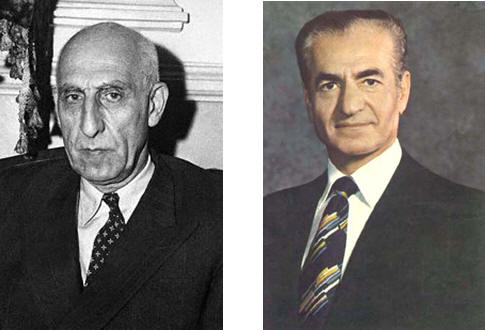
Dr Mohammad Mossadegh, Prime Minister of
Iran who was deposed in a CIA engineered coup in 1953. The United
States Government apologized publicly for that interference in 2000.
Mossadegh was a popular Premier who sought to keep Iranian oil out of
foreign hands. The British and American press ridiculed him after he
broke down in tears following his overthrow and arrest.
On
the right : Shah Mohammed Reza Pahlavi of Iran who replaced Mossadegh..
He ruled from 1941 to 1979.
I met his entourage
on the Shah’s official visit to Moscow in 1965.
A dreadful incident
occurred on July 3 1988, when an Iranian air liner on a regular flight
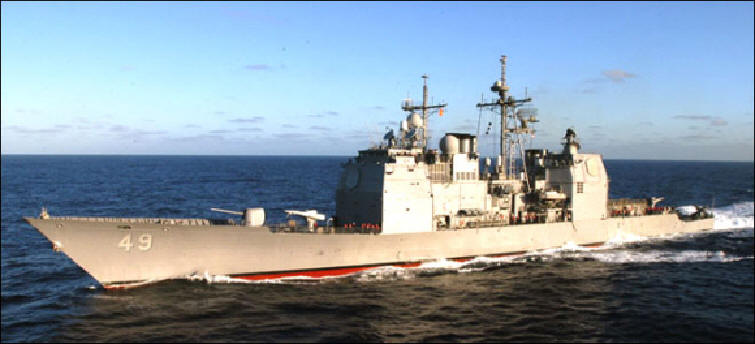
(IA 655) from Bander Abbas to Dubai, was shot down by a US cruiser, the
Vicennes. It was an ordinary civilian flight which our project
officers often took, although some of President Reagan’s apologists
claimed otherwise. Ultimately the American government paid $ 61 million
as an ex gratia compensation, but it never admitted any fault.
Vice President George Bush (senior) stated at the time that he would
“never apologise for the United States, no matter what the facts were”.
290 passengers and crew perished in the shooting down of the Airbus
300, including over 60 children and 38 non-Iranians. The Captain of the
Vicennes, and his commanding officer were both decorated with
Legion of Merit medals in 1990 for their part in the attack on the
civilian airliner.
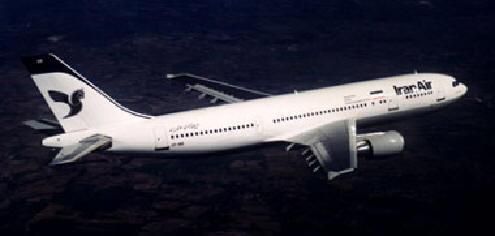
An Iranian Air passenger jet of the type
shot down by the US Navy on 3 July 1988 with the loss of 290 passengers
and crew. It was on a regular flight from Bandar Abbas to Dubai.
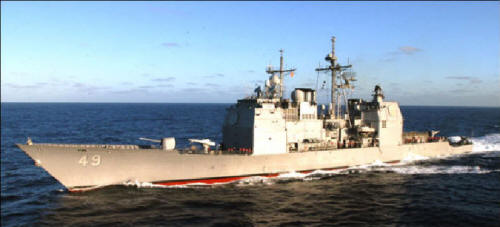
The US warship Vicennes that fired the
missile which destroyed the Iranian passenger plane during the Iran /
Iraq war. The Commander was decorated and commended for his action.
Some observers believe
that the bombing of the Pan Am flight 103 over Lockerbie, Scotland, 5½
months later, on December 21, 1988, was a retaliation by Middle Eastern
groups, for the shooting down of the Iranian flight IA 655, and that
Libya had little to do with it. A telephone warning had been received
on December 5th, stating that an American airliner flying
from Frankfurt to the USA would be destroyed by a bomb in two weeks
time. The caller stated that the bombing would be the work of the Abu
Nidal organisation. The warning was distributed to airlines in
Frankfurt, but was ignored by the Pan Am office.
President Bush
appointed a President’s Commission on Aviation Security and Terrorism,
PCAST, to review and report on aviation security in the light of the
downing of PA 103. At a meeting with victims’ relatives in the U.S.
Embassy in London on 12 February 1990, a PCAST member told relative
Martin Cadman, “Your government and ours know exactly what happened.
But they are never going to tell”. Veteran British Member of
Parliament, Tam Dalyell, reminded the House of Commons of this statement
on 11th July 1990, - a statement that he claimed had never
been refuted.
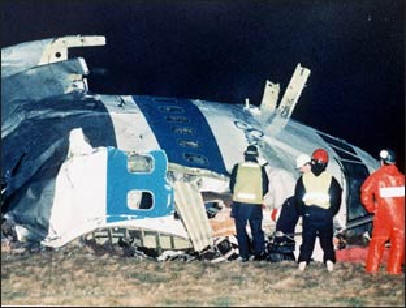
Wreckage of the Pan Am flight at
Lockerbie Scotland, December 21, 1988. It was believed
that
a Middle East group had it bombed in retaliation for the Iran Air plane
shooting by the United States. However the US decided to prosecute 2
Libyans for the bombing. Many now belive they were not guilty.
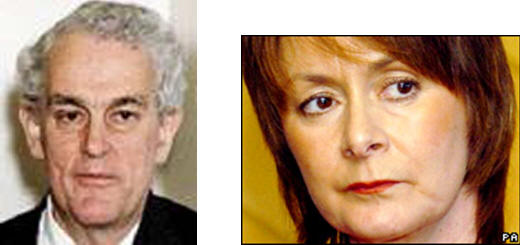
Veteran Labour Member of Parliament,
Above : Shirley McKie, the Scottish policewoman at
Tam Dalyell who persistently questioned the centre of a scandal
about the operations of the SCRO
the British and US governments’ version the Scottish Criminal
Records Organisation. She was
of the Pan Am bombing, and defects in falsely accused then
freed with £ 750,000 compensation
the subsequent trial. but the UK
government and the Scottish Executive would
not reveal why or investigate the SCRO. Then Lord
Advocate Colin Boyd resigned. He had handled the
Lockerbie trial in the Hague and was believed to have
covered
up CIA tampering of evidence at that trial.
Suspicions over the Pan
Am bombing and the subsequent trial and conviction of a single Libyan
for the crime, Abdel Besset Al Megrahi, have intensified since the
discovery of a strange link with a fingerprint case in Scotland.
Policewoman Shirley McKie was accused by the SCRO (Scottish Criminal
Records Office) of leaving a print at a murder scene in Glasgow in 1999
and was subsequently tried for perjury. She was acquitted, and her
father, a former police officer himself, pursued the matter doggedly.
Fingerprint experts in England, the USA and Australia testified that the
supposed print could not possibly have been hers, and some averred after
seeing the subsequent copies, that the original print had been doctored
to make it appear to belong to the officer in question. There was
puzzlement in Scotland over the Scottish Executive’s harassment of Miss
McKie and its refusal to permit an independent public enquiry to take
place. Then the Scotsman newspaper obtained copies of official
documents that showed that the head of Police in Tayside who had looked
into the matter, concluded that criminal charges should be brought to
bear on some officers of the SCRO Scotland’s main fingerprint unit. It
was further disclosed that the Lord Advocate Colin Boyd, who had refused
to mount a prosecution but who had decided instead to charge McKie with
perjury was the official in charge of the Libyan Lockerbie bombing
trial. It was also later revealed that the FBI had put considerable
pressure on British and Scottish authorities to prevent any public
enquiry into the McKie case, that might reflect on SCRO competence, and
on the integrity of the Lockerbie trial.
The father of one of
the Pan Am flight victims, Dr Swire, wrote to the press pointing out
some parallels between Solicitor General / Lord Advocate Boyd’s handling
of both cases. Both the Lockerbie trial and the fingerprint case rested
on slender evidence – in the one the charred remains of pieces of a
supposed timer, and in the other a much-disputed fingerprint. In
neither case would Boyd allow anyone to view the original piece of
evidence. In both cases the SCRO and related investigation offices were
involved.
Some concluded that the
United States was determined to obtain a conviction for the Lockerbie
bombing, both to abate public outcry, and to direct attention away from
the true story of the Pan Am bombing. The real suspects of that bombing
could have exposed the dealings of Colonel North, and the hypocrisy of
the USA which had armed despots and Bin Laden-type Arabs. Any shadow of
doubt thrown against the Scottish SCRO would automatically put the
Lockerbie verdict in doubt. Therefore, the Scottish Executive,
including its First Minister and its Minister of Justice, absolutely
refused to permit a public enquiry, and the now suspect Attorney General
threw his weight behind their decision.
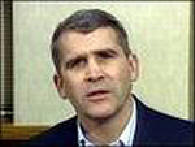
Colonel Oliver North, who was deeply
involved in selling arms to Iran to finance Contra mercenaries in
Central America, contrary to official US government policy. He went on
to play a nefarious role in the Middle East, and may have been partly
responsible for setting up Terry Waite for abduction by Arab militants,
which may explain Waite’s public expression of forgiveness to North at a
televised meeting.
|
Pan Am 103
/ Lockerbie questions
The father
of Flora Swire, one of the 270 innocent victims of the Pan Am
bombing, Dr Jim Swire, and other concerned persons have raised
numerous questions about the downing of flight Pan Am 103 and
related incidents, in an endeavour to uncover the truth of the
whole matter. They have met largely with a wall of official
silence and non-response. One of their conclusions was that the
Lockerbie trial failed several basic principles of justice and
evidence. Among the many queries were concerns on the
involvement of one Vincent Cannistraro who was put in charge of
the CIA investigation but who was not required to appear as a
witness. Cannistraro was one of the leaders of the brutal CIA
Nicaragua campaign, financed partly by the “arms for Iran”
Contra scandal. He was also involved in secretly helping to arm
Osama Bin Laden and the Taliban in the 1980’s but none of these
matters were revealed at the trial. During 1986 – 88 he was
responsible for White House disinformation and lies against
Libya. During the Lockerbie investigation, his agents removed
evidence illegally and reinserted at least one piece after it
had been tampered with. The forensic scientists Lockerbie
notebook contained a page recording the only fragment of bomb
found at the scene. The page had been manually inserted, and all
pages subsequently renumbered by hand.
The
Maltese shopkeeper, Tony Gauci, who provided conflicting
identification evidence, had been promised $ 4 million by the
USA if Al Megrahi was convicted, but none of that was revealed
at the trial. Palestinian terrorist Marwan Khreesat was
employed by Ahmed Jibril, Jordanian intelligence and possibly
also the CIA to make barometrically triggered bombs for Jibril’s
group, targeting Pan Am flights. Why was one stolen just a day
before Khreesat’s arrest ? Could it have been the fatal bomb on
flight 103 ? More alarmingly, the UK Government issued two
telex warnings days before the bombing. One carried a picture
of the Khreesat bomb with instructions to the airline that if
such a device was found, it should be “consigned to the hold of
the plane”. Two days after the bombing, Iran admitted paying
the Jibril group $ 11 million, and some months later, paying $
0.5 million to Abu Talb. These allegations all point to the
generally believed explanation of the destruction of the Pan Am
flight, - that it was a pledged response to the downing of a
civilian Iranian jet (flight IA 655 from Bandar Abbas to Dubai)
by the USS Vicennes earlier that year, with the loss of
290 innocent passengers. (Though denied at the time, the
Vicennes was later admitted to have been inside Iranian
territorial waters, and firing on Iranian boats when it shot the
airliner). The US government never admitted liability,
but under President Clinton, on 26 February 1966, it agreed to
to pay an ex gratia sum of $ 61.8 million to Iran and the
flight victims families.
The IA 655
shooting and its aftermath brought out some shameful propaganda
and ‘spin’ by American politicians and reporters. Ronald Reagan
claimed that the civilian jet was diving towards the U.S. Navy
ship, and increasing speed. Larry King demanded to know from
the Iranian Ambassador, “why a predominately business flight
was carrying so many women and children” !!! This was
rubbish. I knew the flight which my FAO colleagues often took.
Captain William C Rogers III of the guided missile cruiser, and
his air warfare coordinator, Lt. Com. Lustig, were awarded the
Legion of Merit medal by President George H W Bush in 1990, for
“excellent meritorious conduct” on the day in question. But
back to Pan Am flight 103, -
Behind or
around the Pan Am / Lockerbie crash, and other sinister events
like the illegal sale of arms to Iran, the involvement of the
CIA in the drug trade, the financing of brutal Contras in
Nicaragua, and the abduction and imprisonment of Terry Waite, -
lurks the shadow of one Colonel Oliver North. Several who
studied the Lockerbie case in great detail claim that most
American personnel were warned off flight 103, yet it did
contain some CIA agents en route the USA to testify against
Oliver North over “arms for Iran” and other matters. But this
belief and much of the information above has not been endorsed
or admitted by U.S. or UK authorities.
|
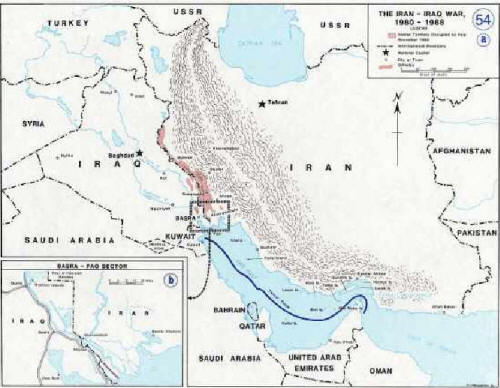
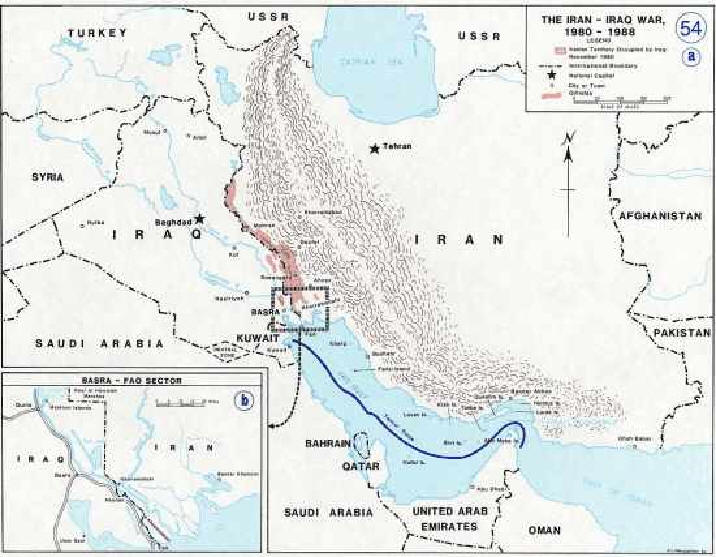
Map of the theatre of the Iran-Iraq war
1980 to 1988.
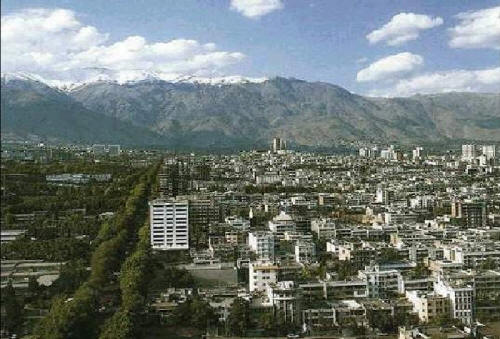
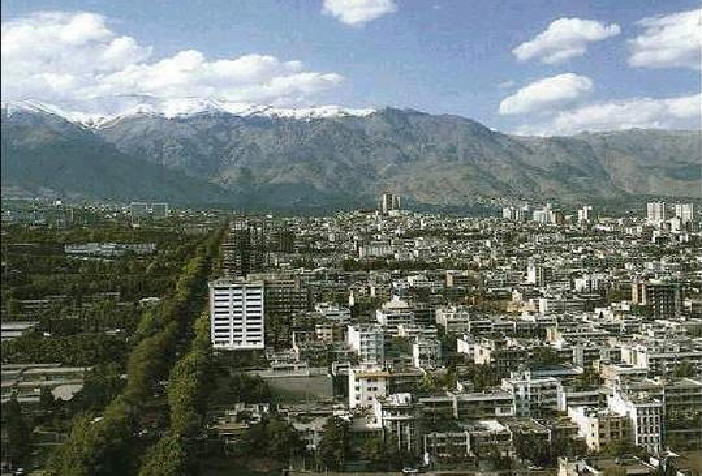
The city of Teheran, capital of
Iran
|
Other questions
The
more one looks into the details of the Pan Am flight bombing,
the more questions are raised. I mention some here, and readers
can peruse the blogs at leisure on the internet. One of the
troubling issues concerns the individuals who cancelled their
reservations on PA 103, and others one would have expected to be
pulled out (if official warnings were issued), yet who did
travel on the flight, and so perished with the 259 victims.
Pick Botha, (former South African Foreign Minister) was to
travel on 103 en route to the UN New York to sign the Accords
granting independence to Namibia. Not so fortunate was the UN
Commissioner for Namibia, Bengt Carlsson, also headed for the UN
meeting. He was to die on flight 103. The United States
Ambassador to Lebanon at that time John McCarthy, is believed to
have withdrawn from the flight as was Steven Greene of the
Office of Intelligence of the U.S. Drug enforcement Agency, and
a son of Oliver Revell of the FBI.
If
as appears to be the case, certain U.S. and diplomatic figures
were warned or advised not to go on flight 103, why was a party
of CIA officers not aware of this or not directed to another
airline ? Among those killed were at least 4, and perhaps 5 or
more, agents from the U.S. intelligence services. Their names
were, Matthew Gannon and Major Chuck McKee of the Agency’s
Beirut office. Accompanying them (possibly as bodyguards),
Ronald Lariviere, also from Beirut, and Daniel O’Connor from the
American embassy in Nicosia. All four had flown from Cyprus
that morning, and McKee is believed to have been trying to
locate and secure the release of American hostages being held by
Hezbollah. Some students of the event and the CIA operations
believe that McKee and his colleagues had uncovered sinister
connections between Oliver North and drug dealers in the Middle
East, and were to report on this back in the USA. Certainly the
CIA showed great interest in McKee’s luggage. They are
understood to have taken his suitcase from the crash site, and
returned it later devoid of contents.
McKee’s mother, Beulah, strongly suspected collusion of
intelligence authorities in her son’s death, and has badgered
the government in vain for years, to get at the truth, and
obtain answers to her questions. Interviewed by Time magazine,
Beulah McKee, then 75, said she thought that her son’s death was
the result of a government operation gone horribly awry. She was
never satisfied with what Washington officials told her.
Pan
Am’s insurers hired a security company, Interfor, to
investigate. They supported the suspicion of U.S. involvement
with a Middle East heroin smuggling operation, and the switch of
the bomb suitcase with the drugs one. The heroin operation may
have been part of a drugs for hostages deal, organised by a
rogue CIA unit in Frankfurt and somehow linked to Oliver North’s
arms for Iran to finance Contras, scandal.
Parents of Lockerbie victims, Paul Hudson, a New York lawyer,
and Dr Jim Swire of England, wrote jointly to President George
HW Bush, and Prime Minister Margaret Thatcher, accusing them and
their administrations of downplaying evidence and stringing out
the investigation till the case could be dismissed as ancient
history. |
Probably the most distinguished commentator on the Lockerbie
/ Pan Am case is Professor Robert Black, a distinguished academic lawyer
who is held in high regard internationally. The following brief on him
is from the Edinburgh University web site:
“Robert Black has been
Professor of Scots Law in the University since January 1981, having
previously been in practice at the Bar. For various periods between 1983
and 1999 he served as Head of the Department of Scots (later Private)
Law. He has been an Advocate since 1972, a QC since 1987 and a member of
every Dean's Council from 1984 to 2003. From 1987 to 1996 he was General
Editor of The Laws of Scotland: Stair Memorial Encyclopaedia (25
volumes), having previously acted for six years as deputy to the late
Sir Thomas Smith QC. From 1981 to 1994 he served as a temporary sheriff.
Over the years Robert Black has acted as the Law Society of Scotland's
examiner in Evidence and as the examiner in Civil and Criminal Procedure
and Pleading for solicitors seeking extended rights of audience, and as
the Faculty of Advocates' examiner in Private Law. He has taken a close
interest in the Lockerbie affair since 1993, not least because he was
born and brought up in the town, and has published a substantial number
of articles on the topic in the United Kingdom and overseas. Professor
Robert Black is often referred to as the architect of the Lockerbie
trial at Camp Zeist in the Netherlands: see
http://lockerbiecase.blogspot.com/
and
http://web.archive.org/web/20020524233852/http://www.thelockerbietrial.com/
“
Interested readers should consult the web sites above. The following is
an extract from Professor Black’s papers on the Lockerbie trial,
reproduced with his kind permission :
Introduction
On 31
January 2001, after just over one hundred and thirty court days of a
trial that had started on 3 May 2000, the three judges in the Lockerbie
trial (Lords Sutherland, Coulsfield and MacLean) returned a unanimous
verdict of guilty of murder in respect of the first accused, Abdelbaset
Ali Mohmed Al-Megrahi, and a unanimous verdict of not guilty of murder
in respect of the second accused, Al-Amin Khalifa Fhima1.
Megrahi was sentenced to life imprisonment, with a recommendation that
he serve at least twenty years.
The
prosecution in their closing submissions conceded that the case against
the accused was entirely circumstantial. That, of course, is no bar to
a verdict of guilty. Circumstantial evidence can be just as persuasive
and just as damning as the direct evidence of eyewitnesses to the
commission of a crime. But to many observers, including me, it seemed
that the case presented by the prosecution was a very weak
circumstantial one, and was further undermined by the additional
prosecution concession that they had not been able to prove how the bomb
that destroyed Pan Am 103 got into the interline baggage system and onto
the aircraft.
The trial court’s crucial
findings and were they justified?
From
the 90 paragraph written judgement produced by the trial court
(available on the Scottish Courts website
http://www.scotcourts.gov.uk)
it is clear that the court convicted Megrahi on the basis of the
following nine factors.
1. The
bomb was detonated through the mechanism of a MST-13 digital electronic
timer manufactured by a Swiss company (MeBo) and supplied principally
(but not exclusively) to Libya.
Commentary.
The
judges accepted prosecution evidence that a fragment of circuit board
found among the wreckage of Pan Am 103 came from a MeBo MST-13 timer.
The managing director of MeBo had denied this in his evidence, but his
credibility was, unsurprisingly, assessed as being very low. The
evidence established that timers of this model were supplied
predominantly to Libya (though a few did go elsewhere, such as to the
East German Stasi). This fragment is also important since it was
the only piece of evidence that indicated that the Lockerbie bomb was
detonated by a stand-alone, long-running timing mechanism, as distinct
from a short-term timer triggered by a barometric device when the
aircraft reached a pre-determined altitude (a method known to be
favoured by certain Palestinian terrorist cells operating in Europe in
1988). The provenance of this vitally important piece of evidence was
challenged by the defence and, in their written Opinion, the judges
accept that in a substantial number of respects this fragment, for
reasons that were never satisfactorily explained, was not dealt with by
the investigators and forensic scientists in the same way as other
pieces of electronic circuit board (of which there were a multitude).
The judges say that they are satisfied that there was no sinister reason
for the differential treatment. But regrettably they do not find it at
all necessary to enlighten us regarding the reasons for their
satisfaction.
2. A
company of which a member of the Libyan intelligence services (Badri
Hassan) was a principal for a time had office accommodation in the
premises of the Swiss manufacturer, MeBo.
3.
Megrahi was a member of the Libyan intelligence service.
Commentary.
The
only evidence to this effect came from a Libyan defector and CIA asset,
Abdul Majid Giaka, now living in the United States under a witness
protection programme. He gave evidence highly incriminating of both
Megrahi and the co-accused Fhima. However, the trial judges rejected
his evidence as wholly and utterly unworthy of credit, with the sole
exception of his evidence regarding the Libyan intelligence service and
Megrahi’s position therein. The court provides no reasons for accepting
Giaka’s evidence on this issue while comprehensively rejecting it on
every other matter.
4. The
suitcase which contained the bomb also contained clothes and an umbrella
bought in a particular shop, Mary’s House, in Sliema, Malta.
5.
Megrahi was identified by the Maltese shopkeeper as the person who
bought the clothes and umbrella.
Commentary.
The
most that the Maltese shopkeeper, Tony Gauci, would say (either in his
evidence in court or at an identification parade before the trial or in
a series of nineteen police statements over the years) was that Megrahi
“resembled a lot” the purchaser, a phrase which he equally used with
reference to Abu Talb, one of those mentioned in the special defence of
incrimination lodged on behalf of Megrahi. Gauci had also described his
customer to the police as being six feet [183 cms] tall and over fifty
years of age. The evidence at the trial established (i) that Megrahi is
five feet eight inches [173 cms] tall and (ii) that in late 1988 he was
thirty-six years of age. On this material, the judges found in fact
that Megrahi was the purchaser.
6. The
purchases were made on 7 December 1988, a date when Megrahi was proved
to be on Malta and not on 23 November 1988 when he was not.
Commentary.
By
reference to the dates on which international football matches were
broadcast on television on Malta, Tony Gauci was able to narrow down the
date of purchase of the items in question to either 23 November
or 7 December. In an attempt to establish just which,
the weather conditions in Sliema on these two days were explored.
Gauci’s evidence was that when the purchaser left his shop it was
raining to such an extent that his customer thought it advisable to buy
an umbrella to protect himself while he went in search of a taxi. The
unchallenged meteorological evidence led by the defence established that
while it had rained on 23 November at the relevant time, it was unlikely
that it had rained at all on 7 December; and if there had been any rain,
it would have been at most a few drops, insufficient to wet the ground.
On this material, the judges found in fact that the clothes were
purchased on 7 December.
7. The
suitcase containing the bomb was sent as unaccompanied baggage from Luqa
Airport in Malta, via Frankfurt, on the morning of 21 December 1988 on
an Air Malta flight, KM 180.
Commentary.
The
trial judges held it proved that the bomb was contained in a piece of
unaccompanied baggage which was transported on Air Malta flight KM 180
from Luqa to Frankfurt on 21 December 1988, and was then carried on a
feeder flight to Heathrow where Pan Am flight 103 was loaded from
empty. The evidence supporting the finding that there was such a piece
of unaccompanied baggage was a computer printout which could be
interpreted to indicate that a piece of baggage went through the
particular luggage coding station at Frankfurt Airport used for baggage
from KM 180, and was routed towards the feeder flight to Heathrow, at a
time consistent with its having been offloaded from KM 180. Against
this, the evidence from Luqa Airport in Malta (whose baggage
reconciliation and security systems were proven to be, by international
standards, very effective) was to the effect that there was no
unaccompanied bag on that flight to Frankfurt. All luggage on that
flight was accounted for. The number of bags loaded into the hold
matched the number of bags checked in (and subsequently collected) by
the passengers on the aircraft. The court nevertheless held it proved
that there had been a piece of unaccompanied baggage on flight KM 180.
8.
Megrahi was in Malta on the night of 20/21 December 1988 and left for
Tripoli from Luqa Airport on the morning of 21 December.
9. On
this visit Megrahi had been travelling on a passport (in a name other
than his own) which was never subsequently used.
Commentary.
Megrahi
(inexplicably, in the view of many) was not called by his lawyers to
give evidence on his own behalf at the trial; so no explanation of his
use of this passport was ever supplied to the court. There is an
innocent (ie non-Lockerbie related) explanation (involving his role in
seeking to circumvent US trade sanctions against Libya and obtain Boeing
aircraft spare parts on behalf of his employers, Libyan Arab Airlines)
which could have been provided.
It is
my firm view that the crucial incriminating findings made by the judges
were unwarranted by the evidence led in court and were in many cases
entirely contrary to the weight of that evidence. I am convinced that
no Scottish jury, following the instructions traditionally given by
judges regarding the assessment of evidence and the meaning and
application of the concept of reasonable doubt, would or could have
convicted Megrahi.
So how
did it come about that the three distinguished and experienced judges
who concurred in the verdict felt able to convict him?
In
paragraph 89 of the Opinion of the Court it is stated: “We are aware
that in relation to certain aspects of the case there are a number of
uncertainties and qualifications. We are also aware that there is a
danger that by selecting parts of the evidence which seem to fit
together and ignoring parts which might not fit, it is possible to read
into a mass of conflicting evidence a pattern or conclusion which is not
really justified.” Regrettably, in my submission, the judges’
intellectual recognition of the danger does not appear to have enabled
them to avoid it. [In John Lawton’s excellent novel A Little White
Death (Orion Books Ltd, London, 1998) a fictionalised account of the
Profumo affair and the Stephen Ward trial, the hero (p501 of the 1999
paperback edition) describes the presiding judge in the trial (Mr
Justice Mirkeyn) as follows: “Everyone doing what they think is expected
of them. Mirkeyn did the same. It’s probably never crossed Mirkeyn’s
mind that he’s a bad judge or a bent judge. He simply did what was
expected. Didn’t even need a nod or a wink.”]
Below:
Robert Black
Professor
Emeritus of Scots Law, Edinburgh, Scotland
Conclusion
Before the verdicts in the
original trial were delivered, I publicly expressed the view that for
the judges to return verdicts of guilty they would require (i) to accept
every incriminating inference that the Crown invited them to draw from
evidence that was on the face of it neutral and capable of supporting
quite innocent inferences, (ii) to be satisfied beyond reasonable doubt
that the Maltese shopkeeper, Tony Gauci, positively identified Megrahi
as the person who bought from his shop in Sliema the clothes and
umbrella contained in the suitcase that held the bomb and (iii) to
accept that the date of purchase of these items was proved to be 7
December 1988 (as distinct from 23 November 1988 when Megrahi was not
present on Malta). I went on rashly to express the opinion that, for
the judges to be satisfied of all these matters on the evidence led at
the trial, they would require to adopt the posture of the White Queen in
Through the Looking-Glass, when she informed Alice "Why,
sometimes I've believed as many as six impossible things before
breakfast." In convicting Megrahi, it is submitted that this is
precisely what the trial judges did.
As far
as the outcome of the appeal is concerned, some commentators confidently
opined that, in dismissing Megrahi’s appeal, the Appeal Court endorsed
the findings of the trial court. This is not so. The Appeal Court
repeatedly stresses that it is not its function to approve or disapprove
of the trial court’s findings-in-fact, given that it was not contended
on behalf of the appellant that there was insufficient evidence to
warrant them or that no reasonable court could have made them. These
findings-in-fact accordingly continue, as before the appeal, to have the
authority only of the court which, and the three judges who, made them.
On 28 June 2007 the Scottish Criminal Cases Review Commission referred
Megrahi’s conviction of the Lockerbie bombing back to the High Court of
Justiciary for a further appeal. The case had been under consideration
by the SCCRC since September 2003 and its statement of reasons
(available only to Megrahi, to the Crown and to the High Court) extends
to over 800 pages, accompanied by thirteen volumes of appendices. The
Commission, in the published summary of its findings. [To be found at
http://www.sccrc.org.uk/ViewFile.aspx?id=293]
Rejected submissions on behalf of Megrahi to the effect that evidence
led at the trial had been fabricated and that he had been inadequately
represented by his then legal team, but went on to indicate that there
were six grounds upon which it had concluded that a miscarriage of
justice might have occurred. Strangely enough, however, only four of
these grounds are enumerated in the summary. They are as follows:
“A number of the
submissions made on behalf of the applicant challenged the
reasonableness of the trial court's verdict, based on the legal test
contained in section 106(3)(b) of the Criminal Procedure (Scotland) Act
1995. The Commission rejected the vast majority of those submissions.
However, in examining one of the grounds, the Commission formed the view
that there is no reasonable basis in the trial court's judgment for its
conclusion that the purchase of the items from Mary's House, took place
on 7 December 1988. Although it was proved that the applicant was in
Malta on several occasions in December 1988, in terms of the evidence 7
December was the only date on which he would have had the opportunity to
purchase the items. The finding as to the date of purchase was therefore
important to the trial court's conclusion that the applicant was the
purchaser. Likewise, the trial court's conclusion that the applicant was
the purchaser was important to the verdict against him. Because of these
factors the Commission has reached the view that the requirements of the
legal test may be satisfied in the applicant's case.
“New evidence not heard
at the trial concerned the date on which the Christmas lights were
illuminated in thearea of Sliema in which Mary's House is situated. In
the Commission's view, taken together with Mr Gauci's evidence at trial
and the contents of his police statements, this additional evidence
indicates that the purchase of the items took place prior to 6 December
1988. In other words, it indicates that the purchase took place at a
time when there was no evidence at trial that the applicant was in
Malta.
“Additional evidence, not made available to the defence, which indicates
that four days prior to the identification parade at which Mr Gauci
picked out the applicant, he saw a photograph of the applicant in a
magazine article linking him to the bombing. In the Commission's view
evidence of Mr Gauci's exposure to this photograph in such close
proximity to the parade undermines the reliability of his identification
of the applicant at that time and at the trial itself.
“Other evidence, not made available to the defence, which the Commission
believes may further undermine Mr Gauci's identification of the
applicant as the purchaser and the trial court's finding as to the date
of purchase.”
This
new appeal will, at the very least, address the fundamental issues of (i)
whether there was sufficient evidence to warrant the trial court’s
incriminating findings and (ii) whether any reasonable court could have
made those findings (and could have been satisfied beyond reasonable
doubt of the guilt of Megrahi) on the evidence led at Camp Zeist. Until
this is done, I will continue to maintain that a shameful miscarriage of
justice has been perpetrated and that the Scottish criminal justice
system has been gravely sullied.
Note : The powers that be ensured that
the Magrahi appeal would never be held in a court of law. There are
facts and issues about the Pan Am flight destruction that the USA would
want to suppress and keep the public unaware of. Nevertheless, Megrahi
was released on compassionate grounds by the Scottish Jusrice Minister.
Saudi Arabia, Kuwait,
and the UAR, each of which I visited only when in transit through the
region, together with Iraq and Iran, are the world’s richest oil
states. The whole region, and Saudi in particular, sits upon a sea of
petroleum deposits under the desert sands. The black liquid gold has
financed the enormous development of the area over the past 40 years.
It has become the world’s greatest supplier of fossil fuel energy,
supplying a major part of the energy needs of the USA, Europe, and much
of the Far East. The enormous surplus wealth has financed the opulent
lifestyles of oil sheikhs, the growth of petro-dollar banks, and also to
some degree, the activities of extremist groups like Al Qaida. The
huge petroleum corporations, mainly American, have also waxed rich and
powerful from its oil business. A mere 60 years ago the region was
still medieval in character, a hostile desert environment peopled by
bedouin tribes and quarreling sheiks, producing little of note but dates
and camels, and conducting a limited trade in gold, coffee, perfumes and
gems. Today its produce powers the world’s industries and transport
systems, and finances a major part of the global economy.
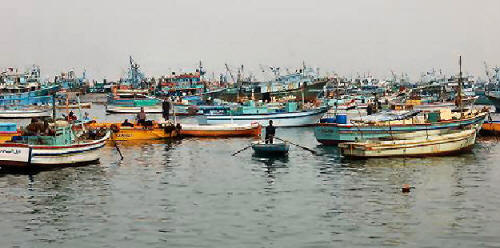
Arab fishing boats
However, we must
leave Arabia and continue east to the countries of Pakistan, and India. |