|
Here, where my fresh-turned furrows run,
And
the deep soil glistens red,
I will repair the wrong that was done
To the living and the dead.
Here, where the senseless bullet fell,
And the barren shrapnel burst,
I will plant a tree, I will dig a well,
Against the heat and the thirst.
Here, in a large and sunlit land,
Where no wrong bites
to the bone,
I will lay my hand in my neighbour’s hand,
And together we will atone
For the set folly and the red breach
And the black waste of it all;
Giving and taking counsel each
Over the cattle-kraal.
Here, in the waves and troughs of the plains,
Where the healing stillness lies,
And the vast benignant sky restrains
And the long days make wise –
Bless to our use the rain and the sun
And the blind seed in its bed,
That we may repair the wrong that was done
To the living and the dead !
Rudyard Kipling The Settler
(South African War ended, May 1902)
Saturday mornings as a
young boy I would often join friends at the local cinema
matinee for an admission cost of 3 or 4 old pennies. The
programme was usually a Western movie or adventure film. Very popular
were the Tarzan and Jungle Jim films, invariably
featuring former Olympic swimmer Johnny Weismuller. These gave me my
first impressions of Africa, (though they were probably all filmed in
the USA), and later reading the books of Scottish explorers and
missionaries like Mungo Park and David Livingstone, I compiled the
common romantic view of the region. Harsh realities of another side to
the dark continent were glimpsed years later in what we
heard about the Mau Mau rebels
in Kenya, and the Apartheid regime in South Africa.
Our
local Laird, Captain James Brander Dunbar of Pitgaveny, (b.1875,
d.1969), was a colourful character, and an old Africa hand. I believe
his father of the same name and title was the model for John Buchan’s
fictional character ‘John Macnab’. I spent an afternoon with
him in 1965 when on a brief home leave and at his request our U.F.
church minister Mr Adamson, brought me to his house which was a
veritable museum of African artifacts. Captain Dunbar wore a kilt most
of the time, and feuded regularly with local councils when he reckoned
they stepped on his realm of authority. Sixty years after he served in
the Boer war, he could still recall Bantu and Bushman words with
accuracy.
Beside the ungathered
rice he lay, his sickle in his hand,
His breast was bare, his
matted hair, lay buried in the sand,
Again in the mist and shadow of sleep, he saw his native land. …
He did not feel the driver’s whip, or the burning heat of day,
For death had illumined the land of sleep, and his lifeless body lay, -
A worn-out fetter, that the soul had broken and thrown away.
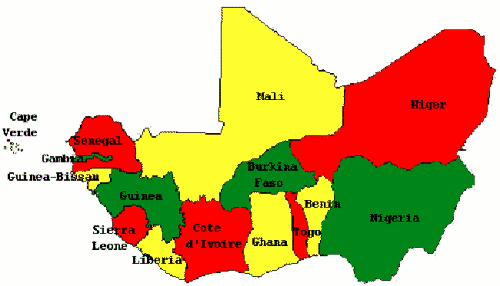
map of West Africa
The history of the
horrific slave trade of the 18th and 19th
centuries, is a shameful blot on the characters of the nations
involved. One is surprised that it took so long to eradicate that
evil. It is salutary to note the arguments made in support of slavery.
They were mainly economic, but also military and even religious.
Similar arguments are put forward today in defence of torture,
prostitution, imprisonment without trial, use of land mines and cluster
bombs, and illegal invasions or interference in the affairs of other
sovereign states. We condemn the evils of the past, but are often blind
to those of the present.
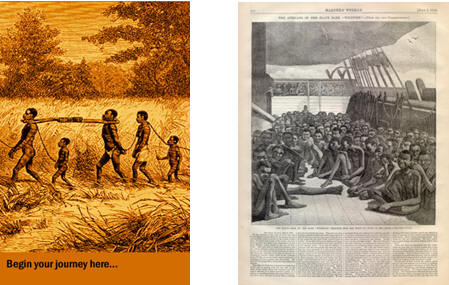
drawing of a
slave march African slave ship
|
The great
campaigner against slavery
William Wilberforce, more than
any other person in Britain, Europe or America, brought the
iniquitous slave trade to an end, by his tireless and life-long
efforts. A devout Christian, and Member of Parliament, he
declined high office and remained independent all his life so he
could more effectively expose the evils of slavery and promote
the abolition. Supported by senior politicians like William
Pitt the Younger, inspired by prominent Christians like John
Newton and the members of the ‘Clapham sect’, and opposed by the
most of the Royalty and the merchants involved in the
West Indies
trade, Wilberforce worked tirelessly to achieve legislation
ending the slave trade in 1807, and
abolition
of slavery in the year of his death in 1833.
The men were
all put in irons, two and two shackled together, to prevent
their mutiny or swimming ashore. The Negroes are so willful and
loth to leave their own country, that they have often leap’d out
of canoes, boat and ship, into the sea, and kept under water
until they were drowned to avoid being taken up … they having a
more dreadful apprehension of Barbados than we have of hell
Captain H. Thomas, “The Slave Trade - 1440 – 1870”.
The stench of the hold (of the
slave ship), while we were on the coast, was so intolerably
loathsome, that it was dangerous to remain there for any time …
now that the whole ship’s cargo were confined together, it
became absolutely pestilential. The closeness of the place, and
the heat of
the climate,
added to the number on
the ship,
being so crowded that each had scarcely room to turn himself,
almost suffocated us. This produced copious perspirations, so
that the air soon became unfit to breathe, from a variety of
loathsome smells, and brought on a sickness among the slaves, of
which many died … The shrieks of the women , and the groans of
the dying, rendered it a scene of horror almost inconceivable.
from “The
Interesting Narrative of the Life of (former slave) Olaudah
Equiano” 1789
The slaves are stowed so close,
that there is not room to tread among them. … For the sake of
exercise, these miserable wretches, loaded with chains,
oppressed with disease, - are forced to dance by the terror of
the lash,
and sometimes by its use. … Such enormities as these, having
once come within my knowledge, I should not have been faithful
to my senses or reason, if I had shrunk from attempting the
abolition…. I could not help distrusting the arguments of those,
who insisted that the plundering of Africa was necessary for the
cultivation of the West Indies. I could not believe that the
same Being who forbids rapine and bloodshed, had made rapine and
bloodshed necessary to the well-being of any part of His
universe. from
Wilberforce’s speeches to Parliament, 1789
Africa,
Africa, your sufferings have been the theme that has arrested
and engages my heart – your sufferings no tongue can express; no
language impart. … The restoration of these poor distressed
people to their rights, is nearest to my heart. We were once
as obscure as the nations of the earth, as savage in our
manners, as debased in our morals, as degraded in our
understandings, as these unhappy Africans are at present. … Had
other nations applied to Great Britain the reasoning which some
(here) apply to Africa, ages might have passed without our
emerging from barbarism. … God forbid that we should any longer
subject Africa to the same scourge, and preclude the light of
knowledge, which has reached every other quarter of the globe,
from having access to her coasts!from Wilberforce’s speeches to
Parliament, 1792
(Most of the above is drawn from
William Hague’s splendid biography of William Wilberforce, the
life of the great anti-slave trade campaigner, Harper Collins,
London, 2007.) |
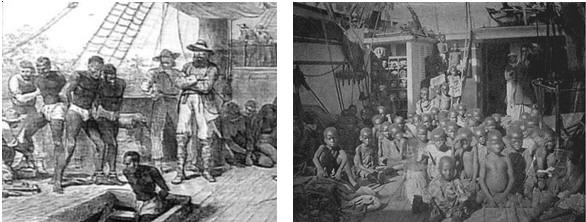
on board a slave ship, -
drawing actual photograph of a slave ship
I worked in several
West African countries in the 1990’s. Some, like Togo and Benin, were
beset with corruption and rotten rulers whose rotund bodies and greedy
eyes gazed from portraits in every public office. They were usually
pictured in uniform, bedecked with medals of doubtful meaning or
origin. Their fancy limousines would be preceded by a score or more of
motor-cycle policemen, and all other vehicles had to drive off the road
as the President’s vehicle approached. In some African countries, any
one who dared to walk past the ruler’s palace gates after dark would be
shot before any questions were asked. The corruption went down the line
with every official grabbing all he could. My heart went out to
idealistic fishery staff members in a francophone country whose
miserable salaries were taxed by their boss to augment his.
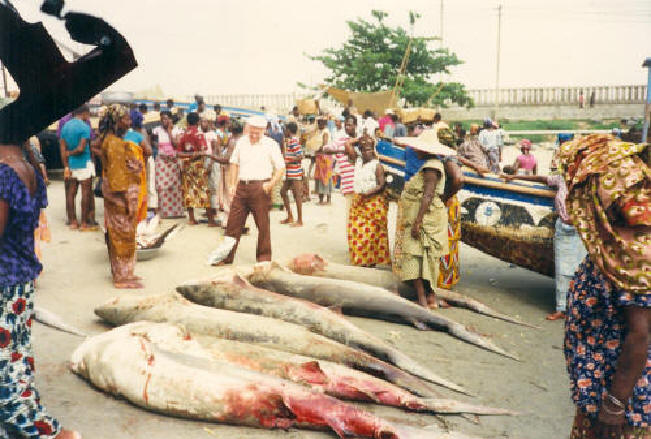
Canoes and catches on West African
beaches
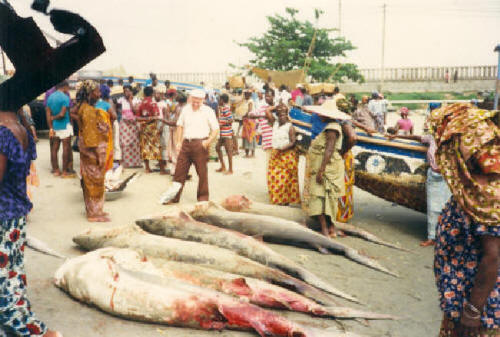
Over in Freetown,
Sierra Leone, before the civil war there, those poor but delightful
people suffered under a government that couldn’t or wouldn’t pay their
salaries. I have had hungry officers in the Ministry of Natural
resources or Agriculture, beg for a few Leones to help them feed their
families. The fishery offices in Freetown were formerly the British
Navy’s barracks in that port. In 1990 they looked as if they had not
been swept out, far less painted or repaired since the day the last
British sailor marched out. In some government offices there and
elsewhere in West Africa, files lay in a heap in the corner of the
offices of directors or senior administrators. Away from the capital,
government officers sat at empty desks beside typewriters that lay idle
due to lack of paper or ink ribbons. The roads in Freetown had potholes
every few yards, yet scores of diamond dealers were driving around in
Mercedes Benz cars while the vast majority of the people lived in
squalid circumstances.
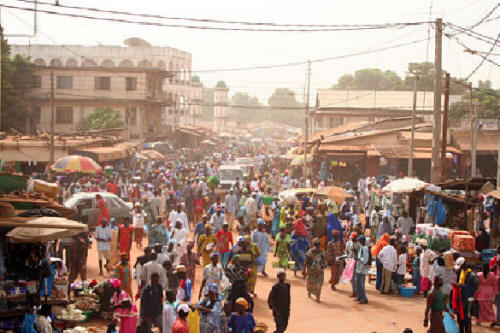
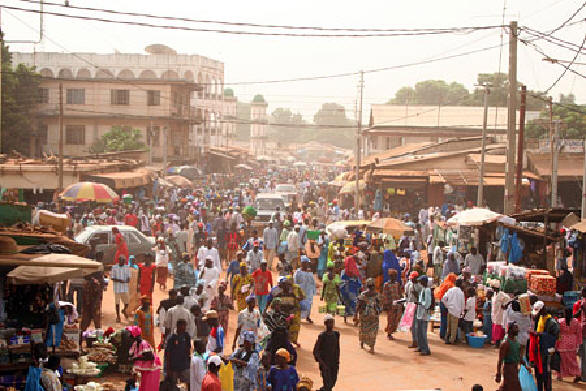
Gambia, market scene
Cape Verde, former Portuguese base off
West AfricaI I visited these lovely but barren islands on behalf of
Iceland’s foreign aid programme.
Gambia, being a smaller
country, north of Sierra Leone, had less population pressure or urban
squalor. It also maintains a strong British culture inherited from
colonial days. One finds Africans who served with Scottish regiments,
still able to play the bagpipes with pride. Offshore, the islands of
Capo Verde, a former Portuguese trading ship base, are very different
from mainland Africa, but struggle to create a sustainable economy due
to poor soil, limited fresh water, and little tradable resource apart
from fish (mainly ocean swimming tunas).
My experience with the
Shell Oil company of Nigeria gave me a glimpse of the problems created
when you have the extraction of enormous wealth from an area where local
people live in dire poverty. I had similar experiences with Caltex in
Indonesia. The Niger delta pays a heavy price in environmental damage
for the oil extraction business, and one can understand why this has led
to attacks on installations, and to bloodshed at times. To give Shell
its due, the company attempts to provide compensation, and in the Delta
area it operates an agriculture extension service bigger than anything
the federal or state governments could mount. My judgement was that the
reason this did not placate the locals was the manner in which the
service was provided. Shell’s pandered and well-paid local officers
(all black, - the whole company is locally staffed), strutted about like
little lords and treated the people accordingly. The locals were not
really consulted, - they were simply told what Shell would do for them,
and how they had to cooperate.
Similarly, my
recollections of Caltex in eastern Sumatra, are of a beautiful modern
floodlit complex behind a high barbed wire fence. Just outside the
fence, local fishers had to manhandle their baskets of fish up a steep
muddy path from the river below to a miserable shack set on top of a
rubbish dump, where their fish were auctioned. There were no facilities
worth the mention, - no clean water, toilets, or proper access for fish
vans or tricycles. And the fishers had to pay 10% of their sales income
for the privilege. Perhaps conditions have changed since, but the
contrast then was obscene.
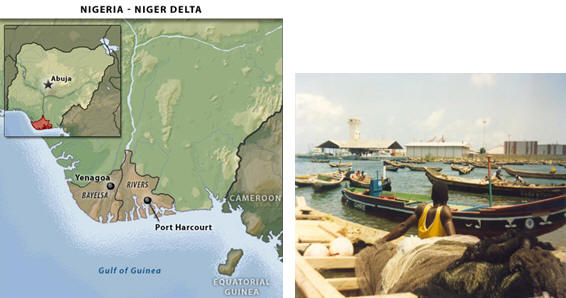
Map of the Niger Delta where Shell Oil
has massive investments. West African marine canoes.
Oil, perhaps more than
any other resource, creates serious social tensions in poor countries
where the enormous income is grabbed by the ruling elite, with little
distribution down the economic ladder. Professor Michael Klare writes :
“When countries with few other sources of national wealth exploit
their petroleum reserves, the ruling elites typically monopolise the
distribution of oil revenues, enriching themselves and their cronies
while leaving the rest of the population mired in poverty – and the
well-equipped and often privileged security forces of these
“petro-states” can be counted on to support them. When the divide
between privileged and disadvantaged coincides with tribal or religious
differences, as it often does, violence isa likely outcome. The Western
press may describe such conflict as “ethnic” in character, but it comes
largely from the perversive effects of oil production.”
[The Dependency Dilemma, in Blood and
Oil, by M. Klare, Penguin, 2005]
With all its faults,
British rule in Africa never produced such horrendous results, - at
least, not since the Boer War which was a monumental foreign policy
disaster. Despite my obvious liberal and leftish views, I must admit
that colonial rule in the 20th century was largely beneficial
for the continent and its peoples. Some Governors were admirable men of
understanding and integrity. My wife and I bought a farmhouse in
Edinburgh from Sir Peter and Lady Isobel Faucus who had served in
Botswana after the war, and till the colony achieved independence. He
and his wife regularly entertained Africans studying in Edinburgh each
Christmas, in a former ‘bothy’ building behind our farmhouse, and we
were also welcomed to these events. I had the chance to visit Botswana
when undertaking work for SADC, the Southern Africa Development
Community, in the 1990’s and found it peaceful and relatively prosperous
as Sir Peter had described it.
Are there not some
bright spots in Africa? Are there not at least a few success stories?
The answer is yes, and I will name two where I spent some time. One is
Ghana where the half-Scot leader, former flight Lt. Jerry Rawlings
managed to bring his country out of impending disaster to be the one
example in West Africa of reasonably fair and stable government and
profitable industry. The people are hard working and intelligent, and
while corruption exists, it is far from the extremes ones finds in most
of the continent. Rawlings called himself “Chairman” rather than
“President”. He avoided fanfare. I was driving around Accra in a taxi
one day when an ordinary-looking minibus passed us. The taxi driver
said, “Did you see who was sitting in the front of that minibus?
That was Chairman Rawlings. He doesn’t mind traveling about like an
ordinary citizen”.
Jerry Rawlings, former President of
Ghana. He had a Scottish mother.
Ghana was also the only
country where I met the Prime Minister [Not
quite correct. In Papua New Guinea I worked with Sir Mekere Maruata,
former head of the National Bank, who became Prime Minister four years
later, in 1999.]
Mr Oti gave me an hour of his time to explain how he wanted a fishery
sector investment project designed. I thought his ideas were sound and
reasonable, but when I took them back to the UNIDO office in Vienna,
they paid not the slightest heed to his suggestions and requests. Was
it any surprise the draft project was rejected ? But that was typical
of the ivory tower attitudes of some UN technocrats. Also, to my
surprise, my proposal to establish a tuna canning plant in Tema, was
ambushed by a team of French consultants in Vienna (they were against
any competition for the French canning plant in Cote D’Ivoire).
However, Ghana obtained alternative finance, and the canning plant went
ahead and is functioning to this day. That was not the only successful
fish canning plant whose establishment the UN tried to block. The other
was in Fiji, but that is a different story.
Another country in
Africa that gives me hope for the future is Namibia. Formerly
South-West Africa, a German colony before the war, and effectively part
of the South African state after the war, it achieved independence under
a SWAPO government in March 21 1990. Few gave it much chance of
survival as it had a population of only 1.5 million, and was mostly
desert, the Namib. But Namibia went from strength to strength. Its
mixed population of whites, coloureds and blacks, - both Bushmen and
Bantu, were surprisingly tolerant of each other, and the Government on
the whole behaved wisely. The fisheries sector was blessed with a
remarkable Minister, Helmut Angula, who spoke six languages, and had
written at least one book that I know of. He took over when the fish
stocks had been ravaged and depleted by South African and European
fleets. Angula set to work assisted by a brilliant fisheries economist
from New Zealand, Les Clark. He had the country claim its legitimate
200 mile EEZ and banned all foreign fishing. The local EU Commissioner
put every pressure he could on Angula to give European fleets carte
blanche to continue to rape Namiba’s fish stocks, but Helmut would not
budge. “I have hardly enough fish for our own fleet, - how can I
give some away to you?”, he told the commissioner. So despite all
sorts of pressure and threats to withhold aid, Namibia won. The EU
conceded, and today that small country has the most prosperous fishery
sector in all Africa. I reported the Namibia experience in a number of
papers and newspaper letters which led a senior Scottish civil servant
handling the fishery sector to remark, “We don’t want to hear another
word about Namibia, - we are fed up hearing that story” !
I was also able to
visit South Africa both before and after Mandela took over. What struck
me on my first visit was how many white South Africans were in favour of
the change, and were ready to do their bit to make it work. I also met
black ANC members of Parliament later, including one who regularly
visited Mandela in Robbin Island. They too were interesting characters,
though wary and suspicious of all whites, including liberal whites like
myself. But I found that also in the USA. The black American of the
1960’s did not trust the liberal northern white. He suspected, probably
correctly in many cases, that under the liberal skin lurked a latent
racist if the person was only put to the test in the appropriate
circumstances. My heart goes out to the new South Africa. It faces
immense problems. How do you provide housing, education, jobs,
health-care, clean water, and a future for 40 million disadvantaged
citizens. It is far from easy. But the country had the most marvelous
first post-apartheid President in Nelson Mandela, a man of tremendous
courage, character and determination.
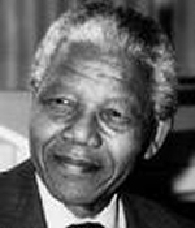
Nelson Mandela
I enjoyed reading
Mandela’s biography, but was more moved by the account of his Robben
Island experience written by his former prison warder, James Gregory, “Goodbye
Bafana”. That is one of the finest books on Mandela, and on the
forces at work in South Africa. Previously I had read the series of
books on the country written by Michael Cassidy, an evangelical Anglican
minister, and many years before, Trevor Huddleston’s epic volume,
“Naught for your Comfort”.
Some tales from Cape
Province may shed light on the difficulties President Mandela faced when
attempting to redress years of racial injustice. Under the apartheid
government, black and coloured communities were largely excluded
from access to lucrative fish quotas and processing or marketing
privileges. This policy was quickly changed under Mandela, and the
fishing cooperatives of the black and coloured coastal towns finally
obtained reasonable access to fish stocks. But Mandela and his largely
black ANC government had to contend with a white bureaucracy that did
all in its power to nullify the changes. It was a case of ‘government
proposes, bureaucracy disposes’ ! When translating the quota
allocations into regulations, they added a number of restrictions that
prevented the communities from realizing the benefit of their newly won
quotas. For example, one community I visited had been granted a quota
for abalone, but were forbidden from selling them to any other merchant
or processor than the local white owned fish plant. With that monopoly
control on purchase, the white company could offer any price it liked.
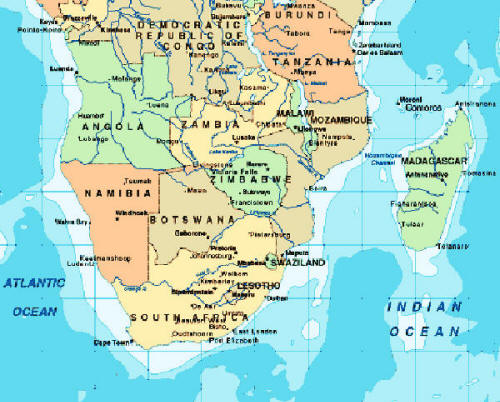
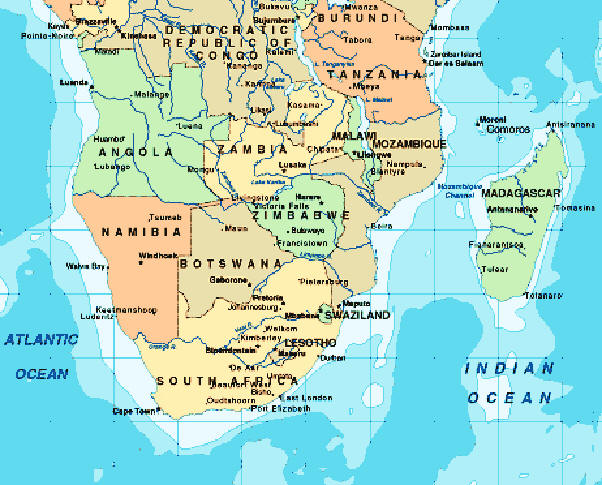
map of Southern Africa
Another coloured
fishing company got a quota for sardine or pilchard to catch which it
needed to buy a small purse seine vessel. I put them in touch with
sellers of a suitable vessel in Scotland, but when they attempted to buy
the boat, with a loan from a local bank, the bureaucracy refused them an
import license. Other indigenous fishermen operated a few long line
vessels for tuna. They had no income for the 4 or 5 months when the
migratory tuna left their shores. So they requested a small hake quota
for that season, which they would catch by using bottom set long lines.
This was refused on the grounds put forward by the white dominated
fishery research board, that unlike bottom trawling, “long lining
would be detrimental to the stock”. The argument that hook and line
fishing was damaging to the resource while the use of huge powerful
trawl nets was not, would have been laughed out of court in any of the
fishery countries of the north Atlantic!
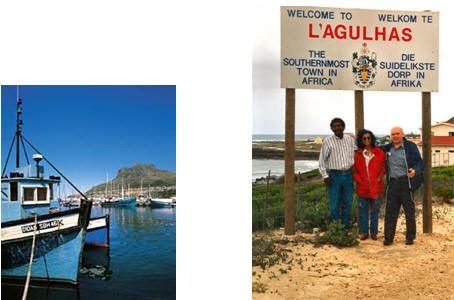
Cape fishing boats, South
Africa Johnny Issel, ANC MP, at the Cape of Good Hope
Together with a local
ANC member of parliament Johnny Issel, I visited a black and coloured
fishery cooperative in the Western Cape. They were hoping to expand
their operations from fish harvesting to processing and marketing, and
were seeking to form joint ventures with fishery enterprises in Britain
that might provide expertise and training, as well as assist them to
obtain the necessary equipment. We were well received and treated
generously. As we sat down to a magnificent meal of curried crab and
lobster, I asked Johnny if he said grace before food. He said no, and
passed the question on to the Coop Secretary. The man replied that he
was not a Christian and didn’t know how to pray. At that, one of the
members stood up, a black man called John Moses. He said he would say
grace, and then proceeded to give an eloquent prayer of thanks for the
food. He had bullet wounds in his legs from attacks by white fishers
who resented the coops newly allocated fishing rights and were disputing
the issue on technicalities. John told me that he was due in court soon
to answer their charges, and he fully expected to go to prison, not that
is seemed to bother him at all. That was how things were even after the
election of Nelson Mandela as President of the New South Africa.
An interesting
character who had an enormous influence on all of Africa through her
music, was Miriam Makeba. She was born in South Africa, and began her
career as a young woman. Now 73 years old, she has been singing for
Africa for over 50 years. Many a time in the bush station by lake
Kariba, we showed films to the staff and locals to provide some
entertainment on a Saturday night. Miriam Makeba’s singing performances
were always well received, and some young staff members like Aston
Musonda, my stores officer, were enchanted by the good looks and
beautiful voice of Makeba. Exiled by the Apartheid regime in her
homeland, she moved to West Africa for a period, where for a while she
was married to the American civil rights leader, Stokely Carmichael.
She returned to her homeland following the election of Nelson Mandela.
Makeba is still active today though she has ceased to give public
performances.

Above : Miriam Makeba, famous African singer. She was already widely
known and appreciated when I went to Africa in 1962, - and surprisingly
is still active in music and entertainment. She was once married to
Stokely Carmichael of the U.S. civil rights movement.
African music is
something special. They have a marvelous natural sense of rhythm which
is well recognized. Not so appreciated, but equally notable, are the
lyrics of popular songs written by African musicians. The songs have a
simplicity and a poetic appeal that I for one found fascinating. Few of
these simple African ballads find their way into the recording studios
of the USA or Britain, which I regard as pity. Some musicals and light
operas have been written by African musicians. One that sticks in my
mind is King Kong, a rather tragic tale about an African
heavyweight boxer who eventually ruins his life. If I recall some of
the lines from one song, they went : “King Kong, bigger than Cape
Town, King Kong, hundred feet tall, King Kong, no one can touch him, -
that’s me, I’m him, King Kong, King Kong. A man of stone, a man of
stone, King Kong, King Kong, he walks alone, he walks alone, King Kong,
King Kong.” That and many other pieces were acted out by an all
black cast swaying and singing in perfect rhythm and harmony.
The musical was written by Pat Williams and composed by Todd Matshikiza
around 1960, and was performed at least once in London.
Looking back on the
colonial era in Africa, the picture is mixed. There was reasonable
government in many if not all cases. Exploitation occurred to a degree,
but there were genuine benefits. Once the horrendous slave trade was
halted in the early nineteenth century, European interventions in the
dark continent were more concerned with trade and with strategic
military and political advantages. The Arab slave trade began earlier
and continued longer, but today it is Africans who sell Africans into
slavery, or abduct them to be child soldiers. My namesake, David
Thomson the historian, wrote in “Colonial Expansion and Rivalry”,
that in 1875, less than ten per cent of Africa had been turned into
European Colonies. By 1895, only one tenth of the huge continent had
not been appropriated. He also remarked that it was a historical
novelty that most of the world should then belong to a handful of great
European powers. I would not attempt to defend colonialism, but simply
note that since 1950, the last 25 to 30 years of Britain’s colonial era
was marked by decency and justice for the most part.
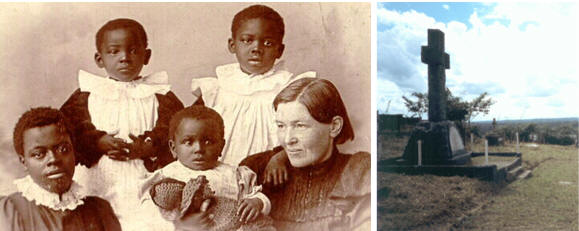
Mary Slessor of Dundee, the
indomitable missionary who saved the lives of countless numbers of
children and mothers in Calabar, Nigeria. On the right : her the grave
by the river, Calabar. Outside the local university there is a statue
of her above the roundabout with twin babies on her knees to recall how
she stopped the practice of infanticide.
The major colonizing
countries were France, Britain, Germany, Portugal, Belgium and Italy,
though Spain also held territory in West Africa. Dutch Boer farmers set
up the independent entities of Transvaal and the Orange Free State in
South Africa. The senseless Boer war was a result of British refusal to
recognize the Boer governments. Early clamour to grant independence to
colonial lands occurred in 1860 -1870, then grew rapidly after WW2.
Mostly the handover of power went smoothly except in a few sad cases
like the Congo, Algeria, Mozambique, and Zimbabwe; (interestingly, -
respective examples of Belgian, French, Portuguese and British rule).
Since obtaining
independece a disappointingly large number of black African governments
have displayed corruption and callous brutality beyond that of any
colonial regime, apart from South Africa where a white minority
maintained a brutal police state to suppress dissent and enforce
apartheid. Non-Arab or non-Muslim black Africans were also mistreated
by the regimes in power in the Sudan and some neighbouring states. It
did not help matters that during the era of decolonization, Africa was
caught up in the cold war power struggle between east and west, and in
the brutal attempts by the old South Africa, to destabilize black
governments and support mercenary-led insurgencies.
|
Brutality,
Interference and Manipulation
Petty tyrants,
supported by either the east or the west, emerged to inflict
appalling cruelty on their own people. Tribal loyalties and
differences were exploited by callous leaders to bolster their
grip on power. Mobutu in Zaire, the former and present Congo,
was typical of the worst of those supported by the west. While
his people remained at poverty level, he amassed over a billion
dollars. In Uganda, Idi Amin exhibited the worst traits of
brutal rule and ethnic cleansing. When he was eventually
ejected from the country, he was granted life-long safety and
comfort in Saudi Arabia. A different fate was reserved for
Moise Tshombe of the Katanga secession in the Congo. His
erstwhile European backers washed their hands of him and
acquiesced with USA and UN support for Mobutu. He was taken off
a flight headed back to Africa, but which was forced to land in
Algeria, where he was incarcerated and eventually died in
prison. No European government lifted a finger to help him
though his brief rule in Katanga was efficient and civilized. I
visited the Katanga during a trip to lake Mweru, and was
impressed by all I saw there. The local priest gave us
hospitality as did the nuns at a local hospital. Before we
left, the French and Bemba - speaking students of a fishery
school, all in bright sailor uniforms, linked arms and sung to
us “my bonnie lies over the ocean”. I often wondered
after what became of them. The UN troops under Connor Cruise
O’Brien were not far away.
The atrocities
in the Congo were to be out-done by more appalling massacres in
Rwanda and Burundi, and by the manipulated deaths by starvation
of hundreds of thousands in Ethiopia, and also in the Sudan and
Somalia. The wars in Angola and Mozambique were fomented by
western powers in cooperation with apartheid South
Africa. The dreadful Biafra war in south-eastern Nigeria was
over control of the oil wealth, and illustrated the sad effects
of colonial powers having carved out “countries” in Africa, with
almost no consideration given to ethnic or religious
differences. The ‘borders’ issue is not solely to blame for
Africa’s troubles, but it has been a significant factor in its
instability.
I visited Biafra
much later, on assignments for the Shell Oil Company and the
Petroleum Trust Fund, and spoke to several local persons who had
some memory of the conflict and the accompanying famine. But my
interest went back farther to the work of a Scots missionary
lady, Mary Slessor from Dundee, whose picture is on the current
Clydesdale Bank ten pound note. She built up a pioneering work
of schools and hospitals at Calabar, and is credited with ending
the tribal practice of killing at least one of any twin babies
that were born. There is a statue of her on a monument above
the roundabout outside the University there. Appropriately, she
is seated, with a set of twins, one on each knee.
|
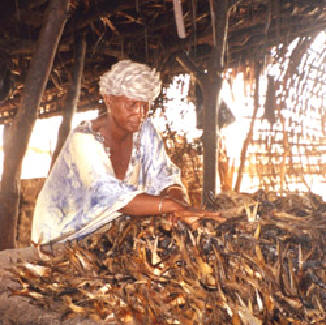
Smoked fish in a West African
market. It takes a cubic metre of wood to smoke one tonne of fish.
There are half a million tones of fish smoked this way in West Africa.
This adds greatly to the demand for fuel wood.
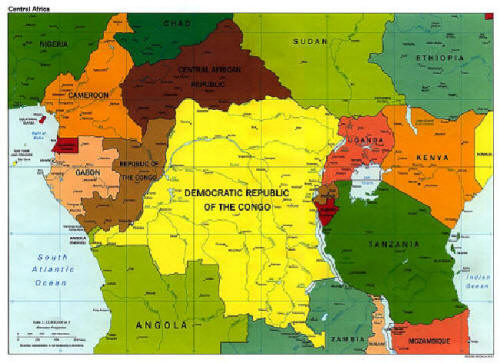
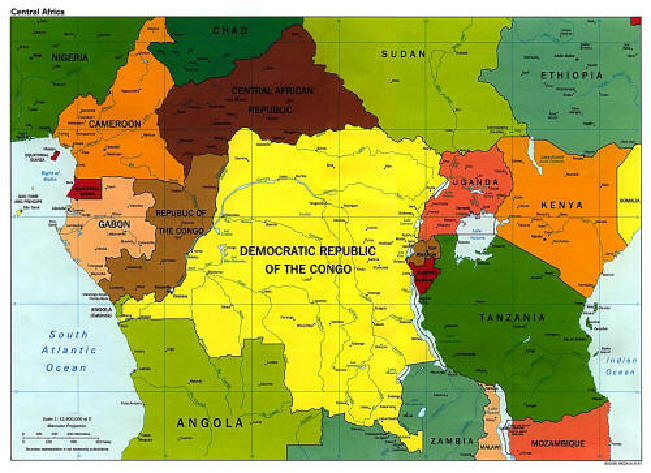
map of Central Africa
|
Uganda’s sad
history
Among the lands
that suffered dreadfully from corrupt and despotic rulers,
Uganda stands out, having gone through a period of brutality and
slaughter from 1965 to 1985 under the alternate rule of two
despots. Milton Obote, (1924 – 2005) who led the country from
independence in 1962 till his overthrow in 1985, was surpassed
in his cruelty and mismanagement only by his own army chief, Idi
Amin, (1925 – 2003), who deposed Obote and controlled the
country from 1971 to 1979.
Obote was a
northerner, of the Langi tribe, part of the the Nilotic people.
Amin was from the southern kingdom of Buganda located around
Kampala. The two men set up a lucrative business smuggling gold
and ivory from neighbouring Congo. This was denounced by King
Frederick Mutasa II of Buganda. Obote dismissed his government
in 1966 and made himself president for life. On Obote’s
instructions, Amin destroyed King Freddie’s palace and murdered
200 of his staff and bodyguards. The two dictators grew
suspicious of each other, and when Obote tried to have Amin
arrested, his army chief took control and executed Obote’s
supporters.
Over the next
nine years, an estimated half a million Ugandans were to perish
under Amin’s brutal rule. He sent most of Uganda’s Asians into
exile, the people who ran most of the trading stores and service
companies in the country. This action crippled the economy.
Then in 1976 he gave refuge to Arab hijackers who had taken over
an Israeli flight. But the Israeli army and air force landed at
night and rescued the passengers, killing the hijackers in the
process. In 1978 Amin invaded the Kayera river territory of
Tanzania, prompting the Tanzanians to respond with a 45,000
strong army counter invasion which drove Amin out of the
country, first to Libya and later to Saudi Arabia where he
eventually died.
Amin’s expulsion
did not end the suffering of Ugandans. President Obote was
restored to power. He reactivated Amin’s horrid State Research
Bureau which continued to perpetrate atrocities for the next
five years. Another half million Ugandans were to die under
Obote’s second regime. He was eventually deposed by Acholi
soldiers (from a northern tribe that Obote had denied senior
military posts to award them to his own Langi tribe troops). In
June 1968, Obote fled into exile in Zambia. He died in South
Africa in 2005.
Today, Uganda
still suffers. To the north-east are the ‘Karamajong’,
cattle-rustling tribes people who can descend to murder of
villagers at times. To the east lies Democratic Congo, and over
there from the SE Ugandan border, there is a haven for a bunch
of warring rebel groups from Rwanda, the Congo, and Uganda, who
make forays into Uganda, but are repulsed by the UPDF the
Ugandan army. Chief among the internal rebel groups is the
‘Lord’s Resistance Army’ which is reckoned to be among the most
ruthless of armed bodies in Africa, that force children into
service in their mindless slaughter, robbery and abuse of poor
village people in areas the army can barely protect. Around
20,000 children are believed to have been abducted to date.
They now attack NGOs, even in southern Sudan, where they are
fiercely opposed by the Sudan People’s Liberation Army. Simon
Wunderli, a Swiss family friend, flies mercy missions into the
troubled areas every week. Speaking of the displaced persons
camps, and the rehabilitation centres for former child soldiers,
he says one abiding impression grieves him most :
“It’s
the void in their eyes, the lack of any glimmer of joy or hope,
the dullness of having seen things that nobody ought to see in a
life time.”
The current
President, Yoweri Museveni, continues to govern a one-party
state. Some fear that his regime is developing features sadly
similar to those of his predecessors’ misrule. |
Apart from the
brutality, corruption and mis-rule of many of its governments, Africa
faces a horrendous problem of destruction of its environment. This
relates in part to the survival mentality of the people, and the
practice of traditional ‘slash and burn’ agriculture that is practiced
all over the continent. In consequence, deforestation proceeds apace,
with soil erosion and desertification in its wake. The deserts are
expanding by leaps and bounds. Former water bodies like Lake Chad, are
now dried up holes. The need for firewood and for new fields to grow
maize or millet, keeps the bush destruction proceeding relentlessly. In
our development projects we placed great emphasis on fuel conservation
and use of alternative fuels and energy. We advocated planting and
operation of sustainable woodlots that could maintain families and
provide fuel and food, and prevent soil erosion. But these ideas were
rarely given the seriousness they merited from either African
governments or UN Agencies. I even advocated temporary import of cheap
wood fuel from South America to give time for African woodlots to be
established. But no, no one saw any merit in that, and so the
environmental destruction continued.
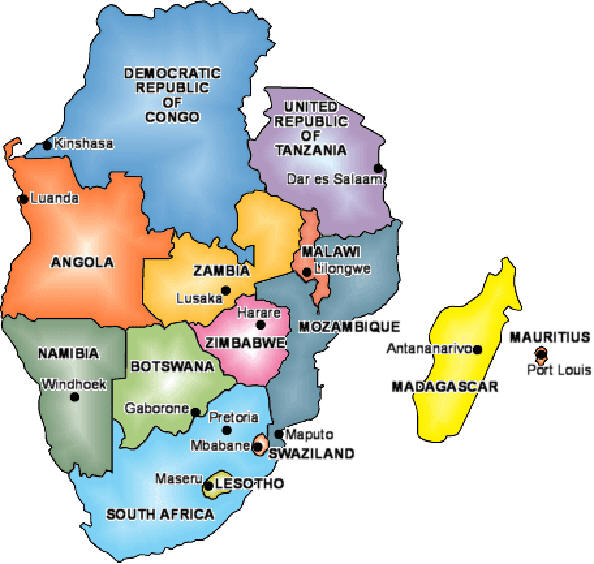
map of Southern Africa
One cannot help
comparing the attitudes and behaviour of Asian farmers with those in
Africa. Asia has its environmental problems too, but the beautiful and
complex tiers of rice fields and water channels one observes from Bali
to China and India, are the obvious results of generations of
painstaking investment in the future. Africans have rarely enjoyed the
luxury of long-term horizons. They are too concerned about where
tomorrow’s meal will come from. They may be dead next year, so why
conserve ? Their prime concern is survival, so they feel they cannot
afford the luxury of investing in a future they may not live to see.
And so they consume the seed corn of the future as they strip the
forests for fuel-wood, and fail to protect, replenish and enrich the
soil. I see little attempt to reverse this fatal direction, by either
national governments or aid organizations. Most of the staff members I
know in the UN Food and Agriculture Organisation, have given up on
Africa. The oft-repeated description is that it is “a basket case”.
The only Asian country they say that of is Bangladesh.
Some states in Africa
are in a mess because of external interference as much as local
failure. I put Zimbabwe in that category. President Mugabe is brutally
ruining the country to grab land for his supporters and so hang on to
power. But he is able to do that and to gain a measure of support from
the blacks because the white settlers and the British Government have
together failed to address a problem that has been crying out for a
solution for over 50 years. Since the time of Cecil Rhodes, the land
has been viewed as ‘belonging’ to the colonials who took possession of
it and settled there in the benign climate. True, they developed
efficient tobacco and maize farms, livestock ranches and orchards, game
parks and safari resorts, - but it was all 90 % white owned. Had there
been a genuine effort since Ian Smith’s time, or even after Mugabe first
came to power, to equip and empower and train local farmers to take over
agricultural land in small stages, then perhaps much of the bloodshed
and violence might have been avoided. Perhaps.
My own impressions of
Southern Rhodesia as it was in the early 1960’s is that it had the
mildest, most placid population of Africans in the region, but also some
of the most ignorant and prejudiced “poor whites” I ever came across.
The problem of maintaining secure employment for the poor whites was one
that concerned the white governments in both Southern Rhodesia and South
Africa. Harold Wilson had first hand exposure to the mean, uncultured
bigotry of some of the whites in Rhodesia which he visited in October
1965 in an attempt to avert the state breaking away from the
Commonwealth. After dinner at Ian Smith’s residence, guests had to sit
through a rude, racist speech by a high-ranking expatriate, Lord Graham,
the Duke of Montrose, who related a stream of smutty stories, all
expressive of racial contempt for black people. Wilson later spoke of
those represented by Smith, Montrose and their cronies, as, “that
land-locked, introvert community”.
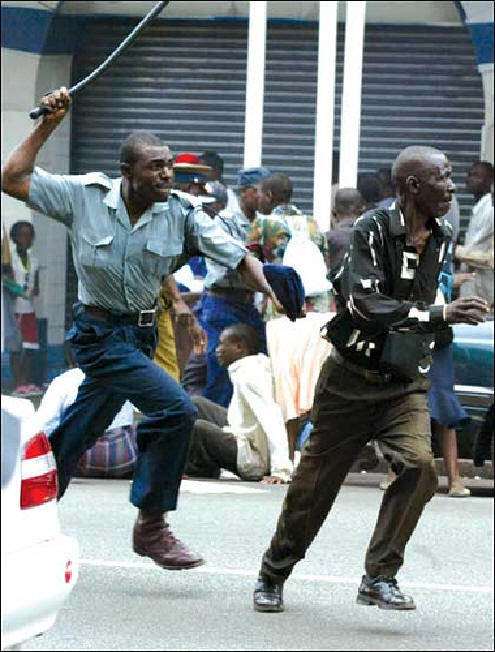
Zimbabwe police in action

Harare dwellers evicted from
their homes take-over of a Zimbabwean farm
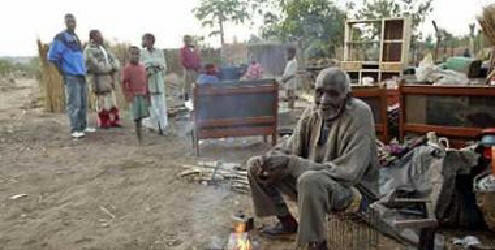
The sad lot of displaced persons
However, the present
collapse of Zimbabwe’s economy is due directly to Mugabe’s mismanagement
of the economy on a massive scale. He has killed the few industries
that were generating income and creating jobs, and has printed money in
large amounts to pay the army that keeps him in power, thus eroding the
value of the little savings his people had. The land reclamation
programme that could have been represented as a good form of wealth
distribution, has turned out to be a way of satisfying his cronies who
have shown zero skills in farm management, and a greater propensity to
exploit workers than was ever exhibited by the white farmers. Robert
Guest visited one of the confiscated farms. The new owner, a friend of
Mugabe’s wife, had evicted hundreds of black farm workers, and had their
houses ransacked to steal the severance payments that their previous
white employer was forced to give them before he was driven off.
Take Sierra Leone, that
has mineral resources and a productive land, a natural seaport, and a
strategic position for trade, - it could be the ‘South Africa’ of West
Africa. It was once self-sufficient in rice. Its diamond mines rival
those of South Africa, and its fisheries could rival those of Namibia
and Ghana. But it lies today, in abject poverty, with no government
worthy of the name, no security, and apparently, no future. Liberia is
in a similar mess. Yet those two states were to be shining examples of
freedom and progress as they were selected to be the homes of former
slaves returned to Africa. The Congo and Angola are other states that
have enormous oil wealth but are languishing in poverty, corruption,
lawlessness and insurrection. What went wrong, and can anything be
done?
Could a new form of colonialism give them stability and set
them on a course for prosperity. I once thought it might. But the
interference of western powers in other countries throughout the world,
the past thirty years, from Vietnam to Iraq, has been almost totally
disastrous. So I doubt if it would be any different in West Africa. It
would be wonderful if the global arms industry could be prevented from
selling any guns or ammunition to the continent of Africa, - it would
certainly help - but it would be a vain hope. As vain perhaps as the
hope that the rich countries would pay a decent price for the raw
produce and materials they import from Africa.
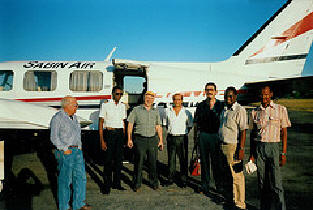
Below : about to board
a flight up the Mozambican coast, May 1993
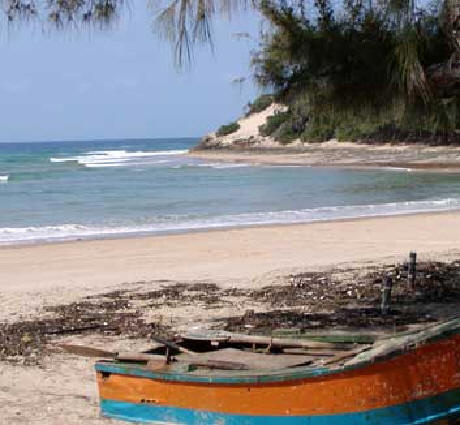
a beach in beautiful Mozambique
I have thought long and
hard about the region’s debt, and whether it should just be written off
in a glorious international “year of jubilee”. But would Africa’s
corrupt rulers then use the new liquidity to buy medicines and school
books ? I doubt it. More likely it would be spent on luxury cars,
palatial mansions, and trips abroad, - if not also on weapons of
repression. So there needs to be corresponding mechanisms and
safeguards, along with the removal of debt, in order to ensure that the
new liquidity will not be abused. But that will be far from easy.
However, as discussed later, I believe that our national and global
financial systems are all biased in favour of the money lender and the
land owner. As in the gambling casino, or the game of Monopoly, the
banker always wins.
After considering
things at length, and examining all the evidence, it appears to me that
the best assistance Africa has enjoyed over the years, is not what came
from the World Bank or the EU, or from the U.N. as good as some of its
aid has been, but rather what has been provided in small amounts and in
simple projects by charities and missions and NGOs who were all working
on very modest budgets. Where would Africa be today if it had not had
the thousands of mission schools and hospitals ? – a lot worse off than
it is. When I was in Zambia, some communist sympathizers used to decry
the Christian charity. But I never in my life saw a hospital or a
school or a leper mission in a poor country that was financed or staffed
by Marxists or communists [That
is, outside of Cuba or Russia or China, and there the assistance
was government controlled.]. Never. They were mostly established and
operated by men and women who had given up all thought of financial
remuneration or the comforts of affluence, and had dedicated their lives
to ministering to the poor and disadvantaged, - all out of devotion to
Christ.
The terrible dark cloud
hanging over Africa today is that of the dread disease “Aids”.
In some countries like Lesotho, infection rates are nearly 40 %. Life
expectancy in the dark continent, which was never high, has dropped
considerably as a result. A really fine permanent secretary we had in
the Namibian Fisheries Department, died suddenly from the disease. It
made us realize that even healthy looking persons could be seriously
affected. Since drug companies stubbornly resist local manufacture of
their remedies that might be distributed at affordable cost, and since
it is hard enough for poor Africans to obtain or purchase even aspirin
or cloroquin, the chances of saving most of the aids victims are slender
at best.
Hope springs eternal in
the human heart, and it is so even in darkest Africa. There are
countries and peoples that could emerge from the chaos with dignity and
with the vision and drive to succeed. Given two big “ifs”, some
countries will make it. The first ‘if’ is that they get good
leadership. The second ‘if’ is that they are not subjected to outside
interference. Among those states with promise, I believe, are
Mozambique, Botswana, Namibia, Ghana, and tiny Gambia. And, we all hope
against hope, - the new South Africa. But who knows? The cards are
stacked against them, and they are surrounded by immense dangers within
and without.
Yet, despite all the
injustice, cruelty, exploitation, and brutality, remarkable men and
women of conscience and moral leadership have emerged, and made great
contributions to the degree of progress achieved so far. South Africa
in particular produced three great men of such stature, - Nelson
Mandela, Desmond Tutu, and Trevor Huddleston. It is fervently hoped
that there will be more such leaders arising in the years to come.
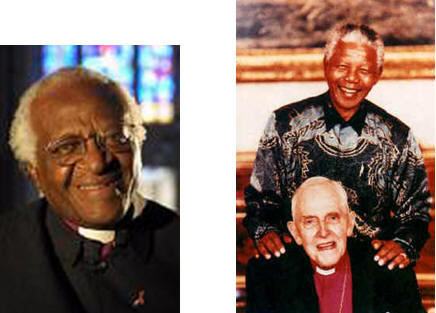
Desmond Tutu, magnificent defender of
freedom and justice touched the
conscience of the world, with Nelson Mandela.
. On the right with President Mandela,
Trevor Huddleston, who laboured for years in South Africa, and whose
book Naught for your Comfort,
Perhaps I could do no better than close this chapter with
Trevor Huddleston’s prayer for the continent:
“God bless Africa. Guard her people. Guide her rulers.
Give her peace. |