|
At sunset Martin Alonzo called out with great joy from his
vessel that he saw land, and demanded of the Admiral a reward for his
intelligence. When he heard him declare this, the Admiral fell on his
knees and returned thanks to God. … Those aboard the Nina ascended the
rigging, and all declared they saw land. … At two o’clock in the
morning, the land was discovered at two league’s distance. The Admiral
landed in a boat bearing the royal standard. On shore they saw trees,
very green, many streams of water, and diverse sorts of fruits. … The
people are of a good size and stature, and handsomely found. Weapons
they have none, nor are acquainted with them. They very quickly learn
such words as are spoken to them. I saw no beasts on the island, nor
any sort of animals save parrots. …
I came to the Cape
where we anchored today. This is a beautiful place. My eyes never tire
of viewing such delightful verdure, and species so new and dissimilar to
that of our country, which could be of great value as dyeing materials,
medicine and spicery. We experienced the most sweet and delightful
odour from the flowers and trees. …
Every day I have been
in these Indies, it has rained more or less. The land is verdant,
temperate, beautiful and fertile. The fish are shaped like dories,
blue, yellow, red, and every other colour. Here also are whales.
Beasts we saw none, nor any creatures on land save parrots and lizards;
but a boy told me he saw a large snake. No sheep or goats were seen.
From the journal of Christopher Columbus, 1492
The immense empire of
Brazil is divided into 20 provinces. Its situation is highly favourable
on account of the two mighty waterways, the Amazona and La Plata. These
link the sea trade with the vast interior of the continent. First
descriptions of the interior were by gold-greedy adventurers
who sought out Dorado, - the fabulous land of gold and diamonds.
Several large mines are still worked by English companies, but
agriculture is now considered to be a sounder basis of progress for the
country. The southern provinces are particularly well adapted for
cattle breeding.
Sugar cane is vital to the region, introduced by the
Portuguese in the 16th century. Pao Brazil dyewood is
exported. This is the product that gives the region its name. Tobacco
is another indigenous plant, held in high esteem by the Indian tribes.
The Pajeo or native priests besmoke their patients with big cigars –
more than 2 feet long. There is an excellent equivalent of Chinese tea
called Herva Mate or conguoha, that grows well everywhere in the
southern province. Infusions are imbibed through a delicate little tube
or bombilha. This is the indispensable national beverage of the south,
while the north has cacao or guarana instead.
Selected from : Amazonia and
Madiera Rivers,
Notebook of an
Explorer Franz Keller
1835 - 1890
“You will find here the
peaceful and generous native people who inhabited this land when the
first Europeans arrived. Most of them were annihilated by exploitation
and the enslaved work they could not resist. It has been estimated
that the conquest and colonization of this hemisphere resulted in the
death of 70 million natives, and the enslavement of 12 million
Africans. Much blood was shed, and many injustices perpetrated; a large
part of which still remain after centuries of struggle and sacrifices
under new forms of domination and exploitation.
I am mindful of your endeavours to have more justice in the
world every time I hear my homeland slandered by those who worship no
other god but gold. Slanders in history have been used to justify the
worst crimes against people,
including the recent slaughters of 6 million Jews and 4 million
Vietnamese.” [I
assumed in the 4 million Castro included civilians killed by the bombing
of Laos and the Cambodian border area. However, some of my Vietnamese
colleagues were later to inform me that 4 million is in fact, the
unofficial local estimate of casualties during the American war. It was
not possible during that conflict to count all civilian deaths.]
Dr Fidel Castro, in a speech to Pope John
Paul II, January 1998
“Common
features of the primate city landscape in South America, are the
sections comprised of shanties, shacks, and makeshift huts inhabited by
those who have no other shelter. Known as barriadas in Peru,
ranchos in Venezuela, villas miserias in Argentina, or
favelas in Brazil, these squatter settlements have been estimated to
house as much as one-third of the urban population.” (Butterworth and
Chance, 1981). Mexico City has some 4 million squatters, Calcutta has
2 million, and Rio de Janeiro has over 1 million.
“In Rio
-- this was in 1948 -- there were said to be three hundred thousand
people living in favelas (urban hillside slums). Today there are nearer
a million. You come on favelas in the most unexpected places. In
Copacabana a few minutes walk from the hotels and the splendid white apartment houses and the
wellkept magnificent beaches you find a whole hillside of favelas
overlooking the lake and the Jockey Club. In the center of Rio a few
steps from the Avenida Rio Branco on the hill back of one of the most
fashionable churches you come suddenly into a tropical jungletown.”
(Dos Passos, 1963)
“They
(street children) seem to be everywhere: begging in front of
restaurants, peddling cigarettes in sidewalk cafes, shining shoes
outside the train station, washing clothes in public fountains. Take a
morning stroll on the elegant, black-and-white mosaic sidewalk that
curves along Rio's Copacabana Beach and you'll smell them; dozens sleep
under the palms there, and the beach serves as a toilet.” (Brookes,
1991)
“. .
the upper classes, and the political right-wing, in Brazil, view street
children as a blemish on the urban landscape and a reminder that all is
not well in the country. Unwanted and considered human waste, these
ubiquitous tattered, mainly black children and adolescents evoke strong
and contradictory emotions of fear, aversion, pity and anger in those
who view their neighborhood streets, boulevards and squares as 'private
places" under siege.” (Scheper-Hughes and Hoffman, 1994)
The huge continent of
South America, the islands of the Caribbean, and the region of Central
America, were all viewed as legitimate prey by the great maritime powers
of the 16th and 17th centuries. Spain was
successful in colonizing most of the region, which it did in remarkably
short time in the wake of its explorers and adventurers such as
Christopher Columbus, Amerigo Vespucci, and Hernando Cortez, who with a
few hundred soldiers, conquered and plundered the great Aztec empire.
The Portuguese followed, and also to a lesser degree, did the Dutch,
French and English. Today it is United States ecomomic and military
power that dictates what freedom and prosperity the peoples do or do not
enjoy.
Scotland once attempted
to invest in and develop a region of central America that could have
become a trading centre similar to Singapore or Hong Kong, but with
Scottish rather than English merchants controlling the business. This
was at the end of the 17th century when Scotland and England
shared a common King, but remained separate kingdoms. The venture was
known as the “Darien Scheme”, and it is sometimes dismissed as a sort of
“South Sea Bubble”. But it was nothing of the sort, and if allowed to
proceed, could have developed into a profitable enterprise with long
term political and economic benefits. Its chief founder, a man of
remarkable vision and imagination, who had founded the Bank of England,
was William Paterson of Dumfries. He envisaged a trading station on the
Isthmus of Panama, that would be a conduit for growing trade between
Europe and the Far East. Darien, he declared, would be “the door of
the seas; the key of the universe”; and affirmed the principle that
“trade will increase trade; money will beget money”. As others have
noted, it was a Panama Canal project, 200 years ahead of its
time.
Below: the Darien National Park today

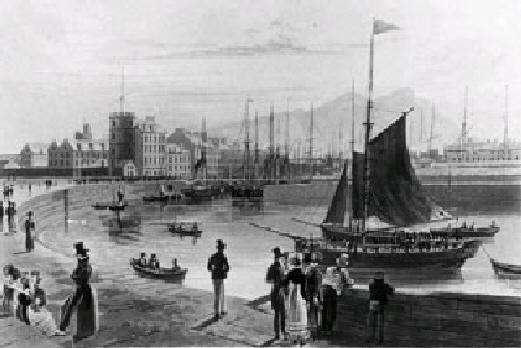
Ships leaving Leith, Scotland, for Darien
(fanciful 19th century sketch)
The venture was scuppered by London merchants, chiefly those
of the East India Company, with the support of the crown. They were
terrified that their near monopoly of colonial trade with the east would
be threatened, so they pulled every string possible to deny official
recognition and support. They blocked attempts to raise capital in
London, and also on the Continent where Sir Paul Rycant, resident in
Hamburg, spied on the efforts of the Darien directors and obstructed
subscriptions to the project. The whole sorry saga is well documented
in a number of books, each with their own bias, depending on the
authors’ English or Scottish viewpoint. Spain’s hostility (encouraged
by England’s ambassador to Spain) was another major factor, as it also
wished to protect its near monopoly on trade with central and southern
America. The one friendly, supportive group the Scots had was the
Indian leaders of the Darien peninsula tribes. They included ‘captains’
Pedro, Diego, Andreas and Ambrosio.
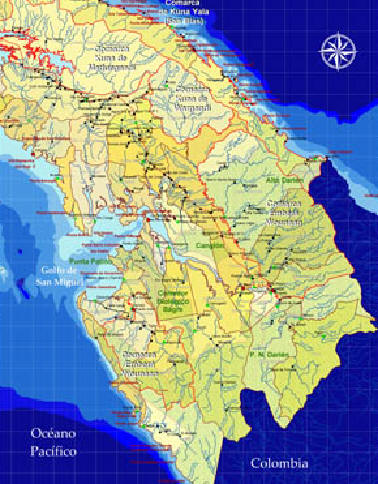
the Darien peninsula area
Attacks by Spanish
ships on the fledgling Darien settlement were largely (but not wholly)
successful, due to a prohibition on assistance from England’s
plantations in north America, facilitated by England’s Secretary of
State, James Vernon, a man of considerable resolution and cunning. The
climate and remoteness of the Darien peninsula also added to the
difficulties faced by the settlement, though that influence has probably
been overstated as similar climate and conditions prevailed in parts of
India, West Africa, and the Malay peninsula where English trade
flourished.
The forces arrayed
against the venture resulted in the destruction of the station and the
death of many of the pioneers. England had written the script and Spain
completed the dirty work with King William’s blessing. The cream of
Scots merchants and civic leaders were involved in the Darien project.
Many knowledgeable Scots who were aware of the betrayal and
interference, wondered why they maintained an allegiance to a Dutch King
sitting on the English throne, lacking both understanding of and
sympathy with, Scotland’s aspirations. In addition to a wave of
national fervour, the Scots had poured into the scheme, all the money
the small country could spare. Among the pioneers who perished there
were two men from my locality, Alexander Kinnaird, Laird of Culbin, an
early Jacobite and his son William. Many hundreds of similar brave and
enterprising Scots died with them. Scotland was bankrupted and shown in
a most brutal way that it dare not assert an economic independence.
Forty-five years later, in even more brutal fashion, it was made clear
to Scotland that it could not assert political independence either.
Seven years after the end of Darien, the Act of Union with England was
signed, a scenario that King William and his advisers probably had in
mind all along.
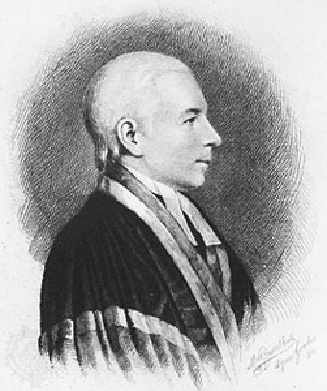
William Paterson, Darien visionary, and
founder of the Bank of England
Professor Paul Scott,
in his book The Union of 1707 : Why and How, says that the Darien
affair gave the English government an added reason to seek to abolish
the Scottish Parliament which had shown it could take initiatives
damaging to English trade. England also wanted to secure its northern
border during the prolonged wars with France. By offering, or appearing
to offer the Darien shareholders some compensation, Scottish support for
the Union could be bought. On the Scots side, English hostility to
Scottish economic development, increased distrust of their powerful
southern neighbour.
Scottish involvement in the Americas thereafter became
insignificant, except for the contribution of individuals within Canada
and the United States. So Scots adventure in South America is now
pictured quaintly in Daniel Defoe’s account of the experiences of
Robinson Crusoe. The book is based on the factual experience of a
Scottish seaman from Lower Largo in Fife, Alexander Selkirk (1676 –
1721), who was voluntarily marooned on one of the islands of Juan
Fernandez 400 miles off the southern coast of what is now Chile. [There
are actually three islands in the Juan Fernandez archipelago; -
Masatierra or ‘Robinson Crusoe’ as it is now known, the only one of the
three that is inhabited; - tiny Santa Clara island; - and Masafuera or
isla ‘Alejandro Selkirk’ which is where its namesake was a castaway. It
is slightly larger than Masatierra, with an area of 50 km2 (i.e. about 6
miles by 3 miles), and has the highest point of the the 3 isles, Los
Inocentes, which rises to 1,319 metres. Ships from Chile sailing to
Easter Island, often call at the archipelago en route.]
Just four years after the end of the Darien venture, on his own
initiative, Selkirk wisely left the unseaworthy privateer ship Cinque
Ports in 1704 (which sank later). The ship was under the command of
Captain William Dampier, a noted mapmaker and greedy privateer, who was
an incompetent and irresponsible seaman. [Dampier
was later to be charged by his crew with “cowardice, brutality and
drunkenness”, and lost his office as a result. He died a pauper, in
1715.]
Selkirk’s experiences
on the island, though harsh, were not too different from the somewhat
glamourised account by Defoe. He was rescued in 1709 by another British
privateer, the Duke, having eluded capture by two Spanish ships
that called at the island. He acquired a ship of his own and
eventually made it back home, married, and later became a lieutenant in
the navy, dying at sea of fever in 1721. I read Defoe’s book with
interest as a boy, and later when serving 3 years in the Zambesi valley,
I found Cowper’s poem ‘On the Solitude of Alexander Selkirk’, to
be a remarkably accurate and poignant expression of isolation which can
also be experienced when one is in a distant land and among people of a
totally alien culture to one’s own.
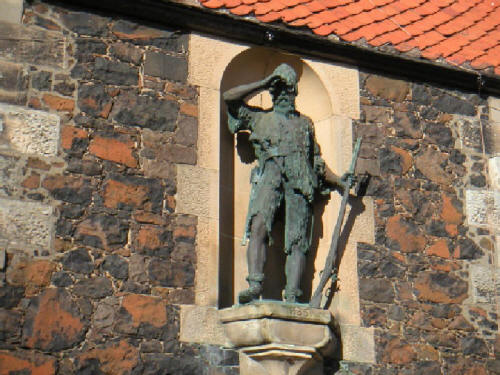
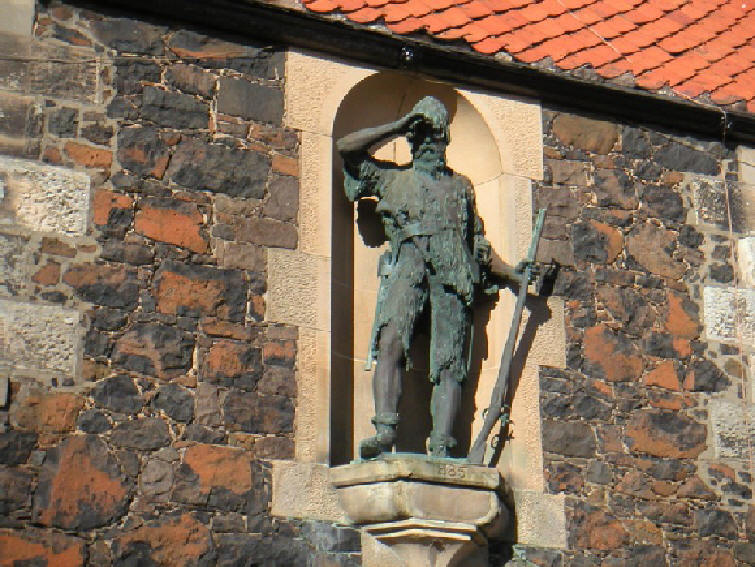
Statue of Alexander Selkirk (Robinson
Crusoe) at his birthplace in Largo, Fife, Scotland
Interestingly, Brian
Keenan, in the account of his years as a hostage prisoner of Islamic
militants in Beirut, refers to a degree of comfort he drew from Defoe’s
book. While identifying with the castaway’s situation, he tried to
retell the whole story in his mind from the perspective of Man Friday
who would have regarded elements of the white man’s ideas and behaviour
as part lunatic, part comical.
Juan Fernandez Islands where Selkirk
spent 5 years
Once when we were operating on the west coast for prawns and
fish, my father was approached about the possibility of taking his
vessel to Venezuela or Guyana to engage in shrimp trawling for a U.S.
company. The enormous shrimp industry was in its infancy at that time.
A businessman who had flown across the Atlantic, had asked my father to
stay ashore and discuss the possibility for a day, so we fished under
the command of the mate that trip. During the day, as deckhands, we
joked about what it would be like to work in warm seas and off
palm-fringed beaches. As things transpired, nothing came of the idea
though my father was not opposed to it in principle. The American,
Morgan by name, chatted to us in the cabin that evening, then made his
way to Prestwick airport for the flight home. I recall that just
before we nodded off to sleep that night in our bunks, the drone of an
aircraft was heard passing high overhead. As it died away, the
engineer, with a touch of dry humour and a hint of skepticism, murmured,
“good-bye, Morgan”. As far as I recall, apart from one brief
letter, we did not hear from him again.
The first true Latin
American I came to know closely was one of the finest examples of those
colourful persons. Milton Lopez, the Chief Fisheries Officer of Costa
Rica, was a student of mine in an international class I taught for a
year in 1972 – 73. He was mature, frank, thoughtful, and perceptive.
We had many interesting discussions on the fisheries of that beautiful
central American state which has both Caribbean and Pacific coasts.
Milton also educated me on the politics and culture of the Latin
American countries and societies. After his return to Costa Rica, Lopez
was seriously injured in a car crash, and spent a long time on crutches,
but eventually made a full recovery.
A second fine friend
from the region was Hector Lupin of Argentina, who served in the Fish
Technology Division of FAO’s Fishery Department in Rome, Italy. Our
families became quite close, and we were kindly gifted with a sliver
‘maté’ tea container which we still treasure. Maté is a kind of tea
made with herbs, that is drunk by gauchos and shepherds all over the
southern grasslands of Argentina and Chile. The tea is shared
communally, and is drunk through a filter via a pipe of silver or lesser
material. Hector was a kind and gentle person, and during the Falklands
war he came to me quite concerned, and asked for reassurance that the
conflict would not become an issue between us. I was only too glad to
provide that assurance, to which he responded, “yes David, just
imagine, - General Galtieri and Mrs Thatcher, - why should we get upset
over those two awful characters” !
A third friend and
colleague from Latin America was from Chile. Ramon Buzeta had been a
supporter of Salvador Allende when a young scientist working for his
country’s fishery research organization. He told me of the brutal
treatment and torture he had to endure at the hands of Pinochet’s
ruthless police and soldiers, following the military coup that was
supported by the CIA and the US Government. Fortunately Ramon survived
and was accepted as a political asylum seeker by Norway. From there he
got work with the United Nations Agencies, and eventually with the South
China Sea Programme where we were colleagues for 2 years. The evil side
of the dictatorship of General Augusto Pinochet has been well
documented, and the revelations of dreadfully brutal torture by that
regime continue to shock the world. But that never discouraged
politicians like Reagan and Thatcher from treating him like a hero and
affording his regime every protection. One only has to look at the way
the World Bank shoveled hundreds of millions of dollars into Pinochet’s
Chile after it had given Allende the cold shoulder, to see how our
much-vaunted democratic institutions serve the rich and powerful at the
expense of justice for the poor.
General Augusto Pinochet of Chile
Let me relate a small
tale about Pinochet as an aside to these memories. The Chilean
Ambassador in the Philippines served his President faithfully, and would
call Ramon Buzeta from time to time, to ‘talk’. Buzeta’s dissident past
was never mentioned, but was alluded to as the Ambassador let him know
that they were keeping their eye on him, and any chance of him being
allowed to return to his homeland would depend on how the regime
regarded him. This message was conveyed politely and diplomatically,
but with the sinister smile of a bully. (As Shakespeare put it in
Hamlet, - ‘that one may smile, and smile, and be a villain’ !)
Well, to the ambassador’s delight, one of the first formal foreign trips
that was organized for Pinochet, was an official visit to the
Philippines. Plans were completed, and the Ambassador was to glow in
the reflected light of his President as he began to be recognized and
accepted on the world’s stage.
Things went oddly and
unexpectedly wrong at the last minute, as sometimes happened in the
Philippines. While Pinochet was aboard his plane flying across the
Pacific, word was received from the Philippine Foreign Ministry that the
visit was off. It was cancelled at the last moment. No satisfactory
explanation was provided, - at least not in public. So the unlucky
Ambassador had to call his President and tell him to turn his plane
round and head back to Chile with the whole delegation. The General was
furious. The ambassador was recalled immediately to report in person to
Pinochet for the events that caused him such public embarrassment.
Before flying back, the ambassador and his wife pleaded tearfully to
Ramon and Jenny for sympathy and understanding. They tried to say that
they had never been part of the brutal side of the regime, and had
always acted in good conscience and considerately of others. Well, as
history has told us repeatedly, these brutal regimes eventually consume
their own children. Those who served ogres like Stalin, and Pol Pot,
and other despots, got no consideration or mercy from them in the end.
What became of the unfortunate ambassador and his family I do not know,
but I daresay his career ended prematurely.
Ramon’s experiences
shed light on the behaviour of right wing military regimes in South and
Central America, and on United States complicity in horrific treatment
of dissidents and of peasant communities whose only crime was to seek
economic justice and a future for them and their children. A powerful
trinity once controlled many of the region’s countries. It was composed
of the military, of big business (and often of drug dealers), and right
wing politicians. It has always been a mystery to me how America has
consistently viewed such regimes with favour, while Castro’s Cuba has
been vilified for half a century.
I listened with care to the speeches made by Fidel Castro and
Pope John Paul 2, on the occasion of the Pope’s visit to the island
state in January 1998. Castro gave an eloquent description of the
suffering of his people at the hands of a dictatorial regime, and of the
failure of the Catholic Church to stand up against the injustice. The
great pope, true to his conservative instincts, was unmoved, and made no
concessions to Fidel’s case for a socialist government to right those
wrongs. John Paul 2, who truly had a genuine concern for the poor, had
no time for the liberation theology developed by priests like Gustavo
Gutierrez of Peru, Leonardo Boff of Brazil, and Juan Luis Segundo of
Uruguay, who sought to present Christ as the political liberator of
oppressed peoples.
Fidel Castro
A dear New Zealand
colleague of mine who went on to work for the ADB and the World Bank,
told me that when serving in Panama as a young volunteer, he lived with
a group of Roman Catholic priests, since suitable accommodation was
limited in the particular area. Most of the priests were of ‘liberal
theology’ persuasion. They had deep personal concern for the poverty
and injustice suffered by the local people. Some even took up arms
occasionally to assist small militias who tried to defend their
communities from the army and from the land grabbers. So, despite
opposition from the Vatican, liberation theology is still being
practiced by elements of the Catholic Church.
At the risk of trying
my readers’ patience, I will mention one more Latin American friend and
colleague. This one was from Colombia. Teresa Salazar was an
enthusiastic and imaginative development economist with the United
Nations Industrial Development Organisation located in Vienna. We
worked together on a number of integrated development programmes and
projects for fishery, agricultural and industrial sectors in Africa and
the Pacific. I mention Teresa mainly to raise the problem of the
narcotic trade in the Americas. Her brother was Minister of Justice in
Colombia for a period, and received so many death threats from the drug
barons, that he sought to prosecute, he had to send his family abroad
for their protection. Teresa described to me what it meant for any
official in her country to take a stand against the perpetrators of that
evil industry.
When one studies the
drug problem deeply, it is disturbing to learn how callously major
governments can collude with the narcotics trade mafia, and can even get
involved in the production and sale of drugs to raise money illicitly
and/or avoid problems of budgetary controls. The Central Intelligence
Agency has long been suspected of ‘being in bed’ with drug dealers, as
has parts of the FBI at times. Drug smuggling routes have been
utilized by the CIA to ship money and arms when legitimate routes were
not possible or could have been open to detection. The most glaring
example was that of Colonel Oliver North [It
would appear that Colonel North was somehow involved in the capture of
Terry Waite who was held hostage by extremist elements in Lebanon for 5
years. Waite has hinted at this betrayal, but the only public
indication was at a brief meeting after his release, when Waite declared
to North, “I wanted to say this to you in person, - I forgive you”.
No explanation, was given, but the guilty look on North’s face said
it all. The US hostage, David Jacobsen, who gave Colonel North thanks
and credit for his own release, nevertheless had serious doubts about
North’s activities and their part in Terry Waite’s abduction and
imprisonment. These are expressed in his book, My Life as a Hostage.]
who sold weapons to Iran to get funds for ‘contras’ fighting the
democratically elected government of Nicaragua. Though Congress had
expressly forbidden aid to contras, (and sale of weapons to Iran), this
activity was undertaken with the encouragement of William Casey, then
Head of the CIA, and (unless we are totally naïve), with President
Reagan fully aware but clinging to ‘deniability’ as willful ignorance is
sometimes termed.
The CIA and the contras
also collaborated with mafia elements and drug traders to increase their
power and income. Similarly the IRA in Northern Ireland, financed much
of its murderous work with drug money, as to a lesser extent did some of
the loyalist paramilitaries. My Thai friends who lived through the
period of the Vietnam war, including some who worked in intelligence
gathering, tell me that the U.S. military was deeply involved with the
war lords of the “golden triangle”, both for strategic advantages, and
to tap sources of finance that did not have to be reported, and could
not be traced.
To be fair, not only
western security services and military have used the drug trade for
their own purposes. Bulgaria was for some time involved in the
international narcotic trade. President Todor Zhivkov’s state security
organization, the KDS, was a leading player in the black market for the
deadly white powder. They used two front organizations through which
the trade was conducted, first Kintex, then later Globus. President
Zhikov was challenged directly about the illegal business by that
strange post-war figure from the world of press, trade and politics in
East Europe, Britain and Israel, - Robert Maxwell.
The removal of
President Manuel Noriega of Panama by the USA through a mini invasion
had other elements to it than his involvement in drugs. Apparently he
had always been part of that business, yet was on the CIA payroll and
was entertained in Washington by the then CIA Head, George Bush senior.
Noriega fell out of favour for other reasons. A US Government web site
states that he ‘was going to become a dictator’ ! Well, that was rarely
a problem to the US in Latin America, Africa or Asia. The real reasons
for Noriega’s removal have been kept quiet. But he was replaced by a
more pliant government leader on 20th December 1989 who
permitted continued US influence over the territory. David Harris, in
his 2001 book Shooting the Moon, declared that Noriega was the
only one of all the rulers, dictators, warlords and juntas around the
world, that the USA in 225 years went after with an unprovoked
invasion. The President was taken to America for trial and imprisonment
for violations of U.S. law committed on his own native turf.
Had that military
operation been directed against a country where the government had
committed mass murder, torture, or serious human rights crimes, like
Pinochet’s Chile, Sroessner’s Paraguay, Somosa’s Nicaragua, Papa Doc’s
Haiti, or D’Aubuisson’s El Salvador, the world might have understood,
but Panama was guilty of none of that. It simply dared to defy the
demands of a handful of corporate executives, and powerful politicians.
Panama had insisted that the Canal Treaty be honoured. It had also
explored the possibility of building a new canal with Japanese finance
and engineering expertise. Yet for these efforts of national sovereign
policy it was to be invaded and taken over.
From a U.S. perspective
the invasion of Panama, and CIA interference in South American states,
is based on the Monroe Doctrine declared by President James Monroe in
1823. This defined America’s “Manifest Destiny” which asserted that the
United States had special rights over all the hemisphere. It has been
used as justification of the displacement of the Red Indian peoples and
the theft of their tribal lands, as well as the invasion of several of
the USA’s southern neighbour countries. Admittedly, Noriega was guilty
of many things, as was Saddam Hussein in more recent times, but neither
was a threat to America. Noriega’s predecessor, General Omar Torrijos
Herrera, who was a committed pro-poor reforming President, was killed in
a plane crash in 1981. The novelist Graham Greene claims that a bomb
had been planted in the plane.
It was Milton Lopez who
first drew my attention to an underlying identity problem that explains
some aspects of the behaviour of his people who are mostly of mixed
descent. There is something in the psyche of Latin Americans, opined
Lopez, that makes them want to be like their conquistador father, and
that despises their Indian mother. A colleague of his, attending the
same college course, Luis Cuciero from Urugauy, put the racial tensions
more bluntly, for the societies of the east coast of South America. He
described a kind of social caste system based on colour, he said; with
people of whitest skin being most highly regarded, and conversely with
black skinned persons. Neither Milton nor Luis displayed any prejudice
whatsoever, I hasten to add, and they mixed well with the students we
had from Africa. The same was true for the one black member of the
class from South America, the Director of Fisheries from Trinidad, who
was a most cheerful and sociable addition to our interesting group.
I was to make two trips
to Mexico, the first in 1966 and the second in 1978. Later, in 1998, I
went to Bolivia for a month, and it is from those two countries only
that I have direct personal impressions of that huge continent and its
dear people.
Mexico covers an area of nearly 2 million square kilometers,
and has long marine coasts on both the Caribbean (Gulf of Mexico) and
the Pacific. It borders the United States to the north, and both Belize
and Guatemala to the south. It had a Mayan civilization for centuries,
from around 550 to 950 AD. The Mayans built the many large pyramids
that remain today in the Yucatan peninsula. The Aztec empire ruled the
region from the 14th century, its most famous king being
Montezuma II, 1502 -1520. The Aztec empire and civilization was ended
abruptly by Herman Cortez and his 700 men in 1519 – 1521.
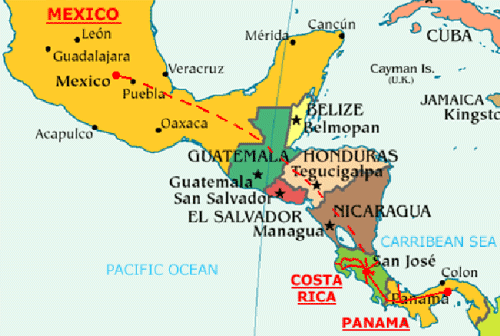
Map of Central America
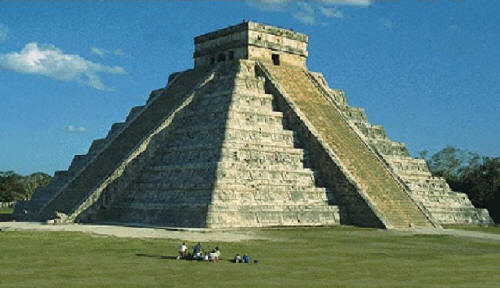
Maya pyramid, Yucatan, Mexico
The country remained under Spain till it achieved
independence in 1810. At that time much of what is now Texas, was held
by Mexico. This included the Spanish mission of San Antonio de Valero,
a Catholic station from 1724 to 1793 when it was secularized. The
Spanish military took it over and called it Alamo (cottonwood) after
their home town Alamo de Parras. From 1800 to 1810 the fort was
variously occupied by Spanish, rebel and Mexican soldiers. Mexico had
permitted Americans to settle in Texas and to own land, provided they
became Catholic. But such immigration was stopped in 1830. In 1835 the
Alamo was taken over by a group of Texan volunteers led by Ben Milam.
They were then besieged in February 1836 by General Antonio Lopez with a
large force of Santa Anna’s army. Within a month the 200 defenders were
overwhelmed. Among those who died in the siege were the commander
William Travis, and the frontiersmen, Davey Crocket and Jim Bowie.
America was to recover the Alamo and take possession of the area later,
finally incorporating Texas into the United States in 1870.
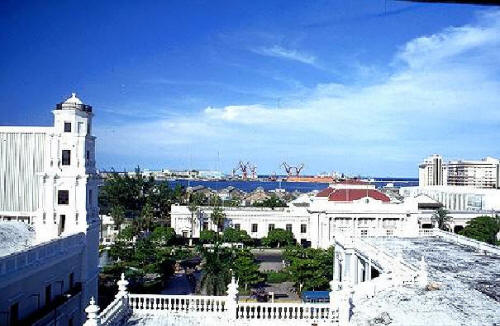
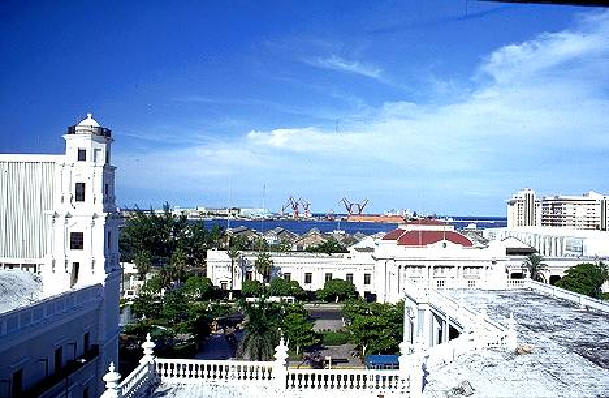
Port of Vera Cruz, Mexico
California was also
part of Mexico for a period. It had been visited and tentatively
explored by Spaniards from the 16th century. During the 18th
century a large number of Catholic missions were established. Following
Mexico’s independence from Spain, California (named after a mystical
Queen Califia of the Amazons), became a province of Mexico and remained
so for 25 years from 1821 to 1846. A fascinating glimpse of California
when a part of Mexico is found in Two Years Before the Mast, the
factual record of Richard Henry Dana’s voyage to that coast, in the
Boston brig Pilgrim, 1834. The Pilgrim collected a
cargo of dried cow hides from trading stations that later became
Monteray, San Pedro, San Diego, Santa Barbara and Santa Clara. Dana
sailed back to Boston in 1836 on another ship, and wrote his book
shortly after. Control of California passed to the U.S. following the
American – Mexican war of 1846 – 1848. The gold rush of 1848-49 added
to the urgency of formalizing U.S. rule, so in 1850 it became the 31st
State of the Union.
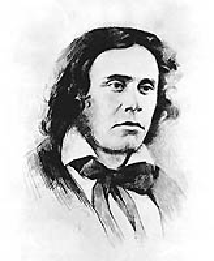
Richard Henry Dana, author of Two Years Before the Mast
From 1864 Mexico was
briefly under French domination, the ‘emperor’ Maximilian [Ferdinand
Maximilian, although appointed by the French Emperor Napoleon III, was
actually an Austrian Archduke, and brother of the last great Emperor of
Austro-Hungary, Francis Joseph, or Franz Josef. Maximilian was well
meaning but naïve, with all the limited vision of European aristocracy.
Tragically his life was ended by firing squad in 1867.] seeking to establish and maintain control of the
territory. This was ended by the great Don Benito Juarez who became
President in 1867. He is known as ‘Mexico’s Lincoln’, and though the
two never met, they held each other in high regard. Of pure Indian
stock, Juarez was educated at a Franciscan seminary. But preferring law
to religion, he graduated in that field in 1834, and became a champion
of workers’ and Indians’ rights. He became active politically and
helped to overthrow the despotic and incompetent Santa Anna. He served
as Governor of Oaxaca until his organization of resistance to Emperor
Maximilian, after whose ouster, he became President of Mexico. He died
in 1872.
Mexico suffered a
violent social revolution from 1910 to 1917 when a new constitution was
drafted and accepted. The revolution, led by colourful but tough
characters like Emiliano Zapata and Pancho Villa, involved much
bloodshed. It is believed to this day that the memory of that
revolution remains a restraint on the excesses of the wealthy, the
politicians, and the military in Mexico.
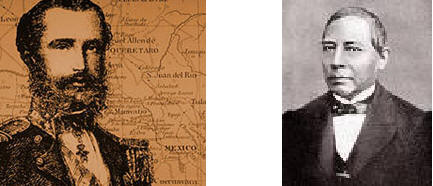
Emperor Maximilian, a tragic imposition
on Mexico by France and the Austro-Hungarian empire, and on the right, -
Don Benito Juarez, President of Mexico
who refused to accept the colonial master from Europe.
My first visit to that
fascinating country was to the Gulf ports of Vera Cruz and Alvarado. I
was making a study tour in the summer of 1968, of the shrimp industry in
the southern US States and Mexico. It is probably different now, but I
recall stopping over in Houston, Texas to get a visa. The taxi ride
into Houston and back to the airport, cost me more than I had to pay for
all my meals and hotel rooms in Mexico ! Vera Cruz was then a rural
town that conformed to many of our Hollywood caricatures of the
country. A few miles up the coast lay the beautiful new pilot port of
Alvarado, which was most impressive. But the flight from the capital
city to the coast and back, was a hair-raising experience as the old
Douglas DC-3 aircraft flew up and down the escarpment in the middle of a
thunderstorm.
Mexico had two main
fisheries to prosecute. One was the shrimp trawl fishery in the Gulf,
and the other was the oceanic tuna fishery in the Pacific. The latter
was a source of friction between Mexico and the USA for many years.
When the UN Law of the Sea of 1972, authorized each sovereign state to
claim fishing rights over an EEZ zone extending 200 miles to sea, Mexico
and most other maritime nations did so. But the USA for long opposed
that element of international law and refused to sign up to UNCLOS [The
UNCLOS law of the sea establishing 200 mile EEZs, was passed in 1982,
and most maritime states signed up to it within a very short time. The
USA was one of the few that held back. President Clinton signed the
agreement in 1994, but the Senate failed to pass it due to opposition by
some Republican Senators.]
as it was called, largely due to pressure from America’s powerful tuna
industry based in San Diego, California. This resulted in several
confrontations at sea between US tuna boats and the Mexican navy. In
the end it was the US tuna industry that lost out. It was dealt a death
blow, not by the Mexican navy, but by school kids in the States who
advised their mothers to buy only those cans of tuna that had “dolphin
safe” labels. As the San Diego fleet was a major culprit in the capture
and death of dolphins in its purse seine nets, it was the tuna it
produced that was effectively boycotted on the market.
The shrimp industry
which was the focus of my first visit, had developed into a major income
earner as shrimp became an extremely popular food dish. Although shrimp
boats took considerable quantities of fish, most of it was then dumped
over the side. Al the freezing capacity and refrigerated storage on the
trawlers was needed for the more valuable shrimp. As an American shrimp
trawlerman told me “we long ago got out of the fish business and are
now in the dollar business”.
All over the world,
shrimp trawl fleets pose a problem because of the ‘discards’, the fish
dumped overboard, which amount in volume to about 2 to 3 times the
weight of shrimp landed. Dayton Lee Alverson who I met in 1969 when he
headed the US BCF / NMFS Pacific Fishery Office in Seattle, later made a
study of the global extent of fish discards, together with J.G.Pope of
lowestoft, and others, and found it to amount to, on average, 27 million
tons of fish each year. This represents a huge financial and resource
loss, and involves a considerable negative impact on the marine
environment. To date, no satisfactory solution has been accepted or
implemented to end the practice of discarding, although I and many other
fishery specialists have proposed a number of actions.
The second visit, 11
years later, took me to the plush surrounds of Cancun on the south-east
coast, for the Latin American Fisheries Symposium. I was there at the
invitation of the Mexican Government and was given a seat at the
conference next to the Minister of Fisheries from China. There was
considerable resistance at the conference to the neo-colonial attitudes
of Spain, France, Britain and the USA who felt they had a right to
muscle in on the continent’s fish resource, and to dominate in matters
of equipment and technology choice. Opposition was also growing to the
fish meal industry which was supported by Norwegian investments [Norwegian
interest in fish meal production in South America, has related mainly to
the enormous stock of anchovy found off Peru, and which has been the
world’s main source of fish meal and fish oil for the past 50 years and
more. One of the Kon Tiki (1947) expedition members, Herman Watzinger,
stayed on in Peru to manage a fish meal operation for a period. I
worked for him later after he became FAO’s Director of Fisheries.]. My paper advocated national control of national EEZ
waters, development and protection of small scale fisheries, reductions
in industrial fishing, and investment in less energy-expensive and less
capital-expensive systems.
Though opposed by
delegates from France and Britain, my suggestions were all accepted by
the conference, led by Peru, the chair country of that session. I was
surprised by the attitudes of the western country representatives at
that conference. Spain behaved as if it was still in colonial power
over Latin America, and the Scandinavian fish meal industry
representatives were totally unaware of the resentment directed at that
hungry monster that consumed millions of tons of otherwise edible and
nutritious fish. Neither Europe nor the USA showed any understanding of
the poorer countries’ need for appropriate technology and less energy
expensive systems. I had earlier warned the young professionals among
the Mexican conveners that my paper would be somewhat radical. They
smiled, and declared that I was not even half as radical as they were!
My visit to Bolivia
came us a surprise. Though welcoming the opportunity to work in that
magnificent land-locked country extending from the high Andes mountains
down to the Amazon valley, I had never regarded it as a ‘fishing’
country. But Bolivia has extensive wild fisheries and fish farming, in
Lake Titicaca, in the waters of the central plateau, and in the many
tributary rivers of the great Amazon. Bolivia borders Brazil to the
north-east, Peru to the north-west, and Chile, Paraguay and Argentina to
the south.
Much of Bolivia’s
history is rather sad and violent. It broke with Spain in 1825, under
Simon Solivar, but over the next 170 years suffered some 200 coups and
counter coups. For much of that period the country was ruled by
dictatorial right wing military regimes. Some of the leaders displayed
a remarkable degree of stupidity and incompetence. As a consequence,
through ill-managed conflicts with its neighbours, Bolivia lost huge
chunks of its territory to Chile, Brazil and Paraguay. I was fortunate
to arrive in the country during the start of its current phase of more
democratic and socially responsible government.
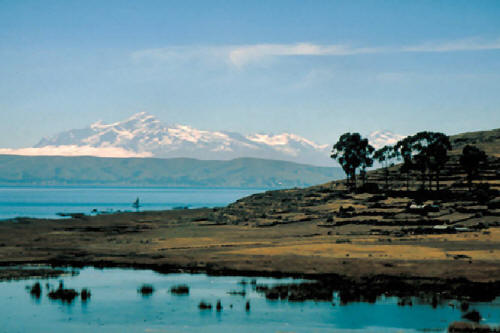
Lake Titicaca in the Andes between Peru
and Bolivia
The highland region
around Titicaca, is populated mainly by Indian peoples with their
distinctive dress and their use of llamas and donkeys. It resembles the
highlands of Scotland, being somewhat bleak, cold and rainy, and in its
main starch crop, potato, of which there are scores of varieties, many
of which Europeans have neither seen nor tasted. The local housing is
poor, often of mud brick, and resembling the poor houses of the west of
Scotland and Ireland in the last century. The climate on the Altiplano
is mostly cold and wet. Towering above are the snow-capped Andes
mountains, but due to global warming, much of their ice cap is melting,
perhaps never to be restored in our lifetime.

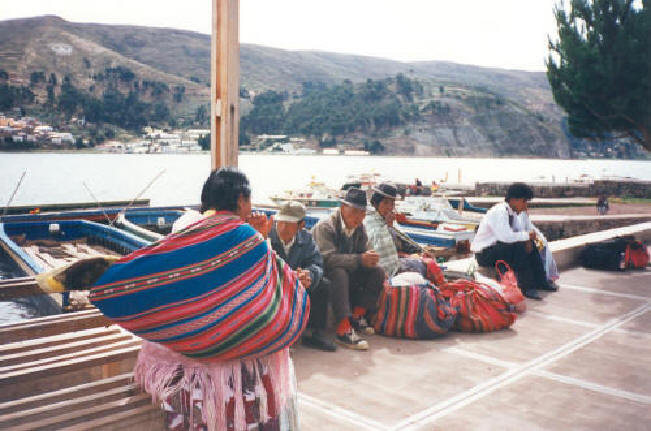
People and boats by Titicaca lake
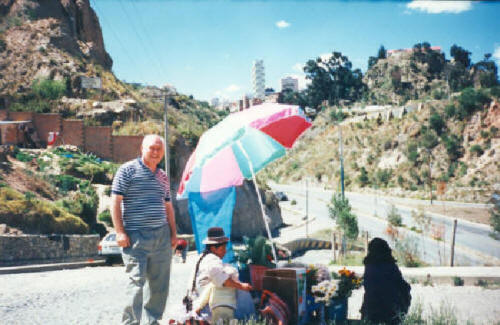
With street vendors in La Paz
Altitude sickness can be experienced on the high plateau or
anywhere above 12,000 to 15,000 feet (3,600 to 4,500 metres). I was
surprised that Bolivians also suffered from it. A party from the Amazon
basin we took to a short course at the aquaculture research centre on
lake Titicaca, was affected. Symptoms varied from light-headedness and
headaches, to shortage of breath and stomach upsets. The normal cure
there is a brew of the herbal tea, maté de coca, which contains a bit of
coca leaf. I found it to be surprisingly effective. The capital city,
La Paz, the highest capital in the world, has a magnificent location,
and is an attractive, friendly place to reside in. The people are
friendly and helpful, with for the most part, a simple, honest, peasant
attitude to life. Whether in the market, the cafes, or the shops, one
is impressed by the basic honesty of the people who insist on giving you
the correct price and the precise change, for the transaction. The
students and young professionals I met, were eager to contribute to
their country’s development, and most helpful to me as a foreign
consultant.
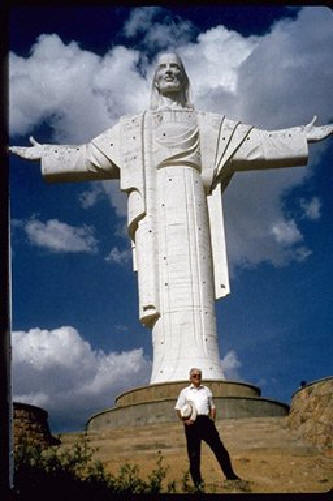
With a much smaller population, and few big cities, Bolivia
has less of the social problems that bedevil the larger countries like
Brazil and Argentina. The indian peoples of the high plateau are mostly
poor and have to struggle against the elements to survive in those
altitudes. The more fertile lowlands are heavily wooded but suffer from
excessive logging and cattle ranching which may not be the ideal form of
land use there.
Down in the Amazon valley, there is an extensive network of
tributary rivers which support travel and communications, and a
substantial fishery. The surrounding land is used for cattle ranching,
cereal crops and forestry. Like much of the Amazon valley, the region
is under threat from excessive logging, inappropriate or unsustainable
agriculture, and competition for use and control of water resources.
But the Bolivian people are well aware of these dangers, and are seeking
to find ways of ensuring sustainable development. I was impressed by
the private University, Instituto de Estudios Amazonicos de Riberalta
led by its founder and President, Said Zeitum Lopez, that was designing
its whole curriculum and research programmes on the theme of long term
sustainability and social equity in resource utilization.
|
Che Guevara
Although he was
born in Argentina, and came to prominence in Cuba, the political
figure that is best known in Bolivia, is that of Ernesto ‘Che’
Guevara. He is admired or disliked depending on ones political
perspective, but when I was there, his picture adorned the walls
of the city and the University, and the Tee shirts of many of
the students. Following the end of military rule, the people
openly embraced Guevara’s memory, partly I guess as an
expression of new-found political freedom, and partly as a sign
of their desire for social justice. Surprisingly Che was in
Bolivia for just two brief periods, 1952, and 1966 – 67, when he
attempted to organize and lead communist guerillas there. His
short life ended there at the early age of 39.
Born in 1928 in
Argentina, of mixed Spanish and Irish stock (his great
grandfather was a Patrick Lynch from Ireland), he graduated as a
doctor in Buenos Aires in 1953. As a student he traveled around
the region on motorcycle, and saw first hand the hardships of
poor peasants under regimes that cared chiefly for the powerful
and the landowners. He became active in Marxist groups in the
continent, and was briefly in Bolivia supporting agitators there
in 1952. In Guatemala the following year he assisted the
leftist government of Jacobo Arbenz.
It was in Mexico
in 1954, where Che first met Fidel Castro who was trying to
organize the overthrow of the Cuban Dictator, Fulgencio
Batista. He joined Fidel’s ill-organised rebels, who sailed to
Cuba from Vera Cruz, and started the uprising in 1956. Despite
a near disastrous beginning, the revolution finally succeeded in
1959 when Batista was overthrown and Castro became President.
Guevara was
first appointed to the Cuban National Bank in 1959, and became
Minister for Industry in 1961. He gradually became
disillusioned with Soviet Communism, and his criticism of Soviet
bureaucracy distanced him from Fidel. In 1965 he left Cuba to
work with the short-lived Lumumbu government in the Congo. He
openly criticized the Soviet Union then, and embraced the
Chinese version of Marxism. While in the Congo he was assisted
briefly by Laurent Kabila, whom he considered insignificant, but
of whom the world was to hear more, some 30 years later.
In 1966 Guevara
moved back to Latin America to start a revolution in Bolivia.
The effort was short-lived and probably doomed from the start
due to opposition from both the USA and the Soviet Union. In
Cuba the following year Kosygin criticized Che before Castro for
working against legitimate communist parties. By ‘legitimate’
Kosygin meant pro-Moscow parties. This explains why the
Bolivian Communist Party gave no support to Guevara. President
Rene Barrientos, with CIA support, ordered the army to hunt him
down. His ragged band of guerrillas were located near La
Higuera at Alto Seco and Valle Serrano where he was eventually
captured and shot by government soldiers, and his remains
dismembered. His death was a bit of a mystery for some years,
but his body was eventually found in Vallegrande. He was buried
with honours in Cuba in Santa Clara, Las Villas, the location of
a battle he led and won against Batista’s forces.
Che’s fame grew
after his death, with his image achieving iconic stature among
leftist student groups. Gradually as Bolivians came to enjoy
some political freedom, he came to be regarded by the public
there as a national hero. In hindsight, despite his courage
and idealism, Guevara was a prisoner of a Marxist ideology that
could never have worked. Today, apart from brave little Cuba,
and perhaps emerging Venezuela, there is no socialist regime in
all of Latin America.
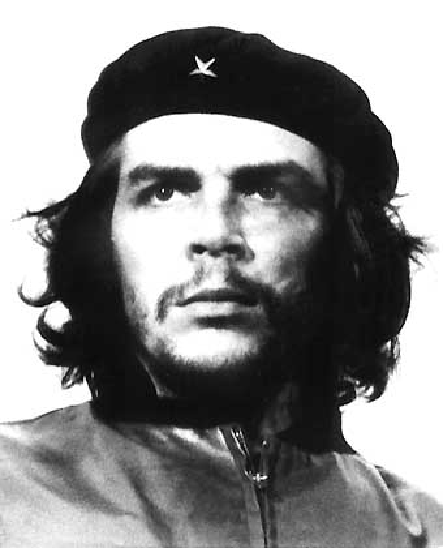
Che Guevarra, the
ill-fated Latin revolutionary
Flying over
Bolivia from Sucre to Santa Cruz, we passed over Vallegrande
where Guevara was killed. My young colleagues from the
University pointed out the area to me, and spoke of Che with a
degree of admiration and sympathy. No doubt they each had
family members of past generations, who had suffered injustices
under the various dictators.
The
romancing
of Che Guevara’s memory was to continue in some unusual ways. A
photograph taken by Alberto Korda in 1961, and numerous black
and white impressions of the same, acquired iconic status and
was widely used to decorate T-shirts and posters for many
years. When Andrew Lloyd Webber produced his famous musical,
Evita, he wrote Guevara into the script as the narrator,
though Che had had next to no contact with the woman.
|
Today the great
continent of South America and the region of Central America, faces many
problems. The aspirations of the rural poor are still being trampled on
by the rich and powerful, in the form of the logging companies, the oil
corporations, the drug barons, and the right wing militias. The urban
poor face dangers and difficulties no less severe. And there is one
group in the urban poor that merit special concern. I refer to the
thousands of homeless or unsupervised children left to struggle for
survival in the streets of Buenos Aires, Rio De Janiero, Bogota, and
other cities of the region. Although I have had no direct contact with
street kids, I have a number of friends who have worked hard to bring
them some relief, care, food and medical help, in Latin America and
elsewhere. We will consider their plight briefly as we complete our
impressions of that part of the world. Street Children [The
term "street children" was first used by Henry Mayhew in 1851 when
writing London Labour and the London Poor, although it
came into general use only after the United Nations year of
the child in 1979. Before this street children were referred
to as homeless, abandoned, or runaways.]
are an urban problem which has its roots in rural poverty, neglect and
the enforced, even violent displacement of large numbers of people from
the land. This problem is accentuated by the fact that the urban
population is becoming younger. By the year 2020 there may be 300
million urban minors in Latin cities, 30% of whom will be extremely
poor. 78% of the Brazilian population live in cities and towns. The
persistent poverty, rapid industrialisation and the burgeoning of urban
shanty towns (favelas), generate massive social and economic upheaval.
Profound poverty means family disintegration, violence and break-up
become more prevalent. Unemployment rose by 7.6% in the month to January
2000, the largest increase since 1984. Brazil is the fifth largest
country in the world with a population of approximately 166 million
people. The disparity between the rich and the poor in Brazilian society
is one of the largest in the world. The richest 1% of Brazil's
population control 50% of its income. The poorest 50% of society have to
live on just 10% of the country's wealth. It is small wonder then that
Brazil may have the world’s largest population of street people, - up to
8 million children and young persons.
The
term street children refers to children for whom the street more
than their family has become their real home. It includes children who
might not necessarily be homeless or without families, but who live in
situations where there is no protection, supervision, or direction from
responsible adults. While street children receive national and
international public attention, that attention has been focused largely
on the social, economic and health problems of the children -- poverty,
lack of education, AIDS, prostitution, and substance abuse. Street
children also make up a large proportion of the children who enter
criminal justice systems and are committed finally to correctional
institutions (prisons) that are euphemistically called schools, often
without due process. Few advocates speak up for these children, and few
street children have family members or concerned individuals willing and
able to intervene on their behalf.
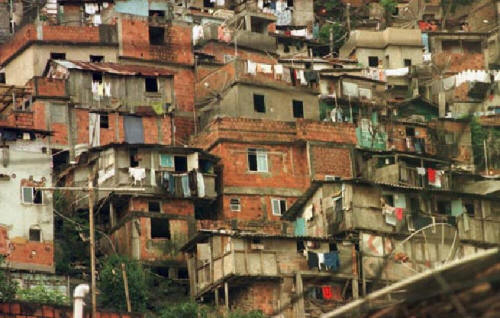
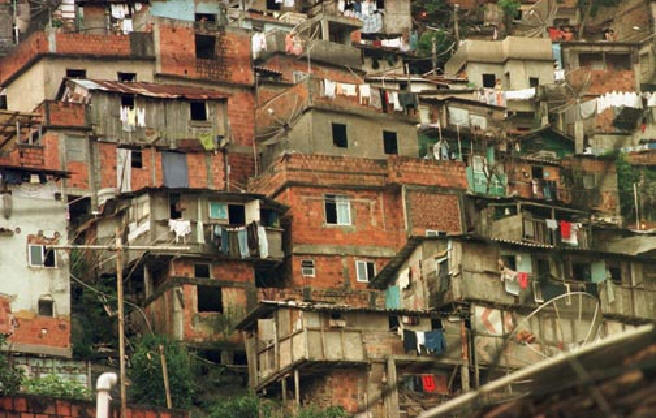
An urban slum in Rio de
Janiero
Published research
indicates that compared with home based children, street based children
are less likely to come from a home headed by their father
and less likely to have access to running water or toilet
facilities; their parents are more likely to be unemployed,
illiterate, less cooperative, and less mutually caring with
higher levels of violence. Nevertheless, it should be borne
in mind that most children from poor and dysfunctional families remain
at home. Similarly, as I have always noticed in S.E. Asia, despite the
many hundreds of girls from poor backgrounds who end up in the vile
prostitution trade, there are millions of young women from
poverty-stricken backgrounds, who never resort to that immoral and
soul-destroying way of life.
|
Death and Violence on the Streets
Human Rights Watch has reported that police violence against
street children is pervasive, and impunity is the norm. The
failure of law enforcement bodies to promptly and effectively
investigate and prosecute cases of abuse against street children
allows the violence to continue. Establishing police
accountability is further hampered by the fact that street
children often have no recourse but to complain directly to
police about police abuses. The threat of police reprisals
against them serves as a serious deterrent to any child coming
forward to testify or make a complaint against an officer. In
Guatemala, where the organization Casa Alianza has been
particularly active and has filed approximately 300 criminal
complaints on behalf of street children, only a handful have
resulted in prosecutions. Clearly, even where there are
advocates willing and able to assist street children in seeking
justice, police accountability and an end to the abuses will not
be achieved without the commitment of governments.
In Latin America many people in the judiciary,
the police, the media, business, and society at large believe
that street children are a group of irredeemable
delinquents who represent a moral threat to a
civilised society a
threat that must be exorcised. The most frightening
manifestation of this view is the emergence of "death
squads": self proclaimed vigilantes, many of whom are
involved with security firms and the police and seek to solve
the problem by elimination. a
threat that must be exorcised. The most frightening
manifestation of this view is the emergence of "death
squads": self proclaimed vigilantes, many of whom are
involved with security firms and the police and seek to solve
the problem by elimination.
In Brazil, a pioneering study set up by the
National Movement of Street Children recorded 457 murders of
street children between March and August 1989. The
state juvenile court recently reported that an
average of three street children are killed every day
in the state of Rio de Janeiro. On 23 July 1993 a vigilante
group openly fired on a group of 50 street children
sleeping in the Candelaria district of Rio de
Janeiro. Seven children and one adult were killed and
many others injured. Of the eight defendants
originally accused, just two have been imprisoned; a further two
have been tried and released. Amnesty International has
estimated that 90% of the killings of children in
Brazil go unpunished.
Backed by
citizen groups and commercial establishments, death squads have
become more and more violent in their goal to "clean-up" the
streets and "guarantee public safety". It is estimated by child
care agencies that up to 5 or 6 children a day are assassinated
on Rio's streets. Children have been executed and some
mutilated almost beyond recognition.
4,611 Street
Children were murdered between 1988-1990. In 1993, eight
children and adolescents were killed in a shooting near the
Candeleria church in Rio. Between 1993-96 juvenile court
statistics showed over 3 000 11 to 17 year olds met with
violent deaths in Rio. The majority believed to have been
murdered by death squads, the police or other types of gangs. In
Sao Paulo, for example, 20% of homicides committed by the police
were against minors in the first months of 1999. The Rio de
Janeiro State Legislature found that drug gangs now account for
roughly half the child murders in Rio. The death squads have
been met with little opposition from ordinary people who feel
threatened by gangs of children. The police also fear the
children who are becoming knowledgeable witnesses to their own
criminal activities in the drug and prostitution business. |
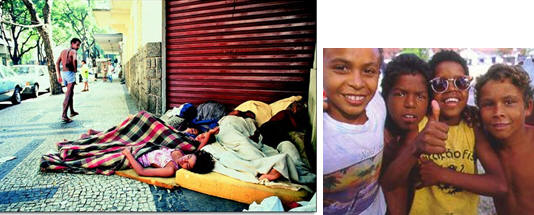
Street children in Brazil
Current efforts [Most
of the information in this section, and the preceding two pages, is
taken from internet web sites on the issue of street children, the
phenomena, the causes, the needs, and the different means used to
address the problem.]
to address the plight of street children:
The correctional
approach views street children as a matter for juvenile justice
organizations. This correctional vision seems to dominate the thinking
of much of the public and criminal justice authorities. The result is
that thousands of street children are housed in institutions. In Brazil,
the National Foundation for Child Welfare operates twenty treatment
centers and "reform" schools for abandoned and delinquent youth.
Conditions in these facilities have been described as both crowded and
abusive. However, some changes appear to be underway, involving the
substitution of correctional initiatives with community-based treatment
alternatives.
The rehabilitative
approach has been gaining momentum throughout Latin America. This
perspective holds that street children are not delinquents as much as
they are victims of poverty, child abuse and neglect, and untenable
living conditions. Because street children are seen as having been
harmed by their environments, hundreds of church and voluntary programs
have been organized in their behalf. These typically provide housing,
drug detoxification, education, and/or work programs. The programs
benefit a limited number of youths, but are unable to address the needs
of the millions of boys and girls who continue to call the streets their
home.
Because the
institutional capacities and resources of virtually all programs are
limited and unable to accommodate the overwhelming majority street
children, services are also provided through a variety of outreach
strategies. In São Paulo, for example, the Catholic Church supports
young lay workers who provide educational, counseling, and advocacy
services to children in a street setting. In addition to teaching basic
hygiene, literacy, and business skills, the general program approach is
to instill self-reliance and empowerment so that children will find
solutions to their problems.
The preventive
approach attempts to address the fundamental and underlying problem
of childhood poverty. In this regard, UNICEF is conducting educational
campaigns to alert policy makers to the causes of children moving to the
streets. In addition to policy advocacy, UNICEF provides technical
assistance and support for promising local efforts. Those receiving
UNICEF's focused attention are of two types: 1) programs which provide
daytime activities, schooling, jobs, and other alternatives to street
work for high risk children; and 2) efforts focusing on the prevention
of family disintegration--cooperative day care centers, family planning
clinics, small business services, and community kitchens.
The
most comprehensive effort on behalf of Brazilian street youth is the
National Movement for Street Children (MNMMR), a nationwide coalition of
street children and adult educators founded in 1985 (Raphael and Berkman,
1992). MNMMR initiatives focus on shifting the management of street
children away from the criminal justice system, codifying the rights of
children into law, and structuring innovative approaches for providing
education and training for youths directly on the streets where they
live. MNMMR projects are targeting an estimated 80,000 youths, the great
majority of whom work on the city streets and live in nearby favelas,
with the remainder are actually living on the streets. |