|
Indo-China is a vast
territory, 40 times the size of France, extending 1,200 miles north to
south, and 1,000 miles east to west. It is bounded on
the west by the Andaman Sea, to the south by the Straits
of Malacca, and on the eastern side by the Gulf of Tongkin and the South
China Sea. It comprises the lands of Burma, Siam, Malaya, Cambodia, Laos
and Vietnam. These countries are each blessed with a soil capable of
producing any kind of crop, free of barren, desert lands, richly watered
by innumerable rivers, lakes and streams, possessing mineral wealth,
situated before an ocean of vast islands, and (apart from Laos), endowed
by nature with numerous, superb, natural harbours which are the
rendezvous of traders from west and east. Francis Garnier the
explorer, compared the peninsula to a human hand with extended fingers
which roughly indicate the course of five great rivers, - Song Koi, the
‘red’ river through Tong-king, Me-kong through Laos and Cambodia, Me-nam
through Siam, and the Salwini and Iriwadi through Burma. The upper
basins of the rivers are separated by mountain ranges.
From the Catholic
Encyclopaedia, Indo-China, 1910
Thailand and Vietnam
which have populations of 62 and 80 millions are similar countries in
many aspects, - religion, climate, geography, and natural resources. They are divided into 76 and 58
provinces, and have land areas of 514,000 and 329,000 sq kms
respectively. The main differences today lie in their economic
performance and colour of government. In GOP, Vietnam lags far behind
Thailand, and it is a communist state with some reforms and compromises
to permit private ownership, foreign investment, and a
free market, while Thailand is a constitutional monarchy with a
parliamentary style government. In 1939 Thailand dropped its former name
of Siam, for its present name which means “land of the free”, reflecting
the fact that it has never been conquered or colonized. Thailand is a
prosperous free market country. Vietnam was the scene of much conflict
and was divided for many years, but its former northern and southern
entities were finally united into a single state in 1976.
Varintip Sooppipat, Thailand and
Vietnam, 2002
We arrived in Vietnam
during monsoon season which meant 24 hours of rain. All the beautiful
scenery was covered in clouds. We strolled around Hanoi and sailed 2
days in Halong Bay. In central Vietnam we visited Hue which was at the
DMZ demilitarised zone that once separated the north from the south.
There we visited the Vin Hoc tunnels built by the villagers after their
houses were bombed. Some families lived in them for 4 years. At
Ho Chi Minh city
we went into the War Remnant museum. The photographs were of many
horrific actions by U.S. soldiers, including rape and butchery. What
does a war or patriotic passion do to human beings ? It surely
brainwashes minds and makes beasts of people. We went by boat down the
river Mekong and delta, where were floating markets, coconut farms and
little rice wine and rice paper plants. We continued into Cambodia and
Phnom Penh. At the Tol Sleng museum, a former school, we saw where for 4
years, people were chained, starved, and tortured to death under Pol Pot
and the Khymer Rouge.
I cannot describe what I saw. It was too extreme. And it happened so
recently in 1975 – 79. From its black recent history, we moved to view
a more positive and impressive part of Cambodia’s ancient civilization,
- the Angkor temples, - the largest temple complex in the world. . . .
. .
From Mariette’s Story, an internet-posted account of one woman’s
impressions
Cambodia
Phalla Song was
secretary to the UN FAO Representative in Phnom Phen at the time I was
leading a project there for that organization. Her attractive,
pleasant, quiet demeanor gave no hint of the personal traumas she had
endured in her youth. On a car trip together to a reception by the
Mekong River, I asked her (as I had asked other Cambodians of her
generation) about the period of the Khmer Rouge and the notorious rule
of Pol Pot.
Her father had been a
Professor of Languages at the University in Phnom Phen. Like all others
in the city, the family was driven out when the Khmer Rouge entered in
1975. They were sent to work on rice paddies not too far from the city.
Being an educated person, her father would have been marked out for
elimination, no matter how the family may tried to conceal their former
role in society. So it was not long before the soldiers came and took
him off “to attend a meeting”. Both young Phalla and her mother had a
good idea of the real intent of the Khmer Rouge. When a soldier
returned later with his clothes, she knew for sure he had been shot or
otherwise killed. But no-one dare show pity or sorrow in front of the
army which would have punished or killed them for the display of
sympathy for the victim. Phalla, just eleven years old, waited for an
opportunity and in the late afternoon went away from the paddies to a
Mango tree nearby. She climbed up into the tree, and suitably hidden,
wept for her father. When she had no more tears to shed, she returned
to the commune where she showed no emotion in front of the others.
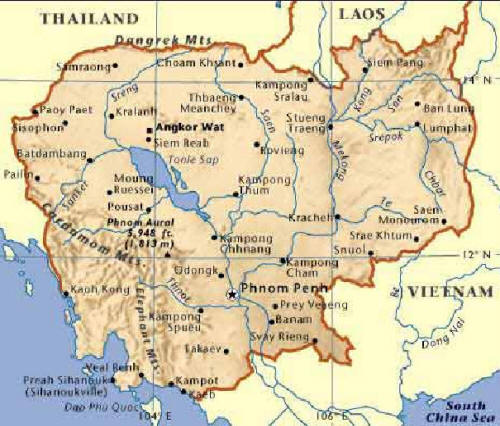
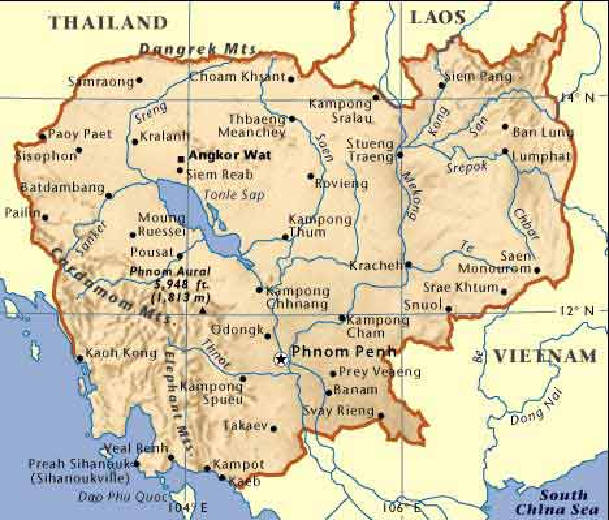
map of Cambodia
Shortly after, Phalla’s
mother was moved to a different commune, and she was left to care for
her infant sister. The child still needed nursing, but this was not
possible. Just getting food for the baby was extremely difficult.
Sometimes Phalla got a little bit of rice porridge, and on a rare
occasion a sympathetic worker would give her a sliver of sugar cane for
the child to suck. But Phalla persevered against all odds. She said
that the attitude of the workers at the start of each day, was, - “if
only we can survive till night-time, it will be something”. And
each morning they would thank God they were still alive. I asked Phalla
if her baby sister survived the prolonged ordeal. She turned to me with
a beautiful smile, and responded, “Yes, - and she was married, just
last month”.
When the Vietnamese
invaded in 1979, and the Khmer Rouge retreated, Phalla and her sister
escaped and somehow traced their mother and some more members of the
extended family. They made their way eventually to the Thai border
where they managed to find a refugee camp that accepted them. They
hoped that the stay in the camp would be short, and that they might even
be accepted in another country, but they were to spend ten long years
there. The atmosphere in the camp was not good as it was infiltrated by
the Khmer Rouge, in collusion with the Thai army. “We dared not
speak any language other than Khmer,” related Phalla, “though we
could speak Vietnamese and French, if the Khmer Rouge heard us, we could
be dealt with, even in the camp.”
Finally, with the settlement reached in 1989, Phalla and the
family were able to return to Phnom Phen. They had lost practically
everything from their past life. Now married with a family of her own,
today she helps to support them in a modest home and on limited income.
I asked her for her view on all that happened, and her hopes for the
future. “I don’t care who runs the government”, she said. “I
don’t want big things for myself. All I want to see is peace, - and
genuine democracy”.
Phalla’s story can be
repeated by thousands of her generation, with variations in the
particular experiences of cruelty, hunger, exploitation and inhuman
wickedness that was perpetrated by the followers of Pol Pot, and his
army of ignorant but fanatical teenage soldiers. How could that
cultured, gentle, educated man (according to all who knew him as Saloth
Sar before), - how could he unleash such brutality and barbarity. His
was to be the purest and most successful form of communism, and to
convince his supporter, China, of its success, he shipped rice abroad
while the people starved at home. Readers will have seen the
“Killing Fields”, film, and some will have read accounts like
“Sideshow”, and “The Quality of Mercy”, by William Shawcross.
Ieng Sari, former Khmer Rouge Foreign
Minister. He was finally tried for his crimes in 2011. He refused to
cooperate in the trial, claiming he had been pardoned by the King.
Pol Pot’s Foreign
Minister Ieng Sary visited Jakarta in 1979. I was staying at the Hotel
Indonesia when his cavalcade arrived. Indonesia always treats foreign
officials with oriental respectfulness, - whatever their private
thoughts about them. Sary emerged from his limousine and into the Hotel
foyer, garlanded with flowers and escorted by a troop of young ladies in
national costume. I did not realize immediately who it was, but I will
never forget the look of ugly delight and embarrassment on that brutal
face, as if he could not believe his good fortune in being treated with
such lavish honour after all he had been party to. I agree with C S
Lewis and Alexander Solzhenitsyn, that evil can never be fully
concealed. It will always reveal itself in some ways, explicit,
implicit or Freudian.
Pol Pot was born as Salong Sar in the small rural village of
Prey Sbor in Steung Saen District of Kampong Thom Province in 1925, or
possibly 1928. I was in the village in 2010 when leading a team
conducting demonstrations of improved farm technologies for poor and
marginal families in four provinces stretching from the Thai to the
Vietnam border. I was fascinated by the children of Prey Sbor playing
their after-school games, and splashing around in the small stream
nearby. I wondered if over 85 years before, a small Saloth Sar engaged
in similar innocent childhood fun, and I mused on the events and
influences that shaped his early life, and turned that carefree
youngster into the callous brute who brought the Khmer Rouge horrors to
that lovely land. Families were to be torn apart, children robbed of
their youth and innocence, a whole generation denied education and
opportunity, countless thousands tortured for no reason other than
insane dogma, and up to 2 million murdered or starved to death.
What potential for good
or evil lies in little children, even in a poor remote rural village,
and how important it is to protect them from infection by false
doctrines of a utopia to be achieved through tyrannical, despotic
Marxism, or right-wing militarism that would bomb nations into
submission to gain control of their resources. The last century has
seen more than its share of each of these evils.
|
Cambodia’s
Holocaust
Educated in
Paris like his early hero Ho Chi Minh, Saloth Sar joined the
French Communist party and later its Indochinese counterpart.
As a young man he had served with the anti-French resistance in
Vietnam, and had obtained the scholarship in Cambodia in 1949.
He returned from France in 1953, joined the Cambodian branch of
the communist movement, the PKRP, and got a private school job
teaching history and geography. As his sister served in a dance
troupe at the Royal Palace, he had regular access to Sihanouk’s
court. In 1966 he visited China where he received considerable
support and slowly began to weaken his ties with Vietnam. By
1968 his armed organization the Khmer Rouge was fomenting unrest
in 11 of the 18 provinces, and had near complete control of the
mountain region bordering Vietnam. Strangely it received some
support from the U.S. army in South Vietnam.
Beginning 1969
the US started secret bombing raids on Cambodia. The raids were
illegal as the US had not declared war on Cambodia, but they
were ordered by President Nixon and Henry Kissinger. When news
of the raids was leaked, Kissinger ordered surveillance and
phone tapping of suspects to uncover the source. By 1973, over
539,000 tons of ordinance had been dropped on Cambodia, (three
and a half times what was dropped on Japan during the war), and
600,000 Cambodians perished. Later the CIA reported that the
bombing had been militarily ineffective and succeeded only in
increasing support for and the popularity of, the Khmer Rouge.
By 1973 with help from China, the Khmer Rouge numbered over
100,000 and controlled 60% of Cambodia’s rural territory.
By 1975 Saloth
Sar had renamed himself “Pol Pot” and hidden his former
identity. He was also known as “Brother Number One”. The Khmer
Rouge swept into Phnom Penh in April, and proceeded to drive its
inhabitants into the countryside where families were separated
and made to work in rice-field collectives and labour brigades.
Foreigners were expelled, embassies closed, the currency
abolished, and newspapers, schools, worship services and private
property were outlawed by the new all-powerful authority, - the
“Angka” (or Angkar). Educated people and former members
of the government, military, police, schools, churches and
mosques, were executed. |
Brother Number One, Pol Pot (Saloth Sar)
|
From that
dreadful “Year Zero”, Pol Pot directed a ruthless programme to
“purify” Cambodian society, and to establish a totally
self-sufficient Maoist agrarian state. The agriculture communes
became “killing fields” where no opposition or deviation was
tolerated. Uneducated peasants and children of teenage years
and younger were put in charge and made into soldiers or
overseers of callous brutality. Within the collectives,
workers, and even children, were regularly required to spy on
and report each other to the authorities. Over 20 dreadful
detention and interrogation centres were established. Only
seven of 14,499 detainees survive the experience. Around 1.5
million Cambodians were killed by the Khmer Rouge, or died from
starvation or overwork in the collectives. On a visit to China
in 1977, Pol Pot received pledges of more support.
On Christmas Day
1978, the Vietnamese, annoyed at repeated attacks over its
border by the Khmer Rouge, invaded Cambodia, and by 7th
January they captured Phnom Penh and drove Pol Pot’s forces into
the north and west. China then invaded Vietnam to punish the
country for attacking the Khmer Rouge, but pulled back after
March. While the Vietnamese were in actual command in Cambodia,
the US and China continued to support the Khmer Rouge as the
legitimate government and the rightful holders of Cambodia’s
seat at the U.N. In 1980 the World Food Programme donated $ 12
million in food to Pol Pot’s forces.
By 1982 the
Vietnamese army started to withdraw, but did not fully do so for
6 years. A new coalition government (including remnants of the
Khmer Rouge) was recognized by the West, China, and the ASEAN
countries. An international conference was held in Paris in
1989, and a peace treaty finally signed by the four internal
factions in Cambodia. King Sihanouk returned to the country.
Elections were by held by 1993 but the Premier Hun Sen refused
to give up control. Around this time the Khmer Rouge forces,
greatly weakened, split into factions. The “Angka”
turned upon its own cadres in a bout of irrational paranoia, and
some 200,000 Khmer Rouge soldiers and officials were executed.
Pol Pot went into hiding but continued guerrilla operations from
near the Thai border. In 1996, Ieng Sary, “Brother Number
Three”, defected to the Cambodian armed forces. Pol Pot had
his Defence Minister and long-time colleague, Song Sen, executed
in 1997. Then finally Pol Pot himself died the following year,
1998, and the nightmare came to a close.
It has to be
asked how the civilized world allowed the genocide to happen.
But as with Nazi Germany’s concentration camps, Stalin’s Gulag
prisons, and the mass murder or manipulated deaths of innocents
in Ethiopia, Rwanda, Burundi, the Congo, North Korea and Sudan,
they just looked the other way at the time, or if they knew of
it as some governments did, it was not considered prudent or in
accord with real politic to intervene.
|
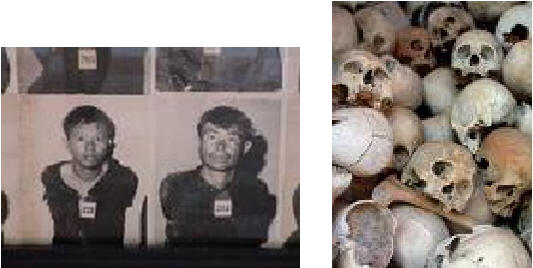
Two of Pol Pot’s
million-plus victims Relics of the killing fields

Khmer Rouge soldiers. They were mostly
young village boys with no education.
We should also question
ourselves and take a hard look at our own societies to see if we are
permitting or fostering attitudes and behaviour that might pave the way
for social conflicts of the worst kind. How could gentle, beautiful
Cambodians turn on their own people and massacre innocent women,
children and old people ? How could similar things happen in Rwanda, or
in Sri Lanka, where ordinary people suddenly attacked their life-long
neighbours without provocation, because the violence was given official
sanction. However, we should be careful before we point accusing
fingers. Our own societies have their dark seams of evil prejudice,
racism and intolerance, some of it permeating cultural and
socio-historical organizations.
Our daughter-in-law
recently attended an Orange Order dinner in Scotland. She came away
horrified at the ugly racist songs and jokes directed against Catholics,
and which have fuelled the IRA / UDA violence for the past century.
In the case of
Cambodia, I believe that the United States government and military
prepared the way for Pol Pot by the carpet bombing of the eastern part
of the country, and the undermining of King Sihanouk, as inscrutable as
he was. For reasons that are still hard to understand, the USA
suppressed information on the Khmer Rouge atrocities, and when
Vietnamese forces drove that insane army out of power, America still
smarting over the debacle in Vietnam, continued to support the Khmer
Rouge government’s seat at the United Nations, (as did communist China),
and provided Pol Pot’s forces with covert support in food and arms
through its eager and money-hungry ally, Thailand. I wrote to my Member
of Parliament at that time, protesting at the British Government’s tacit
support for the Khmer Rouge. Malcolm Rifkind, later to be Foreign
Secretary replied in his usual courteous way. He included a response
from the Foreign Office that I thought unworthy of an intelligent
administration. In effect it castigated the Vietnamese for being an
unelected regime in Phnom Penh. But how that then made the murderous
Khmer Rouge an acceptable and democratic government was a mystery to me.
A former U.S. infantry
captain told me of the CIA support for Pol Pot’s troops which was
substantial and active up to the mid-1980’s, from bases in Thailand. He
personally was witness to the operations which had the cooperation of
the Thai government. His own explanation was that the U.S. government
and military had such deep animosity towards Vietnam following its
effective defeat of American forces, that for some 20 years thereafter,
it would support any army, country, or rebel group, that would oppose
Vietnam.
But to go back to
Cambodia, - that land has probably recovered better from the wars and
bloodshed, than has Vietnam. Its soil was not contaminated, or its
forests defoliated as happened to its eastern neighbour. Today, the
population is surprisingly young. One sees few elderly people. The
young folk are eager to learn. English is becoming the lingua franca of
the educated class. There is widespread computer literacy, and even
taxi drivers and operators of “motos”, motorcycle taxis, have mobile
phones. True, there are some of the remnants of the Khmer Rouge still
around, and even holding positions in government. But that is
unavoidable when the regime covered the whole country.
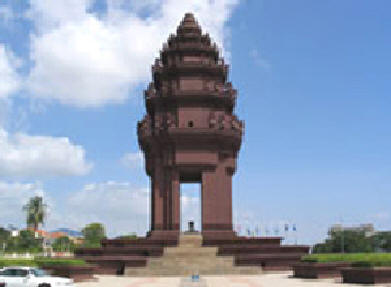
Independence monument, Phnom Penh

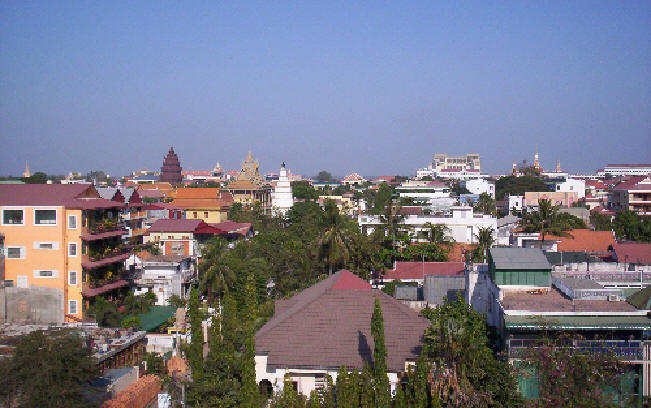
Urban area, Phnom Penh
The Director of
Fisheries, Nao Thuok, told me how he drove ox cart-loads of bamboo from
the mountains and forests north of Siem Reap, to the urban areas and
work camps for the Khmer Rouge. “Only”, as he told me with a rueful
smile, “I was the ox” ! He also had to cut and cart huge stones to
make grinding stones for the rice mills. This heavy labour was
accomplished on a tin-can size amount of rice per day during harvest
season, and half of that during the pre-harvest season. Another staff
member Chap Piseth, was a member of a children’s work camp. They
received a bowl of cooked vegetables per day, with a few grains of rice
mixed in. To stay alive they ate banana tree trunks and even raided
rice fields to chew on the immature grain heads. His knee swelled as
large as his head, and he suffered constant eye trouble. His eyes he
treated with urine, and once he got some sugar palm and sugar cane which
when boiled up gave a vitamin soup that reduced the swelling in his
knee. After the Vietnamese army drove the red guards off, he had to
search for days to find his parents, but eventually they were
reunited.
I asked Nao Thuok if he
ever came across former Khmer Rouge guards after the conflict period.
He said it happened rarely. One reason was that the khmer rouge engaged
in self-destruction, eventually killing each other. To maintain a
Maoist policy of ‘constant revolution’ Pol Pot would send in new teams
of camp guards regularly. The new teams would displace and then
interrogate and eventually kill the former camp guards, accusing them of
betraying the movement in some way. After the hostilities, some former
guards and soldiers were killed by the villagers who had witnessed their
crimes.
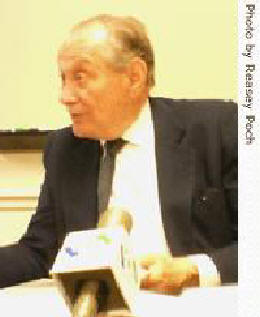
former US Ambassador, John Gunther
Dean. I was to use his Cambodia office building years later when it
had become the offices of the Fisheries Department.
Over a thousand years
ago, Cambodia’s rulers embarked on a colossal public works project, -
one that would vie with the pyramids of Egypt, or the great wall of
China. An enormous complex of temples was constructed at Angkor Wat
near Siem Reap on the north side of the Great Lake of Tonle Sap. The
millions of tons of enormous stones were dragged many miles though the
forests by elephants, or floated on rafts up the rivers and lake. They
were then carved to complex designs and depictions of the people and
their rulers. The temples reflect both Hindu and Buddhist beliefs and
worship. Astonishingly the enormous and extensive wonder of Eastern
civilization, was deserted and abandoned for hundreds of years. This
may have been due to defeats by invading forces from the north and the
west. The region may have been difficult to defend. Whatever the
reason, the magnificent ruins were left to the forest. Enormous trees
grew over the walls, their long roots embracing them like the tentacles
of a giant octopus, and even dislodging some of the huge stones.
Explorers came across the ruins in the nineteenth century, and they have
fascinated the world since.
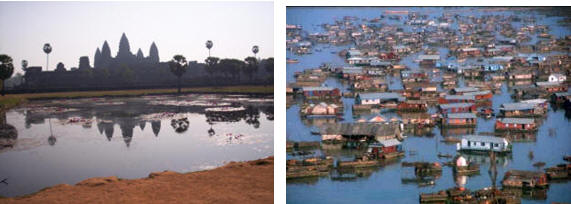
Angkor Wat
temples Floating village on the large
Tonle Sap lake
The past survives in
the ornate and impressive river festival each year when dozens of huge
canoes powered by thirty or forty men in matching brightly coloured
shirts, race each other at the confluence of the Mekong and Tonle Sap
rivers, before the monarch and local dignitaries and thousands of
Cambodians in festive spirit.
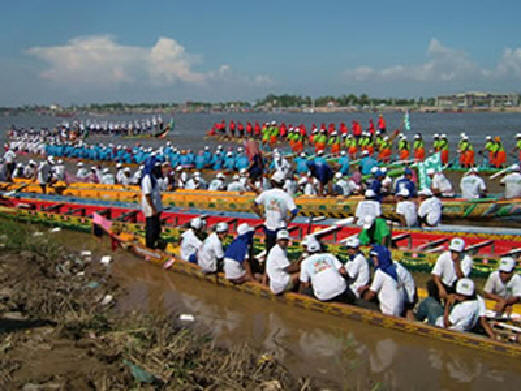
Racing canoes at the annual water
festival
The water and forest
resources of Cambodia are vital to the nation, and also to its
neighbours, Laos, Vietnam and Thailand. The Mekong and Tonle Sap
rivers, and the huge Great Lake of Tonle Sap (the largest freshwater
body in south-east Asia), form what has been well described as the fish
basket of Indo China. UNESCO declared the whole basin as a biosphere
reserve in 1997, and this in turn has attracted the attention of donors
and development banks. But the region is under serious threat from
plans to construct dams on the Mekong river in Laos and in China. The
Tonle Sap basin produces a quarter of a million tons of fish a year, and
supports 300,000 fishers and their families, and is the basis of the
rural economy for over 3 million persons who live in the basin.
The lake must have been
connected to the sea in millenniums past as indicated by its unique
variety and range of aquatic creatures. There are now populations of
freshwater shrimps, crabs, cockles, clams and sardines. The lake also
boasts stocks of the giant Asian catfish and giant carp. These
wonderful creatures are nearing extinction due to the intense fishing
effort which involves the use of many hundreds of tiny mesh-sized traps,
weirs, barriers, fykes, seines, trawls, dredges, gill nets, lift nets,
and cast nets. The stone carvings around the walls of Angkor Wat,
depict most of the species known today, but also some that are now
apparently extinct. Many more species will be lost if effective
management measures are not put in place. This the government is
seeking to do with international assistance.
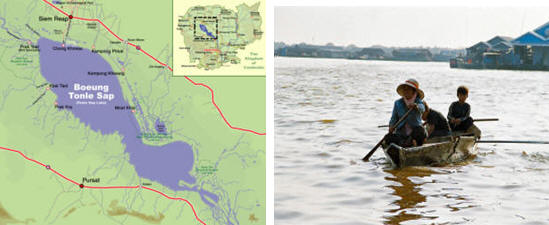
Map of the great lake of Tonle
Sap Canoe on Tonle Sap
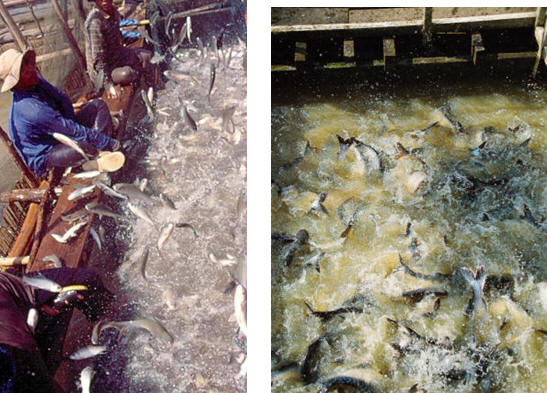
Harvesting fish on Tonle
Sap Live fish in a cage on the lake
My biologist colleague,
Dr Garry Bernacsek, was so fascinated by the stone carvings of fish
around the Angkor Wat temples, he photographed every one of them, then
proceeded to identify each species. The results were fascinating. Most
of the species carved nine centuries ago, are still with us. There were
a few marine species depicted in the frescoes. And there were a few
fish that are apparently now extinct. Garry’s expertise and attention
to detail were invaluable in helping us to construct a detailed
management plan for the whole lake and its adjacent river systems and
flooded forest. We had previously worked together in Sri Lanka, and at
FAO Rome. During his early years with that Agency, he produced a
comprehensive account of African fisheries that in its integrated focus
on the biological, economic and social aspects, was far ahead of its
time. Very sadly for me, and tragically for his life’s work, Garry died
of Hepatitis A and Dengue fever in a Bangkok hospital on July 1st
2006. He was buried near his parents’ home in Toronto, Canada.
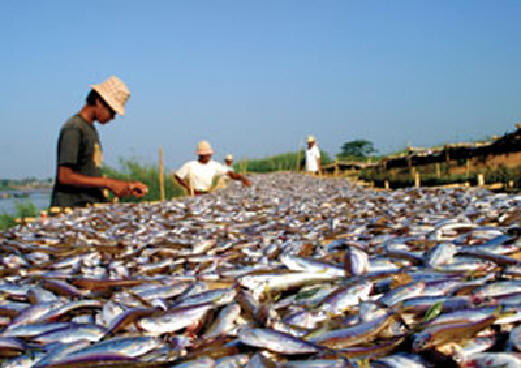
Processing fish from Tonle Sap
Cambodia’s forests are
under threat from loggers, from local inhabitants who need regular
supplies of fuel wood, and who sometimes cut down trees to create new
rice fields. A German member of my Cambodian team, Peter Degen, made an
excellent and moving (though disturbing) film of the devastation and
social distress caused by ruthless uncontrolled logging. The fishers
also utilize huge amounts of forest brushwood to create ‘brush-parks’ to
attract and trap fish, and also the large fyke traps which extend into
the flooded forest, and river barriers constructed at locations or
“lots” that are leased from the government for fishery purposes.
Deforestation results in soil erosion and the transport of silt into the
shallow lake and rivers. The whole delicate and vulnerable environment
needs to be protected, not just for the people of the Kingdom of
Cambodia, but for all the world, since it is a unique basin of
biodiversity.
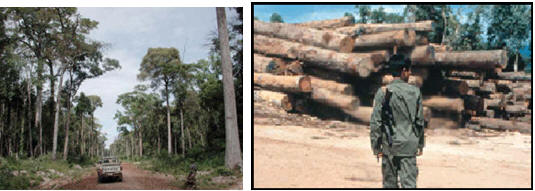
Cambodian rain
forest Logging of Cambodia’s precious timber
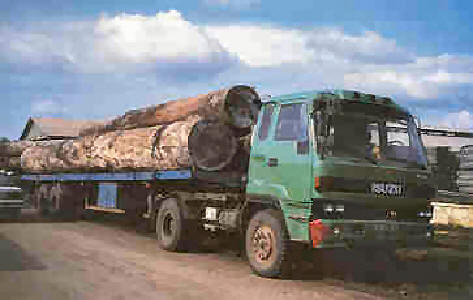
Logging truck
Vietnam
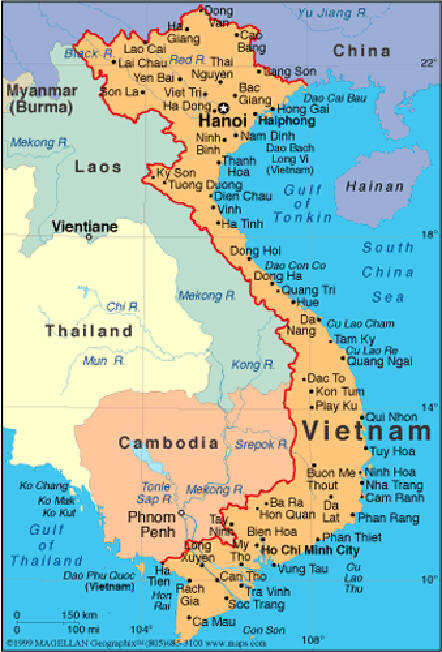
map of Vietnam
I suppose the Cambodia
story really began in Vietnam. It was, like Cambodia, a French colony
for some years after the war. The nationalists under Ho Chi Minh, and
his armed forces chief, General Giap, gradually drove the French out of
the country. I well recall the siege of Dien Bien Phu in 1954, when that
French outpost was over-run by nationalist Viet Minh [Many
years later I was to work with a fine Vietnamese colleague, Dr Pham van
Minh, whose father was killed in the fighting with the French before the
final assault on Dien Bien Phu.].
Our newspapers presented the story rather like the sacking of Rome by
the Huns, Goths and Vandals. It was the end of civilization in
Indo-China for a while. I also recall a Giles cartoon in the Daily
Express, somewhere around the period. A London newspaper vendor was
calling out to women shoppers struggling to get home through wind and
rain, - “Read all about it ma’m, - yellow peril getting nearer !”.

French troops at Dien Bien Phu
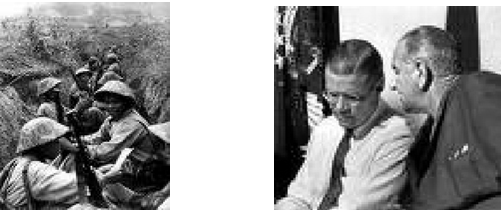
Vietnamese troops at Dien
Bien Phu Robert MacNamara with President Johnson
So the French
eventually withdrew, and the United States began to send military forces
to south Vietnam. They supported corrupt and sometimes inept
governments in Saigon, and refused to allow free elections to take
place. President Kennedy, elected in 1960, began to increase troop
assignments while in office. It is debatable if the huge increase that
took place under President Johnson and his Secretary of defense Robert
MacNamara, would have taken place had Kennedy lived. Certainly he had
his misgivings, but I suppose we will never know. The troop deployments
continued under Richard Nixon and Henry Kissinger while they searched
for the illusive “peace with honour”. It seemed to me that all
they wanted was to save themselves loss of face. But what a price to
pay. Or more accurately, - what a price others had to pay.
MacNamara later admitted that the fears that motivated America to go to
war in Vietnam, were false, and that the methods used to prosecute the
war were self-defeating. But there was little apparent remorse or shame
for his role in the bloody conflict.
I have mentioned
earlier, the conversations I had with the ex-CIA officer Clay Kelly. He
was in Vietnam through most of the war. Part of his job was to fly over
the “Ho Chi Minh trail” to detect movements of troop and supplies. He
claimed to me that much of the bombing of this area was worthless. Most
of the material came up the Mekong river or directly down by land within
Vietnam, from the north. He also claimed that enormous shipments of
generators, vehicles, bulldozers and other equipment, disappeared,
having been shipped abroad again from the ports shortly after arrival.
Prior to the re-shipment, the paint would be scratched or the odd window
broken, - but the vehicles and machinery were still intact and
functioning. He tried to protest about this to General Westmoreland and
Ambassador Bunker but they refused to listen, and in his words, treated
his reports with smiling contempt. But some individuals or groups must
have been amassing enormous sums of money from the illicit re-allocation
of war materials.
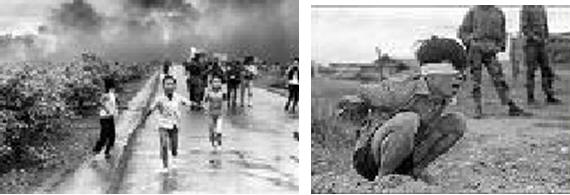
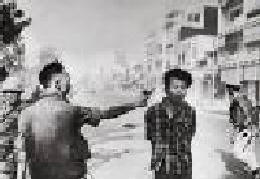
One of the Vietnam war’s
worst images Viet Cong
prisoner
– napalm bombed children
Below : Summary execution of a Viet Cong
soldier
A film clip of the incident was played on American TV, adding to public
doubts about the war.
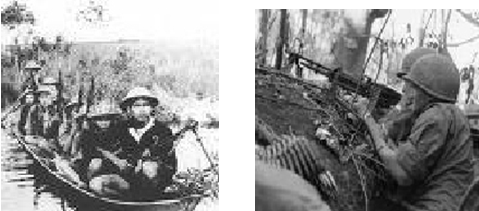
Viet Cong in the
Mekong Delta US soldiers in action in Vietnam
The war cost 330,000
American lives, and over 4 million Vietnamese (1.5m soldiers and 2.5m
civilians), not to mention the horrific casualties in Laos and
Cambodia. One of my students in Rhode Island, a lanky, reserved New
Englander, was killed just 3 weeks after arrival in Vietnam. I can see
young Webster to this day, tall, serious, sincere, quietly going about
his work. He was among those who voluntarily presented me with a pewter
mug engraved with the University crest. I still have it in my study.
Why did he have to die; why did those hundreds of thousands have to
die? What was it all in aid of? Would Vietnam have been any different
today if the United States had just left it alone? - Probably not. -
The madness of war!
The latter phrase is
not just mine. It has been echoed by many respected figures who have
seen conflicts first hand. No less a military man than General
Eisenhower, the Commander of the Allied troops in World War 2, came to a
similar conclusion. His son, John S. D. Eisenhower, wrote that the most
fundamental conviction of his mind from his experience of that conflict,
was the cruelty, wastefulness and stupidity of war.
The respected American
newsman, Walter Cronkite, no ‘bleeding heart liberal’, was with the US
troops and General Eisenhower in Europe during World War II.
Interviewed about his impressions on the 40th anniversary of
D Day, he said that his overwhelming conclusion was of the folly and
madness of war; of civilized people killing each other brutally in large
numbers. “There has got to be a devotion to peace like we never had
before”, said the veteran reporter. When asked if there was such a
thing as a “good war”, he said that no war could be good. Many
frontline soldiers on both sides of conflicts have expressed similar
sentiments. The Pulitzer prize winning war cartoonist Bill Mauldin,
creator of the GI characters, Willie and Joe, has also spoken of the
insanity and the pointlessness of all wars.
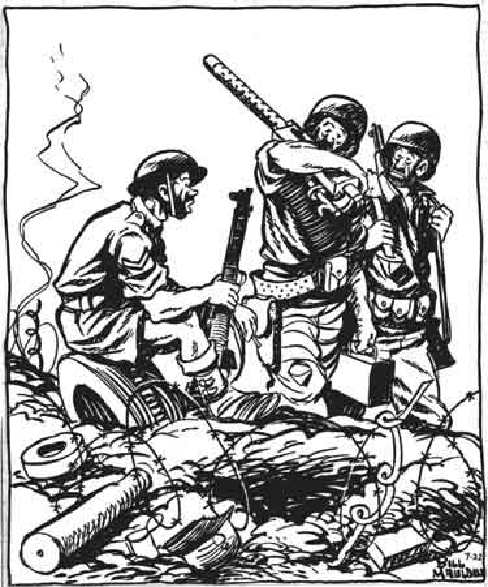 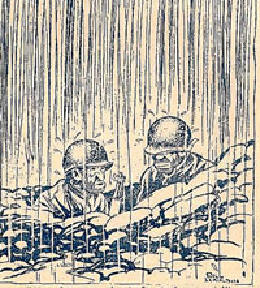
Willie and Joe cartoon by
Bill Mauldin GI’s Willie and Joe. Their creator came to
deplore
the insanity and pointlessness of war.
I spoke to South
Vietnamese Fishery Officers just after the US pulled out of the
country. They said that the countryside was so pitted with bomb
craters, neither farming nor fish farming were possible. In the chaos
following the American withdrawal, former members of the South
Vietnamese forces had a difficult and uncertain time. One of the naval
officers, Do Tan Minh, was married to nurse, and they had a little
daughter. Life became so uncertain and replete with danger, they
decided to flee the country. Together with an uncle, they acquired a 23
foot boat, accumulated some stores of food, fuel and water, and sailed
out one night, into the South China Sea. They sailed eastwards for a
few days, but though they passed a number of foreign ships, none would
stop or take them on board.
Then they ran into a
storm. It raged for some days, and one night was particularly rough.
Do Tan thought the little boat would not survive. He was so sure they
would perish that night, he told me later, he cried out to God to save
them. But when dawn broke, the wind abated, and they were still alive.
However, by then they had run out of fuel and water. They were soaking
hard grains of rice in sea-water to try to make it palatable. More
ships passed, but ignored their signals for help. Eventually one
Scandinavian vessel stopped. The Captain refused to let them on his
ship, but ordered his crew to give them water, food and fuel. He also
informed them the course and distance to Manila.
So the little boat
sailed on for three days more, and eventually arrived at Bataan near the
then Subic naval base. Its occupants were taken by the Philippine
authorities to a refugee camp where they joined thousands more “boat
people” who had already arrived. They were given a small place to
sleep marked out by string. That was all. No furniture and no
utensils.
I mention the story
because we came to know the family while in the Philippines. An
American ex-G.I. who was helping at the camp on a voluntary base, came
to our house and asked if we could spare anything. I showed him some
wooden crates in which we had shipped our goods. He asked if he might
have them and we readily agreed, and also contributed clothes and other
necessities. For the next year and a half, Do Tan and his wife and
child slept in one of our packing cases, - and enjoyed a degree of
privacy that was possible for few others in the camp.
They were hoping to be
accepted as refugees in Australia or America, but were constantly turned
down due to his relatively low rank in the South Vietnamese navy. We
lost touch with them, but in mid-1979 we were flying home for 2 months
leave, and were traveling west to east, from Manila via Tokyo and the
USA to Europe. After the jumbo jet took off from Manila, I wandered up
to the back of the plane. I felt a tap on my shoulder and heard someone
call my name. It was Do Tan Minh, smiling broadly. His family was on
board, and they were headed for Alabama where a Baptist church had
agreed to sponsor them. For them at least, the hardships and
uncertainty were over. For millions of refugees today, all over this
war-torn world, - the ordeal continues.
I have given my impressions of Vietnam’s history, and of the
Vietnam war, in the early part of this chapter. I would now like to to
describe my personal experience of that land and its people, from my
work there in 2005 and 2006. And I would like to add some further
comments on American policy and actions towards that beautiful land, by
respected and informed U.S. observers. But let us begin with a simple
account of the history of the land the Chinese called “the far south”.
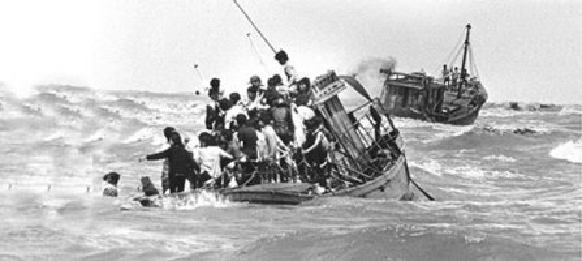
Above : Vietnamese boat people refugees
risking their lives to escape
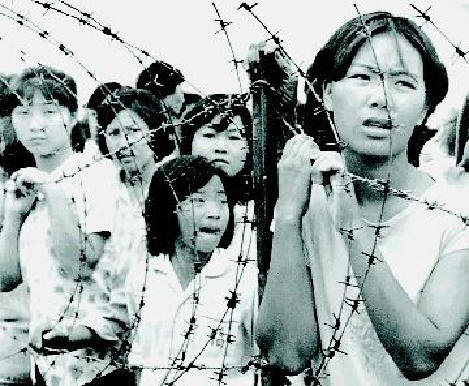
Boat people in a Hong Kong refugee camp
Vietnam was for
centuries under Chinese domination. That may partly explain its long
suspicion towards China, and the Chinese attitude of coolness towards
its small and poor neighbour. North Vietnam was known as Van Lang to the
Chinese of 1,000 and 2,000 years ago. Hanoi was formerly Au Lac, the
capital of a warlord state, until a Chinese potentate annexed much of
the red river valley and created Nam Viet which comprised south-western
China and north Vietnam. For a thousand years from 111 BC, China ruled
Vietnam, beginning with the era of the Han dynasty. Independence first
came to Vietnam in 938 AD under Ngo Quyen who defeated the Chinese at
the battle of Bach Dang River.
South Vietnam was a
separate state in that period, and it was influenced chiefly by Indian
traders, rather than Chinese warlords. South Vietnam also came under
the influence of the Khmer Cham rulers who built the massive Angkor Wat
temples in the Tonle Sap valley near Siem Reap. More than ten
Vietnamese dynasties ruled North Vietnam until the French imposed their
colonial power on both north and south towards the end of the 19th
century. The dividing line between north and south Vietnam was mostly
around the 17th parallel (latitude 17°north), at the northern
end of the present day province of Quang Tri.

Commemorative monument at the 71st
parallel
Shortly after the
French assumed control of Vietnam, a boy was born in Hue Province to a
minor mandarin who had been dismissed for anti-colonial sympathies. The
child, Nguyen Sinh Cung, was to undergo a number of name changes through
his life, but he became Vietnam’s greatest leader under the the title of
Ho Chi Minh. At the age of 21 he left Vietnam on a steamship bound for
France, and began an itinerary period traveling around Europe and north
America. For a while he served as a pastry chef in the Carlton Hotel in
London. He issued a petition demanding democracy and independence for
Indochina, and caused some consternation at the Versailles Peace
Conference. In 1920 Ho became a founder member of the French Communist
Party. He traveled to Moscow in 1923 at the invitation of the Bolshevik
Government, and following some political training, went back to China
and Indochina where he traveled around fomenting revolutionary
movements.
The French at one time
placed a death sentence on him for founding the Vietnamese Communist
Party, but though he was briefly imprisoned in both Hong Kong and China,
Ho escaped their efforts and returned to Vietnam in the early 1940’s to
lead his people towards independence. (I have often wondered whether
any of the American diners in the Carlton Hotel, London, or any of the
French diplomats having their photographs re-touched in Paris, (around
1912 – 1922), had any notion that the little oriental who served them,
would one day defeat the might of both their military forces.)
From the end of the
second world war, the French sought to re-establish their control over
Vietnam. They poured up to 250,000 troops into the country, and
bolstered them with 300,000 south Vietnamese recruits, and received $
350 million in support from the United States. From 1945 to 1954 the
Viet Minh attacked and harried the French troops until the final crucial
battle of Dien Bien Phu, in 1954. France’s strategy was to lure the
Vietminh into an open battle where French firepower would be superior,
but the enemy proved to be much too clever to fall for the trap, and
instead, by tactical maneovers and repeated attacks by fearless national
soldiers, the tables were turned. There, in the mountains near Laos,
the Viet Minh troops under General Vo Nguyen Giap (who amazingly, is
still alive at the time of writing in 2007), defeated the French forces
in three separate major attacks. The Viet Minh suffered heavy losses,
but pressed the attacks until on the 7th of May 1954, the
last of the defending French army surrendered. France had lost close on
100,000 men, and Vietnam double that number.
Following the French
defeat, the Geneva Conference was held, resulting in the Geneva Accords
of July 1954. Under these accords, the country was divided at the 17th
parallel along the Ben Hai river, where a demilitarized zone was
established. Nationwide free elections were to be held in 1956, but
this never happened due to American fears that Ho Chi Minh would win,
and to the blatant rigging of plebiscites by the South Vietnamese
government of Prime Minister Ngo Dinh Diem. These events paved the way
for America’s ill-fated intervention in Vietnam from 1962 to 1973.
President Nixon had hoped that the South Vietnamese army would hold out
after U.S. troops left in 1973, but it took only two years for that
regime to collapse, thus Ho Chi Minh’s forces took over the south in
1975, and the country was formally reunited in 1976.
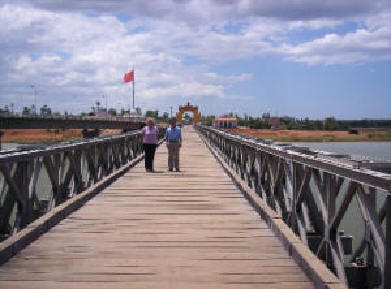
The old bridge over Ben Hai river at the
71st parallel. With my wife is Professor Nguyen Minh who
lost his father in the war with the French before the battle of Dien
Bien Phu
United Vietnam borders
on three countries, - China to the north and north-east, Laos to the
west, and Cambodia to the south-west. The longest border is with Laos
from which it is separated by a series of mountain ranges, chiefly the
Annam Highlands. The main northern river, the Song Hong or Red River,
originates in China, the main central river, the Ca, originates in Laos,
and the main southern river, the Mekong, enters Vietnam from Cambodia,
having traveled from China and through Laos. The country is long and
narrow, with a 3,000 kilometre coastline, and is only 50 km wide at its
narrowest point. The population now numbers over 80 million. More than
half of the population is less than 25 years old. That means that over
40 million Vietnamese were born after the end of the American war and
the reunification of the country. They have no living memory of those
events, and I reckon, though I am no sociologist, that peoples of Asia
and Africa are more ready to forgive and forget than those of Britain
and the USA.
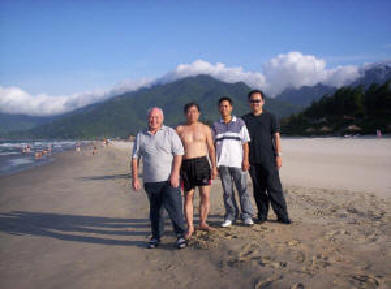
Myself with Director Pham Hai of the
Ministry of Planning and Investment, and one of his economists, Mr Trung.
This was a rare moment of relaxation near his home, for Pham Hai who
suffered a stroke shortly after.
My own travels through
Vietnam left me with impressions of a beautiful land, impressive
mountains, fertile lowlands, abundant forests, and some bays and beaches
that would compare favourably with any that Hawaii has to offer. Hanoi
is a quaint little city, full of parks, lakes and French cafes. It is a
paradise for shoppers seeking oriental curios. And its range of
restaurants would satisfy any diner. Saigon is more commercial, - a
typical modern prosperous business city of the orient. In Hanoi the
houses are tall and narrow, - a reflection of the property tax that
bases rates on the street frontage of each building. The old capital of
Hue retains much of its ancient glory, including the enormous fortress
and palace complex that extends over several acres.
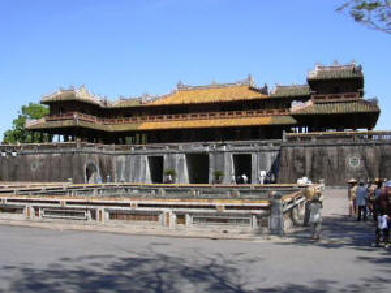
the old citadel at Hue, the historical
capital of Vietnam
There is a second
revered national leader who was largely responsible for Vietnam’s
economic recovery over the past 15 years. He was Nguyen Van Linh often
referred to as the second Ho Chi Minh. Amazingly he won the confidence
of the leaders and people of Vietnam as he argued the case for economic
liberalization. An economics professor, he became a senior advisor to
the government for several years. In addition to charting a new
economic direction for the country, he managed to change the law on
Presidential tenure which was reduced to a maximum of two 5 year terms.
The result of implementing Van Linh’s ideas has been a gigantic leap
forward for the country that had experienced 20 years of stagnation and
starvation after the end of the war in 1975. Now, almost all
malnutrition has been eliminated, and poverty that exists chiefly in the
rural mountain and coastal areas is being steadily reduced. I was
personally involved in the government’s determined efforts to improve
livelihoods for the poor communities of the central provinces, and can
attest to the sincerity and professionalism of its efforts.
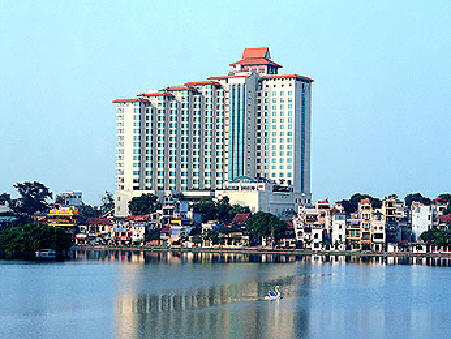
the West Lake at Tay Ho, Hanoi, near
where I lived for a year
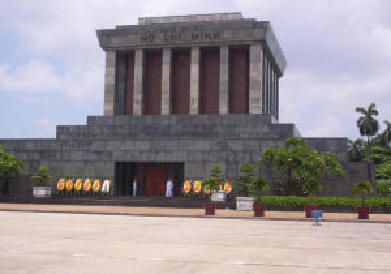
the tomb of Ho Chi Minh in Hanoi.
Actually his ashes were buried in three locations
I stayed for a period
in a hotel by the west lake, Ho Tay, near the tomb of Ho Chi Minh, and
the Long Bien rail bridge over the Red River. The bridge and
surrounding area was heavily bombed during the American war. The worst
bombing by the Nixon / Kissinger administration took place on Christmas
Day 1972 when hundreds of innocent women and children were killed in a
mad, cruel and pointless exercise. What message did that send the
Vietnamese people about ‘Christian’ nations and the season of peace and
goodwill ? By the west lake is a plaque remembering a local
anti-aircraft battery that brought down some American aircraft,
including the one that Senator John McCain parachuted from. McCain was
active in the US Presidential race of 2004. He served over 5 years in
the North Vietnamese prison known as the “Hanoi Hilton”. After the war
he pressed the U.S. government to normalize relations with Vietnam.
When we lived in Italy we knew another former prisoner of war, an ex-USAF
Captain who then served as a military attaché in the U.S. Embassy in
Rome. He occasionally shared with us, when asked, some of the
experiences of his incarceration in Hanoi.
What has become known
as the “Hanoi Hilton” is the Hoa Lo prison which was built by the French
colonial government 1904 to house Vietnamese prisoners. During the
American war, up to 300 US servicemen were interned there, mainly USAF
personnel whose aircraft were shot down over North Vietnam. Today the
Hoa Lo prison (the name means ‘fiery furnace’), is mostly gone, replaced
by a high rise building called the Hanoi Towers. A part of the Hoa Lo
remains as a tourist exhibit at the rear of the new building. It is
somewhat strange to shop or dine in the large modern store above where
many internees from both America and Vietnam, endured years of harsh
imprisonment.
In the province of
Quang Nam I met a former Major in the North Vietnamese army who at the
age of 70 was building up a small integrated farm on a coastal area of
poor sandy soil and brackish water. Despite the environmental
conditions he was producing cashew nuts, elephant grass (for hay), cows,
pigs, goats and chicken, plus a variety of fish from large ponds that
had been dug by hand. He talked of his experiences through the American
war and also the later invasion of Cambodia and defeat of the Khymer
Rouge. He mentioned living rough for years in central Vietnam, sleeping
in the bush, and as he put it, occasionally “sleeping beside dead
bodies”.
The Cambodia experience was in some ways more difficult as
the Khymer Rouge, unlike the Americans, used guerrilla tactics similar
to the Viet Cong. In Cambodia also they faced the danger of thousands
of land mines and vicious bamboo traps that were designed to maim rather
than kill. The Major said that he was wounded 8 times during his 20
years of fighting.
Few Americans spoke
more eloquently or powerfully against the Vietnam war than the Rev
Martin Luther King. And few others had researched the issues it involved
more thoroughly than he, from the political, moral, social, national and
theological standpoints. Any who are interested should read his
address, “Beyond Vietnam”, delivered in Riverside Church New York
in April 1967. It is applicable nearly 40 years later, to the Iraq war,
as it was to Vietnam.
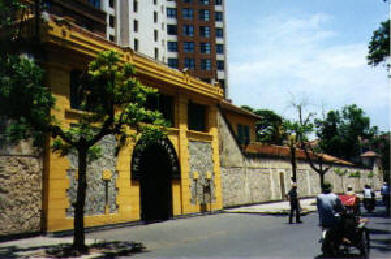
What is left of Hoa Lo prison, the
infamous ‘Hanoi Hilton’
I include a brief
edited extract below :
“It
should be incandescently clear that no one who has any concern for the
integrity and life of America today can ignore the present war. If
America’s soul becomes totally poisoned, part of the autopsy must read
“Vietnam”. It can never be saved so long as it destroys the deepest
hopes of men the world over. I have to live within my commitment to
the ministry of Jesus Christ. The relation of this ministry to the
making of peace is so obvious that I marvel at those who ask me why I am
speaking against the war. Do they not know that the Good News was meant
for all men – for communist and capitalist, for their children and ours,
for black and white, for revolutionary and conservative?
Have
they forgotten the One who loved His enemies so fully that He died for
them? I must be true to my conviction that I share with all men the
calling to be a son of the living God. Beyond the calling of race or
nation or creed there is the vocation of sonship and brotherhood. The
Father is deeply concerned for His suffering and helpless and outcast
children. We are called to speak for the weak, for the voiceless, for
the victims of our nation, for those it calls “enemy”, for no document
from human hands can make these humans any less our brothers.
As I
ponder the madness of Vietnam, my mind goes to its people who have been
living under the curse of war for almost three decades. It is clear to
me that there will be no meaningful solution until some attempt is made
to know them and hear their broken cries. They languish under our
bombs. They watch as we poison their water, as we kill a million acres
of their crops. They wander into hospitals with at least twenty
casualties from American firepower for one Vietcong-inflicted injury.
They see the children degraded by our soldiers as they beg for food.
They see the children selling their sisters to our soldiers, soliciting
their mothers. So far we may have killed a million of them, mostly
children. We have destroyed their two most cherished institutions: the
family and the village. What do they think as we test our latest
weapons against them? Where are the roots of independent Vietnam we
claim to be building? Now there is little left to build on save
bitterness.
I
should make it clear that while I try to give a voice to the voiceless
in Vietnam, I am as deeply concerned about our own troops as anyone
else. We are submitting them to the brutalising process of war and
adding cynicism to the process of death. Somehow this madness must
cease. I speak as a child of God and brother to the suffering poor of
Vietnam. I speak as a citizen of the world that stands aghast at the
path we have taken. I speak as one who loves America, to the leaders of
our own nation: the great initiative in this war was ours; the
initiative to stop it must be ours.
The war
in Vietnam is a symptom of a deeper malady within the American spirit.
In 1957 a sensitive American official overseas said that it seemed to
him that our nation was on the wrong side of a world revolution. We
have seen emerge a pattern of suppression which has justified the
presence of U.S. military advisors in several countries. The need to
maintain social stability for our investments accounts for the
counter-revolutionary action of American forces in Central America, and
why napalm and Green Berets forces have already been in action against
rebels in Peru. The words of the late President John F Kennedy come
back to haunt us. Five years age he said, “Those who make peaceful
revolution impossible will make violent revolution inevitable”.
We can
no longer afford to worship the god of hate or bow before the altar of
retaliation. History is cluttered with the wreckage of nations and
individuals that pursued the self-defeating path of hate. We have a
choice today: non-violent coexistence or violent co-annihilation. If we
do not act, we shall surely be dragged down the long, dark and shameful
corridors of time reserved for those who possess power without
compassion, might without morality, and strength without sight. If we
make the right choice, we will be able to speed the day, all over
America and all over the world, when justice will roll down like waters,
and righteousness like a mighty stream.”
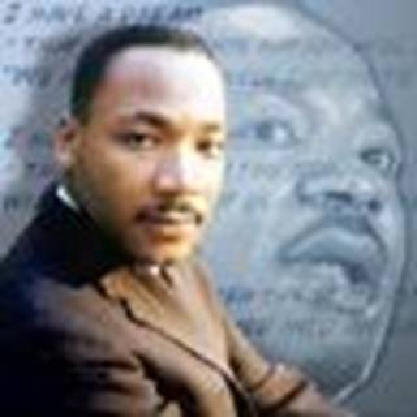
Martin Luther
King, courageous fighter for truth, justice and peace
Overall now, reminders
of the war in Vietnam are few, most of the damaged buildings and
infrastructure having been repaired or rebuilt. Some large bomb craters
remain, and parts of former forests have not recovered from the effects
of Agent Orange which was sprayed in enormous amounts (and at enormous
cost) from the south to the north. Informed foreign observers tell me
that though it has impacted negatively on the vegetation, soil and water
for 40 years, it was of next to no positive help to the U.S. war
effort.
|
Chemical Warfare
The United
States engaged in chemical warfare in a number of countries, but
particularly in Vietnam where two types of chemical weapon were
especially potent, and resulted in many civilian deaths as well
as military casualties. They also had a devastating effect on
forestry and vegetation, - an effect that continues to this day,
some 40 years after their use. The two chemicals in question
were Napalm and Agent Orange.
Napalm, or
naphthenic palmitic acid, was invented or developed by an
American chemist in 1942, and was used extensively by American
troops against the Japanese in the Pacific, after tests had
showed its effect on enemy morale. It is a jellied form of
petroleum or kerosene that is extremely inflammable, and can be
fired from hand-held flame throwers, or used in bombs dropped on
to enemy troops. Its use against civilians was banned by the
United Nations in 1980. The U.S. did not sign the ban, but
claimed that it had destroyed its napalm arsenals. However, as
confirmed by the Pentagon, napalm was used in MK77 and other
bombs dropped on Iraq in 2003. Colonel James Alles of Marine
Air Group 11 recorded its horrific effect on Iraqi soldiers
guarding a bridge that was bombed, and stated :
“The Generals loved Napalm. It had a big
psychological effect”.
Agent Orange was
one of ten herbicides that the U.S. military used in Vietnam.
They were each described by colours, and came to be known as the
‘rainbow chemicals’. It was the presence of Dioxin, a
by-product of Agent Orange’s manufacture, that made it so lethal
to humans. It has been recognized by the U.S. Veterans
organization to cause a range of serious illnesses including
cancer of the lungs, throat and chest organs, and of the
prostate gland. It also resulted in Hodgkin’s disease, chloracne,
multiple myeloma, and type 2 diabetes. (The pictures of
children deformed by the residues of that chemical, would break
the hardest heart, but most Americans have never seen them, and
the military deny that there were such effects). It was
responsible for spina bifida in babies, and in infants it caused
sudden deaths from its effect on the immune system. It was a
powerful defoliant and was used to deny cover to Viet Cong
forces, but even the U.S. military eventually admitted that it
had hardly any impact on enemy operations. Over 19 million
gallons of the lethal substance was sprayed on Vietnamese
forests, around Saigon, along the Cambodian and Laos borders,
and north of Da Nang up to and beyond the 17th
parallel.
So many American
military personnel who served in Vietnam, suffered from exposure
to the chemicals sprayed on the countryside, a November 1990
U.S. Veteran’s Department Staff Report stated,
“It is the war that will not end. It is the war
that continues to stake a claim on its victims decades after the
conflict has ended. This never ending legacy of the war in
Vietnam has created deep feelings of distrust of the U.S.
Government among many veterans and their families. The
(government displayed) a lack of honesty in studying the effects
of these toxic herbicides, and in particularly Agent Orange. It
also made a conscious effort to cover up information and to rig
tests results with which it did not agree.”
At least seven
American chemical companies were involved in the production of
Agent Orange which they constantly claimed was ‘harmless to
humans’. Nevertheless, following pressure by Veterans and their
families, and growing adverse publicity, they paid $ 180 million
in out of court settlements to victims. But the U.S. Government
has never admitted that its use of the chemical caused any
diseases in its soldiers or among the civilians residing in the
areas that were sprayed. |
Surprisingly, there is
little sign of anti-American feeling in Vietnam today. Even those who
lost family members during the conflict, display no indications of anger
or hostility. A lot of Vietnamese, particularly in the south, have
aspirations to emigrate to America, as do many people in S.E. Asia and
Indo-China. China is the major trading partner, due to its proximity,
and exports an enormous variety of household, mechanical, medicinal,
artifacts and clothing goods to Vietnam, but there is little love for
the large northern neighbour that has dominated its former colony for
centuries.
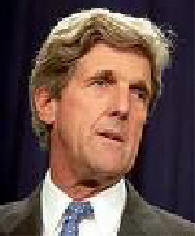
Above : Senator John Kerry,
veteran of the Vietnam War which he came to deplore
In
April 1971, John Kerry spoke before the Senate Committee of Foreign
Relations on behalf of the Vietnam Veterans Against the War. “In our
opinion, there is nothing in South Vietnam that threatens the United
States of America. To attempt to justify the loss of one American life
in Vietnam to the preservation of freedom, is the height of criminal
hypocrisy. Recently in Detroit we had over 150 honourably discharged
and highly decorated veterans testify to war crimes committed in
South-East Asia. They told how some had personally raped, cut of ears,
cut of heads, applied electric power to human genitals, blown up bodies,
randomly shot at civilians, razed villages, poisoned food stocks, and
ravaged the countryside beyond what was done by the bombing power of our
country. We saw first-hand how monies from American taxes were used to
prop up a corrupt, dictatorial regime. We saw America lose her morality
as she coolly accepted a My Lai massacre and clung to the image of GIs
handing out chocolate bars and chewing gum. We learned the meaning of
free fire zones, shooting anything that moves, and placing a cheapness
on the lives of orientals.
We wish
that a merciful God could wipe away our own memories of that service.
The Administration’s denial makes us determined to undertake one last
mission, - to search out and destroy the last vestige of this barbaric
war, to pacify our own hearts, to conquer the hate and fear that have
driven this this land these past ten years and more. So thirty years
from now when our brothers go down the street without a leg, without an
arm, or an eye, and small boys ask ‘Why’, we will be able to say
‘Vietnam’, and not mean a desert, not a filthy obscene memory, but a
place where America finally turned, and where soldiers like us helped it
in the turning.”*
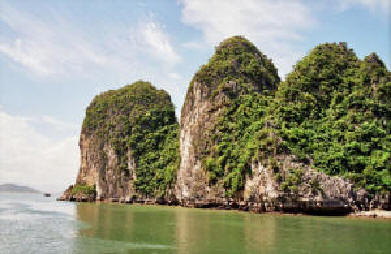
Halong Bay in the north of the Gulf of
Tonkin which gave its name to the infamous Tonkin Gulf Resolution that
was based on false charges concocted against small North Vietnamese
patrol boats.
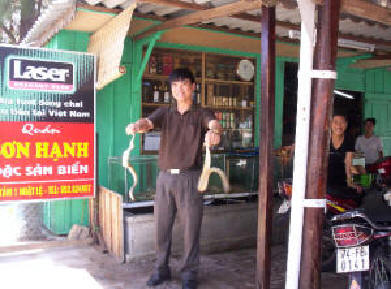
Coastal vendor offering us sea snakes for
lunch
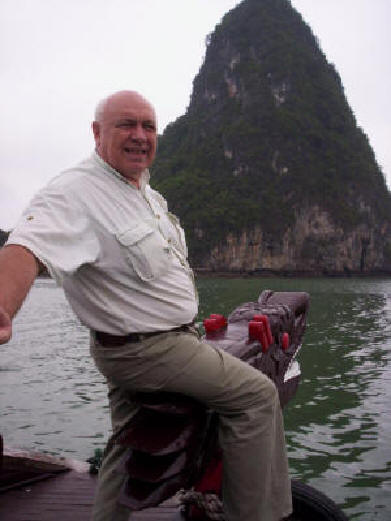
Myself at Halong Bay
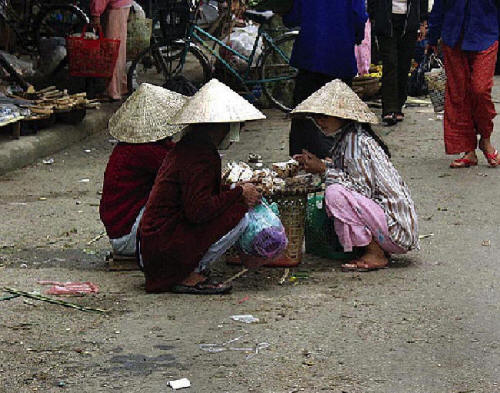
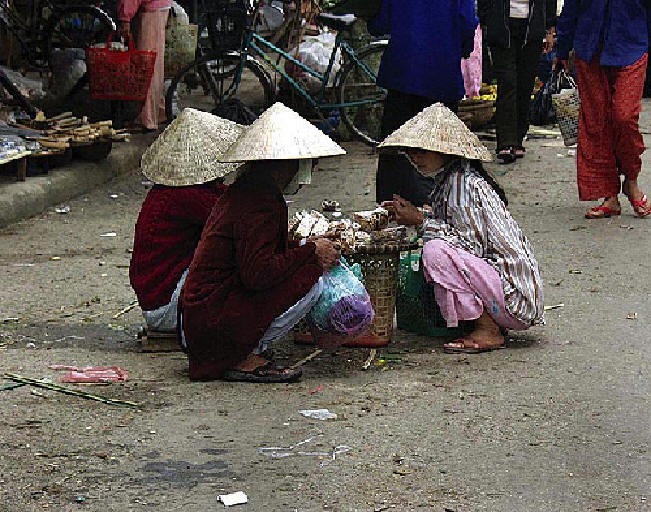
I could not resist taking this snap of
women in typical pose at a Hanoi market
Thailand and the Tsunami
The tsunami disaster of
Boxing Day 2004, shook the whole world to its foundations as we were
made to appreciate the immense forces of nature, and our own
vulnerability. Over 300,000 persons lost their lives, and together with
the aftershock earthquake that struck North Sumatra and Nias Island
barely 3 months later, the total toll in lives is probably well over
340,000. The cost in destruction of homes, fishing boats, and coastal
infrastructure, is incalculable. Fortunately, the whole world responded
with remarkable generosity and millions upon millions were pledged and
donated. The biggest pledges were by governments such as those of the
USA, Britain, Japan, and others in Europe, Scandinavia and Australasia.
But six months after the event, little of those enormous pledges has
materialized. This illustrates why the UN Secretary General was
unimpressed by the pledges, and pleaded instead for money on the
table. One year after the tsunami, there is a rush to spend some of
the money, but sadly there is a corresponding lack of vision or
practical ideas on how best it might be used.
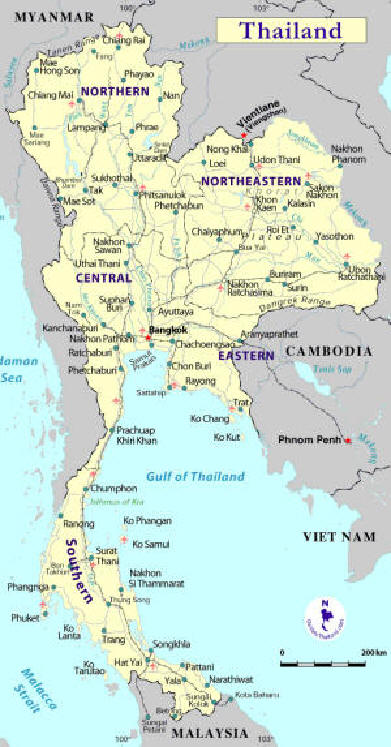
map of Thailand
What has been delivered
well and promptly, in Sri Lanka, Banda Aceh, Thailand, SE India, and the
Andaman Islands, are hundreds upon hundreds of charitable donations and
items of practical assistance from numerous individuals, churches,
missions, charities and organizations like OXFAM, the Red Cross, Tear
Fund and World Vision. Even a small Scottish charity like Blythswood,
that formerly had Eastern Europe as its focus, was able to ship
thousands of tons of clothes and household goods to the stricken areas
within a very short space of time.
From the start, I
established and maintained contact with officials and volunteers in the
countries concerned, and was asked by the fishing industry to assist
them in selecting the most appropriate types of equipment and
assistance, and in identifying the more reliable and trustworthy
vehicles of delivery. The government invited me to attend a
consultative meeting in London, and numerous individuals in UK, Ireland,
and the tsunami hit countries, liaised regularly with me on the
organization of contributions in money and kind.
I made known my
interest in assisting the relief efforts on the spot, as I was familiar
with practically all of the coastal areas and their fishing
communities. It was Thailand that first requested my services in April
2005, through a European project, originally designed to improve fishery
management, but modified early that year to direct assistance to fishers
and fishing communities that had suffered loss.
The
tsunami struck Thailand’s islands and coastal areas on the Andaman
seaboard. The area hit by the huge sea wave includes 6 Provinces, 25
Districts, 95 Tambons (sub-districts), and 40 Villages. To date it is
confirmed that 1,952 Thai persons lost their lives, but a further 1,998
are missing, making a possible total of lives lost of just over 3,950.
The number of children made orphans by the disaster came to 1,172,
including some from outside the 6 province area. A total of 3,302 homes
were completely destroyed, and 1,504 suffered partial damage. The value
of fishing craft, gear, fish cages, ponds, and fishery facilities, lost
or damaged, came to over 1.8 billion Baht (£ 25 million). Damage to
farm lands and crops amounted to 6.6 million Baht (£ 93 million).
Livestock losses came to 17.6 million Baht (£ 25 million), and small
business premises damage to 13.1 billion Baht (£ 18.7 million).
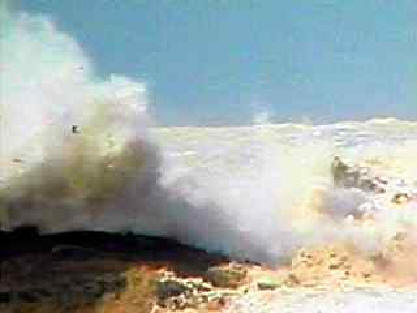
Tsunami wave striking the Andaman coast
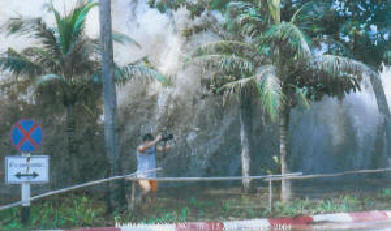
Wherever there was a belt of trees,
however thin, this broke the force of the incoming tsunami
Banda Aceh, Indonesia’s
northernmost Sumatra province was the region to suffer most horrifically
in the tsunami disaster. Sri Lanka’s east coast and south coast endured
the next highest losses in life and property. Losses in Thailand
amounted to over 8,000 persons, half of them Thais, although many of
that number are still listed as missing. Sadly, many bodies will never
be recovered. Over 700 children were orphaned by the disaster. A total
of 4,800 homes were hit by the enormous wave. 3,300 were destroyed
completely, and 1,500 suffered partial damage. Over 6,700 fishing boats
were damaged or lost, along with tens of thousands of nets, fish cages
and fish ponds. This amounted to an enormous disaster by any
yardstick.
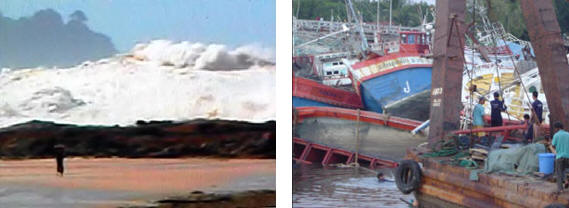
Tsunami wave coming in
towards Phuket Damage caused to boats at Ranong
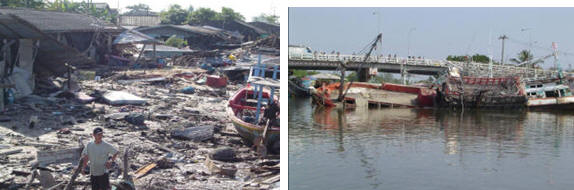
Wreckage on land by the
harbor Large boats turned over in
port
Initial compensation
sums from Thai Government emergency funds, were paid to survivors and to
families of fishermen lost. Practical help was provided to communities
by a range of charities and NGOs which were prompt to respond. My role
in the CHARM / TRS [Coastal
Habitats and Resources Management / Tsunami Rehabilitation Support, an
EU financed Project]
was to identify genuine fisher victims and damaged villages, and to
allocate appropriate practical help to repair vessels, provide
equipment, re-equip fish farmers, and assist fisher women to
re-establish their curing and retail ventures. I was made particularly
responsible to develop and implement workable arrangements for the
fishers to manage their operations and protect their fishing grounds in
cooperation with the national fishery patrol service. With the
enthusiastic and dedicate assistance of a fine Thai fisheries
counterpart, Thewan Thanamalarat, groups of fisher volunteers were
organized and trained in six coastal provinces, and were equipped with
life saving equipment, CB radios, binoculars, first aid kits, charts and
signal flags. Shore communication centres were established and fitted
out to act as the base for all operations, and the repository of data
and information on fish catches, illegal fishing reports, marine habitat
changes, and environmental facts on the local mangrove, sea grass, and
coral resources. The facilities provide each participating community
with the tools and skills to respond to future marine disasters, as well
as the training and facilities to monitor the condition of their coastal
zone and its fishing grounds.
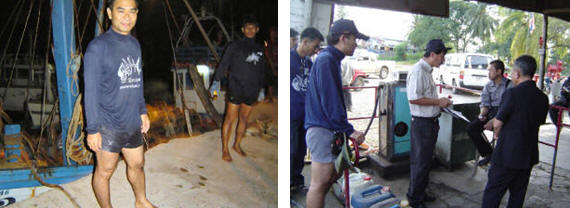
Thewan Thamalarat who led a rescue team
at Ranong and reporting to the Governor on the recovery operation
Yet, while these models
are relatively inexpensive and their replication up and down the tsunami
threatened coasts, would do much to lessen the impact of new disasters;
at the time of writing (2005), the bodies sitting with hundreds of
millions of tsunami relief funds in their hands, seem devoid of
practical ideas for their use. So instead of similar effective inputs
and measures, the money is being wasted on hugely expensive and
hopelessly theoretical studies or bureaucratic exercises of little
genuine relevance. After nearly half a century in development work I
still am astonished by the propensity of bureaucracies to avoid giving
practical help if there is an abstract alternative.
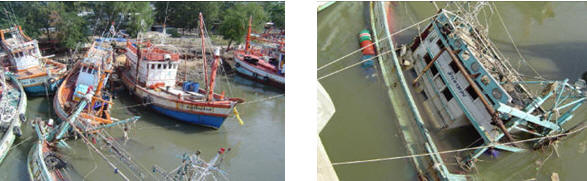
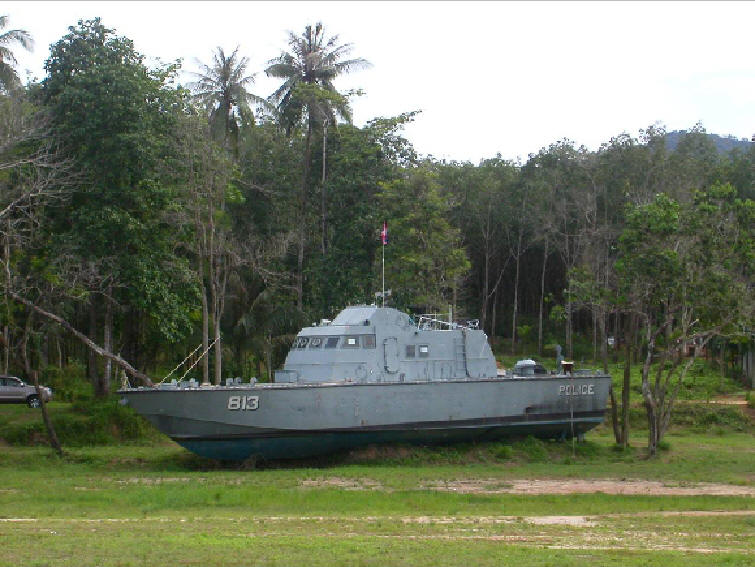
40 ton boats were smashed against each
other Vessel sunk in the harbour
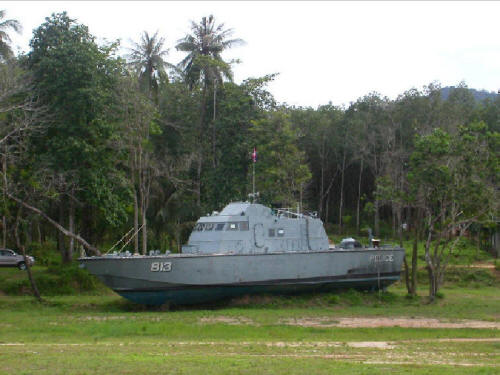
Above : This patrol vessel was swept one
mile inland from the sea
Visits to fishing
villages on the west coast and on the islands offshore, gave me plenty
opportunity to meet with the people and hear first hand from them, their
experiences when the tsunami wave hit, and the subsequent losses they
suffered. Rural peasants all over the world, whether farmers or fishers
or small traders, are remarkably resilient people, and one could not but
admire how they were rebuilding their lives and their communities.
Personal tales of loss and bereavement were particularly poignant. The
province of Ranong, north of Phuket, experienced the worst of the damage
in Thailand, though the scars of the destruction are being covered by
new constructions, and by nature’s ability to replace devastated areas
with fresh growth.
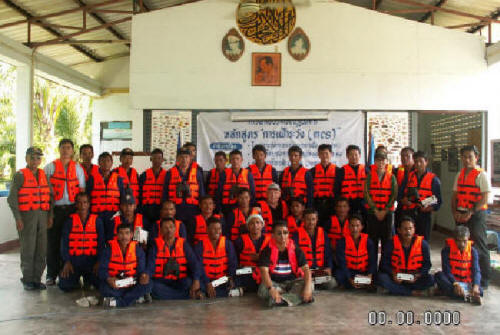
With Thewan and his team, providing
safety training to fishers
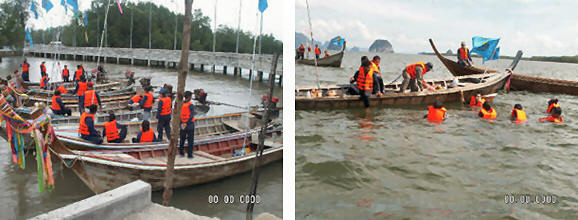
Fishing boats equipped with
safety apparatus Search and rescue exercises at sea
I knew Thailand and its
fisheries through long association that began with my service in the UN
South China Sea Programme, of which Thailand was a member. In 1979,
after the turmoil in Cambodia, I was asked to review fishery extension
services in Thailand, and was taken on a tour of the coastal areas by
national officers. The itinerary took us to the Cambodian border on the
east of the country, the Myanmar (Burmese) border to the north-west, and
the Malaysian border at the south of Thailand. We were accompanied by
an armed guard for the whole of the trip as each area visited had
security problems. But to my surprise, the most dangerous area was not
the Cambodian border where the Khymer Rouge still ruled, nor the Myanmar
border behind which the ruthless military junta held sway, - but the
Malaysian border which suffered from serious instability due to the
local majority Moslem population that had a long-standing dispute with
the Thai government. This problem is now well known, but at the time of
my trip it was being kept quiet by both the Thai and Malaysian
governments. Tanks, gun emplacements, pill boxes and military camps
were strewn all around the three southern border provinces. This
festering problem has erupted in violence in recent years, and like the
Philippine Mindanao problem, it could do with genuine efforts to examine
all the issues and to achieve mutual understanding.
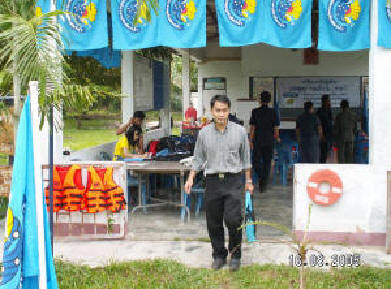
Thewan Thamalarat, former naval officer,
now Thai fishery extension and training officer, who did much valuable
post-tsunami rescue and rehabilitation work
My admirable Thai
counterpart officer for the tsunami rehabilitation and MCS work, a tough
and highly principled ex-naval officer, told me how he was assigned from
the Thai Navy to assist the Thai Air Force during the Vietnamese
invasion of Cambodia. His extensive naval training in security
patrolling, deep sea diving and photography, was considered most useful
to military reconnaissance. He was flown over Cambodia in a single
engined plane, dodging anti-aircraft fire, SAM missiles, and even MIG
fighters at times, to photograph troop movements and deployment in the
country. His considered thoughts after 26 years, were that the USA
feared Vietnamese communism more than the Cambodian variety, though it
was never as brutal, and so pressure was placed on Thailand to be the
buffer state protecting the rest of Indo-China from that threat. As
events transpired, apart from the Cambodia incursion (which was a great
blessing to the Cambodian people, and indirectly to the rest of the
world, none of whose powerful states was prepared to tackle the Khymer
Rouge menace), Vietnam showed no interest in spreading its Marxist ideas
to other states. Indeed, its own brand of communism has been watered
down to become more like Cuba’s than China’s.
Thailand is one of the
very few developing countries in the world, which was never colonized.
It is believed to have been founded in 1238, and was known as Siam from
the mid 14th century until 1939 when it took its present
name. It has been a constitutional monarchy since 1932. During the war
it was allied with Japan, and after the war became an ally of the United
States. There was considerable fear in the USA during the Vietnam war,
that Thailand was a key country in a line of possible dominos that might
fall to communism if it spread from Vietnam and Laos to Cambodia, then
Thailand and thence into the Malay peninsula. In the event this did not
happen. In fact it was Vietnam itself that could be said to have halted
the fall of the dominos when it invaded Cambodia and crushed the Marxist
regime of Pol Pot in 1978. But it got no thanks or recognition for
this from either the USA or Britain who both supported the ousted Khymer
Rouge regime and opposed its loss of a seat at the United Nations.
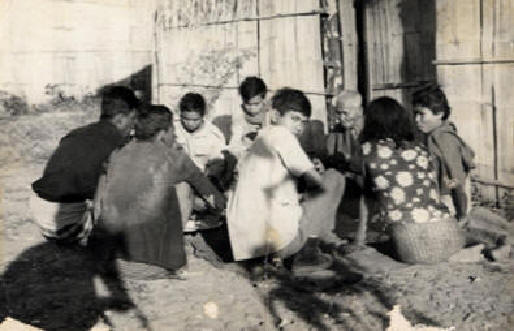
Thai refugee camp for Cambodians fleeing
the Khmer Rouge
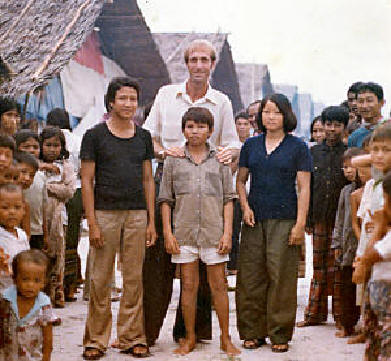
Cambodian inmates of a Thai refugee camp
As a result of the
troubles in Cambodia and in Burma, Thailand has had to cope with a huge
refugee problem on its doorstep. Cambodian refugees numbered nearly a
quarter of a million around 1980, and today there are tens of thousands
of refugees from Myanmar on Thailand’s north-west border. The tale of
Thailand’s dealings with its neighbour governments, and with the UN High
Commission for Refugees, and related organizations, is replete with
accounts of appalling opportunism and manipulation of the situation for
its own ends. Horrid cruelties were perpetrated against vulnerable boat
people by criminal elements in the Thai and Malay marine fleets.
Nevertheless, it must be recognized that Thailand did accept huge
numbers of refugees, and continues to do so. I find this to be in stark
contrast to the paranoia we find in England at a few hundred asylum
seekers. Many of the Thai people have shown genuine compassion to the
unfortunate displaced persons. Some traveled regularly to the refugee
camps with bundles of rice and medicine to relieve their distress.
Again I cannot forget the outcry in the city of Glasgow when a mere 12
asylum seekers were housed there a few years ago. The City council soon
sent them back to London.
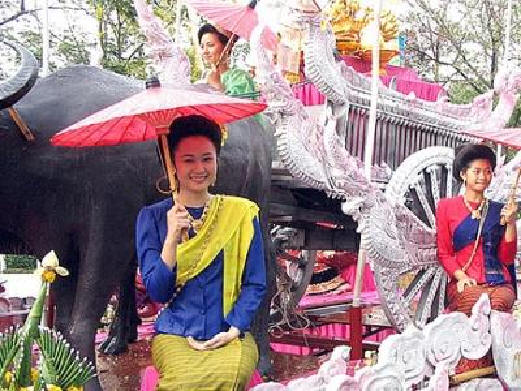
Celebrations and ceremonies in Thailand
are beautifully elaborate
Thai culture resembles
that of Japan in its respect for authority, for age, and for the
monarch. As in Japan, you do not enter a house wearing shoes, which
should be left at the door. Traditional ceremonies are important, and
are attended with enthusiasm and respect. Never having been a subject
race, the Thais are a rightly proud people in the best sense of that
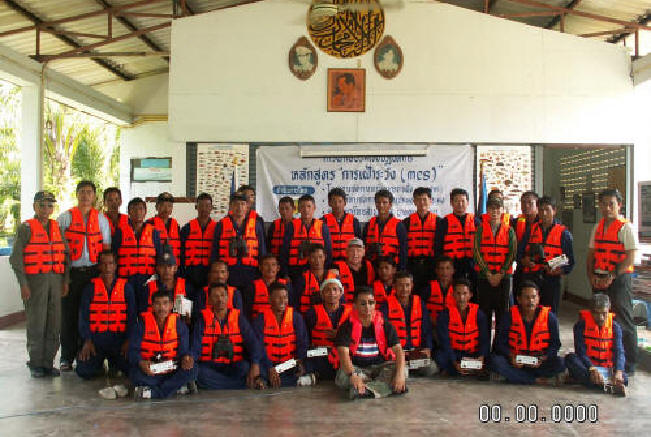
term. They are intensely loyal to their King, and one has to be in the
country during a Royal occasion to feel the strength and sincerity of
their national devotion. Practically every citizen you meet speaks with
pride, admiration and affection, of “my King”, as they refer to
him. King Phumipol Adulyadat himself lives up to all their
expectations, and exhibits wisdom, character and leadership, that each
befit his royal status. When I first heard that the Hollywood film
The King and I, was banned from all cinemas in the country, I put it
down to over-sensitivity. But having come to appreciate the genuineness
and universality of the people’s love for their monarch, I see that
silly Hollywood film as an insulting foreign parody of what is most
respected in their culture.
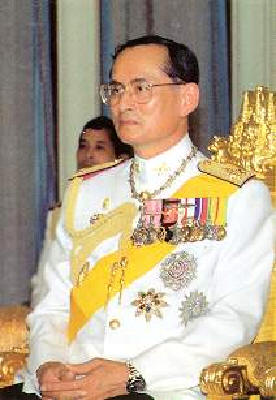
King Phumipol Adulyadat, the highly
respected Thai monarch
Like other Asians, the Thais are extremely hospitable and welcoming of
foreigners, though some of us offend their sensibilities and try their
patience to a considerable degree. Thai food, (genuine Thai food), is
exquisite, flavours ranging from the subtle and delicate to the fiery
and powerful. They possess the oriental distaste for confrontations
which are viewed as extremely rude and unpleasant. If problems have to
be resolved between persons or groups, they have other more passive and
face-saving ways of achieving redress. |