|
Do not steal. Do not covet anything that belongs to your neighbour.
… Do not take advantage of a widow or an orphan. Do not ill-treat
aliens or refugees, or oppress them. … Do not use dishonest standards
when measuring length, weight or quantity. Use honest scales and honest
weights. … If you lend money to one who is needy,
do not be like a money-lender; charge him no interest. … Do not defraud
your neighbour or rob him. Do not hold back the wages of a hired man. …
When you harvest the land, do not reap to the very edges of the fields,
or gather the left-over gleanings. Do not pick up fallen grapes in your
vineyards. Leave them, and the gleanings, for the poor and the alien. …
Do not lend money at interest to the poor, or sell them food at a
profit. Land must not be sold permanently, it must be returned in the
year of jubilee. The fiftieth year is to be the year of jubilee.
Mortgaged land must be returned. Indentured servants must be set
free.*
The Laws of Moses (selected),
from Exodus and Leviticus, NIV translation
A final word to the
arrogant rich : Take some lessons in lament ! You’ll need buckets for
the tears when the crash comes upon you. Your money is corrupt and your
fine clothes stink. Your greedy luxuries are a cancer in your gut,
destroying your life from within. You thought you were piling up
wealth. What you’ve piled up is judgment.
The workers you’ve
exploited and cheated cry out for justice. … You’ve looted the earth and
lived it up. But all you have to show for it is a fatter than usual
corpse. In fact what you’ve done is condemn and murder perfectly good
persons who had to take it, being vulnerable and
defenceless.*
The Epistle of James, paraphrased, from
The Message, by Petersen
I saw an angel come
down from heaven with great authority; and the earth grew bright with
his splendour. He gave a mighty shout, “Babylon the great is fallen;
she is become a den of demons, a haunt of devils, and every kind of evil
spirit. For all the nations have drunk the fatal wine of her intense
immorality. The rulers of earth enjoyed themselves with her, and
businessmen throughout the world have grown rich from all her luxurious
living. … World leaders who took part in her immoral acts, and
enjoyed her favours, will mourn for her as they see the smoke rising
from her charred remains. They will stand far off, trembling with fear,
and crying, “Alas, Babylon, that mighty city ! In one moment her
judgment fell.” The merchants of earth will weep and mourn for her, for
there is no one left to buy their goods. Businessmen who became wealthy
by selling her produce shall stand at a distance, fearing danger to
themselves, weeping and crying, “Alas, that great city, so beautiful, …
decked with gold and pearls ! In one moment, all the wealth of the city
is gone.”
Ship
owners, captains and crews of merchant vessels will stand a long way off
crying as they watch the smoke ascend, “Where in all the world is
another city like this ?” They will throw dust on their heads in their
sorrow and say, “Alas, alas for that great city ! She made us rich from
her great wealth. And now, in a single hour, all is gone”.*
The Revelation, by the apostle John,
paraphrased, from The Living Bible
The rise of capitalism
and global banking systems in the last two to three centuries, has given
enormous power to the individuals and organizations that own or control
land and financial assets. This power has been buttressed and given
both legal and moral support although the actual manner in which the
land and assets were acquired may have been dubious in the extreme, and
based on little more than conquest, pillage, exploitation, patronage,
corruption or manipulation. An interesting aspect to the moral support
for the whole monetary system is how it has assumed or acquired a
religious basis as if it was founded on divine revelation. This stands
in contrast to the economic arrangements that all the great religions
developed and implemented (to greater or lesser degrees), to ensure that
indebtedness did not extend for generations, and that there was relief
and support for the poor and destitute. The pre-Christian era Hebrew
prophets were fierce in their
denunciation of unrestrained and unjust exploitation, as is the whole
teaching of Christ on wealth and its use. But today’s right-wing
Christian churches and organizations, particularly in the USA, see the
maximization of profit and the accumulation of wealth as a Christian
duty. Conversely, poverty and economic disenfranchisement are regarded
as if they were the fault of the poor themselves.

Dollars, Pounds, Euros and Yen, - symbols
of the world’s Currencies
A former Wall Street analyst and President of the Institute
for the Study of Long-term Economic Trends in New York has written,
“Today’s financially oriented economies undermine the ethic of mutual
aid, societal safety nets, and policies that would alleviate debt
burdens. This is the outcome of a 5,000 year process, in which the
privatization of land, credit and industry, has permitted creditors to
assert their rights over the rest of society”
(above all other moral and
social rights). [Dr
Michael Hudson; (editor), Debt and Economic Renewal]

Wall street, America’s financial
centre
The process of the
accumulation of wealth and power by a few at the expense of the many,
has periodically resulted in enormous social upheavals and bloody
conflicts such as the French and Mexican Revolutions, and the liberation
wars of African and Asian territories. Further conflicts are inevitable
if present trends continue. The World Bank reports highest rates of
population growth (2.2% and 2.6% respectively) are occurring in parts of
sub-Saharan and north Africa, and the Middle East where political
turmoil, high unemployment, low economic growth, and massive export of
irreplaceable and depleting natural resources are all presently
occurring. [David
Smiley, Macquarie University, Macro-parasitism and the design of
remedial programs]
Since the days of Adam
Smith, market forces have recognized as a major, if not the major
element in determining the economic performance of nations and
companies. Some have elevated the market to a position of reverence as
if it was part of the immutable laws of the universe. They seem to
think that the market can do wrong. But no less a student of the global
markets as George Soros, has identified their weaknesses and limitations
: “Markets are designed to facilitate the free exchange of goods and
services among willing participants, but are not capable on their own,
of taking care of collective needs. Nor are they competent to ensure
social justice. These “public goods” can only be provided by a
political process.” [Improving
the World Order, George Soros, in The Bubble of American Supremacy]
To me it has always seemed that allowing the market to rule above
all other human or environmental concerns, represents a brazen return to
the morality of the slave trade, the
casino, or the
whorehouse. Of course, even the most ardent monetarist makes
exceptions for things like narcotic drugs or nuclear weapons.
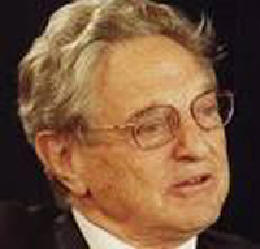
George Soros, financier, currency
speculator, and democracy advocate
Banking and Financial
Systems
Our capitalist system
is based on the control and use of money and assets by banks and
financial houses which in many ways wield more power than do elected
governments. The way banks ‘create’ money, and the freedom they have to
charge for this created money, is one of the wonders of this modern
economic world. Banks ‘create’ money by lending sums far beyond the
deposits or assets in hand. Every new
loan they issue permits
them to lend more money. And the banks charge substantial interest on
the loans they issue on the basis of their remit to issue credit beyond
the immediate reserves they possess. A major financial dealer cum
politician has said, “Let me control a nation’s currency, and I won’t
care who runs the government”.
Furthermore, the banks
are lenders that must be paid before any other creditors. During the
dark days of the demise of Scotland’s fishing industry, banks had to be
paid from each vessel’s trip earnings before the suppliers of fuel, ice
and stores, and before the crew got any wages. The banks gradually
assumed ownership of boats and their assets, and even of ‘quotas’ which
were little more than the right to catch fish in the future. How can
you ‘own’ a fish that is swimming somewhere in the ocean, or own huge
amounts of fish that are not even born yet? The same process occurred
in American agriculture, and the tentacles of bank ownership and control
continue to reach out and claim possession of land, businesses and
assets that no one in the bank worked to create, except that it may have
lent money to the venture, - money that itself was created out of
nothing!

Avarice. This is how Medieval scholars
and ancient Hebrews thought of charging interest on loans of money.
Our modern banking
systems seem to me like an enormous parasite that sucks the wealth and
assets from individuals, businesses, communities, and countries.
Governments all over the world appear to become more and more deeply in
debt to national and global banks. Why should that be ? What right
does a banking institution have to rake in excessive profits and yet
share none of the risks of its borrowers ? Some will protest that they
do, and that some banks have suffered losses. My own impression as a
total layman in the subject is that investors certainly suffer losses,
especially the small investors and pensioners, and some small banks and
peripheral financial organizations suffer losses. But the really big
financial houses appear to gain as more and more people, companies and
governments have their futures mortgaged to them. Publicly, through
World Bank loans and schemes like private finance initiatives, we are
putting our children and our children’s children in debt for
generations. How can this whole gadarene slide into the shackles of
endless debt be ended or reversed?
We need a cleansing
apparatus that would put things to right every few decades. The ancient
Hebrews had such a righting mechanism in the “Year of Jubilee”
instituted under the Law of Moses. It was probably put into practice
only rarely and incompletely, but it was designed to prevent perpetual
indebtedness and bondage. Every fifty years, all unpaid debts had to be
wiped off the books. Just think what such an arrangement would do for
any country or any society!
Serious consideration
is now being given to writing off the external debt of the poorest
countries in the world. Truth be told, in implementing such a policy
the lending countries are just giving something to themselves since the
debtor state can barely pay, and once in a condition of financial
liquidity, would resume purchasing goods from the lender. But some
solution needs to be found to control the corrupt leaders of so many
poor countries, and to limit the power of multi-nationals and arms
suppliers who would be only too ready to take advantage of the
continents new-found liquidity.
The Financial Crisis
From 2008 the world has witnessed an unprecedented crisis in
national banks and global financial systems. Governments have bailed
out banks at taxpayers’ expense while the bankers who gambled their
country’s assets in the global casino to obtain ever larger bonuses and
apparent profits, have largely been rewarded. None have been taken to
court or jailed, though in one case the head of the Royal Bank of
Scotland who oversaw an unprecedented loss of £ 24 billion in 2008 was
stripped of his knighthood in January 2012. But he still retained his
massive £ 12 million pension pot.
The whole Gaderene slide into massive worldwide debt began
with the sub-prime mortgages in the USA. Money was lent to unqualified
borrowers, and then interest rates raised till thousands defaulted and
had their houses taken from them. Meantime the US banks hawked these
worthless mortgages and loans around the world by mixing them up in
financial instruments which were sliced salami style so those foolish
enough to acquire them hadn’t a clue about their value, (they were
worthless), and no-one bank seemed legally responsible to pay for the
losses when the whole house of cards collapsed. But astonishingly the
thousands of intelligent bankers and financial experts in America and
Europe remained blind to the impacts of their mismanagement as they saw
only more and more obscene bonuses coming their way.
The bankruptcy of the large American bank Lehman Brothers on
“black Monday”, September 15 2008 was one of the biggest in a series of
bank failures and rescues by panicking governments in the face of a
tsunami wave of financial losses. The British government had to
nationalize Northern Rock on 12 February 2008 and Bradford and Bingley
on 29th September of that year. Then on October 13 it had to
pump £ 37 billion into RBS, HBOS, and Lloyds TSB. Iceland’s Landsbank
fell into bankruptcy on December 9th, effectively bankrupting
that small country.
The UK bailout of its financial giants RBS and Lloyds TSB is
now estimated to cost British taxpayers up to £ 1.5 trillion. That is £
1,500 billion, - £ 25,000 for every man woman and child in the country,
pensioners, students, and low-paid alike. The figures are astounding,
and probably beyond most ordinary folk’s ability to comprehend. The
cost will impact on people over the next few years in reduced health
services and social benefits, higher taxes, and more costly college fees
which will put university places beyond the reach of young people except
those privileged to have wealthy parents.
In the Eurozone of 25 countries, (Jan, 2012) 14 had public
debts of more than 60 % of GDP. Greece, the ‘basket case’ of the EU had
debts amounting to 142 % of GDP. Italy had a debt to GDP ratio of 119
%. In Belgium and Ireland it was 96 %. In Portugal it was 93 %. The
ECB, European Central Bank, said in December 2011 that it would provide
$ 638 billion ( Euro 489 billion) to 500 banks. Twelve Italian banks
borrowed $ 143 billion (Euro 116 billion.
The response of the EU
and Angela Merkel in particular is to save the Euro at all costs. That
currency only came into being in 2002. Ten years later it is on the
brink of collapse. But it was primarily a political and not a financial
or economic venture. And so the chief politicians of the EU want to
save it. They have demonstrated by their actions that they are quite
prepared to impose technocratic rulers on to Euro states, destroying
what is left of their sovereignty and democracy. But that might be
expected from the lady who was an ardent communist and a privileged
citizen in the DDR (East Germany) before reunification. Her father Horst
Kasner was a Lutheran Pastor who moved from West Germany to the DDR just
after Angela was born in 1954, and was treated like a VIP by the East
German government and allowed many privileges. He was a constant critic
of the West. Some who know Chancellor Merkel well claim that she is
neither democratic nor libertarian, and is much more comfortable with
the apparatus of a strong and dictatorial state. Is that where she will
take the EU ?
The Head of Europe’s
major bank, Deutsche Bank, and of the Institute of International
Finance, Dr Josef Ackerman, gave the world and his fellow bankers this
stark warning over the BBC in early 2012. “We have a social
responsibility to be philanthropic . . . if this inequality in income
and wealth distribution increases, . . . we may have a social
time-bomb ticking.”
That time bomb could
have unthinkable consequences for most western countries.
The World Bank and
International Development
I have very mixed
feelings about the World Bank and its affiliates, the Asian Development
Bank and the African Development Bank. I say that having worked for
these organizations much of the time the past 25 years. First of all,
it should be borne in mind that if you describe World Bank loans as
“aid”, - it is aid with strings attached, and aid that is very much in
the interests of the lending parties. Most World Bank money is actually
spent on goods and services obtained from its member countries. A
smaller percentage of Bank project money is spent inside the recipient
country, - and, - please note, - since the borrowing country has to
contribute the local currency costs of the project, the amount spent
in-country in most cases equals the amount they have contributed to the
project.
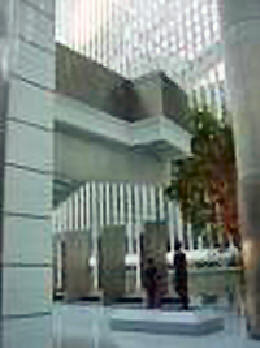
Headquarters of the World Bank,
Washington DC, close to the State Department and the White House.
The loans made by the
World Bank and its affiliates are extremely bureaucratic in their design
and administration, and can be subject to seemingly mindless nit-picking
and arbitrary requirements, often to satisfy internal dogma rather than
assist the borrowing state which is regarded with a surprising lack of
genuine respect.
Some will protest that
WB loans are very cheap. They carry low interest, and often involve a
grace period before repayment commences. That is true only for the most
preferential loans that are for social and environmental investments.
Rates may be as low as one per cent, and the grace period may be 5
years. However one must remember that they are in foreign currency,
usually dollars, and that means an automatic interest rate for the
borrower as the local currency declines in value against the dollar.
Other loans carry rates of around four to six-and-a-half per cent, and
involve conditions that may not be in the borrowers’ best interests.
World Bank loans come
with ‘strings attached’, and governments have to conform to Bank ideas
on the direction of development investments, as well as on how their
economies should be managed. The attempts to impose fiscal policies on
poor countries in Africa have been extremely punitive on the very
section of the population that the loans are meant to help. Bank
officials are for ever trying to get developing country governments to
reduce public sector employment. But this is tackled in a manner that
often reduces the little bit of development that governments can
stimulate. One practical example might suffice.
During the 1970’s under
a UNDP country programme, I assisted the Republic of Indonesia to
establish a nation-wide fishery extension service. Technology units and
extension centres were constructed and put into operation in all 26
provinces of the country. Hundreds of
technical staff were trained to levels of competency in gear and
methods, navigation and seamanship, boat-building and marine mechanics,
fish processing, refrigeration, quality control, and the farming of fish
in fresh, brackish and marine waters. The technical officers were
posted to the field stations in every part of the country and for the
next ten years, the national fisheries grew and prospered. Then along
came a World Bank official (an Englishman), in 1990 who advised the
government to reduce its public sector employees. He said it was a
waste of money to have separate extension services for fisheries as well
as agriculture. Foolishly (as is now admitted), the government
succumbed and scrapped the whole fishery extension service. Thereafter,
all a fisherman or fish farmer could get in the way of technical
assistance was an occasional visit by an agriculture officer who was
trained in the production of rice, livestock or coconuts. It was small
wonder then that within a few years, an imbalance took place in the
harvesting of coastal fish stocks, and mismanagement of the fish farm
sector led to virus disease outbreaks that were to cost hundreds of
millions of dollars and cause several bankruptcies and non-repayment of
bank loans. All that to satisfy World Bank monetary ideology!
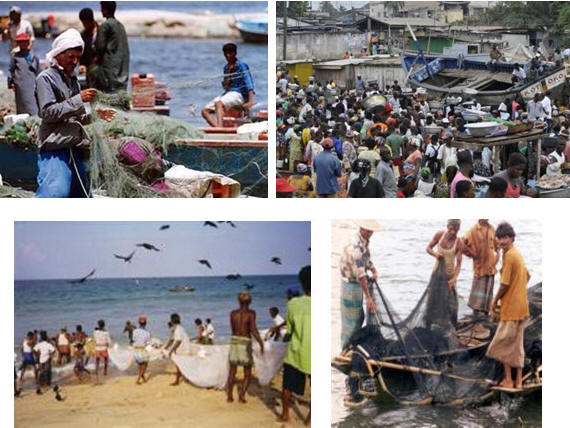
Photos above : poor artisanal fishers in
Arabia, Africa, Sri Lanka and India. There are over 20 million of them
in the world, but they suffer continually from monetarist and
globalisation policies imposed on their governments by the World Bank
and multinational business. In Indonesia where hundreds of technicians,
instructors and extension workers had been trained, and centres
established in all 29 Provinces, the World Bank demanded the Government
close that service and dismiss the employees, to economise on public
expenditure in a nation that had over 3.5 million fishermen and fish
farmers, producing much needed fish protein food for its then 150
million population.
I was
once asked to address a seminar of government officials in the
Philippines on the subject of “how to obtain a World Bank loan”. I’m
afraid I disappointed the whole audience by stating at the commencement
that in most cases, developing countries needed World Bank Loans, like
they needed a ‘hole in the head’. The truth is that far too much Bank
aid is spent on projects the country could well do without. But right
down through the whole government apparatus there is a belief that all
the bureaucrats will benefit in some way from handling and spending the
millions involved. There are groups of projects that are attractive to
government personnel since they are easy to justify, and the Banks
appear to be only to willing to lend money for those infrastructure /
energy projects.
This
applies particularly to the damming of rivers for irrigation and power
generation purposes. Some early ventures of this nature may have been
good and beneficial in the long run. But soon they are seen as money
making projects by central and regional officials, and you then see a
series of dams being constructed with little strategic thought, and
usually with tragic consequences for the environment. This is happening
all over the world. It is happening in Africa, - Nigeria being a prime
example. It is happening in Indo-China where dams planned for the
Mekong river threaten the future of agriculture and fisheries
downstream. It has happened with disastrous results in central Asia
where canals rather than dams have drained the Amu Darya river and dried
up the former inland sea of Aral.
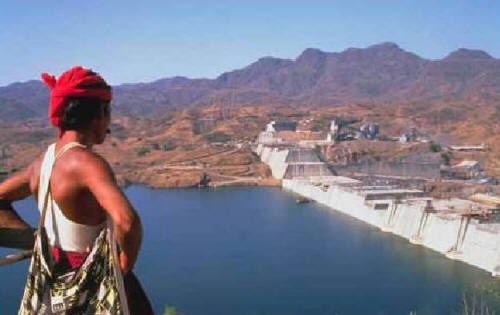
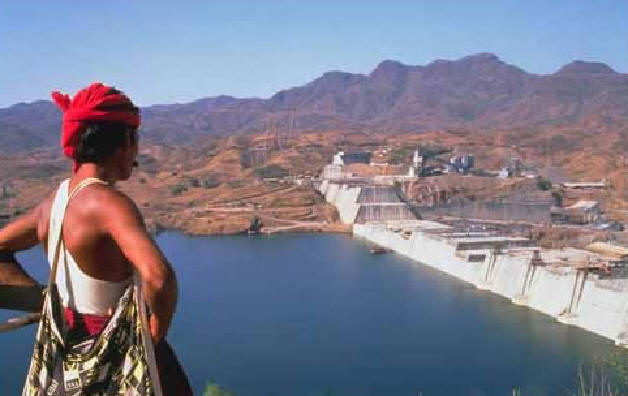
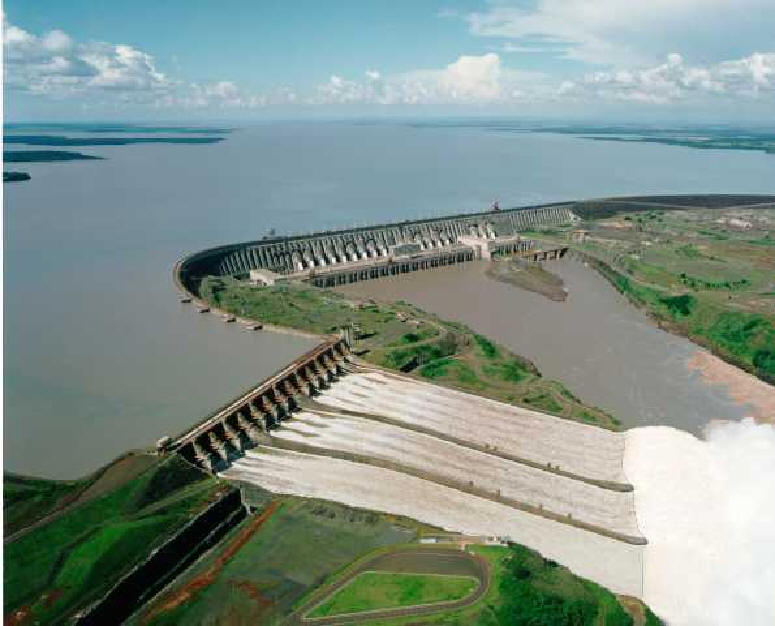
Dams are a favourite investment for
international banks. This one is in India.
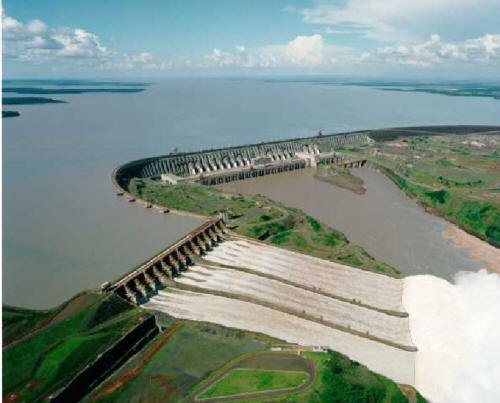
Itaipu dam, Brazil
Some
will ask, “but aren’t the Banks reluctant to lend money for such
projects”? The answer is yes and no. They have huge environmental
departments that are supposed to warn them against this kind of
intervention. But the Banks are in the business of lending money. Few
lay persons realise that the World Bank and its affiliates are
money-making organisations. They make a healthy profit on their
operations. The last thing they want to happen is for countries to stop
borrowing money from them. And they love the big capital-intensive
projects like those for seaports, airports, cement plants, dams and
highways. The kind of projects they don’t like, and the ones the Banks
are poorest at implementing are investments aimed at benefiting hundreds
of thousands of poor rural people. Few of these poverty-alleviation
projects ever succeed in achieving their objectives.
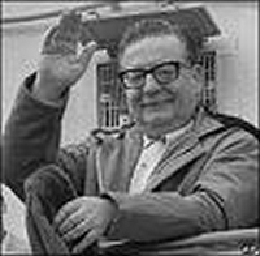
President Allende of Chile. He was
democratically elected, but was overthrown by General Pinochet with U.S.
support. Pinochet became a brutal dictator.
The
loans are often political. If anyone doubts this they should look at
the way the World Bank shovelled huge sums of money into Chile to
support the Pinochet regime after Allende was overthrown, and how they
have no wish to know countries like Cuba. But that is probably just as
well for Cuba. I was assisting a World Bank project in a country I
shall not name, on what was intended to be a $ 100 million investment in
higher education. It was a rather dry, conservative, long-time staff
member of the Bank who remarked half-way through the project, that its
real purpose was political security, not education. Most of the money
was to go into new well-fenced university campuses located far away from
urban centres, whether the institutes needed them or not. Very little
was to go into staff development, even less into laboratory equipment,
and practically nothing into library materials and course textbooks.
The priorities were all upside down. The officer pointed out that in
his opinion the government wanted to secure college campuses and isolate
troublesome students before political protests became widespread. So
the Bank happily lent money to make this physically possible, and
dressed it up as investment in education. But the officer who
identified the real nature of the project just shrugged his shoulders
and said that he had joined the Bank as an idealistic economist, but had
sold his soul to the organisation within the first two years.
United
States governments and legislators often criticise the U.N. Agencies and
the international banks as being over-bureaucratic and wasteful. One
gets the feeling that such pronouncements are made mainly for internal
consumption, to please an electorate that imagines that their tax
dollars are being given away without thought to corrupt, lazy
foreigners. That would seem to be a popular impression. In this area
as in several others, the American public is ignorant of several
aspects. First, of the rich nations, although it is the largest single
contributor to the U.N., it gives a smaller percentage of GNP to aid,
than any of the others. In contrast it gives from 30 to 100 times its
aid amount, to the military and to weapons of mass destruction.
A
second misconception is that the US has no control over UN budgets, and
has difficulty getting detailed information on where the money goes.
The lie to this idea is that the Head of Finance in each of the UN
organisations and agencies, is an American officer ! So, if the
Americans don’t know where the money goes, - no-one does ! The US has
had a strange propensity for appointing its most belligerent military
supporters to head the World Bank. President Johnson did this with
Robert Macnamara, and President Bush has just done so with Paul
Wolfowitz. The one masterminded the huge military expenditure in
Vietnam, and the other, that in Iraq. What kind of a message does this
send to poor, vulnerable peoples ? What compassion if any have those
doctors of death ever shown to suffering humanity?
The
other factor that needs to be borne in mind is that almost no country
ever defaults on a World Bank Loan. That is not wholly true as we have
the case of Argentina at present, and a couple of pathetic basket cases
in Africa, but the few who defaulted before were the poorest of the
poor, and the loans they were unable to repay were modest. Whether a
Bank loan is successful or not, it has to be repaid. I have often told
officials abroad that if they were to offer private banks the same
guarantees and security of repayment, that they give the World Bank, -
they could get extremely preferential rates. This in effect is what
Malaysia has done with good results.
Some will ask about the
corruption involved in the use of international loans, and sometimes
talk foolishly as if the money was handed over in cash, with no
accountability required. What actually happens in most cases is that
the lowly paid government staff members see aid loan expenditures as an
opportunity to supplement their small salaries. In most Asian countries,
this is done in a manner that has been almost formalized. The
contractors or suppliers of equipment are expected to pay a ‘commission’
to the government. I have little inside information, but my guess is
that the payment can be as high as 5 or even 10 per cent of the total
cost, though I have heard of it having to be fifty per cent or more in
Africa. The more corrupt the country, the more, and the larger share of
the ‘commissions’ goes to the greedy persons at the top. In Asia, the
money is distributed around all of the staff members of the Department
concerned, according to rank.
So, when officials of
developing countries put their hands on their hearts and told me they
were not guilty of any corruption, what they really meant was that if
and when a ‘commission’ came their way, they shared it with all others
in the service, according to the unwritten code for such payments. To
confirm this, I recall the case of a village head I knew (the lowest
civil authority rank), who was put in jail. I asked why and was told it
was for corruption as he had taken bribes from businessmen. When I
responded that all officials in the country took such bribes, the
response was, “yes, but he did not share the money with the other
local government officials”.
Do not foreign
consultants like myself, sometimes protest or object to the practice ?
Yes, the answer is that many do. But the response to them by national
officials generally runs along these lines : “What are you
complaining about ? You are a highly paid consultant. We are poorly
paid officials. And this money is not your money. It is money our
country has borrowed and which it will repay in full, with interest. So
what business is it of yours what we do with our money?”.
Now,
what about the current case of Argentina (in 2004) ? Successive
governments led the country into colossal levels of debt, aided and
abetted by wealthy people, financial speculators, and big businesses,
that bled the country of foreign currency and charged poor Argentineans
in U.S. dollars for rentals and contracts. Now those poor Argentinean
workers are being asked to repay the World Bank and other lenders, $ 132
billion, while those individuals and corporations that robbed the
country get off “Scot-free”. So the current President of Argentina,
Nestor Kirchner, has said in effect, “No !, the people need food and
jobs before the bankers start to be repaid, if ever”. I must admit
to strong sympathies with his attitude.
However, as serious as Argentina’s debts seemed to be at the time, -
they are dwarfed by the colossal amounts of sovereign and private debt
that has overwhelmed Greece, and several other EU states. Argentina
could at least take matters into its own hands and by devaluation and
other means get its finances and economy under some control. But Greece
and othe EU states do not have that option. The Eurozone (said William
Hague, UK’s Foreign Secretary), - is a burning building with no exits.
Why
should the money-lender not share in the risks of the business ? When a
business fails, the owner suffers, the workers suffer, the customers
suffer, - but rarely does the money-lender suffer. Banks usually have
priority over other creditors. Surprisingly, in the case of Argentina,
the international banks and the USA have accepted for now the
President’s fiscal priorities, and are giving him time to attend to the
more urgent needs. President Kirchner wants to create a million jobs,
and to ensure that there will be food for all, including the poorest.
In fact a lot of the former debt is now held by nationals and local
companies in the form of bonds that are worth less than half their
original value.
An unholy alliance
The global lending
business centred on the World Bank and its affilliates, was established
after WW II in an attempt to provide low-cost finance to poor countries
that needed to re-build or develop their economies so they could feed,
educate and care for their peoples. Few would argue against the
sentiments that led to the World Bank and its U.N. affiliates being
established. But the World Bank has now become an American institution,
and its lending programme primarily designed to assist U.S. business and
even become a tool of American foreign policy. Global observers, much
more experienced and knowledgable than I, have described how the process
worked, over the past four decades and more.
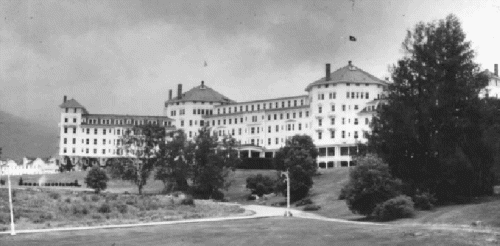
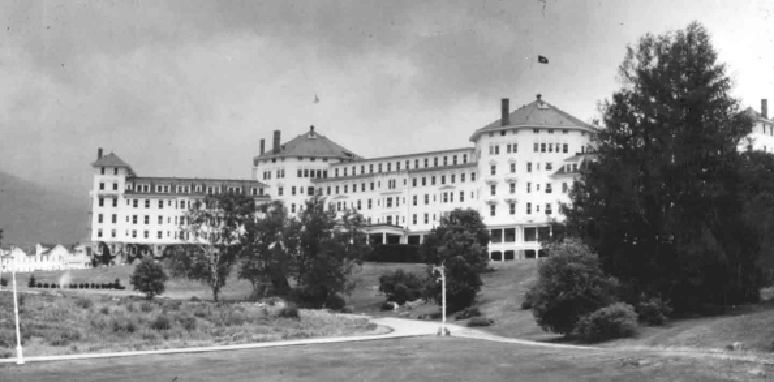
Bretton Woods where the post-war
conference took place that set up the IMF and the World Bank
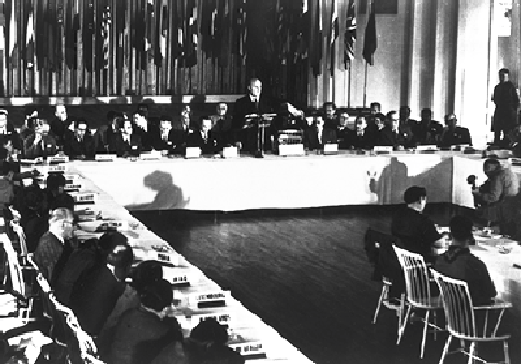
Inside the Bretton Woods conference
The military-industrial
complex whose growing powers were apparent to President Eisenhower 45
years ago, has developed into a monster that could scarcely have been
imagined back then. The petroleum industry is now a major element in
that enormous cartel. Corporations like Halliburton, Bechtel, and the
Texan oil giants, are among the global bloodsuckers that devour the
world’s natural wealth.
Some believe that
Robert McNamara’s greatest and most sinister contribution to history,
was not his ruthless accountants direction of the war in Vietnam and the
colossal build-up of war materials to that end, but his impact on the
World Bank and its lending program. He made it an agent of a global
empire, on a scale never before witnessed. He also bridged the gaps
between the primary components of corporate America, and its links with
the United States Treasury and Defense Department. The list of those
senior officials in the U.S. Government who continued the McNamara
policy in the State Department, in the CIA, in ambassadorial posts, and
in the White House, include names like George Schultz, William Casey,
Richard Helms, James Baker, Caspar Weinberger, Donald Rumsfeld, Dick
Cheyney, and George Bush himself. One can detect a ‘Texan’ thread
running through most of these men and the corporations they served,
mostly petroleum companies, or military-industrial businesses.
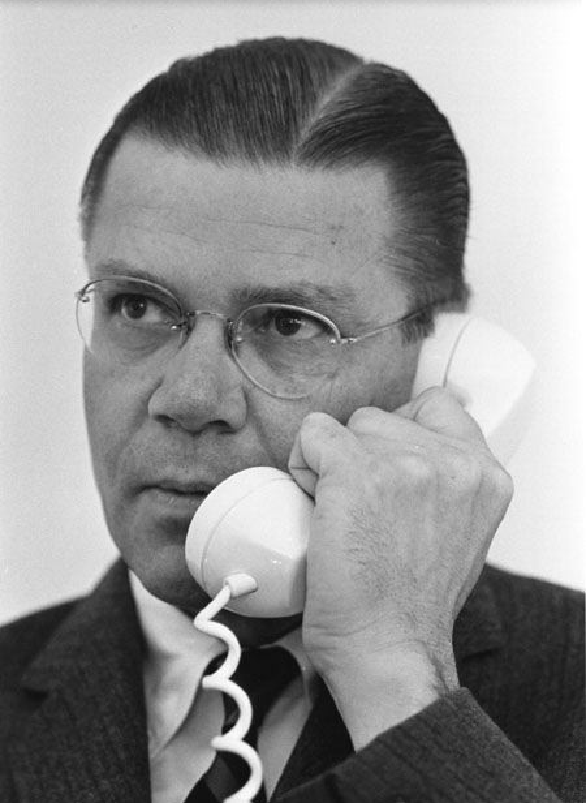
Robert MacNamara. After a career in
automobile manufacturing and sales, he was the logistic brain behind the
Vietnam War. President Johnson then made him head of the World Bank.
Some believe he made that organization a tool of U.S. capitalism and
imperialism.
A respected senior
economist has written : “The 1970’s had been the heyday of the ‘big
project’ paradigm for economic development. Officials from Institutions
like the World Bank, the Inter-American Development Bank, the Asian
development Bank, and the U.S. Agency for International Development,
roamed the globe, making huge project loans and preaching the virtues of
sophisticated development-planning techniques. … By 1990, developing
countries had accumulated more than $ 1.3 trillion in foreign debt. … In
2000, eighty-six percent of the US EXIM’s bank $ 7.7 billion in new
foreign export credits and guarantees went to just ten politically
influential U.S. companies, including Halliburton, Enron, General
Electric, Boeing, Bechtel, United Technologies, Schlumberger, and
Raytheon.” [
James S. Henry, The Blood Bankers, Tales from the global Undergound
Economy, New York, 4 Walls, 2003.]
The other side of the
exploitation story is that many of the countries targeted by the
multi-nationals, have repressive, corrupt governments, and some have
ongoing internal armed conflicts. A corrupt government is a gift to a
foreign corporation intent on seducing them to sign up to large loans
that are to be spent on huge contracts to the same corporations. This
is sometimes referred to as “the resource curse”. One thinks of
countries like Nigeria, Indonesia, Angola, and some South American and
Arabian states in that respect. They have each paid a heavy price for
accepting the “Danegeld” of the petroleum corporations and the
World Bank. There has been an attempt in recent years to counter the
practice by the introduction of a degree of transparency. A campaign, “Publish
What You Pay”, was launched in 2002 to persuade oil and mining
companies to disclose all payments made to individual countries. The
campaign got scant support from the US Government.
A second effort, the “Extractive
Industries Transparency Initiative”, attempted to get the
governments involved to follow a transparency code in their dealings.
Such attempts to address the resource curse, and have civil society
pressure companies and governments, face new obstacles as China and
India join the hunt for fresh resources to feed their rapidly growing
industries and cities.
Even if one argues that
the above is not the whole picture, and that some global lending has
done good, I have deep skepticism about the ability of the world’s
financial bodies to solve the problem of global p overty. As
Schumacher said in 1973, about the use of very sophisticated technology
to put the world’s unemployed to work, - “It is like trying to cast
out demons by Beelzebub the prince of demons”. The interventions
of major banks more often than not add to the problems rather than
solving them. For a start, the mention of their huge amounts of
finance, attracts a host of corrupt politicians and officials, like
flies to a honey pot. And these corrupt persons are not found only in
the developing countries, they are around in western democracies, and in
the cloisters of the United Nations.
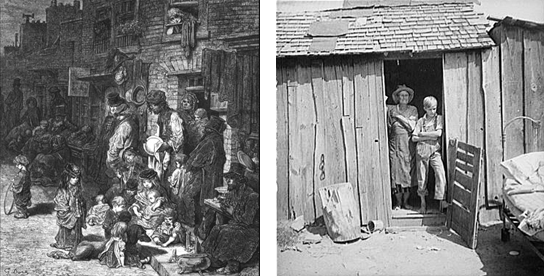
Poverty in old
London Poverty in rural USA during the Depression
No, despite all the
efforts of the World Bank and the major donors, poverty increases. In
2002 according to UN statistics; 1.2 billion people live on less than a
dollar a day; 2.8 on less than 2 dollars a day; over a billion lack
access to clean water; 827 million suffer from malnutrition. And all
this time, the income of the richest one per cent of the world is equal
to the total income of more than half the world (57% to be exact).
Total international aid represents only 0.18 % of global GDP. That is
less than one fifth of one per cent. Meantime one hears foolish
statements about ending poverty. They remind me of a pathetically
funded and even more pathetically implemented UN programme to end all
poverty in Africa, initiated in the late 1980’s. I sat in a meeting
with Food and Agriculture ‘experts’ where one actually said “If this
project ends all poverty, there will be nothing for us to do in the next
decade (the 90’s). A colleague sitting by responded that, “well,
I think we should not assume that all poverty will be eliminated. There
will still be some work to do after the programme is over”. One
wondered what planet they were living on. 7 years later FAO had reduced
its goal to only halving hunger by 2015. By 2006 it admitted that
virtually no progress had been made in eradicating hunger.
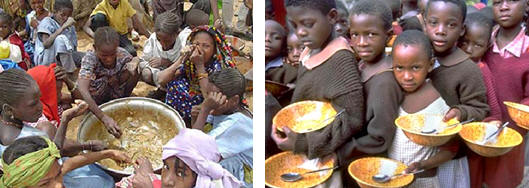
Global hunger and poverty
Similarly when Tony
Blair and Gordon Brown spoke of ending poverty in Africa, having worked
in 16 African states, I had to shake my head. Not at the attempt or its
well-meaning goal, - but at the thought that a country of 60 million
persons could actually remove all poverty from the huge
drought-afflicted, aids-stricken, and corruption-ridden continent. New
Labour can scarcely make a dent in the poverty of Glasgow’s worst
housing estates, or Edinburgh’s districts of Pilton, Niddrie or Wester
Hailes. It cannot end poverty in Brent, in London city. How then can
it do so in all of Africa ? No, one suspects these altruistic
statements are for domestic political consumption. Some may complain
when I pour cold water on a genuine move in the right direction. I
welcomed the move. I wished it were greater. I wished it all success.
I am delighted that there is now a commitment to cancel crippling debt.
But let’s not delude ourselves about the likely outcome of the best that
one country could do. The rich man’s club that we call the European
Union, and the United States of America, both need to dismantle and
abolish the trade barriers they have erected to protect their markets
from the produce of poor countries, and spend a great deal less on arms
and more on practical assistance.
Of the recent world
leaders, President Bill Clinton appears to have the best record of
practical assistance to the world’s poor and disadvantaged, both when in
office, and since leaving it. Together with the musician Bono of U 2,
and philanthropists like Tom Farmer of Scotland, Bill Clinton has
organised and orchestrated possibly the largest amount of private
assistance ever, for the destitute and aids-stricken poor of Africa.
|
Poverty in
London
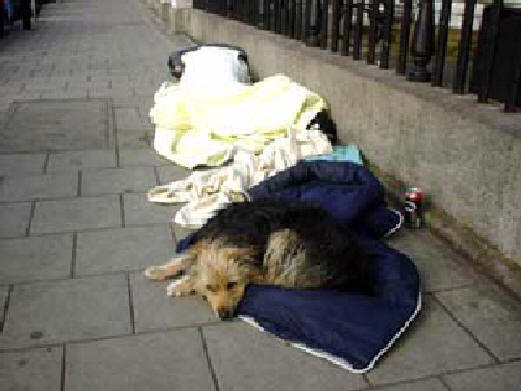
Sleeping rough
in London
The borough of
Brent in London is one of the two boroughs in UK that has a
larger population of Blacks and Asians than it does of Whites.
Out of a total population of 263,000 persons, 46 % are black or
Asian, 29 % UK white, and 21 % Chinese and non-UK white. Of the
200,000 who are of an age to be working, nearly 70,000 are
economically inactive. Some 50,000 of the population have no
educational or technical / vocational qualifications. Over
31,600 households have no adult in employment, and 32,400 have
at least one family member with a long term illness. The
borough sees over 30,000 crimes a year, mostly forms of robbery,
some with violence. The area is also vibrant with a huge range
of social programmes and social activities. Economically it
lags well behind most of the United Kingdom, and is illustrative
of the fact that an affluent modern society like Britain still
struggles to provide employment and good living conditions and
services for all of its peoples, as does the USA for its mainly
black poor population in the Gulf states and in the urban
ghettos of its large cities. There is serious poverty even in
London and in Washington DC. |
Sixto Roxas, (SKR to
his friends), a Filipino economist and former banker I knew in the
1980’s, has worked for years assisting poor peasants, like the sugar
estate workers of the island of Negros, and has some interesting things
to suggest for alternative economic systems. He says, “The world we
are living in today is being cunningly and insidiously organised to fall
into a particular pattern of imposed development, a massive
restructuring in the image of the enterprise system’, that only
engages itself in projects that are profitable to the promoters, and
which ignores humanity’s other needs. “What is left behind is a
gigantic mess of virtually unsolvable problems: health, education,
environmental preservation, care for the poor and the handicapped”.
Today, at 79 years of age, Roxas continues his imaginative efforts
to achieve meaningful and beneficial models of agrarian reform.
People are reduced to
flesh-and-blood machines that earn wages and salaries and generate
profits for the investors, but whose non-economic existence is not
recognized. Roxas proposes that a profit-and-loss balance sheet be
drawn up for the community as a whole rather than for just the income
earners in its area. “The enterprise paradigm has established an
accounting system that measures revenues, costs and incomes for
enterprise owners. A new community paradigm must do the same for
communities”, he says, adding that national income figures such as
GDP, ought to be compiled from community accounts rather than, as at
present, from the incomes of firms and individuals which say little
about the real growth in and distribution of the nation’s wealth.
Attempts to institute
such radical schemes of social accounting and cooperative sharing of
benefits in cash and in kind, have been around since the early days of
the cooperative movement. They rarely thrive beyond a certain level
because they have to exist in a sea of capitalist businesses and
monetary structures that ignore, isolate or reject them, as if they were
foreign bodies inside a living organism. Nevertheless, some still exist
today and a few continue to flourish. Two continuing examples would be
the Kibbutzim of Israel, and the Amish communities of North America. It
is not surprising that both these remarkable socio-economic systems are
maintained by persons of strong religious faith and ethnic identity, as
such communes require a degree of commitment beyond normal employer –
employee relationships. They are not an easy option, neither are they a
cosy haven for
individuals who have no desire to work.
Some more recently
established community-cooperative type enterprises include the
Schumacher-promoted common ownership common-wealth ventures like
Scott-Baader, in the 1970’s, and others in France and West Africa; the
Sustainable Seattle project, and the Briarpatch craft guilds of San
Francisco. Other similar bodies, including work-sharing non-money based
groups, have been set up in Britain and Europe. Some have succeeded,
and some have lasted for a short period only. A number of small but
remarkably successful ‘local currency’ groups have flourished in the
USA, initiated by the E. F. Schumacher Society of Great Barrington,
Massachusetts and similar non-profit bodies. One of the most innovative
and locally successful was SHARE (Self-Help Association for a Regional
Economy) established in 1982. It claims to “put a human scale and a
human touch back into local economic transactions”. It boasts a 100 %
return on loans, and has been able to provide credit to establish family
farms, cheese making businesses, deli food stores, corn markets and
sweater knitwear units.
Ideas on how to bring
millions of financially deprived persons into the modern economic system
have recently focused on recognition of the meager financial asset they
possess in their mud huts, bamboo houses and shanty town shacks. Few of
the world’s poor have legal title to their homes. For many the
miserable properties are rented. Others are erected on land owned or
controlled by the state or the wealthy private sector. What economists
say in effect, is that though these tiny houses are worth only a few
hundred dollars at most, - there are so many of them, - hundreds of
millions, - that their combined monetary value must amount to tens or
even hundreds of billions of dollars. If the poor squatters or slum
dwellers could become bankable entities by having title to their
miniscule assets, then there would be no need for foreign aid or
assistance. They could all then have the possibility to mortgage their
homes and go into business at a micro-level.
This imaginative
philosophy is expounded by the renowned Peruvian banker and economist,
Hernando de Soto, in his book, The Mystery of Capital. De Soto
is the founder of the ILD, the Institute for Liberty and Democracy in
Lima. His radical proposal was referred to by former President
Clinton in his BBC lecture in London. I strongly suspect that the
capitalists who hail this idea as the solution, have little practical
experience of working with poor and destitute. I also suspect that it
gives them an excuse for non-action, for if true, then it is the fault
of the poor that they are in their predicament. It smacks of the
suggestion that the poor are to blame themselves for their predicament,
and the capitalists’idea that the poor can be blessed by the ‘trickle
down’ effect if they (the rich) would just go ahead and become richer by
making their enterprises more profitable.
What proponents of the
capitalization of the assets of the poor do not ask or say, is, - who
will be the main beneficiary of a de Soto measure ? The answer to that
question must be the banks and financial institutions of the world. The
lending banks would stand to make millions of dollars in profits off the
capitalization of the assets of the poor. Something about the whole
scheme fills me with unease. With their tiny amounts of cash, the poor
would then be working, not only to survive and feed their families, but
also to generate profits for the banks. And if they failed, - what
would happen to their assets? Presumably they would be repossessed.
Even under ancient harsh religious laws, lenders had to return cloaks or
blankets given as collateral, to the borrower each evening, so he would
not die of exposure.
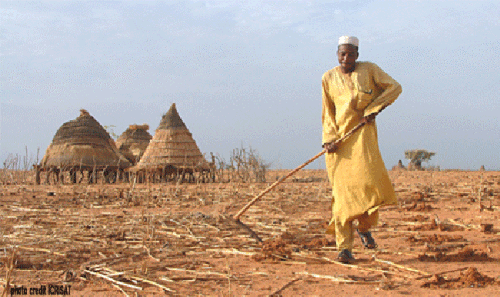
Rural poverty
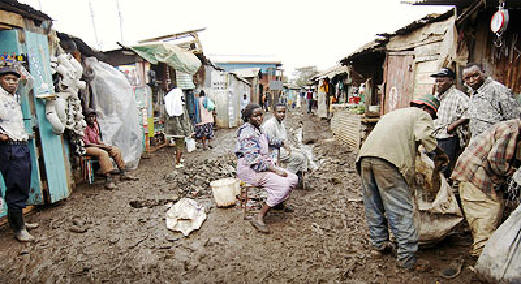
Urban squalor
The experience of the
Grameen Bank in Bangladesh, established by Muhammad Yunus in 1976 has
shown that the poorest of the poor can be surprisingly honest and
faithful in repaying debts. That remarkable bank has experienced rates
of loan repayment that commercial banks can only dream of. It has grown
from lending of $ 27 to 42 persons in 1976, to
$ 2.3
billion lent in total by 1998. Currently the bank has over 2 million
borrowers. Average loans are still less than $ 100 or £ 50
each.
Interestingly Yunus has regularly rejected World Bank offers of large
low-interest loans, for reasons similar to why Mother Theresa would not
accept offers of money for her mission from the Indian Government. Both
offers came with strings attached that would in effect change the
character and philosophy of the core organization. Yunus’s work with
the Grameen Bank was finally given international recognition in October
2006 when he received the Nobel Peace Prize.
The Grameen Bank at work, lending to the
poorest of the poor
Having assisted with numerous credit schemes to help the
rural poor, from a Freedom From Hunger revolving fund in Africa in the
early 1960’s, to multi-million dollar schemes financed by the
international development banks, I feel a bit like a pharmacist friend
who used to say that there was nothing like a lifetime dispensing
medicines to disillusion one completely from any faith whatsoever in
drugs and potions ! Or to use a very different illustration, I recall a
young Pat Kelly-Rogers on the deck of a herring trawler I skippered in
the days before mechanical aids were available to lift, wash and select
fish on deck. Pat was bent over, scooping up small, haddock, mackerel
and herring from a 5 ton haul, and laboriously selecting them into
separate baskets for the different species. He straightened up after a
while, stretched his aching back, and looking up to me on the bridge,
said. – “There’s got to be a better way” !.
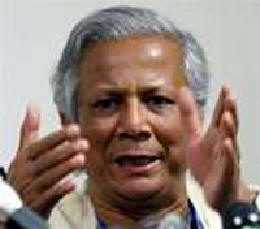
Founder of the Grameen Bank, and Nobel
Prize winner, Muhammad Yunus
The Indian government had him pushed of
the board of the bank he founed when he turned 70. Even banks
established to help the poor attract avaricious financial interest. Mrs
Thatcher and her friends in the city of London did the same with the
Trustee Savings Bank (formerly the Aberdeen Savings Bank which by its
very constitution was “owned by its depositors”. ).
Well, there has to be a
better way to reduce poverty and to improve the earnings and
productivity of the world’s poor. I do not believe it will be possible
by urging them to follow the western path to industrialization and
affluence. There is no way everyone in the world will be able to
consume energy and raw materials at the levels of the populations of the
USA, Europe and Japan. The resources simply do not exist to supply all
humanity with enough to emulate our excessive consumption patterns. The
world’s population will never be able to consume meat protein or
petroleum fuel at the levels of the industrialized societies. In any
case, the era of fossil fuels is coming to a close within the 21st
century, and there will soon be severe global shortages of fresh water.
So a very different route needs to be found to achieve universal access
to basic food, water, health and housing provisions.
Certainly, the poor
have to become more productive, and more efficient. There has to be an
economic motor to create more wealth and drive the small-scale
enterprise society. But the technology and systems that will benefit
the billions of subsistence farmers or fishers, and the unemployed, or
underemployed persons, will have to be appropriate to the smaller scale
and lower cost structures of that half of the world’s population. They
cannot all work in Nike shoe factories producing expensive goods for the
affluent. Petroleum- based energy systems must begin to decline within
the next 20 years or else we are in really serious trouble. So the
machinery and motors developed for small-scale systems in the third
world will have to be low-cost and to utilize renewable fuels or natural
energy. And the West should avoid the hypocritical advice to developing
countries to ‘curb their appetites’. It is like a glutton telling a
beggar to exercise self-control.
|
Radical
thinkers
We desperately
need imaginative minds that can see how to move from our current
stalemate and paucity of thought on tackling the social and
economic dilemmas of our day. All my life I have quizzed
development officers, politicians, and academics, on the best
way forward. Sadly, many of them had little helpful advice, and
were bereft of ideas beyond the stale, failed policies of the
past. If we had invested a fraction of the money we have put
into military arsenals, into health services and renewable
energy systems, the world would be enormously better for it
today. Similarly, if we had put much more practical research
and imaginative thought into beneficial economic and social
innovations, and studied in-depth what was actually happening as
a result of current and past efforts, we might be much nearer
satisfactory solutions than we are now. Too often we zero in on
“improving” the efficiency of systems that are never going to
work.
There are few
remarkable persons in my own experience, who addressed these
issues with imagination, understanding, and professionalism. I
mentioned some already in previous chapters. Here I would like
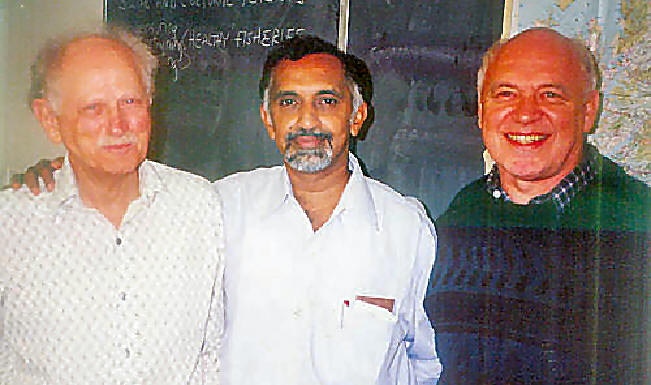
to pay tribute to three: Roger Mullin of Scotland, Menachem Ben
Yami of Israel, and Dr John Kurien of India.
All three have
been enormously helpful to me, and it has been a privilege to
serve alongside them. I worked with Roger in Scotland, Rome
Italy, Vienna Austria, the Marshall Islands, and Namibia. Menachem
and I were colleagues in FAO, and participants in numerous
seminars, conferences, and think-tanks. John Kurien was an
esteemed consultant in ADB and FAO meetings and projects in SE
Asia and Indo-China. He is also the visionary founder of ICSF
the international collective for small-scale fishery workers.
All three have written imaginative and ground-breaking papers on
aspects of development.
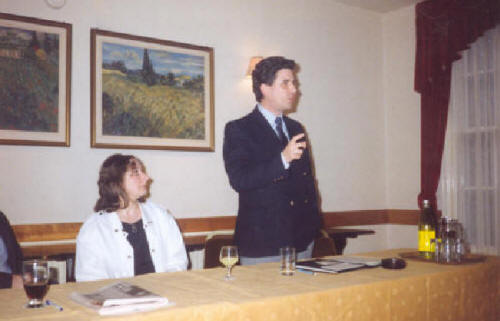
Roger Mullin of Scotland,
education, management, and social structures consultant, who
worked alongside me in Britain, Ireland, Rome Italy, Vienna
Austria, the Marshall Islands, and Namibia.
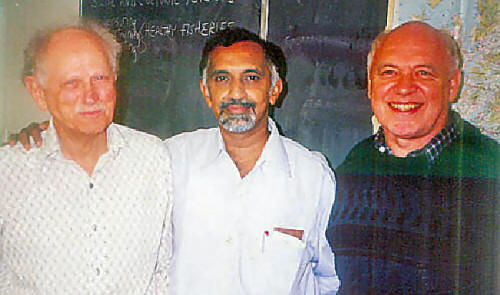
Three radicals: Menachem Ben
Yami, John Kurien, and myself. |
As long as we continue
to spend a hundred times more on armed forces and weapons of war than we
do on global assistance to the poor, we should not deceive ourselves
into thinking that we can solve the problems of world hunger and
poverty. We need to beat our swords into ploughshares and our spears
into pruning hooks. But just imagine if the leading powers were to
unite in a massive effort to conserve soil and water, to re-plant
forests and to reverse the pollution of air, land, and sea, - and to do
it in a way that would provide millions with remunerative work, - just
imagine the difference it would make to the major environmental and
social problems of the world. And let us remember that in protecting,
conserving and enhancing the environment, we are preserving our own
life-support system, and that of our children, and our children’s
children. And in addressing the social evils we are protecting
ourselves and our children from the conflicts that continued social
unrest would lead to, whether in the form of war or of terrorism.
If we are serious about
tackling global poverty, malnutrition and human degradation, we have to
end the destruction of tropical and sub-tropical forests, we must ensure
that global fresh water resources are conserved, and that all peoples,
however poor, have access to clean drinking water. We will have to
reverse the growing desertification in Africa and Asia. Every person
should have the opportunity to work with dignity, whether income-earning
in an activity of their own, or as paid employees. Access to land,
water, and to local natural resources must be equitably administered,
and not be the sole preserve of the wealthy and powerful, whether
individuals or corporations.
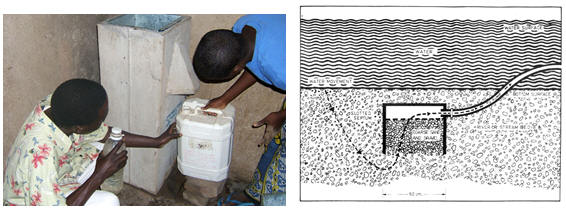
Simple drinking water supply units. This
is possibly the greatest need of the world’s poor, few of whom have
access to safe drinking water. Diagram of Cansdale filters and
pumps. They are specifically designed to be low-cost and to be easily
maintained by poor communities.
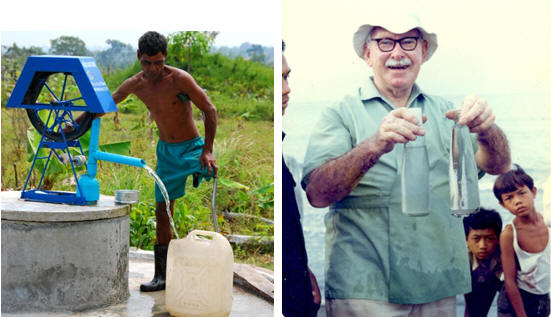
George Cansdale demonstrating water
filtration
Two enormous changes
are essential if this is to happen : Corrupt, despotic regimes must go.
- And global capitalism must take its jackboot off the necks of the
people. I’ll give two examples. Poor countries should be allowed to
produce low-cost local drugs to treat aids, tuberculosis and malaria.
Wealthy pharmaceutical corporations should forego patent rights in these
circumstances. Secondly, a way must be found to deliver small amounts of
low-cost credit to poor farmers, artisans, and peasant traders. At
present, the World Bank or ADB can give a country a loan at 1, 2 or 3
per cent, with a five year grace period. But no third world government
will allow its poor people to access funds at that rate. The government
and the national banks all take a cut, and eventually the impoverished
peasant has to pay anything from 14% to over 20%, with no grace period.
This is no exaggeration. I see it time and time again, all over the
world. There must be a difference in approach to lending to
impoverished peoples for their food security and economic survival, and
lending to a powerful wealthy corporation that will make huge profits.
Referring back to my
two essential changes; - they reflect two different attitudes towards
third world development. The provision of aid is what is commonly seen
as the obvious way to help people out of poverty. Examples of this
approach (however flawed), include bilateral aid from rich states,
multi-lateral aid from the U.N. or the World Bank, and all the
assistance provided by charities and non-government organizations. The
other approach is to target the corrupt regimes and to have them
replaced somehow with democratic and responsive governments. This is
the approach trumpeted by the United States (except that the only
regimes it seems to overthrow are ones with oil resources, or those that
pose a particular threat to American business). For others who do not
possess oil reserves, the ‘freedom and democracy’ argument is used as an
excuse for not giving direct aid. Where intervention has occurred, as
in Haiti and Iraq and Afghanistan, we can ask ourselves, - have these
states really become democratic entities?
I personally favour
by-passing the despotic administrations, and providing practical
assistance direct to the most needy. This is best done through the
charities, the missions, the NGOs like OXFAM, Tearfund, and ITG, and
through concerned individuals. Local production of cheap drugs is
something that even corrupt rulers would have difficulty in opposing.
And through cheap modern communications, information can reach the most
remote village, raising people’s awareness of issues. Corruption
flourishes when it can be hidden or obscured, but will eventually be
shamed out of existence when it comes under the glare of public
knowledge. If a state like North Korea or Myanmar, or Sudan, resists
efforts to free or assist its people, then so be it. But they should be
subjected to the maximum global exposure of their crimes against their
own humankind.
But there is another
aspect to poverty we need to consider. There are countries and areas of
the world that are poor in a statistical sense, judged by cash income or
GDP per head. Yet they may live comfortably and in a measure of
contentment, in an environment that is pleasant and conducive to good
quality of life. There are other communities and regions that may have
a higher per capita income, in states where oil wealth has inflated the
GNP statistically, yet the people live in squalor and under threat from
exploitation, crime, disease, and limited access to medical services and
schools. Readers would no doubt agree that if they had to be poor, they
would rather be poor on a Pacific island, or in Cuba, or in a mountain
farming community in Africa or South America, - than in a back street
slum in Lagos or Mumbai, Buenos Aires, Rio de Janiero, or Jakarta.
Mother Theresa spoke eloquently of the other side of poverty, - and this
extends to spiritual poverty among the world’s affluent. She said there
were people who were:
“hungry,
not just for bread, but for love. Naked, not only for lack of clothing,
but naked of human dignity and respect. Homeless, not only for want of
of a room of bricks, - but homeless because of rejection”.
|