|
Beside yon straggling fence that
skirts the way,
With blossomed furze unprofitably gay,
There, in his noisy mansion, skilled to rule,
The village master taught his little school.
A man severe he was, and stern to view;
I knew him well, and every truant knew:
Well had the boding tremblers learned to trace
The day’s disasters on his morning face;
Full well they laughed with counterfeited glee
At all his jokes, for many a joke had he;
Full well the busy whisper, circling round,
Conveyed the dismal tidings when he frowned.
Yet he was kind, or if severe in aught,
The love he bore to learning was in fault.
But past is all his
fame, - the very spot
Where many a time he triumphed, is forgot.
Oliver Goldsmith
The Deserted Village
It was probably indicative
of my detached attitude throughout the ten years I spent at school, that
on the first day, as a five year old, being taken up the hill for
enrollment and commencement, I asked my mother where we were going. “To
school of course!” she responded with some astonishment at the
question. I obviously had no idea that it was a significant occasion.
Under the tutelage of a fine friend and neighbour of the family, Miss
Grant, I was treated gently during the two years of the infants class.
It was the only class in which I won a prize – third, one
year. (A fellow pupil later reminded me I was only “third-equal”). In
the class were a number of pupils that were to become lifelong friends.
Most were to stay much of their lives in the locality, but a few like
myself travelled farther afield.
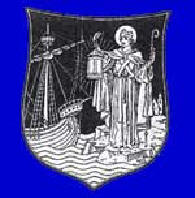
The logo and motto of our
school and town.
It says per noctem lux, - light through the night, - and
depicts a legendary monk, Saint Gerardine, who is said
to have patrolled the beach at night with a lamp to guide
boats safely to shore at Stotfield and Lossie.
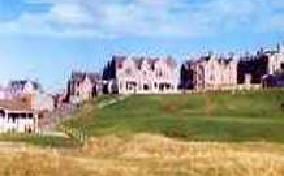
Moray Golf Clubhouse and
Stotfield Hotel, Lossiemouth
We started
writing and drawing practice with slates. Pencils and paper were in short
supply after the war. Later we used nib-fitted pens and wrote from ink
mixed in the class. The nibs were of poor quality and it took real skill
to produce beautiful work. Some pupils did, but I was never among them.
A small bottle of milk was provided daily to each pupil by the new Labour
Government of Clement Attlee. This provision was to continue until
stopped by Margaret Thatcher after she became Education Minister under
Edward Heath in the early 1970’s. Reading books and textbooks were few
and old. For the first six or seven years of my schooling, we used
well-worn and well-thumbed books on geography, history, literature and
mathematics. The geography books stick in my mind. There were hazy
black-and-white pictures with subjects and titles like, “bicycles in a
Bangkok street; sampans and house-boats in Hong Kong; Russian peasant on
the steppes; cocoa plantation in Africa; camels in the Sahara desert;
reindeer sleighs in Lapland; and so on. I guess those texts must have
been published just prior to or just after the First World War.
But the
reading books were good and more memorable. They had some classic essays,
stories and poems. I recall being captivated by short simplified tales
from Hans Christian Anderson, the Grimm brothers, Booker T Washington, and
James Barrie, as well as the poems of Wordsworth and Stevenson. At home I
became an avid reader of Arthur T Mee’s marvellous Children’s
Encyclopaedia which had an incomparable selection of such material.
Stevensons poems, (A Child’s Garden of Verses) touched me at an
early age. Other poems I was drawn to included one by James Hogg, the
“Ettrick Shepherd”. I used to think his ‘Billy and Me’, was
written especially for myself and my older brother Billy:
Where the
pools are bright and deep,
Where the grey trout
lies asleep,
Up the river and over the lea,
That’s the way for
Billy and me.
Where the blackbird sings the latest,
Where the hawthorn blooms the
sweetest,
Where the nestlings chirp and flee,
That’s the way for Billy and me.
Where the
mowers mow the cleanest,
Where the hay lies
thick and greenest,
There to track the homeward bee,
That’s the way for Billy and me.
From the
infants section we moved up to the primary classes at the age of seven.
There was a shortage of trained teachers then, few having been produced
during the war years. So a number of former teachers were brought back
from retirement to fill the gap until more could be trained. The first
two years of primary school we had such teachers. No doubt they had been
competent and inspiring in their day, but they were of an age that found
boisterous 7 and 8 year-olds somewhat irritating. To add to the misery,
they taught by rote which was a dull procedure. We recited multiplication
tables in a sing-song voice for seemingly hours on end. The process
drummed the facts into us, but I am glad my grandchildren are spared that
experience. The strap and the cane were widely used and liberally
applied. It would not be countenanced today, but my recollection is that
excess use, though it did occur, was mercifully limited. We moved from
the bungalow (which I loved), in early 1948, to a draughty 4-bedroomed
semi-detached house facing the sea. That year my father’s boat was sunk
in the Firth of Clyde. It was not the happiest of years.

The local fish market was
filled with fish each week-day
After my
ninth birthday we moved up a further class at school, and were blessed
with one of the first of the cadre of post-war trained teachers. She was
young, pleasant, attractive and easy-going. For the next year, school was
sheer bliss under Miss Boyne from Nairn who was all that a teacher should
be. She was later to marry one of the Baxters of Fochabers, (the Speyside
food processors), so I think her teaching career was not so long, which
was a pity for other pupils. I was privileged to meet up with her 54
years later in a local residential home. She still had that beautiful
smile and winsome personality. And despite her failing health, she was as
cheerful and uncomplaining as ever. I was serving in Indo-China when she
died, and was heart-sorry at being unable to attend her funeral service
and pay my respects as a grateful former pupil.
|
Doctors and the NHS
The National Health Service was brought in by the new Labour
Government after the war, and despite dire warnings and opposition by
many in the medical profession, it worked marvelously well, and was an
incalculable boon to ordinary people. I recall Jim Sillars telling me
of a conversation with a very conservative minded doctor who met
Aneurin Bevin prior to the inauguration of the health service. The
doctor and his colleagues gave Bevin every possible reason why the new
service would not work. The Minister said nothing. He simply took a
note of each objection. Two weeks later he returned to report back to
the medical men. In the words of the doctor concerned, Bevin took up
their objections one by one and showed clearly that none of them had
any foundation in truth or practice. By their own admission, the
objectors were left without a word to say.
There was one doctor in our town who tried in his own way to destroy
the NHS and who set up a local private hospital in anticipation. But
it was to fail, and he went back to work in the NHS. The other
doctors in town were totally different. They were traditional family
doctors of the old school. They knew each family and its history, and
they were proactive in checking up on patients before they got sick!
One was a Dr Simon who was slightly crippled, I think from the effects
of infantile paralysis. The other was Dr William Lyon-Dean who was
town Provost for a period, and later became the Head of Britain’s
Herring Industry Board. In that position he kindly wrote a foreword
to my second book. Both these doctors were familiar callers at the
house. They even visited if they heard you were sick, though they may
not have been your registered physician ! In addition to medical
advice, they were ever ready to offer counsel in other areas of life
like marriage and career. As far as I recall they had little office
assistance, no appointment secretaries, and would have had to do most
of their paperwork by hand.
The doctors mentioned were following the tradition of sterling service
set by two earlier physicians, Thomas Brander and Robert Clark who
served the community between 1890 and 1945, assisted for 35 years by a
distinguished nurse Mary Kelly. Dr Brander’s son Laurie served with
distinction as a pilot in the Fleet Air Arm during the war.
I daresay
those days truly dedicated community doctors are gone for ever. But
oh, what a contrast with the National Health Service of today where
bureaucratic rules depress motivated service!
|
School
holidays were wonderful periods. We looked forward to them as to a
Utopian millennium. They lasted only six weeks, but to us that was an
eternity. The time would never end. For most of us boys, the days would
be spent on the ‘bents’, the grassland of dunes and sand next to the sea;
and over the rocks at low water; and around the harbour and the net sheds;
with occasional sorties into the countryside, or along the beaches that
stretched 3 miles east and west on either side of the town. We made camps
from rusty old sheets of corrugated iron, and boiled ‘buckies’ (winkles)
in seawater in rusty pots over fires of driftwood. If one was fortunate
enough to have or obtain a tent, then it was a great adventure to sleep
overnight, even if in a back-garden or in waste land behind one’s house.
A favourite sport was to get old tyres from cars or trucks, and to run
them along the road or beach, steering them with remarkable accuracy by a
stick. We could drive those tyres for miles and miles. There were few
cars on the roads then, which is why some boys even collected car
numbers. ‘Cigarette cards’ were another collector’s item, containing
pictures and information on cars, aircraft, footballers and film stars.
Sunday School
picnics were also occasions of much pleasure. We would travel by bus or
train to a suitable site where sports and treasure hunts and refreshments
filled the day. The locations may have been only three or four miles from
town, but to us it was like the other side of the world. Invariably some
of the kids would be stung by bees, or fall into water, or slide into cow
dung, - but that was all part of the experience. Eventually, the summer
days shortened, and the start of the next school year came upon us. But
we would return to the classes with six weeks of glorious memories, and
even daring to think about the holidays to come.
For some years after the
end of the war, our town was mobbed with visitors and holiday-makers
during the summer months. The biggest crowds came during the “Glasgow
Fair”, and the smaller “Edinburgh Fair”, - the trades holiday week in
those cities, when working class people sought recreation and some “sun,
sea and sand” like Albert Ramsbottom’s family of Blackpool outing poem
fame. Local housewives offered bed and breakfast to visitors then, as the
normal guest houses could scarcely cope with the numbers. The visitors
were lovely people with hardly any exceptions. Many long friendships were
formed between local families and their guests. Strangely, most years I
recall wonderful summer weather for those weeks. It all ceased when cheap
package holidays became available to more exotic spots in the
Mediterranean and farther afield.
We thought little of the
outside world in those halcyon days of youth. Classrooms were filled with
pictures and murals showing the progress of the seasons of the year.
Politics were neither discussed nor referred to. Religion was limited to
a recital of the Lord’s Prayer on some mornings, a brief grace at school
lunch, and an occasional hymn last thing on Friday afternoon. Some
classes spent an hour on Bible reading once a month. (How I wish our
schools would do that at least today!). There were obligatory annual
parade days when we were marched over to the parish church where the
presence of flags and military officers seemed very out-of-place to me.
One occasion sticks out in my mind. A fairly high-ranking army officer
came to the school hall to give pupils a talk on the British Empire. Before a world map with the relevant parts in red, he growled about those
who claimed the British Empire was dead. It was “far from dead!”
he shouted. “It is flourishing and will be for many years to come”! That must have been around 1950. Within fifteen years, the vaunted
empire on which the sun never set, was gone for ever.
Other patriotic ‘facts’
that I recall being taught were that: British ships were stronger than
American ships because British ships were riveted and American ships were
welded. True they built more ships, but that was because they used a
poorer method of construction. In wheat production we also held our own.
True, the prairies of Canada and the vast fields of Kansas produced more
wheat, but on a production per-acre basis, British farmers were far
ahead. Comforting ‘facts’ like these continued to be dispersed and
accepted long after school. In fisheries I was surprised to learn later
that countries I’d scarcely heard of south of the equator, caught far more
fish than Britain, and that the cod was a very minor species in the global
catch. When I first visited Japan in the seventies, it was a revelation
to find that wages there were if anything higher than those in the UK.
Most Brits had dismissed Japan’s industrial growth on the grounds that it
was based on very cheap labour.
Cold war propaganda was
readily swallowed. Our newspapers, especially the more sensational Sunday
ones, carried regular features about the advance of communist hordes from
the East, or the Soviet Union’s secret plans to invade or destroy
Britain. I visited the Soviet Union in 1965 just after seeing an American
newspaper that claimed no western power knew what the Soviet spacecraft
looked like. There in the middle of the exhibition park in Moscow, was
Yuri Gagarin’s capsule on display for all to see, together with colour
films of the launch and retrieval of that and the later Soviet
spacecraft. On the other hand, few knew or were willing to admit, the
horrors that were continuing within the totalitarian states.
Sea
exploration, flight, and the possibility of space travel intrigued me. At
the age of nine and ten, I had an equally imaginative boyhood friend,
Sandy who was gifted artistically, and later became a master carpenter.
We made cowboys and indians, soldiers and aircraft and rockets, out of
plasticine, cardboard, balsa wood and fireworks. We made small
neatly-rigged boats and set them off to sail to lands unknown. Bottles
containing messages were also thrown into the sea. We constructed our own
“Pharaoh’s tomb” in the garden, and buried secret treasures inside. We
even attempted to put a man in space long before the Americans and
Russians. Our spaceman was only three inches tall, made of plasticine,
and strapped to a firework rocket, but no space programme was more
diligently planned or more eagerly carried out.
Years 4 and 5 of Primary
school in our system were the pre-qualifying and qualifying classes after
which we were split into ‘higher grade’ and ‘advanced division’ depending
on whether they thought we were suited to an academic or more
technical-vocational career. The new teachers, Miss Fleming and Mr Wilson
were excellent and dedicated, if lacking the warm personality and relaxed
approach of Miss Boyne. Under their supervision we began to realize that
education was a serious business and required some application on our
part. This was in 1950 and 1951-52 when changes were taking place in
Britain and the threat of nuclear war and the implications of the cold war
were dawning, even on children. It was in Mr Ally Wilson’s class that we
were first allowed to think about politics. We held a mock election, and
I was the surprise winner, representing the Labour party. (My father and
uncles were all strong socialists). As far as I can recall, one of the
vote-catching elements in my manifesto had something to do with extra
school holidays! My deputy was Willie Souter who was to go on to a
career in the Post Office.
|
Scotland’s Stone of
Destiny
I was ten years old when on Christmas day
1950, a party of students somehow managed to gain access to
Westminster Abbey and to remove the coronation stone that lay in
a shelf under the throne of England. The students in question
were Ian Hamilton, Gavin Vernon, Kay Matheson, and Alan Stuart.
I recall the theft of the stone causing great excitement and
interest throughout the country. There was scarcely a Scot that
did not have empathy for the young nationalists who sought to
return the valued historical item to its ancestral home.
The origins of the stone are clouded in a
mist of romance and legend, and claims that it was Jacob’s
pillow and pillar at Bethel, and that it came to Scotland
through Syria, Egypt, and Ireland. We do know that it was used
in the coronation of Scottish monarchs from the 9th
century onwards. Some sources claim that the original stone was
of black basalt rock and had hieroglyphic markings, and that
monks in Scone hid the real stone when Edward 1st
invaded, and substituted it for the current slab of red
sandstone which Edward took to Westminster in 1296. One of the
Celtic names for it is Lia Fail, - the stone that speaks
(indicating who should be anointed as king).
While the hunt was on to recover the stone in
1950 / 51, there were as to be expected, a number of false
sightings. A large boulder on the side of the Elgin – Forres
road was painted with the inscription – “the Stone, - this is
it”. Eventually the students, having made their point,
handed the stone over to Arbroath Abbey in April 1951, from
where it was taken to London until 1996 when the Government
decided that it could be returned to Scotland and held in
Edinburgh Castle until such times as a coronation was to be held
in Westminster. Interestingly, this followed an exchange of
correspondence between “Robbie the Pict”, a lawyer in Skye
(formerly Brian Robertson), who had challenged the Procurator
Fiscal in Fife to investigate the theft of Scottish property by
one Edward Longshanks, and to have the stolen goods returned to
the rightful owners. Robbie also wrote to the Queen, the
Archbishop of Canterbury, Princess Diana, and then Prime
Minister John Major. The letters are all reproduced in Pict’s
most amusing book, “The Cludgie Stane of Destiny”.
Incidentally, the most sympathetic reply he received was from
Princess Diana. Some civil servants tried to respond on behalf
of the Crown and the Government but were made to look silly by
Robbie the Pict who is a Mensa intellectual with a deep and
comprehensive knowledge of Scots law and history.
Ian Hamilton was to be admitted to the bar as
a gifted young advocate in 1953, but he refused to swear
allegiance to Queen Elizabeth the second, claiming that she was
only Elizabeth the first in Scotland, the ‘second’ applying only
to the English throne. He had challenged the use of that title
in Scotland, together with John MacCormack, and though losing
the case, eventually was accepted as a QC after a compromise
oath was agreed, dropping the offending numeral. Ian Hamilton
QC went on to a distinguished career in advocacy, and to be a
frequent nationalist candidate at elections. He has also
written a number of books, a revised version of the Stone of
Destiny, being the latest. |

Ian
Hamilton QC

Robbie the Pict
Reading continued to be
one of my pleasures – I never viewed it as a chore. The “Just William”
books of Richmael Crompton were enjoyed immensely, though I was
horrified to learn that such a great writer of young boy’s stories was
actually a woman! We also read most of the “Biggles” books by
Captain W. E. Johns. The more classical novels I read were from
the pens of Charles Dickens, Daniel Defoe, Sir Walter Scott, R. M.
Ballantyne, and Mark Twain. There was a writer of sea stories we loved,
by the name of Percy F. Westerman, and we regularly plied the local
library for more of his works. I also read the obligatory religious books
about reformers, martyrs and missionaries, and the classic puritan work
“Pilgrim’s Progress” by John Bunyan. I came to appreciate it more in
later life when I read it again every few years. Another story I read
when at school but came to enjoy more in maturer years was Miguel
Cervantes’ “Don Quixote”.
Radio was the great home
entertainment medium in the days before television destroyed conversation
and indoor hobbies. We listened avidly to “Dick Barton, special agent”
and to “Dan Dare, pilot of the future” which was broadcast over
Radio Luxembourg. Our mothers enjoyed “The McFlannels”, and the
many music broadcasts of the BBC’s “Light Programme”. 20 Questions was a
great radio panel game. The news from London was listened to with
respect. Raymond Glendenning, Barrington Dalby, and Eamonn Andrews, were
talented sports commentators, particularly for soccer and boxing matches.
I recall the Turpin – Robinson fight, and several of the matches involving
our largely ill-fated crop of heavier pugilists like Bruce Woodcock, Don
Cockell, and Freddie Mills.
Half of the class moved
with me into the higher grade section of the school in the autumn
of
1952. Some who had academic ability elected to enter the advanced
division as they
intended to be fishermen or tradesmen. In these final three years we had
a range of specialist teachers, and moved from class to class according to
the day’s timetable. The classes I enjoyed were English, Geometry, French
and Science. Actually, I enjoyed any subject that was well-taught. Only
in my final year did we get a teacher who really knew History. Till then
we got a dull reiteration of dates and battles and kings and queens, with
scarcely any attempt to explain why events occurred. Mr Docherty was
different. He made the subject alive with meaningful accounts of the
forces at work. Sadly we had him for all too short a time. The same
applied to Poetry which I came to love and memorise in large chunks, after
leaving school. Mostly in our classes that wonderful subject matter was
handled in a Philistine fashion. I made my own schoolboy efforts at verse
occasionally. The results are probably better not recalled but one
attempt at a sonnet can be mentioned:
I Found It by the Sea
I found it by the sea one
morn,
All worn and bleached and soaked in brine, -
A steering wheel, lost in a storm
From off some barque transporting
Wine and spices from oriental shores,
Or off some gallant man-o’-war
That to the depths didst one condemn
The Barbary F’luccas from afar,
Or off some stately clipper ship,
That from Shanghai to London plies no more.
What stories that wheel
could have sung
If only it was given a tongue!
For the high school and
advanced division pupils, October brought a 2-week break that was known as
the “tattie holidays”. This was the time of year when the potato harvest
had to be gathered, and as the farms were not equipped with mechanized
harvesters, schoolchildren and others were employed to work a 40-hour week
lifting the tatties. The money was good for that time, - £ 2 - 10/- (two
pounds ten shillings) for each 5 days. We assembled outside the school
between six-thirty and seven in the morning, and awaited the transport
from the farms. It came in a variety of forms: trucks, tractor trailers,
and old buses. Once aboard and under way, the young folk would start to
sing. How the practice began, I have no idea, but it continued all the
way to and from the farms. The songs were a rich variety of Boy Scout and
Army type refrains like “the quarter master’s stores”, “she’ll be
coming round the mountains when she comes”, “John Brown’s body”, and,
“what will we do with a drunken sailor”.

Tattie howkin’
At the farms, the potato
field drills were marked out into stents or lengths that two 12 to 15-year
olds could lift between them. You had to bring your own bucket. The
tractor ploughed continuously round the field, and you had to lift quickly
to have all the potatoes in the large baskets laid out for the farm truck
to collect, before the tractor was back digging up the next furrow. There
was a brief break for tea in the morning, then an hour for lunch which was
provided by the farm, - usually bread and soup, or mashed potato and
mince. An unexpected but welcome break occurred if it rained as potatoes
could not be allowed to get wet. All in all the 2 weeks left one
exhausted, but happy to have survived and to have earned something for the
family. One was also permitted to carry home a prized bucket of potatoes
each evening.
As young 11 to 15
year-olds, our interests revolved mainly around hobbies. Model aircraft
were constructed by most boys some of the time. They were usually
rubber-powered or had little “jetex” engines fired by a pellet of
cordite. Having an aerodrome nearby (RNAS Fulmar) gave us the opportunity
of seeing planes in action every day. There was an aircraft dump behind
the hangers at the west end of the drome. We used to enter by means of a
large pipe through which a shallow ditch went under the perimeter fence.
We would then spend a half-hour inside old Avro Ansons, Dragon Rapides, or
Fairey Fireflies. A civilian policeman patrolled the perimeter each hour
on a bicycle. We would enter just after he passed, but often stayed too
long and got chased on his return.
The active local squadrons
then were composed mainly of De Havilland Vampires which were extremely
noisy, but apparently were useful for training new pilots. They were
later replaced by Supermarine Attackers, and much later by Hawker Siddely
Buccaneers and now Hawker Tornados. Other earlier aircraft that used the
drome occasionally included Fairey Gannets, De Havilland Mosquitos,
Gloster Meteors, and individual planes ranging from a D H Tiger Moth to an
American Grumman Hellcat, kept for semi-private use by flying officers.
Larger bombers and Coastal Command patrol planes like the Avro Lancaster,
Avro Shackleton and, more recently, the BAE Nimrod, operated from nearby
Kinloss. Back in the 50’s and 60’s the station put on a magnificent
annual air day for the public, with awesome displays of speed and flying
prowess, and dozens of fascinating displays in the various hangers.

In the cockpit of a local
jet, Air Day, Lossie, 1953
Occasionally an aircraft
would crash, or be ditched on the beach or golf course. We would race out
of school to visit the scene. If the crash was fatal, we would not be
allowed close, but otherwise we got to surround the plane. One fatality
occurred on the golf course when a single-engined plane hit the ground
near where my father was standing talking with the green keeper. Dad
rushed to the plane and pulled the young pilot out, but he was already
dead from the impact. Fortunately the wreck did not catch fire, probably
because the fuel tanks were empty. The worst crash I recall was when a
Wellington bomber hit the roof of a house by the market cross one Sunday
morning in May 1945. Five family members and three crewmen were killed in
the resulting fire. I watched from the crowd as firemen brought the
charred bodies out on stretchers. A plaque now marks the spot, and one of
the survivors recently visited the town to pay her respects. She had lost
her mother and four brothers in the tragic accident.
Lossiemouth had been
bombed only once during the war, on 12 July 1941. A couple of bombs were
dropped on the aerodrome, causing no damage. But other bombs dropped at
random I believe, hit houses on the east end of Dunbar Street, killing
four persons, including a couple who had moved from Plymouth to escape the
blitz. After the war, some mines were occasionally picked up in the nets
of fishing boats, and a large one was washed up one stormy morning onto
the rocks near our house. It was a great attraction for the kids that
day, but they were kept away till naval and coastguard officers detonated
it. Part of the rusty remains are still wedged among the rocks there to
this day.
The great bomber pilot,
Guy Gibson had been stationed at Lossiemouth for a brief period in his
short life. He wrote in his biography, (Enemy Coast Ahead), of
going down to the harbour and being fascinated by the unintelligible
outpourings of the auctioneer as he sold boxes of fish to the highest
bidder. The aircraft that sunk the German ship Tirpitz in a
Norwegian fjord had taken off from Lossie. But that apart there were no
major raids conducted from our aerodrome. It became a naval air base
after the war (HMS Fulmar), and later reverted to the RAF. A number of
RAF and RNAF officers married local girls and on leaving the services,
settled in the town which they had come to appreciate.
The great comic of the
time was the Eagle which was devoured with relish each week. It
had a marvelous mixture of space age stories, cartoons, features and full
page cut-away drawings of ships and aircraft. None of us could forget Dan
Dare, the pilot of the future, or his crew, the rotund Digby, and the
attractive female officer Professor Peabody. There were a number of
smaller comic strip characters like Captain Pugwash. One of the
contributors was the “zoo man” George Cansdale who I was to come to know
and work with 20 years later. For a period he appeared regularly on
children’s television and on “Blue Peter”. He was a wonderful
biologist and inventor, with an open-ness and boyish zeal that he never
lost. Another contributor to the Eagle was Allan Whicker later to
go on to a life-long career making travel programmes for television.

Eagle comic
|
1953
The year 1953 was memorable for me for a number of reasons. It was
the Coronation year, an event that united the nation and gave people a
focus for celebration after the hardships of the immediate post-war
years. There were other reasons to celebrate. The Korean war was
brought to a close, and Joseph Stalin who had ruled the Soviet Union
with an iron rod since the death of Lenin, died the beginning of March
at the age of 74, possibly with some assistance from his party
colleagues. His death was announced unexpectedly, and I recall the
newspaper headline causing some awe, and giving cause for thought.
The Coronation took place on a cold rainy day. Our local fishing
fleet took people out for a trip round the bay, but the wind and rough
seas made it less than pleasant. But the nation’s joy at their new
young Queen was undiminished.
Celebrations were greater when it was announced on the morning of the
coronation that a British team under John Hunt, had conquered Mount
Everest, and Sherpa Tensing and Edmund Hillary had become the first
men ever to stand on the top of the world. I recall the front page of
the Daily Express next day. Over a picture of the Golden Coach
procession passing cheering crowds, was the triumphant headline, -
“All this – and Everest too!”
The poor weather continued for much of the year causing floods and
loss of life along the east coast. The bad weather had begun in
January with the “great gale” that caused much damage and loss of
life. Thousands of trees were blown down all over Scotland. The
beach at my home was flattened by the force of the extreme wind, and
the edge of sand dunes shaped like a wall as if a huge giant had cut
them with a knife. Beach huts were destroyed, some blown over the
golf course like paper bags. The ferry “Princess Victoria” was
swamped and sunk in the Irish Sea on its journey from Stranraer to
Larne. 128 passengers and crew lost their lives.
A
fishing boat from my home town was caught in the gale as it headed
south through the Moray Firth, and was disabled when the net became
wrapped around the propeller. The “Caronia, INS 276” sent out
an SOS. An Aberdeen steam trawler, the Loch Awe had just made
Wick harbour to shelter. On hearing the SOS Skipper William Imlach
set out immediately after offering any of his crew who did not wish to
go, the chance to remain ashore (all declined the offer). By the time
they reached the area some 15 miles away, the Caronia’s
wheelhouse had been smashed by the heavy seas. Skipper Imlach told
Skipper John Campbell to keep transmitting on the radio-telephone and
he would try to determine their position from his by radio direction
finder. Twice the Loch Awe sailed past the Caronia but
missed it as sea and sky were together in the storm, limiting their
vision. On the final attempt the boats came alongside and the crew
jumped to safety. All seven men survived. I knew each of them, and
their subsequent boats, a second Caronia and the St
Gerardine.
In January the year before
the Flying Enterprise, a cargo ship headed across the Atlantic
encountered the storm just west of Land’s End. The cargo shifted and
caused the vessel to list dangerously. The crew were evacuated
safely, but Captain Carlsen remained on board. A British tug took the
vessel in tow, and Jack Deacy, the mate of the tug, leapt on to the
crippled vessel to assist Captain Carlsen. When it became evident
that the ship was sinking, the line was released, Jack Deacy leapt
into the sea and was picked up by the tug. Captain Carlsen abandoned
his ship shortly after and the Flying Enterprise plunged to the
sea bed.
About that time, a film The Maggie, was being shot in Scotland,
based on Neil Munro’s books about Para Handy and the West Coast puffer
The Vital Spark. In the film, the puffer is grounded and left
high and dry at low water in the Clyde by Broomielaw, listing to one
side. A wag in the large morning crowd shouts to Para Handy as he
looks embarrassedly out of the wheelhouse, - “Are ye hangin’ on
Captain Carlsen!”

The Great Gale, 1953:
Lossie west beach during the storm

MV Caronia which sank
in the Moray Firth

The cargo ship
Flying Enterprise, listed over off Land’s End

Captain Carlsen of the
Flying Enterprise

A West Highland puffer
as featured in the film Maggie
On
a more serious note, an Italian salvage firm later mounted a major
operation to locate the wreck. It sent divers down to blow holes in
the hull of Flying Enterprise, and recovered some cargo. The
question remains to this day, - if as reported, the ship was carrying
only pig iron, coffee and bird cages, - what attracted the salvage
operators, and what did they recover?
Nationally, Winston Churchill was Prime Minister though by the
accounts of all his colleagues since, he was becoming senile and
incompetent. Anthony Eden was Foreign Minister, struggling even then
with problems in Sudan and in Egypt which were to end his Prime
Ministerial career three years later. Most Brits still thought of
their country as one of the three most powerful in the world along
with the USA and the Soviet Union. At home, British law continued to
sanction the death penalty. A policeman pursuing two would-be
burglars was fatally shot on a factory roof. The boy with the gun was
too young to hang, so his 17-year old colleague Derek Bentley was
charged with the murder. Police concocted the story that Bentley had
urged the younger boy to shoot. It is now admitted that did not
happen. But Bentley was hanged nonetheless. The Home Secretary said
that society was well rid of him. That was how things were in 1953.
|
Most of us at some time
were members of a youth organization, - the Boy’s Brigade, Scouts, Guides,
Covenanters or junior football clubs. I was in the junior branch of the
Boy’s Brigade, known as the ‘Lifeboys’, and spent three years as a member
of the Scouts. I also spent several years in the Covenanters, a
non-uniformed boy’s organization that offered a variety of activities, all
built around a Sunday Bible Class that was much more interesting than
church. One of the founding members in London was a brother of George
Cansdale the early television “zoo man”. We had summer camps, winter
hobby nights, and trips to big cities like London and Edinburgh. Jim
Brock, a local technical teacher, who ran our group gave practically all
of his free time to boys like myself, and we each owe him a lifetime’s
gratitude. We built our own hall and formed our own sports teams. The
sports included archery, handball, table tennis, darts, soccer, and
baseball. Some of our members won national competitions run by the
organization.

With school chums at a Covenanter camp near Keith, 1954
The fishing villages from
Aberdeen through Peterhead and along the Moray Firth were like a ‘bible
belt’ in Scotland. A powerful religious revival had swept along the coast
in 1921 to 1923 after commencing at Yarmouth and Lowestoft during the
herring season. The ’revival’ was a historical event as much as the first
world war, and continued to be part of regular conversation till that
generation died out. It stimulated church life and increased the number
of nonconformist evangelical bodies in the fishing villages. My own
parents were members of a local brethren assembly. That was the ‘open’ as
compared to the ‘close’ brethren. But in the North of Scotland even the
‘open’ groups were rather exclusive in their attitudes to other churches.
They were ardent students of Scripture, but had all the marks of a
pharisaical spirit though they would refute that accusation strenuously.
I was much more drawn to
the fresh and vigorous preaching of the then young American evangelist
Billy Graham who visited London in 1954, and came to Scotland in 1955.
However, I continued to attend the gospel hall with my parents, I guess
out of loyalty, though like them I abhorred their exclusive tendencies,
and had no hesitation in going to other Christian services. In my travels
since, I have lost count of the different churches I have been able to
visit and fellowship with. I have also enjoyed learning from other faiths
and from believers whose theology went far beyond the bounds of what I had
been taught. If I have a regret in this area, it is that it took rather
long for me to completely shake off aspects of the insidious
straitjacketed way of thinking that characterized the negative side of the
brethren of north-east Scotland. On the other hand, I do owe them a huge
debt for giving me a solid foundation in the text of Holy Scripture (Authorised
Version) which has been a marvelous thing to carry with one through life.
Not all of the “brethren”
were narrow-minded or sectarian. The assembly in Elgin nearby, produced
one the foremost biblical scholars in Britain in the 20th
century. Professor F. F. Bruce, a prodigious author of theological books,
held the Rylands chair of Biblical Criticism and Exegesis at Manchester
University. I attended some of his lectures on his rare visits to the
home town. Though somewhat dry in delivery, they were riveting and
informative. Subjects ranged from Christian Liberty in the New
Testament, to the Canon of Scripture, to the Acts of the
Apostles, the Epistles, the Early Church, and the Dead Sea
Scrolls. Needless to say, he was not regarded with esteem by the more
sectarian members of the ‘brethren’, who tended to despise some
scholarship as unspiritual or unbiblical.
J I Packer, the renowned
theologian, wrote of Bruce : “No Christian was ever more free of narrow
bigotry, prejudice and eccentricity … yet some liberal academics thought
he was too conservative, and some conservative evangelicals thought he was
too liberal”. My own memories of the man are of his humility and total
lack of any trace of self-importance.

Professor F. F. (Fred)
Bruce, of Elgin,
world-renowned theologian and author
For a young teenager
however, life was not all dour Calvinistic religion, and we enjoyed the
odd evening at the cinema despite occasional twinges of conscience at
watching the sometimes sensual productions of Hollywood. Televisions were
rare in my town until the later 1950’s and radio provided the main home
entertainment. Fourteen and fifteen year-old boys were gauche and awkward
with girls, and we preferred to avoid dances. The girls matured earlier
and they were more at ease with mixed gender activities. I assume it is
the same now though I view with horror the explicit sexual material that
fills the screens and permeates the music and magazines watched and read
by young kids today.
Some juke boxes (nickel
odeons) existed in the early 1950’s, in the bigger towns, mostly playing
the records of Bing Crosby, Frankie Laine, Perry Como, and other crooners.
The enormous boom in pop music was just about to begin, with singers like
Tommy Steel, Cliff Richards, and Adam Faith in Britain, and Pat Boone,
Buddy Holly and Elvis Presley in the USA, but we were largely content with
musicals like Singing in the Rain, Annie (Oakley) get your Gun, or
the Al Jolson story.
Sports-wise, we took a
modest interest in athletics and football, but were proud of the
achievements of any local lad that made good. My father’s fish salesman
and marine insurance officer, Johnny Imlach, had a son Stewart who showed
fine talent and remarkable dedication. He went from the Highland League
to the English First Division, mostly playing the outside left position.
We were all delighted when the daily paper announced his selection to play
for his country – “Imlach for Scotland”. The following year he
helped Nottingham Forest lift the FA Cup.

Stewart
Imlach, Lossie footballer who played for Scotland 1958,
and helped Nottingham Forest win the FA cup 1959. Stewart’s
father was our fish salesman and marine insurance manager.
His son is Gary Imlach the TV sports commentator who wrote a fine
book about Stewart, - “My Father and other
working class heroes”.
Sadly, school days are all
too short, and when they end, they end abruptly. One day, you are in the
comfortable surrounds of desk-filled rooms and fellow classmates, and the
next, all of you are out there in the strange new world of jobs and career
and earning one's living. It has always seemed most unfair to me that some
of life’s biggest decisions have to be made before one has gained the
experience and wisdom that the decisions merit.
So I had to decide whether
to continue my education, and if not, what career would I pursue? I
vacillated for a few weeks and then opted for a fisherman’s life. My
father had wanted one of his sons to follow his profession, and as my
parents were already financing my older brother through college, it was
appropriate that the next son began to earn and contribute to the family
household. In any case I had not distinguished myself at school.
Did I later regret passing
up the chance of more formal education? Not really, as in my own case I
have difficulty with abstract theory, and find learning easier when the
facts and principles are clothed with real-life problems; though I have
often thought that if educated, I would have liked to have been a teacher
of English Literature and History. But it was not to be. “There’s a
Divinity that shapes our ends, rough-hew them how we will”, wrote
William Shakespeare. So it has seemed to me. And often, through the ups
and downs, that benevolent Divinity has put my life and career back on
track when I seemed intent on making a mess of things.
But I never climb up the
old school hill, or pass the scene of my limited education, without
gratitude in my heart to the women and men who passed on to me something
of their knowledge and wisdom. A small housing estate now occupies the
site of the school and its playgrounds. Only the top of the old bell
tower remains at the entrance, a now silent reminder of times past when it
regularly summoned generations of children and young people back to
classrooms and instruction. |

