|
Where do wars and
fights come from among you?
Do they not come from your
desires that war in your members?
You lust for things that
you do not have.
You murder and covet for
what you cannot obtain.
Epistle of James, adapted from the New King
James Version
The military-industrial complex is the skeleton of war.
Weapons and arms are its muscles, and money is
its blood.
As Chekhov suggested, accumulated arsenals of
rifles, tanks, missiles, and nuclear
warheads, growing armies, the whole
military organization
of society and of the
military-industrial complex, - are by
themselves self-fulfilling causes of war.
The “us and them” mentality, intolerance towards
other nations, religions or systems
of belief, are artificially inflated and
skillfully employed by all political leaders
going to war. ... Through mass media,
television and multi-billion propaganda
empires, the ideological pressure on a
population can be overwhelming.
Alexander Nikiti
Political and Economic Causes of War
You can’t pick and
choose from God’s law. ... The same God who said
“Do not commit adultery”, also said, “Do not murder”. ...
Remember, you will be judged.
There will be no mercy for those who have not shown mercy to others, ….
Mean-spirited ambition isn’t wisdom. Twisting the truth isn’t wisdom –
it is
criminal cunning, devilish conniving. ... You end up with everyone at
each other’s throats.
Real wisdom is peace-loving, - characterised by getting along with
others.
It is gentle and reasonable, and willing to yield. ... Those who are
peaceful will
plant seeds of peace and reap a harvest of righteousness.
from the Epistle of
James New Living and The Message translations
The first casualty
when war comes, is truth.
Senator Hiram Johnson 1917
When war is declared, propaganda
campaigns intensify as a way of controlling public opinion and
perceptions. At its most crude, propaganda depends on lies and
misinformation. But it is also about omission, selection and
interpretation of the ‘facts’. A former Pentagon staff member said of
the Administration’s case for war : It was not intelligence, - it was
propaganda. They would cherry-pick from little bits of intelligence, -
make them sound more exciting, take things out of context, and by
juxtaposition,
put things together that didn’t belong to each other. The process began
as early as one day after President Bush took the oath of office.
Robert Dreyfus
and Jason Vest, The Lie Factory
The past 20th Century has seen the most horrific wars and the
largest loss of life from conflicts and their repercussions, than
probably at any time in past history. For those who believe that
mankind is becoming progressively more civilized and more humane, this
must give much cause for thought. However much we may romanticize or
glorify war, or hide behind the bravery of the soldiers of all
nationalities who are maimed and killed as they carry out the orders of
our political masters and the military chiefs, - we should never forget
that war is murder and destruction on a massive scale. It is murder and
destruction with all of the effort that our national resources and
advanced technology can generate. The victims are mostly the ordinary,
innocent, vulnerable citizens of the states in conflict. It has always
seemed strange to me that decent, law-abiding, normally compassionate
persons, can give full support to their governments when war is
declared, regardless of the justification. It is as if the bloodshed
and suffering to be unleashed is acceptable as long as it happens far
away, and they are not called upon to participate in the mayhem, or to
see its effect first-hand.
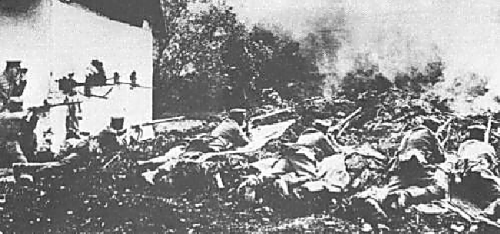
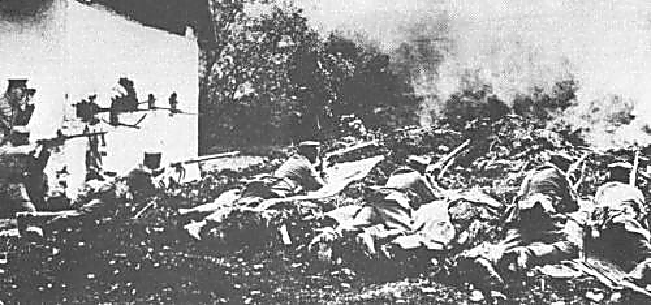
German troops in action, WWI

Trench warfare, WWI
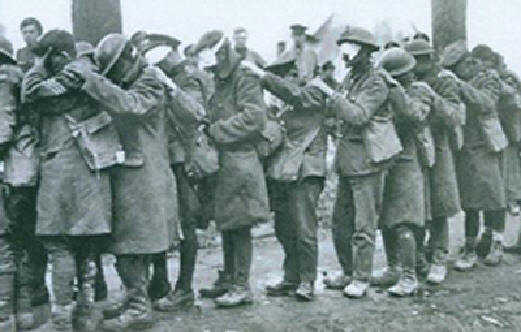
Gas victims at the front, WWI
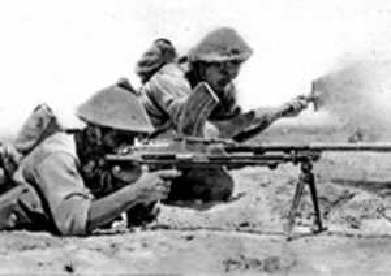
British soldiers at El Alamein
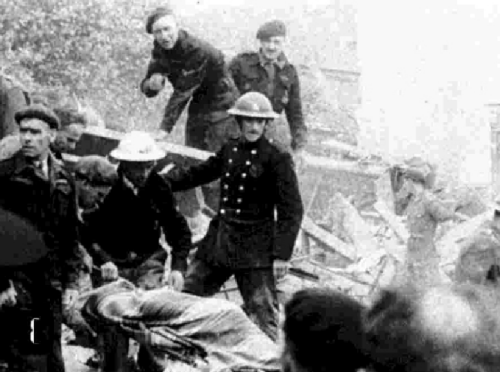
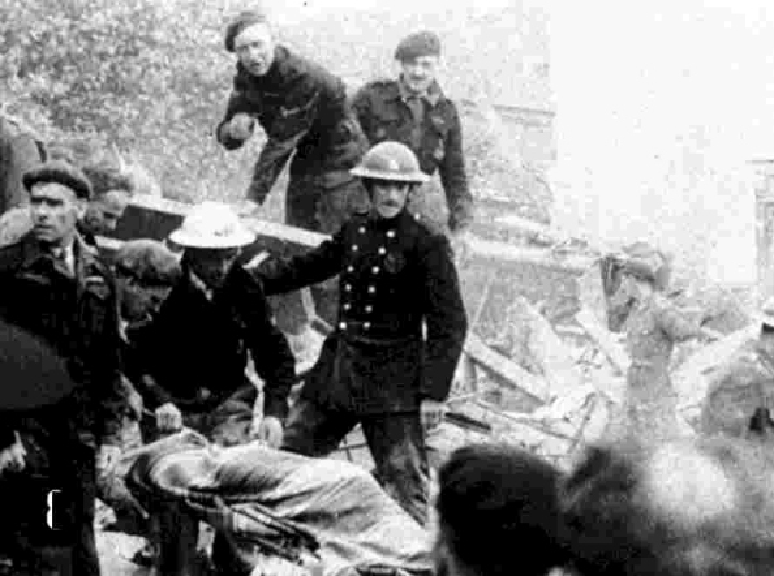
The London blitz, 1940
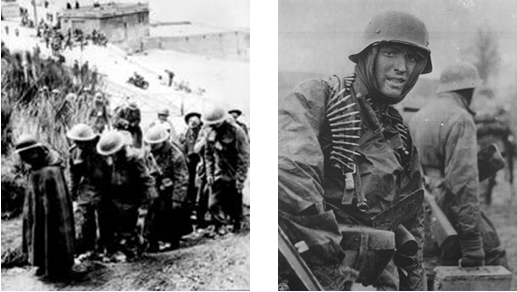
Dunkirk evacuation, 1940, when I
was born German soldiers at the Battle of the Bulge
The First World War is
believed to have resulted in 35 million deaths, 9 million of those were
soldiers and 26 million were civilians. [Another
30 million are believed to have died from the Spanish flu that followed
the war.] The
Second World War caused nearly twice as many deaths, - some 62 - 68
million. 18 million were military personnel, and over 50 million were
civilians. Two thirds of the casualties were from three countries, -
China, The USSR, and Poland. If we add Germany, then three-quarters of
the war deaths were from 4 countries. The mayhem continued in other
conflicts. The Korean War saw 2.5 – 3.5 million deaths, and the Vietnam
War, over 4.0 million. The Biafran / Nigerian war is believed to have
resulted in from 2.0 to 3.0 million deaths. The recent wars in the Congo
caused over 3.0 million deaths. Between 2.5 and 3.5 m civilians were
killed in Afghanistan during the Russian and American invasions, but who
knows how many died in Russia’s war in Chechnya ? Today, the latest
estimate of deaths in Iraq since the American-British invasion, amounts
to over 700,000 and the total rises by the day. The number killed in 20th
century wars is equal to twice the whole population of Britain.
Every single one of these numbers represents the violent
killing of a human being, the vast majority of them innocent civilians,
- women, children, old people, whose only crime was to be in the
conflict arena or in the wrong place at the wrong time. We are shocked,
and our media makes much of, any single brutal murder in our own land.
Yet our political leaders blithely lead us into war, knowing they are
asking our soldiers, sailors and airmen to pour death and destruction on
other populations. They seem to take pride in urging us to war. Behind
their triumphalist grins, do they ever consider for a moment what
suffering and sorrow they have unleashed on the world? Do they ever in
their most sober times of reflection, consider that they will one day
answer to the Judge of all the earth?
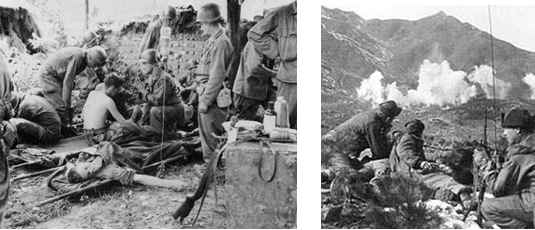
Troops in
action, Korean War U.S. artillery, Korean War
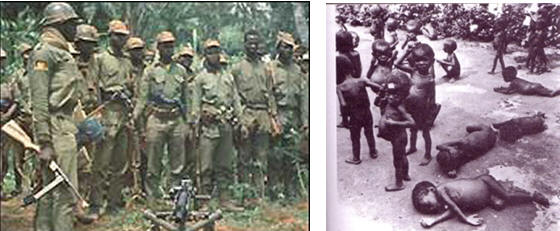
Nigerian soldiers in
the Biafran war Victims of the Biafran War
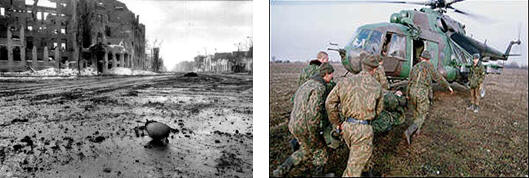
Devastation wrought in the
Chechyan war Russian soldiers in Chechnya
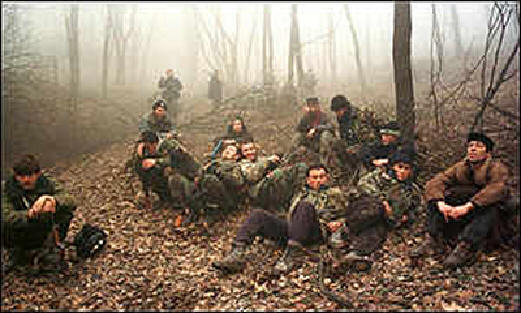
Chechen rebels
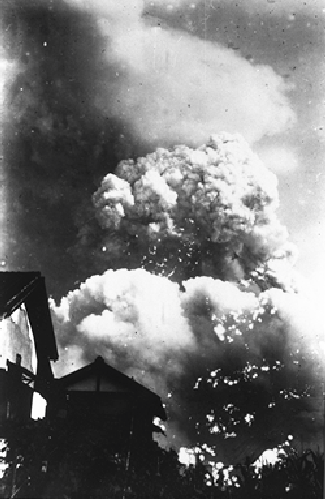
The Hiroshima atom bomb. Each missile
and bomb of the nuclear arsenal of the USA now dwarfs the power of that
early weapon.
Throughout history,
peacemakers and pacifists have had to endure a bad press. Most
governments do not like them, and many administrations treat them like
lunatics, traitors or criminals. We revere them only long after they
are dead, while we vilify their modern counterparts. Personally I have
come to admire persons like David Henry Thoreau, Leo Tolstoy, Ramsay
MacDonald, Mahatma Gandhi, Martin Luther King, George MacLeod, Alastair
McIntosh, and the hundreds of ordinary women and men who protest against
war quietly in all weathers, or take a stand outside the bases where our
nuclear weapons of mass destruction are stored in readiness for use.
These simple protestors are regularly miscalled by our politicians, and
lampooned in our press, but I for one, would far rather, at the end of
my life, be guilty of demonstrating with them, than be complicit by my
silence, in the obscene spending on weapons or in warmongering and
bloodshed.
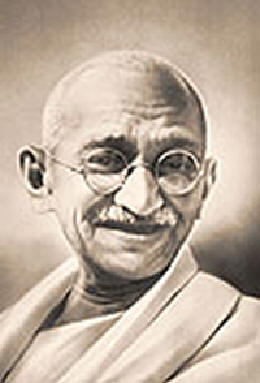
Mahatma Gandhi, renowned pacifist
The whole issue of
civilised, ‘Christian’ countries, taking up arms to exterminate or
conquer others, was eloquently challenged 5 centuries ago by Desiderius
Erasmus of Rotterdam : ”I often wonder what drives men (I will
not say ‘Christians’), to exterminate one another like madmen at the
price of such effort, such expense, such risks. Consider how many
crimes are committed under the pretext of war, when weapons speak and
laws are silent. How many thefts, how many sacrilegious acts, how many
rapes, how many abuses one is ashamed to name. What is it that
is won, that can compensate for the life and blood of thousands of
people ? And it is those who have nothing to do with the fighting who
are most bitterly afflicted by the evils of war. The advantages of
peace benefit everyone, but war makes even the victor weep. It is
accompanied by such a host of calamities that it verifies the poet’s
line that ‘War comes from Hell and is sent by the Furies’.
Some say the rights of
Sovereigns should be upheld, so I will not speak carelessly of the
actions of Princes. I only know that excessive right is excessive
injustice. There are princes who decide first what they want and then
seek pretexts to cloak the real motives of their warlike actions. There
are wise men of integrity who can regulate disputes before they cause
full blown war. What, some will say, can we do if the other side
refuses to come to or accept arbitration ? Then I would say, - if you
are a real Christian – bear and forbear, submerge your rights, whatever
they may be. And if you are a wise man, I would urge you to calculate
the cost of defending your rights. If the price is excessive, do not
insist on your rights (which may be unfounded). Think of the cost of so
many miseries inflicted upon humanity, so many dead, so many orphans, so
many tears, ...” [Erasmus
and the Struggle for Peace,
Jose Chapiro, Boston Beacon
Press, 1950]
If a voice from the
Middle Ages appears to be out of touch with modern times and with the
complex sets of issues that face the major powers today, then perhaps we
might listen to one who was before a General, a supreme military
commander, and a President of the USA. Dwight D. Eisenhower in 1953,
spoke of the twin spectres of fear and force in terms which might well
be applied to the U.S. and British governments 50 years later. The
massive increase in armaments and sophisticated weaponry, and the urge
to put troops into action (often orchestrated by the lords of military
industries and senior officials who themselves had no front line
experience of war), brings countries to the brink of hostilities.
Coupled to that is the fear which governments stir up in the general
population, to get them to support, tacitly or actively, a declaration
of war or a decision to invade another country. He asked the question,
“What is the worst to be feared and the best to be expected if we
continue down the road of fear and force”. His answer was : The
worst is atomic war. The best is a life of perpetual fear and tension;
a burden of arms draining the wealth and labour of the people; a wasting
of strength that leaves governments unable to provide abundance and
happiness for the people.
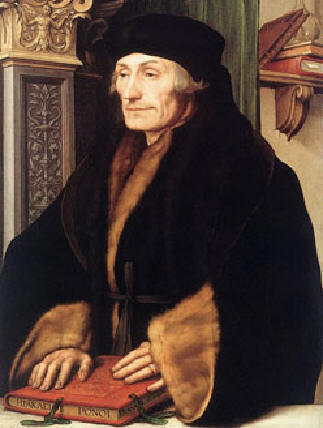
Erasmus of Rotterdam, “war makes even
the victor weep”
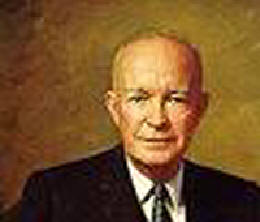
President Dwight D Eisenhour
On the colossal
expenditures on arms and munitions, he said that “Every gun that is
made, every warship launched, every rocket fired, signifies a theft from
those who hunger and are not fed, those who are cold and not clothed.
It represents the sweat of our labourers, the genius of our scientists,
and the hopes of our children. This is not a way of life at all. Under
the cloud of threatening war, it is humanity hanging from a cross of
iron. ... We seek peace founded upon trust and cooperative effort among
nations. This can be fortified, not by weapons of war, but by wheat and
cotton, by milk and wool, by meat and timber and rice. The monuments to
this new kind of war would be roads and schools, hospitals and homes,
food and health. I know of no other course that could be called a
highway of peace. The hunger for peace is too great, the hour of
history is too late, for any government to mock men’s hopes with words,
promises or gestures”.
Erosion of Human Rights
and Freedoms
The marriage of right
wing political ideologies with global capitalism and its brazen grasp
for control of natural resources like petroleum, in the USA and to a
lesser extent in Britain, is showing some troubling signs of a
resurrected fascism. Both countries are now dismissing or treating
lightly, the Geneva Convention, and the International Court of Justice,
in their treatment of prisoners of war, refugees and asylum seekers.
They are both using the supposed terrorist threat to justify their
actions. But as any student of recent history knows, practically every
despotic government has used that ploy to increase its power and
control. We used to associate surveillance of ordinary citizens,
arbitrary arrest, torture, and imprisonment without trial, with despots
like Stalin, Hitler, Mao Tse Tsung, Kim Il Sun, and Pol Pot.
Astonishingly, all of that is now practiced by the USA, with its allies
like Britain conniving in or turning a blind eye to things like
rendition flights. President Bush in October 2006 signed a bill to
legalise brutal interrogation, and trial by military courts.
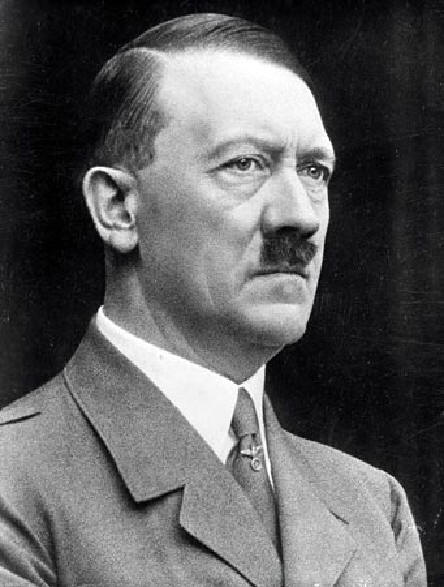
Adolf Hitler
I have personally met
and spoken with, individuals who were tortured by the Khmer Rouge in
Cambodia, by the police in apartheid South African, by Pinochet’s forces
in Chile, by Chinese authorities, by Japanese guards during WW2. I have
also read and studied first-hand accounts by victims in Russia, North
Korea, Iraq, Vietnam, Nicaragua and El Salvador. It all adds up to
state-organised, mindless brutality, seemingly for its own sake, and as
an expression of the power and the prejudices of the torturers. There
also appears to be an element of covering up for their own inadequacies
and trying to silence what’s left of their own consciences. It does
create fear in the population, but only for as long as the regime lasts.
Human rights groups
contend that confessions extracted by torture or severe physical and
mental pressure, are generally worthless. One can draw parallels with
the whole insane practice of forcing false confessions, as carried out
during the worst years of Stalinist Russia or Marxist China, or Pol
Pot’s Cambodia, or in other countries sadly made subject to brutal
totalitarian rule. What was it all for ? The inquisitors knew that the
‘confessions’ were forced, and almost entirely false. Yet they
proceeded to extract them and use them to justify their dogma and
provide a pretext for executions. It all sounds so bizarre, - yet so
devilish. Sadly even today the USA with Guantanamo Bay, Abu Graib and
similar secret prisons in foreign lands, follows a similar path.
The Patriot Act in the USA, and the plan to introduce
identity cards in Britain, and deny normal justice to anyone accused of
a terrorist-related activity (just accused, not found guilty), are
indicative of a growing loss of hard-won freedoms. Some US politicians
and senior officials have even questioned the loyalty and patriotism of
any who dare to protest at the loss of freedoms. There are many
examples of the bizarre lengths to which an administration will go to
suppress protest and label dissenters as potential terrorists. A 54
year old man, Brett Bursey, was arrested for holding a “No War for
Oil” sign at a South Carolina airport where President Bush was to
give a speech, in October 2004. Secret Service officers testified at
his trial that since Bursey’s sign was attached to a wooden stick,
“it could be used as a weapon”.
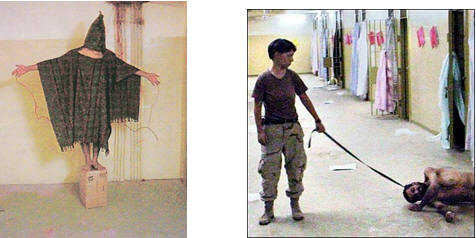
Above :Abu Ghraib
prison where Iraqi Humiliation and fear in Abu Ghraib
suspects were shamefully tortured
George Soros [In
The Bubble of American Supremacy, 2002],
the financier and currency trader, who has spent much of his wealth
establishing centres for democracy and open societies in former
totalitarian regimes, has warned that without strong institutions to
maintain a degree of transparency in government, and to insist that
fundamental rights are not eroded, powerful modern administrations will
act cunningly and ruthlessly to ensure that they are not made
accountable, and that dissent is well muted. The sophisticated control
of the press, of broadcasting, and of public debate by modern
governments in America and in Britain, bad as it is, would be much worse
if we did not have strong independent organizations to tell the truth
and call the authorities to account. Amnesty International, church
groups, civic organizations, and small independent newspapers are among
the voices of protest. They may irritate at times, but their role is
vital for a free society. A really good service is provided by the
global internet where practically anyone can post a view or provide
information.
|
Greed,
Prejudice, Imperialism, and Propaganda
Politicians and
the media, all over the world have been guilty of blatant
propaganda and mis-information or mis-representation of the
refugee problem. In this despicable behaviour they have
appealed to the worst instincts of our societies, and have given
justification in the minds of unthinking, selfish people, for
brutal actions and denial of justice, to many thousands of
homeless, stateless people whose only crime was to be the victim
of war or despotism or civil unrest – elements that in some
cases were fomented by the western powers themselves. Mob law
was supposed to be ended by civil societies, and the law of the
land stood between accused persons and the lynch mob. Now those
guilty of nothing more than being a fugitive from danger,
starvation, or oppression, are denied justice, and often left to
face the irrational inflamed passions of the mob. Women and
children who have committed no crime whatsoever, are locked up
in our jails by our shameless authorities, and sent back to face
worse treatment.
I respected
Enoch Powell at one time, as an intelligent, honest and diligent
politician. But his “rivers of blood speech”, and how it
was perceived and reported, added fuel to the flames of racial
hatred, and encouraged the growth of groups like the British
National Party.
Politicians and
media leaders have a solemn responsibility to think well on the
impact of their words in a situation with enormous potential to
release evil passions. For example, I have complimented
Thailand on its refugee efforts. But there is another side to
the story. The Thai government of that time, connived with the
Khymer Rouge to profit on the food trade, and made it known
surreptitiously during the era of the boat people, that those
refugees should be discouraged from landing in their country.
The Malaysian government may have done something similar. This
gave carte blanche to ruthless and brutal elements in the marine
and fisheries fleets, to rob, rape and murder, boatloads of
innocent fugitives. I believe that all such crimes will be
answered for before the final judgement seat of God.
At the time of
writing, we are witnessing the demonisation of the Moslem and
Arab peoples by neo-conservative groups in America and in
Britain, - including some in our New Labour government. Shame on
them ! I never cease to share with those influenced by such
evil propaganda, how my ten years or so among Moslems in Asia,
S.E. Asia, Indo-China, Africa, and the Middle East, have been
ones in which I experienced only kindness, hospitality,
consideration and respect.
Never once has a
Moslem ever shown me the slightest hostility or antipathy, and,
though I am open and honest with them about my Christian faith,
they have never failed to treat my beliefs and values, with
respect. But to say that is to invite the charge that I defend
terrorism. The accusation is as false as it is stupid. It is
as if when the IRA and UDF were at their worst, it would be
wrong to profess a love of the Irish people and to defend the
right of those who wanted a united Ireland, to express that wish
democratically. We did not bomb Belfast or Londonderry because
a few terrorists were holed up there, and were being protected
by some locals or some communities. But we think we can bomb
civilian areas in cities and towns in Iraq and Afghanistan to
kill insurgents, and we actually imagine that God does not mind
that we murder thousands of innocents in the process.

Moslem
people I worked with in SW Thailand
Young Moslem women
|
Potential Conflicts
over Resources
Most wars and conflicts
have occurred partly if not wholly over the ownership and control of
scarce resources. The one resource in greatest demand today is
petroleum, with other energy sources like natural gas also in demand.
United States foreign policy since WW2 has increasingly reflected that
nation’s demand for abundant supplies of cheap petroleum. With only 5 %
of the world’s population, the USA consumes over 25 % of the world’s oil
production. The U.S. is a large oil producer itself, but because its
domestic consumption continues to rise, it has become a net importer of
the commodity. More than half of America’s oil now comes from abroad,
and the percentage of imported oil is expected to continue to rise.
Most of the petroleum comes from the Middle East, the world’s largest
source of oil. The Caspian Sea and Caucuses region is the next most
important, with West Africa, Latin America and the Far East also able to
export. But when one examines the figures in detail, - proven reserves,
production potential, and oil available for export, then it becomes
clear that America’s inflated demand for petroleum is coming under
threat from a number of factors.
The first is the
growing energy demands of the rest of the world, particularly China
which has a rapidly expanding economy and a colossal 1.5 billion
population. This is why the Middle East and other major oil regions are
of strategic interest to the USA, Europe, Russia, and China. Each of
these major players is investing large funds in, and exerting diplomatic
and military influence on, the oil producing states. So the growing
U.S. energy demand is in potential conflict with the energy needs of the
other major competitors.
A second major factor
is the potential of disruption of supplies from political instabilities
in the states and regions producing the oil. Practically every
production area is vulnerable to such instability whether expressed in
ethnic, religious, or political forms. The resulting conflicts and
tensions have crippled production in states like Iraq, Angola, and
Nigeria, or limited export possibilities as in regions like the Caspian
Sea.
A third factor is the
potential for natural disasters to disrupt production and supplies. The
power and frequency of abnormal weather patterns are increasing as
evident in the severe hurricanes and typhoons striking the coasts of
southern USA and the Asia Pacific coast. Earthquakes and tsunamis can
also be expected. Some of these phenomena are due to global warming;
how much is not certain, but the pattern is already clear. And as has
happened in the Gulf of Mexico, these storms can halt the production
from marine oil installations, and even damage refineries.
The problem for the
biggest consumer, America, is that its transport systems and military
machine cannot function without oil. There is no ready alternative
fuel. That being said, it would appear to be extremely prudent for the
USA to commence development of alternative fuels, and to take steps to
reduce excessive consumption. Instead, the current U.S. government is
doing the reverse. The Bush – Cheyney plan simply calls for
ever-increasing supplies of oil from abroad, and ever-escalating
military and diplomatic efforts to secure these supplies. They also
plan to drill for and extract oil from wilderness areas designated as
nature reserves, though the amounts to be obtained there would not make
any significant dent on the need for imports.
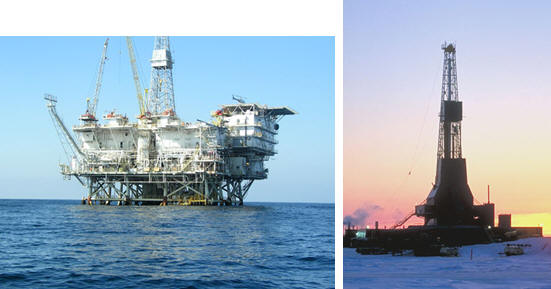
Huge
modern oil rig Oil
drilling rig
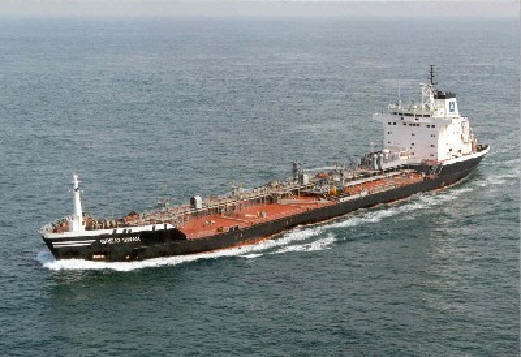
Oil tanker
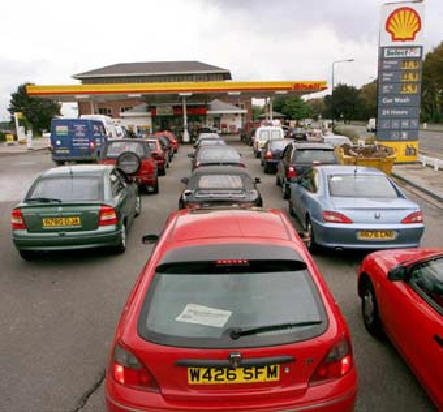
Queue of vehicles at a petrol station
In rough round figures,
world oil consumption has risen to over 70 million barrels per day. Most
experts believe it will rise to 100 mbd after which the ability to meet
the demand will be in serious doubt. A barrel of oil equals 159 litres
(35 imp. gallons; or 42 U.S. gallons). When refined, it yields 72
litres of petrol. America produces 5 mbd (million barrels per day),
plus another 4 mbd of fuel inputs like ethanol, giving it a total
domestic supply of over 9.0 mbd. But U.S. oil consumption is now 20.5
mbd and is projected to rise to over 28 mbd during the next two
decades. At the same time, the domestic demand in China, Russia, Latin
America, India, Africa and Europe, is also expected to increase. Even
with the most optimistic projections of global oil production, it is far
from certain whether world demand can be met in the years beyond 2010.
The elements of potential conflict are therefore in place, yet the
current U.S. administration appears to be making no effort to get off
the collision course. Given the other risks referred to above, further
and more serious global wars over petroleum resources are extremely
likely.
Some observers believe
that the energy resource wars have already begun. They have been taking
place through ‘proxy’ combatants in several parts of the world over the
past 50 years. Africa suffered perhaps more thany other continent from
such conflicts. We had the dreadful civil wars of Biafra in Nigeria,
and of Angola, and more recently the Congo, (formerly Zaire).
Indonesia’s successful take-over of Irian Jaya, (the former Dutch part
of New Guinea), and its unsuccessful but brutal attempt to invade and
control East Timor, both had the petroleum deposits of those regions as
the prime motivating factor. Territorial arguments over islands like
the Spratleys where oil deposits are believed to exist, pit China
against Vietnam, the Philippines, Malaysia and Taiwan. The struggle to
gain control of oil supplies can have unfortunate political
repercussions as in Sudan which can ignore world opinion on its
scandalous treatment of the people of Darfur, since China and the USA
both want its production to boost their nation’s demand for imported
petroleum.

A barrel of oil. It costs but $3 or $4
to produce. Why then does the public pay over $ 80 or $ 90 for it?
The start of the 21st
century has the most powerful states and groups of states competing for
access to the main petroleum and gas production fields in the Middle
East, The Caspian Sea basin, West Africa, and parts of South America.
The USA, the EU states, Russia, and China, are the main players in this
high risk and dangerous global power game. Some suspect the worst of
motives in recent military adventures by the United States Bush
administration, supported by the Blair government in Briain. Their
actions are believed to be undertaken on behalf of oil and financial
oligarchies that want to enrich themselves through predatory wars to
seize control of the world’s major resources, and facilitate a massive
redistribution of wealth away from the world’s poor to further enrich
the already affluent and powerful.
|
The Petroleum Dependency Dilemma
“The U.S.
National Energy Policy 2001, (NEP), or Cheyney Report as it is
sometimes termed, envisages no reduction in petroleum use by the
USA. Instead it proposes steps to increase consumption and
calls for intensified exploitation of all domestic reserves
including untapped fields in Alaska and other protected
wilderness areas. … A chart projects U.S. oil production and
consumption over the next 20 years. Domestic production will
decline by 18 % while consumption will grow by 31 %. Petroleum
imports will have to grow by 68 %, the equivalent of the
combined consumption of China and India today. Future U.S.
demand for foreign oil will be staggeringly large. The NEP
Report makes 35 foreign policy recommendations. These
recommendations are mostly region- or country-specific ideas for
overseas procurement, by removing economic and political
obstacles, bolstering ties with oil-rich countries, and
expanding U.S. presence in key oil producing areas. It also
envisages a close working relationship between the Federal
Government and American oil giants. The government will work
with foreign governments to overcome obstacles to American
investment, and the energy companies will put up the investment
capital and assemble technical and logistic capabilities to
extract oil and deliver it to U.S. refineries.
The U.S.
Department of Energy in 2003 released reports projecting global
energy patterns that show the Gulf producers, - Iran, Iraq,
Kuwait, Qatar, Saudi Arabia and the United Arab Emirates, will
have to double their total daily output from 22.4 to 45.2
million barrels, to satisfy projected American and international
demand.”
Professor
Michael Klare, Hampshire College, Amherst, USA |
In his State of the
Union address of January 2006, President George W Bush finally admitted
to the American people the energy dilemma faced by the nation. He told
them bluntly that America was addicted to oil, and that the nation was
too dependent on unstable regimes for the 60 % of its petroleum needs
that it imported. He then promised to do what others had urged for
years, to no avail. He committed his administration to funding the
development of alternative energy resources and bio-fuels for
automobiles. Even wind energy was to be tapped to a greater degree.
There was to be renewed effort to utilize coal fuel in environmentally
clean ways. It remains to be seen how much of the new energy programme
President Bush would see realised during the remaining two years of his
tenure.
Prime Minister Tony
Blair uncharacteristically called for a massive global effort to cut
pollution, reduce consumption of carbon fuels, and promote a range of
viable natural energy systems. This he did with his typical messianic
zeal. His message comes a bit late and might be better received if he
had more credibility. but he has recognised the urgent need to reduce
global warming and protect the ozone lyer, and should be given credit
for that.
Critcs of major energy
systems change, and of the development and reliance on natural renewable
energy and fuels, mostly question the cost if not also the feasibility.
The cost is much, much less than what we spend on arms and munitions.
While we have given lavishly to nuclear energy and weapons research, we
have spent next to nothing on alternative systems. In fact, for periods
we have blocked andf legislated against any introduction of renewable
energy technology. In the following box I outline just how profligate
and wasteful our leaders have been on wars, military spending, and
doctrinaire actions, and how ready they have been to promote rather than
end conflict.
|
Our
Fiscally Conservative and Peace Loving Leaders
Ronald Reagan, beloved by most Americans, put that great country
into enormous debt by military spending on a scale never known
before in the USA. This was during a time of peace ! In his
actions he was enthusiastically supported by his profligate
Defense Secretary, Caspar Weinberger, who had a bottomless pit
of insanely expensive projects, including, ‘star wars’ – the
militarisation of outer space ! To show a strong image to
Americans, and to the world, these sabre rattlers invaded
Grenada, allowed the finance of brutal contras in Nicaragua,
undermined democratically elected governments in Latin America,
and bombed houses in Libya, killing a child in Muammar Gaddafi’s
family. They also displayed brazen hypocrisy, selling arms to
both Iraq and Iran, as well as providing weapons and training to
the Mujahadeen and Osama Bin Laden. Reagan’s enormous national
deficit was not eliminated until the Presidency of Bill
Clinton.
George W Bush, enthusiastically supported by Defense Secretary
Rumsfeld, not to be outdone by Reagan, took the Clinton surplus
and turned it into an even larger deficit, in the trillions of
dollars – money Americans’ children and grand-children will have
to repay. This debt was incurred in record time, - not to
finance economic growth, education or social services, but to
pay for an illegal and ill-advised conflict in Iraq, planned
years before by his oil industry colleagues, to gain control
over the second largest petroleum source in the world.
Afghanistan was also invaded, and its Taliban government
removed, a regime the U.S. had financed earlier, (along with a
certain Osama Bin Laden), to help defeat the Soviet army.
Afghanistan was the most logical overland route for a pipeline
to take oil from central Asian states through Pakistan for
shipment to the USA.
Margaret Thatcher, renowned for her conservative values and
monetary policies, was remarkably wasteful in some ways. She
cost the country many billions of pounds paying benefits for 3
million unemployed she created in order to make a few firms more
profitable. She spent over a billion on the Falklands war, and
a similar sum in a failed and foolish attempt to impose a
neanderthal ‘poll’ tax. All her reign she was the first Prime
Minister to benefit from (Scottish) North Sea oil. Much of that
priceless wealth was squandered, as was the proceeds from sale
of the ‘family silver’ – public assets that were sold to finance
privatisation schemes. British Rail and the country’s water
supplies were two of the costly and ill-advised privatisations.
She forced premature closure of the coal mines so Britain could
move to oil-fired energy. She displayed little interest in
manufacturing, believing that the City of London’s wealth
manipulators were actually wealth creators.
John Major, Thatcher’s successor, lost the country over a
billion pounds in the utter folly of trying to keep Britain in
the ERM at a currency value far above the pound’s real worth.
Tony Blair, Major’s successor, and ideological child of
Thatcher, propagated blatant untruths and false scaremongering
stories in pushing Britain into an illegal and costly (in human,
political and financial terms) invasion and occupation of Iraq
with his political soul-brother George Bush, so making himself
look like a second ‘Iron Lady”. |
Terrorism
Terrorism has become a
global monster at the start of the 21st century. I daresay
it was always around, but in these modern times it has assumed dangerous
proportions for two reasons. One is that the weapons available to a
ruthless terrorist who is prepared to kill himself in the process, are
horrificly powerful and cheap to obtain. The handful of 9/11 hijackers
had just a few hundred dollars worth of tools, yet they brought down the
twin trade towers in New York. A second reason is that our modern
cities and societies are extremely vulnerable to such attacks.
Aircraft, and mass transit systems are ideal targets for the terrorist.
And our mega cities can be brought to a standstill by a small attack on
a strategic location. There is little that democratic societies can do
to prevent such disasters. All the identity cards and armed police in
the world would not stop a determined and imaginative terrorist as is
evident in Israel that exists in a constant state of war alert.
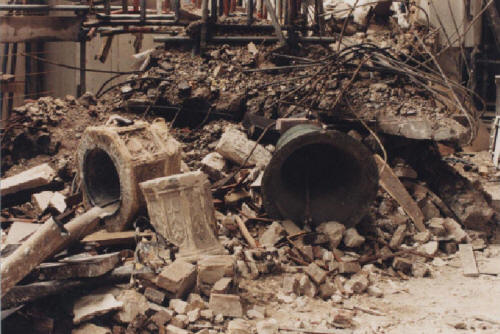
Aftermath of an IRA bomb
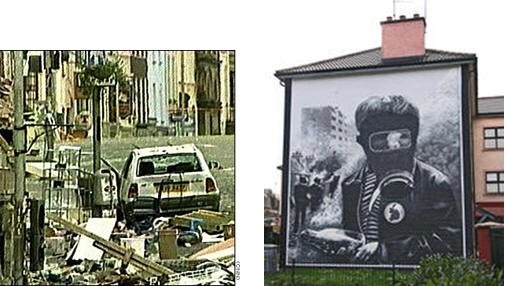
Carnage following explosion of a bomb by
the IRA IRA mural, Northern Ireland
I worked in the
Republic of Ireland, and in Ulster (Northern Ireland) over several
years, when the IRA were at their most active. At one time I was
driving across the border between the two parts of Ireland, four times a
week, and knew what it was to be stopped at gunpoint and searched by
British soldiers. I was working in Italy during the period when the Red
Guard were kidnapping and murdering prominent political leaders. I have
also spent brief periods serving in rebel-controlled, or rebel
infiltrated areas of North Sumatra, Southern Thailand, Southern
Philippines, Sri Lanka, Yemen (before its unification), and in Papua New
Guinea during the Bougainville secession. So I do not speak from lack
of experience of the terrorist problem. I have walked through clouds of
tear gas in Manila when Marcos was suppressing all dissent, and through
marchers in Rome when striking workers and communists brought the
country to a standstill. At no time in all of these experiences did I
feel personally threatened, though no doubt I could easily have become a
civilian casualty in the tense circumstances.
The problem with many
of the terrorist-related situations, is that the West is treating the
symptons but not the disease (and with little apparent success – often
just adding fuel to the flames). The difficulty for western
governments is that they do not want to concede their own guilt or
culpability in any way. Yet they (or their predecessors) have sown the
seeds of terrorism, all over the world. I do not accept the view that
“9/11 changed everything”, and led to the global “war on terror”. Al
Qaida was armed and encouraged by the USA when Bin Laden fought the
Russians in Afghanistan. But it had the West in mind as a target even
then, in response to years of exploitation of Arab oil, and the
seduction and domination of Arab governments. As President Kennedy said
in his inaugural address, those who take a ride on the back of a tiger
may well end up inside the beast. To a degree that has happened, and we
now begin to see the ‘smile on the face of the tiger’.
[Kennedy
was referring to the limerick poem:
There was a young lady of Niger who went for a
ride on a tiger,
They ended the ride with the lady inside, and a
smile on the face of the tiger.
One has to ask, as was
in the mid twentieth century, - what right has a colonial power got to
control a country and its people against their will? For colonial
power, now read ‘neo-colonialist imperialism’.
What right does the CIA
and the big oil corporations, the mining companies, communication giants
(like ITT), the drug companies, the loggers, the major bankers of the
world, - to bribe politicians, to manipulate elections, to invade
illegally, or to terrorise the population through surrogate groups like
the ‘contras’, or right wing military troops ? Yet all of that
continues to this day. The ill-advised and illegal invasion of Iraq,
justified on the basis of totally false information, is but another
example of western imperialism to extend its controls over the resources
of other states, (in this case, petroleum). The removal of a brutal
dictator was also given as a reason, but we have such in Burma, North
Korea, Turkmenisan and Zimbabwe, to name but a few, and there seems to
be remarkable reluctance on the part of the West to remove them, or to
change the regimes in places like Sudan or Somalia. When a unity
government emerged recently in Sudan, out of years of chaos, the U.S.
promptly armed an insurgent group, causing a mini-civil war. The group
was defeated, but in reaction, an extreme Islamic regime seized power
making the last situation worse than the first.
Some evil regimes, such
as the oil and gas rich central Asian and Caspian states are even
supported and provided with arms and military training, since they
provide the USA with bases for its military actions in Afghanistan and
Iraq, and apparently for secret prisons where terrorist suspects could
be tortured far from the prying eyes of the media, and where no system
of justice might protect them.
The Democratic Deficit
and Dishonesty in High Places
Democracy is wonderful in theory. How it is expressed is less
admirable. Even brutal dictatorships hold ‘free’ elections to
demonstrate that their regimes have genuine legitimacy. When I first
lived in Indonesia, civil servants and soldiers had to vote within their
place of work. Any brave government employee who dared to vote for the
opposition would soon be detected and in consequence forfeit their job
eventually. I mentioned elsewhere the Governor of Batangas who spent
years in prison because President Marcos received so few votes in that
precinct. In Africa by contrast, voting mostly follows tribal affinity,
with the power base of political parties running along tribal lines. In
Northern Ireland, one might say (with thankfully less accuracy than
before), that votes are cast according to religious denomination.
I
remember after watching a BBC programme on the treatment of the mentally
ill, debating with my dear mother-in-law, why people who suffered from
some form of insanity were denied the vote. (I believe the law has
changed somewhat since). She suggested that it must be because “they
would use their vote in a foolish way”. I responded, “but is that not
what at least half the voters do anyway?”! She had to agree ! I
mention the silly anecdote to highlight the fact that even in the best
democracies, a seemingly educated, informed electorate, casts its votes
in response to a range of stimuli, not the least of which is the media
that often plays on prejudices, ignorance and fear. One of my best
political friends used to tell me that people are far more likely to
vote out of fear than out of hope. The present administrations in the
UK and the USA are using the powerful weapon of fear to extend
government control and snooping to a degree that we thought could only
happen in a fictional “1984”. During the 2006 Congressional elections
in the USA, the Republican Party openly admitted that it had used fear
as a weapon to intimidate voters, and that they felt it was their duty
to continue to do so.
For a
democratic system to have integrity, there has to be truth,
transparency, and accountability – qualities more conspicuous by their
absence in public life today. Lying has become a way of life for
politicians. Some say there is no future for an honest man in
politics. At one time, Ministers resigned when caught out lying or
deceiving the public, or being found guilty of conflicts of interest.
Today, most of them brazen it out in a conscienceless way. One can
imagine Machiavelli applauding from the visitors’ gallery!
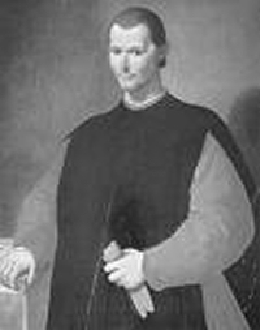
Italian political theorist, Machiavelli
Britain
was lied to by Churchill reporting on the Yalta agreement and what it
meant for most of eastern Europe, especially the Polish nation [In
fairness, Churchill lobbied privately (in vain) to FDR to protect Poland
from the Soviet Union. My point is that he lied about the final Yalta
agreement to Parliament and to the British people.]. Harold Wilson
during his tenure, hid from the British people the real condition of the
country’s economy. We were lied to by Edward Heath over the
implications and intent of the European Common Market. Scottish people
were lied to by London over the value and significance of its oil
resource. We were lied to by Mrs Thatcher over the Belgrano
sinking. (Nothing unusual since lies are the norm rather than the
exception when it comes to armed conflict). We were lied to about the
ERM and the debacle and loss suffered in our unseemly exit, by John
Major and his Chancellor. We have been repeatedly deceived and lied to
about the implication of the treaties of the European Union. At the
time of writing the Scottish Executive continues to lie and suppress the
truth on the McKie fingerprint scandal that could have implications on
events as far back as the Lockerbie bombing lies, and the nefarious
activities of Colonel Oliver North.
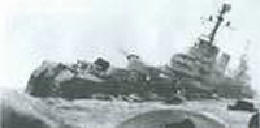
The Argentinian warship
Belgrano (a former WW2 vessel, sunk on Thatcher’s orders when
heading to sea outside of Falklands waters)
Among
the greatest of political lies of the past 50 years was that perpetrated
by Tony Blair and his supine New Labour Cabinet, over Iraq. A detailed
scrutiny of Prime Minister Blair’s record has led some close observers
to conclude that the man’s instinctive response when in a tight
situation, is to lie. Yet when found out, he can turn truth on its head
and claim without shame that he acted out of the best of motives and
intentions. It says much of our current bunch of parliamentarians that
such behaviour is not considered grounds for impeachment.
In January 2008, a
study of false information was released by the Center for Public
Integrity, and the Fund for Independence in Journalism. It had studied
official statements by the Bush administration in a two year period
following the 9/11 attacks on the Twin Towers and the Pentagon. The
study counted 935 falsehoods released in speeches, briefings, interviews
and other communications. Officials responsible were President George W
Bush, Vice President Dick Cheyney, National Security Adviser Condoleezza
Rice, Defence Secretary Donald Rumsfield, Secretary of State Colin
Powell, Deputy Defence Secretary Paul Wolfowitz, and White House Press
Secretaries An Fleischer and Scott McClellan. The exhaustive
examination of records in the 5 years since the invasion, concluded that
the statements were “part of an orchestrated campaign that
effectively galvanized public opinion, and, in the process, led the
nation to war under decidedly false pretences”.
The study,
Orchestrated Deception on the Path to War, estimated that the
greatest number of false statements were from President Bush who was
credited with 260. Colin Powell was next with 254 falsehoods, then
Rumsfield and Fleischer with 107 each, Wolfowitz with 85, Rice with 56,
Cheyney with 48, and McClellan with 14. Most of the untruths concerned
WMD in Iraq, while others related to Saddam’s (non-existent) relations
with Osama Bin Laden. The misleading information was massively
amplified by a media that has since admitted its coverage was “far
too deferential and uncritical”.
Politicians also lie when presenting their policies and manifestos. How
often have the past few British Governments suddenly sprung legislation
or measures upon the country, that were never mentioned in the
manifesto? More blatantly now, how many times do we see an unjust or
unpopular measure trumpeted as if it would accomplish the precise
opposite of its real intent? The word “reform” has taken on a new
meaning under New Labour. It used to convey the sense of improvement,
as in housing, pensions, prisons, hospitals. It now covers a multitude
of sins – including reductions in pensions and health benefits, the
politicisation of education, and additional taxation by every stealth
method possible.
Our
much lauded democratic system has been narrowed and hijacked by
political parties to become a once-in-five-years event. They respond to
the popular will as expressed by the ballot box (with all the injustice
of a first-past-the-post system), yet regard public opinion with
contempt in between. Public protests about the poll tax, and more
recently over the war in Iraq, were treated with derision. And as ever
when it comes to war, the dissenting voices of those who are privy to
the truth, are ruthlessly suppressed. Senior civil servant Clive
Ponting was dragged into court for speaking out on the Falklands war.
BBC broadcaster Andrew Gilligan was pilloried and sacked, and the great
organisation emasculated as a result of one brief radio broadcast that
challenged the government’s story on weapons intelligence. Worse, an
honest senior civil servant of true integrity who was caught up in the
crossfire, Dr David Kelly, lost his life. They said it was suicide.
Rumours from within the security services indicate it may have been
murder. Some day perhaps we will learn the truth. I for one still
believe that God is in ultimate charge, and both governments and peoples
will reap what they sow.
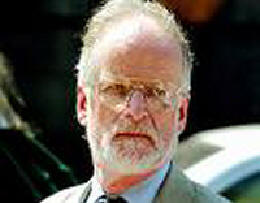
Dr David Kelly, British expert on Iraqi
weaponry who died in suspicious circumstances following his testimony
before a Parliamentary committee looking at the possibility that Downing
Street exaggerated evidence that Iraq had weapons of mass destruction.
While I
criticise the West, let me also mention the shocking and brutal murder
in Russia of the investigative reporter Anna Politvoskaya who was shot
in the elevator of her Moscow apartment building. Her books, Dirty
War, and Putin’s Russia, exposed the injustice and cruelty of the
war in Chechnya, and the corruption in high places associated with the
amassing of obscene fortunes by Russia’s current elite. We should be so
grateful that there are still a few brave souls around like Politvoskaya,
willing to risk life in the cause of truth and justice. Needless to
say, President Putin has not shed a single public tear over her death or
expressed the slightest regret.
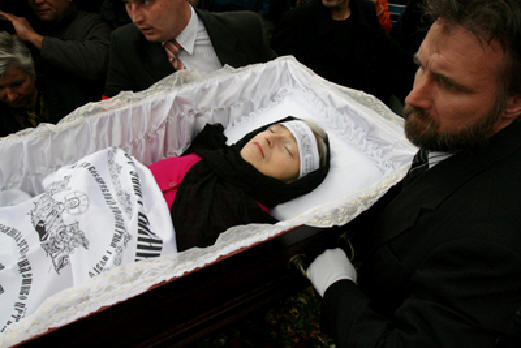
Body of murdered journalist, Anna
Politkovskaya
In the
United Kingdom we have forgotten about the recent murders of eloquent
opponents of war and nuclear expansion. On 21 March 1984, a celebrated
writer, rose-grower and environmentalist was to have presented a paper
on An Ordinary Citizen’s View of Radio-Active Waste Management,
when she was brutally attacked and murdered. while some believe that
her opposition to nuclear weapons was the reason, others like veteran MP
Tam Dalyell, suspected it was because she had been sent papers for safe
keeping by her nephew, Commander Robert Green. These papers were
believed to have exposed the source of orders to sink the Argentine ship
Belgrano. The murder then may have been some kind of botched
intelligence robbery attempt since the house had been ransacked but no
money taken.
On the
6th April, 1985, another prominent anti-nuclear campaigner,
William McRae, was found shot and dying in his car north of Fort William
in the west of Scotland. his car had been ransacked and the contents of
his briefcase had been meticulously shredded. Nurse who attended McRae
in Aberdeen Royal Infirmary said that there were two bullet wounds in
McRae’s head. Police refused to release information on some of the
belongings found in the car or near it, which they claim to have later
returned. No one was arrested for the murder which the authorities
claim was suicide. (A revolver was later recovered some distance from
the car). Mccrae was a lawyer and a former Vice-Chariman of the
Scottish National Party. He also had some connection with a smaller
nationalist group, Siol nan Gaidheal, or ‘seed of the Gael.
Before his death he had repeatedly told colleagues that he was under
surveillance by intelligence bodies.
Both
the UK and U.S. governments have resorted to astonishing levels of
propaganda and bombast to attack opponents of their policies. Abusive
and cleverly dishonest rhetoric bordering on slander if not downright
lies, is incorporated in the speeches and utterances of ministers and
officials. Much more appalling propaganda pours out of their surrogate
mouthpieces like Fox News in America, and the Sun or Mail newspapers in
Britain. If any readers doubt my judgment, they might care to read how
publicity and accusations were orchestrated during the McCarthy era in
the USA, from around 1948 to 1952, with politicians like Richard Nixon,
and even the Kennedy’s climbing on to that bandwagon. The parallels
with today’s “war on terror” are extremely troubling.
Scotland has suffered so much from the democratic deficit, it is hard to
know where to begin in selecting examples. I mention the propaganda on
Scotland’s oil resource above, and have alluded to the Trustee Savings
Bank rip-off elsewhere. A few years ago the brave new Scottish
Executive announced it would repeal Section 28 that prohibited the
teaching of homosexuality in school. Now many will think that was a
proper action to take. But I am here talking only about its democratic
or undemocratic nature. Brian Souter offered to finance a referendum on
the subject. The government tried to prevent official bodies from
involvement. Eventually it went ahead, and those against scrapping it
won by over a million votes. What did the Executive do? It poured
scorn on the whole exercise.
A
second item from Scotland’s experience will arouse less passion. In
despair at the loss of their industry and the growing number of men and
boats forced onto the scrapheap, some fisher wives in Grampian ports
decided to act. They formed a group, The Cod Crusaders’ and proceeded
to lobby for an end to the iniquitous, irrational, and doctrinaire
aspects of the EC Common Fisheries Policy. Over 250,000 persons signed
their petition. That was more votes than any politician was elected by,
- and more than some Scottish Parliament parties had received. So what
was the response of our democratic institution and its leaders? They
decided it merited no action whatsoever.
Nelson
Mandela who struggled against the oppression and denial of human rights
and dignity that characterised Apartheid South Africa, spoke in his
Nobel Peace Prize speech about the challenge of the dichotomies of
war and peace, violence and non-violence, racism and human dignity,
oppression and repression, liberty and human rights, poverty and freedom
from want. He said there must be a world of democracy and
respect for human rights; a world freed from the horrors of poverty,
hunger, deprivation and ignorance; relieved of the scourge of civil
war and external aggression, and unburdened by the tragedy of
millions of refugees.
Well might we quote some lines [From
“Recessional”, by Rudyard Kipling] from the one often termed ‘the poet of imperialism’:
Far-called, our
navies melt away; on dune and headland sinks the fire;
Lo, all the pomp of yesterday is one with Niniveh and Tyre!
Judge of the nations, spare us yet, lest we forget - lest we forget!
The
tumult and the shouting dies; the captains and the kings depart:
Still stands Thine ancient sacrifice, - a humble and a contrite
heart
Lord God of Hosts, be with us yet, lest we forget – lest we
forget!
|