|
“When you enter
the land that I am giving you, let the land, too, keep a
Sabbath for the LORD. For six years you may sow your field, and
for six
years
prune your vineyard, gathering in their produce. But
during the seventh
year the land shall have a complete rest, a sabbath for the LORD,
when you
may neither sow your field nor prune your vineyard.
The
fiftieth year you shall make sacred by proclaiming liberty in the land
for all
its inhabitants. It shall be a jubilee for you, when every one of
you shall return
to his own property, every one to his own family estate.
In
this fiftieth year, your year of jubilee, you shall not sow, nor shall
you reap
the after-growth or pick the grapes from the untrimmed vines. Since
this is the
jubilee, which shall be sacred for you, you may not eat of its
produce, except
as taken directly from the field. In this year of jubilee, then,
every one of you
shall return to his own property. Therefore, when you sell any land
to your
neighbor or buy any from him, do not deal unfairly.
Do
not deal unfairly, then; but stand in fear of your God. I, the LORD, am
your God. Observe my precepts and be careful to keep my
regulations, for
then you will dwell securely in the land.
The
land shall not be sold in perpetuity; for the land is mine, and you
are
but aliens who have become my tenants. Therefore, in every part of
the
country that you occupy, you must permit the land to be redeemed.”
from the
25th chapter of Leviticus
New American Bible translation
As soon
as the land of any country has all become private property, the
landlords, like all other men, love to reap where they never sowed, and
demand a rent even for its natural produce.
Adam
Smith,
The Wealth of Nations,
1776
All
right of property is founded either in occupancy or labour. The earth
having been given to mankind in common occupancy, each individual seems
to have by nature a right to possess and cultivate and equal share.
William Ogilvie of Pittensear,
The Right of Property in Land, 1782
To put
the bounty and health of our land, our only commonwealth, into the hands
of people who do not live on it and share its fate will always be an
error. Whatever determines the fortune of the land determines also the
fortune of the people.
Wendell
Berry, Conserving Forest Communities, 1995
I had
just returned from a series of assignments in Namibia where that small
country had reclaimed its fishing grounds from the European and South
African fleets that had exploited them to a state of severe depletion,
when I got a call from a young university researcher by the name of Andy
Wightman. I had written a few articles on national and local ownership
rights of marine waters, including one published in a national Sunday
newspaper, together with Roger Mullin. The success of the fledgling
African government and its local fishing industry, elicited a number of
complimentary responses from fishermen’s associations and those like
Wightman who were working on parallel issues of ownership and control of
land. Following a coffee meeting with Andy in the Royal Mile, I was
invited to submit a paper to an environmental journal, and later to
speak at an international conference on land reform and taxation. At
the international conference in Edinburgh University, I was struck by
the number of senior academics and researchers from other countries, who
saw the issues of land reform and taxation as lying at the root of much
of the inequality and injustice of current relevant laws and management
structures. It was particularly interesting to hear senior professors
from the USA, UK and Russia, in complete harmony on the issue. It was
at that conference I first obtained an in-depth glimpse of the works and
idea of Henry George.
Andy Wightman, writer, lecturer, and
tireless Scots advocate of land reform
Andy
Wightman went on to publish Who owns Scotland? and Scotland :
Land and Power, and to be a leading proponent and supporter of
Scotland’s limited act on land reform, Land Reform Scotland Act 2003.
The Act has guaranteed, 1) the right to roam, including wild camping and
canoeing, 2) the right of pre-emptive purchase at government valuation
by a community of rural land that is put up for sale, and, 3) in areas
traditionally governed by crofting tenure, the right of a community to
buy their land at valuation even when the laird has not placed it on the
market. An earlier 1976 act allowed individual crofters to buy their
patch freehold. That act forced individualism and so was shunned by many
indigenous tenants. The 2003 act in contrast, allows land to be bought
with tenancies over it to be held by the community.
There
are two powerful and privileged groups in most of the world’s societies
who increase their wealth day by day with scarcely any effort or
sacrifice on their part, save a tenacious defense of their property and
power. The two groups are those with legal title to land, and those who
own or control the major banks and financial institutions. The
constantly increasing value of their assets is based on the labour and
industry of the rest of society. Yet they continue to tax society at
increasing rates by the tools of rent and usury.
The
ownership and control of land is a concept that has come down to us from
medieval times, and become a foundation truth of capitalist society.
Yet a number of cultures and civilizations have regarded it as an alien
principle. Under the old Hebrew economy, land was ultimately God’s
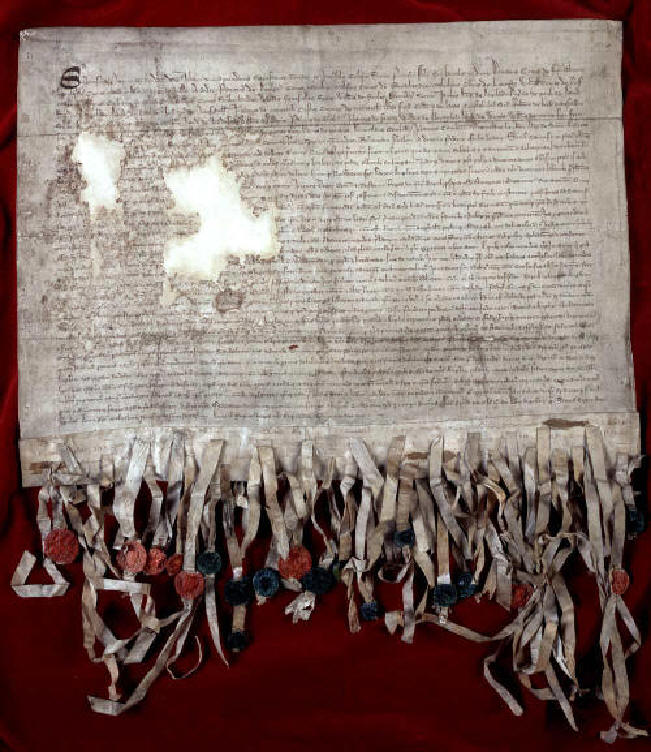
property (Leviticus 25). The early Scots constitutional document, the
Declaration of Arbroath,1320, and subsequent legal statements,
declared that the land was held under God on behalf of the people. The
King or Guardian could not utilize lands in ways that offended the laws
of God, or were contrary to the interests of the people.
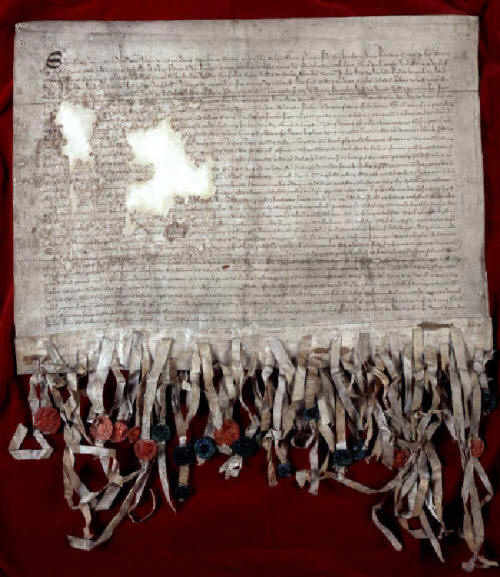
Copy of the Declaration of Arbroath,
Scotland’s oldest constitutional document
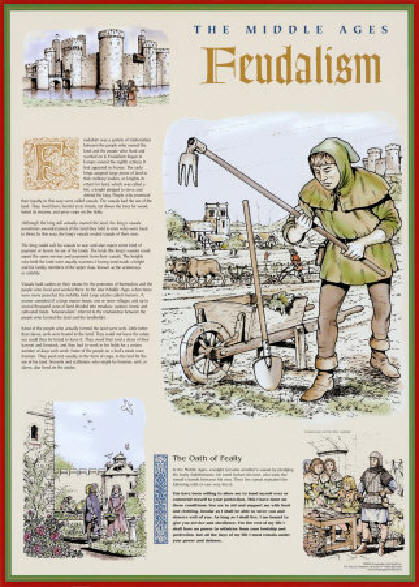
Illustration of feudalism
Many
peasant peoples have had a strong historical attachment to the land they
tilled or on which their animals grazed. Few such attachments were
stronger than those of the Hebridean and
West Highland Scots which made their eviction in the
century of the Clearances – 1750 – 1850, all the more cruel.
American Indians regarded land and nature as a sacred gift
of God, and could not conceive of it being sold or fenced off. To this
day, most of the countries of the South Pacific prohibit or limit the
sale of land and permit only its lease for a period. Most states in the
world prohibit the ownership of land by foreigners.
Similarly, the key role played by major banks and financial
institutions, in the control of global and national economies, began in
medieval times, and has developed to the point today where their
tentacles extend to the smallest and most remote pockets of economic
activity. Strangely the fiercest condemnation of excessive interest
charges is found in the Hebrew scriptures, and yet that people were to
dominate much of the banking world to present times. Islamic law also
prohibits the application of interest charges to
lending. Banks
make money out of nothing. Banking laws permit lending
far beyond the original financial deposits, and further
credit issue is maintained by a myriad of methods. Today,
small borrowers pay obscene rates of interest to the banks through the
numerous credit vehicles such as
credit cards, hire purchase schemes, overdraft facilities,
and direct
bank loans.
It fell
to a young American printer, a 7th grade school graduate, to
recognize the key roles of land ownership and taxation in protecting the
wealthy and powerful, and how they might be managed for the benefit of
all. Henry George, 1839 – 1897, was a ‘curious and attentive lad with a
strong mother wit’. He was also a voracious reader, devouring the works
of Adam Smith, David Ricardo, Hubert Spencer, and John Stuart Mill. His
first major book was Progress and Poverty, published in San
Francisco, and destined to be regarded as one of the classic works on
economics. Among its and George’s later admirers were notable figures
such as Leo Tolstoy, Albert Einstein, Winston Churchill, and John Dewey.
Henry George wrote of the “deplorable circumstances where in large
measure a very powerful few are in possession of the earth’s resources,
the land and its riches, and all the franchises and other privileges
that yield a return”.
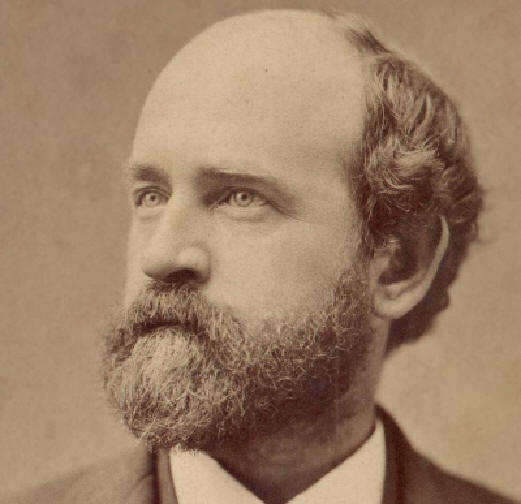
Henry George, the proponent of a Land Tax
based economic system
He
asked, “Why should a man benefit merely from the act of ownership,
when he may render no services to the community in exchange ? What
gives the wealthy the right to become rich – not for service rendered to
the community, but from the good fortune to have advantageously situated
land?”.
His
solution to the inequalities produced by the economic system of 19th
century America, was a single tax, - a land tax, that would release the
value inherent in the nation’s land, to the benefit of the people as a
whole. He reckoned that a single tax would absorb all rents with no tax
whatsoever on wages or interest. A single tax would in effect lead to
ownership of land as common property. While his idea excited interest,
it did not lead to such action in its day, but now, over a century
later, there are numerous academics, economists, reformers, and students
of government, who believe that a land tax would indeed be a hugely
beneficial measure for any country.
In
Britain today, we cannot get a land ownership register, never mind a
land tax, so powerful are the vested interests that oppose any
encroachment on their privileged positions of profit and power.
Scotland is the most backward part of the country in terms of land
reform and land distribution. Nearly two-thirds of the country is owned
by around 1,000 persons. This situation is largely a relic from feudal
ages past and from the aftermath of the Jacobite rebellion when King
George granted huge swaths of the north-west of the country (the
highland estates) to those who sided with him and with the Hanovarian
cause. There is sufficient land in Scotland for every man, woman and
child to have 4 acres, yet when anyone wants a tiny plot on which to
build a small dwelling house, they have to pay anything from £20,000 to
£70,000 pounds or more. Why should a piece of unused land cost almost
as much as a house ?
A close
friend of mine, author of the book, Soil and Soul: People versus
corporate power, Alastair McIntosh, has been a powerful and
articulate voice for justice in our management of land resources, and
for respect for our historical and spiritual roots. His book is largely
about land reform and the community land trust of which he was a founder
on the Isle of Eigg. He noted that when Keith Schellenberg first bought
Eigg, in 1975, he paid £ 250,000 for it. When the island was sold on to
Marlin Maruma, two decades later, he got one-and-a-half million (though
it was less than he might have got had it not been for the
market-spoiling tactics of the Isle of Eigg Trust). By this time it no
longer conferred respect to claim to be “The Laird” in many parts of
Scotland. It had become thinkable to challenge the system whereby one
class of people live from the proceeds of a tax known as “rent” paid by
those who lack control over the place where they live.
McIntosh goes on to say that ‘rent, after all, is a tax from the
relatively poor to the relatively rich. Even the land component of our
mortgages can be traced back to such a transfer of wealth from poor to
rich. Land is not in short supply in rural Scotland. There is no earthly
reason why the building plot should typically cost as much as building
the house. After all, there are 5 million Scots and 20 million acres of
Scotland. That’s 3 football pitches each, which is not bad even if two
of them are on mountain sides. The central cause of the rural housing
shortage continues to be control over land ownership and a planning
system set in place when county councilors were typically lairdic types,
who valued the countryside not for the number of people whose lives it
could support in dignity, but as a playground for themselves and tied
housing for their servants.’
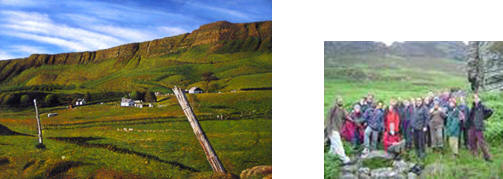
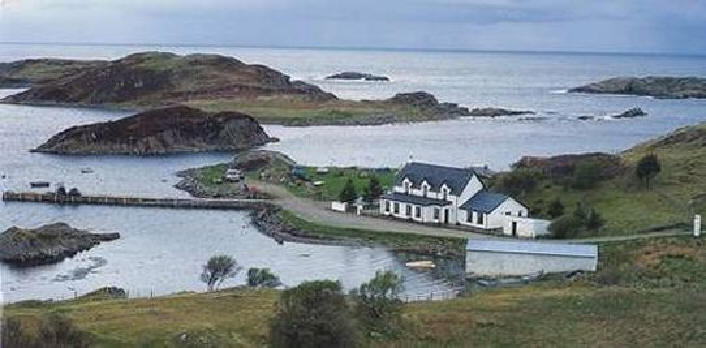
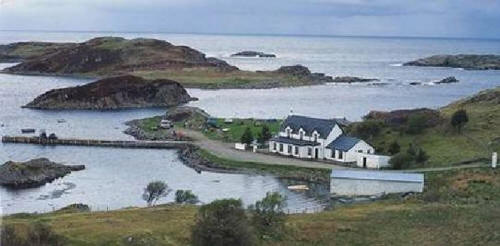
Island of
Eigg, Scotland Members of the Eigg Trust
Scotland’s west coast
Alastair believes that the 1976 crofter’s right to purchase the land he
works, did not sit well with the crofting communities or accord with
their views on rural communities, environmental sustainability, local
entrepreneurship, or affordable housing. He believes, under land
reform, crofting communities can be democratically accountable
landholders unto themselves, and that it is essential to block the
leakage of community assets onto speculative private markets. “This
can be achieved in various ways. Burdens on title deeds are one. Joint
ownership (or shared equity) is another, where the community retains a
controlling interest. And a third is to develop existing crofting
tenure so that communities retain inalienable control of the land upon
which private properties are built. Crofting matters for the future of
Scotland. It matters as a pattern of tenure by which people can live
with the land if not necessarily from the land. This generates a cycle
of belonging, identity, values, and therefore, responsibility that
sustains both people and place.”
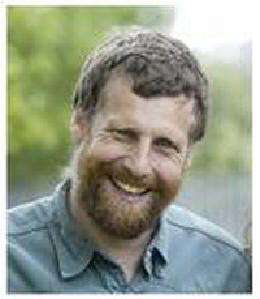
Alastair McIntosh, writer, lecturer,
poet, and advocate of crofters’ rights
My own
view, which is mirrored in the land laws of some of the small island
states of the Pacific, is that there should be no private ownership of
land, but that all should be held by the state for the benefit of the
people. Land then may be leased, but not held in perpetuity by a single
family or corporation. In rural areas, communities could control local
land use and distribution in much the fashion as described by McIntosh.
These are my views and if ever put into practice, they would channel the
enormous income from increasing value of real estate, to the people who
live in the country, instead of to the banks and speculators as at
present. However, those powers are so entrenched in our society and its
legal and fiscal structures, that the chances of such reforming
legislation ever coming about, are close to zero!
Similar
land reform issues are being faced by the descendants of the once mighty
tribes of American Indians whose reservations today amount to just 4 %
of the land area of the USA. Winona LaDuke, a Muckwuck or Bear Clan,
Mississippi band, Anishinabeg Indian, struggled with the land issue for
many years, trying to win back or buy back, their reservation lands.
Her tribe, of which there are some 250,000 around today, is known as
Ojibways in Canada, or as Chippewas in the northern USA. Spanish
historians of the post-Columbus period have estimated that 50 million
American Indians perished in a sixty-year period. In addition to the
genocide, there followed cultural extinction that eliminated knowledge
and records of America’s indigenous peoples from most of the country’s
libraries and schools. White settlers believed they had a God-given
right to the continent, and that led to a denial of any rights for the
natives.
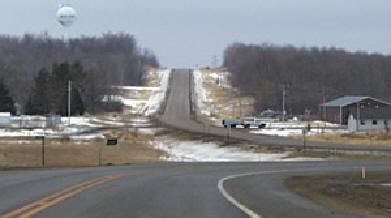
Access road through the White
Earth Reservation
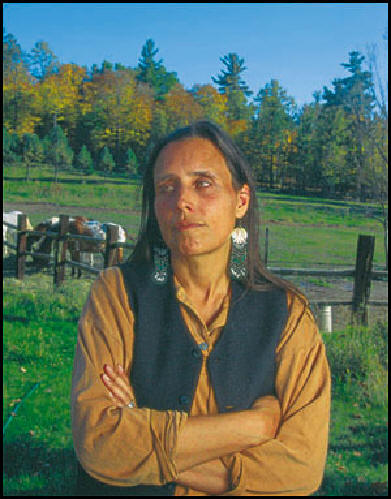
Winona LaDuke, advocate of native
Indian’s rights
The
White Earth Reservation of Winona’s people was created by treaty in
1867. In 1887 a General Allotment Act was passed to teach Indians the
concept of private property and to facilitate the removal of more lands
from that nation. The reservation land was divided into 80 acre parcels
and distributed among the Indians with scant regard to the ecosystem or
to traditional land tenure patterns. After the land parcels were
allocated, the “surplus” land was given to white homesteaders. The
federal government then began to tax the Indians for their ‘allocated’
lands, and when they were unable to pay the taxes, the land was
confiscated. Speculators also came and cheated illiterate Indians out
of their reduced land-holdings. The sad story is a tale of land
speculation, greed, and unconscionable contracts. The White Earth
Reservation lost 250,000 acres to the State of Minnesota. Throughout
America, reservations lost on average a full two-thirds of their land
this way.
The
LaDuke project, if we can term it that, seeks to restore land to Indian
ownership and utilization on the lines of the traditional economy. It
also addresses the issue of absentee landlords, and works to restore and
strengthen cultural values and practices. Through numerous legal
battles they attempt to redress the Federal Government’s failure to
honour treaty obligations, and to reverse past decisions that were
clearly illegal. Winona believes that the term ‘sustainable
development’ is a misnomer. She says that it is communities that are
sustainable, not development per se. But proper use of land is at the
centre of the project. Her tribes are entering into a co-management
agreement with northern Wisconsin and northern Minnesota to prevent
further environmental degradation of the region.
The
pattern of ‘colonial’ expropriation of land from indigenous peoples has
been repeated all over the world. In South Africa we had the shameful
Apartheid policy that forced people into miserable townships from
where they had to serve the labour needs of the mining industry or of
the affluent suburban whites. In Kenya, Lord Delamere told a Native
Labour Commission of 1912-13: "If ... every native is to be a landholder
of a sufficient area on which to establish himself then the question of
obtaining a satisfactory labour supply will never be settled."
During
my years in the Philippines, I saw the social inequities, environmental
damage, rape of resources, and exploitation of the rural poor, that all
result from ownership and control of land by a privileged few. The
situation continues all over the country, but especially in Negros, and
the Visayan islands, and in huge parts of Luzon. It is the leading
factor contributing to the nation’s four main ills : wealth and
political power in the hands of a small elite; an over-powerful army
that treats rural peasants with callous brutality; NPA and Mindoro
(extreme Moslem) led terrorist reprisals; and blatant corruption
throughout the government and its institutions or organs.
What
has and continues to happen in the Philippines, is going on throughout
Latin America, Africa, South Asia, and Indo-China, to varying degrees.
Rural peoples who had traditional ownership or user-rights to their
lands, are having these disregarded or overthrown by legal thievery or
the power of the market in a situation of escalating land values. Poor
families are being pitted against powerful property developers. The
basic problem to me is the privatisation of land. When it is a saleable
commodity, (as with fish quotas or fishing rights) it leads to a trade
in people’s jobs and communities’ futures.
Land
ownership and land tenure are extremely sensitive and contentious issues
in the Pacific states and small island countries of the Indian Ocean and
the Caribbean. Over 90 % of land in the Pacific islands is customary
land, - held by individuals or families under traditional or legally
recognized customs. Land may not be bought or sold, especially to
foreigners, except under arrangements that are strictly controlled.
This can be frustrating to colonial powers or investors from abroad, who
continually badger governments for more flexibility, - fortunately, with
little success in most cases. But land can be leased for a period to a
foreign company, or to a local joint-venture company with oreign
partners.
Perhaps
no other issue is more delicate, or discussed more often by the Pacific
states and international bodies like the World Bank, and the Asian
Development Bank. These institutions, accustomed to globalization and
to western capitalism, are not normally sympathetic to traditional
practices when they conflict with modern business attitudes, - but they
have come to recognize that in those island societies, land has deep
cultural, tribal, historical, and even religious significance for the
people, and outsiders meddle in the arrangements at their peril.
Australian governments tried to impose their laws on land ownership or
title to Papua New Guinea, but failed, and probably caused some damage
in the attempt.
As
expressed elsewhere, I personally believe that all land should be kept
under national control, and all income from escalating land values
should be shared between the people and government, and used to assist
young couples to obtain their first home, or to help small or emerging
businesses with locations for their establishment. At present it is
mostly banks and speculators who benefit.
|
Changing land values in Cambodia
The lovely people of Cambodia went through such horrors during
the period of the Khmer Rouge regime, are now somehow putting
the past behind them and building a productive and sustainable
future for themselves and their children. Among the many
threats they face is land-grabbing which is increasing at an
alarming rate.
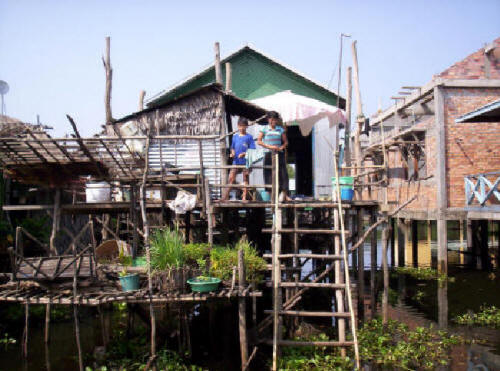
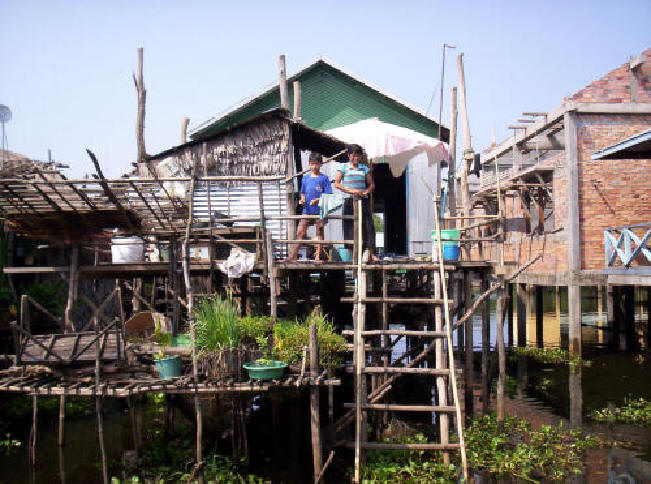
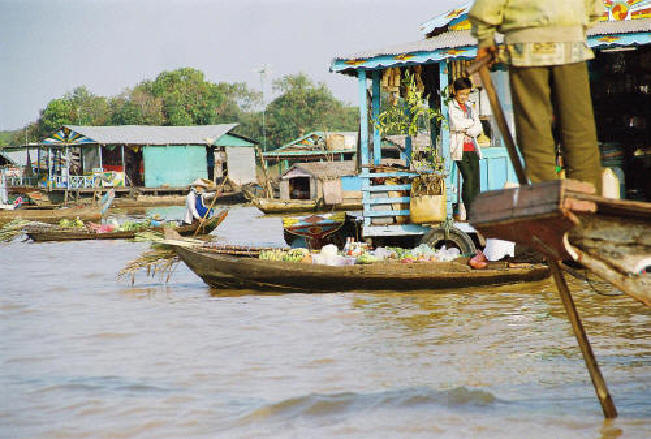
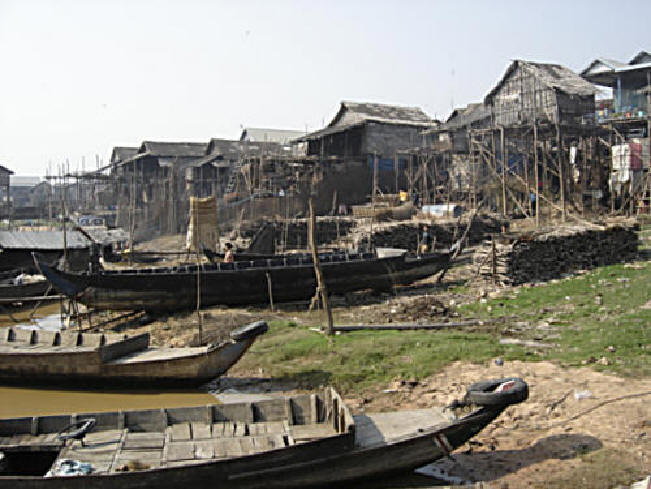
Rural villages in Cambodia’s Tonle Sap basin
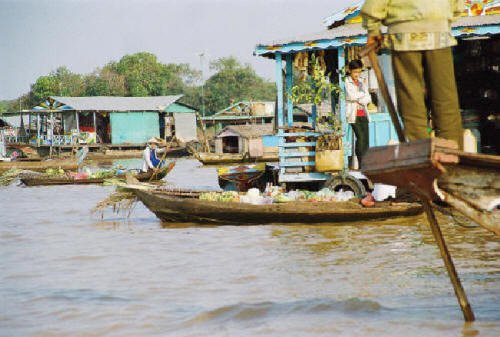
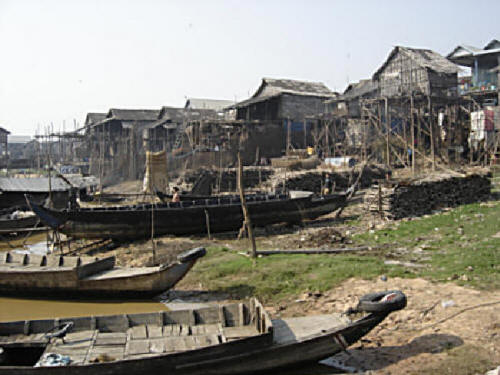
The land-grabbing is fuelled by escalating prices to meet the
demand for commerce and tourism, and housing for the wealthy.
Individuals and families that acquired a few hectares of land
ten years ago, have become millionaires as a result. This has
tempted thousands of others to engage in land speculation.
Small farming communities where cash income is as low as one
dollar a day, can be sorely tempted to sell out to these
opportunists. Where they do not sell, the would-be buyers can
get around that obstacle by bribing local officials and
individual community members to connive in legalising an
improper purchase. But if the buyer is very rich, or a senior
military officer, or a high-ranking government person, then even
the legal niceties can be disregarded.
Take a community that has lived for generations in the Tonle Sap
region (which the United Nations has declared a biosphere to be
protected), and which engages in simple sustainable agriculture,
fishing or forestry. Located nearby are the magnificent temple
complexes of Angkor Wat. That national treasure attracts
tourists from all over the world and these tourists need to be
housed and fed. The expansion of hotels and restaurants in the
provincial capital of Siem Reap has been phenomenal. That in
turn has raised demand for real estate and so escalated the cost
of local land. The growth in business has benefited those with
opportunity and some capital, but it has largely left the rural
people behind, apart from a few who have been able to obtain
work in the service sector.

The main temple site of the immense and historic Angkor Wat
Temples
So, while foreign tourists can reside in 4 or 5 star
air-conditioned hotels, and enjoy good dining at cheap prices,
there is hardly a village in the surrounding countryside where
the people have access to clean water. Their schools are barely
equipped, and village school teachers get a poverty-level wage.
Health services are also minimal. Water-borne disease is the
main cause of high infant mortality. Tuberculosis is prevalent
as are dengue fever and malaria. And as elsewhere in the world,
HIV and aids are on the rise.
Now the land and water on which they rely for survival and
livelihood, has become an attractive commodity for business and
investment. The possible existence of petroleum deposits
underneath the basin could escalate the demand for ownership and
control of the land. So the future of the 3 million rural
inhabitants of that region of Cambodia, looks uncertain to say
the least.
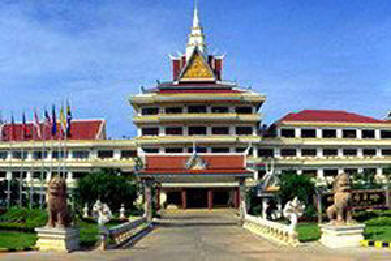
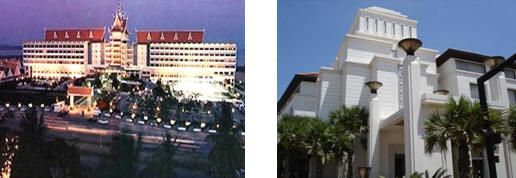
Luxury hotels springing up in Siem Reap, near the Angkor Wat
site
The question such situations raise is – should land be traded
for the benefit of the wealthy and powerful, or should it not be
held in trust or controlled for the benefit of the whole
nation? If industrial development is to take place, should not
the enormous wealth it generates be shared substantially with
the people it has displaced from their generational source of
livelihood?
 |
In the
Celtic lands, waged labour was needed in land-owner-controlled
industries such as fishing and processing seaweed for industrial uses.
But equally, the vacated land was wanted for sheep farming, wool being
more profitable than tenants. As for the Potato Famine, that was a
political famine. In both Ireland and Scotland tenants had become
over-reliant on the single crop that could produce high yields from
little land. Meanwhile, as the people starved, food was exported from
Ireland to English cities. These are colonial realities that have to be
faced so that our peoples can move on.
[Most of the above section
draws on Alastair McIntosh’s brilliant and scathing review of a book
written by Michael Fry, Wild Scots: Four Hundred Years of Highland
History, John Murray, 2005]
The
idea of individual or private ownership of of fixed parcels of land is a
relatively recent phenomenon, and by no means universl, writes Ed
Iglehart. It is the result of replacement of custom in earlier more
innocent societies by statute in later more individualistic societies.
When property is created by a legal title, transferable for money, the
deep relationship between land and occupier, gained through residence,
labour and improvement, can be ignored, and the land acquired or
disposed of at will. Absentee owners, inconceivable before, can evict
residents with the full support of the law.
Scotland and Land Reform
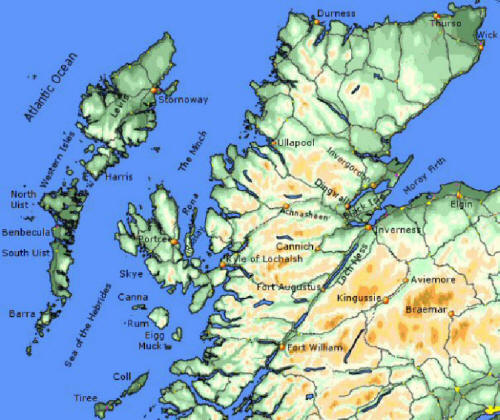
map of northwest Scotland
The
need for a reform of the law and taxation relating to land ownership and
use, is nowhere more pressing than in Scotland. That country has a land
area of over 19.0 million acres, 3% of which is urban and 97% is rural.
Over 16 million acres of the rural land is privately owned as follows:
|
One quarter
is owned by |
66 landowners in estates of |
30,700 acres and larger |
|
One third
is owned by |
120 landowners in estates of |
21,000 acres and larger |
|
One half
is owned by |
343 landowners in estates of |
7,500 acres and larger |
|
Two thirds
is owned by |
1252 landowners
in estates of |
1,200 acres and larger |
So, as
Ed Iglehart says, in Land and Democracy, quoted above, two-thirds
of Scotland is owned by one four-thousandth of the people.
(1999 Territory,
Property, Sovereignty and Democracy in Scotland,
www.caledonia.org
web site).
No one
has researched and advocated the case for land reform in Scotland the
past 20 years as much as Andy Wightman. Below are some excerpts from
one of his papers.
|
LAND AND POLITICS
Land and politics have been intimately related since the
beginnings of modern society. As Jean-Jacques Rousseau argued,
'The first man who enclosed a piece of ground and found people
simple enough to believe him was the real founder of civil
society' (Rousseau, 1754). In Scotland, as elsewhere, the
history of landownership began with a system of governance based
upon the feudal relationship between the Monarch and the
nobility - a system of land tenure still with us today 900 years
later and an indication if ever it was needed of the resilience
of Scotland's land laws and our historic failure, indeed
inability, to do anything fundamental about reforming them.
Rights over land which began as political rights of civic
administration, evolved over time and under the control of those
who possessed them, into full-blown property rights.
This transformation has been carefully and assiduously protected
and nurtured by landed interests for many centuries. And it has
been this careful definition and assiduous protection which has
denied Scotland the kinds of reforms enjoyed by our West
European neighbours. And closely associated with politics has
been the phenomenon of power - political power, economic power,
and cultural and social power. As Loretta Timperley observed in
her academic analysis of landownership in Scotland, 'Power and
land ownership have been synonymous in Scotland from time
immemorial'.
THE POLITICS OF LAND REFORM
The 19th and early 20th century saw radical action on land
reform and delivered lasting social and economic progress. In
the aftermath of the Second World War, however, despite Labour's
commitment to land reform, little has happened. It was not
until the 1970s that political attention again seriously engaged
with the land question. That period ended of course with the
election of the Conservative Government in 1979 and led to those
long years of political discontent in Scotland. Ideas have,
though, moved on since the 1970s. No longer, for example, is the
land reform debate conducted across the ideological divide
between private and public landownership. And the denial of a
land reform agenda by the Conservatives also resulted in civic
society picking up the issue and responding in a practical way
on the ground to the problems it faced. This approach, most
prominently captured in the activities of the Assynt crofters
and of the islanders of Eigg eschewed the barren rocks of
political ideology and instead generated a revitalised citizen's
agenda for land reform, an agenda it should be noted which has a
long and honourable history going right back to the Chartists
and the National Land Company, the Highland Land League, the
Stornoway Trust and the Scottish Farms Alliance.
For much of this country's recent history the political process
has failed to respond to 150 years of civic effort to promote
more equitable and socially beneficial forms of landownership
(Boyd, 1999). He argues that there have been four great
failures. These were:- the failure between 1840 to 1886 to
legislate to break up sporting estates and sheep farms into
smallholdings and thus secure the continuity of peasant society
in Scotland; the failure between 1890 and 1940 to legislate to
protect scenic landscapes, provide a right to roam and establish
national parks ; the failure between 1950 to 1980 to legislate
to fully protect and safeguard areas of national and
international significance to nature conservation and; the
failure between 1950 and 1999 to legislate to protect the public
and local community interest in land for livelihood improvement
and economic development.
Typical of the vast tracts of land in the
area which remain largely un-taxed
The lesson is that civic society can articulate and develop the
case for land reform but without the political means or will to
deliver, its efforts are largely in vain. The political means
are now in existence but what of the political will? How have
the various traditions in Scottish political life responded to
the need for land reform and what has been their record?
Labour, to the extent that it gave much thought to the land
issue at all over the past 20 years has, right up until recent
years, remained burdened with the legacy of state socialism and
state ownership - this was the response of McEwen himself to the
land question. The legacy goes right back to the early days of
the Labour movement. In response to the excesses of Victorian
and Edwardian capitalism, the left sought refuge in the power of
the state to solve economic and social problems. In the process
it rejected the social democratic model which had merged on the
continent.
A social democratic property owning society with strong mutual
and cooperative institutions exists right across Scandinavia and
Western Europe. Walk into any village in the Netherlands, in
France, in Denmark or Norway and you will find farmer-owned
supermarkets, banks and food processing factories. The
revolutions which swept Europe in the 18th century laid the
groundwork for today’s rural economy of small-scale proprietors
linked by a strong network of collective institutions which give
European social democracy a distinctive and culturally rooted
constituency of support.
In Scotland, however, two further centuries of landed power
prevented that pattern from emerging and so the engine for an
alternative social democratic model based upon co-operatives of
small scale proprietors controlling the land and economy was
lost. The Tories meanwhile were busy privatising public assets
and promoting a property-owning democracy which could be relied
on (or so it thought) to vote Conservative. What was
inconsistent about this ideology, was that it attacked public
monopolies but not private ones, and limited the ideals of
property ownership to the home. There was no promotion of a
property owning democracy in the countryside - precisely the
opposite in fact. Tory politicians would have as soon
countenanced an extension of a property owning democracy in
rural Perthshire as they would have engaged in a massive
programme of nationalisation of heavy industry. Some later
actions of Michael Forsyth did begin to acknowledge and develop
the idea on state-owned agricultural and forestry estates, that
giving individuals and communities more power over land was a
good idea and consistent with Conservative philosophy.
Andy Wightman, 6th
John McEwen Memorial Lecture on Land Tenure in Scotland,
1998 |

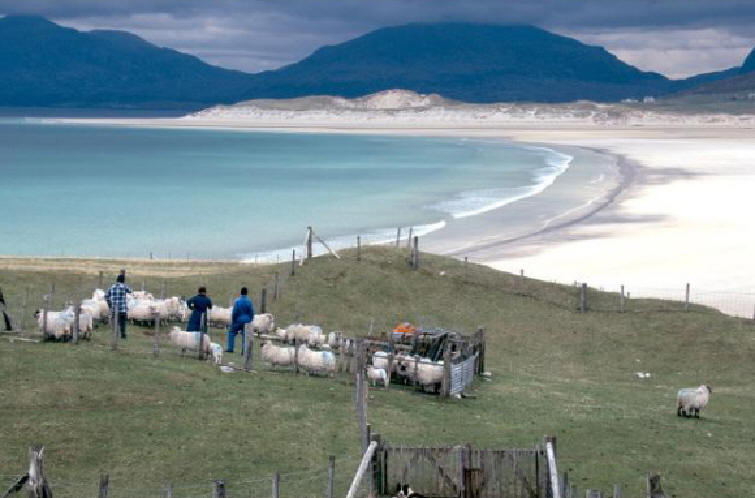
Croft settlements
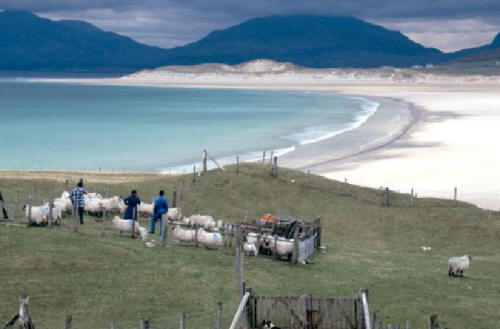
Crofters at work on the Isle of Harris
The
issue of land reform is one then that concerns historical justice,
cultural and spiritual values, economic opportunity, sustainable
communities, and a taxation system that is truly fair and equitable.
There
is a much less well known and parallel need in Scotland, to address an
evil that has robbed communities of their assets, and continues to do
so. Much land and property in urban areas and countryside regions, was
classed as “Common Good Property”. This includes parks and museums and
libraries, parts of green belts and some buildings of charitable
institutions, that were donated to the townsfolk in years past, by
wealthy benefactors. These public assets have been brazenly disposed of
by Councils for private developments that benefit only the councils
themselves and the commercial developers. The whole process is illegal
and unethical, but has been perpetrated without any transparency or
public accountability, so that today few in our towns and cities realise
it has happened. Yet at the same time they wonder why council tax and
water charges escalate year by year. The assets they have been robbed
of by stealth, could have comfortably covered the costs of water,
schools or waste disposal.
While I
believe in a basic land tax, I recognise that there are other
imaginative ways in which taxation could support land reform and
sustainable land use. Lester Brown of the Earth Policy Institute, has
written about the value of an environmental tax which is being
introduced in a number of countries.
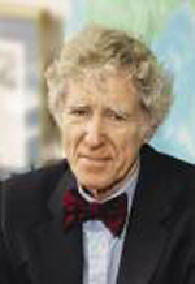
Lester Brown of the Earth Policy
Institute
“Several European countries are benefiting from a steady decline in
income taxes as governments lower taxes on income and raise taxes on
environmentally destructive activities—like burning gasoline or coal.
The purpose of this tax shifting is to incorporate the environmental
costs of products and services into the market price to help the market
tell the environment truth. This rewards environmentally responsible
behavior such as reducing energy use. Among the various environmentally
damaging activities taxed in Europe are coal burning, gasoline use, the
generation of garbage (so-called landfill taxes), the discharge of
toxic waste, and the excessive number of cars entering cities. Germany
and Sweden are the leaders among the countries in Western Europe that
are shifting taxes in a process known there as environmental tax reform.
A four-year plan adopted in Germany in 1999 systematically shifted taxes
from labor to energy. By 2001, this plan had lowered fuel use by 5
percent. It had also accelerated growth in the renewable energy sector,
creating some 45,400 jobs by 2003 in the wind industry alone, a number
that is projected to rise to 103,000 by 2010. In 2001, Sweden launched
a bold 10-year environmental tax shift designed to convert 30 billion
kroner ($3.9 billion) of taxes from income to environmentally
destructive activities. Much of this shift of $1,100 per household is
levied on cars and trucks, including substantial hikes in vehicle and
fuel taxes. Electricity is also being taxed more heavily. This tax
restructuring is an integral part of Sweden’s plan to be oil free by
2025.
Among
the other European countries with strong tax reform efforts are Spain,
Italy, Norway, the United Kingdom, and France. There are isolated cases
of using taxes to discourage environmentally destructive activities
elsewhere. The United States imposed a stiff tax on chlorofluorocarbons
to phase them out in accordance with the Montreal Protocol of 1987 and
its subsequent updates. When Victoria, the capital of British
Columbia, adopted a trash tax of $1.20 per bag of garbage, the city
reduced its daily trash flow 18 percent within one year. Cities that are
being suffocated by cars are using stiff entrance taxes to reduce
congestion. First adopted by Singapore some two decades ago, this tax
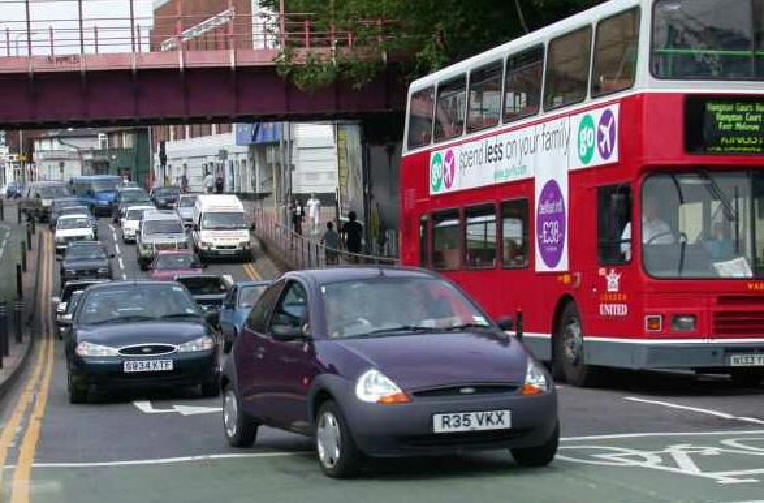
was later introduced by Oslo, Melbourne, and, most recently, London.
The London tax of £5, or nearly $9 per visit, first enacted in
February 2002 by Mayor Ken Livingstone, was raised to £8, more than $14,
in July 2005. The resulting revenue is being used to improve the bus
network, which carries 2 million passengers daily. The goal of this
congestion tax is a restructuring of the London transport system to
increase mobility and decrease congestion, air pollution, and carbon
emissions. While some cities are taxing cars that enter the central
city, others are simply imposing a tax on automobile ownership. New York
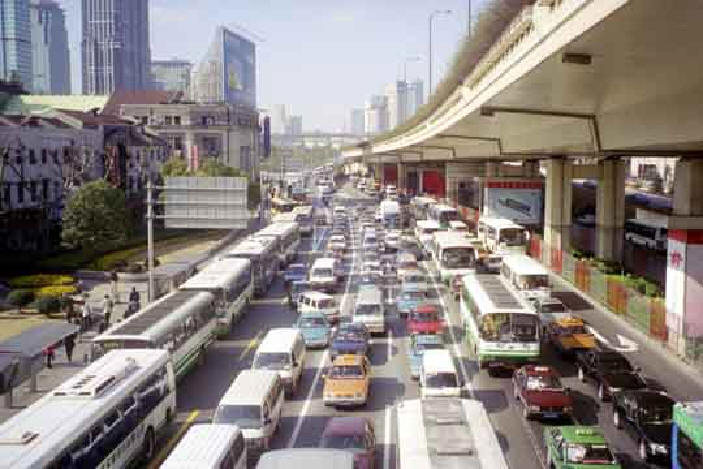
Times reporter Howard French writes that Shanghai, which is approaching
traffic gridlock, “has raised the fees for car registrations every year
since 2000, doubling over that time to about $4,600 per vehicle—more
than twice the city’s per capita income.” In Denmark, the steep tax on
an energy-inefficient new car doubles the price of the car.
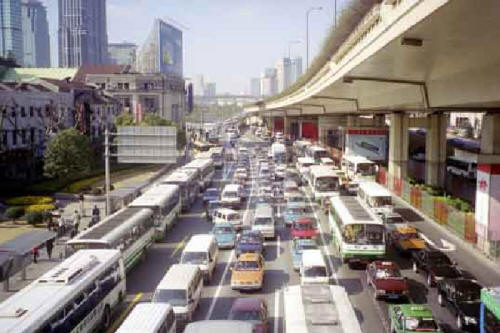
Traffic in the streets of Shanghai
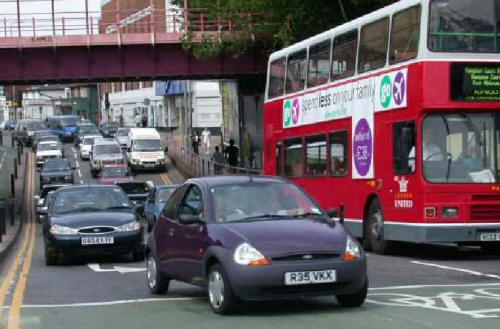
London traffic

Traffic in Tokyo
An
excellent model for calculating indirect costs is a 2001 analysis by the
U.S Centers for Disease Control and Prevention (CDC), which calculated
the social costs of smoking cigarettes at $7.18 per pack. This not only
justifies raising taxes on cigarettes, which claim 4.9 million lives per
year worldwide (more than all other air pollutants combined), but it
also provides guidelines for how much to raise them. In 2002, 21 U.S.
states raised cigarette taxes. Perhaps the biggest jump came in New
York City, where smokers paid an additional 39¢ in state tax and $1.42
in city tax—a total increase of $1.81 per pack. If the cost to society
of smoking a pack of cigarettes is $7.18, how much is the cost to
society of burning a gallon of gasoline? Fortunately, the International
Center for Technology Assessment has done a detailed analysis, entitled
“The Real Price of Gasoline.” The group calculates several indirect
costs, including oil industry tax breaks, oil supply protection costs,
oil industry subsidies, and health care costs of treating auto
exhaust-related respiratory illnesses. The total of these indirect
costs centers around $9 per gallon, somewhat higher than those of
smoking a pack of cigarettes. Add these external costs to the average
price of gasoline in the United States—just over $2 per gallon in
2005—and gas would cost $11 a gallon. For Americans, this is shockingly
high, but it is not that much higher than the $9 per gallon that
British, German, French, and Italian drivers now regularly pay for
gasoline.
Asia’s
two leading economies -- Japan and China -- are now considering the
adoption of carbon taxes. For the last few years, many members of the
Japanese Diet have wanted to launch an environmental tax shift, but
industry has opposed it. China is working on an environmental tax
restructuring that will discourage fossil fuel use. According to Wang
Fengchun, an official with the National People’s Congress, “Taxation is
the most powerful tool available in a market economy in directing a
consumer’s buying habits. It is superior to government regulations.”
Environmental tax shifting usually brings a double dividend. In reducing
taxes on income—in effect, taxes on labor—labor becomes less costly,
creating additional jobs while protecting the environment. This was the
principal motivation in the German four-year shift of taxes from income
to energy. Reducing the air pollution from smokestacks and tailpipes
reduces the incidence of respiratory illnesses, such as asthma and
emphysema -- and thus overall health care costs.
Some
2,500 economists, including eight Nobel Prize winners in economics,
have endorsed the concept of tax shifts. Harvard economics professor
N. Gregory Mankiw wrote in Fortune: “Cutting income taxes while
increasing gasoline taxes would lead to more rapid economic growth, less
traffic congestion, safer roads, and reduced risk of global warming --
all without jeopardizing long-term fiscal solvency. This may be the
closest thing to a free lunch that economics has to offer.”
Accounting systems that do not tell the truth can be costly. Faulty
corporate accounting systems that leave costs off the books have driven
some of the world’s largest corporations into bankruptcy. Modern right
wing economists and businessmen cleverly externalise social and
environmental costs, in order to maximise corporate profits. In the
wake of their ruthless push for economic efficiency, we see an erosion
or collapse of pension provisions, a decline in health benefits, and
enormous increases in the cost to all consumers of basic services such
as water supplies.
The
risk with our faulty global economic accounting system is that it so
distorts the economy that it could one day lead to economic decline and
collapse. If we can get the market to tell the truth, then the world
can avoid being blindsided by faulty accounting systems that lead to
bankruptcy. As Øystein Dahle, former Vice President of Exxon for Norway
and the North Sea, has pointed out: “Socialism collapsed because it did
not allow the market to tell the economic truth. Capitalism may collapse
because it does not allow the market to tell the ecological truth.” One
might add that neither system was prepared to recognise the spiritual
truth that they both devalued and degraded their human capital.
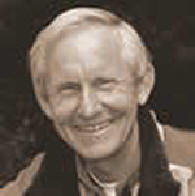
Oystein Dahle,
former Vice President of Exxon Norway, now Chairman of the WorldWatch
Institute |