|
In the free element
beneath me swam,
Floundered and dived, in play, in chase, in battle,
Fishes of every colour, form, and kind;
Which language cannot paint, and mariner
Had never seen, from dread Leviathan
To insect millions peopling every wave:
Gather’d in shoals immense, like floating islands,
Led by mysterious instincts through that waste
And trackless region, …
James Montgomery,
World before the flood
Sweet is the breath
of morn, her rising sweet,
With charm of earliest
birds; pleasant the sun,
When first on this
delightful land he spreads
His orient beams, on
herb, tree, fruit, and flower,
Glistering with dew;
fragrant the fertile earth
After soft showers; and
sweet the coming-on
Of grateful evening
mild; then silent night,
With this her solemn
bird and this fair moon,
And these the gems of
heaven, her starry train, …
John Milton,
Paradise Lost, Eve to Adam
Admiring Nature in her
wildest grace,
These northern scenes with weary feet I trace;
The meeting cliffs each deep-sunk glen divides;
The woods, wild-scatter’d, clothe their ample sides;
Th’outstretching lake imbosomed ‘mong the hills,
The eye with wonder and amazement fills:
The Tay meand’ring sweet in infant pride,
The palace rising on his verdant side,
The lawns wood-fring’d in Nature’s native taste,
The hillocks drop’t in Nature’s careless haste,
The arches striding o’er the new-born stream,
The village glittering in the noontide beam –
Poetic ardors in my bosom swell,
Lone wand’ring by the hermit’s mossy cell;
The sweeping theatre of hanging woods,
Th’ incessant roar of headlong tumbling floods –
Robert Burns
Verses written with a pencil
As a young boy I had
the immense privilege of spending childhood years on the Moray Firth
coast which was then replete with aquatic and marine life. We had
salmon and trout in our rivers and lochs, and an abundance of fish and
crustaceans in the rocky pools and inlets along the shore. Near the
lighthouse, just over a mile from the edge of town, there was a small
stretch of ponds we called ‘the lighthouse lochs’. They were just
shallow water bodies, - but fascinating to a young lad as they contained
stickleback, frogs, tadpoles, caddis fly larvae in their self-made
houses of tiny twigs and stalks, and many other life forms like dragon
flies, pond skaters and water beetles that would carry bubbles of air
down to hidden nests. Many a summer hour was spent in fascinated
observation of these creatures. But the lighthouse lochs are long since
gone completely, - bulldozed over to create a caravan park.
Section of the Moray coast where the
writer grew up
Along the beach and the
rocky pools there were even more life forms. Sand eels, small plaice,
saithe, gurnards, conger eels, gobies, hermit crabs, common crabs, and
lobsters abounded, while just offshore were schools of sprat, mackerel,
and herring, feasted upon by seagulls and gannets, seals and dolphin.
That was the situation until a mere 40 or 50 years ago. Today the coast
is largely sterile and bereft of life except for a few hardy limpets,
mussels and crabs. The same is true all around Scotland’s coast. Many
hitherto productive coastal waters yield only crabs and prawns. Some
sprat and mackerel are returning seasonally, but coastal marine life has
largely died.
How did that happen?
What has caused the demise of such profusion of life in a few decades?
My guess is pollution. We have had an enormous increase in pesticide
and fertilizer use, and the run-off from our fields and farms has
accumulated in coastal waters, together with huge quantities of plastic
and industrial waste. Every housewife today uses an array of cleaning
fluids and powerful detergents that are also poured into our seas
through each urban sewage sytem. Mother nature can accommodate and deal
with a surprising amount of poisonous pollutants, but eventually its
tolerance margins are exceeded and life begins to die. That process is
taking place all over the world.
Our natural environment
of air, sea, and soil, support all of life on this planet –
“spaceship earth” as Schumacher described it. When the first
American astronauts orbited the moon at Christmas 1968, as they
transmitted the awesome pictures of earth-rise over the lunar landscape,
they read together from the Genesis account of the creation. Five times
in that account we read, “and God saw that it was good”. After
the final sixth day it says that “God saw that it was very good”.
Appropriately the Apollo 3 spacemen expressed their best wishes to
all back home that memorable Christmas, - all of those back there on
‘the good earth’.
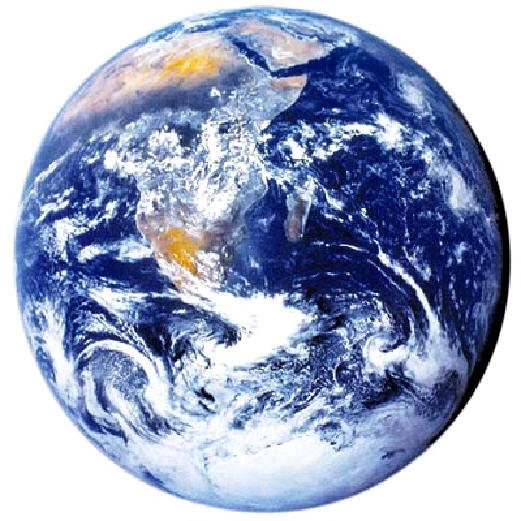
Planet earth as seen from space
The earth’s land
surface is about 13.5 billion hectares. About 10% of land is now
farmed, 20% could be farmed, and 70% is unsuitable given present
technology. Food resources are generally abundant though scarce in
particular regions. Since 1950, cereal output has grown by 2.7% a year
while population has increased by 1.7% annually. The world’s population
is now over 6.0 billion persons and is expected to level out at 11.0
billion by the year 2,200 AD. Global resource researchers like Susan
George believe that with careful environmental management, the earth
could feed a population of that size. Around 30 % of our fish
production and nearly 50 % of our cereals are fed to animals. If we cut
down on meat consumption, we could eliminate a lot of the world’s hunger
and malnutrition.
One would think that
modern man with the benefit of the accumulated wisdom of the centuries,
with his much-vaunted knowledge and power, and with his oft-stated
desire to achieve sustainability and long-term food security, - would be
doing his utmost to preserve the earth’s forests, protect and conserve
its soil, and keep its waters clean and its oceans productive of fish.
But sadly we see the opposite. The greed-powered destruction of our
tropical forests, the poisoning and eroding of our soils, and the
polluting of our waters and seas, - continue, and continue if anything
at an accelerated pace. Desertification proceeds apace in Africa, Asia
and parts of the Americas, as neither governments nor UN bodies are
prepared to take the substantial actions necessary to reverse it.
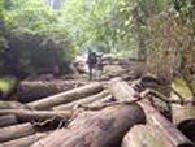
Logging of tropical hardwood forests
Some societies have
been particularly guilty of this wanton assault on our life-support
system and its wonderfully inter-connected life forms. The Soviet Union
may well have the worst record of causing serious environmental damage
in the 20th century. The logging barons of S.E. Asia and
South America, have behaved like mafia hoodlums, with the support of
government and military officials in the respective countries. The
United States and some west European countries have accumulated enormous
amounts of poisonous sludge, industrial, chemical and nuclear waste,
which they regularly try to dump on poorer countries through deception
and bribery. This is not fantasy. I have been in small African and
Pacific states where local officials and businessmen have detailed to me
the approaches made by foreign interests to get a dumping site for the
waste material. I have even been approached myself by the waste agents
to see if I could identify a compliant country or regime, and been
offered handsome commissions if I succeeded.
The world’s natural
store of genetic material that determines the characteristics of our
crops and animals, is being tampered with in the name of scientific
progress, and with the excuse that this would help to ‘feed the
hungry’. Well, the existing genetic strains of rice and maize and wheat
and soya bean, have managed to feed the world since the dawn of
civilization, so I do not see the problem. Indeed, many of them are
particularly suited to the soils and climates of the regions where they
are grown. No, I see the development of genetically altered crops and
animals as a way of giving the huge agro-business corporations control
and ownership of all the seed used in the world. Then we will see
globally what American farmers saw over the last century. The farmer
becomes a serf, enslaved to the corporation which sells him his seed and
his fertilizer, which markets his crop, - and which does so through a
credit system that leaves the farmer permanently in debt and unable to
break out of the system.
The groundwork for the
elimination of natural plant varieties, and their replacement with
hybrids that depend on chemical inputs, was largely undertaken under the
‘green revolution’ movements of the 1960’s and 1970’s. The
beneficiaries are multinational agro-business corporations that acquire
‘ownership’ of the new strains of crop seeds the market for which they
then control, along with the related pesticides and fertilizers. In
this they are supported or protected by GATT / WTO and agreements like
the Plant Breeders’ Rights Bill. European Community farming policies
appear to be designed to push the small and medium farmers out of
business in favour of the multinational corporations. Butter mountains
and wine lakes have been tools to that end. Today, some 90% of the
world’s food trade is in the hands of five multinationals. Unilever and
Nestle are the two largest of the food giants. In the face of these
monsters, ‘free trade’ becomes an abstract idea.
Former soldier,
diplomat, and senior official in the Reagan administration, Clyde
Prestowitz, later President of the Economic Strategy Institute in
Washington DC, wrote eloquently and powerfully about the harm done by
imposition of the USA’s own political ends through the WTO and the IMF.
He claimed that in the past two decades, a general view developed on the
global economy path, known as the ‘Washington Consensus’. It had been
popularized by Tom Friedman under the rubric of “the golden
straitjacket” which called for balanced budgets, low taxes, free flows
of capital, goods, and services; privatization; deregulation; protection
of property rights and intellectual property; small government and
liberalization of interest rates. It was argued by the high priests of
the global economy at the US Treasury, the IMF, the World Bank, and the
elite Universities, that implementation of these measures would bring
prosperity and narrow the gap between rich and poor. This in turn would
bring stability and peace. Friedman opined that a main mechanism to
bring it about would be the “electronic herd”, that group of faceless
gnomes in Wall Street, Kabuto-Cho, The City and elsewhere who stare at
computer screens and send trillions of dollars coursing around the world
at the click of a mouse.
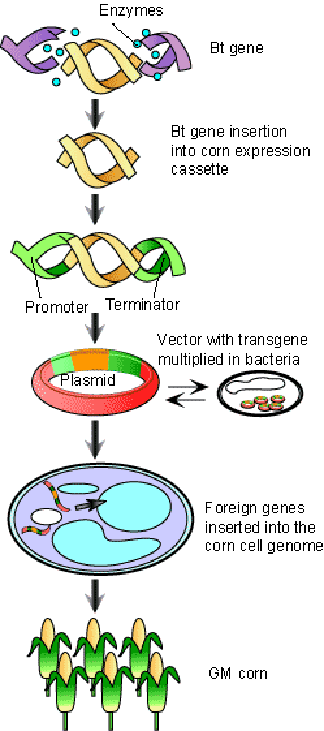
Diagram of GM crops
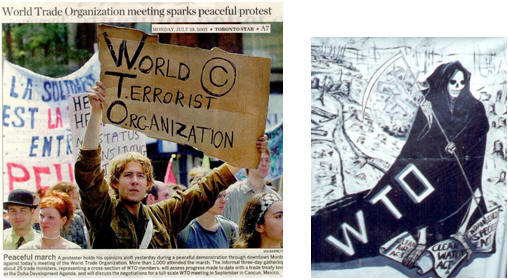
Public protest against the WTO.
WTO protest poster. The organization has potential for great good or
massive harm, depending on its decisions and measures implemented
Director General of the
WTO, Supachai Panitchpakdi, former University Professor, and Deputy
Prime Minister of Thailand, blamed the Asian financial crisis on
American manipulation of the global economy by these means. He said, “The
impact of the 1997 Asian financial crisis was devastating to Thailand
and Southeast Asia, and caused many to question whether the U.S. and the
IMF had a good understanding of how globalization affected Asia’s
economies.” [Clyde
Prestowitz, Rogue Nation, Basic Books, New York, 2003]
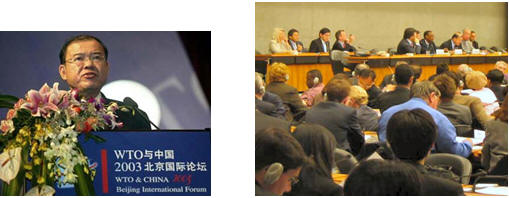
Above : WTO President, Supachai of
Thailand Inside a WTO symposium
Dr Supachai might well
have added that manipulation of the WTO by the big food corporations has
equal potential for evil upon the millions of small farmers in the
world. It could also impact negatively on the world’s resources of seed
and species, limiting biodiversity by facilitating agro-business
monopolies or cartels that could determine who grows what in any corner
of the planet.
To illustrate how
globalization can affect the smallest activity in rural parts of the
third world, take aquaculture for instance, - the farming of fish – in
the tropics. It brought me into contact with those that wanted to
acquire and retain commercial rights to new strains of tilapia, carp and
other cultured species. They offered to assist or finance research work
in poor countries, but on the understanding that they and they alone
retained ownership of the new fish species strains that were developed.
There are also corporations that are working towards a monopoly control
of feed supplies for farmed fish.
Against this
background, there are hundreds of agriculture and soil scientists, and
research workers, who labour to protect existing species of plants and
animals, and to help poor countries to maintain ownership of their own
seed sources. In forestry, soil, water and in crop and animal
production, scores of un-named, unheralded specialists, are active in
protection of species we need for our survival, and of the soils and
water they and we need to grow and flourish. Sadly, many of these
illustrious pioneers of the environment, have been voices in the
wilderness, largely ignored and sidelined by those in power, with their
fixation on power and big business.
|
Pioneer 1 : Clean water and low-tech human scale
solutions
It was during
the first five years I spent in Indonesia, that the realization
of the paramount need for clean water came to me. In every
project station and field site I visited or worked in, there was
a basic need for clean water. I saw it first in the fish
markets where dirty water was poured on to fish displayed for
sale, - making the fish seem fresh, but covering them with
bacteria and pollutants. I noticed it also in the ice plants
which utilized un-filtered and un-treated water to make blocks
of rather poorly frozen ice. Fish farms and processing plants
suffered from the same deficiencies in their water supplies.
And in practically every fishing village I knew, the people were
drinking water that contained bacteria, parasite larvae and
amoebas. So I began my search for an effective and low-cost
method of cleaning available water.
What first
struck me was how expensive it was to clean dirty water, and how
sophisticated was the equipment required. In cost and
complexity, these ‘modern’ systems were totally unsuited for
application in poor rural villages. It appeared that the only
companies involved in the sector were ones that focused all
their attention on expensive large scale projects that were
designed to serve city centres, luxury hotels, holiday resorts,
and housing schemes for the affluent. The poor rural village
was simply not considered. So it had to make do with deep wells
or shallow wells that were easily contaminated, or to utilize
river water that was replete with pollutants. In fact, during
the period I was mostly in Indonesia (I hope it has changed
now), there were hundreds of miles of canals that served as
communal baths, sewers, laundry places and sources of domestic
water for hundreds of thousands of Javanese.
One day I came
across a small item in a British Council newsletter obtained
from the embassy in Jakarta. It showed a smiling bespectacled
gentleman holding aloft a model of a unit that the article said
could provide clean water from a polluted source. The man’s
name was George Cansdale which rang a bell in my memory. I
wrote to him and eventually made contact, and asked him, by the
by, if he was the Cansdale I recalled who had been the TV “zoo
man” of the 1950’s and ‘60’s.
He replied that
he was indeed the same person. He had been a forestry officer
in Ghana before the war (the Gold Coast as it then was). After
the war he became Director of Whipsnade Zoo in London. Later he
moved into work with marine aquariums and fish farms, and it was
in that connection he developed his water filtration equipment.
Cansdale’s units
were simple, low-cost, and very effective. Rather than being
filters per se, they were devices that converted the local river
bed or pond bed into a filter. The unique design of the filter
plates ensured that crystal clear water was obtained within 2
hours of installation, and biologically clean water was produced
after several days of continuous use. No chemicals were
required, and the filter plates did not need to be changed. The
clean water had no parasites or larvae, and over 97 % of
bacteria had been removed. Because the resulting water was not
100% sterile by Geneva standards, the World Health Organisation
refused to approve use of the system. Apparently they would
rather see the people continue to die than have them obtain
water that was immensely better than what they had known
before. It was silly, as a little chlorine or similar treatment
could have made the added difference.
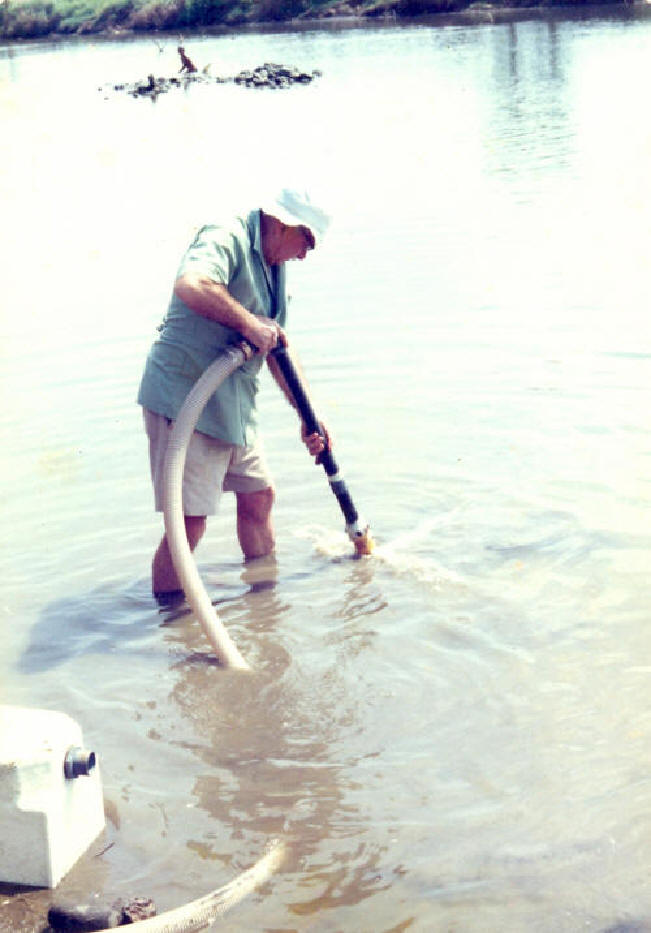
Cansdale at work
We had Cansdale
install units effectively throughout Indonesia, and then in the
Philippines, Thailand and Singapore. OXFAM and Rotary also
later bought thousands of units for use in Africa. He even
installed a unit that successfully excluded all crustacean seed
from the intake pipe of the Marine Laboratory in Aberdeen. He
offered to supply a World Bank financed marine university in the
Philippines with all its fresh and salt clean water needs. The
cost then was $ 50,000 installed. But the local authorities,
with World Bank agreement, decided instead to install a $500,000
system that they thought would be more reliable. It never
worked, and today, 25 years later, the campus and laboratories
still have impure and inadequate water supplies.

George
Cansdale, with my wife Margo, Manila, 1979
George was 65
when he worked for us in S.E. Asia. I believe he continued
working till he was over 80. His son Richard now carries on the
business. He had written several books, and while in Africa had
produced a lexicon of local languages, and become quite an
authority on snakes. A most cheerful and congenial person,
George was a committed Christian, serving as the Warden at All
Souls Church, Langham Place London, where Dr John Stott, a
leading evangelical teacher, scholar and preacher in the Church
of England, continued to minister and lecture into the 21st
century. George recorded much of the Bible on tape for use by
the blind, and often visited homes for deformed and handicapped
children to entertain them with an animal from the zoo. As he
told me later, he would drive home from these havens for
children with serious birth defects to whom he had brought a
little fun and laughter, - with a very heavy heart. For me
George Cansdale was one of life’s “most unforgettable
characters”.
|
Respect
for nature and for its importance, - even sacredness, - is found in many
societies in different parts of the world. Globalisation and
westernisation has weakened these beliefs and reduced awareness of them
among subsequent generations. Anthropologists have to help us dig for
them among the myths and proverbs and taboos of times past. They can be
seen to some degree in the prohibitions of the Polynesian groups, in the
seasonal rituals of early religions, and in the poetry, songs and oral
histories of native peoples in all continents. Few peoples have
expressed their respect for the earth’s environment more eloquently than
the Red Indian tribes of north America. Here are some of their hallowed
statements:
"Treat
the earth well:
It was not given to you by your parents,
It was loaned to you by your children.
We do not inherit the Earth from our
Ancestors, we borrow it from our Children."
Ancient Indian Proverb
“The
great mass of our people think only of the love we have for our land,
we do love the land where we were brought up. We will never let our hold
to this land go, to let it go it will be like throwing away (our) mother
that gave (us) birth.”
Letter
from Aitooweyah Principal Chief of the Cherokees
"When
we Indians kill meat, we eat it all up. When we dig roots, we make
little holes. When we build houses, we make little holes. When we burn
grass for grasshoppers, we don't ruin things. We shake down acorns and
pine nuts. We don't chop down the trees. We only use dead wood. But the
white people plow up the ground, pull down the trees, kill everything.
... the White people pay no attention. ...How can the spirit of the
earth like the White man? ... everywhere the White man has touched it,
it is sore."
Wintu Woman, 19th
century
I believe the rise of the ‘green’ movement in all of its
forms, was very necessary to awaken us to the dangers of destroying our
environment and going beyond the tolerance levels of benign nature. I
support every sane and humane effort to protect species and maintain or
enhance the natural environment. However, some elements of the green
movement have become dictatorial and have begun to follow political
agendas that are determined more by the prospect of power or finance
than by the protection of nature. The more extreme appear to want to
protect every creature except the human species. Some are selective in
their targets and programmes, wishing to provide absolute protection to
overgrown populations of seals or some seabirds, yet ignoring the
horrible mistreatment of battery hens, veal calves, or cows made to eat
the infected bodies of their own kind. I supported the innovation of
“dolphin friendly” labels on canned tuna, which led to the demise of
much of tuna purse seine fleet based on America’s west coast. But I do
not support efforts to ban all harvesting of seals, or to prevent small
Eskimo communities from using a few marine mammals for their own
consumption. It would be an education for those promoting such agendas
to spend a year or two in a genuine Innuit community and discover the
enormous respect for nature and for marine mammals that these Arctic
peoples traditionally possess.
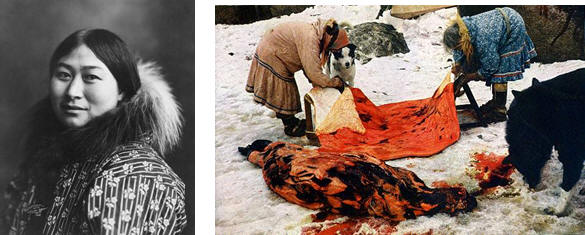
Inuit Indian
lady Inuit Eskimos
skinning a seal carcass
Some green advocates
display astonishing contempt for the folk in rural communities, and for
their way of life. The small population of Barra, Scotland, have had to
fence the whole island to keep two breeds of rabbit separate, though
they did not seem to suffer from free movement in the past. The
islanders of Islay were threatened by David Bellamy who said he would
organize a boycott of all their produce if they did not give up their
peat bog for the exclusive use of migratory geese who only stayed a few
days. The geese had survived well for thousands of years, and continue
to survive today despite the little bit of peat that is dug out of the
bog. But that is the brutal face of much of the intimidating and
control mind-set of the extreme members and NGOs in the green movement.
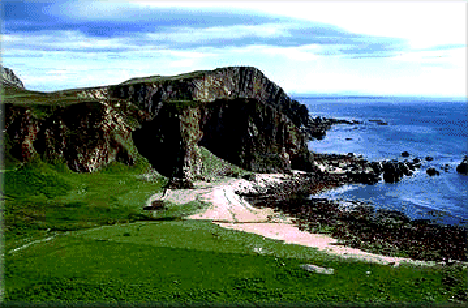
The Island of Islay in the southern
Hebrides
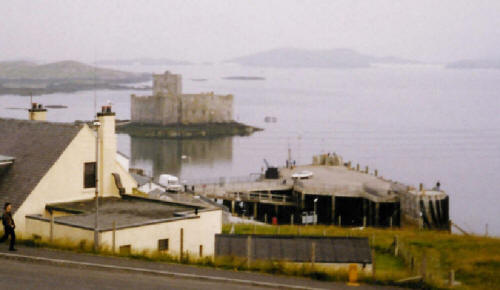
The Island of Barra, southernmost of the
Hebrides
In Britain and
particularly Scotland, there is a growing anti-green lobby that has
built up around opposition to the control of emissions, high taxes on
transport fuel, and even more so, on the proliferation of electricity
generating windmills. The main objection is that these installations
damage our scenic landscape, but there other objections ranging from
their capital and operating costs, and their potential to kill some
birds. While recognizing that some of the objections have a degree of
merit, one gets the impression that few of the protestors have thought
the whole energy question through. Given all the costs they entail,
from research to waste disposal, nuclear power stations are by far the
most expensive energy systems we have. And given the ongoing and
unresolved problem of disposal of nuclear waste and decommissioning of
the reactors, they are also the greatest environmental threat of all the
energy producing systems. But we prefer to pass these dangers and
disposal / decommissioning costs on to our children and grandchildren,
and pretend that we have solved nuclear power’s inherent problems when
we have only passed the pandora’s box on to future generations.
One of the most
articulate spokespersons for environmentally friendly industry and
energy, has been Professor Barry Commoner of the USA, still active in
his late 80’s. Here are some of his reflections on the environmental
and energy issues: [Barry
Commoner, Interview, New Scientist, 23 June 1997]
“The environmental crisis arises from a fundamental fault: our systems of
production--in industry, agriculture, energy and
transportation--essential as they are, make people sick and die. The
modern assault on the environment began about 50 years ago, during and
immediately after World War II.
The sharp rise in environmental pollution in the 20 years following World
War II could be traced to such new technologies of production: new ways
of producing electric power, transportation and food that, while they
generated these valuable goods, now violently assaulted the environment
as well. The changes were massive and fast: in less than two decades the
total amount of automotive horsepower increased fourfold, of inorganic
fertilizer nitrogen sevenfold, of synthetic organic chemicals 20-fold.
These were manmade mistakes that were therefore within our power to
remedy. The mistakes were made by the auto companies when they decided
to build bigger cars with high-compression engines that for the first
time emitted nitrogen oxides, which in turn triggered the smog reaction;
by the petrochemical industry that persuaded farmers to spread huge
amounts of toxic pesticides -- many of them carcinogenic -- into the
environment; by electric utilities that, believing propaganda that
nuclear power would be "too cheap to meter," built the plants that
generate highly radioactive spent fuel, which is yet to be dealt with.
I am
grateful that my own adult life has covered this span of time, so that I
have witnessed most of the notorious environmental blunders that led to
the crisis--sometimes as simply a bystander, other times as an attentive
observer, and at least once--in the case of DDT--as an unwitting
perpetrator.
Scientists, engineers and technologists who designed and built the new
technologies--not to speak of their corporate masters--gave no public
notice of their environmental faults, because they were unaware of them,
uninterested in them or, in some cases, deceitful. The vaunted sorcery
of modern technology was hard at work, but environmentally, it was in
the hands of apprentices.
Outsiders were needed to set things right--or at least to help the
American people learn what went wrong and why. In every case, the
environmental hazards were made known only by independent scientists,
who were often bitterly opposed by the corporations responsible for the
hazards. The result of grassroots action was that the American people
were informed, became concerned, and sought ways to act.
There are existing pollution-free alternatives to the production
technologies that brought on the postwar environmental crisis. The major
source of photochemical smog--petroleum-fueled vehicles--can be replaced
by emission--free electric vehicles. In turn, many power plants now
fueled by oil, natural gas or uranium can be replaced by zero-emission
photovoltaic cells or wind generators.
What is needed now is a transformation of the major systems of production
more profound than even the sweeping post-World War II changes in
production technology. Restoring environmental quality means
substituting solar sources of energy for fossil and nuclear fuels;
substituting electric motors for the internal-combustion engine;
substituting organic farming for chemical agriculture; expanding the use
of durable, renewable and recyclable materials--metals, glass, wood,
paper--in place of the petrochemical products that have massively
displaced them.
The new production technologies may be more economical than the ones they
replace. For example, a recent CBNS study shows that in the states
adjacent to the Great Lakes the impact of trash-burning incinerators on
the airborne dioxin deposited in the lakes can be reduced to zero by
diverting the trash to intensive recycling programs. The net economic
effect would be a $500-million reduction in disposal costs, including
the cost of paying off the incinerators' existing debt.
I believe that the first step is to extend the environmental issue into
the relevant social, economic and political arenas. Consider, for
example, the decision to replace conventional cars and light trucks with
electric vehicles, powered, ultimately, from solar sources. The relevant
corporations are reluctant to make this change because, compared with
conventional ones, electric vehicles would initially be more costly and
more restricted in their uses. Such a shift would damage a corporation's
economic interests, they argue, in comparison with firms that refrained
from making the change. This issue can be dealt with by establishing,
as a national industrial policy, that all suitable vehicles are to be
powered by electricity, placing all of the auto industry's firms on the
same level playing field, economically.
A useful approach to this question is to think about it in economic,
rather than purely environmental, terms. Seen that way, the wholesale
transformation of production technologies that is mandated by pollution
prevention creates a new surge of economic development. But this would
touch on other social concerns as well. The wave of new productive
enterprises would provide opportunities to remedy the unjust
distribution of environmental hazards among economic classes and racial
and ethnic communities. For labor unions it would represent a source of
new jobs and opportunities to advance the cause of a healthy work
environment and worker retraining.
Indeed,
the transformation, although environmentally mandated, may be much more
powerfully inspired by the vision of an economic renaissance that would
be generated by the new more productive technologies. The most
meaningful engine of change, powerful enough to confront corporate
power, may be not so much environmental quality, as the economic
development and growth associated with the effort to improve it.”
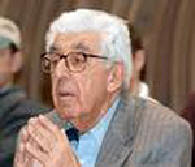
Barry Commoner
Following the tragic
tsunami wave disaster that hit S.E. Asia on Boxing Day 2004, the UK
fishing industry wanted to help the fishers of the stricken region to
get operational again. Together with Association and Government
representatives, I attended a meeting in Whitehall to discuss the best
approach. A representative of WWF was present, and she advised us
strongly (a) to refrain from rebuilding the inshore fleets as this would
cause over-fishing (though there was hardly any excess fishing in the
stricken areas before), and (b) not to let them build the
replacement boats from wood as this would destroy the mangrove forests
(though it is quite impossible to build a boat from mangrove wood)!
I found it difficult to
reconcile the representative’s air of superiority with the depths of her
ignorance. Fishermen throughout the north Atlantic today have grave
concerns at the way WWF and other ‘green’ bodies are colluding with the
European Commission and the United Nations to destroy fishing fleets and
fishing communities in the name of conservation.
So, while advocating a
respect for and protection of nature, based on proven science and
practical approaches, I believe such approaches must be based in the
communities concerned, and must involve human ecology, and a respect for
traditional lifestyles, whether hunting as for Eskimos and fishers, or
crofting as in west Scotland, or subsistence agriculture as in much of
Africa.
Possibly the finest
example of a naturalist who was also concerned about human ecology, is
the late Sir Frank Fraser Darling who like most true prophets, had his
work and advice ignored by the powers that be in his lifetime, yet was
honoured later as if they had really listened to what he had said. His
vision and ideas impacted on much of the world, but his epic work on the
highlands and islands of Scotland, was treated with disdain by
successive Labour and Tory governments in the country.
|
Pioneer
2: A true visionary who was a practical environmentalist
The bare hills,
rugged peaks and lonely lochs of Scotland that are pictured on
our calendars, and give much of the impression of the country to
both locals and visitors, do not represent pristine unspoiled
nature as some imagine. It is largely a despoiled landscape.
At one time, the hills were covered by the forest of Caledon,
and in prehistoric times, mammoths, elk, wolves, musk ox, bears,
wild boar and other hardy mammals, populated the wild
countryside. Climate changes and hunting gradually eliminated
most of the mammals, and the needs of rapacious kings for timber
to build naval ships, wiped out the once magnificent forest.
Then came ethnic cleansing or the ‘Clearances’ that removed
tenant farmers to make way for sheep and later deer.
Both the sheep
and the deer further despoiled the landscape, and without a
farming people to till the soil, it degenerated into what we see
today. All is not lost, but it could take 100 years to restore
the environment. The redoubtable highland environmentalists,
Ron Greer and Derek Pretchell say of the future, “left alone,
it will become like Iceland. With the proper long-term
investment, it could be like Norway”.
But Scotland has
not been blest with rulers of much vision or long-term
commitment. Poor Ramsay MacDonald, facing the depression with
an ideological Chancellor, Philip Snowden, who clung tenaciously
to the gold standard, had only one minister in his cabinet with
any inspiration for putting the unemployed to work and investing
in the land and its fauna. A proposal was made to have the
unemployed plant trees all over the country, including the
Highlands of Scotland. But the suggestion was rejected, and its
proponent left to join the fascists. He was Sir Oswald Mosley.
The Attlee
Government however, had appointed as Secretary of State for
Scotland, Tom Johnston, a man of immense ability and broad
understanding. He in turn had asked an outstanding naturalist
to study the “highland” problem, and advise on what could be
done to improve the region, its natural resources, its crofting
communities, and its economy. The naturalist was Frank Fraser
Darling.
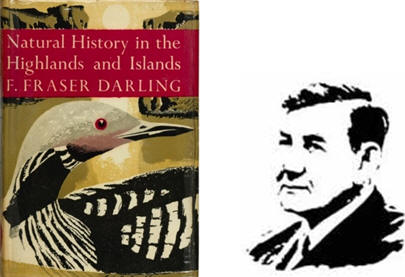
Fraser
Darling’s epochal book, Natural Sir Frank
Fraser Darling, naturalist and ecologist
History in the Highlands and Islands
Darling’s two
best known works were, Natural History of the Highlands and
Islands, 1947, and West Highland Survey, 1955. He
was ahead of his time in envisioning an integrated approach to
the management of natural resources, and its relation to human
ecology. Had his advice been taken in 1955, the region would
have been put on the road to recovery, and would have avoided
the depopulation and economic depression it has experienced
since. But Tom Johnston had been replaced, and the new regime
in Scotland was interested only in big industry for the central
belt. So Scotland’s greatest natural ecologist and human
ecologist, was rejected by his own government. However,
Scotland’s loss was the developing world’s gain, and Darling
went on to apply his knowledge and skills in Africa and Asia.
I did not have
the privilege of meeting Sir Frank, but my Chief Fisheries
Officer in Zambia, Jim Soulsby did. He and his wife Liz
entertained him during his Africa tour 1956 – 1961. For Jim,
the encounter with Fraser Darling was one of the most memorable
of his life.
Darling was
uniquely equipped to pioneer analysis of the complex
relationships between man landscape and wildlife, which he did
in regions as far apart as west Scotland, north Canada, central
America and east Africa. In his search for the principles that
underlie the complexity of nature in its widest sense, he
combined a remarkable intuition with rigorous scientific
investigation, and a gift for lucid writing that informed and
inspired scientists and laymen alike.
Writing to
Edward Goldsmith, editor of the Ecologist, in 1978, a
year before he died, Darling made some profound and weighty
observations: “… one of your
shortcomings is that you are not pessimistic enough and perhaps
you are in too much of a hurry. To change man is going to take
more time than we have. I have tried to for 40 years – but
despite small strugglings, Man goes on his own way. (It) seems
to me … God gave Man free will too soon. Having got this gift
of God, compassion, we can’t brush off two-thirds of humanity
despite earthquakes in Persia and floods in the Indian valley,
exacerbated by economic exploration of the Himalayan forests.
We continue to fell the Mato Grosso and kill the indigenous
Indians, but we subscribe to the notion of “the sanctity of
human life”. (The phrase seems to mean less and less when
applied to some poor child whose cry we don’t hear). So am I
without hope? Not really. We can be learning all the time.
May compassion stay with us, despite our apparent human
determination to cut it in two.” |
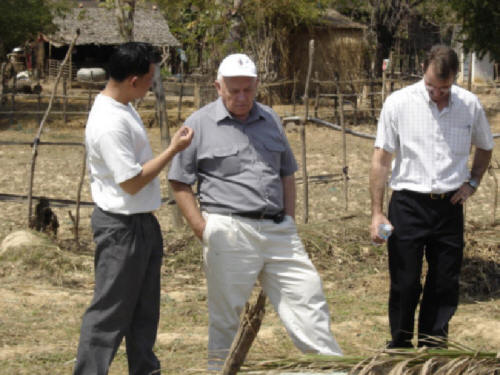
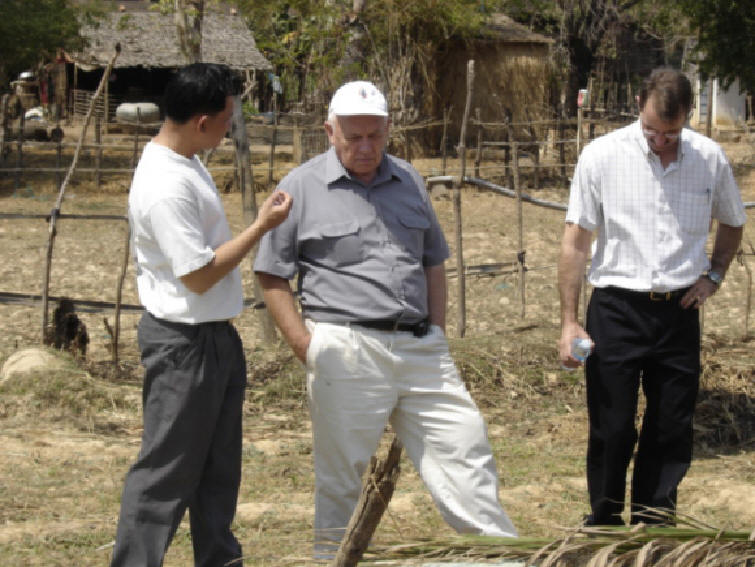
Discussing land use with international
bank and government officers
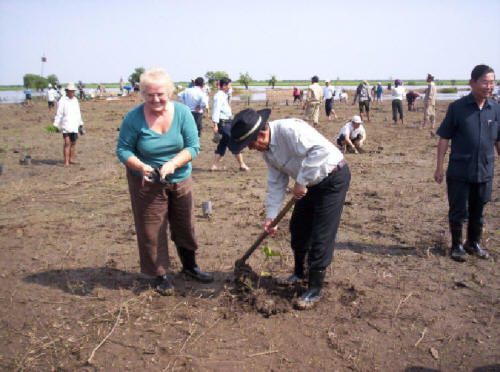
Planting trees in the Tonle Sap basin, -
Margo with the Provincial Governor
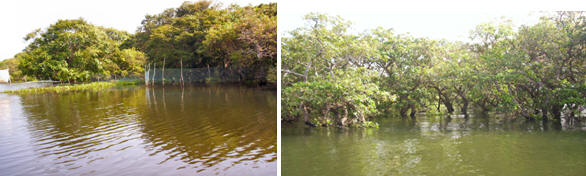
Flooded forest areas of the Tonle Sap
basin. These trees that have adapted over thousands of years to
flourish on both dry and flooded land, are a vital part of the inland
eco-system, just as mangrove trees are for coastal marine areas. They
protect soils, act as a carbon sink, provide shelter for spawning fish
and for young fish, as well as bird life and insects including honey
bees. The flooded forests are also a major source of poles for the
houses and fences of local communities.
Our brutal treatment of
the natural environment which we have raped and despoiled to satisfy our
appetite for hardwood timber, petroleum, hydro-powered energy and
expansion of global industry into the most remote and most delicate
parts of the earth, has impacted destructively on indigenous cultures,
human lives, and thousands of species of animals and reptiles, birds and
fish, insects and plants. We have been undermining the source and
sustainers of our fresh air and our water, and even more, of our very
souls and man’s spiritual links with the rest of creation. A writer who
formerly worked for the corporations that bribed and seduced countries
into debt and then used that tool to gain control over their natural
resources, has described the ongoing battle with global corporate
emptires. “The Ecuadorian rain forests no more precious than the
mountains of Java, the seas off the coast of the Philippines, the
steppes of Asia, the savannas of Africa, the forests of North America,
the icecaps of the Arctic, or the hundreds of other threatened places.
Every one of these represents a battle line, and every one of them
forces us to search the depths of our individual and collective souls.”
[Ecuador
Revisited, Confessions of an Economic Hit Man, John Perkins,
Penguin Plume Books, 2006]
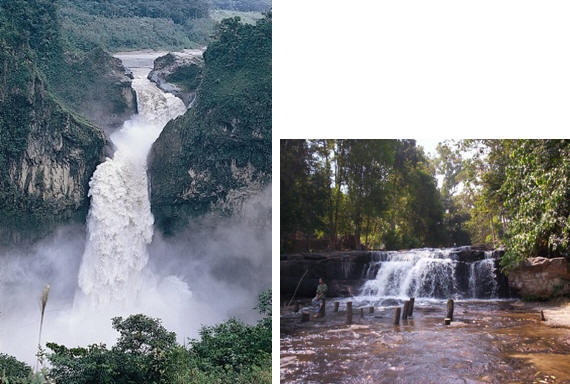
Ecuadorian waterfall and rain
forest Cambodian river and
forest area
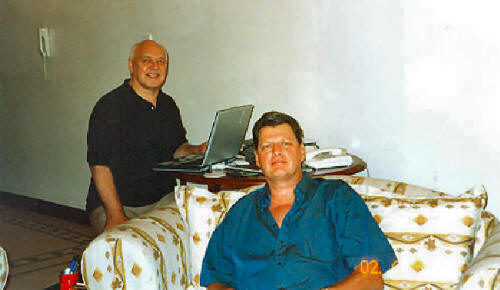
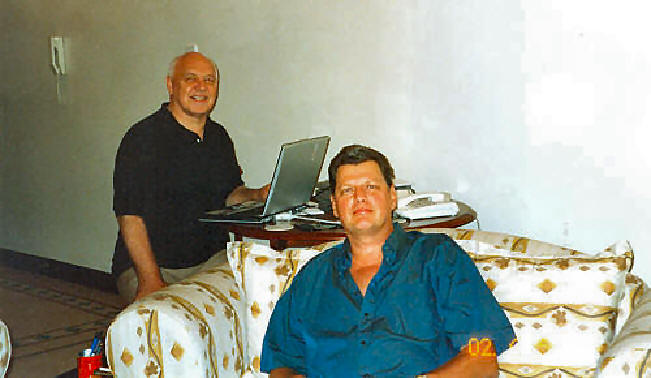
Gary Bernacsek and myself in
Colombo, Sri Lanka, 2002
Over a number of years
I workec with with a remarkably able, committed and visionary biologist
from Canada, Garry Bernacsek, in FAO, Rome, in Sierra Leone, in Sri
Lanka, and latterly in Cambodia. His reports on ecosystems and
fisheries management are much valued and utilized today. His last
appointment was a regional one with the Mekong River Commission which he
was looking forward to with enthusiasm. Sadly he barely was into the
job when he was hit by more than one tropical illness, and he died in
Bangkok on July first 2006. Along with his family and close friends, I
was devastated at the news. I want to close this chapter on the
environment with a few lines from a poem about nature Garry wrote and
sent to me before he died.
O Nature!
How foolish you have been,
What a silly thing you have done,
Crowning eons of work and experiment
With a creation that
Can now destroy you.
. . . . . . . .
But I can see your
Foolishness and patience
May be at an end.
Your attempts at self preservation
Have been too feeble
You must take more seriously
The task of ensuring your own survival.
. . . . . . . . . . .
Foolish Nature, be
foolish no more
Be cunning and unpredictable
Like your best creation.
Garry Bernacsek 15 July 1999 |