|
I must go down to the seas again, to the
lonely sea and the sky,
And all I ask is a tall ship, and a star to
steer her by;
And the wheel’s kick and the wind’s song, and
the white sails shaking,
And a gray mist on the seas face, and a gray
dawn breaking.
I must go down to the sea again, for the
call of the running tide
Is a wild call and a clear call that may not be
denied;
And all I ask is a windy day with the white
clouds flying,
And the flung spray and the blown spume, and the
sea-gulls crying.
I must go down to the seas again, to the
vagrant gypsy life,
To the gull’s way and the whale’s way, where the
wind’s like a whetted knife;
And all I ask is a merry yarn from a laughing
fellow rover,
And quiet sleep and sweet dream when the long
trip’s over.
John Masefield
I really don’t know why it is that all of
us are so committed to the sea, except I think it is because … we all
came from the sea. And it is an interesting biological fact that all of
us have, in our veins the exact same percentage of salt in our blood
that exists in the ocean and, therefore, we have salt in our blood, in
our sweat, in our tears. We are tied to the ocean. And when we go back
to the sea, whether it is to sail or to watch it we are going back from
whence we came.
. President John
F Kennedy, Newport, Rhode Island, 14 September 1962
The picture of the old salt with the tall hat and
leather boots, sorting his lines, is of my great grandfather, Alexander
(‘Sanny Caccy’) Thomson; (Caccy or Caukie, as he was one of the few
Catholics in the community). My forebears on both sides were fishers,
as far back as we can trace. Those of my great grandfathers’ time were
line fishermen operating sailboats, Scaffies, Fifies and Zulus,
[The
scaffie had lines like a Viking sailboat, the fifie had a
straight stem and was built to grip the water better when sailing close
to wind. The zulu incorporated features from both, and proved
ideal for drift net fishing. Some books tell of the design being a
compromise between a strong-minded fisherman and his equally
strong-minded wife. I met ‘Dad’ Campbell, the then aged son of
the zulu designer William Campbell, in Portland Oregon in
1968, and asked if there was any truth to the tale, but he dismissed it
as jesting gossip.]
and shifting to the drift net for herring in the appropriate season. My
grandfathers operated drifters, both motor and steam driven, and these
larger boats worked year-round for herring.
The town of Lossie was
built chiefly on herring. From about 1900, merchants and farmers loaned
fishermen the money to build the drifters, and the community prospered.
The fleet worked off Norfolk and Suffolk in the autumn, Dunmore East,
Ireland in the winter, then the Moray Firth, Shetland and the Minches in
the spring and summer.
The bulk of the herring catch was gutted, dry-salted, and
packed in barrels. That continued till after the 1914 – 18 war when the
changes it brought to the economies of Russia and East Europe, meant a
collapse of the huge export market for salt herring. So the drifters
were gradually abandoned, and the fishers turned back to white fish
again (haddock, cod, hake, flatfish). This time they looked for a more
productive method than line fishing, and they found it in the Danish
seine net.
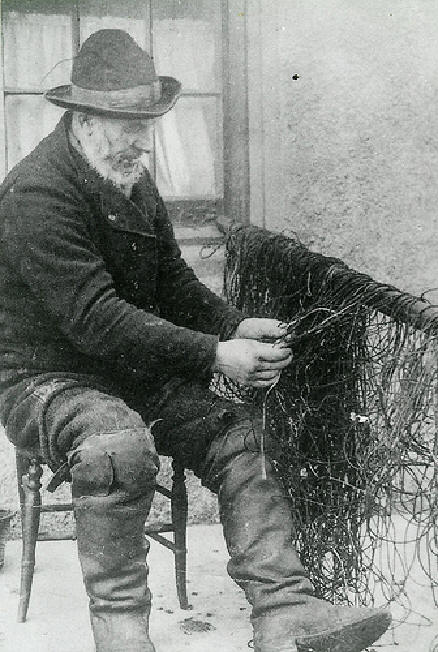 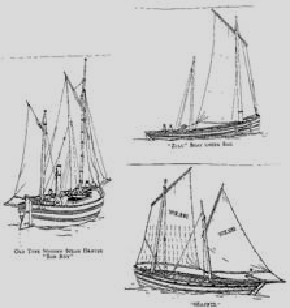
Great
Grandfather, Alexander Thomson, ‘Sanny Caccie’ Old Scots sailboats
(Peter Anson’s drawings)
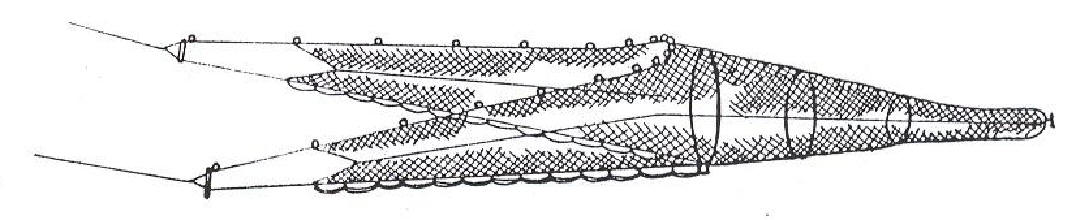
The Danish seine or “snurrevod”
was a light long-winged bag net that could be pulled over the
sea-bed by small, lightly-powered boats. The net was kept open
horizontally by a mile of manila rope, set in a semi-circle on each
side. The ropes were winched in slowly till the wings of the net came
together, by which time any fish encircled by the warps had been herded
into the net which was speedily hauled to the surface. The Danes
winched the gear in while their boat was held fast to a large anchor.
Scots fishers preferred to tow the gear slowly forward while the ropes
were slowly warped in. The Danish method suited the capture of plaice,
their chief target. The Scottish ‘fly-dragging’ method permitted the
net to take faster and higher swimming fish like haddock and cod. Along
with most of the east coast fleets, our local boats adopted the gear
which soon proved to be a money-earner, in place of the abandoned
herring nets. By the time I left school, Lossiemouth had the largest
seine net fleet in Scotland. The local harbour could scarcely
accommodate all the boats, and many fished from west coast ports like
Oban, Lochinver and Kinlochbervie. Larger seine netters were later to
use Peterhead as their base.
Below :
Drawing of a seine net in operation.
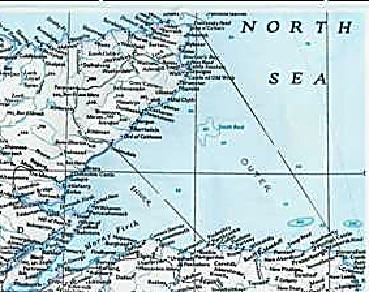
Above : The Moray Firth, inner and outer
sections
I recall the premier
showing of an underwater film of the seine net in operation, in 1953, in
our home town. The film had been shot in the shallow waters of Burghead
Bay by a renowned Naval frogman Commander ‘Buster’ Lionel Crabb RNVR GM
OBE whose disappearance some 3 years later has been the subject of much
speculation. His life ended mysteriously when he went swimming around a
Russian Naval vessel at Portsmouth in 1956. [The
Russian naval ship was the Ordkhonikidze. The previous year Crabb
had inspected the heavy cruiser Sverdlosk, that was carrying
Soviet leaders Bulganin and Kruschev for a meeting with the British
Labour Government (at which Kruschev behaved in typical fashion).
Little information or explanation of the Ordkhonikidze incident
was released at the time by the British and Soviet governments, though
there was much speculation, and Prime Minister Eden later forced MI6
Director John Sinclair to resign over the matter. (I have talked to two
former RN divers who claim that Crabb was taken to the Soviet Union
where he died or was killed for his non-cooperation.) He had undertaken
a number of dangerous assignments for the British Navy during the second
world war, for which he was highly decorated.] Anyhow, the film he shot in the Moray Firth was shown in
the local town hall to a fascinated audience of fishermen and would-be
fishermen. It was one of the first films to record fish actually being
caught in a trawl-type net. The technology however was still at a low
stage of development. The nets were small and made of cotton. Within
ten years they were to be replaced with synthetic high-opening trawls,
and the rope warps were also to be made thicker and of synthetic
material.
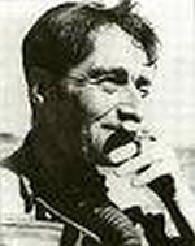
Commander ‘Buster’ Lionel Crabb RNVR GM
OBE who first filmed the seine net in operation under water and later
lost his life under a Soviet naval ship.
But all that was in the future. When I went to sea, the
technology was fairly simple, though to me, a young lad, there were no
finer boats on the sea, and none better at catching fish. The Scottish
fishing ports and fishing fleets shared a remarkable camaraderie and
culture that was a world apart from sheer money-making or soul-less
materialism. It was a way of life. Fishermen loved their profession;
they were proud to be members of the sea-faring community. As a visitor
remarked perceptively, “there is an ‘esprit de corps’ about them”.
In those days there was no Sunday fishing [Here
I speak only of the family-owned seiners and ringers. Company-owned
trawlers were a different matter.]
The vessels sailed at midnight Sunday, and not a minute before. It was
a great sight then to stand on the pier and watch the fleet sail “out
into the darkness, and eastwards to the dawn”. The first evening
stroll I took with the lovely young lassie who was to become my wife,
was to watch the fleet depart on such a night. That was after I had left
the sea. For the first seven working years of my life, I was on the
boats watching the crowds wave to us from the pier as we set off on our
weekly fishing trip. The practice died out in the 1970’s. Today much of
the fishing fleet works on Sunday as on other days of the week. Yet
there are still some fishermen who respect the day of rest, mainly in
the Hebrides, but also among some devout east-coasters.
Once at sea, the radio-telephones were switched on, and the
men on first watch, (usually the younger deckhands), began to talk and
sing to each other. It was mostly hymns and gospel music they shared.
The singers were not necessarily strong church-goers, but it was the
done thing nevertheless. Often they acquired their knowledge of
spiritual songs in fishermen’s missions, gospel halls, or Salvation Army
meetings. But it mattered little what their background had been, the
hymn singing was a fishers‘ thing, not a church thing. The singing and
exchange of news continued till daylight or till they reached the
fishing grounds and work began in earnest.
Since my father was
then fishing around the Republic of Ireland, my baptism was to take
place in that fishery, and we had to voyage across to the emerald isle.
We sailed into the Moray Firth and west to Inverness from where we went
through the Caledonian Canal built by the great civil engineer Thomas
Telford in 1822, and on down past Fort William to Oban. From Oban we
sailed south-west, and then west past the southern end of Mull, and the
famous Stevenson-built lighthouses of Dubh Artach and Skerryvore near
where the brig Covenant was said to be shipwrecked in RLS’s
marvelous tale “Kidnapped”. From there we punched our way across
the north coast of Ireland, in the teeth of a north-westerly gale, and
then headed south to Rosan Point and Rathlin O’Birne island, then east
into Donegal Bay. Arriving at Killybegs harbour after 12 hours of rough
passage, we were glad to make port, myself especially, having gone
through the throes of sea-sickness most of the way. But within a few
weeks I had my sea-legs, and was working on deck with confidence, and
with an appetite that rough seas could not diminish. Over the next year
we visited most of the fishing harbours in the Republic, and caught our
share of haddock, cod, whiting, hake, skate, gurnards and soles. We
even spent a winter at the herring in Dunmore East on the south coast.
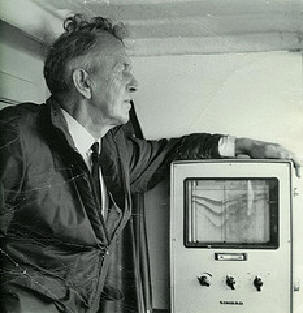
My father, Skipper Jimmy Thomson
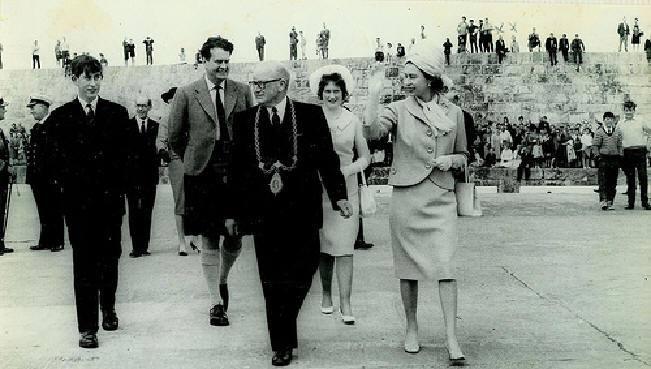
Visit of the Queen to our harbour, 1956
Each December and January, huge schools of herring came to
the Waterford coast to spawn. Fleets of large trawlers and drifters
fished for them offshore, ring netters and seiners worked on the schools
close to land, and Dutch luggers, many with crews of young boys from
orphanages, brought the herring which they salted on board in barrels
and took back to Holland for additional curing. The herring were so
thick on the sea-bed at times, they could be caught with almost any
gear. We sewed small-meshed herring bags on to our seines and were soon
filling them with up to 20 tons of herring a time. Some tows there were
more, but the cotton bags simply burst. We sold some catches in
Ireland, and sailed over to Milford Haven in Wales with others to obtain
slightly higher prices from processors like Birds Eye. The weather in
winter on that stretch of water from the Fastnet light to the south
point of Wales, was rough to say the least. I recall the boat dipping
under the green swells till the whole deck was awash, then coming up
again like a whale till the next sea hit us. The approach to Milford
Haven was dangerous at the best of times. In darkness and bad weather,
and without the benefit of radar or electronic position fixing, it was a
salutary experience for a 15 year old boy, taking the boat around the
dangerous and exposed ‘Smalls’ rocks before the entrance to the bay and
the sound.
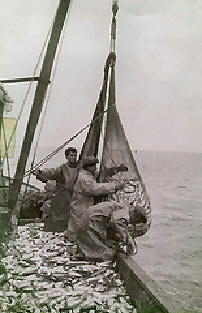
Loading up with fish in the days of
plenty
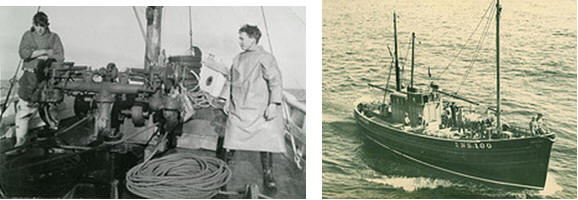
Myself attending the
winch with Sean Cotter My father’s vessel, MFV
Kincora
The year in Ireland was memorable, though not without its
sorrows. I had lost my paternal grandmother and an uncle the previous
summer. Then we got word that another uncle had been lost at sea off
the north of Scotland. His body was never recovered. Altogether I lost
three uncles and a cousin at sea, and many, many friends. One of the
first boys I befriended in the Killybegs fleet, ‘Benny’, was lost the
following year off Dunmore East. My other Killybegs chum, Anthony, was
washed overboard two years later. Strangely, despite the considerable
loss of life, we did not think much of the danger, any more than I
suppose miners did of their profession. It was just one of the risks of
the job. My home port lost its share of vessels over the years. During
my lifetime, boats that were sunk or wrecked included the
Resplendent, Caronia, Devotion, Trust, Palm, Briar Rose, Strathyre,
Scotia, Polaris, Incentive, Balmoral, Guide On, Arcadia, Renown,
Valkyrie, Sapphire, Ben Aigan, Argosy, Balmoral (2), Premier, Valkyrie
(2), to name but some. At least three of those losses
involved the whole crew, and 4 crewmen were lost in another. Several
individual deaths at sea also happened over the same period. Our small
harbour probably lost more than 20 boats and over 30 men in a period of
around 40 years. Throughout the north of Scotland overall, there has
been a horrific loss of boats and men year after year. Scarcely a
winter passes without another major fishing vessel tragedy occurring.
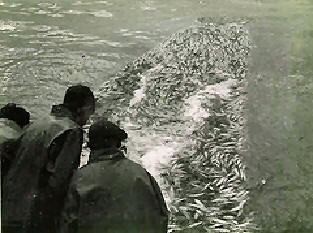
A bag of herring taken off Dunmore East
Having been at sea in
times of bad weather, severe gales, and storm force winds, I am
sometimes asked about the element of fear. The truth is, it rarely is a
factor. For me, the exception would be when sailing close to rocks or
reefs in strong tides, heavy swells, or poor visibility from rain, snow,
fog, or darkness. Then, one has every reason to be extremely alert, and
a natural fear is a healthy step in that direction. But to observe a
storm at sea, from a reasonably stout vessel, however small, is an
aesthetic experience rather like climbing a steep mountain, I guess.
One feels something like an inner thrill, - strong feelings of awe, and
wonder, and amazement. This is precisely what was said by that
amazingly tough, courageous and intrepid lassie, Ellen MacArthur, of her
single-handed sail voyage around the world, and her encounter with the
storms south of Cape Horn. “This is nature!”, she exclaimed.
“This is the sea, in all its power and grandeur”! And I cannot but
agree with her, though the storms I knew were much inferior to what she
endured. Over the years, I have witnessed the many moods of our seas
and oceans, from the calm, but occasionally turbulent tropics, to the
northern and southern latitudes with their breezes and active weather
patterns, to the Arctic waters, sometimes frozen over, or carrying huge
icebergs. The sea reflects our global climate and environment, perhaps
better than any land mass or vegetation. It can be incredibly
beautiful, remarkably pristine, and it can be dark and foreboding, or
wild and untamed. Yet it is the source and sustainer of most of earth’s
life forms, and without its benign influence, our planet would die. The
primeval poem of Moses in the Book of Genesis, tells us that all life on
earth began when, “Darkness was upon the face of the deep, and the
Spirit of God moved across (or hovered over) the face of the waters; and
God said, ‘Let there be light’.”.
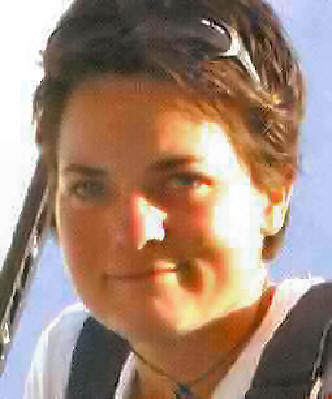
The remarkable lone yachtswoman, Ellen
MacArthur
In May 1956 we decided
to return to Scotland and join the home fleet which was enjoying good
fishing and reasonable prices. The trip home was unforgettable. We
sailed north past Tory Island on a day that was as pleasant and calm as
it had been rough on my first voyage around that coast. Huge basking
sharks were lazily taking their fill of plankton, and I had fun trying
to sail over them which we occasionally did, but without any damage
whatsoever to those large but harmless monsters. We sailed through the
Caledonian Canal in one day, which you could do in the summertime then
provided you started at the first of daylight, and worked hard at
opening and closing the sluices speedily. Today the locks and sluices
are electrically operated, but bureaucratic rules limit the times of
their operation. Yet the canal remains a great benefit to fishing boats
and yachts, and a tribute to its builder, the Scottish engineer Thomas
Telford, who designed the waterway and cut the channels adjoining the
lochs, and built the “Neptune’s staircase” of locks that lift and drop
the boats from sea level to the highest lochs on the route through the
Great Glen.
|
Two
‘Peters’ who wrote of Scottish Fishers
Peter F
Anson, an Admiral’s son from Portsmouth, was a Benedictine monk
for 11 years, yet had a life-long interest in and love for
fishermen, fishing boats, and fishing communities, and founded
the Apostleship of the Sea in 1921. A gifted writer and artist,
he set up the Society of Marine Artists. He wrote and
illustrated 35 books, and was made a knight of the order of St
Gregory in recognition of his marine work. His books cover
marine art, the church and sailors, and harbours, boats, and
fishermen from Brittany to the Shetland Isles. But it was
Scotland’s fisheries that absorbed most of his attention, and
for most of his working life he lived on the Moray Firth coast.
His drawings of sailboats, steam drifters and the early motor
fishing vessels, are now a classic historical record, as are his
descriptions of life on the fishing boats and in the coastal
communities. Among his best known publications are:
Fishermen and Fishing Ways; Scots Fisherfolk; and Fishing
Boats and Fisher Folk on the East Coast of Scotland.
Comments
made by Peter Anson in 1971 (at the age of 82), have a strangely
prophetic relevance to what we face today: “I described what
is now a vanished world, for the fishing industry on the east
coast of Scotland, and everything connected with it, have
undergone tremendous changes. Fisheries are now concentrated in
(a few) major ports; the numbers of fishermen and vessels have
dropped to half what they were 40 years ago; and many of the
harbours are now empty, except for a few small yachts, and
haunted by the ghosts of long-dead fishermen. Nevertheless,
(Scottish) fishermen have preserved those qualities of sturdy
independence and shrewdness which enable them to fight against
the forces of nature as well as London bureaucracy, always
trying to tie them up with ‘red tape’.”
Peter
Buchan – “Oxo” to his friends, - was a fisherman from Peterhead
who served on line boats, steam drifters, and seine net boats,
the family ones named Twinkling Star, and Sparkling
Star. He possessed a natural gift for poetry which he wrote
mostly in the ‘Doric’ tongue, the dialect of the Aberdeen /
Buchan area. Peter Buchan is to the fishing communities of
north-east Scotland, what Charles Murray of “Hamewith”
fame is to the farming towns of the same region. I was
privileged to be involved in the publication of some of his
poetical works which were published under the title “Mount
Pleasant” after a location where he spent many happy boyhood
days.
Among his
best loved poems are; The Mennin’ Laft; Not to the Swift;
Best o’ the Bunch; Home Thoughts at the Haisboro’; The Skipper’s
Wife; and Buchan Beauty. Peter also wrote some
couthy stories, and contributed to local publications on the
Doric dialect. It is very difficult to select a few lines from
Peter’s work, since each poem has merit. But here are four
verses from Home Thoughts that describe the close of the
annual herring fishery off Yarmouth and Lowestoft in the late
autumn of the years from 1890 to 1930. For the sake of
non-Aberdeenshire people, this poem is in English !
November’s moon has waned; the
sea is dreary,
December’s greyness fills the
lowering sky;
But we are homeward bound, our
hearts are cheery
For far astern the Ridge and
Cockle lie.
The silver harvest of the
knoll’s been gathered;
The teeming millions from
their haunts have flown,
From Ship to South-Ower Buoy,
the sea’s deserted,
And we have reaped whereof we
had not sown.
When snow lies deep, in cosy
loft a-mending
Our nets, the times of danger
we’ll recall,
The days of joy, the nights of
disappointment,
Each silver shimmer and each
weary haul.
And children, sitting
chin-in-hand, will listen –
Forsaking for the moment,
every toy;
For there’s a deep and wondrous
fascination
In sea tales, for the heart
of every boy.
|
Fishing at home proved
to be somewhat harder than in Ireland. We went farther afield to find
fish, and often worked night and day without stopping. The longest I
stayed on my feet in one stretch was two days and two nights, but even
when we got some rest more often than not it amounted to only four hours
per working day. One learned to snatch sleep at every opportunity, even
in the galley with our oilskins on while awaiting the call to shoot the
gear. I was in charge of the ropes and the winch, which meant that I
had to be the first on deck when operations began. That first ice-cold
lash of salt spray across the eyes before daylight on a winter’s
morning, is something I will recall as long as I live, and the
recollection makes me grateful for a dry clean bed and 6 or 7 hours
undisturbed sleep each night. After I left the sea, more modern vessels
were constructed with whalebacks or with wholly enclosed shelter-decks,
but in my time deckhands were fully exposed to the elements. Strangely,
the improvements have not seemed to result in any reduction in the loss
of lives or of fishing vessels in the North Sea.
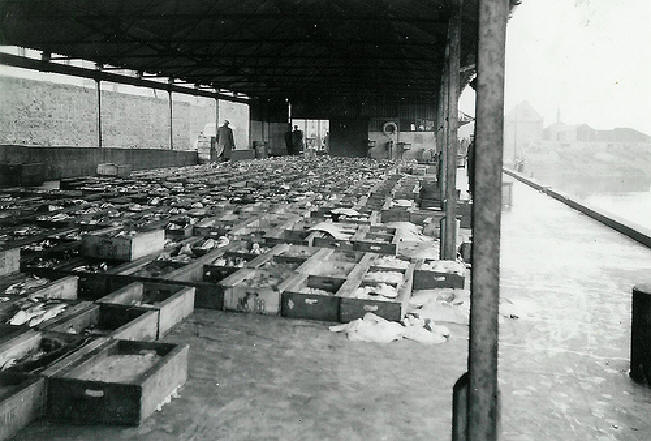
Our fish market in the days
before the EU CFP depleted our fleet and restricted our access to fish
stocks
Seine-net boats
supplied local fresh fish markets, and their trips rarely lasted more
than 5 days. Some boats landed their catches daily. This contrasted
with the distant water trawlers from Hull and Grimsby in England,
fishing off Iceland and Spitzbergen, that were at sea for up to 21
days. It is surprising to think now that their cod catches stored in
ice could stay fresh that long. Other trawler fleets operating from
Aberdeen, Granton (Leith), Fleetwood and Milford Haven fished mainly off
Rockall, St. Kilda and the Faeroe Isles, and would limit their trips to
14 days. The distant water trawlers packed their fish in bulk, in ice,
in compartments in the fish hold which were separated by pound boards or
duck boards. The seine net vessels placed all their fish neatly in
wooden fish boxes that held 7 stones of fish plus ice. This made the
fish more presentable on the fresh fish markets.
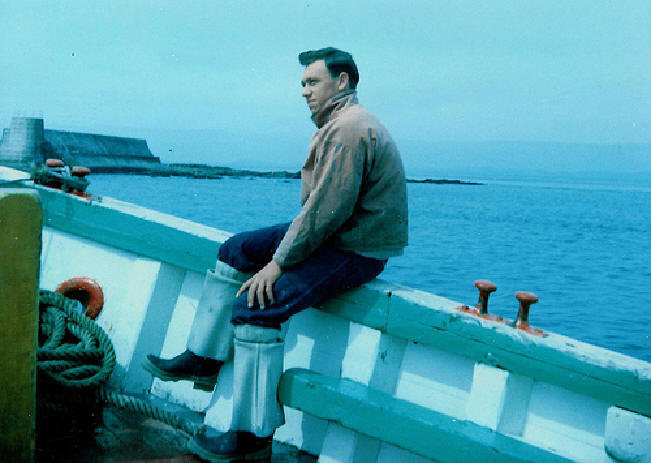
Myself on deck, approaching the harbour
on a fine summers day.
We operated in waters
varying from a depth of ten fathoms (60 feet) to 120 fathoms. By
present standards that would be considered shallow. Today only prawn
trawlers would bother to tow their nets in 10 fathoms of water, and few
white fish boats would do so in less than 30 fathoms. Our modern deep
water vessels now fish on the sea bed as much as 700 fathoms below
(4,200 feet). This is for deep water species such as blue ling,
grenadier, orange roughy, rat-tail (or rabbit fish), siki dogfish and
black scabbard. In our day we thought we were exploring the deep when
working grounds of 100 to 120 fathoms, such as the “skate hole” off
Fraserburgh, or the “Noup deep” off the northwest coast of the Orkneys.
On such trips in the summertime, we would stay at sea for five days and
return with a mixed catch of different types of skate and ray, witches,
megrims, monkfish, dogfish, halibut, cod, haddock, saithe and hake.
Our regular fishing
grounds were the banks of the Moray Firth, North Scotland, Hebrides,
Minch, Dubh Artach and the Clyde. On soft bottom grounds you would tend
to get a predominance of whiting, especially off the west coast. On
the harder gravel or shingle you found mainly haddock, and some cod
during their spawning season. Plaice were a shallow water fish, and the
more valuable species, brill, turbot, wolf-fish and lemon sole, would be
found on harder bottom, or close to rocky ground. My father preferred
to go after quality fish and was for ever setting his net close to rough
sea bed. In consequence, the gear often snagged, and sometimes got very
badly torn. Dover sole, or black sole were a much prized species, and
we caught them mostly on sandy and muddy bottom in the Irish Sea and on
the south and west Irish grounds. Powerful Dutch beam trawlers were
later to concentrate on this species with considerable success.
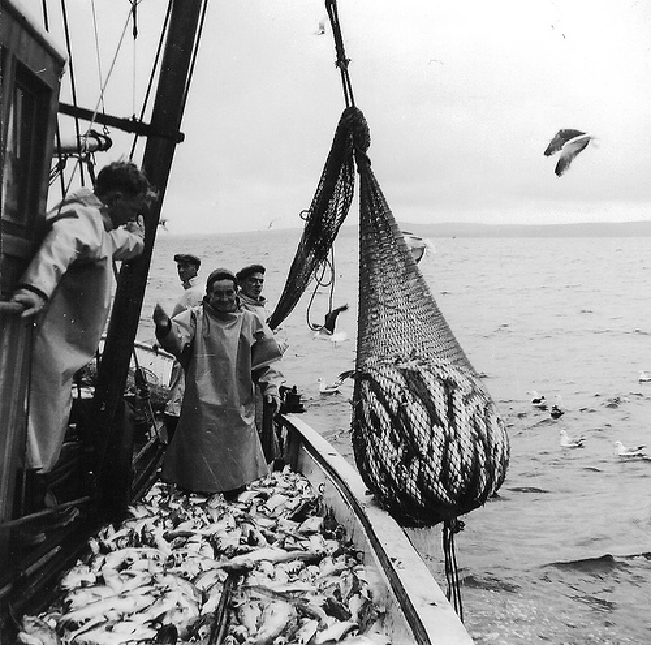
Haddocks caught off the Orkney Islands
When fishing for haddock, which we did for most of the year,
there was not much by-catch. The same was true of the whiting
fisheries. Large haddock, like large cod, were easy to handle, and a
crew could gut them in relatively short time. Small haddock, or small
whiting, were a different story. There could be 150 to 250 fish to a
box, and so 100 boxes would contain 15,000 to 25,000 fish. Whiting have
small sharp teeth, and ones hands would be ‘ripped to shreds’ gutting a
large number. An average deck crew of five men would have to gut 3,000
to 5,000 fish each when handling 100 boxes, not to mention the washing,
packing and icing, and the setting and hauling of the gear. Small
whiting and small haddock fetched minimum prices most of the time, and
could be sold for fish meal in the warmer months, which was galling
after so much work. So our crew was glad that the skipper generally
targeted the larger more valuable fish, even though that meant more
repair of torn nets at times.
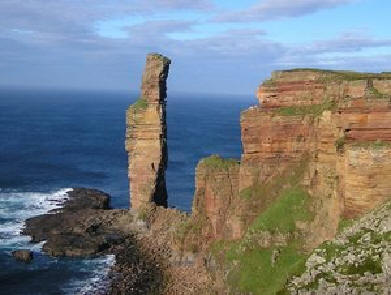
Above : The Old Man of Hoy, the
towering rock off the entrance to Hoy Sound
We worked most of the
year on ‘Stormy Bank’ which lies to the west of the Orkneys and
near the Sule Skerry lighthouse. The prime catch there was large
haddock and my father was adept at finding and catching them. We landed
our catches mostly at Scrabster, just west of John O’Groats, except for
the last two days fish which we would carry to our home port. We spent
some stormy evenings in Scrabster, and one wild, snowy December night,
were called out to pull an Aberdeen steam trawler off the rocks under
Holburn Head light. If as often happened, we had to remain there for a
week-end (our boats never fished on Sunday), then we would be royally
entertained at the local Fishermen’s Mission by the junior Salvation
Army Band and songsters from Thurso. Our fish salesman there was a fine
man of considerable integrity, and a leading member of the local
Salvation Army. John Sinclair, was also Lord Lieutenant of Caithness,
and a respected friend of the Queen Mother whose Castle of May was
located nearby. One of the superintendants of the Scrabster fishermen’s
mission later married the young Salvationist who led the songsters. I
caught up with them again many years after, in charge of a
Congregational church in Alloa. They were as bright and as enthusiastic
as ever.
When fishing closer to
the Orkneys we enjoyed occasional spells in Stromness harbour. We would
enter Hoy Sound from the west, past the tall and imposing “Old Man of
Hoy”, the huge pillar rock in the shape of a man standing face to the
sea, and once inside turn north into Stromness harbour while the famous
former naval base of Scapa Flow lay open to the south. The Orkney
people were wonderfully hospitable, and it was a treat to be
weather-bound there or to spend a week-end with that happy community.
The womenfolk were expert bakers, producing a marvelous range of scones,
pancakes and shortbreads. It was in Orkney that my path first crossed
that of the great Captain Cook. He had charted the seas around the
islands, and a plaque at the west side of the town marked where his ship
had collected fresh water. I was later to use charts in Newfoundland
that were based on Cook’s survey work in Canada. And in the Pacific, I
traveled to many of the islands he visited on his epic voyages of
discovery.
There was little time
for activities other than work or sleep on a fishing boat, except when
weather bound in a harbour, or at anchor. Books were read at all spare
moments, and the radio provided both news and entertainment.
Occasionally a musical instrument would be played, usually a mouth-organ
or squeeze-box (melodian). My father was adept at both. Playing cards
were sometimes produced. Generally they were not regarded as a wise
pastime, though ‘cribbage’ was popular with the older men. Draughts was
the great board game in the cabin. Matches would be observed intently
by all the crew as if the contestants were top chess players. Another
game that suited the smooth cabin table with its half-inch lip of wood
to keep plates and cutlery in place, was “penny-ha’p’ny football”. It
was usually played with two pennies and a sixpenny bit but any sized
coins could be used.
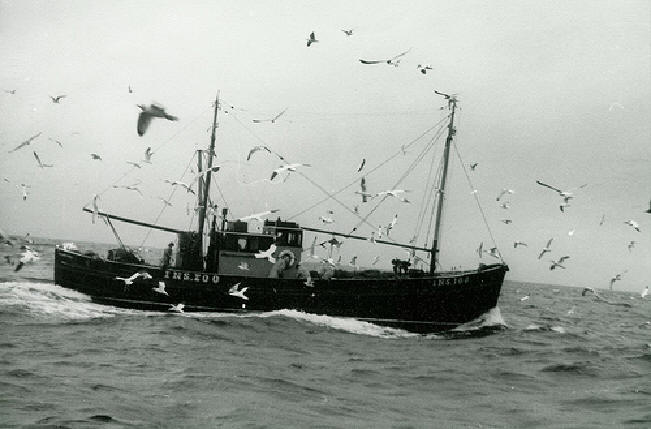
The Kincora in the Firth of Clyde,
1960
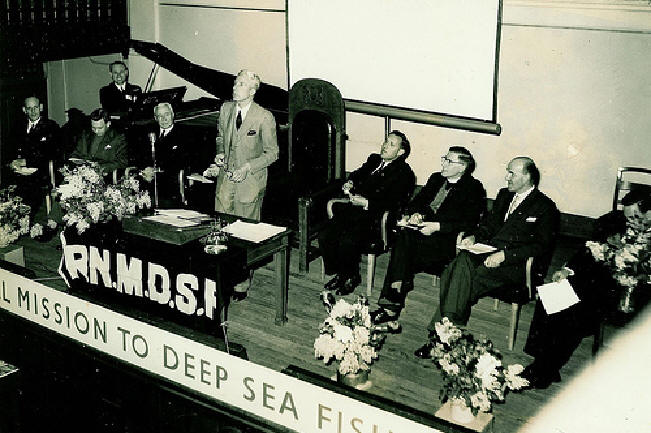
In Caxton Hall, London, 1958 I am second
from the left. Admiral Sir William Agnew is in the chair.
In 1958 I was given a
surprise honour in being invited to be the fisherman speaker at the
annual meeting of the Royal National Mission to Deep Sea Fishermen,
which was then held in Caxton Hall in London. I had rejected the
invitation at first as there were many fishers much more mature and more
deserving of the opportunity, but the organization insisted and I
reluctantly agreed. It was only a ten-minute slot in a fairly long
programme, but my contribution was appreciated by all including the
senior committee member Admiral Agnew [Sir
William Gladstone Agnew, Vice-Admiral, who commanded HMS Vanguard during
the royal tour of South Africa. He gave valuable and unstinting
support to the Fishermen’s Mission during his retirement.] who led the applause with a loud “Bravo!”.
The long established mission was still then undertaking extensive social
and spiritual work in the country’s major fishery ports. The RNDSF had
begun in the 19th century when it served Dogger Bank fishers
from a mission ship stationed at sea. The great Dr William Grenfell of
Labrador fame, served as a Fishermen’s Mission worker before moving
across the Atlantic.
A particular treat for us in the fishing year, was the annual
cod fishery in the Firth of Clyde. The cod used to arrive there in
February to spawn, and would be plentiful until the end of April. We
liked the Clyde fishery because there was almost no night-time fishing,
and the grounds were rarely more than a two-and-a-half hour steam from
port, whether Ayr, Girvan or Campbeltown. Campbeltown Bay lay inside of
Davaar island which you could walk to at low water. Inside a cave on
the island was an amazing rock painting of Christ on the cross that has
had a deep impression on many visitors. In the 1950’s west highland
“puffers”, - small, tubby steam-powered cargo boats, still carried coal
and other cargo to and from the small coastal and island ports. The
quaint, romantic puffers were made famous by Neil Munro in his “Para
Handy” tales. We often lay beside puffers at night in Campbeltown,
and occasionally exchanged a fry of fish for a basket of coal.
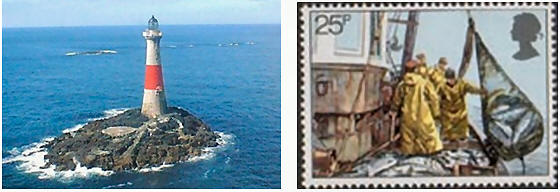
Dubh Artach lighthouse off the island of
Mull, SW Scotland. Right : UK 1981 postage stamp of seine net fishing
based on a Kincora photo. The artist Brian Saunders added the wheelhouse
front from a photo of the seiner Success KY 211 in Gloria Wilson’s
book. Thanks to reader John Spink for pointing that out.
When in Ayr or Girvan
harbour, our cook would stock up with “Land o’ Burns” bakery
bread which I then considered the tastiest in all Scotland. (One of my
esteemed colleagues I was to meet later, Roger Mullin, was a son of one
of the company’s master bakers). The Ailsa Craig, “Paddy’s Milestone”,
dominates the Firth, and we fished on every side of that enormous rock
with its huge colonies of gannets. One of my father’s boats was sunk to
the south of the Craig. It happened in March 1948.
The “Resplendent,
INS 199”, a 60 foot seine netter, had sailed from Campbeltown
and reached the fishing area before dawn in the middle of a light
blizzard. My father was “dodging” as we say, - keeping the boat’s head
to wind, while he waited for the weather to clear. Another fishing boat
approached, and my father wondered if it wanted to pass a message, (not
all boats had radio-telephone then). But the other skipper had taken a
momentary black-out and his vessel ran straight into my father’s boat
which was holed under the port light and sunk in minutes. All of the
crew survived though one was injured. My father was the last to be
picked up. He had lost consciousness in the water but had grabbed a
rope that was flung to him. On the rescuing vessel they could not
prise his
unconscious hands from the rope. It was one of three shipwrecks that my
father
survived.
The news of the sinking
was broadcast on BBC radio that morning before my mother had been
informed. I had called at a friend’s house on the way to school and was
asked rather nervously about it by his parents. I responded with
remarkable confidence that it must have been another boat of the same
name. Other chums at school approached me to see if my father was
safe. I had no idea, but, accepting by then that the boat had sunk, I
told them with similar assurance that all the crew had gotten off
safely. This was the case, though my father was at that time still
unconscious in Campbeltown hospital. My mother who had not heard the
radio reports was eventually given the news by lunchtime that day.
Recently I made a
nostalgic trip to Ayr of which I have many pleasant memories from the
cod fishing days. We used to visit the home of the Head of the fire
station, John Cooper, an extremely fine man. One of his employees then
was a young Jim Sillars, the future Member of Parliament for Ayrshire
South and Glasgow Govan. John and his lovely wife May were the soul of
hospitality. He was the epitome of the “honest men” of Ayr, and
she of the “bonnie lassies”. [From
the poem “Tam O’ Shanter”, by Robert Burns.] I would fillet fish for them each week, and for Tom and Ina Martin who
ran a colporteur’s van and shop, as well as the Watson’s, a mining
family in New Cumnock. Anyhow, when I wandered recently down to the
former pier and fish market near the mouth of Ayr river, I was surprised
to see that all trace of the fishing activities had gone. The pier that
once thronged with merchants and boxes of fish landed from seiners,
ringers and trawlers, was strangely clean and quiet. The area had been
totally re-developed with large blocks of modern flats. It left one
with a strange feeling that a world one knew had been lost. I was
reminded of how the old Authorised Version put it, “As for man, his
days are as grass; as a flower of the field, so he flourisheth. For the
wind passeth over it and it is gone, and the place thereof shall know it
no more”.
What happened to Ayr
has happened to fishing ports all around Britain. Britain’s surrender of
its 200 mile fishing zone to Europe, and the rigorous application of the
EC common fisheries policy, has ensured the demise of our once great
fishing fleets, and the industry that thrived for 500 years. Scotland
used to have over 40 thriving fish market ports. Today there are less
than ten of any consequence. It has taken Europe only 30 years to
destroy the once great industry that Scots fishers spent over 3
centuries developing. People’s jobs and community’s future livelihoods,
have been traded on the market place in the form of “Individual
Transferable Quotas”. ITQs were supposed to result in economic
efficiency, but they do not produce a single extra fish, only widespread
social injustice and deprivation. In every place where they have become
a major weapon of government fishery policy, - like in Canada, New
Zealand, and the EU states, they have been a means of legal thievery,
allowing those with money and influence to steal the harvesting rights
of fishers and fishing communities, - rights that their fore-fathers
toiled and invested, and risked their lives for generations to secure.
The most iniquitous
consequence of that callous policy, I have personal knowledge of, from
the hundreds of hard-working, law-abiding individuals and families who
have lost their livelihoods, life earnings, and sometimes homes as
well. And also from the many once thriving coastal communities from the
Hebrides to the Moray Firth, that now lie stagnant and bereft of any
economic future, save what will come in the form of hand-outs from the
Brussels and London regimes that robbed them of access to their
resources in the first place. Once thriving, self-supporting
communities are now economic graveyards.
One might put it all
down to sheer incompetence or bureaucratic stupidity and pig-headedness,
but I suspect worse. Behind all of the irrationality and lies and
manipulation and deceit by politicians and civil servants in Edinburgh
and London, and Brussels, one senses the hidden hand of a right-wing
agenda that sees control over resources and profits in fewer and fewer
hands, as being economically efficient and justified by some unspoken
monetarist philosophy.
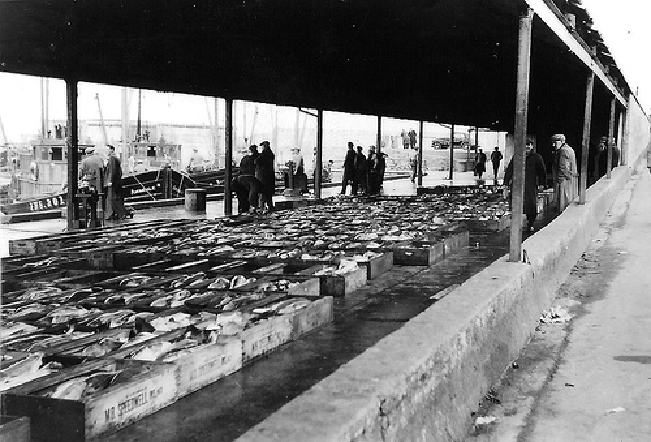
More fish, - but this market has been
empty now for over ten years.
|
The Demise
of the Scottish and English Fishing Fleets
Our
fishing heritage pre-dates Columbus. He sailed on English line
fishing sailboats to Jan Mayen Island in his preparations for
the Atlantic crossing. Those vessels had live-wells built into
the hulls to enable them bring cod and halibut back alive from
the long voyages. Other fish were split and salted, and some
boats even carried ice harvested in winter from the marsh-lands
in Yorkshire and Lincolnshire. Herring fleets were built to
compete with the Dutch who had pioneered drift net fishing in
the 17th century. By the 18th and 19th
century, fleets from Bristol were fishing off Newfoundland for
cod. The British navy regularly burned down settlers camps in
Newfoundland at the end of each year, to prevent the development
of an indigenous new world fleet that might compete with the
English merchants.
The
development of steam power, and the otter trawl led to the
growth of the distant water fleets of Hull and Grimsby. These
ships fished as far north as Spitzbergen, and as far west as
Greenland. Fleets from Aberdeen and Fleetwood operated off
Iceland and the Faeroe Isles. Diesel and diesel-electric power
led to the development of the stern trawler, the
freezer-trawler, and the factory trawler. A British company of
Scandinavian origin, Salveson’s built the first two factory
trawlers in the world, the Fairtry 1 & 2. These models
were quickly copied by the USSR which built hundreds of similar
factory ships.
By 1970,
the fishing industries of England and Scotland were among the
finest in the world, in technology, efficiency, and quality of
produce. Britain was producing over a million tons of fish a
year, and with the advent of the new UN Law of the Sea, was
preparing to claim its international right to the resources of a
200 mile Exclusive Economic Zone around the British Isles.
However,
in 1970, a rise in white fish prices and a resurgence in herring
fishing was boosting the prosperity of fishermen and fishing
ports. The country’s fishery future looked secure. Then came
Britain’s entry into the then European Common Market in 1973,
negotiated by Edward Heath.
Hours
before Britain was to be admitted, the original six members
drafted the notorious addition to the “Acquis Communautaire” (that applicant states had to accept in entirety). It
obliged new members to surrender the control of their waters to
Europe, and to agree to “equal access to a common resource”
as far as fish was concerned. All new applicants for
membership would have to accept the condition, and that has been
the case since. Despite a stream of subsequent lies and
deception that this was not really the case, the government had
sold the fishing industry like a pawn to gain entry to Europe.
The European Commission then assumed the authority to delegate
shares of the fishery resource to member states.
Astonishingly, apart from Ireland, and the European maritime
states that had nothing to lose and everything to gain, Britain
was the only nation in the world to give up that sovereign right
to its exclusive fishing zone, and accept the principle of
‘equal access to a common resource’ which was made a condition
for all EC members.
Year’s
later, Spain’s full entry into the EU CFP nearly doubled the
size of the EU states fishing fleets, and the later entry of the
Baltic states brought more fishing effort. The English and
Scottish fleets had to be seriously reduced in size to
accommodate the others.
What it
had taken British seamen and merchants 500 years to develop, was
systematically reduced and destroyed by the EU Common Fisheries
Policy in the 30 years from 1975 when measures started to be
applied. No other nation in the history of the world has given
up its fishing industry to foreign interests as has Britain. No
state outside the EU has surrendered its 200 mile EEZ fishing
zone to another body. Today, the vessels that reap the benefits
of the UK marine EEZ are fleets from Spain, France, Denmark,
Holland, and the new EU member states of Poland, Latvia,
Lithuania and Estonia. In consequence, much of the fish
purchased by British housewives, though caught in British
waters, are from Continental fishing vessels.
I was
later to describe the destructive impact of the European Common
Fisheries Policy on our fishing fleets and fishing communities,
in a number of publications. Following the Kyoto Conference of
1995, the United Nations Food and Agriculture Organisation
commissioned a number of studies of vulnerable coastal
communities. The studies were financed by the Japanese
government. I was honoured to be asked to undertake the
European study that was to focus on the Hebrides and the west
coast of Scotland. This study was included in the FAO
publication TP 401, A Key to Fisheries Management and Food
Security. On the basis of that study, I then produced a
book entitled The Sea Clearances which was published in
2003. I was also asked to give a lecture on the subject at
Edinburgh University and other institutes.
However,
despite these publications, and numerous letters to the national
press, and submissions to the Westminster Parliament, the House
of Lords, and the Scottish Parliament, our government refused to
budge on its attitude to our fishing industry which they viewed
as small beer, and a pawn well worth sacrificing for other
benefits they imagined the European Union would bring. |
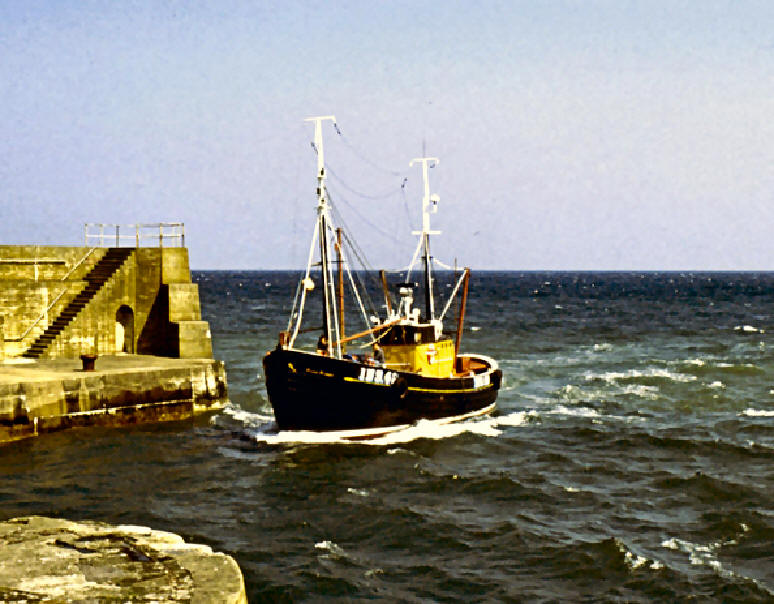
One
of the fleet of beautiful seine netters which once operated from our
home port. None of these vessels remain. Most were forcibly
decommissioned.
If I was to make a
serious career of the fishing, I had to acquire relevant qualifications,
so I attended some navigation classes led by our town Provost and
excellent mathematician, Roy Tulloch. That enabled me to pass the
examinations for Second Hand (Fishing mate). Two years later I went to
Aberdeen to study for my Skipper’s papers at Robert Gordon’s Technical
College (now a University).
Among the other fishing
students then were Terry Taylor who became one of Aberdeen’s top distant
water trawler skippers, Willie Cowie of Buckie who also did well on his
boat the Strathpeffer, and a really fine young man from Mallaig
on the west coast, Zander Manson who was to become a top herring
fisherman. Sadly, Zander lost his life when his boat the Silvery Sea
was run down by a cargo vessel just off the coast of Denmark in 1995
with the loss of all on board. But mercifully those future
events were hid from us then.
Certificates of
Competency for Fishing Skippers involved examination in the 32 articles
of the ‘Rule of the Road’ as we called the International Regulations for
Prevention of Collisions at Sea. The character, colour, height and
horizontal range of all ships’ navigational lights, had to be stated
with precision. One had to recognize by models or illustrations of
lights, the type of vessel represented, whether it was under way or at
anchor or being towed, and say within a given arc of the compass, the
direction in which it was heading. Fog signals had also to be
recognised. Eye tests had to be conducted first to ensure candidates
had colour vision. There followed a number of navigational papers on
determining position by sextant observations of stars and of the sun at
its meridian. Chartwork took up a morning or afternoon, and there was
an oral exam at which one could be asked any question the examiner
considered relevant. Among the questions candidates expected were the
local lighthouse flashing sequences, fog signals of various specialist
ships, legal obligations of masters, and actions to be taken in
emergency situations. One had to demonstrate ability to read and send
morse code, use semaphore flags, know the main code flag signals, handle
a sextant, and operate pieces of equipment like a radio direction
finder. (Today it is the use of radar and satellite navigation
instruments that predominates).
Along with the other
candidates, I duly sat and passed the three-and-a-half days of
examinations, (my certificate being the ‘full’ one that covered any size
of fishing vessel, anywhere in the world, - now termed class 1 fishing
captain). Having acquired the necessary qualification, I was then ready
to take on appropriate responsibility.
But events had
overtaken me. It was the family’s intention to assist me to obtain a
vessel which I would command. Practically all the boats in our fleet
were family owned, with brothers, uncles, cousins, holding shares of a
quarter, an eighth, or even a sixteenth. Financing such a venture was
made easy by a generous Government grant and loan scheme. We had gone
as far as getting plans and quotations for a 72 foot 200 hp seine netter
from boatyards in Buckie and Fraserburgh. The Head of Gardner’s had
promised us the first of a new range of their marvelous marine workhorse
engines. I had compiled a set of fishing charts, a record of annual
fishing activities, and Decca navigator readings of the position of
particular fishing grounds.
But that year, the
North Sea and Moray Firth were replete with small haddock which swamped
the market and brought prices down. Fish that failed to fetch the
minimum price for human consumption were withdrawn from auction and sent
‘up the road’ to the fish meal plant for about ten shillings per 7-stone
box. (That would be just over a penny per kilo in today’s money). My
senior uncle counseled waiting till prospects improved before taking on
the burden of repaying a new boat, then costing around ₤23,000. Because
interest on the money borrowed was heaviest in the first few years of a
new vessel’s operation, it was important to maximize earnings during
that initial period. So the venture was postponed. Needless to say I
was disappointed. But another door was about to open.
Far away in East
Africa, a huge dam had been constructed on the river Zambesi at the
Kariba gorge. This large undertaking was designed to provide electrical
power for the mines and townships of the ‘copperbelt area’ of Northern
Rhodesia. But it also had a political motivation, to cement the ties
that had created a Central African Federation out of the territories of
Northern and Southern Rhodesia, and Nyasaland. Today such dams are
being constructed with little thought for their environmental or social
impact. Despite the lack of such concerns 50 years ago, the Kariba dam
was to be beneficial from both points of view. The local tribes people
were to suffer, but that was for an initial period only.
The Batonga tribesmen
who lived along the river in the Gwembe valley, had to be moved upland
as the water rose to form a huge lake, 120 miles long, by 25 miles at
its widest points and nigh 400 feet at its deepest, then the largest
man-made lake in the world, extending from near the Victoria Falls to
the Kariba gorge. To compensate the tribesmen, a fund was established
to train and equip them to become fishers instead of farmers.
A Grimsby trawler
skipper was hired to go out and teach the people to fish. He was
planning to take his family with him, but changed his mind at the last
minute due to fears of social unrest in Northern Rhodesia as it
approached the transition to independence. The Colonial Office,
Department of Technical Cooperation, was contacted to find a replacement
fishery training officer quickly, this time preferably, a single man.
Word was sent from London to the White Fish Authority area offices in
the main fishing ports. The number of responses was modest. I was
approached by the local officer, somewhat casually, as he did not think
I would have any serious interest. But the opportunity had great
appeal, only I thought it unlikely they would take one so young and
inexperienced. The Member of Parliament for Banffshire, a fisherman’s
son himself, thought otherwise, and gave me a strong reference. I was
interviewed in London in April of 1962, and left for Northern Rhodesia
in August of that year. |



