Oh the breezes blowing o’er the sea from Ireland,
Are perfumed by the heather as they blow,
And the women in the meadows digging pratties
Speak a language that the strangers
do not know.For the strangers
came and tried to teach us their ways,
They scorned us just for being what we are,
But they might as well have tried to catch a
moonbeam,
Or light a penny candle from a star.
And if there’s
going to be a life hereafter
As somehow I am sure there’s going to be
I will ask my God to let me make my heaven
In that dear land across the Irish
Sea.
Galway Bay*
“So near to home, - so
far from care”.
Thus the Irish tourist board describes the Emerald
Isle to potential visitors from Britain. Despite its turbulent
history and troubled present (in some parts of the north), Ireland has
been and remains a happy country with a delightful people. The Irish are
welcoming, and hospitable. They love to sing and to converse, and are
at their best when expressing their priceless humour. They are a
down-to-earth people, generally unsophisticated and unpretentious, but
that does not mean they lack perception, and if Paddy senses you are
trying to trick him, he will string you along as though totally unaware
of your intentions, but in the end will turn the tables on you with
remarkable skill.
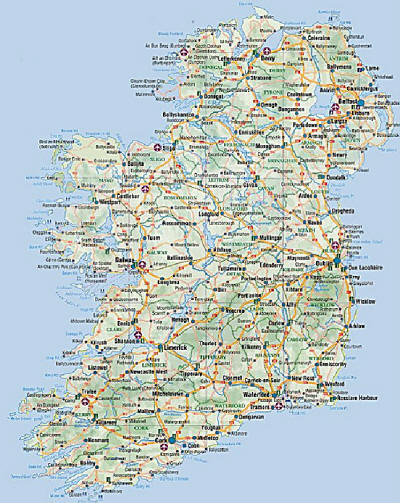
I used to visit Ireland during the summer holidays from
school when I was given a much prized opportunity to serve as a cabin
boy on the family boat. I remember fishing in Galway Bay when sailing
hookers carried peat around the Arran Islands and Connemara, and
when curraghs were rowed out into the Atlantic to fish for
basking sharks. The curragh was a light canvas covered boat with
a high stem and flat stern, and fine seaworthy lines for coping with the
Atlantic swells. The master boat builder with whom I was privileged to
work on Lake Kanba, Dick Heath, chose the lines of the curragh as
a basis for the planked canoe he designed for Zambia’s fisheries. It
proved to be an excellent boat for the sometimes short sharp waves on
the large lake. But back to west Ireland, - we spent the odd night in
Kilronan in the main Arran island of Inishmore. At the home of Mrs
Joyce, a prominent lady of the island, we sat around a peat fire on a
stone floor under an oil lamp, and were served tea and home bakes. As a
special treat I was given a glass of milk. It tasted odd to me, till I
realized it was goat’s milk. Connemara was another fascinating area
where houses and dress had changed little in centuries. When I go to
Ireland now, it amazes me that there seems to be not a single old
thatched cottage left there, - just one large modern bungalow after
another.

Old Galway harbour
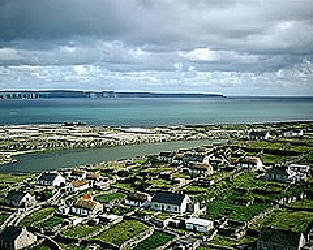
Aran Isles, the town of Inisheer
My father’s family
loved the Irish. Four of the family boats fished round the coast there
several years for a Dublin firm. Every port they went into, they were
met with kindness and friendship. In the 1940’s and 50’s Ireland was a
poor country, - a far cry from the ‘yuppy’ society one sees in Dublin
today. I used to think it surprising that those Scots fishers, - mostly
fundamentalist, non-conformist types, were so drawn to the devout
Catholics of the Republic, - and the Irish Catholics to them. But so it
was. Mercifully, the tensions in Ulster did not affect their
relationships. The Scots were regarded as fellow-Celts, and if their
home-spun religion appeared strange to the devout Roman Catholics, they
still recognized a common bond of faith, uncontaminated by political
agendas.
Ireland suffered from
the time of Henry VIII due to it being regarded as a potential enemy or
supporter of the Catholic powers in France and Spain that threatened
England from time to time. Not that England did not threaten Europe
also. – reading the history of those costly and pointless wars with
France and Spain, - it all appears so foolish now. But through the
reigns of the Henry’s, Elizabeth, James 1st, Charles 1st,
Cromwell, Charles 2nd, and on to King William of Orange and
the George’s, - how Ireland suffered, - used by the continental powers,
and punished in return by England. All this led to much absentee
landlordism, and prevented the development of truly representative local
government.
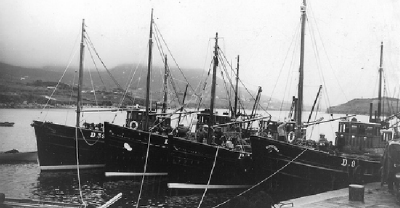
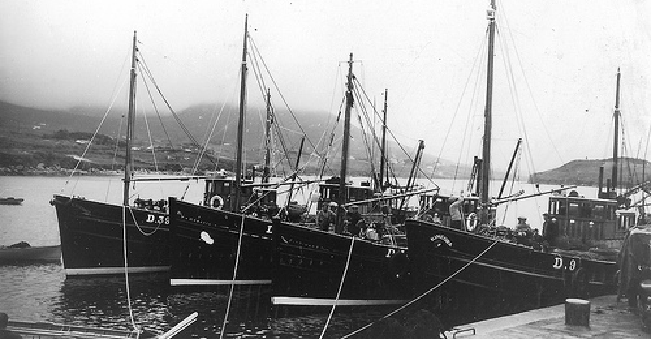
The four vessels operated by H J Nolan’s
and the Thomson family, 1949 to 1956. They were Moravia, Casamara,
Kincora and Kittiwake.
The country was never
wealthy, it had an exploitative land-owning class, and there was little
industry except in the north, and that developed after the plantation of
protestants from the Netherlands and Scotland first by James 1st, and
later by William of Orange. Then came the dreadful potato famine of the
early nineteenth century, when hundreds of thousands died of starvation,
and many thousands emigrated. Yet through all those troubles, Ireland
supplied much cannon fodder for English or British armies, and much
cheap labour to further the industrial revolution. The surprising thing
to me, is not the strength of Irish nationalism, or the growth of a
small but murderous IRA, - the surprising thing to me is the amount of
goodwill towards England that still exists throughout the emerald isle.
The horrors of the
potato famine are largely forgotten today, yet they occurred a mere 150
years ago. Whether the potato blight caused by a fungus Phytophthora
infestans could have been prevented or controlled at that time is
doubtful, but what most certainly could have been avoided was the death
by starvation of close on a million persons, and to some degree, the
emigration of close to another million in desperation for survival in
foreign lands. Four and a half million pounds left Ireland annually at
that time, in payment of rents to absentee landlords, - far more than
was needed to feed the population during famine.
|
A glimpse
of the Irish famine, 1846 – 1851
In a
report to the British Parliament, one of the first to put on
official record the stark facts arising from the starvation of
thousands upon thousands of Irish peasants, told of the horrors
taking place that till then were largely hidden from the British
public, and tragically ignored by authorities :
“Tipperary
is in insurrection, Clonmel in a state of siege, government
bayonets displayed. The people’s food is locked up. Hilltops
are covered with thousands of men, livid with hunger. Provision
boats are boarded, mills and stores ransacked. Galway, Cork,
Clare and Limerick are counting their deaths from starvation.
Families in Cavan are resolved on a suicide of starvation to
escape beggary. Thousands wait for typhus or other hideous
phantom to rescue them from the griping horrors of want.
Meanwhile the British Government vacillated and observed
complacently that ‘in many of the most distressed districts,
the patience and resignation of the people have been most
exemplary’,”.
An
eyewitness reported more graphically, “We are here in the
midst of one of those thousand Golgothas that border our island
with a ring of death from Cork to Loch Foyle. There is no need
of enquiries here, no need of words. Grass grows before the
doors and we fear to look inside lest we see yellow chapless
skeletons grinning there. We walk amidst the houses of the dead
and out at the other side of the cluster, and there is not one
where we dare to enter. They are all dead: the strong man and
the dark-haired woman and the little ones with their liquid
Gaelic accents. They shrunk and withered together till they
hardly knew each other’s faces. The father was on a ‘public
work’ and earned the sixth part of what could have maintained
his family, which was not always paid to him. But it kept them
alive for three months, and so, instead of dying in December,
they died in March”. [Quoted
in chapter 8, ‘What Parliament Did’, in The Trial of Patrick
Sellar by Ian Grimble, R Paul, London, 1962.] |
Tradition tells us that
it was an Irish monk who first brought the Christian gospel to
Scotland. He was Colum Cille or Columba as he is now known. His
original settlement in Iona has been restored and now functions as a
non-denominational centre of Christian ministry and concern for the
third world. Irish monks preserved the Christian faith through the dark
ages, in their lonely abbeys and hermitages built in the most isolated
rocky islands or remote hillsides. Irish priests and poets enriched
European culture for centuries. And some surprising non-Catholic Irish
writers and theologians had an influence on Britain. It was a Church of
Ireland cleric, John Nelson Darby that founded what came to be known as
the Plymouth Brethren. Their first meeting place was in Merrion Hall,
Dublin, - not in Plymouth. Another prominent evangelical, brilliant
Irish lawyer and theologian, Sir Robert Anderson, was head of the
Scotland Yard CID in Queen Victoria’s time.
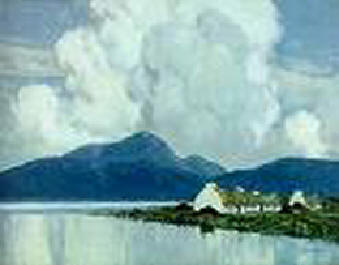
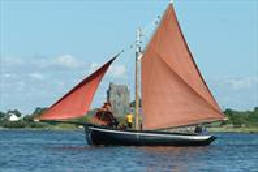
Connemara in the
1950’s. An old Hooker sailboat in Galway Bay
(It does not look like that today)
My favourite Irish poet
is W B Yeats, who was also a playwright and a mystic. I spent some time
around his beloved Sligo when fishing out of Donegal Bay, and often
thought of him when admiring the heights of Ben Bulben beneath which he
is buried at Drumcliffe. Most of Yeat’s poetry is pleasant and
romantic. “When you are old and grey and full of sleep”, is one
of the most touching of love poems. But Yeats had his mystic and
prophetic side somewhat like Blake and Shelley, and there are a couple
of lines from his poem, “The Second Coming”, that I feel are
sadly relevant to these dark modern times :
“The best lack all conviction, while the
worst
Are full of passionate intensity.”
Irish music also
stirred me as did Scots plaintive songs and pipe tunes. The Irish have
an abundance of folk songs (of varying quality), that are best heard in
a singing pub of which there are many scattered throughout the land.
When I first visited the country, it was a common place event to have a
young lad wander off the street and start to sing in a corner of a pub,
with no musical accompaniment, and in some cases, rather little
ability. I guess it was one of the few ways they could pick up a few
pence then. Public houses had their own character in Ireland. They
were not the hard drinking places that one found then in Scotland, but
neither were they the more genteel tavern – restaurants for which
England is renowned. Most Irish pubs served only drink, but they were
social centres where people gathered to share the news of the day. They
also served delicious ‘club orange’ and ‘club lemon’ drinks. I have
tried them since, and somehow they don’t taste the same today.
Of Irish historical and
non-fiction books, I have mentioned two in the following box. Both were
written out of hard experiences of poverty and injustice, - one in the
North and one in the South of Ireland. Both have been recognized as
classics in their own way. Reading them even today is a moving
experience.
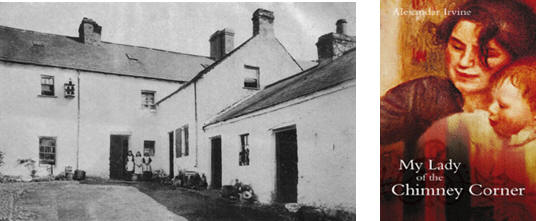
Pogue’s Entry, Antrim, birthplace of Andrew Irvine. His moving book
My Lady of the Chimney Corner.

Above : Andrew Irvine
|
Memorable
Irish Books and Films
If there
is a book that portrays the beautiful side of the Irish people
more than any other, to me it is Dr Alexander Irvine’s
poignantly inspiring portrait of his mother who lived in Pogue’s
Entry in Antrim. – “My Lady of the Chimney Corner”. [My
Lady of the Chimney Corner,
First published in 1913. Republished 1993 by the Appletree Press
Ltd, Belfast]. His
parents, of poor peasant stock, were unusual in Ireland – from
opposite sides of the religious fence, - farm labourer Jamie a
Presbyterian and Anna a Catholic. In consequence, neither
attended their churches much thereafter, but both displayed
remarkable Christian faith and character through periods of
severe poverty. For years, their little house was a haven of
consolation and encouragement to the local people in Antrim,
hospitality and counsel being administered liberally with rich
helpings of couthy Irish humour.
The home
is now a museum, and Anna and Jamie are buried in the churchyard
nearby. Irvine described his moving book as only “the torn
manuscript of the most beautiful life I ever knew”. He
wrote, “I have merely pieced and patched it together, and
have not even changed or disguised the names of the little group
of neighbours who lived with us, at ‘the bottom of the world’.”
Another
book, less well known outside of Ireland, is “Paddy the
Cope”, [My
Story – Paddy the Cope,
Patrick Gallagher’s autobiography, c.1947, reprinted 1979, by
The Kerryman Ltd Tralee, for the Templecrone Cooperative
Society, Dungloe.] the amusing yet instructive autobiographical story of
Patrick Gallagher who founded and ran one of the country’s most
successful rural cooperatives. Gallagher was illiterate, and the
book is written as taken from his verbal accounts, with all the
grammatical forms and the
pronunciation
he used. But the book is a remarkable account of the resilience
of a community intent on achieving some control of their
economic future, in the face of powerful local vested
interests. I referred to it often when encouraging poor fishers
in Africa and Asia to work together to improve their lot. It
was surprising how well they related to the Donegal farmer, and
the constraints and obstacles he overcame in life.
One of my
treasured possessions is a concert programme signed by all of
the actors in the film The Quiet Man, and by its Director
John Ford. The family boats were fishing out of Galway and
Connemara in 1952 when the film was made, and they lent some of
their new fish boxes to make a stage for the concert which was a
kind of a thank-you by the cast to the local people. John
Wayne, Maureen O’Hara, Victor McClaughlin and Barry Fitzgerald
were among the stars of this light and entertaining picture of
life in rural Ireland in the 1930’s. When first released, the
film played to packed audiences in Dublin, night after night,
continuously for three years.
Much later
I was to see the film “Michael Collins” on the Irish
struggle for independence and the tensions between De Valera and
Michael Collins (played by Liam Neeson) which led to Collins
death. It is a moving film, spoiled for me by the way the
crowds were dressed – they were attired more like middle-class
Americans than Irish of 1922 – few black shawls and no homespun
trousers.
We were
often in O’Connell Street Dublin where much of the early IRA /
British fighting took place, and in the main Post Office which
still bears the bullet marks from 1916 when it was held for a
period by Patrick Pearse and a contingent of the Irish
Nationalists. In the middle of O’Connell Street was a huge
stone column with a statue of Lord Nelson. We used to climb the
steps inside to get a glorious view of Dublin from the top.
Nelson’s Column is gone now, blown up by the IRA over 30 years
ago. Below : the
Post Office and Nelson’s Column.
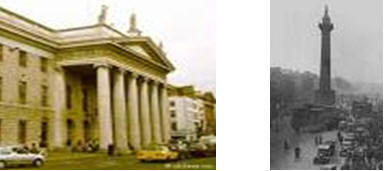
Dublin Post Office, O’Çonnell Street, where
Nelson’s monument O’Connell Street,
much fighting took
place in the early 1920’s
1955, later blown up by the IRA |
On a visit to the House
of Commons in 1990 at the invitation of Lord Winchilsea [Sir
Christopher Denys Stormont Finch Hatton, the Rt Hon the Earl of
Winchilsea and Nottingham, Liberal Peer.],
we went to get a cup of tea at one of the many bars in the House, I
found myself face to face with a bust of John Redmond, the highly
respected Member of Parliament for Waterford, and Chairman of the Irish
Parliamentary Party who did much to facilitate the granting of
self-government and later independence to the Irish Republic. I had
stayed with the MP’s niece, Maud Redmond, for a summer holiday in 1954.
She was a retired music teacher who had worked in that capacity for the
Austrian Empress and her family in Vienna before the outbreak of WW1.
Miss Redmond’s cottage was full of priceless antiques, and she was kind
and patient enough to introduce me to that world. She taught me how to
recognize gold and silver stamps, Sheffield plate, Adam’s fireplaces and
Chippendale furniture. She was secretary of the local RSPCA and loved
animals, her favourite being a Shetland collie that my father had
brought over from Scotland. Miss Redmond was never happier than when she
would fill her room on a Saturday evening, with the finest musicians
from Waterford, plus the motley crew from our fishing boat. She was as
delighted with the crewmen’s attempts to serenade or recite doggerel
poetry, as she was with the accomplished performances of her musical
friends.
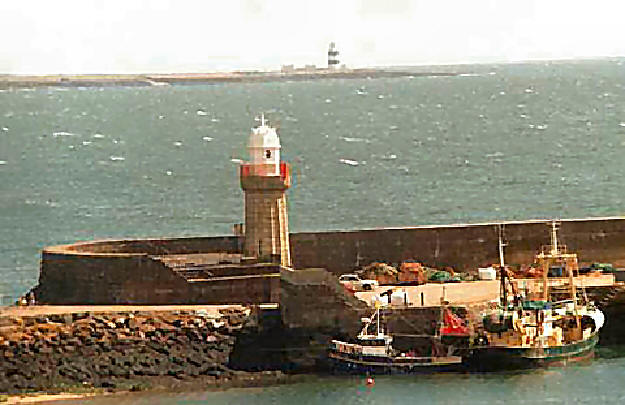
Dunmore East harbour light with the Hook
lighthouse in the background
Looking back, the
fishing system used in Ireland over 50 years ago, compares well in terms
of quality and freshness of produce, with any in use today. The four
Scottish boats that supplied H J Nolan’s with fish, would gut, wash,
select by size, and pack, whiting, cod, haddock, hake and flatfish in 7
stone (98 lbs) boxes with ice, and cover them with a sheet of
greaseproof paper. When fishing in the Atlantic off the Arran Isles,
the four boats would inform the Galway agent daily by radio of the
catches and he would telephone Dublin for an appropriate amount of empty
boxes and ice. The fleet would come inside the islands to put all their
catches on a single boat that would then take them the 3 hours to Galway
where the fish truck from Dublin would be waiting. After unloading, the
vessel would take ice and boxes back for all four boats. Each boat
would take its turn in making the Galway trip. In this way, there was
fresh fish on Dublin market at 6.00 a.m. each weekday morning, that had
been caught the previous day in the Atlantic off the west coast. I
doubt if any market in Europe can surpass that standard for fresh fish,
even today.
My best personal friend
in Ireland was Sean Cotter of Castletown Berehaven in County Cork.
Along with myself he was an apprentice deckhand on my father’s boat in
the mid-1950’s. A gem of a fellow, Sean (Johnny) had a rich store of
tales from that wild and remote south-west part of Ireland, which he
would relate with appropriate colour and exaggeration. He was as cool
as a cucumber when encountering more sophisticated society. I will
never forget him bargaining with a draper in Dun Laoghaire for the
purchase of a suit. No Jew or Arab could have beaten the price down
better or gotten more extras out of the draper than Johnny did. He was
a fine seaman, and later went on to become a successful skipper of a
French-built trawler fishing on the wild Porcupine Bank in the Atlantic,
west of the Arran Isles. After a gap of forty years I had an
opportunity to go to Castletown and look him up, and found him aboard
his vessel in the harbour. He did not recognize me at first. When I
said I was “one of the Thomsons from Lossiemouth”, he responded,
“do you know David?, - how is David these days?”. Within minutes
I was given the royal treatment, and ended the evening in his bachelor
house round a roaring fire while his crew brought up huge fresh Irish
ham sandwiches from the shop and Sean poured mug after mug of hot
steaming tea. He had given up drinking for health reasons some time
before, but had never married. He lost his life a few years ago, sadly,
but somewhat appropriately, at sea. He had semi-retired to a one-man
boat, the Kyle Mhor, which he fished with skill, but something went
wrong that last morning, 31st May 2000. The vessel capsized
south of Black Bull Head, and he was drowned. The fishermen of
Castletown called me and gave me a moving account of how they bid Sean
their last farewell. His sister and brother-in-law in England, also
wrote of him with deep affection and admiration. Sean was the third of
three young Irish fishermen I knew in 1955 who all lost their lives at
sea.
Another fine young
Irishman I got to know was Pat Kelly-Rogers. Pat was the son of Captain
Kelly-Rogers, then the head of Aer Lingus, the Irish airline. During
the war years he had been Winston Churchill’s personal pilot. I had the
privilege of meeting Captain Kelly-Rogers through his son Pat. His
daughter Aine also became a friend of my wife’s. Pat could have had any
career he wished I think, but he loved the fishing. He had served in
the US Navy during the Viet Nam war, but came back to Ireland to pursue
his real interest. He served for a while as a crew member on a herring
trawler I operated for a year in Ireland. Later he acquired a boat of
his own, and fished well for a period, but lost the vessel following a
collision at sea when pair trawling for herring off the south coast.
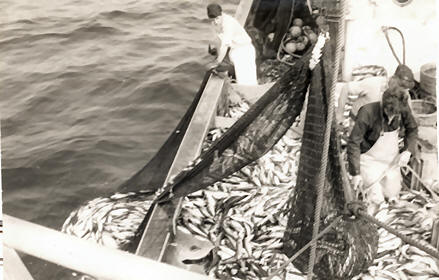
Pat Kelly Rogers on left helping
with a mixed bag of mackerel, herring and haddock on the Dayspring
off Donegal. The Mate, Peter Smith of Buckie is on the right.
Peter later became a successful skipper of inshore, coastal, and deep
sea vessels around Scotland and abroad.
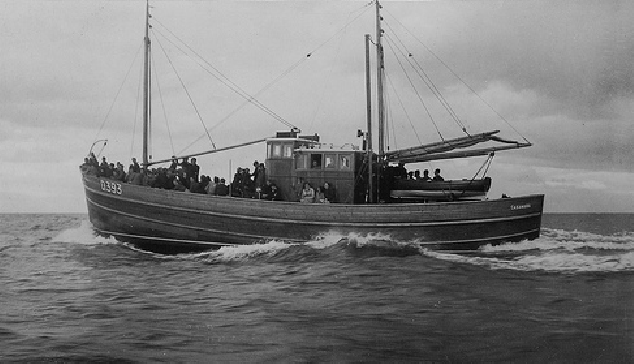
Taking locals out for the blessing of the
bay, Galway, 1950
In Dunmore East there
was an interesting character engaged in both fishing and the sale of
nets and chandlery. He was Alan Glanville from England, who had served
with FAO in Ceylon (Sri Lanka) in the early 1950’s, along with Einar
Kvaran of Iceland with whom I worked years later in Indonesia. Alan had
also worked with John Garner and Gourock trawls on the early development
of wing trawls in Britain. Alan was regarded as a “gentleman fisher” by
other fisherman as he went to sea only when it suited him and when it
was profitable. However, he did well in Dunmore East, both at the
herring fishery and in selling nets and gear. I was to meet Alan
occasionally at fishery exhibitions and when visiting the south coast.
At the age of 75 Alan was operating a steel vessel off the south-west
coast, fishing for bluefin tuna by deep sea rod and line. He was then
thinking of establishing a tuna ranch in one of the Irish bays.
Following the tsunami disaster in SE Asia, at the age of 80, Glanville
had some fishing boat hulls of suitable design built in Chile and sent
from there to the fishermen of Sri Lanka.
Other fishermen in the
Republic who I came to know and admire included James McLeod, a
qualified merchant navy captain and airplane pilot, who pioneered
herring fishing in the west, and set up a net factory in Killybegs.
James lived to over 90 years of age, and when he was no longer permitted
by age to fly aircraft, he took to piloting gliders. Albert Swan was
another skilled fisherman, who established the large Swan net company.
Then there were the McAllig brothers from Dunkineely who operated
several trawlers. Willie McCallig was a crew member on my father’s boat
when we fished in Ireland. He was killed in a car crash along with a
relative, in 1994. In Castletownbere there were the O’Driscoll
brothers, and in the Aran Isles, Pat Jo O’Donnell, Pat Jennings and
Keiran Gill.
Ulster, (Northern
Ireland), was not a part of the island I visited much, though my father
had fished before from Ardglass and Portavogie. There was one family in
the north we knew well, and sometimes visited, as they had many
connections with Scotland and with my father and his brothers. They
were the Chambers family of Annalong, a village beside Kilkeel in County
Down. Jack Chambers was the oldest brother, but Victor was the leader,
and a real pioneer in Irish fisheries. He had four vessels in
succession, each breaking new technological ground in the capture of
demersal fish and herring. The family boats had names like Green
Pastures, Green Isle, and Green Hill. Recently I met a grandson of
Jack Chambers in Malaysia where he was serving on an ocean going mission
ship.
Ireland is a favourite
holiday destination for our family. My wife and I particularly enjoy a
week on the Shannon – Erne waterway where you can rent a small cabin
cruiser for less than the cost of a bed and breakfast room for two, and
cruise up or down most of the length of Ireland, in leisurely fashion
and surrounded by pleasant scenery and interesting bird life. Truly, -
so near to home, and so far from care.
All of the above, I
hope, paints a cameo picture of the land of the shamrock and its much
admired people. But it is a background against which I would like to
consider the problems of Ulster and the bloody work of the IRA and the
UDA. Sadly, few national symbols are more prophetically accurate than
the ‘red hand of Ulster’. I knew many Irish nationalists, - in fact
there are few in southern Ireland that would not fit that description.
I also knew several members of the IRA, and more indirectly, some
members of the UDA. Once I sat beside the formidable MP and Free
Presbyterian Minister Dr Ian Paisley on a flight from Rome (of all
places) to London. He was a most courteous and congenial traveling
companion, and I was surprised to learn that we had some acquaintances
in common.
Structural injustice
has led to civil disobedience and violence in many countries. The cries
of Unionists in the North, for Irish Catholics to obey the laws of the
land, reminded me very much of similar injunctions (in pre-Apartheid
days) from whites in South Africa, to their disadvantaged black
citizens. The attitude of hard-line whites in the American south to the
civil rights movement of the 1960’s is another example. Historical
injustices have to be rectified. That is why the root cause of the
Irish troubles are often referred to as “the sins of our fathers”.
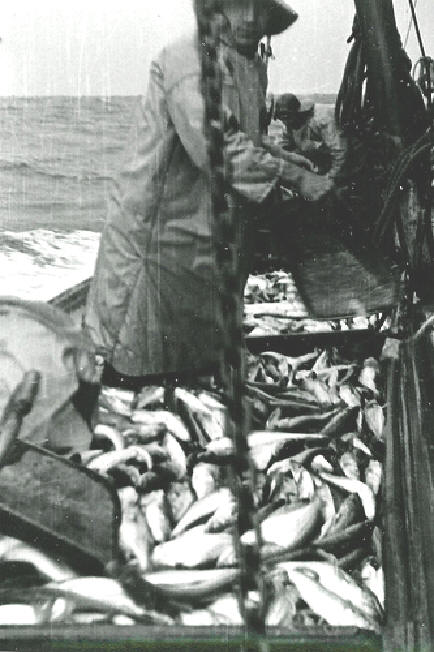
A bag of saithe (coley) west Ireland,
1949
Domination of Ireland
by successive English and British Governments from the time of Henry the
8th, has caused untold sorrow. The fierce vengeance of Cromwell’s and
later King William’s armies, and the plantation of Protestants in
Ulster, centuries ago, sowed the evil seeds of the current tensions and
conflicts. While British attempts to create coalition governments in
Ulster have been regarded with suspicion or lack of cooperation by
political parties there, a sea change is taking place as the Republic is
no longer the ‘poor brother’ since it joined the EU and became a
prosperous financial centre. Unionist determination to stick with the
United Kingdom has been weakened by Britain’s industrial decline, and by
the coolness of UK governments towards Ulster.
I recall sitting next
to a young red-headed IRA activist in London airport in 1965 while he
railed to his lawyer about the British Government having killed his
father, and how he owed them no allegiance and they held no authority
over him. I had another zealous IRA man join my crew on a trawler I
fished briefly from Killybegs, but he turned on the organization when it
tried to get his brother to go on a hunger strike to the death. The
problem for Eddie was that those who wanted his brother to die that way,
in his opinion, would not miss a meal themselves for the cause.
One of the fishing
boats part-owned and operated by my uncles when working with H J Nolans
in the early 1950’s, the Casamara, was used to carry arms
shipments from Libya to the IRA in 1985. That was long after Nolans
sold the vessel. Commanded by an Adrian Hopkins of Dun Laoghaire from
where we often fished, Casamara was reported to have made three
arms shipment voyages in the year in question, carrying from 10 to 16
tons of weapons and ammunition, including AK 47 rifles, pistols,
anti-aircraft machine guns and rocket launchers. Also in the cargo were
a million rounds of bullets and thousands of mortar shells. General
John de Chastelain who inspected arms that the IRA had put out of use,
identified some as coming from the Casamara shipment. I find it hard to
believe that that lovely 65 foot seiner built by Tyrrell’s of Arklow in
the late 1940’s, which was manned by such fine crews of fishermen and
which had harvested fish all round the emerald isle for 30 years, was to
be used for the murderous weapons trade in the 1980’s.
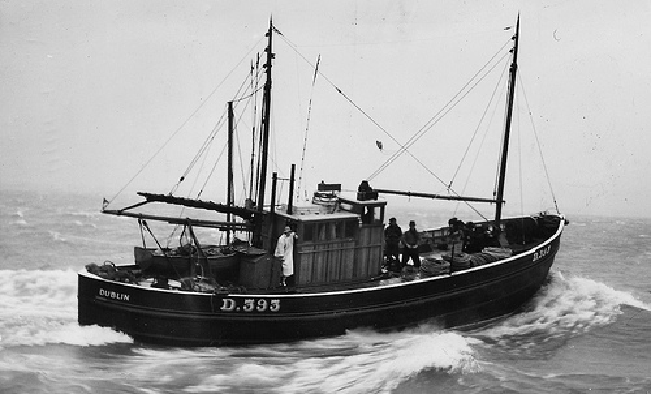
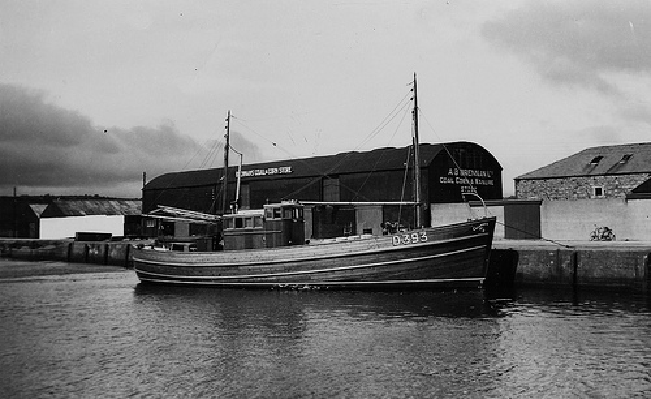
The Casamara when operated by Nolan’s and
the Thomson family.
Some 20 years later it was used for gun-running by the IRA.
Hopkins was reported to
have used three different vessels over a 2 to 3 year period, - the
Casamara, the Villa, and the Eksund. At one time he
changed the Casamara’s name to avoid detection. He and his
Eksund crew, including IRA member Gabriel Cleary, were arrested by
French authorities in the Bay of Biscay in 1987, and spent the next 3
years in French jails. Released on bail, Hopkins made his way to
Ireland where he was picked up by Gardai police in Limerick. Numerous
reports, including Ed Moloney’s 2003 book, The Secret History of the
IRA, claim that the arms shipments were financed and organized by
one Thomas ‘Slab’ Murphy, a wealthy pig farmer whose property adjoined
the Irish Republic border. These reports describe Murphy as a veteran
IRA commander, and its most lucrative smuggler. It was also suspected
that he was behind the brutal murder of Eamon Collins near Murphy’s
farm. Collins had been a witness against Murphy in a British court
case.
Thomas Murphy was said
to have been on the beach at Clogga Strand in County Wicklow when the
Casamara discharged her cargo of weapons and ammunition. In 2006,
Northern Irish and Republican police raided Murphy’s farms after British
police had searched over 240 properties in England, valued at £ 55
million, that were believed to be part of an IRA money-laundering
operation.
Most Irish Catholics
supported the movements to rid all of Ireland from the UK, though only a
few would agree with the violent means of the IRA. So it was hardly
possible to have a Catholic Irish friend who did not harbour national
symathies. Rather, I suppose as it would be difficult to find ordinary
Arabs in the Middle East who did not want their lands to be free of
American or Israeli domination. Despite all of the violent background,
and the historical injustices that have beset Ireland, rather
wonderfully, even avowed Catholic nationalists and Protestant unionists
can be great friends cooperating effectively and in harmony. I knew
some who were in that category. Two who come to mind, Paddy Smyth and
Bobby McCullough, a fish merchant and a skipper of a large vessel,
worked marvellously together, though they constantly teasing, and
playing practical jokes on one another. The core problem of Ireland is
political, not religious, and it relates to basic justice.
Nevertheless, the
political divides are drawn largely along denominational lines, and so
Catholic – Protestant tensions live on in Northern Ireland where it
would seem that the Reformation and the European religious wars occurred
only yesterday. Elections in Ulster are seeing a polarization of votes
for the extremist parties, the DUP and Sinn Fein. Both the propagators
of armed struggle and armed resistance, use religion for their political
ends. For all the sworn adherence of the IRA to the church, or of
extreme Protestants to Biblical truth, both parties in Ulster would do
well to take to heart the words of Pope John Paul II in Drogheda 1979 :
“Violence is a lie, for it goes against the truth of our faith, the
truth of our humanity, the life, the freedom of human beings. Violence
is a crime against humanity for it destroys the very fabric of society.
O my hearers I beg you to turn away from the paths of violence and to
return to the ways of peace.”
The solution to
Ireland’s problems lies with the Irish, with the thousands upon
thousands of peace-loving men and women and young people, and with those
who once practiced violence but have since renounced it. Men like
former loyalist para-military Billy McIlwaine, and women like former
republican para-military Mary Smyth, and the Soldiers of the Cross
movement they supported. Billy McIlwaine, former man of violence has
written: “I appeal to the men and women in the various paramilitary
organizations to examine in their hearts what they hope to achieve by
violence and bloodshed in Northern Ireland. … Is there not a better
way? Is there not another way than the bomb and the bullet? I love this
country and its people, and I pray that Catholics and Protestants,
Loyalists and Republicans, might live together in peace”.
A peaceful future is
being carved out of the landscape of bitterness by courageous people
like the women who campaign tirelessly for peace, and organizations like
the the Corrymeela Community of Christians for justice and peace. There
are also outstanding men like Dr John Robb who as a surgeon at Lismore
Hospital Ballymena, had often to repair the horrendous damage done to
human bodies by the indiscriminate bombs. His father Dr John Charles
Robb, a pioneer in medical and hospital work, served in Downpatrick
Hospital for many years. My father was placed under his care in 1953
when he was landed unconscious from a brain hemorrhage due to excessive
hours at sea without sleep. Thankfully, my father recovered, and in the
process he got to know the Robb boys, Johnny and Jimmy, both of whom
spent some time at sea with us later when on vacation. They were great
fun, keen rugby players, and real gentlemen. Both graduated as medical
doctors, though Jimmy had intended a different line of work, but changed
to medicine after a life-changing visit to Calcutta where he observed
human misery and suffering to an extreme degree.
Johnny became a
renowned surgeon, often operating on bomb victims at Lismore Hospital as
mentioned above. He was made an honorary Senator by the Dublin
Government in appreciation of his efforts to promote peace in the
north. I mentioned his name to the Rev Iain Paisley during the
conversation we had on a flight to London. The leader of the Democratic
Unionists said, “ah, ... - he’s all mixed up. But, … he is a very
good surgeon”.
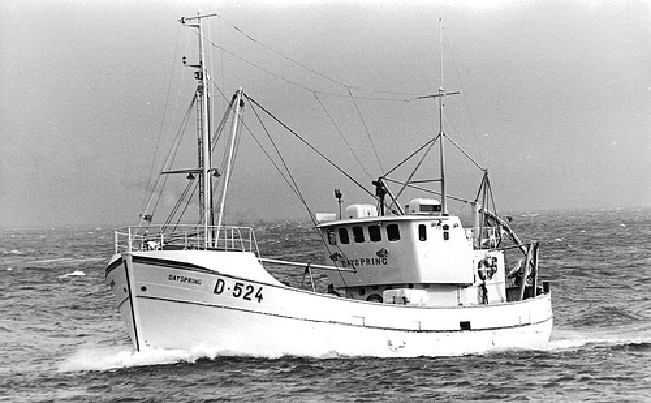
MFV Dayspring en route Ireland
from Norway |