|
From the lone shieling of the misty island,
Mountains divide us, and a waste of
seas -
Yet still the blood is strong, the
heart is
Highland,
And we in dreams behold the Hebrides
Canadian Boat Song,
authorship
uncertain
(published
in Blackwood’s Magazine, 1829)
Oh Scotia, my dear, my native
soil ! For whom my warmest wish to heaven is sent!
Long may thy hardy sons of
rustic toil, Be blest with
health and
peace and sweet content ! And O may Heaven their simple
lives prevent From Luxury’s contagion, weak and vile!
Robert
Burns
The Cotter’s
Saturday Night
Having given some of my
impressions of Ireland, I guess it would be appropriate to say a little
about my homeland before talking more about foreign lands. I am one of
those Scots who can view his country both from the inside, and from
abroad. I was brought up
in Scotland and have
retired there. But I have also spent most of my working life overseas,
and have had to look at it often from that perspective. When I discuss
some foreign lands, I may have the odd criticism to make of negative
aspects of the culture, or of mis-rule by perverse, greedy, or
undemocratic leaders. Criticism, like charity, should begin at home.
So I will have something to say about our failures as a people, and
about the failures of some of our leaders or their administrations. I
should also give credit where it is due, and applaud the work of those
who have done our country proud.
Scots are not a
homogenous people as I found when I came to know Highlanders, Orcadians,
Glaswegians, and folk from Ayrshire, Dundee, and the capital
city of Edinburgh.
Even along the Moray coast where I was brought up, accents and language
varied from village to village. The Celtic Highlanders are a sensitive
people, they love music and social activities, but are never keen to
push themselves to the front. The people of Shetland and Orkney are
very Norse in their character and outlook. East coasters are
industrious, thrifty, independent thinking, and argumentative.
Glaswegians are robust, honest, fearless, and
down to earth. Edinburgh
folk are generally more tolerant, and they do have a touch of the
cultured attitudes comedians like to poke fun at. However, they take it
all in good humour. Ayrshire residents are friendly and principled.
Borders people are somewhat conservative and less easy to be convinced.
All of these are merely personal views and others may have different
descriptions.
If there is one trait
that I believe marks Scots society as different from England, it is that
Scots generally look down on no-one and look up to no one. This may
explain how the Labour Party grew in Scotland, and why the first Labour
MP, the first Labour Prime Minister, and so many in subsequent Labour
Governments, were Scots. The English are more hierarchal in their
attitudes, which may be a Norman or Anglo-Saxon thing. This is not a
criticism. It is just that English society generally pays more
attention to class, rank and wealth, or the lack of these appendages.
This is seen in everything from politics to humour. Mrs Thatcher for
example, failed badly in Scotland which once had a majority of
Conservative MPs. She, more than anyone else, destroyed the Tory party
in Scotland. A basic reason for that is that she thought a ‘Scottish
Tory’ was the same as an ‘English Tory’. Far from it. Scottish
conservatives had very different characteristics. They retained a
strong social conscience for instance, and many of them were embarrassed
by the ‘poll tax’ Thatcher introduced. Scots humour is more earthy and
self-deprecating than the English variety. Gilbert and Sullivan music
hall productions are replete with English humour. I have sat through a
performance in Edinburgh that simply left the audience cold. I daresay
the reverse would be the case with Harry Lauder, Stanley Baxter, “Scotland
the What”, or Billy Connolly, in an English theatre.

The Saltire,
the national flag of Scotland
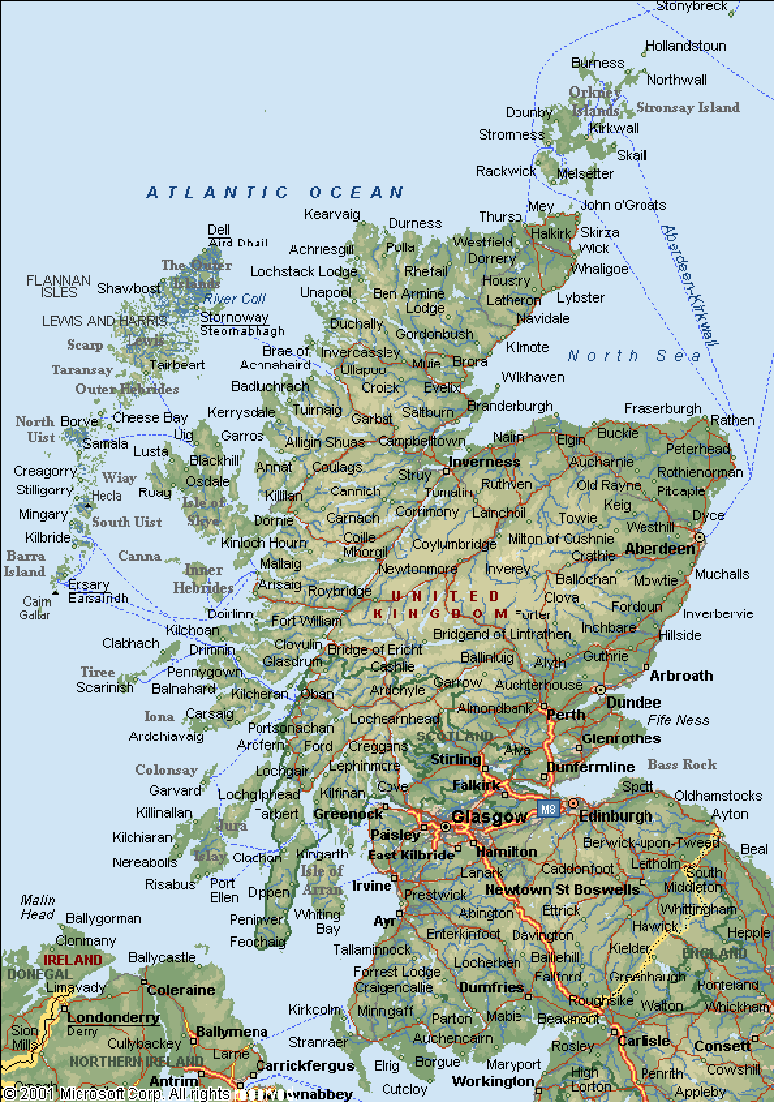
Map of Scotland
|
Significant
Historical Memories
Two historical
memories that I feel mark the Scottish psyche to a significant
degree, are the “Highland Clearances”, and the
unemployment of the depression years. Both serve to deepen the
national propensity to be suspicious of government, and to view
the prospect of poverty and joblessness with some horror. I
daresay those attitudes pre-date both the events referred to
since they are prominent in the writings of Robert Burns, who
despite his radical views, possessed a bit of the gloomy
Calvinistic attitude towards life’s misfortunes. People of my
granny’s generation held a dread of having to end their days in
the “poorhouse”. I recall the local poorhouse in Elgin, - still
in use in the immediate post-war period. It was definitely not
an attractive establishment.
The Highland
Clearances took place between 1790 and 1850. It was ethnic
cleansing of a region, only the people were replaced with sheep,
not with other settlers. Before the Jacobite rebellion of 1745
– 46, the majority of the Scottish population lived north-west
of a line drawn from Aberdeen to Glasgow. After 1850 the
reverse was the case. Today the population of the Highlands is
less than ten per cent of that of Scotland. Following the
defeat of the Jacobite army, King William took the land from the
clan chiefs who supported the rebellion and gave it to those
most loyal to him. Most of the new land-owners were absentee
landlords much of the time. But they wanted more rent from the
estates to support their lordly lifestyles in Edinburgh, London
or Paris. Along came the agricultural improvers who claimed
that keeping sheep on the land would be much more profitable
than having tenant farmers. This was music to the ears of the
landlords, the chief of whom were the Duke and Duchess of
Sutherland, probably the wealthiest couple in Britain at that
time. Over a period of around sixty years, rents were raised
and those unable to pay were evicted. Some were evicted
regardless of whether they were in arrears. The factors who
zealously undertook the Sutherland’s clearance work were Patrick
Sellars and James Loch. Houses and farm implements were burnt to
prevent future use. Some of those evicted died of exposure.
Many emigrated to Canada, some being lost in the Atlantic on
that risky voyage. More died during their first experience of
the Canadian winter. Those that survived prospered. Defenders
of the clearances say that since the survivors did well
eventually, the clearances were a good, even a benevolent thing!
To this day attempts continue to defend the avarice, injustice,
and wickedness of the Clearances.
[Those
with doubts about the clearances should read John Prebble’s
book, The Highland Clearances, and the powerful account
by Ian Grimble, The Trial of Patrick Sellars.]
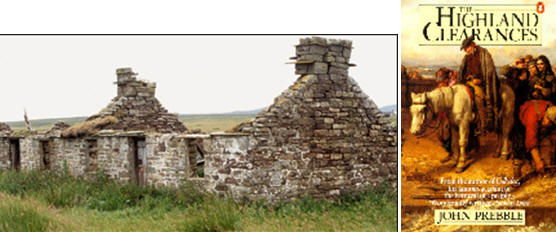
Ruins of one
of the many Highland homes emptied during the Clearances
Right : John Prebble’s book
The Highland Clearances
The Highland
people who remained were obliged to eke out a living on small
patches of land close to the sea. They began by making kelp
from seaweed, a laborious process which made money for the
landowners while the kelp market continued which was not for
long. Over the years, the remnant of the once large population
developed a sustainable survival system of mixed small-scale
farming and fishing that we now know as ‘crofting”.
Crofting was
not, and is not, the glamorous, idyllic rural existence it is
sometimes made out to be. But it displayed the resilience and
ingenuity that often marks populations who have their backs to
the wall. The sheep that were introduced by the landlords made
money initially, but they were environmentally disastrous and
their numbers had soon to be greatly reduced.
Unemployment,
and all that went with it in the 1920’s and 1930’s hit the
working class hard, and etched itself into the corporate
memories of communities in Clydeside, the central belt, and the
mining communities of Fife and Lothian. It contained echoes of
earlier memories of Victorian social conditions so eloquently
described by early socialists like Keir Hardie. The early
relief measures were an affront to human dignity and
particularly unpleasant to Scots brought up on the Calvinist
principles of thrift and industriousness. There was the
poorhouse, means testing of applicants for benefit, and the
indignities of existence on a sub-economic income. Life was
also hard on wage earners whose incomes were cut back to the
minimum by unscrupulous employers.
My wife’s
grandfather, a coal miner in Shotts, in the central belt, used
to tell how the experienced miners would contract with the mine
company to work a particular seam or shaft as a team of men.
They had to know the geology of the coal face, and to be able to
estimate the amount of coal that could be extracted, and how
long that would take. If their judgement was good, and the team
worked extremely well, then each man could come out of the
operation with a reasonable living wage. After one such venture
that produced well, he went to collects the men’s pay, and found
the company had reduced the rate. Asked why, the company clerk
responded that they were earning far too much from their high
output. Jimmy said, “I looked that clerk in the eye for a
period, then told him, - ‘Young man the time is soon coming when
you just won’t get men to do what we have to do to earn a
living’.”
Another elderly
Scots friend of mine, told me of skippering a steam trawler
fishing off Rockall in the 1930’s. He happened to check the
settling sheet after a voyage when expenses seemed unusually
high. He discovered that they had been charged twice for the
coal fuel. He asked the office to refund the crew the
difference. The office manager was displeased but released the
money. But before the trawler sailed on the next trip, George
was informed that his services were no longer required.
Experiences like these increased distrust and poisoned relations
between workers and employers. This was reflected in industrial
unrest then and for 20 years after the war. |
The Clearances
described above have been well documented by notable writers such as
John Prebble, Ian Grimble, Eric Richards, and others. However, it
astonishes me that books are still being produced to deny that they ever
occurred, or to claim that they comprised a benevolent programme of
action by sympathetic landowners. At least three such books have been
produced in the past 6 years (1999 – 2005). But the first major
apologetic work was by the woman who had written eloquently and
courageously about the treatment of black slaves in America. Harriet
Beecher Stowe shocked the conscience of America in 1832 with her work,
Uncle Tom’s Cabin. Yet only 4 years later she traveled to
Britain where she was lavishly entertained and applauded by the Duke and
Duchess of Sutherland. She succumbed completely to their seduction and
her critical faculties evaporated to the point where she wrote a book Sunny Memories,
which completely denied the avarice and inhumanity
of the clearances.
A
highland man who
had witnessed the cruelty, Donald MacLeod, wrote a powerful response to
Stowe’s book in 1857, called Gloomy Memories. The great modern
writer James A. Michener, was so appalled by Beecher Stowe’s
defence of the
Sutherlands, he resolved to write a work on Scotland, focusing on the
Clearances. He was then studying at St. Andrews and travelling
throughout Scotland. He referred to the Clearances as ‘the repulsive
depopulation of the glens’, and said of Stowe’s book, ‘It was a
remarkable instance in which a sensitive writer could see clearly the
consequences of inhuman behaviour at home, but failed to understand
equal inhumanity when encountered abroad’. [Michener’s
comments are found in the chapter, ‘Selecting a Subject’, in his
publication, My Lost Mexico, Tor, 1992]Unfortunately Michener never got round to producing his book on Scotland
and the period of the Clearances.
The long term effects
of the social and environmental injustice of the Clearances could have
been remedied to a degree if the ideas and work of two visionary men had
been fully accepted by the post-war governments. Those men were Tom
Johnston, the Secretary of State for Scotland after the war, (and author
of “Our Noble Families”), and Fraser Darling, the gifted
naturalist and environmentalist who was hired by Johnston to examine the
region and propose measures to reverse the decline in people and
resources. But the new generation of economists and government advisers
had no time for such romantic nonsense. They saw big industry as the
only hope for Britain’s future. So Fraser Darling’s report was shelved
and his advice ignored, - just as a later British government dismissed
the prophetic warnings of its economic adviser to the National Coal
Board, Dr. Ernst Fritz Schumacher, author of “Small is Beautiful”.
Schumacher believed in economics as if people mattered, and the need to
protect living nature and planet earth.
|
Scotland’s
finest Member of Parliament
He died a
hundred years ago without ever achieving high office. He never
had the privilege of attending school, and was a teenager before
he could write. He worked 12 hours a day from the age of 8 to
24, first as a bakers errand boy, and then as a miner. He was
dismissed from the mines for forming a miners union, but later
became secretary of the Scottish Miners Federation. He founded
and edited a newspaper, entitled The Miner, later called
The Labour Leader. He stood for election to
parliament in 1888 and came bottom of the list. Then in 1892 he
was elected for West Ham south in London, and in 1900 for Mertyr
Tydfil in Wales. In 1896 he was arrested for speaking at a
large open air meeting in support of the suffragettes. His
support for self-government for India, and for equal treatment
of blacks in South Africa, were also cause for fierce opposition
he encountered.
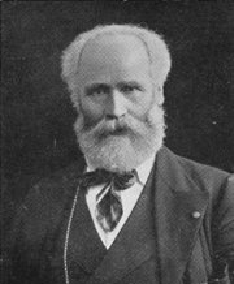
Scotland’s finest Member of
Parliament, Keir Hardie
In June 1894, in
the Commons, he opposed the unanimous passing of congratulations
on the birth of the royal heir (future Edward VIII), insisting
that a message of condolence be added to the families of 251
colliers killed in a mine explosion in Wales. Not a single MP
supported him.
A devout
Christian, James Keir Hardie stated in 1910, “the impetus
which drove me first into the Labour movement, and the
inspiration which has carried me on in it, has been derived more
from the teachings of Jesus of Nazareth, than from all other
sources combined”. A convinced pacifist, Keir Hardie
opposed the Boer War, and the First World War. He organised a
national protest strike, and several anti-war demonstrations,
and as a result, was denounced by enemies, and some erstwhile
friends, as a traitor. He died in 1915, some say of a broken
heart. More than any other man, Keir Hardie founded the Labour
party in Britain. In integrity, sincerity, and genuine concern
for mankind, few of New Labour’s leaders or appartchniks are fit
to clean his boots.
|
|
Scotland’s
greatest Secretary of State
Born in
Kirkintilloch in 1882, Thomas Johnston was to become one of the
most influential of the thinkers and writers in Scotland in the
first part of the 20th century. He attended Glasgow
University, and while a student, founded the socialist weekly
Forward, which he edited for 30 years. Johnston was early
on a member of a group known as the Red Clydesiders. It
included noted socialists like James Maxton and Manny
Shinwell. He was also a strong supporter and admirer of Keir
Hardie the first Labour (ILP) member of parliament. He wrote
two epic books, A History of the Working Classes in Scotland,
and the more controversial, Our Scots Noble Families,
which went through over 20 editions till he personally stopped
further publication till after his death. It is now available
once again in paperback form. Both works recount social
injustice perpetrated throughout the country’s history, and make
salutary reading for defenders of those who ruled the land or
wielded power through their titles or ownership of vast estates.
Tom
Johnston was elected to Parliament first in 1922, and again in
1935, after which he remained an MP until the end of the war.
Ramsay MacDonald appointed Johnston as Under-Secretary of State
for Scotland in 1929. In 1939 Sir John Anderson made him
Commissioner for Civil Defence in Scotland, and in 1941 Winston
Churchill appointed him as Secretary of State for Scotland. Tom
Johnston probably did more for Scotland in that time, and in the
subsequent 5 years, then any other Secretary of State the
country has had, (or any other First Minister of the devolved
government).
In 1944
Johnston established the North of Scotland Hydro Electric board
which was to supply substantial amounts of renewable energy for
the remainder of the century. He was inspired in this action by
President Roosevelt’s Tennessee Valley Authority, and its
harnessing of hydro-power.
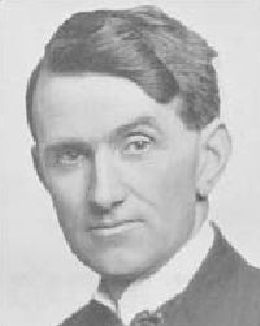
Scotland’s greatest
Secretary of State, Tom Johnston
TJ as he
was popularly known, was Chairman of the Hydro Board after
stepping down as an MP in 1945. He also became Chairman of the
Forestry Commission and the Scottish Tourist Board, and a
Governor of the BBC, but would accept no remuneration for those
services. He was Chancellor of Aberdeen University from 1955
until his death in 1965. An avid supporter of Home Rule,
renewable energy, conservation of natural resources, and
policies to promote full employment, he was far ahead of his
time in most of his political and developmental ideas for
Scotland. He was one of the few in government that appreciated
Fraser Darling’s vision and values, commissioning his
ground-breaking West Highland Survey. |
The painful experiences
of the depression years lie behind much of the seeming obstinacy of
Scottish trade unions, and the difficult labour relations of the
post-war years in Scotland. I recall a train journey in which a
Clydeside worker related with obvious pleasure, how he had found ways to
‘beat the system’ in a naval dockyard, and how he and his son could make
good money by feigning work in numerous ways, and by pilfering materials
that were not needed. I heard him out, and then remarked that I had put
in long hours the past week for rather little money, and that if what he
said was typical of industrial work today, - then I was not surprised
that the country was on the decline as appeared to be the case. He did
not flinch or show any embarrassment. “Well,” he responded,
looking me firmly in the face, “I don’t care. All I saw as a boy
growing up in Glasgow, was poverty, unemployment, dole queues, pawn
shops and moonlight flittings. And if the boot is on the other foot
now, - good and well!” That attitude was typical of many in the
post-war period, who felt that their families had suffered unjustly
under a system that cared mostly for the wealthy and privileged class of
society.
All too often,
governments ignore and stifle the protests of the poor or
disenfranchised till it is too late, and the resentment boils over and
explodes in anti-social behaviour that can cost the country dearly. So
we have the present troubles in Zimbabwe where the landless Bantu people
are now taking cruel revenge on those that have held the land for half a
century and failed to introduce any meaningful programme of land
reform. I believe that much, if not all of the hostility of Arab
peoples to the West is due to a perception that we never paid any
attention to their values or aspirations, and simply used them to obtain
their oil. During the Cold War, communists could rely on the tacit
support of peasants in the Philippines, Cambodia, Cuba, Chile and
Nicaragua because those peasants saw the United States as more
interested in propping up their corrupt and brutal dictators, than
helping to improve the lot of the poor in their country.
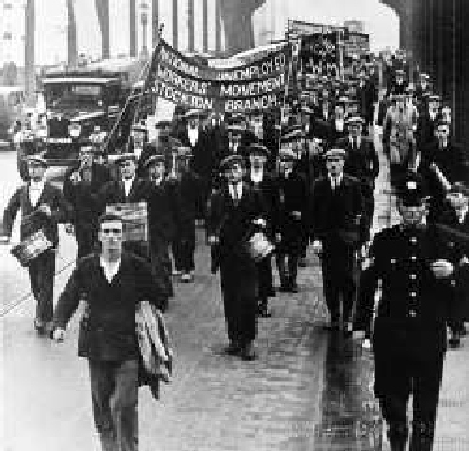
Unemployed march during the 1930’s
But here we are
discussing Scotland. There are still ghettos of long-term unemployed,
and under-employed person in our cities. For 12 years we had a family
home close to the large public housing estate of Wester Hailes. There
were 20,000 persons accommodated in dreary apartment blocks that are
thankfully being replaced or renovated. I found that there was a
sub-culture prevalent in the urban estate. It embodied a hostility
towards the more prosperous world outside. That prosperity, they
believed, was due to good fortune (not hard work), and should have been
shared with them. The common lifestyle was to stay up all night and
sleep during the day. Minds were drugged by constant television and
music (pop, disco or rap). And bodies were drugged by more dangerous
substances. It was all in an attempt to deaden the pain and ease the
dreadful boredom of a sub-human existence. A most troubling aspect for
me was the number of men who had never ever worked or held down a job in
their lives. And they usually sired children that followed in their
steps. Their manhood and provider-spirit was destroyed by the years on
welfare hand-outs. So they would find an alternative source of macho
spirit by showing how much they could drink, or by foul language at
times, and in worse cases, by abusing their wives.
Yet, even in such
depressing circumstances, there were those that struggled to live above
the prevailing culture. There were some lovely homes and stable
families in the ghettos. It was far from easy for those determined to
make something better of their lives, and though they abhorred the
negative aspects of ghetto life, they sympathized with the bitterness
and resentment of those that gave in to the despair. I knew and know
some who did all they could to assist, counsel and encourage, their
neighbours who had fallen victim to violence, addiction or depression.
Unemployment is a curse, and it is made worse by a system that kills
enterprise and traps families in a net of welfare support measures that
undermine dignity and self-worth, and effectively discourage attempts to
obtain work and become self-supporting.
Inspired by a
Stone
Scots in the
dreary immediate post war years were suddenly inspired by the radical
(though harmless) action of four young Glasgow students. It was 1950,
the year George Orwell and Harry Lauder died. The Attlee Labour
Government was nearing its end, some foodstuffs were still rationed, and
petrol rationing had just ended. In Ayrshire 116 men were trapped below
ground in a major mine disaster at New Cumnock which claimed the lives
of 13 of the men. Abroad, the combined forces of North Korea and China
had pushed the U.S. / UN offensive back and prompted General MacArthur
to threaten the use of nuclear weapons. British people enduring poor
housing and low living standards were struggling to rebuild the economy
after the war. It was certainly not an opportune time to inspire Scots
with dreams of their nation’s return to independence. However, these
circumstances did not deter the idealistic four who rather naively
thought they could lift their country’s spirits by retrieving its
ancient symbol of sovereignty.
The Stone of
Scone, or Stone of Destiny, on which each of its monarchs had been
crowned, was a revered symbol of the Scottish Kingdom for over 500
years. But it was looted from Scotland in 1297 by Edward 1st
to become the coronation stone of all subsequent English monarchs.
England had agreed to the return of the stone to Scotland under the
Treaty of Northampton in 1328 but that promise was not honoured until
1996. Over the years, a number of patriotic Scots had sought the return
of the stone, but as with other treasures, marbles, relics and gems
looted from the empire lands, London had no interest in relinquishing
its plundered goods.
I recall Christmas
day 1950 since it was a bitterly cold early winter with snow in many
places, and my father had brought back from Ireland a suitcase full of
sweets and chocolate, and some nylon stockings, which were available
only on ration in the UK. As we celebrated Christmas Eve, and Christmas
Day with a whole chicken (absolute luxury then!), we had no knowledge of
four young students who had motored to London to redress an injustice of
more than six centuries. When the news broke shortly after Christmas,
all of Scotland was agog at the audacity and success of the daring
exploit.
Iain Hamilton,
later to be a famous QC, persuaded fellow students Gavin Vernon, Kay
Matheson, and Alan Stuart, to join him in what appeared to be an
impossible and foolhardy escapade. They were to travel to London in two
small cars, break into Westminster Abbey, and remove the 350 lb Stone of
Destiny from underneath the coronation chair, carry it out of the Abbey
under the noses of its guards and policemen, and bring it back to
Scotland. The very idea seemed preposterous, but neither that nor the
probability of long prison sentences, deterred the young patriots.
You can read the
whole exciting story in Stone of Destiny by Iain Hamilton, and
watch a film of the event of the same name, available on DVD. The
plotters were dogged from the start by bad weather, lack of money,
illness, miscommunications, and car problems. They were stopped and
questioned by police several times, and kicked out of the Abbey by a
night watchman just hours before the actual operation. As the film
accurately portrays the escapade, it was carried off more by luck and
persistence. But the four youngsters succeeded, and within days the
headlines of every national newspaper announced the daring and
scandalous ‘theft’ of the stone, and the hunt to recover it.
Back home our
family along with most Scots was delighted and astonished. There was
not a single Scottish voice raised against the action. As the police
searched everywhere, a boulder outside Forres was painted with the
inscription – “the Stone – this is it”. But it was one of many
false leads. Eventually the stone was returned, and surprisingly the
students were not prosecuted. Iain Hamilton told me 59 years later that
Lord Wheatley had advised the government against prosecution. He had
two reasons, - 1. It would create a furore in Scotland, and,- 2. He
could not guarantee the result of any court case against the four
culprits.
The stone has
since been returned to Edinburgh (in 1996) on the understanding it would
continue to be used in coronation services of future monarchs. So
attitudes have softened a bit over the past half century. As for Iain
Hamilton, now in his eighties, he is as fiercely patriotic as ever, and
dismisses his remarkable and audacious feat with wry humour. “Ach,”
he says, “it was so easy ! It was just guarded by the might of the
whole British Empire, - and an old watchman, a priest, and a Bobby !”
Social problems
Ugly racism has come to
Scotland as to the rest of the UK. It has festered in the pockets of
sectarianism and ignorance, and in the ghettos of the long term
unemployed and underemployed, and has been exacerbated by the demonizing
of refugees by both Labour and Tory politicians. It was not always
thus. Possibly because there were so few coloured persons in the
country, the Scotland I knew as a young boy was largely free of
prejudice towards persons of other races.
Mohammed Gulam was the
first Asian I knew. He came to our town before the war, and went door
to door selling cheap ladies and girl’s clothes. I can still hear his
voice, in that strange mixture of Doric and Pakistani English as he
spoke to my Granny on his knees before an opened suitcase. (My mother
was less impressed with his merchandise). “Fit-a-like Nellie”,
he would say, “wanna buy some sto-kans ? Here’s a nice bloos. Fit
aboot a hade-square?”, and so on. Down at the paper shop he
was a welcome character and treated as a fellow townsman by the locals.
He even named one of his boys after a Lossie man, - Ali Gulam, after an
Allie McCleod as I recall.
Gulam, as we all called
him, persevered till he saved enough money to bring his wife and
children over. As soon as the kids were old enough, they helped out in
a little family shop they set up. The shop soon grew, and became a
thriving business. By the time he died, Gulam was a respected local
businessman. A huge crowd attended his funeral, and his grave is the
largest in our cemetery. One of his daughters Perveen, married the
wealthy Glasgow MP Mohammad Sanwar. Another son became a local SNP
councilor. Gulam’s grandson, Anas Sarwar became deputy leader of Labour
in Scotland in late 2011. I thought all that a nice reflection on the
humble diligence of the suitcase salesman.
Today there are
millions of Mohammed Gulams seeking a new life in the prosperous west.
The refugees and asylum seekers total around 34 million at the time of
writing, - almost the same number that were displaced after World War
II. They come largely from the Moslem states or regions of eastern
Europe, the Balkans, and the Middle East, (driven from home by conflicts
in which the west has had a major role), and hence bring cultural
baggage that makes them different from the refugees of the 1940’s who
were mostly of Catholic or Greek Orthodox background. While I advocate
a compassionate attitude towards immigrants, I believe that they should
be required to learn and respect both our laws and our values if they
are to be granted permanent residence. Multi-culturalism and political
correctness should not weaken or undermine our essential character.
Unfortunately, in London and much of the south of England, criminal
gangs of Albanian and Chinese origin, have flourished, and are
terrorizing whole neighbourhoods. I also believe that the numbers of
refugees and asylum seekers would be considerably reduced if the West
began to address the root causes of their dislocation instead of
aggravating them by its haste to bomb their countries or ignore their
distress.
Like much of Britain,
Scotland saw the rise of socialism as heralding a new dawn of social
justice and economic prosperity. Successive Labour Governments did
indeed bring much needed changes (as did the Conservatives who gradually
accepted the need for those changes). The most important innovations,
which were hailed and lauded by my parents and grandparents generations,
were the National Health system, unemployment benefit, the old-age
pension, free education, and adequate housing for those who could not
purchase a home. Astonishingly, at the start of the 21st
Century, it is a supposedly “Labour” Government that is starting to
dismantle or compromise those benefits. There were however, some
unfortunate aspects to the way social benefits were administered. It is
always thus with bureaucracies. The system could be, and was, abused by
those who became expert in making it work to their advantage. One very
negative aspect of the safety nets, to me, was the “welfare trap”. Once
an unemployed person was fully ensconced in the range of benefits, it
became extremely difficult for him or her to break out of it and get
back to full-time employment. Many of those I knew who tried, had to
give up in frustration because the system penalized them as soon as they
attempted to start earning money again.
While maintaining a
family home in Edinburgh in the 1980’s, I was working in S.E. Asia where
the teeming millions had no social safety net other than their extended
families and the kindness of friends or neighbours. I interviewed many
individuals in those poor but happy and industrious societies, and
attempted to understand how the poor functioned and survived despite the
absence of social protection and support measures. There is no simple
explanation, but one thing became clear; - welfare nets should not curb
or discourage, personal initiative and enterprise, - especially at the
lowest levels of society. In that respect, our administration
frameworks and social measures, are far too inflexible, and our freedom
and enterprising spirit is choked by over-regulation. President Clinton
tried with some success to address similar problems with the American
welfare system.
The problems with our
present day welfare systems and the health service may relate in part to
the growth and power of management that seeks to control to a greater
and greater degree. The drive for management efficiency blinds us to
the real questions we ought to be asking; - not ‘how do we execute or
control these activities more efficiently?’, - but, ‘are these
actions really helping the unemployed or under-employed’. And ‘are
these systems and methods really the best way to treat sick people and
bring them to good health?’. The issue is analysed brilliantly by
David Ehrenfield, Rutgers University Professor, in his book, The
Arrogance of Humanism, and his paper, The Management Explosion.
Rutgers claims that the growth of the management obsession has
developed over centuries, and was depicted by Dickens in Little
Dorrit, and more humourously by C. Northcote Parkinson, in Parkinson’s Law.
For society to survive with is better features
intact (and thus actually have welfare and health systems work for the
good of their clients), Ehrenfield believes we must solve the problem of
bureaucracy. But as long as we are a power-worshipping society
dominated by the myth of control, we doom ourselves to an excess of
administration and all the misery that entails. But let us return to
my homeland.
My Moray home town was
favoured as a local base by a number of politicians. Gordon Campbell,
later Secretary of State for Scotland, and made Lord Campbell of Croy
after his election defeat, lived round the corner from my parent’s
house. Winnie Ewing the Nationalist MP and Euro MP, had a house in the
square that used to belong to one of my uncles. She gave it the
delightful name, “Goodwill”. Her daughter-in-law, MP and MSP
Margaret Ewing lived in a lovely cottage on the west side of town, with
her husband Fergus, MSP for Inverness till her untimely death in March
2006. She served the area well and was much loved by the local people.
In the fifties and sixties, the Banffshire MP Sir William Duthie, when
visiting his constituency, used to stay at his sister’s house, just
behind my parent’s home, and later at the house of a widowed aunt of
mine.
Like many of the
fishing constituencies, Moray formerly voted Conservative. The mould
was broken by the Nationalist Winnie Ewing when she defeated Gordon
Campbell in 1974. It has never elected a Labour or Liberal MP as far as
I know. Yet there were many staunch Socialists in the area, including
my father and all of my uncles. In hindsight I think they were rather
naïve socialists as they lived far from the industrial belt where
unionism was strong, and where Labour Councils often performed
badly. They would interpret the actions of the Soviet and Chinese
governments in the best possible light. Their political heroes were men
like Keir Hardie, the Ayrshire miner and first Labour MP, Tom Johnston a
visionary Secretary of State for Scotland, and Aneurin Bevin, the Welsh
Minister of Health in Attlee’s Government. Even Ramsay MacDonald,
despised or regarded with embarrassment by many in the Labour party, was
revered, partly I suppose because he was a local man and went from
obscurity and poverty to national leadership.
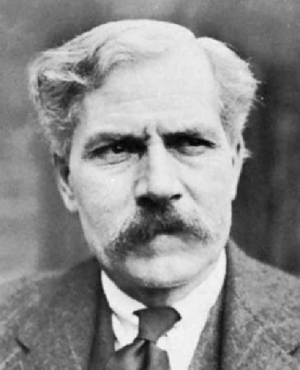
Ramsay MacDonald, first Labour Prime
Minister of Britain
|
Lord
Campbell of Croy
Gordon
T.C. Campbell, later Secretary of State for Scotland, was born
in Lossiemouth according to several of his obituary notices.
This fact surprised me as I do not recollect him ever saying it,
though he lived in and campaigned from the town, during his
period as a Conservative member of parliament, 1959 to 1974. He
was decorated for his war service, and left the army with the
rank of Major. His father had been a Major General, and his
mother was Violet Campbell the novelist. He married Nicola
Madan, who was a descendent of the great engineer Brunel. Much
has been made of the wounds he received in the last weeks of the
war. These kept him in hospital for a year, and left him with a
visible limp. He and his wife had three children, two sons and
a daughter.
Following
his death in April 2005, there were a number of adulatory
obituaries, most of them by Tory party grandees, but one which
was effusive, was by the veteran Labour MP, Tam Dalyell. From
all of these it appears that Campbell was a gentleman in the
best sense of the word, and that he had the skills of a quiet
but reliable diplomat. I guess his attributes lay in diplomacy,
or could have served him well as a senior civil servant. But as
a politician, he had distinct limitations. He could appear
distant, and unaware of the real problems and concerns of
ordinary people. His thinking at times was woolly. And as a
speaker, he could put any audience to sleep. Two incidents
stick out in my memory. The Sunday Post which was then a true
blue Tory newspaper, once remarked that Gordon Campbell “could be bested in a debate by a ‘speak your weight’ machine”!
When talking to him outside his house, in 1965 about my
work in the Zambesi valley, he expressed great interest it, “because he hoped there would be orders for boats for the Buckie
shipyards, from the Kariba fishery”. This was
preposterous. Buckie boats were powerful, modern, decked
vessels made for the North Sea. They cost then over £ 25,000.
The little open Kariba canoes, however well constructed, and
equipped with a modern outboard motor, cost less than £250 at
that time. |
I took an interest in
national politics in the early 1980’s when spending a bit more time each
year at our home in Baberton Farmhouse in Edinburgh. Malcolm Rifkind,
later British Foreign Secretary, was our local Member of Parliament. He
was an excellent constituency MP and never failed to respond to any
request I made. But it was Nationalist politics that interested me, and
I got to know prominent members of that party, including Jim Sillars,
Margo MacDonald, David Stevenson and Neil McCormick (later a Euro MP).
I also became friendly with the Liberal politician Donald Gorrie, later
both an MP and MSP. Donald was and remains, a man of deep sincerity and
integrity.
I sometimes accompanied
Sillars on his speaking engagements as did a young Alex Salmond, then an
economist with the Royal Bank, (now Scotland’s First Minister).
When Jim won the Glasgow Govan seat from Labour, overturning a 17,000
majority, though I was in Italy at the time, - I was one of the first he
telephoned after the count. Jim had started out in the Labour party for
whom he won Ayrshire South in 1974. He became disillusioned with Harold
Wilson and ‘London Labour’, and though being groomed for high office, he
attempted to set up a separate Scottish Labour party, and later joined
the SNP for whom he won the Govan seat. Quite unlike his pugnacious
public image, Jim was and is an extremely gracious and considerate
person, with a wonderful sense of humour, and an almost puritanical
lifestyle. He had a sharp and energetic political mind and would
prepare his positions on each issue with considerable thoroughness. I
greatly enjoyed debating these issues with him en route to and returning
from his speaking engagements in the early 1980’s.
Four political
friends. My early political heroes were mostly Labour Party pioneers.
During the ‘70’s and ‘80’s my political friends came from other
parties. Below are four of them, from Labour / SNP, SNP / Independent,
Liberal-Democrat, and Conservative parties :
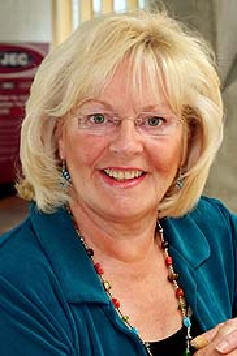
Jim Sillars, former Labour MP from South
Ayrshire, and later SNP MP for Govan, Glasgow
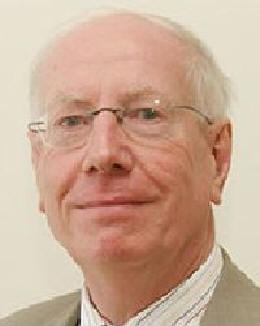
Margo MacDonald, former SNP MP, now
independent MSP, Edinburgh
Donald Gorrie, OBE, former Liberal
Democrat MP and MSP, Lothian
An odd coincidence
occurred in Sumatra in 1985, when I had been posted there by the Asian
Development Bank, to advise a bank-financed project that had fallen well
behind schedule. The project, based in Padang on Sumatra’s west coast,
was to construct a fishing port, three harbours, 300 fish farms, and
fleets of offshore tuna trollers, and inshore canoes. I arrived late
one Saturday night in February of that year, and was allocated a small
guest house as a residence. It was practically bereft of facilities, so
I went down-town to a Chinese-owned store to buy a short-wave radio. I
got back to the house as it was getting dark, and plugged the radio to
the electric socket. I fiddled with the tuning knob till I found the
BBC overseas service. The first voice that came booming over the
transistor radio was that of my good friend Jim Sillars. He was
speaking up for Scottish miners who had been on strike to protest pit
closures, and who were then being victimized by the Thatcher government
in ways that went far beyond legal justice.
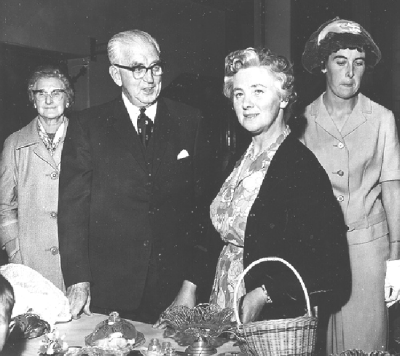
Sir William S. Duthie, OBE, Conservative
MP for Banff, with my mother
at a fishermen’s mission sale in 1965.
What brought about the
surge of interest in national politics was the asset stripping of
Scotland’s wealth by its big brother England, and later by its rich
uncle the European Union. The Daily Express once printed a list of
Scottish industries which it claimed would be lost if Independence came
about. Every one of the industries named (plus some more) were later
lost, not under an independent government but under a UK Government and
within the European Union. Scotland lost its shipbuilding and car
manufacture industries. The coal mines were all closed down. The steel
industry was sacrificed to maintain steel mills in England. The Rosyth
Naval dockyard was decommissioned contrary to pledges made, and the work
it did given to the south of England. Most of all, - North Sea oil,
that immense but limited resource of liquid black gold, was extracted
with all of the revenues and taxes going to the UK Government. The only
part of Scotland to obtain significant income from the oil was Shetland
where the young, competent and totally incorruptible Chief Executive Ian
Clark, negotiated substantial benefits for the region.
I met Ian several times
later when he was with BNOC. His brother used to live close to us at
Duffus and is married to a sister of one of my best friends. Most
unfortunately for Scotland, Ian was squeezed out of the national oil
company and went south to work for Costains. He is now retired and
residing in Campbeltown, Argyll.
The EU insanity of its
Common Fisheries Policy, is matched only by the madness of its Common Agricultural Policy.
Farmers in every corner of the country
have expressed to me their utter frustration at the waste and the
malevolence of EC interference in our national food production. Why
should a little cheese maker in Islay be forbidden to source its milk
from the local dairy, and have to buy it instead from the continent?
And why should both the cheese plant and the dairy farm have to close
down in consequence? Why were our small abattoirs closed down in favour
of large abattoirs located far from the farms? And why had the country
to suffer the horrendous outbreak of foot-and-mouth disease as a result,
with bureaucratic stupidity preventing less costly vaccination instead
of outright slaughter of thousands of healthy beasts?
Manufacturers tell me
the same story. For all the products they sell to Europe, they would
far prefer to be free of its mountains of paperwork and ridiculous
regulations, and sell instead to Scotland and to the rest of the world.
Most of those I have spoken to have said that if Britain was to remain
in the EU, and they had the chance of starting out again, they would
definitely not go into business.
The current asset that
Scotland is being robbed of is its fish resources. When every other
country was rightfully claiming a 200 mile exclusive economic zone in
accord with the UN Law of the Sea, the British Government handed ours
over to the European Union and gave European fleets equal access to our
fishing grounds. Under the European Common Fisheries Policy, the
Scottish fleet (the largest part of the British fleet) has been
systematically reduced to a rump of its former self while the enormous
Spanish fleet (equal in size to 50% of the combined European fleet when
Spain joined the Union), has been assisted to fish off West Africa, off
West Ireland, and now, in the North Sea.
My home town which once
possessed the largest fleet of seine net boats in Britain, is now a
marina for yachts, and from our family that financed and operated ten
boats since the war, there is not a single vessel in operation, and not
a single member of the extended family working in the fishing industry.
The local harbour that was once packed with fishing vessels each
weekend, is now empty but for a few yachts. The fish market that once
was filled twice a day with a range of fresh quality fish, lies totally
empty now.
One of my best friends
who built a modern stern trawler to fish on grounds over 500 fathoms
deep for non-quota species, saw that resource given almost entirely to
continental fleets, mainly French and Spanish. To maintain his vessel,
and keep his crew in work, he has had to fish on license from other
countries outside of the EU, - first for pink shrimp off Greenland, and
later for hake off Namibia. All this while European fleets are
permitted to harvest fish in Scottish waters. And up to the time of
writing, beautiful seaworthy Scottish fishing craft which could have
another ten to twenty years of productive life, are being scrapped to
satisfy a European ideology. Meanwhile subsidized new boats are being
constructed in Spain to prosecute the Scottish fishing grounds.
For over 20 years I
badgered politicians and civil servants about the madness and wickedness
of the Common Fisheries Policy, and took every opportunity to provide
witness statements to consultations undertaken by Westminster and
Holyrood, - but all to no avail. The authorities were blind and deaf to
facts and reason. Interestingly, not a single government or EU
supporter ever challenged my statements in the press. When a
fishermen’s association brought an Icelandic scientist and Faeroese
Fishery Minister to Scotland to speak on the issue, not a single
Scottish or British Minister was prepared to debate with them, nor would
any of our fishery scientists allow the Icelandic scientist to challenge
them in an open forum.
Even more than the East
coast, the Hebrides and west coast of Scotland have been hit hard by the
European Union Common Fisheries Policy, and the equally insane Common Agricultural Policy.
The area has also suffered from
successive government attempts, Labour and Conservative, to impose
monetarist policies and measures that benefit mainly big industry and
big landowners, - and even these interventions are beneficial to them
only in the short term. I attempted to describe some of the negative
results of these policies in a book, The Sea Clearances, which I
had discussed before publication with former HIE Chairman, and prolific
author, Jim Hunter, and with the great John Prebble before he died in
January 2001. I also wrote a paper on the subject for Scottish
Affairs, the parliamentary journal published by Edinburgh
University, but though several MSPs said they had read it with interest,
not a single one challenged its statements or conclusions.
I broadcast these
concerns on radio, in the press, and at conferences in academic,
environmental and political gatherings. Those who supported the EU
policies maintained a complete silence. I understood from their failure
to respond, that they had no credible arguments to justify the common
fisheries or common agriculture policies, or to defend their regulations
and measures. The few government fishery scientists, administrators
and economists that did discuss the issues with me, eventually admitted
(in private), that there was neither rationality nor sustainability to
the EU management programme.
Yet the Hebrides and
west coast region, that has suffered from government mistreatment and
neglect for so long, still retains a magic of its own that continues to
fire the imagination and stir the affections. Is it due to the scenery,
the climate, the people, the culture, the music, or the history?
Probably a combination of all of these factors plus an additional
romantic element that is captured or touched upon in writings as varied
as RLS’s Kidnapped, Neil Gunn’s many excellent novels, Fraser
Darling’s Highlands and Islands, and Adam Nicolson’s Sea Room.
(Adam is typical of the best of the descendants of landowners, who
truly loves and appreciates the region and its people, and sympathises
with their suffering. His book was highly praised in reviews, and
nominated for awards. I wrote to him after reading it with pleasure,
and told him that he was ‘a poet with prose’).
One of the things I
admire most about the west coast people, is their stoic diligence, and
humble determination to carve out a sustainable livelihood in that
sometimes harsh environment, despite the efforts of Brussels, London and
Edinburgh, to make that all but impossible. I recall the prawn creel
fishers of Achiltibuie, lacking harbour, pier or landing facilities,
still producing and marketing high quality nephrops, keeping them
alive in tubes over the ‘Sabbath’, and flying them from Inverness to
Spain to supply the lucrative continental market. I think of Sandy
MacDonald, expert boat builder and farmer, who I worked with in Africa
over 40 years ago. He and his dear wife Liz, have developed a farm,
sawmill, boatyard, whiskey blending business and occasional lobster
fishery, on the most westerly point of Scotland and the British
mainland, at Ardslignish, north-west of Tobermory.
The establishment of a
devolved Parliament with limited powers in Scotland, was something about
which I had mixed feelings, mainly because I felt it was not the real
thing. It had no power over the issues that really matter, like
economic policy, defense, and acceptance or rejection of European Union
measures. The performance of most (but not all) of the MSP’s since make
the place resemble a parochial town council rather than a national
parliament. There is a dearth of strategic thinking and vision, and an
abundance of shallow mediocrity and petty party dogma.
The unbelievable
mismanagement of the new parliament building at Holyrood in Edinburgh
(an architectural monstrosity), the cost of which increased from £40
million to over £450 million [Kirsty
Wark, the talented and experienced television interviewer who was
involved in design selection with a New Labour selected team, justified
the cost of the ugly carbuncle by stating that “if you picked the
cheapest tender, you would end up with a shed!”. Well, we ended up
with “a shed”, as it turned out, - the most expensive shed ever!] is just the worst example of the Executive’s cronyistic way of making
decisions and its incompetence and irresponsibility in managing
taxpayer’s money. Some private finance initiative projects display
similar short-sightedness and poor financial management.
As far as its limited
powers go, I am reminded of a priceless quote in a film about the
Mexican leader Benito Juares. When asked why he was not prepared to
accept the generous measure of responsibility that the Emperor
Maximilian was prepared to yield, his reply was to ask what it was
precisely that was being with-held. The answer in the film was, “I
suppose, it is the right to govern ourselves”. “Exactly”, responded
Juares, “and that is what we are struggling for”.
The treatment of
Scotland by successive UK Labour and Conservative Governments, and in
the past 30 years by the European Union in its various forms, which
together have connived actively or passively in the demise of the steel,
automobile, and coal industries, and the crippling reduction of
shipbuilding, fishing and textile industries, remind me of the words
that the Roman historian Tacitus attributed to the Caledonian Chief
Calcagus (Gaelcagus) following the battle of Mons Graupius : “We,
the most distant dwellers upon the face of the earth, the last of the
free, have been shielded intil now by our remoteness. But the Romans,
pillagers of the world have now exhausted our land by their
indiscriminate plunder. To robbery, butchery and rapine, they give the
lying name of ‘government’. They created a desert and called it peace.”
Due to the difficulties
of UK management of Scotland’s economy, there was considerable
emigration of Scots to Canada, USA, Australia and New Zealand during the
20th century. In the colonial era scots also emigrated to
South Africa, India, Sri Lanka, and other lands where their skills and
attitudes were welcome. A recent book by Rev Angus MacKinnon, Atlantic Voyage,
gives a definition of the attributes of the
emigrant Celt. “He is at home in every part of the globe, wherever
he is, as much as Jew or Arab. His mind carries with him all the riches
of his past. He travels light through the ages, because his nature is
not defined by geography, not his wealth by possessions. Volatile, prone
to fall, yet capable of rising to noble heights, he has a spiritual
ancestry that is somehow transmitted through generations. Thus in
countries like Canada, and in U.S. states like Montana and Carolina,
where Scottish highlanders settled during the 19th century,
there is more than a grain of truth to the refrain : “but yet the blood
is strong, the heart is Highland”.
In May 2007, an
election for the devolved administration in Holyrood, resulted in a
narrow victory for the Scottish National Party who gained a one seat
majority over Labour. This was the first time Labour had been beaten in
an election in Scotland since 1959. However, the Liberal Democrats who
were happy to join Labour in a coalition government, would not do so
with the SNP since they objected strongly to the nationalists’ policy to
put the Independence question to the Scottish people in a Referendum.
But by deft handling of the situation, First Minister Alex Salmond and
his minority Government, surprised friends and foes alike, and took a
number of initiatives in Scotland’s favour that the previous Labour /
Liberal-Democrat executive would not consider due to their deference to
Westminster. All the warnings of economic chaos and political
confusion, made repeatedly before by the unionist parties, were shown to
be quite false. Some began to change their tack, and started to admit
that Scotland could be self-sufficient and prosperous as an independent
state. Rather illogically they also began to fault the SNP for not
fully implementing nationalist policies which they (the unionist
parties) strongly opposed.
Then in May 2011,
against all predictions, the SNP won an overall majority in the Scottish
Parliement. This had been thought impossible, even for the Unionist
parties. Following that result, the leaders of the Labour, Conservative,
and Liberal parties in Scotland all resigned. A major outcome of the
election victory is that the SNP will hold a referendum on Independence
in 2015. The result of that vote may well witness further steps towards
real self-government in Scotland. |