|
Oh beautiful
for spacious skies,
for amber
waves of grain,
For
purple mountain
majesties, above the fruited plain!
America! America! God shed His grace on thee
And crown thy good with brotherhood, from sea to shining
sea!
Oh beautiful for
pilgrim feet, whose stern, impassioned stress,
A thoroughfare for freedom beat, across the wilderness!
America! America! God mend thine
every flaw,
Confirm thy soul in self-control, thy liberty in law!
Katherine Lee Bates 1913
I had not read much
U.S. history before
moving to America, but had immersed myself in some of its
poetry and light fiction. My father used to recite John Greanleaf
Whittier’s “Barbara Frietchie”, with great gusto, and I later
came to enjoy the verses of Longfellow, Lowell, Poe, Whitman, and
others, as well as the songs of Stephen Foster and Cole Porter, and the
books by O’Henry, Mark Twain, Zane Grey, Herman Melville, and Richard
Henry Dana. As a boy I loved to watch western movies, and devoured the
romanticized versions of the ‘wild west’ history, with the detailed
accounts of the different Red Indian tribes, that were probably as
manufactured as those of the different clans
in Scotland. Much later, books like “Bury My Heart at
Wounded Knee”, gave a more factual and far sadder account of that
period of American history.
The picture most of us
in UK or Europe acquire of the United States, is taken largely from the
cinema and television. Alistair Cook’s long-running “Letter from
America”, gave radio listeners a more observant picture of the land
of the free and its colourful people. When I first went to work in the
USA, it was a surprise to learn that most Americans were quite cautious
and conservative, unlike the swashbuckling characters of Western movies
or Rambo-like films. I lived
in Rhode Island, New England for two years, and that
admittedly is quite unlike the south or west of the country. New
Englanders are often termed “swamp Yankees”, a description that
emphasizes their dry uncommunicative characteristics. But the area like
much of America, is also a melting pot of Irish, Italian, English,
Scandinavian, Portuguese, and other European immigrants, so
generalizations are just that. I recall in New Bedford stopping a
stranger to ask the way, and being surprised by the response :
“Sorry, me Portuguese, - me no speak English” !
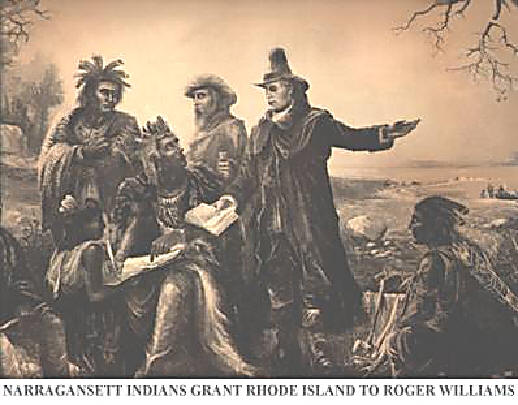
Rhode Island had been
founded by a Baptist,
Roger Williams, who was hounded out of Massachusetts by
its Calvinist leaders. The descendants of the Pilgrim Fathers who left
Britain to seek freedom to worship God, were not prepared to grant the
same freedom to others whose beliefs differed slightly from theirs.
Baptism of believers by immersion was not in their tenets. So Williams
moved south-west and founded the
State of Rhode Island and Providence Plantations, the
smallest in the Union. By the time I came to work there, there were not
so many Baptists around. Churches were fairly conservative, unlike in
California or
the Southern States. But little Rhody had a reputation as
a centre of Mafia activity, and the first few
week-ends I was there, the local godfathers were shooting
each other in supermarkets or restaurants. The police appeared to leave
them to it, perhaps reasoning that a self-inflicted cull of gangsters
might be in the State’s interest.
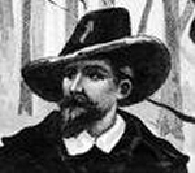

Left : Roger Williams the founder of the
State of Rhode Island and Providence Plantations
Right : Map of the State of Rhode Island
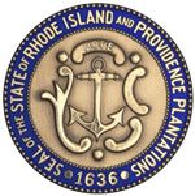
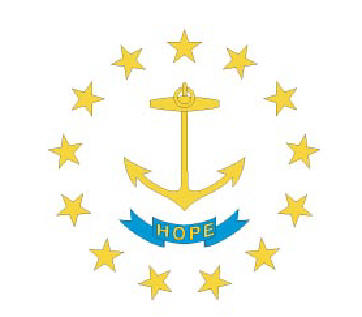
The seal and the flag of Rhode
Island. Note the motto, “hope”, and the symbol – the anchor.
|
Rhode Island
The smallest
State in the Union, with only around one million inhabitants,
and sandwiched between Connecticut and Massachusetts, the “Ocean
State”, or ‘Little Rhody’ as it is more commonly called, was
named after an island in Narragansett Bay that was thought to
resemble the island of Rhodes in the Mediterranean. One of the
New England states, it forms a rough north-south rectangle, 48
by 37 miles, with its southern border facing the sea at the
outer end of Long Island Sound.
Its full title
is “the State of Rhode Island and Providence Plantations”. Once
the home of various groups of Mahican Indians, it was
established as a colonial territory in 1636 under a charter from
the English king. The charter permitted a remarkable degree of
freedom of worship, which was the chief desire of its founder, a
former English clergyman, Roger Williams. It was the first of
the American States to renounce allegiance to King George III,
on 4th May 1776. Yet it was the last of the original
13 States to join the Union, which it did on 29th May
1790. Since then Rhode Island has continued to be something of
a maverick state, and tends to vote for the Democratic party,
even during years of Republican landslide votes.
Roger Williams
gave the State its beautiful motto “Hope”, and its symbol, - an
anchor. To this day, the motto and symbol adorn all State
buildings, letterheads and furnishings. Roger Williams was a
Baptist, but today over 60 per cent of R.I. people are Roman
Catholic, an indication of the degree of influx of immigrants
from Europe. The State flower is the violet, its bird is
unsurprisingly the Rhode Island red, and its tree is the red
maple. We lived in West Kingston, near to the University where
I served as an Assistant Professor for two years. The States
ocean heritage was reflected in the many marinas, the naval base
at Newport, and the graduate school of oceanography at the
university. There was and is a flourishing fishing fleet at
Galilee, supported by a successful fishermens’ cooperative at
Point Judith. Apart from flounder, hake, cod and herring, the
fleet produces prized lobster, and some swordfish.
When we arrived,
John Chafee was Governor. He was later Secretary to the Navy,
and after that became one of the State’s Senators. He died in
1999 and was succeeded by his son Lincoln. In our time, the
Senators were John O. Pastore who was a senior member of the
foreign affairs committee, and Claiborne Pell, who was active in
marine affairs. The Kennedy family owned lavish homes in the
State, and often holidayed in, or rather, cruised around, the
islands just offshore, - Block Island, Martha’s Vineyard, and
Nantucket Island, (the latter two being part of Massachusetts
State). |
For me one of the first
clear differences of the USA from Britain, was that the whole society
was remarkably democratic. From village halls to school boards, to
congress and the senate, Americans treasure and respect their open,
transparent systems. The nation is also largely free from the class
distinctions that plague England. Wealth is perhaps the one distinction
that is respected. But in academic institutions, like the one I had
been appointed to, there was a remarkable absence of rank, or its
importance. I had hardly started work when I was asked to join a Marine
Resources Committee which included the head of the Graduate School of
Oceanography, and later Under-Secretary for Commerce, Dr John Knauss.
At our first lunch meeting, they were discussing the marine and
fisheries programmes and how they might best develop. Dr Knauss turned
to me and asked, “Dave, what do you think?”. I nearly choked on
my coffee and ham sandwich at the question. No one of his rank in a UK
University at that time, would have been so ready to consult the
institute’s most junior member of staff like that.
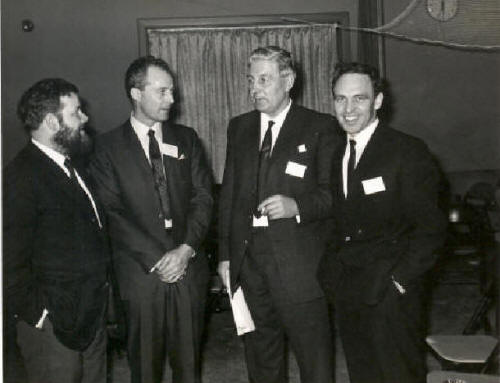
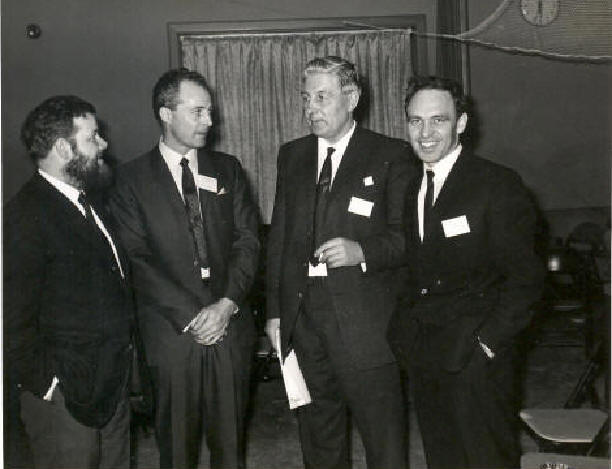
With staff and conference speakers at the
University of
Rhode Island, 1968.
The democratic and
almost class-less nature of American societies and institutions was
impressed on me later when I was invited to be one of the speakers at
the Boston Fish Expo which was also addressed by illustrious characters
like Senator Edward Kennedy, Senator Magnasson of Washington (who gave
his name to the new Fisheries Act), and a NASA scientist. I became
close to the head of the Point Judith Fisheries Co-op, Jake Dykstra, who
though a working fisherman to this day, was on first name terms with
many Senators and Congressmen due to his sagacity and leadership
skills. With Dykstra’s support I was to organize an applied research
project at the local port, funded by the then Bureau of Commercial
Fisheries, (now National Marine Fisheries Service). The experiment
worked extremely well giving the fleet an extra source of winter income
from herring, and generating a welcome profit for the Co-op’s meal
plant. The Bureau chief offered to fund any project I thought would be
profitable, the following year, but by that time I was moving on to
other fields of work. I was also invited to join the Oregon State
University which had an active fisheries programme. The Pacific coast
and the western forests were fresh and inspiring, so it was with
reluctance I declined the offer.
Part of URI campus
I managed to visit a
number of other American States, - mostly the seaboard ones. The list
includes New Hampshire, Maine Vermont, Massachusetts, Connecticut, New
York, New Jersey, Maryland, Washington DC, Texas, Colorado, New Orleans,
Alabama, Mississippi, Florida, Washington, Oregon, California and
Hawaii. A trip round the Gulf ports included stops at Brownsville,
Texas; Baton Rouge, Louisiana; Biloxi, Mississippi; Mobile, Alabama; and
St. Petersburg, Florida. Biloxi was one of the towns to be hardest hit
years later, by hurricane Katrina at the end of August 2005.
A working visit to Long
Island was typical of life in America. A swordfish skipper, Phil Rhule,
invited me there to advise him on seine fishing for hake and flounder.
He had me delivered back to Rhode Island by local float plane which
landed in Point Judith harbour. The pilot flew over the area and asked
me to show him where I’d parked my car. He then landed in the creek
adjoining the harbour and taxied up alongside the shore to the car park
where I’d left my Chevrolet.
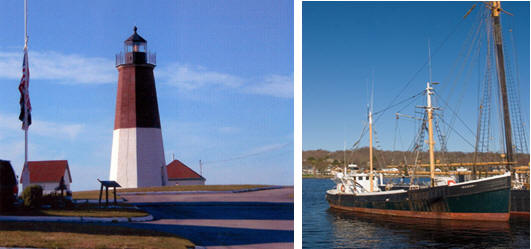
Lighthouse at Point Judith, Galilee, Rhode Island New
England dragger

I enjoyed the west
coast and Hawaii more than the eastern states, although heavily wooded
New England was glorious in the fall of the year. As a fisheries man, I
have happy memories of clam bakes in Maine, clam chowder in
Massachusetts, grilled swordfish steaks and lobster dinners in Rhode
Island, shrimp gumbo in the Gulf States, and Japanese sashimi in
Hawaii. A visit to Oregon’s wide open spaces and rugged coastline,
gave me a picture of the more unspoiled parts of the American West. On
a journey from Corvallis to Newport on the coast, my host stopped to
attend a lunch meeting of the local Rotary Club. The speaker that day
was a young University student who had decided she should educate the
older generation on the music beloved by the new younger people of the
country. It was my first introduction to Simon and Garfunkel, and
proved to be a pleasant and memorable experience.
When you’re weary,
feeling small
When tears are in your eyes, I will dry them all;
I’m on your side. When times get rough
And friends just can’t be found,
Like a bridge over troubled water I will lay me down. Paul Simon, 1969
Newport Oregon was
later to become a centre of fishery and ocean science when a large
Marine Science facility was established with support from NOAA and OSU.
Its impressive new Library building was to be named after Captain Barry
Fisher, former Gloucester schooner fisher, and dragger captain on the
east coast. I first met Barry in 2007, when I made a trip to sea on his
New Bedford based dragger in which he was then experimenting with the
Scottish seine. We became great friends and he later visited us in UK.
I was instrumental in arranging his first appointment to the Oregon
State University. Following that he did great pioneering work in the
north Pacific fishery.
|
Barry Fisher
- a great pioneer fisher
Born in
Gloucester Massachusetts in 1929, and died in Newport Oregon in
2001, Barry Fisher was a colourful and charismatic figure in
fishery circles wherever he went, but chiefly in Oregon and
Alaska from where he conducted a number of pioneer offshore
fishery ventures. The best known was his joint venture with
USSR factory ships which had been prohibited from trawling
inside the American 200 mile EEZ. Barry agreed to catch fish
for the Soviet fleet, and to sell and transfer the catches to
the factory ships at sea. This was done by using detachable
bags on the trawls, and simply un-zipping them and attaching
them to buys. The factory ship was then informed by radio and
proceeded to pick up the bag full of fish and draw it up the
stern ramp. The trawl bags were later dropped into the sea near
Fisher’s vessel which could recover them for further use. Barry
also led a Cooperative for midwater trawl fishers, and supported
applications of marine science to the huge fisheries of NW USA
off the coasts of Alaska, Washington, and Oregon.
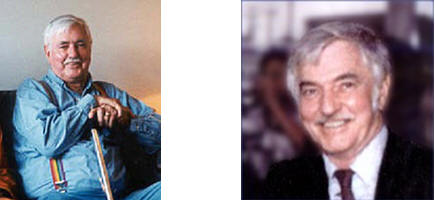
Captain Barry Fisher, fishing pioneer, leader, and spokesperson.
Barry was
respected and admired by fishermen from Alaska to Scotland, and
by senior officials in government and business. Two of these
were Alexander Popov, President of Russia’s Binom fishery
company, and Senator Ron Wyden of Oregon who spoke of him at the
dedication of the building in his honour. He was an impressive
speaker, whether in the cabin of a fishing boat, or on an
international conference platform. He had a poetic gift and
salty wit in expressing ideas in effective ways. To this day,
those who heard that speech recall his talk entitled “How to
take your wife to Hawaii on 2 cents a pound !” Fishermen and
fishery officials as far apart as West Samoa, and Grimsby
England, were captivated by his enthusiasm and colourfully
expressive talk.
A ‘Doryman’
report states : “Fate shoe-horned into one man's skin the
energy, intelligence, creativity, courage and goodwill of half a
dozen ordinary people. It's easy to get lost in the maze of his
activities and achievements -- but what an awe-inspiring
landscape to be lost in.
Barry Fisher was
a Gloucesterman. Add the name "Fisher" to a birthplace like that
and it would be hard indeed not to go to sea. Barry did it as
young as possible -- after "lumping around the wharves from age
11" -- by joining the U.S. Merchant Marine. This was in 1943: by
war's end, still in his early teens, he had seen North Africa
and the Mediterranean, witnessed the Allied re-invasion of
France, been on the infamous Murmansk convoy in the Russian
Arctic, and had his ship torpedoed from under him by a German
U-boat.
After the war,
he was granted just a few short years of peace in which to roam
the east coast fisheries, from North Carolina's Cape Hatteras to
Newfoundland's Grand Banks. Then came Korea, and during two
tours of combat duty in the U.S. Army he collected a
shoulder-load of medals, including two Bronze Stars, the Combat
Infantry badge, three Purple Hearts, the Army Commendation
medal, the U.S. Presidential and Korean Presidential
Distinguished Unit citation, and four Battle Stars on his Korean
Service medal.
In a subsequent
engagement, this "dauntless leadership" left him recovering from
serious wounds in an Army hospital. But relaxation wasn't
Barry's style; he used the time to get a GED, and the GED took
him to Harvard, where he earned a B.A. in History.
Harvard was
important to him for more than just books, however. While there,
he met and married Carol Lee Smith. In 1955 and 1957, his sons
Christopher and Frederick were born. After a period on a timber
cruiser in South America, he came back to Harvard for a Master's
in Education, and then came the first of several periods of
teaching.”
In 1964, Barry
bought a 65-foot dragger and returned to fishing out of New
Bedford. However, it was the west coast fishery that attracted
him, and four years later he accepted a post as Associate
Professor of Fisheries at Oregon State. That became a
springboard into the Bering and Alaska Sea fisheries, and his
now legendary pioneering work with the Pacific fishers.
During and after
his commercial fishery work in the Pacific he contributed
heavily to marine fisheries programs at Oregon State
University's Hatfield Marine Science Center. He also supported
the Oregon Coast Aquarium, the Conservation Law Foundation, and
other organizations too numerous to list. From 1983, he was
president of Midwater Trawlers Cooperative, and was an effective
spokesman for fisheries interests at the highest levels of
regulation and government. In 1985, he was re-appointed to the
OSU faculty, this time as Professor of Fisheries.
Dr William
Hogarth of NOAA praised Captain Fisher at the dedication of the
Library building in his honour. "This dedication is a real
tribute to Barry," said Dr. Hogarth. "It is a tribute to his
vision and will become part of his exceptional legacy. Here,
NOAA Fisheries will make a substantial investment in the science
of fisheries, and I think Captain Fisher would approve."

F.V. Excalibur was Barry Fisher’s final command. It fished
exceptionally well in the north Pacific. |
Two
major racist blots mar the history of the United States of America. The
first was slavery which provided forced labour for the cotton fields and
farms of the southern states for over a century, and its after-effects
of racial discrimination for the next hundred years. Much of the horrid
truth of the treatment of slaves in the USA (a mere 150 years ago) has
been obscured and romanticised by books like Uncle Tom’s Cabin,
and films like Gone with the Wind. Anyone brave enough to read
an unvarnished factual account of the behaviour of slave owners in the
southern states (and beyond), should see the narrative of the life of
Frederick Douglass, An American Slave, - ‘written by himself’ in
1845. What is deeply troubling about the picture painted by Douglass,
more than the cruelty and injustice, is the incredible hypocrisy of the
slave owners who were mostly (on the surface) devout churchgoers and
office holders, - often leading prayer meetings and revivals, yet
abusing and whipping their slaves severely and forbidding them any
education, religious or secular.
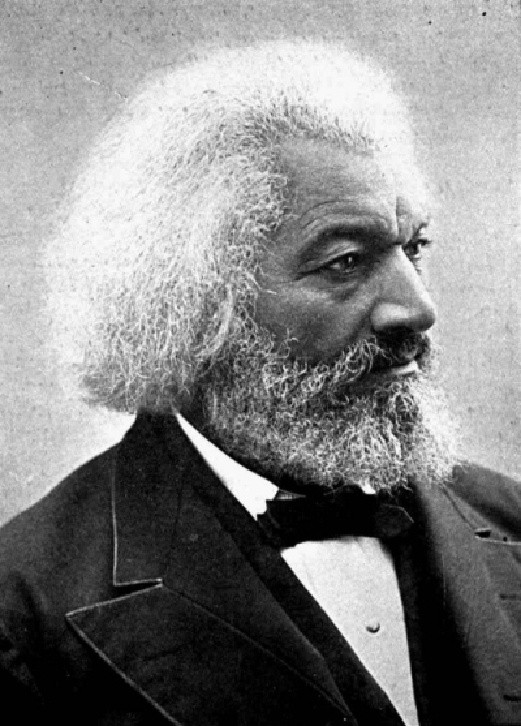
Frederick Douglass, author of the
powerful and moving testimony, “an American Slave”. His book is the
best eye witness account of the life of slaves in the U.S. southern
states in the 19th century.
The
second was the ethnic cleansing of the mid-west of Red Indian tribes, to
have their lands expropriated by ranchers, gold miners, and railroad
companies. In the process, the U.S. government broke practically every
promise and treaty made to guarantee protection of their traditional
lands and later reservations. One of the foremost proponents of the
policy of “manifest destiny” as U.S. imperialism and expansion was then
described, to give it some kind of divine right, was the Civil War hero,
General Sherman. Sherman was a fierce soldier who believed in fighting
total war, and who led his troops in destroying much of the
infrastructure of the Confederate south. After the Confederate
surrender he expressed his own revulsion at the horrors and carnage of
war. But his military instincts came back to the fore during the
conflict with Red Indian tribes. He wrote to General Grant, “We must
act with vindictive earnestness against the Sioux, even to their
extermination, men, women, and children.” He advocated the
widespread slaughter of Buffalo herds to deny Indian tribes their main
source of meat and hides. A railroad shareholder, he believed expansion
of the railway would be a powerful weapon in the programme to eliminate
the whole Red Indian race.
One of his most enthusiastic military
officers was Lt. Colonel (called ‘General’ because of his volunteer rank
in the confederate army), George Armstrong Custer. Custer had graduated
with the lowest marks of his army college class. He was twice court-martialled,
and had a reputation for disobeying orders and making his own
decisions. Custer was based at Fort Riley in 1866, and given the
command of the 7th Cavalry. From northern Texas to what is
now east Colorado and west Kansas, to South Dakota, and Minnesota, his
troops harried and murdered Indian people, raping women and destroying
villages. They participated in and encouraged the slaughter of buffalo,
and had gold prospectors enter Indian lands contrary to the U.S.
government treaties.
The brutal and
swashbuckling Lt. Col (sometimes called ‘General’) George A. Custer. A
flamboyant and controversial character, he was court-martialled at least
twice, but always managed to get himself reinstated and ended his days
leading the 7th Cavalry at the battle of the Little Big Horn
River June 25 1876. The battle was intended to crush Black Hills Sioux
and Cheyenne Indian resistance to the take- over of their lands
previously guaranteed to them by the United States government.
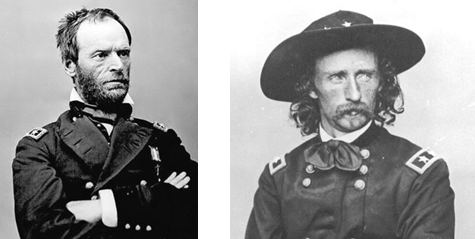
General William Sherman, Union army
hero Lt. Col. “General” George Custer, former
who applied total war concepts in both Confederate
army officer who later led the
the Civil War and the Indian wars 7th
Cavalry into the battle of Little Big Horn
The famous last stand of ‘General’ Custer
at the Little Big Horn river, has been glamourised and romanticised over
the years. Some accounts talk of the 7th Cavalry
encountering over 25,000 Indian tribes peoples who overwhelmed and
killed them. Indian versions of the incident mention only a few hundred
braves and their families. They claim that Custer either shot himself
to avoid capture, or was killed by a squaw wielding his own sabre.
Indian accounts are probably as fanciful as the western press and
Hollywood romanticised versions of the battle. Reports differ on how
many soldiers were killed. It appears that there were 197 under
Custer’s direct command, and 73 killed of those who were in the other
two detachments that survived the encounter with the Sioux who were led
by chiefs Sitting Bull and Crazy Horse. Crazy Horse later stated :
"I was hostile to the white man ... We preferred hunting to a life of
idleness on our reservations. At times we did not get enough to eat and
we were not allowed to hunt. All we wanted was peace and to be let
alone. Soldiers came...in the winter..and destroyed our villages. Then
Long Hair (Custer) came... They said we massacred him, but he would have
done the same to us. After that I lived in peace, but the government
would not let me alone. I was tired of fighting...”
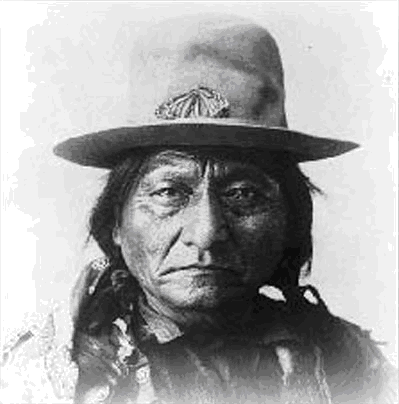
Sitting Bull of the Sioux Hunkpapa
tribe. A Latoka medicine man and chief,
he was killed by reservation police on December 15 1890.
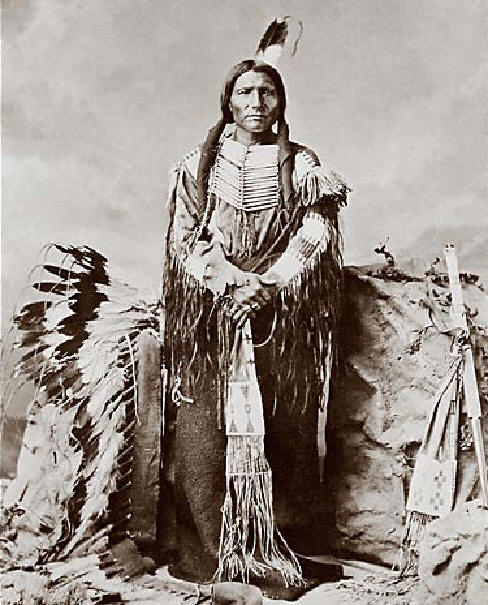
Chief Crazy Horse (Tashunka Witco) of the
Black Hills Oglala Sioux. He was bayoneted and killed by a soldier at
Fort Robinson on 5th September 1877 after surrendering to
government troops.
One of
the final tragic incidents happened on 29th December 1890,
when American troops killed over 300 Miniconjou Indians, including
women, old men and children, led by the infirm Spotted Elk or ‘Big
Foot’. It was standard practice to attack Indian villages during the
winter when families would be together in their tents, and those who
survived would probably die of exposure or starvation. This occurred at
Wounded Knee creek in South Dakota. That same year, old Chief Sitting
Bull who had been given assurances of his and his people’s safety after
they surrendered, was killed while resisting arrest for allowing a ghost
dance to take place. Below are some expressions of Indian views of
their treatment.
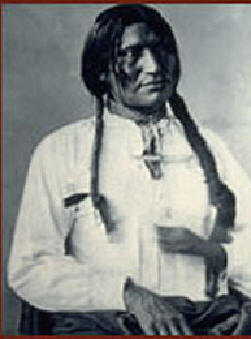
Chief Spotted Elk (Big Foot) of the
Minneconjou people, Teton Sioux
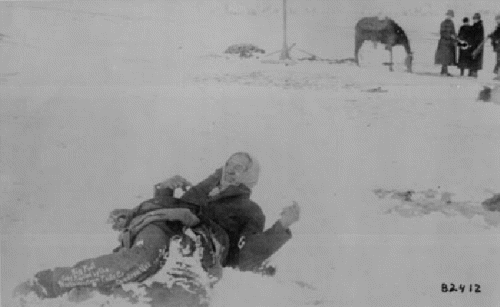
Old infirm Spotted Elk, massacred along
with 200 of his people on
29 December 1890 by Col. James Forsyth and his troop of soldiers.
"Where today are the Pequot? Where
are the Narragansett, the Mohican, the Pokanoket, and other once
powerful tribes of our people? They vanished before the avarice and
oppression of the White Man, as snow before a summer sun. Will we not
struggle, should we give up our homes, our land bequeathed to us by
the Great Spirit, the graves of our dead and all that is dear and sacred
to us? 'Never!”* Tecumseh Shawnee, (from Native
American Quotes).
"The white people, are trying to make
us into their image, to be what they call "assimilated," bringing us
into the mainstream and destroying our own way of life and our own
cultural patterns. They believe we should be like those whose concept of
happiness is materialistic and greedy, which is very different from our
way. We want freedom from the white man rather than to be intergrated.
We don't want any part of the establishment, we want to be free to raise
our children in our religion, in our ways, to be able to hunt and fish
and live in peace. We don't want power, we don't want to be congressmen,
or bankers....we want to be ourselves. We want to have our heritage,
because we are the owners of this land and because we belong here. The white man says,
there is freedom and justice for all. We have had "freedom and justice,"
and that is why we have been almost exterminated. We shall not forget
this."*
(Grand Council of
American Indians, 1927)
The first American
election I took any interest in was the 1960 contest between Richard M
Nixon and John F Kennedy, to replace Dwight D Eisenhower as President of
the most powerful country in the world. This was the first election in
which television played a major part. The public debate between the two
young candidates of similar ability was deemed to have been crucial in
determining the outcome. I watched the televised debates with interest
at our home in Scotland, and was not surprised that Kennedy won by a
narrow margin. Along with millions of young persons in January 1961, I
was impressed by his inauguration speech:
“Let the word go forth from this time and place to friend and
foe alike, that the torch has been passed to a new generation of
Americans – born in this century, tempered by war, disciplined by a hard
and bitter peace, proud of our ancient heritage – and unwilling to
witness …the undoing of human rights. We shall pay any price, bear any
burden, meet any hardship, support any friend, oppose any foe, to ensure
the survival and success of liberty“.
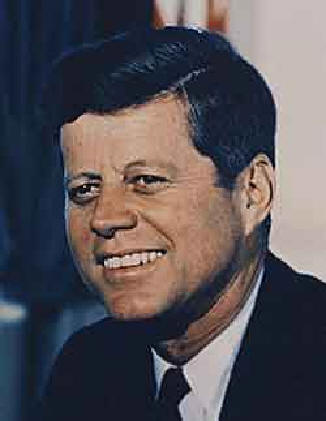
Above : President John F.
Kennedy, assassinated 22 November 1963
Just 2½ years later I
was lying in a warm bath in my house in the Zambesi valley with the
radio switched on to the BBC overseas service. An announcer interrupted
the light music programme to say something about a President having been
assassinated. I thought she had said “Kennedy”, but reflected, “surely
not!” Sadly the news bulletin that followed confirmed that it had
indeed been John F Kennedy who had been murdered. [Conspiracy
theories have abounded since the death of President Kennedy. I have no
more insight on the event than other concerned observers, though I was
never convinced that Lee Harvey Oswald was guilty. He was a CIA
employee most of his life, and was based in the Dallas CIA office
(despite continuing misinformation to the contrary). The murder appears
to have been the product of an unholy alliance between anti-Castro
Cubans, southern white supremacists, and elements of the Mafia, with
possible encouragement from Hoover’s FBI and the military-industrial
complex. It is interesting to note that before she died, Jackie Kennedy
warned Hillary Clinton that her husband should be very very careful,
since he like Jack, evoked strong feelings of support or hostility.]
The Vice-President from
Texas, Lyndon Johnson, assumed responsibility immediately after the
assassination. One of his first acts was to increase substantially, the
military expenditure in men and arms, on Vietnam. He was opposed in the
1964 election by Senator Barry Goldwater, whose hawkish views on the
Vietnam war, and right-wing attitudes to the economy, got him portrayed
as an extremist by the media. Johnson won by a landslide, and then went
on to do most of the things Goldwater had advocated. It was rather like
the way Tony Blair won the British 1995 election by his contrast with
Margaret Thatcher (rather than John Major, his milder opponent), and has
since gone on to out-Thatcher Thatcher on many domestic and foreign
policy issues. In fairness to Johnson, he did try hard to prosecute his
“war on poverty”, and he did support integration of schools, and the
granting of civil rights to black people, both being measures for which
Goldwater failed to show much enthusiasm.
Johnson was in some
ways an enigmatic character. On the one hand he was largely responsible
for the enormous build up of the American war effort in Vietnam. Some
thought he was sold out completely to the military industrial
corporations (in which his wife Lady Bird was a large shareholder). Yet
he also sought to pursue the ‘war on poverty’, (with about as much
success as George Bush junior pursued the ‘war on terrorism’). He got
the Civil Rights Act passed in 1964, and appeared to support the work of
Dr Martin Luther King. Yet at the same time, he allowed the notorious
FBI chief, J. Edgar Hoover, to tap Dr King’s telephones, and to spread
whatever negative and slanderous material he dug up about him. Not much
of a church goer or a professed believer, he had Dr Billy Graham visit
and preach at the White House more than any other President, - much more
in fact than Richard Nixon who the press claimed was Billy Graham’s
close friend.
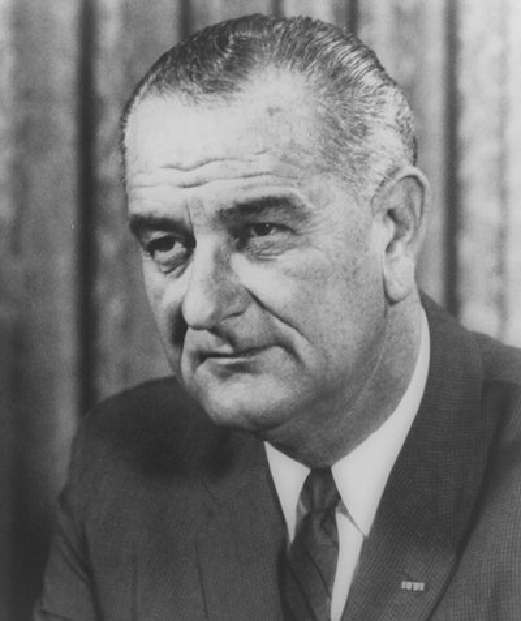
President Lyndon B. Johnson
America’s campuses were
in fervent opposition to the Vietnam war when I arrived. Its black
communities had been struggling and fighting for justice for nearly ten
years, under the inspired leadership of Martin Luther King and other
civil rights leaders. That movement was not much in evidence in New
England which had very small populations of blacks and coloureds, but it
was strongly supported by the academic communities and liberal whites.
King himself did not trust the liberal whites much as he correctly
discerned that for many of them their support was intellectual rather
than genuine and practical, and that most of them cautioned patience and
only passive action. I recall similar attitudes by Africans who would
trust the word of a white Afrikaaner although they did not like him, but
would be skeptical of liberal whites whose support or sympathy was seen
as shallow and unreliable.
Luther King was a
remarkable charismatic figure who was also well educated and had thought
out his positions after deep study of the political, social and
theological principles involved. He was also an inspired orator in the
tradition of the colourful black preachers of the deep south. His
father, grandfather and great grandfathers had been baptist preachers,
and he saw himself as such, although his theology was less than
orthodox. Below are some quotations from the first six years of his
struggle against racism.
“If we
arrested every day, if we are exploited every day, if we are trampled
over every day, don't ever let anyone pull you so low as to hate them.
We must use the weapon of love. We must have the compassion and
understanding for those who hate us. We must realize so many people are
taught to hate us that they are not totally responsible for their hate.
But we stand in life at midnight, we are always on the threshold of a
new dawn. (1956)
Love is
creative and redemptive. Love builds up and unites; hate tears down and
destroys. The aftermath of the 'fight with fire' method which you
suggest is bitterness and chaos, the aftermath of the love method is
reconciliation and creation of the beloved community. Physical force
can repress, restrain, coerce, destroy, but it cannot create and
organize anything permanent; only love can do that. Yes, love—which
means understanding, creative, redemptive goodwill, even for one's
enemies—is the solution to the race problem. (1957)
I am
convinced that love is the most durable power in the world. It is not …
impractical idealism, but practical realism. Far from being the pious
injunction of a Utopian dreamer, love is an absolute necessity for the
survival of our civilization. To return hate for hate does nothing but
intensify the existence of evil in the universe. Someone must have sense
enough and religion enough to cut off the chain of hate and evil, and
this can only be done through love. (1957)
In our
struggle against racial segregation in Montgomery, Alabama, I saw at an
early stage that a synthesis of Gandhi's method of nonviolence and the
Christian ethic of love is the best weapon available to Negroes for this
struggle for freedom and human dignity. The Gandhian approach may well
bring about a solution to the race problem in America. His spirit is a
continual reminder to oppressed people that it is possible to resist
evil and yet not resort to violence.* (1958)
The
reason I can't follow the old eye-for-an-eye philosophy is that it ends
up leaving everyone blind. Somebody must have sense and somebody must
have religion. We are moving up a mighty highway toward the city of
Freedom. There will be meandering points. There will be curves and
difficult moments, and we will be tempted to retaliate with the same
kind of force that the opposition will use. But I'm going to say to you,
'Wait a minute, Birmingham. Somebody's got to have some sense in
Birmingham.' (1963)
I
cannot make myself believe that God wanted me to hate. I'm tired of
violence, I've seen too much of it. I've seen such hate on the faces of
too many sheriffs in the South. And I'm not going to let my oppressor
dictate to me what method I must use. Our oppressors have used violence.
Our oppressors have used hatred. Our oppressors have used rifles and
guns. I'm not going to stoop down to their level. We have a power that
can't be found in Molotov cocktails. (circa 1963)
Non-violent direct action seeks to create such a crisis and establish
such creative tension that a community that has constantly refused to
negotiate is forced to confront the issue. It seeks so to dramatize the
issue that it can no longer be ignored... I am not afraid of the word
tension. I have earnestly worked and preached against violent tension,
and there is a type of constructive tension that is necessary for
growth. (1963)”
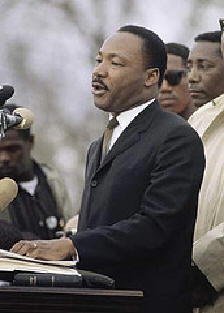
Dr Martin Luther King, assassinated 4
April 1968
Lyndon Johnson was
still President when I arrived in the USA in 1967, to take up an
appointment with the University of Rhode Island. His Vice-President,
Hubert Humphrey came to the URI campus to deliver a speech, and our
Department was asked to drive him and his entourage from the helicopter
pad to the auditorium. An anti-war demonstration was being held
opposite the auditorium, led by radical economics Professor Riach (whose
classes I happened to be attending in my spare time). Humphrey
attempted to reason with the protestors for a few minutes, - to the
consternation of his body guards, - but gave up quickly and went inside
to make his speech. There was a scuffle, and Professor Riach got
arrested, so we had no lectures from him for a couple of weeks. (Riach
appeared on the third week and prefaced his lecture with a remark on how
helpless and vulnerable a poor man was under the American judicial
system.) On a slightly amusing note, there was also a lone anti-protest protestor
carrying a banner, “End this Jewish-Communist plot”, and with a
voice that matched the combined shouts of the crowd. So we had alternate
cries of : “Stop the war!” – “Bomb Hanoi!” - “Stop the war!” – “Bomb
Hanoi!”
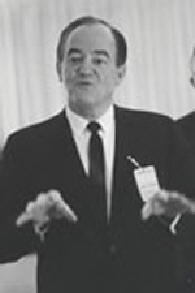
Vice President Hubert Humphrey
Throughout America,
campuses seethed with unrest over the Vietnam war. The protest songs of
Bob Dylan, Joan Baez, and scores of other ballad singers, were then
becoming the hymn book of the anti-war youth. A favourite was “Where
have all the flowers gone”.
Where have all the flowers gone, long time passing?
Where have all the flowers gone, long time ago?
Where have all the flowers gone?
Young girls have picked them everyone.
Oh, when will they ever learn?
Oh, when will they ever learn?
Where have all the young girls gone, long time passing?
Where have all the young girls gone, long time ago?
Where have all the young girls gone?
Gone for husbands everyone.
Oh, when will they ever learn?
Oh, when will they ever learn?
Where have all the husbands gone, long time passing?
Where have all the husbands gone, long time ago?
Where have all the husbands gone?
Gone for soldiers everyone
Oh, when will they ever learn?
Oh, when will they ever learn?
Where have all the soldiers gone, long time passing?
Where have all the soldiers gone, long time ago?
Where have all the soldiers gone?
Gone to graveyards, everyone.
Oh, when will they ever learn?
Oh, when will they ever learn?
Where have all the graveyards gone, long time passing?
Where have all the graveyards gone, long time ago?
Where have all the graveyards gone?
Gone to flowers, everyone.
Oh, when will they ever learn?
Oh, when will they ever learn?
Pete Seeger, 1961
Lyndon Johnson eventually decided not to seek re-election
after Senator Eugene McCarthy (not at all to be confused with the
infamous Senator Joseph McCarthy) won 20 of the 24 delegates in the New
Hampshire Democratic primary. To many people it seemed that Johnson
withdrew because Robert Kennedy had decided to enter the race for the
Democratic nomination. However, as a close observer in the country at
that time, it was clear to me that Bobby Kennedy decided to make his bid
only after seeing how the McCarthy campaign was gaining remarkable
steam, and attracting huge crowds of disaffected youth. McCarthy beat
Kennedy in the Oregon primary (I think that was the first election
defeat for a Kennedy in the USA). As things turned out, Bobby Kennedy
was assassinated on June 4th after narrowly beating McCarthy
in the California primary, and Hubert Humphrey won the nomination of his
party with significant help from Mayor Daley of Chicago, and deals made
by the Democratic power brokers, behind closed doors in smoke-filled
rooms. But it was to no avail, Richard Nixon won the election, or
rather Humphrey lost since the anti-war voters did not trust him. He
also lost democrat votes in the South due to the third party candidature
of George Wallace. But for my money, - if Bobby Kennedy had stayed out
of the race, - Eugene McCarthy would have been the next President of the
United States.
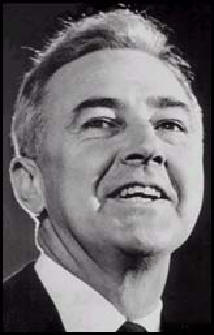
Above : Senator Eugene McCarthy
(Incidentally, one of the many youthful supporters of Eugene McCarthy
and his anti-war stance in 1968, was a Miss Laura Welch, a less than
conservative Texan Democrat, who was to wed George W. Bush 9 years
later, and go on to be America’s First Lady when George was inaugurated
as President in January 2001. Not surprisingly, she adopted quite
different political views on her marriage to George.)
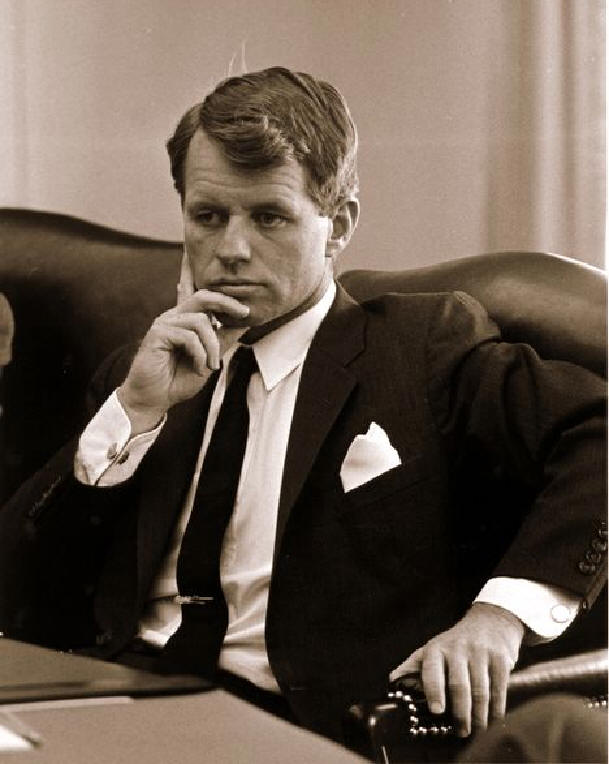
Robert Kennedy, assassinated 6 June 1968
That Eugene McCarthy
might have won the 1968 election, I would qualify the above by adding, -
“depending on the influence of the military-industrial complex”. This
enormously powerful lobby group which President Eisenhower had warned
about on leaving office, had grown fat on the spoils of the Vietnam
war. It was said that Johnson’s wife “Lady Bird”, was a major
shareholder in one of the biggest military corporations. Some surmised
that the military-industrial group may have been behind the JFK
assassination, and that they used an unholy alliance of anti-Castro
Cubans and southern supremacist whites to carry it out. The one was
seething with rage at what they saw as Kennedy’s betrayal of the “Bay of
Pigs” invasion adventurers, and the other was equally furious at the
support John and Robert Kennedy gave to the black civil rights movement
in the southern states. [Some
have surmised that there are references to the Kennedy assassination
plot in the White House tape recordings of Richard Nixon. He kept
trying to get the FBI, the CIA and Congress to stay out of the Watergate
investigation. “Tell them this will open the whole Bay of Pigs
thing”, he ordered his subordinates. The “Bay of Pigs thing”,
informed observers claim, was code for the Kennedy assassination by
some vengeful CIA officers and Miami Cubans, possibly aided by mafia
bosses and southern white supremacists.]
I guess we may never know. Certainly Lee Harvey Oswald was not the
assassin. He was a CIA employee till the day he died, and as he said in
one of the few statements made after his arrest, - he was set up, - he
was a “patsy”. I say this having read all the evidence I could obtain,
including the many official and semi-official attempts to portray Oswald
differently.
Do I know of any
evidence for that, other than what I have read in newspapers and books?
Only this tiny bit, and it is hearsay evidence. Clay Kelly was 18 years
with the CIA, much of the time in Vietnam. After leaving the service,
he and his Vietnamese wife ran a restaurant in Makati, Manila. Liking
Vietnamese food as I do, I was a regular diner on my periods in the
Philippines. Much of what Clay told me over several evenings, later
came out in the JFK film and subsequent books. But some of what he
alluded to has never been published, though he claimed to have left a
manuscript with the New York Times. Clay had tried to expose much of
what he uncovered in Vietnam, and the senior US officials involved.
However, even Senators as senior as ‘Scoop’ Jackson, felt the material
was too explosive to touch. Clay was forced out of the CIA, and had a
contract taken out on his life at one point. The dogs were called off
when he agreed to keep quiet on the subject.
But in America of 1968,
sad and traumatic events were taking place. Martin Luther King was
assassinated in Memphis on April 4th. I was surprised, even in the
liberal north-east, how many red-neck, conservative whites were pleased
that he was killed. Not in the University, I hasten to add. Most of
the professors were tolerant and broad-minded men. Two months later
Robert Kennedy was shot. My mother called from Scotland to ask me “what
kind of a country are you living in?” It all smacked of the
involvement of ruthless power groups. One high level assassination might
be the work of a single crazed person, - but three assassinations in the
space of six years? I think not. A lawyer I knew had been a school
friend of Sirhan Sirhan (the young man who shot Robert Kennedy), in his
youth. He said the boy never struck him as a potential murderer. But
his behaviour in that fateful year smacked of sophisticated mind
control. However, here again, we may never know the whole truth this
side of time.
The murder of Dr King
followed a similar pattern. James Earl Ray was eventually convicted of
the killing, but he maintained his innocence till the day he died. And
strangely, the King family believed him, as did most of the civil rights
leaders who concluded that Ray was set up to be the fall guy, much as
they thought that the charges against Lee Harvey Oswald were designed to
take public attention away from the real perpetrators of the Kennedy
conspiracy.
|
Martin Luther
King
Born in Atlanta
Georgia in 1929, the son of a notable black minister of the same
name, the future preacher, civil rights leader, and fearless
opponent of injustice, was to die at 39 years of age. In his
short life he traveled over 6 million miles, delivered over
2,500 messages, wrote 5 books, received 20 honorary degrees,
plus the Nobel Peace prize, was declared “1963 Man of the Year”
by Time magazine, and changed the course of history for America
and its black peoples.
The young King
attended Booker T Washington high school and Moorhouse College,
both in Atlanta, then Crozer Theological Seminary in
Pennsylvania. There he obtained a BD degree and won the Plafker
award as the outstanding student, and also the J. Lewis Crozer
Fellowship. This allowed him to enter Boston University
although he had also been accepted for Yale and for Edinburgh.
He received his PhD from Boston, where he also met and married
his wife Coretta Scott (who died in 2006). The same year saw
him commence his non-voilent activities in the civil rights
field, beginning with the Birmingham bus boycott started by Rosa
Parks. He was to accept the Presidency and leadership of
numerous civil rights associations over the next 12 years.
King was
imprisoned over 20 times, attacked and beaten on a number of
occasions. In January 1956, after being released from jail in
Montgomery, Alabama, he received a hate call at his home around
midnight. This was followed by a profound religious
experience. He said later that he experienced the presence of
the Divine as never before … and heard the quiet assurance of an
inner voice saying, “Stand up for righteousness. Stand up
for truth. And God will be at your side for ever”. Four
days later his house was bombed. But from then on, King was to
display amazing bravery and courage in the face of danger, until
his murder by white racists in 1968.
In 1962, King’s
efforts led to the defeat of the brutal public safety
commissioner of Alabama, Eugene ‘Bull’ O’Connor. When in jail
during that struggle he wrote a now famous “Letter from
Birmingham Jail”. In 1963 he led a march by 250,000 persons
in Washington DC where he delivered the famous “I have a
dream” speech. The following year, in July 1964, President
Johnson signed the Civil Rights Act.
In King’s final
speech, delivered just before his death, in Memphis Tenessee in
1968, when seeking to support a local sanitary worker’s strike,
he summed up his life’s goal and purpose thus:
“Let us rise up
with greater readiness. Let us stand with greater
determination. And let us move on in these powerful days, these
days of challenge, to make America what it ought to be. We have
an opportunity to make America a better nation. And I want to
thank God for allowing me to be with you here in Memphis. Some
here talk about threats, and what might happen to me from some
sick white brothers. I don’t know what will happen.
We’ve
got difficult days ahead. But it really doesn’t matter with me
now – because I’v been to the mountain top. Like anybody I
would like to live along life. But I’m not concerned. I just
want to do God’s will. He’s allowed me to go up to the
mountain. And I’ve looked over, and I’ve seen the Promised
Land. I may not get there with you, … but as a people we will
get to the Promised Land.* And I’m so happy tonight. I’m not
worried about anything. I’m not fearing any man. Mine eyes
have seen the glory of the coming of the Lord !”
|
So Richard Millhouse
Nixon was duly sworn in as the 37th President of the USA in January
1969. We watched the inauguration, and the cabinet introductions later
that week. Afterwards, in hindsight, it was hard to believe that most
of those smiling family men who were assuming high responsibility after
years in public service, were to break the law, and to lie and hide
evidence, at the behest of a paranoid chief executive. Nixon himself
was a remarkably able statesman who sadly had a dark, vindictive and
dishonest side to his nature. But the Watergate scandal was not to
break for another five years.
President Richard M. Nixon
I read all of the books
published by the characters in the Watergate affair, which gave a
fascinating insight to the behaviour and mind-set of persons in high
political or executive office. While working for the World Bank in
1978, and on later occasions, I was able to visit many of the locations
where the events took place. Even now, interesting facts or tit-bits of
information arise to shed further light on Watergate (or to add to the
confusion, depending on one’s point of view). [The
identity of “Deep Throat” who guided Woodward in his search for
the truth, has since been revealed. He was then the second
highest official in the FBI, and former WW2 spy, W. Mark Felt, whose
abhorrence of the Nixon White House behaviour led him to encourage the
Watergate scandal investigators. Interestingly, American opinion is
divided between those who regard him as a hero, and those who believe he
was disloyal and unpatriotic.] It has emerged that one of the reasons that paranoid
Richard Nixon wanted to get inside information from the Democratic Party
office in the Watergate complex, was his fear of their support by a
wealthy maverick American businessman. It was believed, not without
reason, that Howard Hughes had decided to use his colossal wealth to
take over the party machine through Larry O’Brien following the
assassination of Bobby Kennedy, in an effort to put his own man into the
White House.
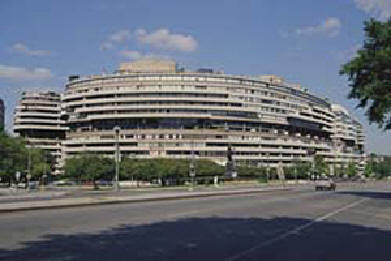
The Watergate building in Washington DC
|
Watergate
If you walk
south from the rear of the White House in Washington DC, you
will pass the headquarters of the World Bank on your left hand
side. Continue towards the Potomac river and Georgetown beyond,
and you will see a stately building on your left before the
river. It is the Watergate complex of offices, hotel and
apartments. At 2.30 am on the 17th of June 1972,
plain clothes police were alerted to a possible break-in, and
found five men inside. They had been trying to place bugs in
the office of the Democratic National Committee. The men were
an assortment of Cuban Americans and ex-CIA security men. They
had been directed by another ex-CIA man working in the White
House, - Howard Hunt. The operation, along with umpteen other
illegal acts, had been financed by the Committee to Re-Elect the
President or CREEP (what a Freudian slip choice of letters!).
The full facts of the criminal activities took two years and
countless inquiries and hearings to establish as the White House
and all involved tried to stonewall the investigation.
Among those
guilty of complicity in criminal acts, or of perjury at the
subsequent hearings and trials were : John Mitchell, former
Attorney General; Patrick Gray, former head of the FBI; Maurice
Stans, Fund-Raiser to Richard Nixon; Jeb Magruder, White House
Official; John Erlichman, Counsel to the President; and H R
Haldeman, White House Chief of Staff; and finally President
Richard Nixon himself who had to resign from office before he
would be impeached.
The story was
first unraveled by two young newspaper reporters, Bob Woodward
and Carl Bernstein who worked for the Washington Post. They
were persistent in their enquiries, and were assisted by an
anonymous inside source nick-named “Deep Throat”. In June 1973
the President’s former Counsel, John Dean, broke ranks and
started to reveal the cover-up. A month later, a security
officer Alexander Butterfield, revealed that Nixon had taped all
the conversations in his office. The Justice Department’s
special prosecutor, Archibald Cox, subpoenaed the tapes. Nixon
refused to release them, and fired the prosecutor instead. The
new attorney General, Richardson, refused the order to sack Cox,
as did his assistant Ruckelshaus. Both had to resign.
The Supreme
Court unanimously ordered the President to hand over the tapes.
As they were gradually released, they failed to support Nixon’s
side of the story. One tape had a mysterious 18 minute gap from
an erasure. Further tapes revealed clear obstruction of
justice. On July 17 1974, the House (Congress) judiciary
committee passed the first of three articles of impeachment.
Within 2 weeks, on 8th August, Richard Nixon became
the first American President to resign from office.
The events
happened over 30 years ago, but they are relevant to present day
attempts by supposedly democratic governments to suppress
opposition and dissent, and to control the media and conceal
unpleasant truths about themselves. The
behaviour
of senior officials in Nixon’s White House reads like a
Shakespearian tragedy. Most of them, but not all, have since
confessed their culpability. Several came to personal faith in
God through the crisis. One of the original burglary organisers
remains a ‘true believer’ in the Nixon cause. G Gordon Liddy,
still maintains his and Nixon’s innocence. A Nixon foundation
currently propagates his statements to discredit the accepted
view of the Watergate scandal.
|
A far greater scandal
than Watergate, to my mind however, was the mass murder of thousands
upon thousands of Asian civilians in the intense carpet bombing of
Vietnam, Laos and Cambodia by the US military, - in the name of
liberation. It had escalated under President Johnson following the Gulf
of Tonkin resolution which was passed in a frenzy of patriotic anger
after two small Vietnamese boats were said to have attacked an American
warship in international waters. The event was totally fabricated by
the US Navy and the CIA, as is now openly admitted. I have never
trusted military statements in time of war since. But the bombing was
further escalated by the paranoid and single-minded determination of two
men who did not want to lose face, and who were determined to achieve a
military victory at all costs. These two men were Richard Nixon and
Henry Kissinger. In my travels through Indo-China I have met several
families who lost innocent relatives to those bombs. Much of the
bombing was indiscriminate and based on wild hunches rather than genuine
intelligence. Clay Kelly of the CIA informed me in some detail about
the myths of the Ho Chi Minh trail which supplied only 20% of the
Vietnamese war material. This is now admitted by the authorities. Many
years later, when working in Vietnam, I was made aware of the human toll
on innocent civilians, and the environmental destruction and
contamination that was still evident over 30 years later. “No
civilians live in the east part of Cambodia”, (which was heavily
bombed), according to the Nixon administration. What wicked nonsense!
No one who knew Indo-China could have ever swallowed that lie.
Kissinger was the
ultimate modern exponent of power poitics and American imperialism.
It is strangely to the credit of Ronald Reagan that he never appointed
Henry Kissinger to any office or position of power, perhaps with the
exception of membership of the Foreign Intelligence Advisory Board in
1984. This view is expressed by former hostage David Jacobsen in The
Nightmare in Beirut, who together with his fellow prisoners was
appalled by Kissinger’s repeated advice to leave the hostages to their
fate.
Henry K. and Nixon practiced Realpolitik, - the view
that government and state policy are matters divorced from moral
considerations, to be dictated only by the necessities of power, and
judged only by success. Historians tell us that modern realpolitik
was developed in the nineteenth century by Count Camillo Benso di Cavour
in Italy, and by the great Bismarck in Germany. In their eyes, reasons
of state justified any means, provided they yielded the results
intended. Looking back at the results of Kissinger’s realpolitik,
one must doubt that it actually met the latter criteria, and simply
conclude that it caused untold misery, involved great cost in money and
lives, and sowed the seeds of future global instability, enmity and
cynicism. All that just to save the faces of those two men who confused
their vanity with national prestige.
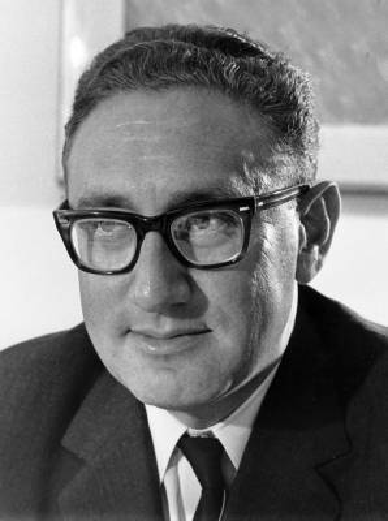
Henry Kissinger
It seems to me as a
complete amateur in this field, that it was based on very short-term
political views and goals. Is Indo-China today any different from what
it would have been had it been left alone to develop its own forms of
government? Was all that war effort, and all that human sacrifice
really justified? Yet the world still honours the guilty, blames the
innocent, and ignores the victims. Henry Kissinger was awarded the
Nobel Peace Prize, an event that made the musician-comedian, Tom Lehrer
exclaim that “satire is now officially dead!" This was one of
the strange relapses of the Nobel Committee set up by Alfred Bernhard
Nobel of Sweden, the inventor of dynamite and gelignite.
Most Americans now
regard the Vietnam War as a mistake. But many of them believe so only
because the USA did not win the war, or because the war was not really
winnable. Not so many see it as unjustified interference in a foreign
country’s internal affairs. Few Americans know that the United States
prevented nation-wide elections from taking place in Vietnam since it
knew that Ho Chi Minh would win such an election by a landslide. Few
also will admit that the United States overturned or undermined
democratically elected and legitimate governments in Chile, Bolivia,
Brazil, Ecuador, Grenada, Guatemala, Panama, Nicaragua and Haiti, simply
because it did not like their politics or policies, though they were no
threat to the security of the USA. The U.S. also financed the
suppression of opposition movements fighting for social justice, in El
Salvador, Dominica, Honduras, Mexico, Peru, and Uruguay. The events
referred to are well documented, and occurred within the past 40 years.
Even less Americans know how their government covertly supported Pol Pot
and the Khmer Rouge, or armed and encouraged Saddam Hussein and Osama
Bin Laden when it suited it. American governments support democracy and
free trade only when it works to their perceived benefit, and rarely
when the results of those measures weaken US influence, or affect US
business profits. The hypocrisy of American administrations that
magnify the crimes of dictators or the supposed ill-intentions of
democratically elected leaders when it suits them, and which camouflages
its own military misdeeds, is one of the most distasteful features of
that great country’s character and international behaviour.
The
Bush Family Dynasty
I had
little direct contact with senior US politicians apart from being
introduced to Vice President Hubert Humphrey, and Senator John O.
Pastore, then a senior member of the Senate Foreign Relations
Committee. I missed meeting senator Edward Kennedy at the Fish Expo,
Boston, 1967, which he addressed a day before I spoke there. Later,
when working for the World Bank in Washington DC, I sometimes
encountered Cabinet members like Zbigniew Brzezinski, as they went to
and from the State Department Building.
When I
first served at the University of Rhode Island, a young George W. Bush
was still attending Yale, over in adjacent Massachusetts. During my
final year, he was eligible for the draft (for Vietnam), but avoided
that by getting accepted in the National Guard regardless of a waiting
list of some 100,000 candidates, and as an officer and a trainee pilot,
despite not attending an officer school, his low exam grades, and a
waiting list of 150. However, in this he was little different from
other sons of politicians or high ranking government officials. Of the
234 sons of Senators and Congressmen who were eligible to serve in
Vietnam, only 28 ever did, and only 19 of those experienced conflict
action. Those who send other parents’ sons to fight in their wars
rarely allow their own sons to do so. I believe the same is true for
the current wars in Iraq and Afghanistan.
George
W. Bush’s grandfather, Prescott Bush, a successful businessman, was a
respected Senator from Connecticut. A very moral man, he had much more
liberal views than his son and grandson, and resembled what we call in
UK, a “one-nation Tory”. He had a social conscience, supported civil
rights, and social programmes for the poor and underprivileged. Some
complain that he traded with Nazi-sympathising businessmen in Germany
before WW2, but I believe it was older generation members of the Bush
and Walker families that expressed fascist and racist views many years
before that. Prescott Bush voted to censure Senator Joseph McCarthy
following his witch-hunt to expose “communists” and “commy sympathizers”
in government, Hollywood, and the military. When his son GHW Bush
lobbied for deregulation of the oil industry, PB refused to support him,
believing that measure would only enrich oil barons at the expense of
consumers. Prescott Bush had stepped down as a Senator for Connecticut
just four years before I arrived in neighbouring Rhode Island. Son
George attempted to become a Senator twice (for the State of Texas), but
was defeated both times, first by Ralph Yarborough, and then by Lloyd
Bentsen.
George
HW Bush, the former President, and father of George W Bush, was a
Congressman representing the 7th District Texas when I went
to the USA. He had previously set up the Zapata oil corporation.
Richard Nixon made him Ambassador to the United Nations, and later
Chairman of the Republican National Committee. Gerald Ford appointed him
Ambassador (actually Chief of the Liaison Office) to China, and then
made him Head of the CIA. But it was the Presidency that attracted him,
and he made several attempts to become Vice President, but Nixon
rejected him in favour of Spiro Agnew, and later Gerald Ford. Gerald
Ford rejected him in favour of Nelson Rockefeller, and in the election
against Jimmy Carter, chose Bob Dole instead of Bush. GHW’s opportunity
finally came when Gerald Ford toyed with but declined President Reagan’s
offer to serve him as Vice President. Following Reagan’s second
presidential term, George HW Bush was elected President in 1988.
Neither
George HW Bush nor George W Bush shared the liberal views of Prescott
Bush. Both fought subtly (and not so subtle) racist campaigns when
standing for election in Texas. Both opposed civil rights. In 1968
young GW Bush helped Edward Gurney win his senatorial election in Texas
against Leroy Collins. Collins believed that segregation was unfair and
morally wrong, but Gurney and Bush portrayed him as a radical, an
agitator, and a race-mixer. To prove their point they distributed
pictures of Collins meeting with Martin Luther King. Such messages
strongly influenced affluent and conservative white voters in Texas at
that time. Aided and encouraged by Karl Rove, GWB was to descend to
more visceral levels in 2000, when he sought successfully, to defeat
John McCain for the Republican party presidential nomination.
G H W
Bush and Barbara Pierce had six children one of which died in infancy.
They were George Walker Bush who became President, John Ellis Bush
(Jeb), Neil Mallon Bush, and Marvin Pearce Bush and surviving sister,
Dorothy (Koch).
G W
Bush’s brother Jeb who became Governor of Florida, made some of his
money with Miami businessmen of Cuban extraction who were reputed to
have been part of the Miami mafia. The characters included Miguel
Recarey jr. who was believed to be involved in extortion and medicare
fraud; Hiram Martinez jr. who served 6 years in prison; Camilo Padreda
who was indicted for embezzling $ 500,000; and Orlando Bosch who was
believed to have masterminded the bombing of a Cuban Airlines flight in
October 1976, with the death of all 73 on board. Jeb Bush lobbied his
father several times to get concessions on their behalf, and President
Bush pardoned Orlando Bosch for his suspected terrorist crimes. Another
brother, Neil, was deeply involved in the collapse of the Silverado
Savings and Loan of which he was a Director, and which cost U.S.
taxpayers some $ 1.0 billion. He and his co-directors faced a $ 200
million civil suit. Being insured against such actions he had to pay
only a nominal $ 50,000 yet had that amount and legal expenses of $
200,000 paid by sympathetic friends of the family. His mother Barbara
claimed Neil was being victimised because of who he was. The fourth
son, Marvin Bush had a strange connection with 9/11. He was a Director
of Securacom (later Stratesec), which was responsible for security at
the Twin Towers. The company also did work for the U.S Army, Navy and
Air Force, and for Dulles International Airport (surprisingly since an
Arab firm was a partner in Securacom). Following his 7 years with the
firm, Marvin Bush joined the board of HCC insurance which also insured
the World Trade buildings.
In
fairness to former President George HW Bush, he was a handsome, athletic
man, wholly loyal to the Republican party and to other Republican
Presidents. He had a distinguished war career as a naval pilot, and all
who worked under him at the CIA confirmed that he was a good boss to
have. He and wife Barbara were tireless and enthusiastic participants
in the endless series of receptions and social gatherings for the elite
of government, business, and the diplomatic scene.
On the
downside some Republican colleagues considered him to have little
knowledge or understanding of foreign affairs when he was made
Ambassador to the UN, and White House colleagues have said that he
rarely spoke at cabinet meetings. Although he consistently denied any
inside knowledge or involvement in the Iran-Contra scandal, GHW’s
diaries indicate otherwise, and before leaving office he gave a
Presidential pardon to Caspar Weinberger, Elliott Abrams, and others who
were believed to be guilty, and who had lied to Congress about their
roles and activities.
I learned some
interesting background to George Bush senior’s wartime record from Hugo
Parkman when he was serving in the Philippines. Hugo is long since
retired to Georgia, but he was a sailor on the US submarine Finnback
when on September 2 1944, they picked up a downed pilot near Chi-Chi
Jima island in the Pacific. The pick-up scene was filmed and can be
viewed. Bush had bailed out from his Avenger aircraft, leaving his two
crewmen behind, instead of attempting to ditch in the sea. Apparently
the only close eye-witness to the bail-out was Chester Mierzejewski,
rear turret gunner of an escorting plane. Later, on the San Jacinto,
Bush told Chester that he was sure the two crewmen, Lt. Ted White and
Jack Delaney, were already dead, but deserting them caused him some
obvious concern. Subsequent accounts claim that Bush’s Avenger aircraft
was on fire and billowing smoke, and that one of the crewmen did bail
out, but Mierzejewski refuted those versions consistently throughout his
life. Some biographical books glorify Bush’s wartime service to a
ridiculous degree, for instance, claiming that he fought off sharks for
hours before being rescued by the USS Finnback. However, he did
serve his country’s air force with distinction, which is more than could
be said of George junior. Also it is strangely characteristic of the
extreme neo-conservatives who surrounded his son, G W Bush, that they
despised his father as being ‘soft’ because he had a humanitarian
conscience.
Politics and the Faith
Community
As a Christian, one of
the aspects of the political views of Americans, that has long saddened
and grieved me, is how evangelicals have been seduced by right wing
politics. So we had the rise of the “religious right”. Coupled to that
we have the abomination of the “prosperity gospel” proclaimed by
TV evangelists with millionaire lifestyles. Most American Christians
are genuine, sincere, compassionate persons. But many have been
brain-washed into accepting extreme right-wing views as essentially
Christian and Biblical. Some churches have statements of faith adorning
their sanctuaries, - not the ten commandments or the eight beatitudes,
but a summary of the rightness of the capitalist system, as if it was
part of holy writ. I guess it is the same for them as it was for British
Christians in the Victorian era. The spread of the Empire and the spread
of Christianity were synonymous. Or so they thought. For many U.S.
believers, there is little distinction between the spread of capitalism,
U.S. business, and American values, - and the spread of the Gospel. For
example, they swallowed Reagan’s assertion that the brutal “contra”
thugs of Nicaragua, were “freedom fighters”, and “the moral
equivalent of the founding fathers”. In their attitude to the
Watergate affair mentioned above, some evangelical leaders condemned
Mark Felt for leaking clues about the misdeeds. Apparently, in their
morality, it was all right for the President and his staff to lie, to
break the law, and to cover up the truth, but it was wrong for any
government employee to blow the whistle on them.
Historical precedents
are many. From the Crusades, to the Papal indulgences, to the
Inquisition, to the Protestant–Catholic wars, to Apartheid, to
Northern Ireland, - religion has regularly been used to instigate
bloodshed or to justify blatant greed and political ambitions. At times
these ambitions were downright stupid, but that did not prevent the
powers that be from using God’s name to justify them, and shedding the
blood of innocent civilians and young soldiers in the process.
Not all evangelicals in
the USA subscribe to the religious right line. Black Christian leaders
tend to take an opposite view. Martin Luther King, Jessie Jackson and
others spoke out fearlessly and eloquently for social justice and
peace. White leaders and writers like Professor Tony Campolo and Jim
Wallis, regularly speak out against injustice at home and abroad.
Campolo runs a number of children’s and educational charities in
American inner cities, and in countries like Haiti. Wallis fights for
social justice, moral politics and personal responsibility. He is the
founder of Sojourners, and seeks to respond to cultural breakdown
and political impasse with a call to integrate politics and
spirituality.
Recently, a prominent
conservative Christian who was appointed to the White House staff, and
assisted in the Administration’s programme of support for faith-based
organizations, David Kuo, wrote a book about the seduction of American
believers by the right-wing core of the Republican party. Once fully
involved in that activity himself, Kuo has had time to reflect, now that
he has left the White house and is suffering from a terminal disease in
the form of a brain tumour. In the book “Tempting Faith” he
blames the churches as much as the government for the state of affairs,
although he claims that senior Bush administration figures like Karl
Rove and his subordinates, treated the faith leaders with ridicule and
contempt behind their backs, while courting and encouraging their
loyalty. He said that he, “Felt a pressing spiritual need to say
what is important, - to warn Christians about politics, … because they
are being used, and it will not answer the problems, and it corrupts the
name of the God we are trying to serve”.
|
Interesting Comparison with the 4th and 5th
Centuries
The
marriage of, (or alliance of) religious fundamentalism and
neo-conservatism in the USA, has been documented in recent books
like American Theocracy by Kevin Phillips. This
is not a new phenomenon in the church’s history, and in fact
goes back to the 4th Century AD when Emperor
Constantine made Christianity the official religion of the Roman
Empire, - with similar unpleasant results. In the prologue to
one of his early books on church history, “Light in the
West”, Professor F F Bruce, (mentioned in chapter 2),
reviewed the church’s experience from 300 to 500 AD, and made
some observations that could be relevant to church – state
relationships in the USA under President G W Bush’s
administration.
Bruce wrote of a number of unhappy precedents that occurred
under Constantine and in the aftermath of his rule :
“The evident patronage extended to Christianity by the ruling
powers, made it popular in an undesirable sense. Christian
leaders were tempted to exploit the influential favour they
enjoyed, even when it meant subordinating the cause of justice
to the apparent interests of their religion. On the other hand,
they were inclined to allow the secular power too much control
in church affairs, even if it was by way of gratitude for the
imperial goodwill. Where church leaders were able to exercise
political as well as spiritual authority, they did not enjoy any
marked immunity from the universally corrupting tendency of
power – a tendency which presents an even more displeasing
spectacle in Christians than it does in other people, because it
clashes with the first principles of Christianity. We see in
these centuries the emergence of worldly ecclesiastics on the
one hand, balanced by the inordinate extremities of asceticism
on the other. We see nationalist animosities interfering with
the proper exercise of Christian duty, to the point where
national groups professing Christianity wage fierce warfare upon
each other. We see the ugly spirit of intolerance not only
directed against non-Christians but also against Christians of
divergent beliefs or practices; we even see some Christians
invoking against others the aid of the imperial state which but
lately had persecuted all Christians alike. We see an
unreasonable insistence on uniformity in non-essential matters,
such as the fixing of the date of Easter and even more
unimportant things than that. We see spiritual liberty hampered
by a steady increase of centralized control and
organisation.”
(Light in the
West, F. F. Bruce, Paternoster Press, 1952) |
Although Jimmy Carter
was elected in 1974, the country swung to the right until Bill Clinton
won the Presidency. Carter’s election was largely a reaction to the
Watergate scandal, and an expression of the public desire for decency
and truthfulness in high office. If in the 1960’s anyone had predicted
that Ronald Reagan would be elected President, the idea would have been
treated with some derision. (I think there is a brief scene to that
effect in one of the “Back to the Future” movies). Reagan’s
election (helped by an ‘understanding’ with the Iranians not to release
the U.S. hostages till after), marked a major advance of Conservative
politics in America, as Margaret Thatcher’s one did in UK. By that
time, the youth of both countries had switched off politics due to sheer
disillusionment. The ferment that occurred in the college campuses in
the sixties, was conspicuous by its absence in the eighties, despite the
Iran / contra scandal, the Grenada invasion, and the support of rotten
dictators from Chile to the Philippines.
It was the same in
1980’s Britain. I attended a lecture by Caspar Weinberger in Edinburgh
University, when he lauded the “star wars” militarisation of space, as
one of the greatest potential boons to mankind. Though the auditorium
was packed with students, there was not a murmur of protest or
rebuttal. In 1992 the same Weinberger was found guilty of five felony
charges of obstruction, perjury and false statements in connection with
the Iran / contra arms scandal. He was given a full pardon by President
HS Bush later that year.
I guess that most
Americans view of the rest of the world from the perspective of their
own culture, values and prejudices, just as the British did during the
heyday of empire under Queen Victoria and for half a century
thereafter. An explanation of the American global psyche is given by
Eric Alterman: Despite their long history of involvement in the
global marketplace as buyers and sellers, the American people were new
to the concept of diplomatic give-and-take. … The buffer of two oceans,
a vast expanse of land, and a dearth of powerful neighbours had combined
to create habits of mind that led Americans to believe that they could
construct a world system based on what they considered their own
universally applicable principles, rather than on more traditional
considerations of balances of power.
[Roosevelt,
Truman, and the Yalta Conference,
in When Presidents Lie, E. Alterman, Penguin, 2004.]
The Clinton Presidency
followed that of George Bush senior, and it may yet be judged by history
to have been one of the most successful of those in the post-war years,
despite the man’s personal failings. (Although Michael Moore calls him
‘the best Republican President we have ever had”, and the late
Senator Eugene McCarthy described his administrational approach as being
“Governor of the United States”). There were no foolish, costly
foreign wars apart from attempts to halt tribal conflicts in Africa, the
budget was balanced, employment reached high levels, progress was
maintained with Arab – Israeli negotiations, and the “star wars” program
was mercifully shelved. Yet some observers felt that Clinton was much
too hesitant in pushing social programmes. His gifted wife Hillary,
tried to strengthen medicare, and was demonized for the attempt by the
powerful pharmaceutical-medical industry lobbyists. One of the few
Republicans to express admiration of her efforts was surprisingly,
ex-President Nixon. Bill Clinton went on to become a close friend of
Bush senior in his retirement. Although once political foes, George
would often say, “You just can’t help liking Bill Clinton”.
The year 2000 brought
the election of George Bush junior (assisted by a weak campaign by his
Democrat opponent, Al Gore, and some doubtful practices and manipulation
of the vote in Bush’s brother’s state of Florida), and the conservative
agenda was revived. This time, the White House was taken over by an oil
industry clique that had long planned for major interventions in the
Middle East. The September 11th attack on the twin towers in
New York, and on the Pentagon, gave them the excuse they needed. The
people of Afghanistan and Iraq were to pay the price for America’s
revenge, and the administration’s hidden agenda. [Contacts
in diplomatic circles in London are of the opinion that the U.S.
Administration had decided that Saudi Arabia had become a risky
long-term prospect for American bases in the Middle East. To maintain a
military presence there and protect future oil supplies, it was decided
to ‘make’ Iraq the location of permanent U.S. bases. It was also
thought that removal of Iraq as a threat would make Israel more secure.
So the Bush administration sought ‘legitimate’ cause to wage war on and
invade Iraq. This was also the view of George Soros ( The Iraqi
Quagmire, in The Bubble of American Supremacy, Weidenfeld &
Nicolson, London, 2004).]
To justify the invasion of Iraq, and convince the United Nations and
other countries, the White House mounted a massive propaganda wave based
on false information that Saddam Hussein possessed weapons of mass
destruction. A former CIA officer, Ray McGovern claims that the
decision to go to war predated the garnering of ‘evidence’ by the CIA,
and not vice-versa. Practically all of the Iraq intelligence produced
by the CIA and the MI5 in Britain, has been discredited, leading
taxpayers to wonder what these colossally expensive institutions are
actually doing. Respected American diplomats like Ambassador Joseph
Wilson have catalogued with care the way that truth was suppressed and
lies given credence in order to justify the invasion of Iraq. [Ambassador
Joseph Wilson, The Politics of Truth, Carroll and Graf, New York,
2004] But he and
other critics of the war and its supporting lies, in both the USA and
the UK, have had to pay a price in unprincipled official attacks and
vindictiveness by their governments.
A great many more
thousands of innocent civilians were to die from the bombing and
shelling of Iraq and Afghanistan than were killed in the twin towers
attack, - possibly 200 innocent Iraqi civilians for every person who
died in the twin towers attack – which Iraq had nothing to do with! But
the U.S. military has never been squeamish about ‘collateral’ damage.
What made it all so hypocritical was the undisputed fact that it was
America that supported and armed Saddam Hussein during the Iran-Iraq
war, and that it had trained and armed and financed Osama Bin Laden and
the Taliban / Mujahedeen in Afghanistan, when it used them to drive the
Soviet army out of that country. Those two evil characters and the
extreme Islamic movements were kept in power or put in power by America
herself. The whole sorry saga has been well documented by ex-CIA
officers and former diplomats who served in Pakistan and the Middle East
throughout that period. The removal of the Taliban regime from
Afghanistan had unfortunate repercussions for the west. That regime
restricted women and supported some extremist groups, but it stopped the
culture of opium poppies, and the processing and export of narcotic
drugs. Now that the country has been ‘liberated’ by the U.S. the opium
trade is flourishing as never before.
An interesting and
prophetic statement about US military involvement in the Middle East,
was made by then Senator John F Kennedy on 27 June 1958, in relation to
the U.S. Administration’s handling of a crisis in Lebanon. He said,
“The fact remains that the American people have no clear and consistent
understanding of why we are there, what we are going to do, or what we
hope to accomplish …. We are confronted once again with armed conflict
in the Middle East because we have developed no alternative to armed
conflict”. (Following the New
England Conference of Senators, 26.6.58).
Some will protest that
without the strong stand of the United States, the world would have been
dominated by ruthless dictators and totalitarian regimes. Also, while
criticizing the excesses of the capitalist system, I have said little
about the evils of Communist and Marxist regimes in Russia, China, East
Europe, and Indo-China. These issues on the other side of the political
coin, I have tried to address in the sections on the Soviet Union and on
Cambodia. I have also commented on the cruelty and mis-rule perpetrated
by corrupt governments on their own people, in developing countries in
Africa and in S.E. Asia.
However, two wrongs do not make a right, and the West should at least
live by the standards it proclaims, or else it has no moral authority to
put the rest of the world right.
The temptation for the
most powerful country in the world, in any century, is to use its power
to protect its own interests above all others. Even then, as
Machiavelli indicated, they have to find moral arguments to defend their
actions. As Joseph Schumpeter wrote of the Roman Empire in
Imperialism and Social Classes in 1919 : “(It’s wars) were
always invested with an aura of legality. Rome was always being
attacked by evil-minded neighbors. The whole world was pervaded by a
host of enemies, it was manifestly Rome’s duty to guard against their
indubitably aggressive designs. … There was no corner of the known
world where some interest was not alleged to be in danger or under
attack. If the interests were not Roman, they were those of Rome’s
allies; and if Rome had no allies, the allies would be invented. When
it was utterly impossible to contrive such an interest, - why, then it
was the national honor that had been insulted”. The much maligned
Ramsay MacDonald, in a speech to the House of Commons in 1914,
responding to the Foreign Secretary Sir Edward Grey, argued that the
stupidest and most costly of Britain’s wars then, from the Crimea to
South Africa, had been fought to ‘defend the national honour’.
The Iraq war was
entered into in accordance with a well developed plan by right wing
Republicans and the oil industry in the United States. Iraq had the
second largest oil reserves in the world. The United States needed to
secure more and more petroleum from the Gulf region to feed its
seemingly insatiable domestic appetite for oil. Yet we had a cacophony
of different reasons for the invasion broadcast and spread around by
insidious propaganda. There were ‘weapons of mass destruction’ – which
never materialized. There was ‘Al Qaida’ which had no links at all with
Saddam Hussein. There was ‘regime change’, which must have been illegal
under international law. And now there is ‘democracy’. Democracy
achieved by force?
Along with most foreign
friends of the USA, I believe that great country lets itself down in the
eyes of the world by its paranoid insistence on seeking military
solutions at the expense of patient diplomacy and in the absence of any
apparent attempt to see issues from the perspective of peoples of
different nationalities, cultures and faiths.
Iraq is a tragic
example. Anne-Marie Slaughter, Dean of the Woodrow Wilson school of
public and international affairs, Princeton University, wrote, “we
Americans are the preachers and promoters of democracy. If America
won’t listen, won’t consult, won’t play by the rules, won’t try to see
the world through any lens but its own, can we still be sure that
American power is a force for good?”
America however,
contains so much that is good and admirable. The land that produced or
gave opportunity to, Thomas Jefferson, Alexander Hamilton, William Penn,
Benjamin Franklin, James Madison, Abraham Lincoln, Harriet Tubman,
Booker T. Washington, Elizabeth Blackwell, John Muir, Mary Cassatt,
Henry George, Helen Keller, Paul Robson, Thomas Edison, Henry Ford, Dale
Carnegie, Jesse Owens, Bobby Jones, Martin Luther King, and Billy
Graham, has shown much excellence in the fields of statesmanship,
literature, art, ideas, invention, athletics, music, justice, and
inspiration. It has also brought some wonderful benefits to the world, -
and I am not referring to Coca Cola, Microsoft, hamburger or
Hollywood! (Some of those I name were born abroad, and some died
abroad, but it was in America that they served with distinction. They
were all human of course, and subject to human frailties, but still they
were people of tremendous character, dedication, and vision.)
The country is
amazingly democratic, and remarkably responsive to entrepreneurial
initiatives. Even America’s enemies admit this. One Iraqi Arab
recently conceded that America was a just and democratic state, - only
he added, “that is just within its borders. It is not ready to treat
people in other lands with the same values or respect”. Be that as
it may, the country has a rich heritage of opportunity and countless
examples of the pioneering spirit. Young men and women from the USA
have served abroad selflessly in the Peace Corps movement and with
charities and missions. Thousands of brave young Americans have given
their lives abroad, however misled their politicians may have been in
asking them to make that sacrifice in certain of their foreign wars.
Within the United
States, however, there are growing tensions that have been fortified by
generations of neglect of the poor and underprivileged. The lack of
justice and opportunity for the urban poor, has led to outbursts of
seemingly irrational violence at times, like the Watts ghetto riots in
Los Angeles in August 1965, and the shocking behaviour of desperate
people and opportunist criminals in Louisiana during the aftermath of
hurricane Katrina in September 2005. Socialism is a bad word in the
USA, and the prevailing philosophy is that everyone ought to work to
maintain themselves and their families. That is fine, if reasonably
paid work is available, and the people remain healthy, or have access to
medicare. But as we were told long ago, “The poor you have always
with you”. And if any nation fails to provide a safety net for the
sick, handicapped, unemployed or other victims of society’s ills, then
it will ultimately reap consequences that could threaten the stability
and future of the state.
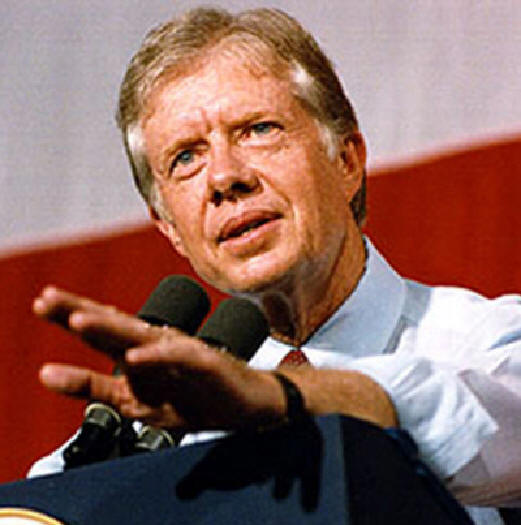
President Jimmy Carter
Who are America’s best
ambassadors today? I think of individuals like Andrea Jaeger and her
Silver Lining Foundation for children suffering from cancer and other
serious disease. I think of Joni Ericsson Tana who has shown the world
how to serve others through music and art despite a crippling life
injury. I think of the schools established in Haiti to educate poor
‘slave’ children, funded by one of Tony Campolo’s organizations. Then
there is Peter Hun of California who established a garment factory in
Vietnam with 1,400 employees. After observing how they cycled many
miles to work, he provided all with a free breakfast. When that
increased productivity significantly, he also provided a free lunch.
Then he hired two doctors to serve the 5,000 family members of workers
so all could enjoy free professional medicare. I also think of
numberless missionary and charity workers, and the results of their
labours, like Hugo and Doris Parkman who helped so many Filipino
children obtain corrective surgery for hair-lip malformations.
Joni Ericson Tana, one of many exemplary
Americans
Since I have been
critical of some U.S. administrations, let me mention one ex-President
who has been undertaking marvelous humanitarian work for over 20 years.
Jimmy Carter has been active in conflict mediation all over the world
through his foundation and the Carter Centre. He and his wife also work
for Habitat for Humanity, a global housing charity for the poor.
Thousands of selfless American men and women laboured and died abroad,
unheralded and barely recognized, rescuing and educating street children
in many cities, serving in mission hospitals, schools and charities in
Latin America, Africa and Asia.
Their work is often
criticized by Marxists and leftists. From first hand personal
experience my view is that apart from a few exceptions it was almost
entirely exemplary. Some of the missions have been accused of being
fronts for the CIA. Well, the CIA at times has infiltrated and used all
kinds of vehicles as fronts, including internationally respected bodies
like the BBC, the Reader’s Digest, and the Care organization, and so I
do not doubt that charities and missions were similarly used when it
suited CIA purposes. But some communist movements, and extreme Islamic
groups have similarly penetrated innocent organizations, so the
accusation is one that could be made in several directions. [The
S.I.L. or summer Institute of Languages is a Christian organisation that
has been prominent in mission work in Latin America among the tribes of
the Andes and the Amazon forests. It has been accused of being a front
for the CIA, and for logging, mining and petroleum companies that wish
to exploit the natural resources of that continent. However, even those
who suggest this relationship offer no direct proof except that these
corporations appear to penetrate the region on the coat-tails of the
missions which established relationships with the tribes and began to
provide education and medical services.
My own
guess is that some corporations viewed the missions as an easy entry
point, and may have provided donations towards their educational and
social work. Few missionaries would have objected to that as in the
1950’s, 60’s and 70’s, there was little awareness of global resource
exploitation. My own experience however is that such corporations
almost never donate to charities or missions serving the rural poor.]
In 2008 Barack H Obama
was elected and was sworn in as the US’s 44th President in
January 2009. My wife and I were deeply moved at his election and the
sense of hope he brought to the country. That has since been dissipated
by a polarized Congress and Senate and a fiercely partisan Republican
party determined to stop his reforms at every turn. This polarization
has been so sad for America and for the whole world that looks to the
USA for leadership in democracy and justice.
I close with two more
verses from America the Beautiful. That anthem never moved me
more than when it was played at the funeral of Robert Kennedy, and as
his coffin was carried to the graveside at Arlington, and laid to rest
there.
O beautiful for heroes
proved in liberating strife
Who more than self their country loved and mercy more than life!
America! America! May God thy gold refine
Till all success be nobleness
And every gain divine !
O beautiful for patriot
dream that sees beyond the years
Thine alabaster cities gleam undimmed by human tears !
America! America! God shed his grace on thee
And crown thy good with brotherhood
From sea to shining sea !
Katherine Lee Bates 1913 |