|
Of the Russian, - who can say?
When the night is gathering, all is grey.
Kipling The
ballad of the king’s jest
I cannot forecast to you the action of
Russia.
It is a riddle, wrapped in a mystery, inside an enigma.
Winston Churchill
3rd October 1939
Never under-estimate the Russian.
Menachem Ben Yami
(former soldier
in
the Red Army Jewish Brigade)
The vast and populous
land of Russia, and its past empire, or the later Soviet Union, have
always carried a mystique and an attraction to most western observers.
From the wild snowy wastes of Siberia to the arid deserts of central
Asia, and from the Baltic and Arctic ports to Vladivostok on the
Pacific, and Sebastopol on the Black sea, the region and its peoples
have been too extensive to regard as a single entity. Ancient tales and
records of fur-clad Tsars and Tsarinas, of strange hypnotic characters
like Rasputin, the ‘mad monk’, of Emperors like Peter the Great, of the
medieval cities of Moscow and St. Petersburg were raw material for
fairly tales and legends. The Greek Orthodox faith with its bearded
priests and onion-domed churches, added to the mystery as did the
impression of a land mostly gripped by the severe weather of long
winters.

Hakluyt’s Voyages
give us a glimpse of the Russia of the middle ages. Richard Hakluyt was
a clergyman and geographer in the time of Queen Elizabeth, Walter
Raleigh and
Francis Drake. He took a life-long interest in the voyages of early
explorers and captains of merchant ships, and collected the accounts now
published in the classic book that bears his name. Much of the record
consists of the actual voyage logs and reports by those intrepid sea
captains. Hakluyt untiringly assembled information and minutely
detailed sailing directions for various parts of the globe. Some of the
expeditions of English merchant ships to Russia border on the
incredible. Those relatively small sailing boats went north past Norway
and east through the Barents Sea to Archangel, and from there up-river
to near Moscow, then overland to the Volga river, then south to the
Caspian Sea, and across it to trade with eastern merchants. After all
that, the whole journey had to be repeated in reverse. In one of the
accounts, a captain who suffered all sorts of dangers, several times
nearly losing his life and all the cargo, says at the close of his
report, in massive under-statement, that he “hoped his employers
appreciated all he endured to ensure a profitable investment for them”
!
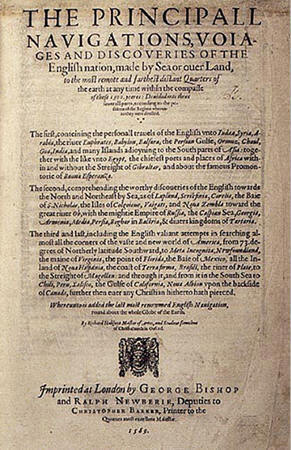
Above: a page from Hakluyt’s
“Principall Navigations”, 1589,
his book of voyages of exploration and early trade routes by English
ships.
The Russian people and
their satellite citizens have come through long periods of severe
hardship from the elements, from famines, from wars and from oppressive
rulers, - first the Tsars and Emperors, and later the Soviet dictators,
- Lenin, Stalin, Bulganin, Kruschev, Brehznev, and others. Kruschev I
have a soft spot for. He was different from the staid, sullen,
doctrinaire leaders of Russia’s communist governments, and actually
began the process of de-Stalinisation of the country. But no doubt he
was guilty of much also.
From my youthful
fascination with aircraft, I was to develop a strong interest in space
flight and recall the news we received in October 1957 that the Russians
had successfully launched the world’s first artificial satellite,
“Sputnik 1”. The Daily Express headline next day said it all :
“Midnight - and London hears the first signal – Space Age is Here !”
On the 12th
April 1961 (on a fine day) we were fishing on Stormy Bank to the
west of the Orkney Islands. The cook served up lunch and when we went
below, my father announced that the Russians had put a man in space. I
asked with some concern how they were ever to bring him back to earth
again, but was assured that he had already returned safely. The
spaceman was Yuri Gagarin, and his craft was called Vostok 1.
The spaceship had made a single orbit of the earth and was brought down
in Kazakhstan. The event caused world-wide excitement, and some
consternation in the USA where President Kennedy committed substantial
funds to the American space flight programme. Sadly, Gagarin
himself was to die in an airplane crash in 1968 while training for the
Soviet space station programme.
The Russians launched
Vostok 2 four months later, with Gherman Titov on board. This
craft orbited the earth 17 times. The following year Vostok’s 3
and 4 were launched. They remained in orbit for 3 and 4 days
respectively. 1963 saw Vostok 5 and 6 launched, the
latter containing the world’s first woman astronaut (or cosmonaut),
Valentina Tereshkova. The Vostok programme was then terminated
and replaced by the Voshkod programme that involved a 3-man
spacecraft.
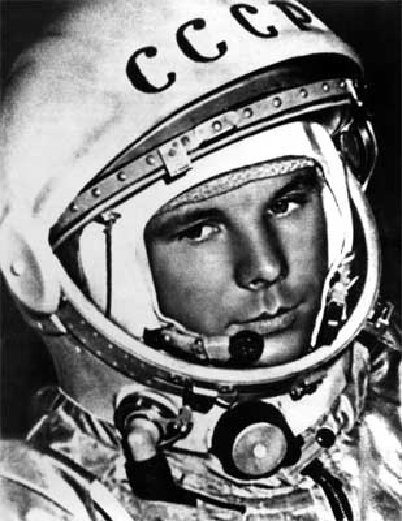
Yuri Gagarin, first man in space, April
1961
The first American
orbital space flight was in February 1962 when John Glenn took his
Friendship 7 Mercury capsule on a 3 orbit flight. The previous year
there were two sub-orbital flights of 15 minutes duration that reached a
height of 116 miles above the earth. By May 1963 there were 3 more
Mercury flights, the longest lasting 34 hours. The Gemini
2-man capsule programme began next and between March 1965 and November
1966 there were ten Gemini flights, the longest one lasting
nearly two weeks. The Russian Soyuz space staion programme began
in 1967 and lasted till 1977. The American Apollo programme
started in 1968 and continued till 1975. Six Apollo flights
successfully landed men on the moon (in 1969, 1971, and 1972).
Russian progress in
science and technology lay in contrast to the brutal control of the
Soviet satellite states, and was becoming evident in the suppression of
all kinds of dissent within Russia. The gulag prison camps that
stretched all over the continent from around Moscow to inside the Arctic
circle, and east across Siberia, were full of political prisoners and
other dissidents whose only crime was to express their sincere
thoughts. There were also thousands of innocent victims of the system
who were given ten year hard labour sentences on trumped up charges,
simply to create fear or to “encourage les autres”.
In 1956 Hungary
attempted to throw off the Soviet yoke. Growing resentment of the
foreign control erupted into a national uprising in October of that
year. Within a few days there were 2,000 Soviet tanks in Budapest and
other cities. Hundreds of citizens were killed, many imprisoned, and
suspected leaders were executed. Communist control was reestablished,
though with a new awareness that people’s aspirations could not be
completely ignored.
Another East European
country tried to extricate itself from Soviet control in 1968 when a
liberalization programme was led by national communist leader Alexander
Dubcek. It was to be known as the “Prague spring”. But like the
Hungarian revolt, it also met with fierce opposition from Moscow, though
this time there was an attempt to downplay Russia’s role by the use of
Warsaw Pact forces to crush the liberalization movement and to restore
the “orthodox line” to Czech politics and government.
I was to visit the Soviet Union in 1965, participating in a
United Nations FAO seminar and study tour on fisheries education that
took us to Moscow, Murmansk and Kaliningrad. We were treated warmly by
our Russian hosts, and shown kindness and hospitality by all the people
we encountered. Contrary to western impressions there was no apparent
attempt to restrict our movements, and I was able to attend Sunday
services at the large Moscow Baptist church. Later in 1996, I spent
some time in a former Soviet State, then independent Turkmenistan,
located just north of Iran and east of the Caspian Sea.
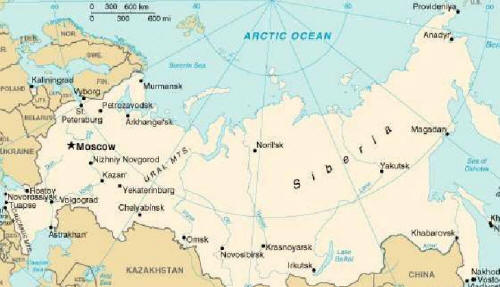
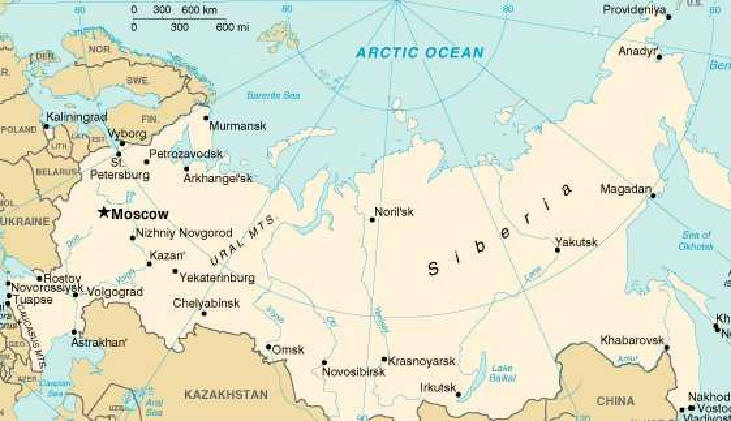
Map of Russia
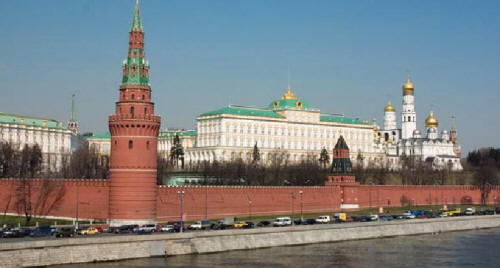
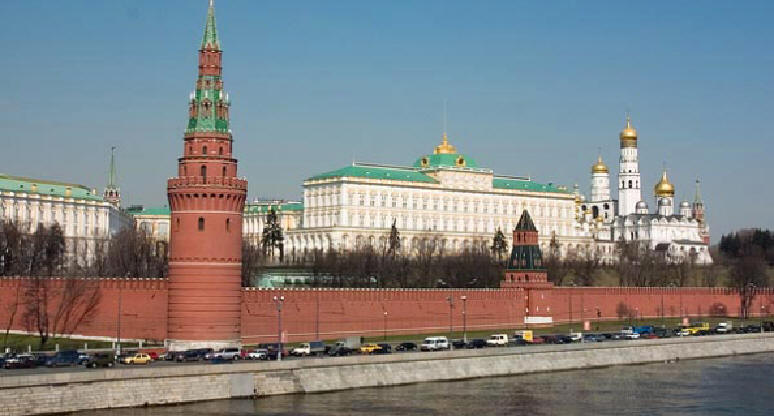
Moscow and the Kremlin
In between those dates I became an avid reader of the works
of Alexander Solzhenitsyn beginning with “One day in the Life of Ivan
Denisovich”, and on through Matriona’s House, Cancer Ward, The
First Circle, Lenin in Zurich, August 1914, and The Gulag
Archipelago. I devoured all 3 volumes of The Gulag, but have
yet to meet another person who lasted the distance. I found many who
read Volume 1, a few who managed to read Volume 2, but none who read all
three. It is a pity as Volume three is the best of the series. It is
the one that paints the picture of the hope and triumph of the human
spirit against impossible odds. The most moving chapter is “Truth
under a tombstone; poetry under a stone”.
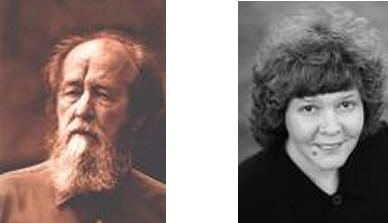
Alexander
Solzhenitsyn, author of Irina Ratushinskaya, Russian
dissident poet
The Gulag Archipelago
|
Alexander
Solzhenitsyn and Irina Ratushinskaya
Just over 50
years ago, one cold night in a Soviet prison camp outside of
Moscow, a woman prisoner was being made to stand outside by the
barbed wire fence, for some minor infringement. Her pleas to be
allowed back into the barracks for shelter and rest were ignored
by the sullen guard. On the other side of the fence, in the
men’s section, a ‘zek’ or prisoner was sweeping up leaves and
putting them into a brazier fire. “Woman”, he said under his
breath, “I swear to you, by these leaves and this fire, that one
day the whole world will read about you!” The ‘zek’ was
Alexander Solzhenitsyn, a former artillery captain in the Red
Army, who had been decorated for bravery, but was imprisoned for
criticizing Stalin in a letter to a friend in 1945.
During his 8
years in the Gulag prison camps, and 6 years in exile in
Kazakhstan, Solzhenitsyn collected thousands of pieces of
evidence from documents, oral testimonies, eyewitness accounts
and other material, on the brutal injustices of the Soviet
regime. Much of the material he put into verse since he could
not be sure that written notes would not be found. When he
finally left prison, he was thoroughly searched, but the guards
could not see or remove the poetic evidence in his mind. After
his exile he settled in a lonely Siberian village of Riazan
where he worked as a teacher.
While there he
began to document the evidence on paper, eventually compiling
the 3-volume Gulag Archipelago 1918 – 1956. One of the first
short stories he managed to get published in Moscow was
‘Matryona’s House’. During this time he also wrote ‘One day in
the Life of Ivan Denisovich’ which was published in 1962,
surprisingly at the instigation of Nikita Kruschev who had
decided the time was ripe to start telling the truth about
Stalin. ‘The First Circle’ and ‘Cancer Ward’ followed in 1968,
but Leonid Brezhnev’s government was less sympathetic. They had
him expelled from the writer’s union in 1969, and deported from
the USSR in 1973. He had been awarded the Nobel prize in
literature in 1970, but was not able to collect it till 1974.
Some in the West
have difficulty understanding Solzhenitsyn, - his fierce moral
outrage, and his skepticism towards aspects of western
liberalism and materialism. He is a Russian patriot in the
tradition of Tolstoy and Dostoevsky. Like them, he is a
chronicler, a witness whose experience is part of the way to
approach truth and judge events. Much of Western democracy he
regards as spiritually exhausted, and claims that the sufferings
of the Russian people under communism have taken them through a
spiritual training far in advance of Western experience.
Solzhenitsyn
believes that mediocrity triumphs in the West under the guise of
democratic restraints. He also criticizes Russia’s embrace of
the worst aspects of capitalism, and calls his country back to
its spiritual roots. These are typified in the story of the
peasant woman Matryona whose life of toil had been full of
disappointments but who maintained her integrity through it
all. In the book he says that it was long after she died before
he realized who she really was. “We had lived side by side, and
never understood that she was that one righteous person without
whom, as the proverb says, no village can stand. Nor any city.
Nor any country.”
For those who
find Solzhenitsyn a bit heavy, there is another Russian
dissident who conveys a similar message, but with a beautiful
innocence of heart, and complete lack of hatred towards the
perpetrators of institutionalized cruelty. She is Irina
Ratushinskaya, a poet, who spent years in prison for simply
writing about truth and beauty. Her two books are “In the
Beginning”, and “Grey is the Colour of Hope”. [Grey
is the Colour of Hope,
and
In The Beginning, by Irina Ratushinskaya,
translated by Alyona Kojevnikov, and published in 1988 and 1990
by Hodder and Stoughton, Sceptre Books, Sevenoaks, Kent,
England.]
It never ceases to amaze me, that even in cruel totalitarian
regimes, with their extreme efforts to control information and
free thought, that there arise men and women who refuse to
submit to political idolatory, or to eat its meat. They rise
like rare flowers in a desert, or as Solzhenitsyn described
them, like heads bobbing up to the surface of a misty sea after
a storm. We are yet to hear from most of them, but I am sure
there are many, living or dead, who have borne witness to the
truth despite brutal repression, in China, North Korea, Burma
and other dictator-ruled states that through much of the last
century have sought to keep the people subject to their control,
and ignorant or misled about the truth.
|
Ratushinskaya’a poetry
does not translate too well, but here are two extracts from her book,
Grey is the Colour of Hope, written in 1986:
“In the (convict railway) carriage, the fact that I am a ‘political’
arouses much interest. I have to explain everything from scratch yet
again : about human rights, about my poetry, then read my poetry – to
the whole carriage. The guard is clearly interested, too, for he makes
no move to stop me. … I read on : what price I and my poems if I can’t
get through to this audience ? Too many of us have been too far
‘removed from the people’ already. …
The guard (they’ve changed shifts again) utters a word of caution :
“Be quiet for a bit, the boss is about due to come around.” And
once his senior has been through, he prompts me, “Go on, what else is
there?” I do go on. Who needs this more than you in uniforms, be
they zek [ “Zek”
is the Russian term for a convict.] uniforms or military ones? Not all of you are lifelong
thieves and bandits.
Your lives have been disfigured, but your souls are intact. How do your
souls fare, hammered by the machinery of lies and violence from early
childhood ? How wonderful if they do not succumb, but is there any
chance of that ? I continue to hope that there is. … … …
You must not under any circumstances allow yourself to hate. Not because
your tormentors have not earned it. But if you allow hatred to take
root, it will flourish and spread during your years in the camps,
driving out everything else, and ultimately corrode and warp your soul.
… If you can spot no spark of humanity in (the KGB and Gulag guards),
no matter how hard you try, remind yourself that cockroaches are
exterminated without hatred, rather with a feeling of revulsion. And
‘they’ – armed, well-fed and belligerent – are like vermin in our big
house, and sooner or later we shall get rid of them and live in
cleanliness. Is it not pathetic that they have designs on our immortal
souls.
All this in sum brings about one marked change in your physical
appearance : by the end of your first year, you will have what are
known as ‘zek’s eyes’. The look in a zek’s eyes is impossible to
describe, but once encountered it is never forgotten. When you emerge,
your friends embracing you, will exclaim : “Your eyes ! Your eyes
have changed !” And not one of your tormentors will be able to
bear your scrutiny. They will turn away from it like beaten dogs.”
Unlike the works of the
dissidents, Russian novels can be heavy, and some of the music can be a
bit dull. But the Cossack dancing, - now that is something exciting. I
am sure that it must be the most exhausting form of group dance of any
in the world. And there is one musical instrument that can be
excruciatingly beautiful to listen to. I was in the Kremlin theatre with
our group, attending a variety show that had a bit of most kinds of
Russian culture. Towards the end a well-known local musician came on
stage and sat down to play his balalaika. The lights went out and a
single beam focused on the minstrel. He started to play, the strings
vibrating so softly and at such high pitch, you could scarcely hear,
then the volume increased as he developed the melody, and the music
filled that large theatre to the delight and appreciation of all
present.
Russia in 1965 was
still living very much in an immediate post-war atmosphere. To me it
resembled Britain of the 1945 – 49 period. There was a lot of visible
war damage around still awaiting repair, and the people regarded Germany
as the enemy to be feared. The word ‘enemy’ was used to me by the
interpreters only of Germany and China, not interestingly then, of the
USA. The post-war atmosphere was also evident in their showing us a
propaganda film of the war, and taking us in Kaliningrad to a bunker
where the last few SS soldiers held out till they were all killed. It
had been preserved exactly as it was found.
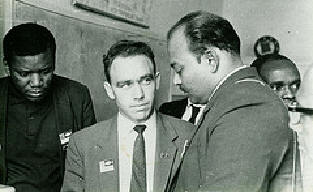
Myself in Russia with an international
group, 1965
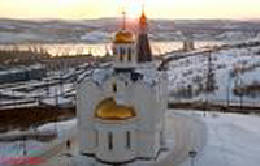
Murmansk in the frozen north of Russia
On our return to Moscow
from Kaliningrad and Murmansk we were put into a different hotel which I
was told by those who knew, was standard practice for foreign visitors.
The first night our group was invited to a ballet performance. I
declined together with a Singapore colleague, and one of the
interpreters agreed to stay with us. An East German chemical exhibition
being held near the hotel.
As we wandered down the
road, we were accosted by a small but very drunk Russian man who
demanded to know if we were German. We had difficulty convincing him we
were not as he realized that we were definitely not Russian. He said
that the Germans had killed his father and he was going to take his
revenge on them. He had difficulty identifying the country of my
Singaporean friend but then associated him with the only Indo-chinese
country he knew – Vietnam! He threw his arms around my startled
colleague and began to apply full-blooded Russian kisses on his mouth.
We pulled them apart and ran up the road, ducking into a side street
till our little drunk friend passed, then we walked briskly back to the
hotel. The group bus had just arrived back from the ballet. The party
came out in leisurely fashion and stood in the fore court getting some
fresh air. We ducked inside a doorway as we saw our amorous
acquaintance come staggering back. He went up to the group, who were
blissfully unaware of his intentions, and picked out a dusky Pakistani
officer. As we beat a hasty retreat inside, the last we saw was two
strong colleagues vainly trying to prise our friend off the astonished
Pakistani who was being kissed as never before in his life!
Our conversations with
interpreters and other Russians left me with some interesting
impressions. One interpreter, Vassily, had been trained as an artillery
officer during his national service. He told me, “David, I hope I
never have to use that skill”. Russians love to joke, and their
humour is very earthy. In some ways they resembled Aberdeenshire Scots
to me. They discussed politics and world affairs with surprising
frankness since the country was still under totalitarian rule. And they
also displayed an eager interest in religion and the Christian faith in
particular. Most of the interpreters at one time or another, came to my
room and asked if they could see my Bible. They said there were many
believers in Russia, including some in high position, naming a few, but
they were not people with whom I was familiar. One Sunday we were
invited to watch Moscow Dynamo versus Spartak in a local derby football
match. I asked if I could attend a church instead. This was readily
permitted, only they said I would have to find my own transport, and
they could not spare an interpreter. However, the hotel kindly gave me
the address and time of service, and I got a taxi to take me there. It
was a moving experience to be in the Moscow Baptist church with two
thousand local worshippers including a surprising number of young
people. The church provided me with an interpreter, and even had my
greeting read out to the congregation. The service continued for two
hours, and I was given a lift back to the hotel by two of the members.
Nikita Khrushchev had
been replaced as Soviet leader, a year before my Moscow visit, by
Brezhnev and Kosygin who ran the Soviet Union for more than a decade
till Brezhnev was replaced after his death by the aging Andropov, who
was to be succeeded by the aging Chernenko. Despite his histrionics at
the U.N., and his often bellicose statements, I warmed to the bluff,
peasant-like Khrushchev who at least exhibited some colour, in contrast
to the dreary line of post-Stalin leaders. He also was the first to
publicly denounce Stalin for his dreadful purges, and to permit a degree
of press freedom that led to the emergence of dissident writers like
Solzhenitsyn who till then could only publish under the samizdat
underground informal press. On taking power, Leonid Brezhnev soon
stamped on the fragile shoots of freedom that Kruschev had permitted.
I believe it was in
late 1984, when my wife and I were walking through Edinburgh’s west end,
that we were surprised by an unusual event in Scotland, - a very large
motorcade of police cars and motor-cycles coming from the direction of
the airport. Two or three limousines drove past with the police escort,
and headed into Princes Street, but we were unable to recognize the
occupants. Later we discovered in a surprisingly brief news item, that
the visitor given such large police protection, was a Soviet politician
by the name of Mikhail Gorbachev. He of course went on to become the
Soviet leader, and was described by Mrs Thatcher as “a man with whom
we can do business”. He was to be the architect of the
modernization and opening up of the Soviet Union with his policies of
glasnost and perestroika. Surprisingly, Gorbachev did not
appear to realize himself what the policies would lead to, or how they
would open the door to forces he could not control. I personally was
sure he committed political suicide when following the attempted coup
that involved his abduction, he defended the Communist Party. His
failure to read events accurately, or to fully appreciate the public
reaction, led to his fall from power, and the rise of Boris Yeltsin.
This brought an end to the mighty Soviet Union, and ushered in the
Russian Federation, leaving a number of satellite states to pursue their
own course.
Since then the Russian
Federation has withdrawn somewhat from the rather chaotic measure of
democracy and transparency brought in by Yeltsin’s government. A former
KGB chief, President Vladimir Putin, now maintains an iron grip on
Russian institutions and the Federation states, just I suppose, as in
the USA, a former CIA Director, George Bush senior, and now his son,
George junior, has led the United States back down an extreme right wing
and imperialist path. Putin’s absolute refusal to countenance any form
of self-rule for Chechnya has resulted in a blood bath both inside and
beyond that state. Russia’s political and economic decline may have
bottomed out as the Federation begins to discover the power it can wield
from its massive gas and oil reserves, its proximity to the Middle East
and Central Asian states, and the overhaul of its nuclear arsenals. But
there are sinister repeats of past brutality being seen in the ruthless
and brazen murders of brave news reporters and dissidents – even beyond
Russia’s borders.
One of the worst and
most blatant acts of suppression of free speech was the murder of
newspaper reporter Anna Politkovskaya. This brave and determined
investigative journalist had exposed much of the brutality, torture and
injustice in Russian suppression of Chechnya. She was gunned down in
her apartment block in Moscow in October 2006. Together with the murder
of Alexander Litvinenko in London the following month, it was indicative
of a callous tough new attitude to dissent by the Kremlin authorities,
reminiscent of the worst periods of Soviet rule.
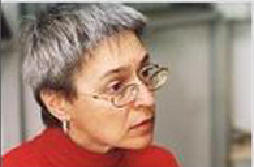
Anna Politkovskaya, investigative
journalist, murdered in October 2006
While welcoming the
demise of the Soviet Union and its record of cruelty, dictatorship and
mismanagement of the economy and the environment, some informed
observers believe that the emergence of the USA as the world’s sole
super-power is not a healthy situation. It has lead to the GW Bush
government invading foreign states imposing its will, and ignoring human
rights and international justice, while neglecting the less affluent of
its own people at home. Since the fall of the Soviet empire, the
salaries of corporate executives have risen ten times more than those of
the lower paid in the USA. There have been huge tax reductions for the
most wealthy, windfall profits for the big corporations, and a relative
decline in health entitlements, welfare allowances and social services
for the poor. There have also been a surprising number of financial
scandals involving the theft or illegal manipulation of billions of
dollars of investors and taxpayers money. However those factors are
genuinely related or not, it would appear that the fear of communism or
socialism reducing support or rationale for the capitalist system,
seemed to place a check on the excesses of the USA while the Soviet
Union continued to be a global super-power. Now that the threat is
gone for the present, we see re-emerging the behaviour of some of the
worst or most extreme elements of U.S. capitalism.
Turkmenistan
At the southern border
of the former Soviet Union, and facing both Iran and Afghanistan to the
south, lies the state of Turkmenistan. It was made a member of the
Soviet Republics in 1925, and stayed within that orbit till it obtained
its independence in 1991 after the break-up of the USSR. I was to
assist a team that had been provided by the European Union Tacis
programme to help the former soviet satellite on the road to
privatization. Two strong impressions remain with me from that
assignment. The first is the character of the ancient Turkmeni people
whom one could not help admiring, and the other was the nature of the
independent government, - centrist, totalitarian, and built around a
personality cult. My Turkmeni driver, Kurban, a strong, energetic and
reliable man, wept like a child when we said goodbye at the airport on
my final departure.
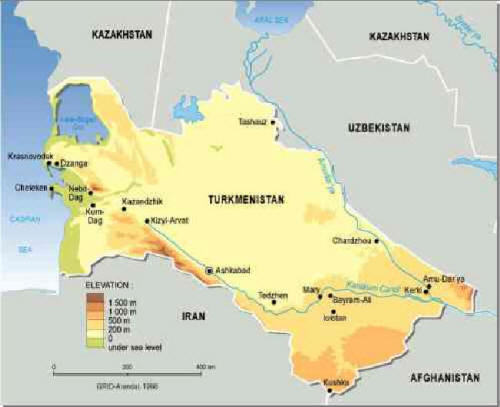
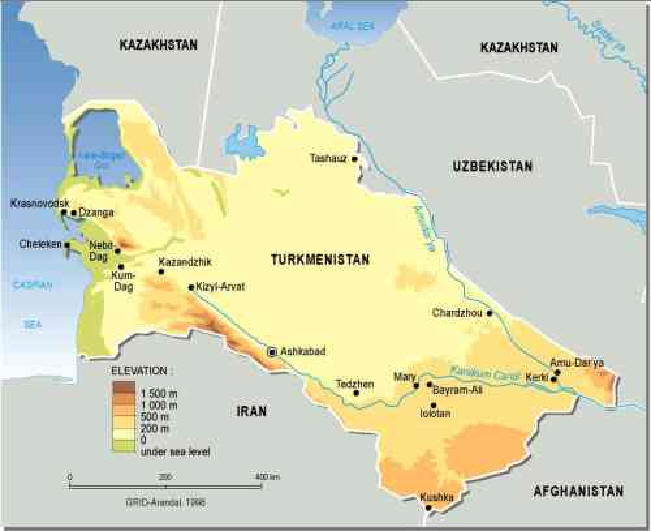
Map of Turkmenistan
The country is an
enormous desert, the Kara-kum (black sand) desert, stretching from the
Caspian Sea to the Amu Darya river. The population of just under 5
million is mainly Turkmen, with perhaps 10% of Russians, and a
sprinkling of Uzbeks and others. The natural resources include
petroleum, gas, sulfur and salt, and its agriculture produce is mainly
cotton and rice. Fish, both kilka sprat and sturgeon, are
produced from the Caspian Sea where the country has a port, formerly
Krasnovodsk, now Turkmenbashy after the invented national name of
President Saparmurat Niyazov. The capital city Ashgabat, is a mixture
of soviet and central Asian architecture, some of it bizarre to western
eyes. It was built on the site of a Russian fortress dating from 1881.
Ashgabat was destroyed by an earthquake in October 1948. Over 120,000
of its inhabitants perished in that disaster. The modern city was built
with wider streets and buildings more spaced out to minimise possible
future damage from quakes.
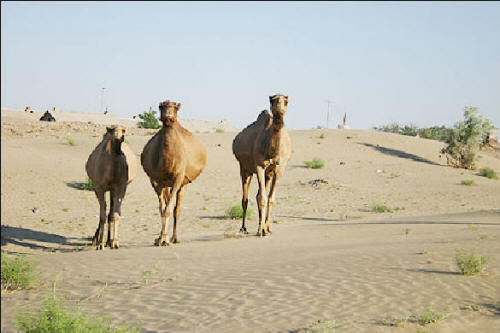
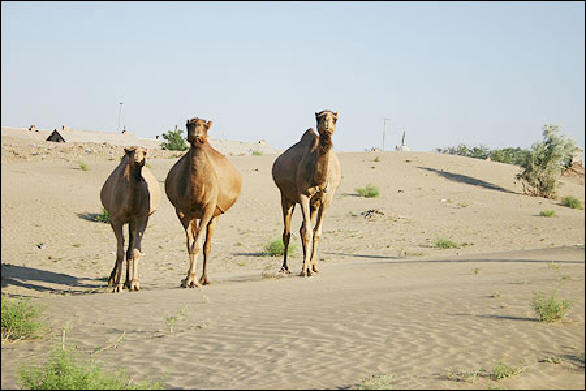
The Kara-kum desert
Not far from the
capital, half-buried under desert sands, lie the remains of the once
huge city and fortress town of Nisa which was the capital of the
Parthian empire from around 300 BC till 300 AD. It may have been the
site of an earlier Persian fortress built 2,500 years ago by Darius the
Great. Modern Persia, Iran, lies only a few score of miles to the
south. 90 kilometres west and close to the border with Iran, at
Bakharden, there is an underground hot spring lake called Kov Ata inside
a vast cavern. I found it weird to be swimming down there in the warm
sulfuric water, far below the ground, together with my Turkmeni driver
and Russian interpreter. Following our subterranean bath, my Turkmeni
driver took me and Ellena the Russian interpreter, to a pleasant
location by a stream in a mountain pass where he lit a fire and grilled
shish’ kebabs for our picnic meal.
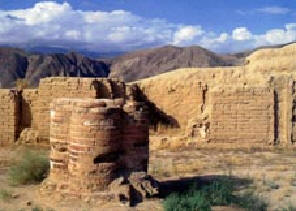
Ruins of the ancient fortress of Nisa
Only 3.5% of the land
is arable, and even that is cultivated only by water extracted from the
Amu Darya river, and led by canals to the cotton growing areas and small
farms. This is the source of huge environmental problems, not just for
the country, but for the whole region. Western industrialization and
agricultural mechanisation has created dust bowls in central America,
and areas of pollution around our cities and factories. But Soviet
industrialization and central control of agriculture has shown even less
concern for the planet’s life support system. The great Aral Sea
located between Kazakhstan and Uzbekistan was once the fourth largest
inland sea in the world, covering over 25,000 square miles and
supporting a large fishing industry. It has now shrunk to less than a
third of its size and this reduction is bringing ill-health,
unemployment, and food shortages to the region. The salt content of the
sea has doubled, and winds now carry salt and sand from the dried-up
areas, depositing it around within a 300 km radius, destroying pastures
and adding to deserts and toxicity.
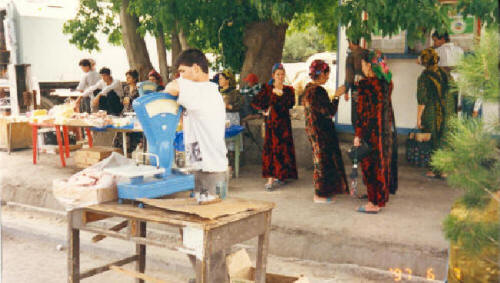
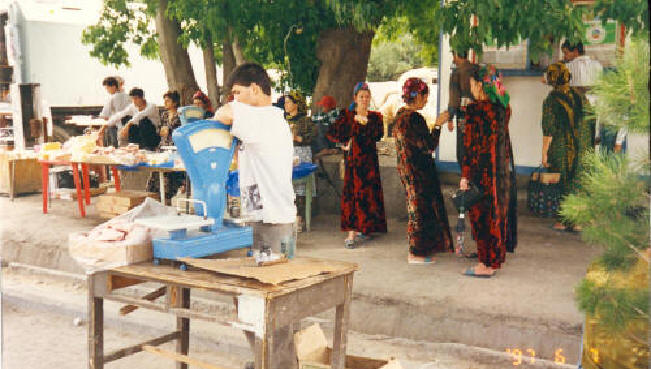
Above :Turkmeni women in national dress
in Ashgabat. (the picture had to be taken surreptitiously as neither
people nor police like foreigners to do this).
Even Turkmenistan which
is chiefly, but not solely to blame for the diversion of fresh water, is
suffering the consequences in salination of its surface water bodies,
residues of chemicals and pesticides in its soils, and pollution of the
huge Caspian Sea. In hindsight it is easy to see that cotton was a most
unsuitable crop for a region with so little fresh water; but it became a
major export earner, making Turkmenistan the tenth largest cotton
producer. So it is difficult for any administration to reverse the 40
year policy, to dismiss thousands of workers, and to substitute with
other environmentally friendly industries. Like most of the world’s
environmental problems, there are no short-term solutions, and few
governments are prepared to inflict the pain necessary to achieve the
long-term gains.
The resilience of the Turkmen people and the Russian
residents, in struggling to make a life in adverse circumstances is
admirable. Their struggle is made all the more difficult by a
government that has retained most of the worst aspects of Stalinist rule
and controls. To take one example, the manager of the processing plant
and fishing fleet on the Caspian Sea, was working wonders to pay his
work force, keep the vessels operating and produce the canned and frozen
fish the country needed for food and exports. This was against the
background of restrictions placed upon the operation. No worker could be
dismissed, and the plant had to supply free fish to the army and the
hospitals. State supplied budgets were invariably inadequate. The
manager became an expert in robbing ‘Peter to pay Paul’. He bartered
fuel oil to pay Russian shipyards to overhaul his vessels, and bartered
fish to get metal plate to can the next lot of sprats. What was his
thanks ? A bureaucrat came down from the capital to inspect the books.
He said that the manager was not acting according to the rules and had
him arrested and imprisoned.
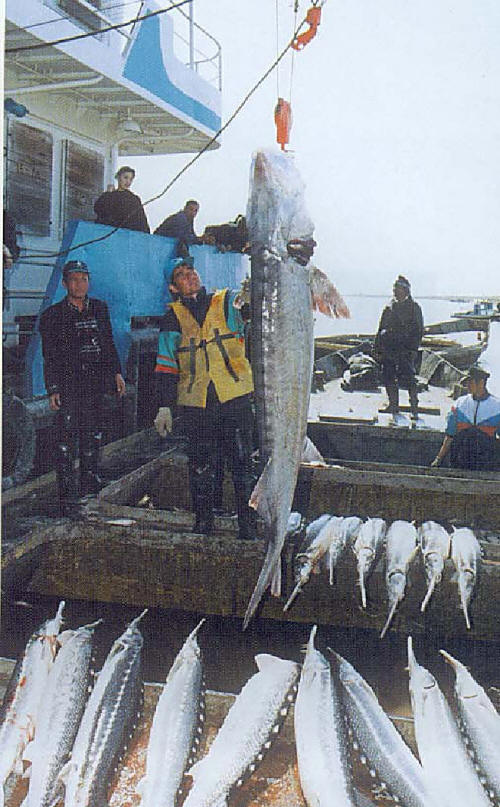
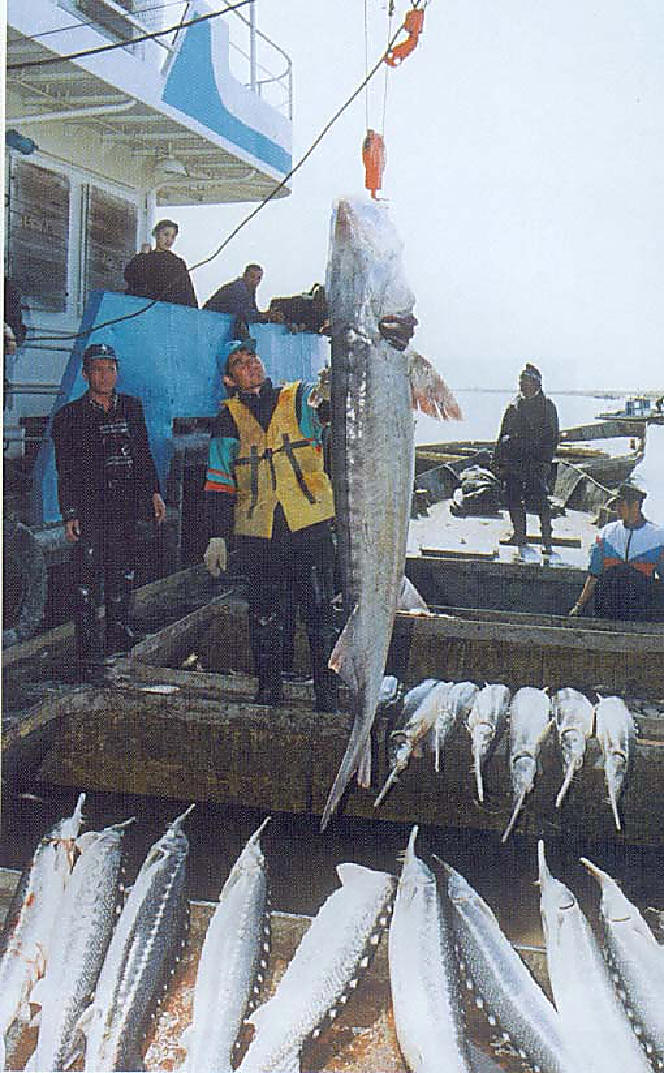
Sturgeon fishing in the Caspian Sea
The Government was committed on paper to de-nationalisation
and privatization, but officials appeared to have little concept of what
that meant. We asked one senior officer to explain how it would work
out in practice. He said that the State would retain 51% of the shares
of any company. A private sector firm buying into the industry would
have to pay the State a high price for the 49% of shares on offer. They
would then be expected to invest heavily to renovate the factory, though
plants were in such bad shape, it would be easier and cheaper to build
new. The new managers would have to retain all of the existing work
force, and to continue to supply free food to the army and the
hospitals. On top of all that they would be expected to produce a
healthy profit for the government. Small wonder then that privatization
has proceeded at a snail’s pace in that land.
It is all so
depressing, and even more so when there are some possibilities to put
the country on a path to economic progress and environmental
rehabilitation. The people are hard working and willing to endure much
deprivation to carve out a future for their families in the rugged
desert lands of central Asia. During my stay I was privileged to share
the hospitality of the Turkmen people in their own homes. It was rather
eastern in form. We sat on the floor on Persian rugs, and helped
ourselves to food from an array of local produce and Turkmen cooking.
On several occasions I was generously entertained by my Turkmeni friends
who made
shish’ kebabs on charcoal fires with mutton meat, onions, large peppers
and tomatoes, over which they poured vinegar as it cooked. On the
Caspian Coast my Russian hosts did the same with sturgeon meat.
In the
nine years since my time in Turkmenistan, the President for life
continued to reinforce his ruthless steely grip on power, practically
isolating the country from the rest of the world. His paranoid control
of the country extended beyond political dissent to social and religious
activities. Though he permitted the Russian Orthodox church and the
small local Roman Catholic church to continue to function (possibly
because the Vatican was seen as powerful politically), he suppressed
other bodies. A Russian baptist house church was bulldozed to the
ground. The local population is officially unaware even of events in
neighbouring states, like the popular uprising in Kyrgystan, that has
deposed the former President there, and his indifferent regime.
Saparmurat Niyazov had become communist party chief in 1985, and held
the offices of President, Prime Minister, and Commander in Chief till
his death in late 2006. He had renamed himself ‘Turkmenbashi’, meaning
‘father of all Turkmen’.
Now the
whole Caspian Sea region has acquired global strategic importance due to
its enormous reserves of natural gas and petroleum. These resources are
distributed in a region that is difficult to access and to export from
due to its remoteness and to the political tensions and differences of
the region’s states. Nevertheless, the USA, Europe, Russia and China,
are assiduously courting the governments of Azerbaijan, Kazakstan,
Turkmenistan, and others, to obtain supplies and to build pipelines that
would carry the oil overland and on to the Black Sea or the Persian
Gulf. One current proposal is for a pipeline from Turkmenistan to
travel west under the Caspian Sea. The gas reserves which exceed oil
resources in the region, are much more problematic to extract, store and
transport.
My late
Icelandic friend Hilmar Kristjonsson who led our study tour visit to the
USSR, used to say that culturally the orient began on a longitude
somewhat to the west of Moscow, which I think sheds some light on
aspects of Russian life. It reflects a statement attributed to
Napoleon, “scratch a Russian, and you’ll find a Tartar underneath”.
Another
friend and colleague, Menachem Ben Yami, who fought with the Red Army
during the war, and spent some months in Moscow, used to say, “never
underestimate the Russian”. I often recall that statement as the
vast country goes through its current turmoil. The Russian people will
endure, they will persevere, and they will emerge from it all,
hopefully, stronger and progressing to a degree of peace and plenty.
During
my first visit to Soviet Russia, our group attended a series of
receptions at which there were the obligatory toasts. The first toast
always was to “Mir”, - to peace, and to friendship. It was the
diplomatic norm, but I often felt I detected genuine sincerity in the
persons proposing the toast. They were invariable prematurely aged from
the efforts to re-build the country after the war, with limited
resources, and under a ruthless regime, - but build it they did, and on
meeting visitors from abroad, they wished them only peace. |