|
The following biography
of Robert M. Adam is courtesy of "Archives Hub,"
a national gateway to descriptions of archives in UK universities and
colleges.
Robert Moyes Adam
(1885-1967) spent most of his professional life as an illustrator in the
Royal Botanical Gardens in Edinburgh. It was as a landscape photographer,
however, that he became best known. Widely published, particularly in
regular features in the Scots Magazine and many of the books published
about the Scottish hills or flora during the 1940s and 1950s, his
photographs display a uniformly high quality and form a documentary and
artistic portrait of the life and landscape of Scotland - especially the
highlands and islands.
He was born in Carluke, Lanarkshire in 1885, son of a Congregational
minister. He had a varied education, studying science at Heriot Watt
College, drawing at the Edinburgh College of Art and botany at Edinburgh
University. In 1903 he was appointed as assistant gardener at the Royal
Botanic Gardens in Edinburgh to help the Professor of Botany to prepare
lecture drawings. In 1906 he began to photograph plants and in 1914 he was
appointed to the establishment as assistant in charge of the studio. He
remained in this post, regraded in 1915 as 'botanist' until his retirement
in 1949.
Adam bought his first camera (quarter plate) in 1899 at the age of
fourteen while still at school in Edinburgh. He bought a half plate field
camera made to his own specification by Watson and Son in 1908 which he
was to use almost exclusively for the rest of his life although he
continued to make a small number of quarter plate negatives. He later
acquired a 5x4 reflex and a Leica camera but these were used sparingly. He
began to keep registers of his negatives in 1901 which continue until
1956, and kept meticulous notes about his images and the printing of the
negatives over which he took extreme care. He favoured producing great
depth of field in his images by using very small apertures.
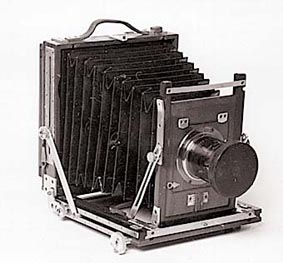
This camera made by Watson and Son is similar
to that used by Adam
His botanical photography
brought him to the attention of botanical writers but by the 1930s his
landscape work was also in demand from authors of travel books. It was,
however, the editor of the Scots Magazine, Robert Daw, who, by publishing
large monthly thematic blocks of his pictures between 1944 and 1947,
brought him to general attention. Until ill-health overcame him in 1956 he
was the major Scottish photographic illustrator of his time with his work
being used in books, magazines, newspapers and advertising materials of
all kinds. Adam's landscape photographs were especially successful.
Although he always disclaimed art in his photographs, careful composition,
general overall sharpness, typically high viewpoints in his mountain
pictures and meticulous printing were his hallmarks. Many of his views
have additional importance as historical records of the vanishing
lifestyle and altered landscape, particularly of the north and west of
Scotland. The record of his first visit to Mingulay in 1905, three years
before its evacuation, is a notable example of this.
The University of St
Andrews holds an extensive collection of
Robert M. Adam's photographs dating from about 1902 to 1956,
with much of it available on-line. Click
here for more information.
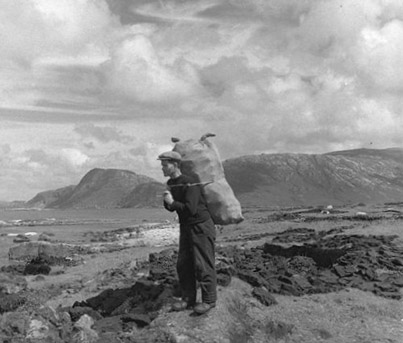
Crofter carrying Peats, Isle of Fladday,
Harris
photographed by Adam in the 1930s |



