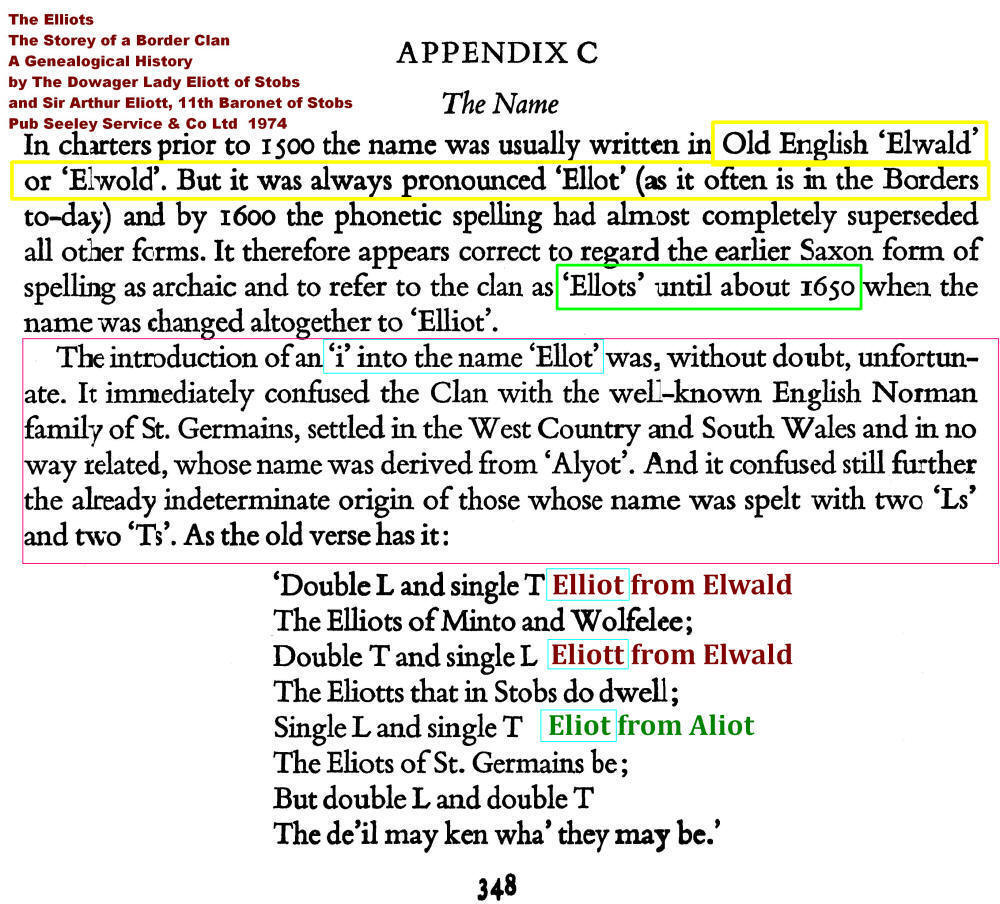
The name Elliot originates
from the village of Eliot in Forfarshire although the old English form of Elwold also
appears in Scotland. The Elliots were one of the notorious Border clans and were found in
the district of Upper Liddesdale. The principal family in the early days was the Elliots
of Redhaugh, but the branch that later was to represent the senior line was that "of
Stobs" The Elliots of Stobs originated in the 16th century from Gawain Elliot of the
Redhaugh family. His younger son, Gilbert Elliot was convicted of High Treason in 1685 for
his work towards religious liberty, only pardoned after the ascension of William of
Orange. He was created baronet in 1700 and conferred a Lord of Session as Lord Minto in
1705. His son and grandson, the 2nd and 3rd Baronets were likewise educated for the bar,
sat in parliament and held other high official positions. Jane, sister of the 3rd Baronet
was famed for her composition "The Flowers of the Forest" that told the story of
the men lost at Flodden. George, 4th Baronet was conferred 1st Earl of Minto, he also
followed his father before him into politics and in 1794 was made Viceroy of Napoleon's
island Corsica. In 1807 he was appointed Governor General of India, succeeded by his son
who became Viceroy of India in 1905 and who was the chief architect of the Morley-Minto
Reforms that despite being radical at the time were still insufficient to stem Indian
discontent.
I am in the middle of research
into the lands possessed by the first Ellot/Elliot Border Reiver
clan chieftain. The name Elliot was notorious for its variants, due
to problems of medieval phonetic spelling, explained by David
Crystal in his encylopedia of the English languate. One problem was
the many failed attempts by
scriptores, whose maternal language was neither Gaelic nor
Middle Scots ( not spoken yet when Alyth was probably founded with
the barony, consisting of a thanage probably alienated by William I
in the late 12th century to the ancestor of Walter d'Alyth, the
first baron.
Walter of Alyth was
Walter Elliot. Elliet was one of many variants of this Breton name.
An early Bruce adherent, he forfeited Alyth to Adam Brunyng in 1306,
whose son John later supported Bruce. In recompense Alyth/Ellot/Eloth/Elliot
( non English scribes struggled with the name ) Bruce had the
Elliots settled in Liddesdale, as vassals of his natural son Sir
Robert. Scott of Satchells referred in the 17th century to Alyth as
"the town of Elliot at the foot of Glen Shie." The gaelic "aileadh"
is perhaps based on guesswork, and the 1640 name Elieht is very much
in line with Scott's claim. Alliot was another variant of Elliot,
imported from Brittany among William the Conqueror's Breton
contingent. Many settled in the Breton Count of Richmond's honour,
and today the names Alliott, Allott
and Allitt are still found more commonly in Yorkshire.
Dalliot = d'Alliot was another no longer extant variant. Elliots/Alliotts
( plus variants like Elligott and Ellacott) were established in
Scotland during the "Davidian Revolution." DNA analyses confirm
their Celtic-Brittonic origins.
13th and early 14th
century charters reveal a problem with Walter's name, based on an
old Breton clan toponym. He had relatives in Perth whose surnames
were spelt Alight, Alyght. Early documentary records probably reveal
the hand of a French speaking scribe. The th in names like "de
Monthemer" was pronounced as a "t". At Arbirlot, the name first
cropped up as Eloth, before later correction as Ellot and Elliot (e.g
Elliot Water)
Scott of Satchells
wrote (17th c)
The town of
Elliot was their antiquitie, Wich stands in Angus at the
foot of Glenshie;
With brave King Robert Bruce they hither came;
Which is three hundred and eighty years agone;
In West Teviotdale*these gentlemen did dwell,
They were twelve great families, I hear my goodsir tell;
Their chief was then a Baron of renown,
Designed Reid-heugh, which is now called Lariston.
(Alyth now
stands, of course just on the Perth and Kinross side of the
modern county border)
As Elliot Clan
historian, I thought that this might interest you, and set off a
debate among local historians.
I have now traced two
historic maps showing Eliot in place of Alyth, and The Forest of
Elieht instead of Alyth. Whilst the old medieval misspelling has
been retained, here were two cartographers who listened to, or heard
how, the name was pronounced, and at a time when spelling was
becoming more accurate, entered Eliot and Elieht into their
hand-drawn maps. Scott of Satchells was also spot on when referring
to the town of "Elliot" at the foot of Glen Shee. There is now no
doubt that (a) Walter Elliot of the Brae, shown as Walter of Alyth
in the 12th and 13th century ( land forfeiture 1306, summons by
Edward I to military service, and swearing of fealty to Edward after
the battle of Dunbar ) was recompensed for loss of his lands by the
grant of other lands in Liddesdale. All information on websites
other than that now being revised by our clan society is now blown
out of the water. The charter name Elwald, given circa 1320 was
spurious, although we shall never know the reason why and can only
speculate about an attempt to give these warriors of Anglo-Norman
origin, who came to Scotland during the "Davidian Revolution",
possibly in the retinue of west country barons who are known to have
benefited. For example, the Berkeleys (now Barclays) are purported
by Professor G W S Barrow, the highly respected former Emeritus
Professor (Edinb.)to have come from Castle Cary in Somerset, where
today there are Eliots, who share the same ancestry as the current
Earl of St Germans, Peregrine Eliot, who has confirmed that the
theory that his family, was never based on more than supposition.
His ancestors first settled at Plympton in the post-Conquest lands
of Judicael, viscount of the Halegouet, the Elliots ( and Alliots,
Eligotts, Ellacotts etc etc) ancestral homelands during the Breton
Viking wars. Robert of Bampton, Somerset, was also an ally of David
I, in support of his neice the Empress Matilda, during the first
English Civil War. The Scottish de Braose branch was a Devon family.
The name Elliot in
South Wales indicates Breton participation in the conquest of that
territory by William fitzOsbern during 1070-71.
The most important thing now is to establish the Breton origin of
the name and its several variants, and to discount Elwald as an
attempted anglicisation ( which undoubtedly it was, for whatever
reason) and to stress the migration of Elliot ancestors to England
and Wales during the Norman Conquest, and later to Scotland when the
Macmalcom dynasty was importing scores of Norman, Breton and Flemish
knights and setting up feudal military tenure. There are even silly
websites which claim that the name is of Hebrew or Jewish origin!!
God help us with rubbish like that on the internet.
Incidentally, I have a "first" in History, UCL London 1971.
Sincerely,
Keith E Hunter
Hello Mr McIntyre
You have already been kind enough to accept previous information from me about the Breton origins of the Elliots, transplanted into Liddesdale from the north by Robert Bruce circa 1320. Your information that Alyth (Perthshire) had been spelt on an early map as Elieht was crucial: an online search of NLS maps, now digitized, revealed other maps which showed Alyth as Elieht, Elyeht, and finally on separate occasions, by the highly reputed cartographers Herman Moll and John Adair - as Eliot. The 17th century antiquarian, Scott of Satchells, had long since claimed that the Elliots came from the town of Elliot, with twelve great families, at the foot of Glen Shee. How the name Elliot - often shown as Alliot, or more accurately in medieval times as Dalliot, or more accurately d'Alliot, according to the clerical preferences of the time - was written as Alyth, which with the y clearly representing the semi-vowel of yes led me to consult the work of historians of the English language, like David Crystal, who has a clear answer. The evidence now accumulated, DNA, primary and secondary sources, etc., is overwhelming. Like the Stewarts, the Elliots were of Breton origin, involved like the Stewart progenitor from Dol, Walter fitzAlan, in the "Davidian Revolution". This paper will now be published via a link in the Autumn issue of the Elliot Clan Society Newsletter. The only loose end now remaining is to find what was the Elliot connection with Arbirlot, or Aber-ellot etc. I am beginning to suspect a connection with one of the first two abbots, sponsored by Bishop Jocelin of Glasgow, whose forename was distinctly Breton, and popular with the viscounts of Rohan (Roc'haned) in Brittany who founded the town and castle of Josselin, but proof is another thing.
Heartening to know now that Alexander Elliot Salmond has some Breton ancestry! ( I don't think he knows this yet.)
This comment system
requires you to be logged in through either a Disqus account
or an account you already have with Google, X, Facebook or
Yahoo. In the event you don't have an account with any of
these companies then you can create an account with Disqus.
All comments are moderated so they won't display until the
moderator has approved your comment.