Est. 1634
The
Anglo-Scottish border runs from Berwick-on-Tweed in the east to
the Solway Firth. Until the eighteenth century this was an area of
virtually continuous strife which only began to decline in the
seventeenth century with the Union of the Crowns in 1603. By the
sixteenth century the border was divided into six administrative
districts, three on the Scottish side and three on the English
side. Each district of March, as it was known, was administered by
a Warden whose function was to defend the border during wartime
and to maintain law and order during peacetime. The latter
function required cross-border cooperation with the Warden there
to counter the Reivers who raided across the border and violated
the peace treaties. Cowdenknowes seems to have been just within
the Scottish East March.
The
Homes (pronounced and sometimes spelled as Humes) of Cowdenknowes
in Lauderdale were descended from the first Lord Home and were one
of the greater Borders laird families. Mungo Home, heir of his
father John Home of Ersiltoun, Whitrig and Crailing, had Sasine of
Ersiltoun, Brotherstanes and Whitrig. In 1493, and in 1494, he
also had Smailholm. On 4 March 1506 he had a charter from King
James IV of the lands and barony of Ersiltoune with the dominical
lands called ‘Coldaneknollis’ with fortalice and manor thereon,
which the king added to the barony of Ersiltoune. In 1507, he
married Elizabeth Stewart, illegitimate daughter of the Earl of
Buchan. Their eldest son was John. Later, as Sir John Home of
Cowdenknowes, he became embroiled in the feud between the Kerrs
and the Scotts. This feud arose when James V, attempting to escape
from the supervision of the Earl of Angus, enlisted the Scotts of
Buccleuch. They, with 600 men from Liddesdale and Annandale,
attacked the royal train near Melrose. Their attempt to liberate
the king failed and Kerr of Cessford was killed during the
attack. Twenty-six years later, in 1552, the Kerrs had their
revenge when a group of Kerr supporters waylaid Scott of Buccleuch
in the High Street of Edinburgh. He was then killed by Sir John
Home of Cowdenknowes.
Sir John
was succeeded by his eldest son, Sir James Home of Synlawis, who
by 1573 was Warden of the East March with title ‘of Cowdenknowis’.
In 1580 he was appointed a Gentleman of the Bedchamber to James
VI. During the Earl of Arran’s regime, Sir James was imprisoned in
Blackness Castle and ordered to give up the house and fortalice of
Cowdenknowes. On Arran’s fall, Sir James became Captain of
Edinburgh Castle. Sir James died in 1595. During his lifetime he
had filled a number of prominent positions such as Warden of the
East March, Baillie of the Earldom of the March, and Privy
Councillor.
Sir
James was succeeded by Sir John his eldest son, who inherited the
Barony of Ersiltoune. In May 1595 Sir John was serviced as heir to
the lands of Finlaw and others. Later, in 1602, the lands at
Smailholm were added. Sir John was one of the commissioners
appointed to discuss the proposed union of Scotland and England.
During
the first part of the 17th century the Homes incurred financial
difficulties. Parts of the lands of Cowdenknowes were mortgaged,
foreclosed and sold off to several different families including
Jacob Livingstoun of Biell, and Scott of Harden. The lands of
Cowdenknowes had always been part of the Barony of Ercildone,
which through many different spellings, eventually became
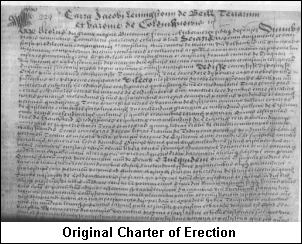
Earlston. On January 15th, 1634, Cowdenknowes was erected into a
separate Barony from Earlston in favour of Jacob Livingstoun of
Beill and Skirling.
The following is an excerpt from
the Royal Charter which reads as follows;
"All
and Whole the lands and Barony of Coldinknowis comprehending
therein all and sundry the lands Barony mills woods fishings and
others particularly and respectively underwritten with their
pertinents viz; all and whole the lands and mains of Coldinknowis
with the tower fortalice manor place houses biggings yards
orchards dovecots mills woods fishings annexis connexis parts
penicles and whole pertinents thereof whatsoever".
(**This
is an excerpt from the original Royal Charter and is to be Taken
for it's Historical value only, many of the contents mentioned,
including the House and Tower, are now privately owned and are
detached from the Barony as it is today**)
James
(Jacob) Livingston of Beill and Skirling (Baron of Beill) was a
groom of the Royal Bedchamber to King Charles I and one time
Keeper of the Privy Purse. He was the fifth son of Sir John
Livingston, himself third son of Henry Livingston of Falkirk. He
was uncle to the first Earl of Newburgh. He married in 1632 Anne,
daughter and eventual heiress of John Nasmith of Coldinknowis,
surgeon to the King. They had no issue. At that time the Barony
came into the possession of Thomas Hamilton, 1st Earl of
Haddington, son of Thomas Hamilton of Priestfield.
Thomas
Hamilton was born in 1563 and educated in Edinburgh and Paris. By
1587 he was an Advocate and by 1592 an ordinary Lord of Session.
In 1593 he became a Privy Councillor and Lord Advocate in 1596.
In 1602 he became Parliamentary Commissioner concerned with the
Union of the Crowns. He became Lord Binning in 1613, Earl of
Melrose, Lord Byres and Binning in 1619, and the Earl of
Haddington in 1627. Among the various properties that he acquired
was Cowdenknowes.
Thus by
the mid 1630s certain land in Berwickshire had come into the
possession of the Hamilton family, Earls of Haddington. On 30 June
1637, Thomas, 3rd Earl of Haddington, was serviced as heir to his
father Thomas, 2nd Earl of Haddington. During the Second Bishop’s
war of 1640-1641, despite the Earl’s connections with the Royalist
Earl of Huntly, he was appointed a Major General of the
Covenanting Army in command of a brigade watching the English
garrison at Berwick. On 29 August 1640, a skirmish occurred
between the two forces and the English raiding party returned to
Berwick, the Earl and his officers to Dunglass Castle where they
were killed by an explosion caused when the powder magazine was
ignited by the enemy. Upon his death his lands and titles fell to
his brother John, the 4th Earl of Haddington. John was a Royalist
and present at the Coronation of Charles II at Scone. His eldest
son Charles became the 5th Earl in 1669. In 1685 on his death the
Earldom fell to Charles’s second son Thomas. Thomas, the 6th Earl
of Haddington was loyal to the Hanoverian government during the
Jacobite Rebellion of 1715 and fought on the government side at
Sheriffmuir. Later he was made a Knight of the Thistle and served
as Sheriff of Stirlingshire prior to his death in 1735. Thomas had
several children including Charles, Lord Binning, who for his
active support of George I in 1715 became Knight Marshall of
Scotland in 1718. In 1717 Lord Binning married Rachel the younger
daughter of George Baillie of Jerviswood, the proprietor of
Mellarstain, one of the Great Houses of Scotland. Charles, Lord
Binning died in Naples in 1732. His heir was his son known as
George Baillie of Jerviswood, and he was succeeded by his son also
George Baillie of Jerviswood. His eldest son George, an Advocate,
became the 10th Earl of Haddington. He was prominent in Scottish
legal and political circles becoming the Sheriff of Stirling, then
Lord Advocate, a Member of Parliament, and finally Lord
Jerviswood, before his death in 1879. The Barony of Cowdenknowes
remained with the Baillie-Hamilton Family until the Rt Hon John
George Baillie-Hamilton, the 13th Earl of Haddington, passed
possession to the present owners family.
The Barony today, is in the possession
of the Harden family. The first
Harden to hold the title was Barry George Harden
(Recognized by Letters Patent from the Lord
Lyon, King of Arms). Barry was born 1945 to William Harden,
of Gillingham, Kent, a Decorated
longtime member of the Royal West Kent Regiment. In August of
2006, The Barony was passed down to the current and 16th Baron,
Mark Harden of Cowdenknowes.
Additional information
"Cowdenknowes"
(pronounced "Cow - den - now's" ) was originally "Coldenknollis".
It was then corrupted into "Coldunknowes". This was
eventually corrupted again into "Cowdenknows" and then "Cowdenknowes"
(which was immortalized in the old Scottish Folk song "The
Broome o' the Cowdenknowes") and more recently into the modern
English of "Coldingknowes".
In
Scotland, "Cowden" stands for colltuinn, which is
Gaelic for "Hazel". The word knowes means hilltop. Thus the
place name may well indicate the "Hazel knolls" or the more
modern "Hazel Hill".
Here is
an except from the "Scottish place name Society", GENERAL SURVEY
OF LOTHIAN [139], Original pagination [pp] from W.J. Watson,
History of the Celtic Placenames of Scotland, 1926 (reprinted 1993
by BIRLINN, Edinburgh, ISBN 1 874744 06 8).
"Cowdenknowes
is Coldenknollis, 1559 (Lib. Melr.); Coldunknowes and Coldin- in
Blaeu ; here 'Cowden' stands for colltuinn, calltuinn, hazel, as
it usually does in Scots; the name is a hybrid, meaning 'hazel
knolls".
|
Here are some examples of the different
spellings recorded as follows; |
|
Document/Record & Date
|
Spelling on Record |
|
Crown Charter of Erection, 15th January
1634 (See below) |
COLDINKNOWIS |
|
Crown Charter of Confirmation, 16th
December 1872 |
COLDINGKNOWS
|
|
County of Berwick, Search Sheet No.101
|
COWDENKNOWES
|
|
Extract Decree of Special Service recorded,
15th March 1872 |
COWDENKNOWS |
|
Register of the Great Seal of Scotland
|
|
15th January 1634 |
COLDOUNKNOWIS |
|
28th June 1634 |
COLDOUNKNOWIS |
|
7th November 1634 |
COLDOUNKNOWIS |
|
1st July 1646 |
COLDOUNKNOWES |
|
16th July 1649 |
COLDENKNOWES
|
|
General Register of Sasines
|
|
Disposition, 15th November 2003
|
COLDINGKNOWES & COWDENKNOWS
|
|
General Register of Sasines, County of
Roxburgh, 2nd December 2003 & 6th February 2004 |
COLDINGKNOWES & COWDENKNOWS
|
|
General Register of Sasines, County of
Berwick, 6th February 2004 |
COLDINGKNOWES & COWDENKNOWS
|
Do visit
their web site here!
|



