|
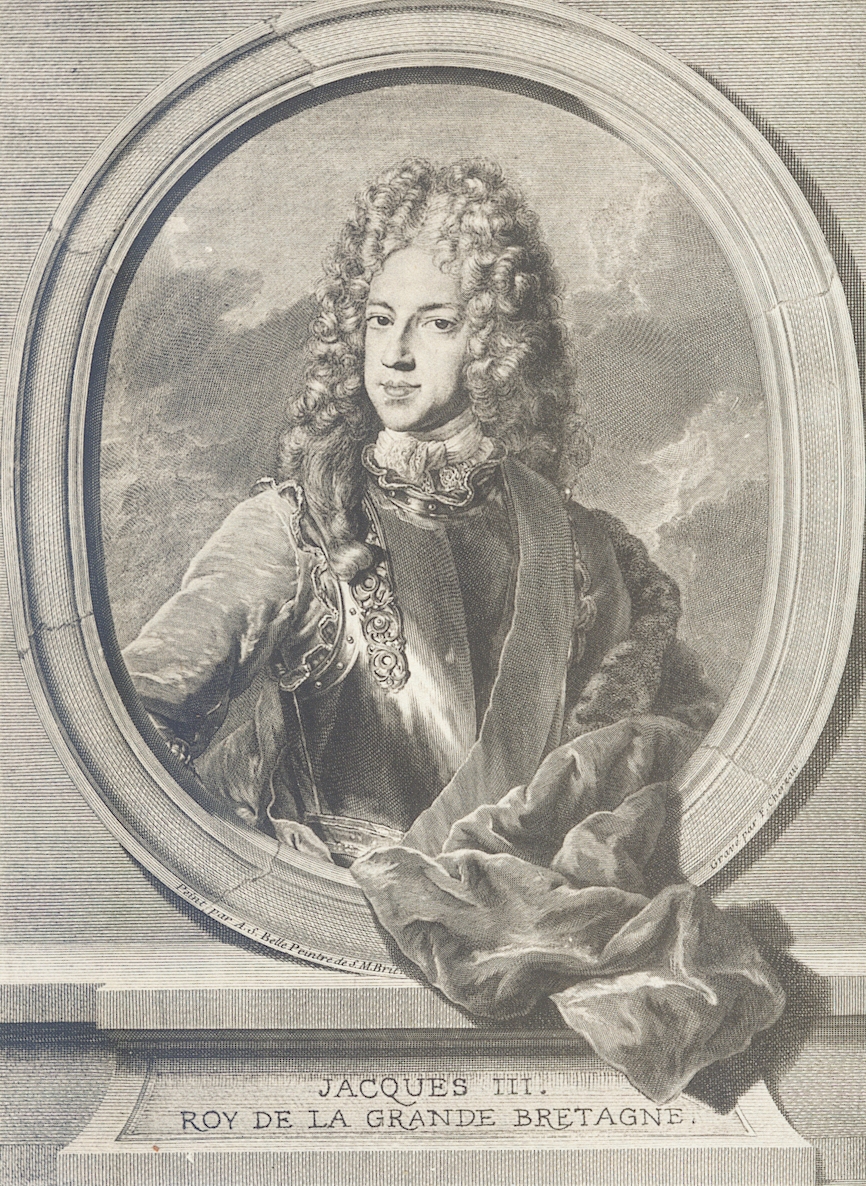
Prince James
Francis Edward Stuart
FOR
nearly a century after the completion of the
Revolution, the adherents of the House of Stuart
continued to hope and plot and struggle for the
restoration of the fallen dynasty. The complete
diplomatic and military history of Jacobitism
still remains to be written. In the Stuart Papers
at Windsor, in public archives at home and abroad,
and in the records of many private families, there
is still much material for the elucidation of the
strange, pathetic story of the lost cause. All
that can be done here is briefly to re-tell the
story of the armed attempts which were made on
behalf of the Stuarts, so far as they took place
in the Highlands of Scotland.
The
courage, wisdom, and clemency of William of Orange
soon placed the Revolution Government on a secure
basis. It was to his great enemy abroad, Louis
XIV., that the Jacobites naturally looked for
help, and in him they found a zealous and powerful
ally.
King James II. died at St. Germains in 1701, and
his heritage of misfortune descended to his son,
James Francis Edward Stuart, then a boy of twelve,
known to his adherents as James III. of England
and VIII. of Scotland, to his enemies as the
Pretender, and to both parties as the Chevalier de
St. George.
All
along it was in Scotland that Jacobitism had its
strongest footing. As the Jacobites were to find
to their cost, the people of England,
notwithstanding local ebullitions of Jacobite
feeling, were as a whole satisfied with the
results of the Revolution; at all events, they
never thought that the restoration of the exiled
family was worth a civil war. In Scotland it was
different. There the Revolution Settlement was by
no means universally popular. The old Cavalier
party hated it, of course; most of the Highland
clans hated it because it meant the ascendancy of
Argyll; the Cameronians hated it because it meant
an uncovenanted king. The action of the Government
in the matter of the Darien project exasperated
Scottish national feeling almost to the point of
hostilities. The Union of 1707 was carried in the
face of a great popular outcry that the honour and
independence of the ancient kingdom were being
sacrificed at the behest of English politicians.
At first it was very far from being a success.
Various measures, some excellent in themselves,
were imposed on the country in the most
unconciliatory manner, as the English way is
sometimes apt to be, and the proud and sensitive
temper of the Scots was prompt to resent every
insult, real or imaginary. The early legislation
of the United Parliament was very unpopular north
of the Tweed; so was its taxation; still more so
was the method of collecting that taxation—by an
army of English officials. All this discontent was
actively fomented and exploited by Jacobite
agents; the repeal of the Union was made a
cardinal point in the Jacobite scheme; and
throughout the country the feeling was fostered
that the "king over the water" was identified with
the cause of Scottish nationality and Scottish
liberty.
An
abortive attempt at an invasion of Scotland in the
Jacobite interest was made by Louis in 1708. Early
in 1707 Colonel Hooke, the well - known Jacobite
agent, came over from France to inquire as to the
possibility of a rising against the Government. He
stayed at Slams Castle, in Aberdeenshire, as the
guest of Lord Errol, and thence communicated with
the leading Jacobites throughout the country. The
Cameronians were sounded as to their willingness
to co-operate. Hooke was given to understand that
in the event of a French landing the Scottish
Jacobites could raise a force of 25,000 foot and
5000 horse.
Accordingly, in January 1708 a fleet, consisting
of five ships of the line, two transports, and
twenty-one frigates, was fitted out at Dunkirk
under the command of Admiral Fourbin. On board the
fleet some 4000 troops were embarked, and the
Chevalier himself accompanied the expedition. A
British squadron under Sir George Byng was sent to
watch Dunkirk, but the French admiral succeeded in
getting to sea. The expedition reached the
Scottish coast at Montrose, turned south, and
anchored off the Isle of May. Byng, however, was
on their track. His approaching fleet was sighted
by the French on March 14. They at once put to
sea. One of their ships was captured, the
remainder escaped and returned to France, and so
the expedition ended. The Jacobites in Scotland
had made no serious preparations for its
reception. A few conspirators were put on their
trial, nobody was convicted, and the whole thing
blew over.
No
further attempt at insurrection was made while
Queen Anne lived. Towards the end of her reign the
hopes of the Jacobites rose high. It was believed
that many who willingly accepted the rule of a
Stuart princess would not welcome as her successor
the petty German sovereign whom the Act of
Settlement called to the throne; it was well
understood that Anne herself was favourable to her
brother’s claims; and it was more than guessed
that Bolingbroke was on the same side.
Queen Anne died on August 1, 1714. A Tory scheme
for proclaiming James her successor collapsed, and
George I. was proclaimed king without opposition.
The proclamation took place in Edinburgh on August
4. No serious danger was apprehended in Scotland.
Some military precautions were taken at Edinburgh
Castle and elsewhere, a few rioters were punished,
and an eye was kept on such of the great
landowners as were known to be disaffected. It was
not till the following year that there was to be
serious trouble. When it came it was entirely the
work of one man.
John Erskine, eleventh Earl of Mar of the Erskine
line, has left a name notorious for unprincipled
political versatility. The ill-tongued Master of
Sinclair speaks of his "dissolute, malicious,
meddling spirit." Before the Union he had been
Secretary of State for Scotland, and had since
been Keeper of the Signet, a Scottish
representative peer, and a Privy Councillor. In
1713 he had become one of the Tory Secretaries of
State. On Queen Anne’s death he did his best to
stick to office. He hastened to tender his
services and allegiance to the new sovereign.
"Your Majesty," he wrote to King George, "shall
ever find me as faithful and dutiful a subject and
servant as ever any of my family have been to the
Crown, or as I have been to my late mistress, the
Queen. And I beg your Majesty may be so good not
to believe any misrepresentations of me, which
nothing but party hatred and my zeal for the
interest of the Crown doth occasion; and I hope I
may presume to lay claim to your royal favour and
protection." In order further to impress on the
King the importance of securing his adherence, Mar
had obtained from certain of the great Highland
chiefs a letter authorising him to assure the
Government of their loyalty to His Sacred Majesty
King George. "We entreat your Lordship would
advise us," the letter proceeds, "how we may best
offer our duty to His Majesty upon his coming over
to Britain; and on all occasions we will beg to
receive your counsel and direction how we may be
most useful to his Royal Government." Among those
who signed this document were MacLean of that Ilk,
Glengarry, Lochiel, Keppoch, Grant of Glenmoriston,
and MacPherson of Cluny."
Mar’s efforts to retain office were unavailing. He
shared the fate of the rest of the Tories, and was
dismissed on September 24. From that time forth he
seems to have thrown in his lot with the Jacobites,
though he remained for some time a courtier of
King George.
On
August 1, 1715, he attended a levee at Court. On
the same or the following day, "in the dress of a
private person," and accompanied by Major-General
Hamilton, Colonel Hay, and two servants, he went
on board a Newcastle collier in the Thames. On
reaching Newcastle two or three days later, he
hired another vessel and continued his voyage to
Scotland. He landed at Elie, in Fifeshire, and was
soon joined by some of his Fifeshire friends. On
August 17 he was at Kinnoul. On the 18th he
crossed the Tay, with forty horse, on his way
north; and "next day," says Rae, "he sent letters
to all the Jacobites round the country, inviting
them to meet him, in haste, at Braemar, where he
arrived on Saturday, the 20th of August."
"All the Jacobites round the country" were
evidently waiting for the summons. They promptly
responded to it. The pretext for the gathering was
a great "tinchel," or hunting gathering, to be
held at Braemar on August 26. Among those who were
present when the day arrived were the Marquis of
Huntly, the Marquis of Tullibardine, Seaforth,
Glengarry, the Earl Marischal, and a long list of
the chief Scottish Jacobites, Lowland as well as
Highland.
The
result of the meeting was that on September 6,
1715, the standard of King James VIII. was raised
at Braemar. There is a well-known tradition to the
effect that at the raising of the standard the
gilded top of the flagstaff fell to the ground, an
omen, in the eyes of the superstitious Highlanders
of the misfortunes which were to overtake the
cause.
As
soon as the standard of insurrection had been
displayed, King James VIII. was proclaimed at
Aberdeen, at Dundee, at Montrose, at Perth, at
Brechin, and at Inverness; and the Castle of
Inverness was seized and garrisoned by Brigadier
MacIntosh of Borlum. The chiefs called out all
their followings. Mar himself appears to have had
a little difficulty with his own vassals. There is
a well known letter addressed by him to John
Forbes of Inverernan, called "Black Jock," Bailie
of the Barony of Kildrummie, which illustrates in
a startling manner the tyrannical authority which,
even at so recent a date, a great Highland lord
exercised over his vassals. It is difficult to
realise that the writer was not a mediaeval
marauder, but a man who had been a Secretary of
State to Queen Anne, and who was a well-known
figure in the London society which knew Addison
and Steele, Bolingbroke and Ormonde.
"INVERCAULD, Sept. 9, at
night, 1715.
"J0CKE,—Ye was in the right not
to come with the hundred men ye sent up to-night,
when I expected four times the number. It is a
pretty thing, when all the Highlands of Scotland
are now rising upon their King and country’s
account, as I have accounts from them since they
were with me, and the gentlemen of our
neighbouring Lowlands expecting us down to join
them, that my men should be only refractory. Is
not this the thing we are now about which they
have been wishing these twenty-six years? And now,
when it is come, and the King and country’s cause
is at stake, will they for ever sit still and see
all perish? I have used gentle means too long, and
so I shall be forced to put other orders I have in
execution. I have sent you enclosed an order for
the lordship of Kildrummy, which you are
immediately to intimate to all my vassals. If they
give ready obedience, it will make some amends,
and if not, ye may tell them from me that it will
not be in my power to save them (were I willing)
from being treated as enemies by those who are
ready soon to join me; and they may depend on it
that I will be the first to propose and order
their being so. Particularly, let my own tenants
in Kildrummy know that if they come not forth with
their best arms, that I will send a party
immediately to burn what they shall miss taking
from them. And they may believe this not only a
threat, but, by all that’s sacred, I’ll put it in
execution, let my loss be what it will, that it
may be an example to others. You are to tell the
gentlemen that I’ll expect them in their best
accoutrements, on horseback, and no excuse to be
accepted of. Go about this with all diligence, and
come yourself and let me know your having done so.
All this is not only as ye will be answerable to
me, but to your King and country.
"Your assured friend and servant,
"MAR."
At
the same time a manifesto was issued, which, as it
contains a very clear and complete statement of
the Jacobite appeal to the country, may here be
printed at length
"Manifesto by the Noblemen, Gentlemen, and
others, who dutifully appear at this time in
asserting the undoubted rights of their lawful
Sovereign, James the Eighth, by the Grace of
God, King of Scotland, England, France, and
Ireland, Defender of the Faith, etc.; and for
relieving this, his ancient Kingdom, from the
oppressions and grievances it lies under.
"His Majesty’s right of blood to the crowns of
these realms is undoubted, and has never been
disputed or arraigned by the least circumstance or
lawful authority. By the laws of God, by the
ancient constitutions, and by the positive
unrepealed laws of the land, we are bound to pay
His Majesty the duty of loyal subjects. Nothing
can absolve us from this our duty of subjection
and obedience. The laws of God require our
allegiance to our rightful king—the laws of the
land secure our religion and other interests; and
His Majesty, giving up himself to the support of
his Protestant subjects, puts the means of
securing to us our concerns, religious and civil,
in our own hands. Our fundamental constitution has
been entirely altered and sunk amidst the various
shocks of unstable faction, while, in searching
out new expedients pretended for our security, it
has produced nothing but daily disappointments,
and has brought us and our posterity under a
precarious dependence upon foreign councils and
interests, and the power of foreign troops. The
late unhappy Union, which was brought about by the
mistaken notions of some and the ruinous and
selfish designs of others, has proved so far from
lessening and healing the difference betwixt H is
Majesty’s subjects of Scotland and England that it
has widened and increased them. And it appears by
experience so inconsistent with the rights,
privileges, and interests of us, and our good
neighbours and fellow subjects of England, that
the continuance of it must inevitably ruin us and
hurt them; nor can any way be found out to relieve
us, and restore our ancient and independent
constitution, but by the restoring our rightful
and natural king, who has the only undoubted right
to reign over us. Neither can we hope that the
party who chiefly contributed to bring us into
bondage will at any time endeavour to work our
relief, since it is known how strenuously they
opposed, in two late instances, the efforts that
were made by all Scotsmen by themselves, and
supported by the best and wisest of the English,
towards so desirable an end, as they will not
adventure openly to disown the dissolution of the
Union to be. Our substance has been wasted in the
late ruinous wars, and we see an unavoidable
prospect of having wars continued on us and our
posterity so long as the possession of the crown
is not in the right line. The hereditary rights of
the subjects, though confirmed by conventions and
parliaments, are now treated as of no value or
force, and past services to the Crown and royal
family are now looked upon as grounds of
suspicion. A packed-up assembly, who call
themselves a British Parliament, have, so far as
in them lies, inhumanely murdered their own and
our sovereign by promising a good sum of money as
the . reward of so execrable a crime. They have
proscribed, by unaccountable and groundless
impeachments and attainders, the worthy patriots
of England for their honourable and successful
endeavours to restore trade, plenty, and peace to
these nations.
"They have
broken in upon the sacred laws of both countries
by which the liberty of our persons was secured,
and they have empowered a foreign prince (who,
notwithstanding his expectations of the crown for
fifteen years, is still unacquainted with our
manners, customs, and language) to make an
absolute conquest (if not timely prevented) of the
three kingdoms, by investing himself with an
unlimited power not only of raising unnecessary
forces at home, but also of calling in foreign
troops, ready to promote his uncontrollable
designs. Nor can we be ever hopeful of its being
otherwise, in the way it is at present, for some
generations to come. And the sad consequences of
these unexampled proceedings have really been so
fatal to great numbers of our kinsmen, friends,
and fellow-subjects of both kingdoms, that they
have been constrained to abandon their country,
houses, wives, and children, to give themselves up
prisoners, and perhaps victims, to be sacrificed
to the pleasure of foreigners and a few hot-headed
men of a restless faction, whom they employ. Our
troops abroad, notwithstanding their long and
remarkable good services, have been treated, since
the peace, with neglect and contempt, and
particularly in Holland; and it is not now the
officers’ long service, merit, and blood they have
lost, but money and favour, by which they can
obtain justice in their preferments. So that it is
evident the safety of His Majesty’s person and
independency of his kingdoms call loudly for
immediate relief and defence.
"The
consideration of these unhappy circumstances, with
the due regard we have to common justice, the
peace and quiet of us and our posterity, and our
duty to His Majesty and his commands, are the
powerful motives which have engaged us in our
present undertaking, which we are firmly and
heartily resolved to push to the utmost, and stand
by one another to the last extremity, as the only
solid and effectual means for putting an end to so
dreadful a prospect as by our present situation we
have before our eyes; and with faithful hearts
true to our rightful king, our country, and our
neighbours, we earnestly beseech and expect, as
His Majesty commands, the assistance of all our
true fellow-subjects to second our attempt,
declaring hereby our sincere intentions that we
will promote and concur in all lawful means for
settling a lasting peace to these lands, under the
auspicious government of our native-born rightful
sovereign, the direction of our own domestic
councils, and the protection of our native forces
and troops. That we will in the same manner concur
and endeavour to have our laws, liberties, and
properties secured by the Parliaments~ of both
kingdoms; that by the wisdom of such Parliaments
we will endeavour to have such laws enacted as
shall give absolute security to us and future ages
for the Protestant religion against all efforts of
arbitrary power, popery, and all its other
enemies.
"Nor have we
any reason to be distrustful of the goodness of
God, the truth and purity of our holy religion, or
the known excellency of His Majesty’s judgment, as
not to hope that, in due time, good examples and
conversation with our learned divines will remove
those prejudices, which we know his education in a
Popish country has not riveted in his royal
discerning mind; and we are sure, as justice is a
virtue in all religions and professions, so the
doing of it to him will not lessen his good
opinion of ours. That as the King is willing to
give his royal indemnity for all that is past, so
he will cheerfully concur in passing general acts
of oblivion, that our fellow-subjects who have
been misled may have a fair opportunity of living
with us in the same friendly manner that we design
to live with them. That we will use our endeavours
for redressing the bad usage of our troops abroad,
and bringing the troops at home on the same
footing and establishment of pay as those of
England. That we will sincerely and heartily go
into such measures as shall maintain effectually,
and establish a right, firm, and lasting union
betwixt His Majesty’s ancient kingdom of Scotland
and our good neighbours and fellow-subjects of the
kingdom of England.
"The peace
of these nations being thus settled and we freed
from foreign dangers, we will use our endeavours
to have the army reduced to the usual number of
guards and garrisons; and will concur in such laws
and methods as shall relieve us of the heavy taxes
and debts now lying upon us, and at the same time,
will support the public credit in all its parts.
And we hereby faithfully promise and engage that
every officer who joins with us in our king and
country’s cause shall not only enjoy the same post
he now does, but shall be advanced and preferred
according to his rank .and station and the number
of men he brings off with him to us. And each foot
soldier so joining us shall have twenty shillings
sterling, and each trooper or dragoon, who brings
horse and accoutrements along with him, £12
sterling gratuity, besides their pay
;
and in general we shall concur
with all our fellow-subjects in such measures as
shall make us flourish at home, and be formidable
abroad, under our rightful sovereign, and the
peaceable harmony of our ancient fundamental
constitution, undisturbed by a Pretender’s
interests and councils from abroad, or a restless
faction at home. In so honourable, so good, and
just a cause, we do not doubt of the assistance,
direction, and blessing of Almighty God, who has
so often succoured the royal family of Stuarts,
and our country from sinking under oppression."
Long before the raising of the
standard at Braemar, the Government had fully
appreciated the coming danger, and active measures
of precaution were being taken. Parliament voted a
reward of £100,000 for the capture of the
Pretender. On July 16, the House of Commons voted
an Address to the King, urging the necessity of
active measures against those concerned in
rebellious riots and disorders, and the King in
his turn called upon the Parliament to make
provision for the defence of the country. The Riot
Act, still in force, was passed.
The whole available military
force in the country amounted to some 8ooo men.
Parliament voted a large increase to the army, and
the Government proceeded to raise thirteen
regiments of dragoons and eight of foot. An Act
was also passed empowering the King "to secure and
detain such persons as His Majesty shall suspect
of conspiring against his person and Government,"
which had the effect of suspending for six months
the Habeas Corpus Act in England, and the
corresponding "Act of 1701" in Scotland. It was
also enacted that, should any Crown vassal in
Scotland become guilty of high treason, any
sub-vassal holding of him should take his place as
holding direct from the Crown, and that, on the
other hand, should any sub-vassal be implicated in
the rebellion, his estate should pass to his
immediate superior. Legislative provision was made
for circumventing the well-known plan by which a
landowner, who considered it likely that he might
himself soon fall within the scope of the law of
treason, could provide against a possible
forfeiture by conveying his estate to a member of
his family; and the Crown lawyers in Scotland were
empowered to call upon any suspected persons to
appear and find security for their good conduct.
This power was extensively exercised, apparently
with the result of forcing a good many waverers to
join the standard of rebellion.
In Scotland, active measures
were taken spontaneously by the friends of the
Hanover succession. A body, called " The
Association of Men of Quality and Substance," was
formed at Edinburgh on August 1. Their Bond of
Association sets forth that the subscribers "do,
conform to the laudable practice in former times
of imminent danger, hereby mutually promise and
solemnly engage and oblidge ourselves to stand by
and assist one another to the utmost of our power
in the support and defence of His Majesty King
George, our only rightful sovereign, and of the
Protestant succession, now happily established,
against all open arid secret enemies for the
preservation and security of our holy religion,
civil liberties, and most excellent constitution
both in Church and State." The signatories then
undertake to subscribe certain sums of money "for
supporting and maintaining of such a number of men
to receive orders from His Majesty’s
Commander-in-Chief for the time for so many days
as the commissioners or managers aftermentioned
shall find the money subscribed for sufficient to
maintain;" and provision is made for the election
by the subscribers of "a competent number of
managers.... for expending of the money according
to the intent of these presents, and for giving
such necessary directions and orders as shall be
proper."
At the same time was formed an
Association of "those who were willing and capable
to fight in so good a cause, but not able to take
the field at their own charge." Its members bound
themselves "that upon the first notice of the
Pretender’s landing in any part of Britain, or
upon the advice of any insurrection or appearance
of his friends and abettors at home in a hostile
manner for the support and assistance of the said
Pretender, they shall assemble and meet together
with their best horses and furniture, whether for
foot or horse service according to their
abilities; and to the best of their power to
comply with and obey such orders as they should
receive from the government for the supporting of
His Majesty King George, his person and
government, etc."
Both these Associations
received zealous support. In Edinburgh a body
named "The Associate Volunteers of Edinburgh" was
formed, amounting to some 400 men, and similar
volunteer forces were raised at Glasgow, Dumfries,
and in other parts of the country. The Government,
however, was somewhat doubtful as to the
advisability of encouraging the, of armed bodies
not subject to military law, and all this
volunteer zeal was somewhat coldly received. It
was intimated that "His Majesty, supposing that
the measures the Government had taken for the
security and defence of this part of the nation
would prove effectual for that end, was not
willing to put his loving subjects to any further
trouble and expense."
The regular forces in Scotland
at this time consisted of four reduced regiments
of foot and four regiments of dragoons, in all
some 1800 men. These were concentrated at Stirling
under the command of Major-General Wightman, an
officer who was to give proof of his capacities
for Highland warfare in the affair of Glenshiel
four years later. Then, as always, Stirling was
the key of the Highlands, and so long as it
remained in the hands of Government, the Jacobites
in the north were effectually separated from their
friends in the south. The force under Wightman was
reinforced by two regiments from England, and the
States of Holland were called upon to send over
the contingent of 6000 men with which they had
undertaken to support the British Government in
the event of invasion or rebellion. The whole of
the forces in Scotland were placed under the
command of the Duke of Argyll, who was not only a
distinguished soldier and statesman, but himself a
great Highland chief and the hereditary leader of
the Whig cause in the Highlands. He left London on
September 9, reached Edinburgh on the 14th, and on
the 17th arrived at Stirling and took over the
command of the army. In response to his request, a
battalion of the volunteers, which had been raised
in Glasgow, marched to Stirling, and was attached
to his command; and measures were taken for
protecting the Western Lowlands against the
contingency of a Highland raid.
In the meantime, Mar had
collected a considerable force and had begun his
march to the south by Moulinearn and Logierait.
Some 500 of the Atholl men joined him, under the
Marquis of Tullibardine, and by the time he
reached Dunkeld his army numbered about 2000. His
first object was to seize Perth before it could be
occupied by the Hanoverians. He accordingly sent
forward Colonel John Hay, brother of Lord Kinnoul,
with a detachment of 200 horse. Hay entered Perth
on September 14, and there proclaimed King James.
Mar himself, with the main body of the army
reached Perth on the 28th. In a few days his force
amounted to upwards of 5000 men.
The possession of Perth was
all-important to the Jacobites. The town itself
was a rich source of supply. It commanded some of
the most fertile districts in Scotland; it
isolated the Hanoverians in the north; it enabled
the Jacobites to overawe a great part of the
Lowlands, and it afforded excellent quarters to
the men. There Mar settled down and applied
himself to recruiting and raising money. A
circular letter was issued requesting, or rather
demanding, "loans" from all from whom it seemed
likely that they could be extracted. Orders were
issued for the collection of the land tax. Loans
were demanded from Montrose and other burghs, and
a series of proclamations and manifestoes were
printed and distributed. Plenty of recruits kept
coming in from the north—MacIntoshes, Mackenzies,
and Gordons. By the middle of October the force
amounted to some 12,000 men.
Mar remained at Perth for more
than six weeks. At the end of September James
Murray, who had been nominated by the Chevalier
his Secretary of State for Scotland, arrived with
assurances of speedy assistance from France, and
of James’s intention shortly to come in person to
place himself at the head of his followers. A
serious calamity, however, had just befallen the
Jacobite cause abroad. Louis XIV. died on
September 1, 1715. He had been a faithful and
powerful friend to the Stuarts. The Regent Orleans
did not continue his policy, but from the
beginning cultivated the friendship of the British
Government, which meant, of course, the
discontinuance of all countenance to the claims of
the exiled family. Their adherents could no longer
look to France as a base of operations. It appears
that they had succeeded in fitting out a
considerable fleet at Havre, St. Malo, and other
French ports, on board of which were a large
quantity of military stores and over 1800 men.
These preparations were frustrated by the
vigilance of Lord Stair, then British Ambassador
at Paris, who represented to the Regent that to
permit the sailing of these vessels would be a
breach of the Treaty of Utrecht, and would be
regarded by the British Government as an
unfriendly act. Orders were accordingly given to
the French naval authorities to seize the vessels
if they attempted to sail.
The period of inactivity at
Perth had the worst effect upon the Highland army.
As had been so clearly shown in the campaigns of
Montrose and Dundee, a force of Highlanders was
only really formidable when kept constantly
marching and fighting. Kept idle in camp or
quarters, and occupied only in recruiting, raising
money, and digging entrenchments, the clansmen
soon became discontented and dispirited. The
Master of Sinclair in his Memoirs tells us how the
time passed. "Mar," he says, "after coming into
Perth did nothing all this while but write; and as
if all had depended on his writing, nobody moved
in any one thing; there was not a word spoke of
fortifying the town, nor the least care taken for
sending of powder to any place; we did not want
gunsmiths, and yet none of them was employed in
mending our old arms. Whoever spoke of those
things, which I did often, was giving himself
airs, for we lived very well, and as long as meat,
drink, and monie was not wanting what was the need
of anie more; most of us were going home everie
day for our diversion, and to get a fresh supplie
of the readie. In that we followed strictly the
rule of the gospel, for we never thought of
to-morrow. If it escaped any extravagant fellow to
say that more troops were coming to join the Duke
of Argyle from England or Ireland, he was lookt on
as a visionare; or if any seemed to think that
these few troops he had would fight, there was no
doubt he was a coward, and despaired of our
success, which I’m sure they could not have been
so positive of in their circumstances but by
believing no one would fight against them, which
they said confidently; but so soon as men have
nothing reasonable to trust to they seldom fail to
please themselves with phantoms, and a drowning
man catches hold of every straw."
In the meantime the Jacobites
in the south of Scotland and in the north of
England had risen. Before we proceed to give an
account of their operations, there are a few minor
events of the war in Scotland which fall to be
narrated.
So early as the 8th of
September an attempt was made to capture Edinburgh
Castle. The enterprise was designed by Lord
Drummond, son of the so-called Duke of Perth, and,
says Patten, "there were no less than ninety
choice men picked out for the enterprise, all
gentlemen. They had corrupted one Ainesly, a
sergeant, who was afterwards hanged for it, a
corporal, and two centinels within the Castle.
These were to be ready to assist at a certain
place upon the wall near the Sallyport, where,
having contrived a scaling-ladder made of ropes,
and with pulleys, which being fastened to the top
of the wall by the conspirators, the centinel was
to draw
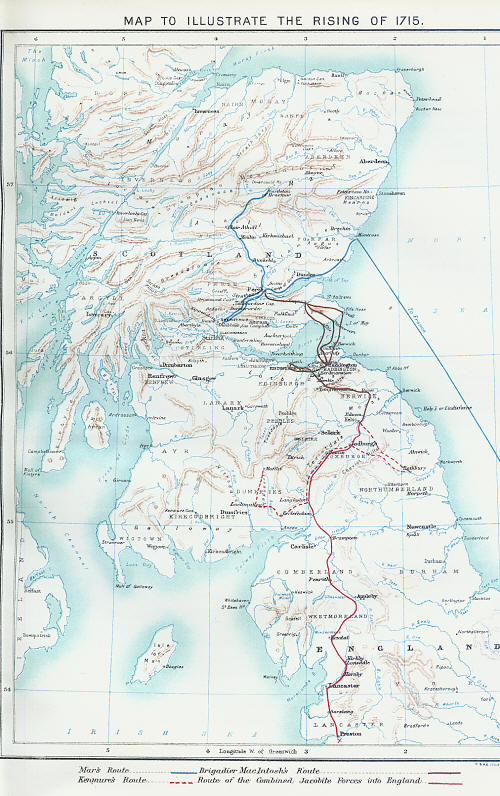
Click on map for larger image
up with a small rope provided
on purpose." A certain Mr Arthur, formerly an
officer of the Scots Guards, was concerned in this
conspiracy. He communicated the matter to his
brother, Dr Arthur, a physician in Edinburgh.
"This gentleman," says Rae, "having appeared very
melancholy all that day before the attempt was to
be made on the thought of the sudden revolution
that was at hand, his lady importuned him till she
got into the secret, and that evening about 10
o’clock sent a servant with an unsigned letter to
My Lord Justice Clerk." The Lord Justice Clerk,
Sir Adam Cockburn of Ormiston, at once
communicated his intelligence to Colonel Stuart,
the Commandant of the Castle. In consequence of
this warning the sentries were visited at an
earlier hour than usual on the night of the 8th.
The treacherous sentinel, finding himself
discovered, threw the ladder over the wall and
fired upon the conspirators, who fled; the plot
was frustrated and the Castle was saved.
A more successful enterprise
was carried out by the Master of Sinclair, already
mentioned as one of the chroniclers of the
insurrection. A large quantity of arms, destined
for the forces which were being embodied by the
Earl of Sutherland in the north for King George,
had been put on board ship at Leith. After
sailing, the vessel was compelled by contrary
winds to enter the harbour of Burntisland. News of
this reached Perth, and it was resolved to make an
attempt to seize the prize. Sinclair started for
Burntisland at the head of 400 horse, each trooper
having a foot soldier mounted behind him. The
party reached Burntisland at midnight, took
possession of the town, seized the boats in the
harbour, and easily captured the vessel. The
result of this raid was the capture of over 420
stand of arms.
The Jacobite clans in the West
Highlands also showed some activity. On September
17 a body of Macleans, Macdonalds, and Camerons
made an ineffectual attempt to seize Fort William.
In September the M’Gregors seized the boats on
Loch Lomond and proceeded to plunder the lowland
shores of the Loch. An expedition was organised
against them, consisting of about 100 seamen from
the ships of war then lying in the Clyde,
supported by volunteers from Paisley, Dumbarton,
and the neighbouring towns. Several man-of-war’s
boats were towed up the Leven by horses, and it
was determined to attack the M’Gregors in their
stronghold at Inversnaid. Rae gives a somewhat
amusing account of how the expedition fared.
"At Night they arriv’d at Luss,
where they were join’d by Sir Humphray Colquhoun
of Luss, and James Grant of Pluscarden, his Son in
Law, followed by 40 or 50 stately Fellows in their
short Hose and belted Plaids, arm’d each of ‘em
with a well fix’d Gun on his Shoulder, a strong
handsome Target, with a sharp pointed Steel of
above half an Ell in length, screw’d into the
Navel of it, on his Left Arm; a sturdy Claymore by
his Side, and a Pistol or two, with a Durk and
Knife on his Belt. Here the whole Company rested
all Night; and on the Morrow, being Thursday the
13th, they went on in their Expedition, and about
Noon came to Innersnaat, the Place of Danger,
where the Pasley Men and those of Dumbarton, and
several of the other Companies, to the Number of
100 Men, with the greatest Intrepedity leapt on
Shore, got up to the top of the Mountains and
stood a considerable Time, beating their Drums all
the while, but no Enemy appearing, they went in
quest of their Boats, which the Rebels had seiz’d,
and having casually lighted on some Ropes,
Anchors, and Oars, hid among the Shrubs; at length
they found the Boats drawn up a good way on the
Land, which they hurled down to the Loch. Such of
them as were not damag’d they carry’d off with
them, and such as were they sunk or hewed in
Pieces. That same Night they returned to Luss, and
thence next Day to Dumbarton, from whence they had
first set out, bringing along with them the whole
Boats they found in their Way, on either side of
the Loch, and in the Creeks of the Isles, and
moor’d them under the Cannon of the Castle. During
this Expedition, the Pinnaces discharging their
Pateraroes, and the Men their small Arms, made
such a Thundering Noise thro’ the multiply’d
rebounding Echoes of the vast Mountains on both
sides of the Loch, that the M’Gregiours were cow’d
and frighted away to the rest of the Rebels, who
were encamp’d at Strathphillen, about 16 Miles
from the Head of the Loch, where, being all join’d
as above, they continued till the 18th of October;
about which Time they were also joined by Stuart
of Appin with 250 Men, Sir John M’Lean with 400,
M’Dougal of Lorn with about 50, and a Part of
Broadalbine’s Men, in all making up, by the
modestest Computation, 2400 Men."
This force marched to Inverary
and threatened the Campbell stronghold, but,
finding it strongly garrisoned under the Earl of
Ilay, the Duke’s brother, they withdrew without
having effected anything, and ultimately
dispersed.
We have now to glance briefly
at the rising in the south. On October 11 a party
of Jacobites under Lords Kenmure and Carnwath
assembled near Lochmaben. On the following day
they seized a quantity of arms intended for the
use of the militia, which had been deposited in
the house of Henderson of Bradeholm. They then
marched to Moffat, and on Thursday, October 13,
they entered Lochmaben and proclaimed James VIII.
On the 14th they marched to Ecclefechan, on the
15th to Langholm, and on the 16th they reached
Hawick. On Monday the 17th the party, which only
numbered some 180, reached Jedburgh. Next day they
marched into England, to Rothbury, where they were
joined by the insurgent Jacobites from
Northumberland under Lord Derwentwater and Mr
Forster—a force amounting to some 300 horsemen.
The conjoined forces then marched to and occupied
Kelso.
The occupation of Stirling by
the troops of the Government, and the vigilance of
the naval force which now patrolled the Firth of
Forth, effectually separated the Jacobites in the
south from the main body of the army encamped at
Perth. Mar, however, determined to reinforce them
with as large a force as possible. Preparations
were quietly made for embarking 2500 men under
Brigadier MacIntosh of Borlum in boats at
Pittenweem, Crail, Elie, and the other small ports
along the Fifeshire coast.
At the same time preparations
were made at Burntisland as if for some
expedition, in order to induce the Government
vessels lying in the Firth to concentrate there.
On the nights of the 12th and 13th of October the
enterprise was carried out. The King’s ships
succeeded in capturing one boat of the flotilla
and in turning back some others, but about 1600
men effected a landing at North Berwick, Aberlady,
Gullane, and other places on the coast of East
Lothian. As quickly as possible they concentrated
at Haddington. Their object was to march
southwards in order to join Kenmure’s force, but
the temptation of a raid on Edinburgh was too
great. They were only seventeen miles from the
capital, Argyll was at Stirling, thirty-six miles
away, and they knew that they could count on many
friends among the inhabitants. However, John
Campbell, the Lord Provost, acted with the utmost
promptitude and decision. He at once called out
the City Guards, the trained bands, and the
volunteers, told them off to their respective
posts for the defence of the city, and sent an
urgent express to Argyll at Stirling for a
reinforcement of regular troops. Argyll instantly
started with 300 dragoons, and 200 foot mounted on
country horses, and reached Edinburgh just in
time. The Jacobites were at Jock’s Lodge when he
entered the city. On finding that he was just too
late, Brigadier MacIntosh gave up the project of
attacking Edinburgh and marched to Leith, where he
took possession of the citadel built by Cromwell,
blocked the gates, planted the ramparts with
cannon from the ships in the harbour, and awaited
events.
On the morning of Saturday,
October 15, the Duke of Argyll, with a
force of regulars, militia, and volunteers,
amounting in all to about 1100 men, marched down
to Leith and summoned MacIntosh to surrender,
declaring that if he were obliged to attack the
citadel he would give no quarter. "He received,"
says Rae, "a resolute answer from a Highland laird
called Kinackin, who told the Duke that as to
surrendering they laughed at it, and as to
bringing cannon and assaulting them, they were
ready for him; that they would neither take nor
give any quarter with him, and if he thought he
was able to force them he might try his hand."
Argyll had no guns, the Jacobites were well and
strongly posted, and an attempt to carry the
citadel by assault must have been attended with
tremendous loss. He accordingly retired to
Edinburgh to make preparations for a serious
attack on the following day. It was obvious that
the citadel could not be permanently held by the
Jacobites. Accordingly that night about nine
o’clock they abandoned it, and taking advantage of
the low ebb of the tide, they marched off along
the sands eastward in the direction of
Musselburgh. About two in the morning they reached
Seton House. Before departing they had reported
their movements to Mar. The boat which carried
their messenger across the Firth had a shot fired
after her by the citadel, and so was taken by the
Government cruisers for a friend, and allowed to
pass untouched.
MacIntosh remained at Seton
House for three days, and while there succeeded in
obtaining large supplies of cattle, meal, and
other provisions. On the 18th letters came from
Mar with orders to continue the march towards
England. Accordingly, on the morning of the 19th,
the Highlanders left Seton. That night they
arrived at Longformacus. Immediately after their
departure Seton was occupied by a force of
dragoons and militia under General Wightman. On
the 20th MacIntosh and his men reached Duns. There
they remained till the 22nd, when they resumed
their march towards Kelso, which they reached on
the same evening.
As we have seen, Kelso was by
this time occupied by the Jacobite forces under
Kenmure, Derwentwater, and Forster. On the
approach of the Highlanders. a party of horse
marched out to meet them at Ednam Bridge "in
Compliment to their Conduct and Bravery," and
escorted them in triumph into the town.
The total Jacobite force at
Kelso now amounted to 1400 foot and 600 horse. On
the following day, Sunday October 23, the army
attended Divine Service, and a sermon on the text
"The right of the first-born is his" (Deuteronomy
xxi. 17), was preached by the notorious Robert
Patten, who acted as chaplain to the English
insurgents, and afterwards turned king’s evidence
to save his own neck. On Monday King James was
proclaimed in the market-place with great
ceremony.
The Scottish division of the
insurgent army was divided into five troops of
horse and six regiments of foot; the English
insurgents forming five troops of horse. So long
as they remained in Scotland the whole force was
commanded by Lord Kenmure. They remained in Kelso
to the 27th of October, a fatal delay, as it gave
the Government troops in the north of England
ample time to make their dispositions.
Much time was lost through the
dissension and lack of discipline which throughout
were the curse of all the Jacobite enterprises.
There was much dissension as to whether the army
should cross the Border. The Highlanders were
exceedingly unwilling to do so; ultimately the
majority yielded to the promise of sixpence a day
of regular pay. Some 500 deserted and found their
way home as best they could.
Lord Winton proposed that the
army should march into the west of Scotland. It
was also suggested that an attack should be made
on General Carpenter, who was now in the immediate
vicinity with a force not exceeding 1000 in
number, fatigued by long marches, and consisting,
to a large extent, of raw recruits. "But," as
Patten says, "there was a fate attended all their
councils, for they could never agree to any one
thing that tended to their advantage." On October
27 they marched to Jedburgh; there they
remained till the 29th, when it was at last
definitely resolved to march into England. From
Jedburgh they marched to Hawick, and from Hawick
to Langholm. At Langholm a party was detached to
attack Dumfries. Dumfries could have been easily
captured, and its possession, as being the
principal town in the south-west of Scotland,
would have been of the greatest importance to the
cause. However, the leaders of the English
Jacobites strongly urged that the whole available
force should be sent into England, and the party
which was marching against Dumfries was recalled
when it had reached Ecclefechan. On October 31 the
army crossed the Border and encamped for the night
at Brampton, having marched 100 miles in five
days. As soon as they entered England Forster took
over the command, holding a commission to that
effect from Mar.
Penrith was reached on November
2. The posse comitatus of Cumberland had
been called out by the sheriff, and was assembled
near Penrith under Lord Lonsdale and Bishop
Nicolson of Carlisle. It amounted to some 14,000
men, but these did not prove very formidable
antagonists. "As soon," says Patten, "as a party,
who they had sent out for discovery, had seen some
of our men coming out of a Lane by the Side of a
Wood, and draw up upon the Common or Moor in
order, and then advance, and that they had carried
an Account of this to their main Body, they broke
up their Camp in the utmost Confusion, shifting
everyone for themselves as well as they could, as
is generally the case of an armed but
undisciplined Multitude." None of these warriors
received any hurt, except "one man that was shot
through the arm." On November 3 the Jacobites
reached Appleby, where they remained for two days.
On the 5th they marched to Kendal, and on the 6th
to Kirkby Lonsdale. On the 7th they entered
Lancaster unopposed. In the course of their march
they had proclaimed James VIII. in all the
principal towns, and had collected the public
revenue. Few recruits had joined them; on the
other hand, they had suffered from some
desertions. For example, Rae mentions that at
Appleby "Mr Ainsley, who had joined ‘em at
Jedburgh, disliking the prospect of their affairs,
deserted them with about 16 Tiviotdale Gentlemen."
At Lancaster they succeeded in seizing a quantity
of arms which were in the Custom House, a
considerable sum of public money, six pieces of
cannon, and "some claret and a good quantity of
brandy, which was all given to the Highlanders to
oblige them." Their spiritual wants were
ministered to by the Reverend Mr Patten, "the
parson of the place excusing himself." They were
now in a Jacobite country, and many Lancashire
gentlemen joined them, with their servants and
friends. "It’s true," says Patten, "they were most
of them Papists, which made the Scotch Gentlemen
and the Highlanders mighty uneasy, very much
suspecting the Cause, for they expected all the
High-Church Party to have joined them. Indeed,"
proceeds this estimable divine, "that Party who
are never right hearty for the Cause till they are
mellow, as they call it, over a bottle or two,
began now to show us their blind side; and that
it’s their just character, that they do not care
for venturing their Carcases any farther than the
Tavern; there indeed, with their High-Church, and
Ormond, they would make men believe, who do not
know them, that they would encounter the
greatest opposition in the World; but after having
consulted their Pillows, and the Fume a little
evaporated, it is to be observed of them that they
generally become mighty Tame, and are apt to Look
before they Leap, and, with the Snail, if you
touch their Houses, they hide their Heads, shrink
back, and pull in their Horns. I have heard Mr
Forster say he was blustered into this Business
by such People as
these, but that for the Time to come he would
never again
believe a drunken Tory."
Considering that this passage was written by as
selfish and cowardly a rascal as ever escaped the
gallows, it is not without its humorous aspect.
On the 9th the
Jacobite army marched out of Lancaster in pouring
rain; on the same night their horse reached
Preston, and the foot on the following day. At
Preston they were in the very centre of English
Jacobitism. They were cordially received by the
inhabitants, and were joined by many recruits. It
was here, however, that their final disaster
awaited them.
Preston had
been occupied by a small force of regular troops,
commanded by Sir Henry Haughton. On the approach
of the Jacobites Haughton evacuated the town and
retired to Wigan. His retreat greatly encouraged
the insurgents, and made them imagine that the
Government troops would not look them in the face.
They were
soon to be undeceived. The troops in Cheshire were
commanded by Major-General Wills. The force under
his command and the regiments quartered in
Shropshire, Worcestershire, and Staffordshire were
ordered to concentrate at Warrington on November
ro. Wills himself reached Manchester on the 8th;
there he heard that Carpenter was on his
way from
Durham. On Friday, the r ith, Wills marched to
Wigan with four regiments of dragoons and
Preston’s foot, the old Cameronian regiment. At
Wigan he found the regiments of Pitt and Stanhope,
and heard that the insurgents were still at
Preston. He decided to attack them on the
following day.
Forster
seems to have been extraordinarily ignorant of the
movements of his enemy. Patten says that he relied
for his intelligence upon the Lancashire
gentlemen. He seems to have been very badly
served, and to have known nothing of Wills’s
approach until he was actually before the town.
Wills
marched out of Wigan on the morning of Saturday,
the 1 2th,
and about
one o’clock arrived at the bridge across the
Ribble, just outside Preston. To his astonishment
he found it undefended, Forster having ordered it
to be abandoned. He suspected some stratagem, and
thought that probably an ambuscade awaited him in
the deep and narrow lane beyond the bridge. "On
these suppositions," says Patten, "he proceeded
with caution, and caused the hedges and fields to
be viewed and the ways laid open for his cavalry
to enter. But finding the hedges also clear, he
concluded then the enemy was fled, and expected
that they had abandoned the town and all, and
would endeavour by their long marches to return to
Scotland, tho’ he thought it impossible for them
to do it." He found, however, that the insurgents
were determined to defend the town. MacIntosh was
the moving spirit in the defence. Under his
direction barricades had been thrown up in• the
streets and mounted with the guns which had been
seized at Lancaster. "The Earl of Derwentwater,"
says Patten, "signally bebav’d, having stripp’d
into his waistcoat, and encouraged the men by
giving them money to cast up trenches, and
animating them to a vigorous, defence of them."
There were four main barriers commanding the chief
avenues to the town. The principal barricade,
which protected the approach from Wigan, was
commanded by Brigadier MacIntosh. As soon as he
had inspected the approaches to the town Wills
disposed his troops for the attack. The main
attack was made on MacIntosh about two in the
afternoon. It was headed by Brigadier Honeywood,
one of the regiments under his command being
Preston’s foot. The Government troops, who had to
advance up a narrow street flanked by houses which
were filled with the enemy’s men, suffered
terrible loss. Parties, however, were detached to
attack these houses from the lanes behind them,
and a number of them were successfully occupied.
Other houses close to the barricade were set on
fire, and the insurgents were compelled to retire
further into the town.
The
barricade on the Lancaster road was similarly
attacked by Brigadier Dormer. Fighting went on all
the afternoon and all night, the troops gradually
forcing their way from house to house and from
street to street. Before daybreak not a few of the
recruits who had joined the Jacobite army made
their escape in the direction of Liverpool by the
Fishergate. This Street had been barricaded, but
had not been attacked for want of available
troops.
On Sunday
the 12th, about mid-day, Carpenter arrived from
the north with three more regiments. Although
senior to Wills, he refused to take over the
command from him, saying that "he had begun the
affair so well that he ought to have the glory of
finishing it." At his suggestion, however, some
alterations were made in the disposition of the
troops, and the effective investment of the town
was completed.
The
Jacobites were now caught in a trap, and it was
evident that the struggle could only end in one
way. The leaders began to talk of surrender. The
Highlanders were furious when they heard of it.
They "were for sallying out upon the King’s
force," says Patten, "and dying, as they called
it, like men of honour with their swords in their
hands. But they were overruled, and were not
allowed to stir.
The common
men were, one and all, against capitulating, and
were terribly enraged when they were told of it,
declaring that they would die fighting, and that
when they could defend their posts no longer they
would force their way out and make a retreat. . .
. Their madness was such that nothing could quiet
them for a great while. . . . Many exclaimed
against Mr Forster, and had he appeared in the
Street he would certainly have been cut to pieces.
But as he did not appear publickly, yet he had
been actually killed in his chamber by Mr Murray
had not I with my hand struck up the pistol with
which he fired at him, so that the bullet went
through the wainscot into the wall of the room."
A concise
account of the negotiations which took place on
the afternoon of the 13th and on the following
morning was given by General Wills in his evidence
at the trial of Lord Winton before the House of
Lords. "About two o’clock," he says, "Mr Forster
sent out one Mr Oxborough, an Irish Man, offering
to lay down their Arms, and submit themselves, and
hoped that I would recommend them to the King for
Mercy; which I refused, and told them I would not
treat with Rebels, for that they had killed
several of the King’s Subjects, and that they must
expect to undergo the same Fate; upon which he
said, that as I was an Officer, and a Man of
Honour, he hoped I would shew Mercy to People who
were willing to submit: Upon which I told them,
all I would do for them was, that if they laid
down their Arms, and submitted Prisoners at
Discretion, I would prevent the Soldiers from
cutting them to Pieces, till I had further Orders;
and that I would give them but one Hour to
consider of it, and sent him back again into the
Town to acquaint Forster of it: Before the Hour
was expir’d they sent out Mr Daizell, Brother to
the Earl of Camwath, and he wanted Terms for the
Scotch. My Answer was, that I would not treat with
Rebels, nor give them any other Terms, than what I
had before offered them: Upon which it was
desired, that I would grant further Time till
Seven a Clock next Day, to consult the best Method
of delivering themselves up. I agreed to grant
them the Time desired, provided that they threw up
no new Intrenchments in the Streets, nor suffer’d
any of their People to escape; and that they sent
out the Chief of the English and Scotch, as
Hostages for the Performance; and I sent in
Colonel Cotten to bring them out, who brought out
the Earl of Derwentwater and Mr MacIntosh. The
next Day, about Seven a Clock, Mr FOrster sent out
to let me know that they were willing to give
themselves up Prisoners at I)iscretion, as I had
demanded. Mr MacIntosh being by when the Message
was brought, said he could not answer that the
Scotch would surrender in that Manner; for that
the Scotch were People of desperate Fortunes; and,
that he had been a Soldier himself, and knew what
it was to be a Prisoner at Discretion: Upon which
I said, Go back to your People again, and I will
attack the Town; and the Consequence will be, I
will not spare one Man of you. MacIntosh went
back, but came running out immediately again, and
said that the Lord Kenmure and the rest of the
Noblemen, with his Brother, would surrender in
like Manner with the English."
The troops entered the town in
two bodies, meeting in the market-place. The
Jacobite gentlemen and officers were placed under
a guard in the inns, and the other prisoners were
confined in the church. The Government troops had
lost 146 men killed and wounded. Of the
insurgents, who, during the attack, had been well
under cover, there were seventeen killed and
twenty-five wounded. As great numbers of the
insurgents had succeeded in making their escape,
the prisoners only amounted to 1497, including
Foster. and Lords Derwentwater, Widdrington,
Nithsdale, Winton, Kenmure and Nairn. Among the
prisoners were several officers who had held
cornmissi:ns in the army. These were tried by
court-martial at Preston, and on December 2 four
of them were shot. Most of the ordinary prisoners
were confined in the castles of Lancaster,
Chester. and Liverpool. The noblemen and most of
the gentlemen were taken up to London. Their
treatment on their arrival there reflects little
credit on the authorities. At Highgate they were
received by a detachment of the Guards under
General Tatton. Here, says Rae, "everyone of ‘em
had his arms ty’d with a cord coming cross his
Back ; and
being thus pinion’d, they were not allow’d to hold
the reins of the Bridle; but each of ‘em had a
foot Soldier leading his Horse: And being rang’d
into four Divisions, according to the four
different Prisons to which they were allotted, and
each Division placed between a Party of the Horse
Grenadiers and a Platoon of the Foot
; In this
Manner General Tatton set out from Highgate about
Noon, and proceeded to London thro’ innumerable
Crowds of Spectators, who all of ‘em express’d the
utmost Detestation of their rebellious Attempt, by
upbraiding them with their Crime, shouting them
along in this disgraceful Triumph; and incessantly
crying out, King George for ever; no Warming-Pan
Bastard: the Mobs in the meantime marched before
them beating on a Warming Pan, while the General’s
Drums beat a Triumphant March. After this the
Noblemen and three or four others were sent to the
Tower; Mr Forster, MacIntosh, and about Seventy
more, to Newgate, Sixty to the Marshalsea, and
Seventy Two to the Fleet."
The 13th of November was a
fatal day for the Jacobite cause. The notorious
Simon Fraser, afterwards Lord Lovat, who had fled
from justice after the atrocious crimes of his
youth, had returned to the Highlands and was
making a bid for the favour of the Government. He
put himself at the head of 300 Frasers, and
recalled from the Jacobite army the remainder of
his clan, who had joined Mar at Perth. In
conjunction with Duncan Forbes of Culloden and
Hugh Rose of Kilravock, he planned an attack on
Inverness. The available force amounted to about
1300 men. The small Jacobite garrison, however,
did not wait to be attacked, but on the night of
November 13 evacuated the town and escaped across
the Moray Firth. The key of the northern Highlands
was again in the hands of the Government.
On the same day the battle of
Sheriffmuir was fought.
Mar had remained at Perth since
September awaiting events. Recruits had been
coming in from the north, Lord Seaforth with his
Mackenzies, also Macraes, Chisholms and others. By
the beginning of November the force amounted to
some 12,000 men, and a movement to the south was
determined on.’ On the 9th a council of war was
held. It was decided that the camp should be
struck, and that the army should march to Dunblane.
There 3000 men were to be detached "to amuse the
King’s army at Stirling" by attacking Stirling
Bridge and the neighbouring fords. While Argyll
thus had his hands full, the main body of the
Jacobites was to cross the Forth further up,
descend on the Lowlands, and follow MacIntosh into
England.
On November 10 Mar marched out
of Perth, leaving a garrison, under the command of
Colonel Balfour, to hold the town. He reached
Auchterarder, nine miles distant, on the same
night, and there was joined by General Gordon. On
the 11th he "rested . . . to settle the order of
battle as well as the order of marching." The
Master of Sinclair gives a very vivid picture of
the incapacity of the leaders and the lack of
discipline of the army. "We marched," he says,
"the blind leading the blind, not knowing whither
we were going or what we were going to do." Of
Mar, he says that "a name and noise was all he
sought." On the moor of Auchterarder the army was
reviewed. In this review, says Sinclair, "there
were squabbles about the posts of our squadrons,
and we were never so constant in anything as our
being disorderly."
On the morning of Saturday the
12th, General Gordon and Brigadier Ogilvie were
ordered to advance and occupy Dunblane. The main
body of the army was to follow under General
Hamilton, Mar himself, in the meantime, having
gone to Drummond Castle to meet Lord Breadalbane.
Hamilton had reached Ardoch, when an orderly
arrived from Gordon with the news that his
advanced guard had come into touch with the enemy.
An express was sent off to Mar, who returned with
all speed. Gordon was ordered to halt till the
main body came up to him. They joined him at
Kinbuck, and there the army lay under arms all
night. The Master of Sinclair comments with
characteristic vigour on the singular lack of
military knowledge with which the ground of their
bivouac was selected. "I can take it upon me to
defy the most ingenious engineer after a month’s
thinking to contrive a place. so fit for the
destruction of men, without being in the least
capable to help themselves. God knows, had we been
attacked by any three regiments of foot posted in
the high grounds about they had cut us to pieces."
Argyll had good spies in Perth,
and received immediate information of his enemy’s
intentions. He determined not to wait to be
attacked. He ordered the troops at Edinburgh,
Glasgow, Kilsyth and Falkirk to join him at
Stirling with all possible speed, and to be in
readiness to march on the night of the i ith. On
the morning of the 12th he crossed the Forth at
the head of some 3000 regular troops, consisting
of five regiments of dragoons (Portmore’s,
Evans’s, Stair’s, Kerr’s, and Carpenter’s, each
180 strong), and eight regiments of foot
(Forfar’s, Winton’s, Shannon’s, Morison’s,
Montague’s, Clayton’s, Orrery’s, and Edgerton’s).
The Glasgow volunteer
battalion, 500 strong, were still at Stirling, and
were eager to march with the regulars ; but, much
to their disgust, were left to garrison Stirling,
along with the Stirling militia, which, says Rae,
"they did with great care and exactness."
On the evening of the 12th,
Argyll reached Dunblane, and encamped that night
on a rising ground to the east of the town. Next
morning he arid a party of his officers
reconnoitred the Jacobites’ position. Mar, as
usual, was undecided, and fell back upon his
favourite expedient of a council of war. Some of
his followers wished to avoid a battle and return
to Perth till the spring: but the clansmen at last
saw their enemy before them, and were eager to
fight. So it was determined to attack Argyll.
Argyll drew up his force on the Sheriffmuir in two
lines, with three squadrons of dragoons on the
right and left of the front line, and six
battalions of foot in the centre. The second line
was composed of two battalions of foot in the
centre, with one squadron of dragoons on either
flank, and one squadron was held in reserve behind
each wing. The Duke himself commanded on the
right, Wightman in the centre, and General Witham
on the left. Owing to the nature of the ground, it
was impossible for either army to see the whole of
the other; the result was that, when the opposing
forces came into contact, they were not opposite
to each other. Each was out-flanked on the left.
It was intended that the Jacobite force should
attack in four regularly-formed columns; but when
the attack was made, it was just the old
disorderly Highland charge. Mar’s right wing was
composed of the Macdonalds, Macleans, and the
Breadalbane men. When the order to attack was
received, it is recorded that Sir John Maclean
placed himself at the head of his clan and
addressed them in these words : Gentlemen, this is
the day we have long wished to see; yonder stands
MacCallum More for King George, here stands
Maclean for King James. God bless Maclean and King
James! Charge, gentlemen."
The rush of the clansmen was
scarcely checked by the heavy fire with which they
were received, and which mortally wounded the
young chief of Clanranald. Witham’s line was
broken to pieces, and forced back on Dunblane,
with great slaughter. He did not check his retreat
until he had nearly reached Stirling Bridge.
On Argvll’s right the fortune
of war went otherwise. The left wing of the
Jacobites, composed chiefly of Camerons and
Stewarts, advanced with great determination. But
the regular troops held their ground, and the
assailants were, as they advanced, charged in
flank by a body of cavalry, under Colonel
Cathcart, and were put to flight. Argvll gave them
no time to rally, but at once advanced in pursuit.
The fugitives immensely outnumbered their
pursuers, but Argyll succeeded in keeping them on
the run for over two miles, until the river Allan
was reached. Mar’s right wing did not pursue their
beaten opponents very far, but re-formed on an
eminence called the Stony Hill of Kippendavie,
where, says Rae, "they stood without attempting
anything with their swords drawn for near four
hours’ space." Here they were found by
Argyll when he returned from the pursuit. Argyll
expected to be attacked by them, and formed his
men accordingly. But "after a while they drew off
their rear ranks towards the right, and began to
disperse." The Duke, whose troops were by this
time dead beat, had no desire to attack them, and
accordingly retired into Dunblane. The fugitives
of the left wing were, so far as possible,
collected there, and there the army lay on their
arms all night. The insurgents in the meantime had
drawn off towards Auchterarder.
On the following day Argyll
returned to Stirling, and two days later Mar
re-entered Perth. The losses of the Government
troops amounted to 290 officers and men killed,
187 wounded,
and 133 taken prisoners—6io in all. Those of the
insurgents are estimated at about 8oo killed and
wounded, and some eighty or ninety prisoners,
including Viscount Strathallan and a number of
other gentlemen of rank.’
Both sides claimed the victory.
The day after the battle Colonel Balfour
distributed at Perth "An Account of the great and
signal Victory obtained over the Duke of Argyll by
His Majesty’s forces commanded by the Duke of
Mar;" and Mar on his return to Perth caused
thanksgiving sermons to be preached and a Te
Deum to be sung. The substantial fruits of
victory, however, remained with Argyll. He
remained in possession of the field of battle, and
had captured fourteen of the Jacobites’ colours,
six of their guns, and part of their baggage. What
was much more important, he had effectively put a
stop to Mar’s project of marching to the. south.
For all practical purposes, the back of the
rebellion was broken when Mar returned to Perth.
The doubtful issue of the contest is celebrated
in one of the most familiar of Scots ballads—
"There’s some say that we wan,
Some say that they wan,
Some say that tiane wan at a’, man;
But ae thing I’m sure,
That at Sheriffmuir
A battle there was which I saw, man
And we ran, and they ran,
And they ran, and we ran,
And we ran, and they ran awa’, man."
Towards the end of November it
appears that Mar approached Argyll with the object
of obtaining terms of surrender, but the
negotiations came to nothing. Every day now
strengthened the hands of the Government and
weakened those of the insurgents. Early in
November the Dutch auxiliaries had landed in
England, and had at once been ordered north. Two
of the regiments which had been engaged at Preston
were sent to Glasgow, and a train of artillery was
shipped at the Tower under orders for Scotland. On
the other hand, many of the Highlanders were
quietly dispersing, and no news came of the
supplies or~ reinforcements from abroad which the
Jacobites hoped for.
The prospects of the Stuart
cause were thus darkening down, when news came
that James himself had landed in Scotland. He
arrived at Peterhead in a French ship on December
22, attended by a retinue of six gentlemen
only. News of his landing reached Perth on the
2 6th, and Mar, accompanied by the Earl
Marischal and a number of the Jacobite leaders,
set out to meet him. James reached Aberdeen on the
24th and lodged that night at Fetteresso. There he
stayed till the 27th, when he was joined by Mar
and his companions.
The Prince was detained at
Fetteresso for a few days by an attack of ague.
There he received the homage of various adherents,
and loyal addresses of welcome from the Episcopal
clergy of the diocese of Aberdeen and the Jacobite
magistrates of Aberdeen. On Monday, January 2,
1716, he resumed his journey by Brechin,
Kinnaird, and Glamis. On the 6th he entered
Dundee; on Monday the 9th he made his public entry
into Perth and reviewed the troops. On the same
night he took up his quarters at Scone.
Whatever James’s virtues were,
they were not those of the successful leader of a
desperate insurrection. Sinclair speaks of him as
"entirely a stranger to his own affairs, as much
as if he had dropt out of another world or from
the clouds." Lethargic in mind and body, reserved
and melancholy in temperament, he had none of the
cheery courage and infectious good-humour which
endeared Prince Charlie to his followers. "If he
was disappointed in us," says one of them, "we
were tenfold more so in him. We saw nothing in him
that looked like spirit. He never appeared with
cheerfulness and vigour to animate us. Our men
began to despise him; some asked if he could
speak. His countenance looked extremely heavy. He
cared not to come abroad among us soldiers, or to
see us handle our arms or do our exercise. Some
said the circumstances he found us in dejected
him; I am sure the figure he made dejected us; and
had he sent us but 5000 men of good troops, and
never himself come among us, we had done other
things than we have now done." While James
remained at Scone he was surrounded by royal
state; all the etiquette of a Court was
maintained, and various proclamations were
solemnly issued in his name. All able-bodied men
were called to his standard. A meeting of the
Estates was summoned. His coronation was appointed
to take place on January 23. However, when that
date arrived he was otherwise occupied.
Argyll’s reinforcements were
arriving from the south, and it was evident that
he would soon advance against Perth. It was now
the depth of an unusually hard winter; the ground
was deeply covered with snow, and the roads were
almost impassable. It was decided to throw a
further obstacle in the way of Argyll’s advance by
destroying the villages between Stirling and
Perth, so as to deprive the advancing troops of
shelter and supplies. An order to this effect
under James’s. sign manual was issued at Scone on
January 17. It was carried out by parties of
Highlanders. Between the 24th and the 29th
Auchterarder, Blackford, Dunning, Muthill, Crieff,
and Dalreoch were burnt. An account of the burning
of the villages was written at the time by an
inhabitant of Auchterarder.’ He gives a terrible
description of the sufferings of the unfortunate
people, who were turned out into the bitter winter
weather without food or shelter. "It would have
pierced a heart in which there remained the very
least spark of humanity," he says, "to have heard
the mournfull screeches and frightfull cryes of
poor women while rocking their infants in cradles
upon the snow in the open fields, and looking on
their houses, the sanctuaries appointed by God for
their protection from the injury of such a season,
and their corns, the provision and means of their
subsistence, crumbling in a moment into ashes."
James, to do him justice, seems to have deeply
regretted the necessity of this step. On January
26 he issued a declaration inviting those whose
property had been destroyed to lodge claims with a
view to compensation, and when he embarked at
Montrose he left behind him a letter to the Duke
of Argyll with a sum of money for the benefit of
the sufferers. Neither letter nor money seemed to
have reached their destination.
Argyll’s Dutch and English
reinforcements reached him before the end of the
year, and increased his force to some 9000 men.
The artillery, which was expected by sea, was
detained at the mouth of the Thames by bad
weather. Argyll did not wait for it, but collected
from Berwick and from Edinburgh Castle guns enough
to make an efficient siege train.
On January 21 Colonel Guest
with 200 dragoons was detached from Stirling to
reconnoitre the roads leading to Perth, which were
deeply covered with snow. On the 24th Argyll
himself examined the country as far as
Auchterarder. By the 26th the guns from Berwick
and most of those from Edinburgh had arrived. Two
days were spent in making and repairing- gun
carriages, and completing other details of
equipment. The artillery sent from London reached
Leith on the 2 8th, but Colonel Borgard, the
officer in command, hearing that Argyll was
already provided with a sufficient train for his
expedition, left his guns and stores on board, and
with his men marched with all speed to Stirling
just in time to join the expedition. All was now
ready for the advance. A day’s thaw followed by a
heavy fall of fresh snow had rendered the roads
more difficult than ever. But Argyll was
determined to proceed at all costs. and
accordingly, on Sunday, January 29, he marched out
of Stirling and reached Dunbiane. Parties were
detached to dislodge the Jacobites from Braco
Castle. Tulilbardine, and the other positions
occupied by them. On the 3oth the army advanced to
Auchterarder, where they bivouacked for the night
in the snow.
News of Argyll’s imminent
advance had reached Perth on the 28th. The general
feeling in the Jacobite camp was that Perth should
be defended. Preparations were made to resist an
attack; the Highlanders to a man were eager for
battle. But the leaders had determined that the
cause was lost, and that the only thing now to be
done was to effect a retreat with the least
possible loss. On January 31, about 10 o’clock in
the forenoon, the insurgent army marched out of
Perth, leaving their guns behind them, crossed the
Tay upon the ice, and took the road towards
Dundee. On the same day they were followed by
James and Mar, the former, Rae tells us,
"followed his flying adherents with tears in his
eyes, complaining that instead of bringing him to
a crown they had brought him to his grave."
On the same day Argyll reached
Tullibardine. There he heard of the evacuation of
Perth. He at once ordered a detachment of 400
horse and iooo foot to press on and occupy the
town. He himself and General Cadogan rode on with
the cavalry and entered Perth about one in the
morning of February 1. The foot reached Perth
about ten in the following forenoon, and the
remainder of the army arrived that evening.
The retreating Jacobites
reached Montrose on February 3. On the following
day orders were issued to such of the clans as
remained together to be ready to march in the
evening towards Aberdeen. As the hour appointed
for the march approached, James’s horses were
brought round and his guard was mounted as usual,
but he did not appear. He had slipped out on foot
and gone to Mar’s lodgings. He and Mar reached the
shore by a side street. There a boat
awaited them, and they went on board a French
ship, the Maria Theresa of St. Malo, which
was ready for them in the harbour. A quarter of an
hour afterwards they were joined by about a dozen
more of the leaders. The ship hoisted sail and put
to sea, and a week later landed them on the French
coast near Calais.
The army, thus left to itself,
melted rapidly away. The Highlanders scattered in
all directions towards their native glens. When
the army, now commanded by General Gordon, reached
Aberdeen two days later, it amounted to only about
1000 men. Most of the leaders succeeded in
effecting their escape by sea either to France or
Sweden; the remainder of the men dispersed. Few
prisoners were taken; indeed, Argyll does not seem
to have been very anxious to make prisoners. He
occupied Aberdeen on the 8th. Parties were
detached to occupy various houses throughout the
Highlands. A few sparks of rebellion smouldered on
in the Hebrides, but they were stamped out without
difficulty. Argyll’s army was distributed among
the various Scottish garrisons. The Duke himself
returned to Edinburgh on February 27, and a few
days later set out for London. The insurrection
was over.
Few prosecutions for rebellion
took place in Scotland, the general feeling of the
people as well as of the Crown lawyers themselves
being adverse to severity. A large number of the
prisoners taken at Preston were tried by
Commission of Oyer and Terminer at Liverpool,
convicted and executed. Further trials and
executions took place in London. Many Scots
prisoners were removed for trial to Carlisle, a
proceeding which excited great indignation in
Scotland, being justly regarded as an invasion of
the judicial independence of the country. The
peers implicated—Nithsdale, Winton, Carnwath,
Kenmure, Nairn, Derwentwater, and Widdrington—were
impeached before the House of Lords for high
treason, and all sentenced to death in the usual
horrible terms.’ Nithsdale escaped from the Tower
through his wife’s heroism; Winton by his own
ingenuity; Kenmure and Derwentwater went to the
block. The lives of Carnwath, Nairn, and
Widdrington were saved by falling under the
general Act of Indemnity passed in 1717, which
brought the vengeance of the Government to an end. |