View our terms and conditions for use of our web site and our privacy policy. Visit Electric Scotland's Aois Community, our social networking site. Find our contact information and learn more about us. The Home Page of Electric Scotland ES Common Header Bar
This is where you'll find a comprehensive resource on Scottish accommodations. Electric Scotland's Article Service where you can both read articles and post your own. Beth's Newfangled Family Tree is a monthly publication giving genealogy advice as well as what's hapening on the Scottish Scene around the world. This is where you'll find around 300 books on Scottish history that we've published on the site. Our pages where you'll find books and articles about Robert Burns and his work. Gives you some information on the business scene in Scotland. This is where you can view Scottish events around the world and add your own. Learn about the history of Clans and Families of Scotland and the Scots-Irish. The personal site of Alastair McIntyre where he's posted his own mini biography as well as his travel journals. 5 volumes worth of biographies relating to Significant Scots. A weekly newsletter about the political scene in Scotland from the Scots Independent Newspaper. Lots of Scottish recipes along with contributions from our visitors. Play our collection of online games. 6 volume Gazetter on the place names of Scotland. This is our page for trying to give you advice on Genealogy. A FAQ where you go to get answers to frequently asked questions. Information and pictures about Historic places in Scotland such as castles and other properties. Main index page for our very large history section. Children resources including over 800 children's stories and lots of online and offline games. A bit of a catch-all page where you find loads of pages about music, haggis, scots language, culture, religion, humor and lots more. Our nature page where you can explore information on Scottish Wildlife, Plants, Flowers and lots more. Our weekly newsletters archive. Thousands of pictures of Scotland for you to enjoy. Loads of poetry and stories for you to enjoy with many contributions from visitors to our site. Our very own Webcard program which you can use to send online postcard to friends and relatives. Huge resources about the Scots Diaspora around the world and here is where you can find this information. A continually building information resource on the Scots-Irish who emigrated to Ulster and then onto many parts of the world, especially the USA. Create your own family tree with our special software. You can also import and export gedcom files. Our web-based scottish search engine which is a free resource for Scottish companies as well as Scottish organisations around the world. Current Scottish News headlines and links to Scottish news resources. A range of services, both big and small, that we currently offer. Our Tartan pages, giving you access to information on Tartans as well as tartan search engines. Sponsored by House of Tartan. Our travel section where we have loads of suggested tours of Scotland as well as old historic travel books. A wee collection of videos some of which we've produced ourselves. Learn about the last 100 pages we've added to our site which is updated daily.

Click here to get a Printer Friendly Page
 

Send Flowers

The Court of the Lord Lyon
Differencing


Information Leaflet No. 6

DIFFERENCING

In Scotland Arms are heritable property, and on their original owner’s death they descend to his heir, normally his eldest son, and in turn to his eldest son, and so on forever. A younger brother may inherit his father’s Arms if the elder brother dies first and leaves no heirs of his own. Otherwise younger sons and their descendants inherit only the right to apply for a Matriculation of their ancestral Arms with a "MARK OF DIFFERENCE" or "A DIFFERENCE" added to them.

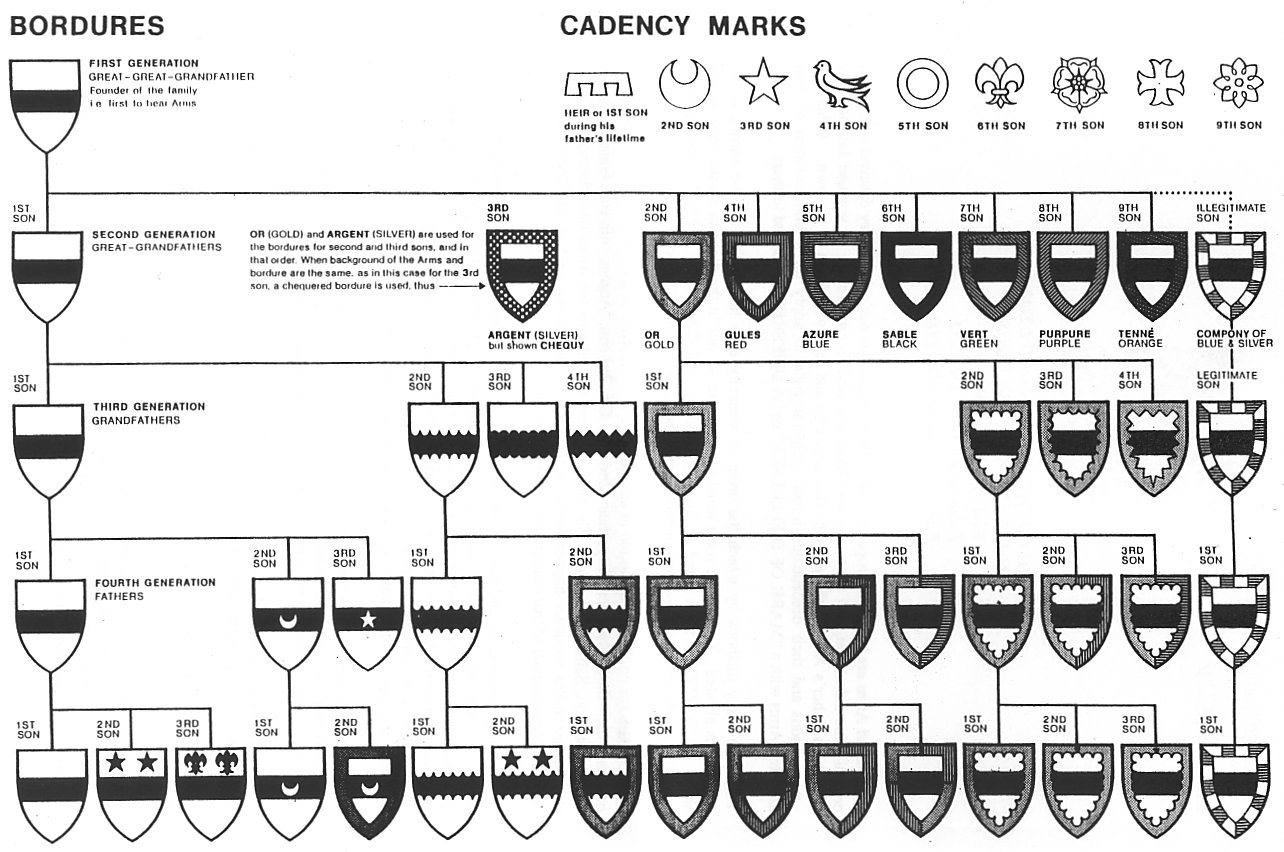
There are many methods by which the order of seniority of a family line can be shown in the differences allotted. Two of the most usual methods are set out in the diagram on the back of this sheet, the BORDURE most usual in Scottish heraldry, and CADENCY MARKS more usual in England and elsewhere. These two methods, and others, can be and often are combined.

BORDURES (or borders) are allotted to an armiger’s sons in order of their birth in a set sequence of colours which shows their seniority, thus:- 2nd son, Or; 3rd son, Argent; 4th son, Gules; 5th son, Azure; 6th son, Sable; and so on. The first or eldest son inherits the Arms undifferenced. Where the bordure in this sequence happens to be of the same colours as the field of the Shield, it is made "chequy" (chequered) of that colour and a contrasting one.

In the next generation, the 3rd from the founder, this system continues as above for younger sons as it shows the seniority of their descent from the founder, NOT their father. When the previous generation, the 2nd had already borne a bordure for difference as is shown in the diagram where all the 2nd generation’s borders have been used up, the bordure is further differenced by varying its inner edge in a set sequence of patterns as shown. This combination of varying colours and patterns of border continues in the same way for each subsequent generation.

When these differences as in the diagram are not available to younger sons of the senior line, having been used by junior lines, an alternative system or systems is used as shown, such as adding small marks of cadency or varying the edge of the main charge on the Shield.

An illegitimate son is accorded a special border of blue and white, called a "bordure compony". This is inherited by all his legitimate descendants thereafter, varied in similar ways.

In certain cases differences are allotted for a lady of a junior line matriculating Arms in her own right.

It is entirely for the Lord Lyon alone to decide which differences to allot when matriculating Arms as he alone knows all the differences which have already been allotted from the systems and are recorded in the Public Register of All Arms and Bearings in Scotland, and the principles on which they are allotted and should continue to be allotted.
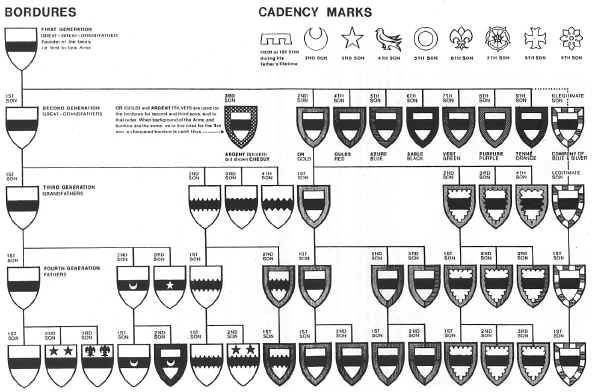
Bordures & Cadency Marks