|
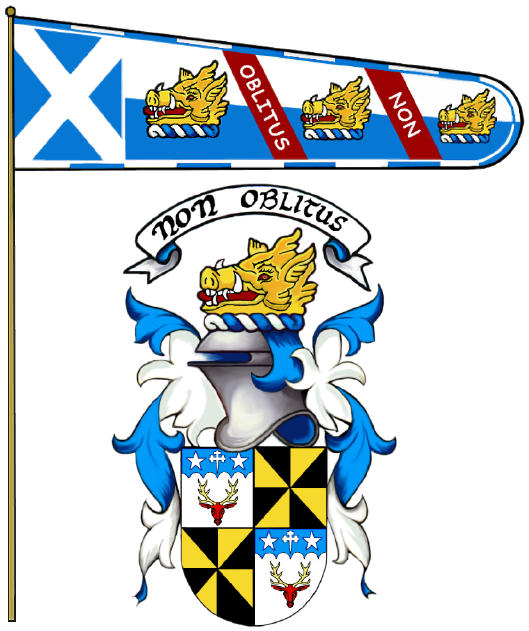
The name MacTavish stems from Taus Coir, (Tammis) a son born to Gillespic and a daughter of Sween the Red, Lord and Toisech (meaning leader, Chief) of Castle Sween and of
Knapdale, in the last half of the 11th century. Gillespic later repudiated his wife and two sons to make a more powerful alliance by marrying his cousin Eva
O'Duin, daughter of Paul 'an sparain', the treasurer to the King of Scots. Eva was the heretrix of Lochawe and from her marriage with Gillespic came the founding of what later became known as Clan
Cambel. Their grandson, Dugald, was the first to carry the name Cam Buel (wry-mouth).
Taus (Thomas) became the progenitor of the Clan Tamhais (his brother Ivar (Evir), became the progenitor of Clan Iver). With the changing of the Gaelic to English in the mid 1600's, MacTamhais became (phonetically) MacTavish or Thom(p)son. In old charters the two names had many variant spellings. (refer to section Septs and Connected Names) Other spellings found within the Charters of the Commons of Knapdale and Argyll appear as MacAvis, MacCamis, McCawis, McKavis,
McKnavis, MacAnish, and MavTavifh, to name a few. It seems that from the end of the 1600's, the spelling, MacTavish and Thom(p)son were the most common. They were recorded as a Clan of great Antiquity with Charter lands from the 12th century in both North and South Knapdale. The Clan was seated in their Charter lands of Dunardarie where they were one of the clans known as "the Children of Colla or "the children of the mist". The Dalradic Kingdom of Dunadd is on Dunardarie Lands.
During the period known as the Jacobite uprisings, the MacTavish were, as many Highland Clans, sympathetic to placing the Stuarts back on the throne, as was their right. When Charles Edward Stuart, better known as Bonnie Prince Charlie, landed on Scottish soil in July of 1745, some Highland Clans were preparing to join Prince Charles and his forces to
gain freedom once again, for Scotland.
Adjacent to the Lands of Dunardarie was, Auchnabreck, the lands of Sir James Campbell who was a great friend to the MacTavish Chief and was also a Jacobite sympathizer; he was very "anti" Campbell of Argyll. Unknown to both Sir James and to Dugald MacTavish, the Duke of Argyll had installed a servant in the house of Sir James, to spy. This servant intercepted four letters written to Sir James Campbell from Dugald MacTavish of Dunardarie, making the arrangements on the plans for raising their men to join Prince Charles Edward
Stuart.
When Argyll received these letters from the servant, he sent the Sheriff of Stonefield (John Campbell) to confront Dugald MacTavish and Sir James Campbell of Auchnabreck. Dugald admitted "these are of my hand". A warrant was issued, arresting Dugald MacTavish of Dunardarie for treasonable acts. Dugald was transported to Dunbarton Prison, September 1745. The Duke of Argyll hoped this would put an end to the "plotting" in
Knapdale. He took no action at this time against Sir James, no doubt because Sir James was titled and a Campbell. However, the Duke took care of Sir James after Culloden. A tremendously large request of funds was demanded from Sir James Campbell of Auchnabreck as part of his "contribution" to the costs incurred by the Campbells of Argyll, knowing fully well that Sir James Campbell of Auchnabreck could never pay this bill. The House of Auchnabreck and the lands were sold by public auction to pay the debt; the "House of Auchnabreck" was no more. Dugald was released with the General Pardon in 1747 and bought Lot #4 of the Auchnabreck land, which was the area of Inverlussa.
Due to the fact that the Clan MacTavish could not be raised as a Clan at Culloden as the Chief was imprisoned, the MacTavishes and Thom(p)sons joined within the ranks of the MacIntosh and of the Frasers at the urging of their Chief. As we all know, 16 April 1746 the Highland army were defeated by a much larger force of the English army, which included a few "Highland" clans and a large amount of Lowland Scots. The largerst of the clans fighting against the Highlanders was the Duke of Argyll
Campbells. How different history could have been had the large force of Argyll Campbells fought for the Highlanders rather than the English. On that day, the Highland army of Prince Charles did lose the battle; but as we enjoy today, the number of Scottish Highland Games and Festivals, we obviously "won" the war. The Highlands suffered a "genocide" following the Battle of Culloden, which went on for up to 2 years. The Campbell of Argyll Regiment was acting in the government's stead in Argyll and was termed the "Black Watch", not to be confused with the brave British and Canadian Regiment of the same name. Some Highland Chiefs joined with the English victors and treated their own clansmen very badly, assisting the victors in transporting those Clan members off their land and, indeed, from their country. It was a very dark and shoddy treatment carried out by some Chiefs of their own kin. The MacTavish Chiefly line remained in Dunardarie with their clansmen and were not involved in this "clensing" of their own kin to suit the government troops.
This was the time that many of the MacTavish started to use the
"Thom(p)son spelling, for it was not healthy to be known as a "Mac", which is too obviously a Highland name. Many scattered to the border country, to Ireland and to the New World. The Chiefly line of
MacTavish, however, retained the spelling of MacTavish and remained in Scotland, and continued on Dunardry soil. If there was one advantage of Chief Dugald being incarcerated in Dunbarton Prison and, as a result, the MacTavish not at Culoden as a Clan, it was that we kept our lands without penalty. It is also of interest to note that the Duke of Argyll, the same man who had Dugald arrested in 1747, was advised by King George III (in the 1750s) to place Dugald MacTavish as his Chamberlain and Baillie of the area. One of Dugald's first cases in this position was between the Duke of Argyll and a young woodsman; not surpisingly the Duke of Argyll lost this case. (Source: Refer to A Noble Past - A Glorious Future, Clan MacTamhais History.)
Dugald's son and Heir, Lachlan MacTavish succeeded his father in 1775; but by 1785, was forced to sell Dunardry by public auction on the 31st December, for there was not the funds to keep it in the hands of the Clan, due to the fact that the Crinan Canal (built through the center of Dunardry land - Argyll's decision) had lasting effects. He and his wife and son,
Dugald, who was three years old, moved to Edinburgh and Lachlan was installed as Governor of Taxes. Lachlan and his wife, Mary, had three more children: John George, (1787-1847), Margaret and Flora. Lachlan registered his Arms in April 1793 and was attempting to buy back Dunardry but passed away in September 1796 without accomplishing this quest. His Heir, Dugald, was a mere lad of 14 (under the age of consent) and so, did not register for the Arms. Dugald was well schooled and studied law and held the prestigious title of "Writer of the Signet" for
Kintyre. (The Lord Lyon of today, is also a Writer of the Signet.
Dugald was placed as the "Sheriff-substitute" of Kintyre, and built
"Kilchrist Castle" in 1824. His wife, Letitia Lochhart, bore him 10 surviving children. The first born, Lachlan, died at birth. The second son, William (1816-1870) at age 18 immigrated in 1833, sailed to Canada with the Hudson Bay Company as a company clerk and took up his duties at Fort Garry. He succeeded as Chief on the death of his father, Dugald, in 1855. William rose within the company to be appointed as
Governor of Assiniboia and Ruperts Land and was instrumental in the formation of events leading up to the confederation of Canada in 1867, with John A. MacDonald, first Prime Minister of Canada.
As Lachlans son, Dugald, was under age in 1796 and did not register the arms, and as a grown man, his duties as a Writer of the Signet did not allow him time to register the Arms, he died without registering them. Unfortunately, this carried on with his son William and I am sure, with his move to the "wilds" of the new world, it was neglected again, to be registered. As a result, the Chiefly line was "lost" until, 1949, when the Lord Lyon, Sir Thomas Innes of Learney, contacted the MacTavish family in Canada, advising them that they were the long, lost Chiefly line, inviting them to petition for the Arms and Chiefship of the Clan.
William's great grandson, Dugald MacTavish, was matriculated by the Court of the Lord Lyon 23 July 1997 and granted the Arms and Title of Chief of the Clan MacTamhais (MacTavish-Thom(p)son). Dunardry is the 26th Chief of the Clan in an unbroken line. |


