View our terms and conditions for use of our web site and our privacy policy. Visit Electric Scotland's Aois Community, our social networking site. Find our contact information and learn more about us. The Home Page of Electric Scotland ES Common Header Bar
This is where you'll find a comprehensive resource on Scottish accommodations. Electric Scotland's Article Service where you can both read articles and post your own. Beth's Newfangled Family Tree is a monthly publication giving genealogy advice as well as what's hapening on the Scottish Scene around the world. This is where you'll find around 300 books on Scottish history that we've published on the site. Our pages where you'll find books and articles about Robert Burns and his work. Gives you some information on the business scene in Scotland. This is where you can view Scottish events around the world and add your own. Learn about the history of Clans and Families of Scotland and the Scots-Irish. The personal site of Alastair McIntyre where he's posted his own mini biography as well as his travel journals. 5 volumes worth of biographies relating to Significant Scots. A weekly newsletter about the political scene in Scotland from the Scots Independent Newspaper. Lots of Scottish recipes along with contributions from our visitors. Play our collection of online games. 6 volume Gazetter on the place names of Scotland. This is our page for trying to give you advice on Genealogy. A FAQ where you go to get answers to frequently asked questions. Information and pictures about Historic places in Scotland such as castles and other properties. Main index page for our very large history section. Children resources including over 800 children's stories and lots of online and offline games. A bit of a catch-all page where you find loads of pages about music, haggis, scots language, culture, religion, humor and lots more. Our nature page where you can explore information on Scottish Wildlife, Plants, Flowers and lots more. Our weekly newsletters archive. Thousands of pictures of Scotland for you to enjoy. Loads of poetry and stories for you to enjoy with many contributions from visitors to our site. Our very own Webcard program which you can use to send online postcard to friends and relatives. Huge resources about the Scots Diaspora around the world and here is where you can find this information. A continually building information resource on the Scots-Irish who emigrated to Ulster and then onto many parts of the world, especially the USA. Create your own family tree with our special software. You can also import and export gedcom files. Our web-based scottish search engine which is a free resource for Scottish companies as well as Scottish organisations around the world. Current Scottish News headlines and links to Scottish news resources. A range of services, both big and small, that we currently offer. Our Tartan pages, giving you access to information on Tartans as well as tartan search engines. Sponsored by House of Tartan. Our travel section where we have loads of suggested tours of Scotland as well as old historic travel books. A wee collection of videos some of which we've produced ourselves. Learn about the last 100 pages we've added to our site which is updated daily.

Click here to get a Printer Friendly Page
 

Send Flowers

Mini Biographies of Scots and Scots Descendants (A)
John Armstrong


Colonel John Armstrong was one of the most important people in the early history of the Ohio valley in the United States. His parents, Thomas Armstrong & Jane Hamilton, came from Ireland; Thomas was the 2nd generation to be born in Ireland after the family was banished from Scotland.

Born in New Jersey on April 20, 1755, John Armstrong grew up in Pennsylvania. He joined the Continental Army in 1776, serving under George Washington.

While in the Revolutionary War, Armstrong survived several historic battles, including Stoney Point, Monmouth and the Battle of Yorktown. He also made the famous Christmas Day crossing of the Delaware River, which probably changed the course of the war.

Although the highest rank he achieved in the Continental Army was captain--he later earned colonel in the Ohio militia--Armstrong earned his stripes.  The army was very tiny. There wasn’t much room for upper-level officers. Despite his low rank, Armstrong rubbed elbows with the likes of “Mad” Anthony Wayne, the Marquise de Lafayette and George Rogers Clark.

   Following disbandment of the Continental Army in 1784, Armstrong joined the First U.S. Regiment, where he secretly explored land west of the Mississippi. His travels took him no further than the St. Louis area, but the mission laid the foundation for future discoveries In many ways, his excursion across the Mississippi was the precursor of the Lewis and Clark expedition.

   Armstrong later commanded Fort Pitt in Pennsylvania and Fort Finney, a Jeffersonville stronghold located near the current site of the Kennedy Bridge. In 1791, he survived in St. Clair’s defeat, the largest Indian massacre in the United States.
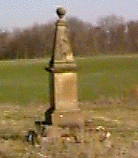
Armstrong obelisk  After living much of his later life in Ohio, Armstrong returned to Clark County in 1814 to the farm he had established 18 years before. On Feb. 4, 1816, he died on the property where a 10-foot obelisk still marks his grave.

   Armstrong’s politics and military duties helped keep him from becoming a household name. Because he agreed with Alexander Hamilton’s philosophies instead of the more popular views of Thomas Jefferson, his accomplishments weren’t as celebrated. Armstrong was also charged with removing squatters from their land, which diminished his popularity on the frontier.

Thanks to Susan Anderson for this information.


Return to A Index
Return to Mini Bios Index

